Showing posts with label South Carolina Slavery. Show all posts

Monday, June 4, 2012

The Lords Proprietors Voyage to Carolina

The Lords Proprietors of Carolina


King Charles II  --  On March 24, 1663, Charles II granted to the Lords Proprietors a slice of North America running from the Atlantic to the Pacific, lying between 36 degrees north latitude on the north and 31 degrees on the south. This huge section of continent was granted absolutely to the following men, to be financed by them, and for them to profit by, and to rule, with the help or interference of such a local government as they might permit. Above them was only the King. In the order named in Charles' charter they were: the Earl of Clarendon, the Duke of Albemarle, Lord Craven, Lord Berkeley, Lord Ashley, Sir George Carteret, Sir William Berkeley, and Sir John Colleton. The most important of these was Lord Ashley (Anthony Ashley Cooper), who specified the street plan for the new city and whose secretary, the philosopher John Locke, wrote the Fundamental Constitution of Carolina.


Two years later, the charter was amended to raise the north line 30 minutes and the south line by two degrees. In other words, the huge slice of North America that was Carolina included: the present states of North and South Carolina, Georgia, Tennessee, Alabama, Mississippi, Louisiana and Arkansas, a small part of Missouri, most of Oklahoma, Texas, New Mexico and Arizona, the southern half of California, the southern tip of Nevada, the north part of Florida, and a slice of northern Mexico.

  1. Edward Hyde, Earl of Clarendon
  2. George Monck, Duke of Albemarle
  3. William, Lord Craven (Earl of Craven)
  4. John Berkeley, Baron of Stratton
  5. Anthony Ashley Cooper, Earl of Shaftesbury
  6. Sir George Carteret
  7. Sir William Berkeley
  8. Sir John Colleton

King Charles II of England

English colonies have proliferated along the Atlantic coast, some formed by those fleeing religious persecution, others are seeking fortune in the New World. The growth has caused a shortage of good land around Jamestown and with the Virginia governor on the wrong side in the coup that costs Charles I his head, Virginia's ports are ordered blockaded by Oliver Cromwell... leaving the only route south into the rich lands of Carolina a swampy wilderness that borders Virginia. [Lindley Butler ]

But the lands of Carolina are populated by the Tuscarora, a successful people with both an agrarian and a hunter society, as well as a trading culture that carries them as far as the Great Lakes. And they are a tribe of warriors not to be taken lightly.

The Virginian English find cleared land theirs for the taking, at least in their perspective, as many of the Indians have died from diseases brought by the Europeans and town sites as well as cleared agricultural sites abound along the riverbanks. Still, expansion southward is slow, and only a few hundred settlers homestead among the Indians during the next decade.


George Monck, Duke of Albemarle 

Civil war in England comes to an end in 1660 and Charles II is placed on the throne. He rewards eight of the men who helped him with huge land grants in Carolina and they become the Lords Proprietors. They quickly insist that their charter include the settled areas north of the Albemarle Sound. And suddenly, the people who thought of themselves as Virginians are now under new rulers, with the prospect of government and taxes a reality.
Edward Hyde, Earl of Clarendon

The Fundamental Constitutions of the Carolinas  --  The Fundamental Constitutions of Carolina, a complicated document combining the old feudal land laws with liberal political notions, is handed down to the displeased settlers. Taxes will be collected, but an effort is made to give the landholders a voice in their own government. And religious freedom is confirmed in the new laws.

The Quakers are the first to establish a church in Carolina. And in this promising political environment, an effort is made to encourage fair treatment of the natives as well. [Clara Sue Kidwell ]

Anthony Ashley Cooper, Earl of Shaftesbury

Agitated colonists  --  The efforts of the Lords Proprietors are not well-received in the Carolina colony. The colonists are an especially independent lot, self-sustaining and disdainful of outside government meddling. And there is more than just the rebellious spirit of the settlers that stands in the way of success for the Proprietors--the colony's lack of a deep-water port drives up the costs for shipping and there is general stagnation in the economy. [William Price ]

By 1670, there are really two colonies in Carolina, the one north of the Albemarle Sound and the second far to the south around the growing port of Charleston. The deepwater port there creates tremendous economic activity and the Proprietors begin to concentrate their efforts on the winning settlement, bringing still more wealth to the region.


Sugar slaves  --  The Charleston area sees the emergence of a new cash crop, rice, and with it the need for labor. This need intensifies in Virginia as well, with the clearing of land and expanding tobacco plantations.

Slavery is already present in the Americas, brought by the Spanish, and soon the English colonists who can afford it turn to African slaves as a source of labor.

Indian slave being loaded onto boat

Slavery is legal in Carolina and there were slaves available, but the colony was, for the most part, not as wealthy as its neighbors to the south and north. Lack of ports meant less trade and, consequently, less money, holding the rise of slavery back in what is now North Carolina. But with the expansion of the colonies, the English settlers encourage their Indian trade partners to bring their captured neighbors to them as slaves, and many of the tribes seem more than eager to oblige.

Many of the enslaved Indians are destined, not for the plantations of Carolina, but to other colonies or to the Caribbean, and so they are taken from their native lands to faraway places, never to return.


Lawson surveying in woods  --  Englishman John Lawson would have an impact on the colony's growth, following his arrival and early explorations in 1701. Lawson was a surveyor and a writer with a keen interest in the people, flora and fauna of this New World and he would write of his travels and observations in a successful publication called A New Voyage to Carolina.

John Berkeley, Baron of Stratton

After his journey, he settles on the Neuse River near the native village of Chattoka and he writes glowingly of his Indian neighbors, describing them as a kindly and considerate people. [John Lawson ]
Lawson helps to establish the town of Bath, North Carolina's first, and more settlers are attracted to the region, drawn both by his book and the availability of building lots on the Pamlico River.

Portrait of Baron de Graffenried

He convinces a Swiss Baron, Christopher de Graffenried, to settle a group of Palatines, German Protestants fleeing religious persecution, in the new Carolina colony. Lawson arranges a purchase of land at the point where the Trent and Neuse rivers join, and De Graffenried names the new settlement New Bern, after the capitol of Switzerland. The Baron would later accuse Lawson of selling land that belonged to the Tuscarora, but De Graffenried would be the only one around to tell the story. [source: http://www.unctv.org/birthofacolony/act4.php]


Thursday, May 31, 2012

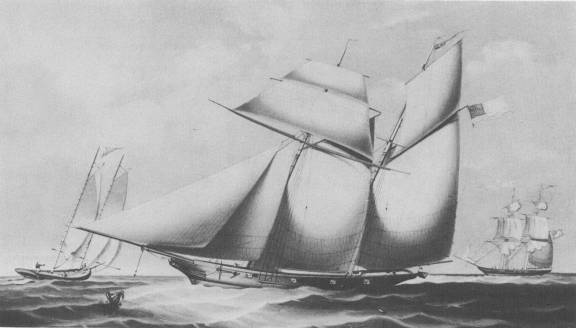
THE WANDERER: THE LAST AMERICAN SLAVE SHIP


THE WANDERER: THE LAST AMERICAN SLAVE SHIP AND THE CONSPIRACY THAT SET ITS SAILS , By Erik Calonius, REVIEWED BY KIMBERLY PALMER

From the  The Washington Times -- On July 4, 1858, a ship called the Wanderer left Charleston, S.C., and set sail for the Congo. Disguised as a luxury cruise ship, the Wanderer had first raised suspicion when it docked in Long Island and loaded far more supplies than usual for a casual cruise. Officials surmised (correctly, as it turned out) that the ship was a slave ship.

In “The Wanderer,” Erik Calonius brings to light the tale of the last known ship that brought slaves to the United States from Africa. Using newspaper accounts, letters and legal documents, Mr. Calonius, formerly a London correspondent for the Wall Street Journal and Miami bureau chief for Newsweek, reconstructs the journey in painstaking detail.

Where little or no evidence remains of the Wanderer’s voyage — including the brief excursion into Africa and the slave market where the ship’s crew purchased the slaves — Mr. Calonius writes that he used eyewitness accounts of the slave trade to describe what the slaves and the crew of the Wanderer likely experienced.


The result is a compelling and heartrending record of a journey that helped push the nation to the brink of the Civil War.

Transporting slaves from Africa was outlawed in 1820, but nearly four decades later, the practice — profitable but risky — continued. The Wanderer’s crew eluded the law by charming officials who were not all that interested in enforcing it.

When the ship reached the 3,000-mile long African shoreline, patrolled by 28 British and American ships, one of the British patrol ships spotted it. The Wanderer’s captain — William C. Corrie, a well-connected Southerner — invited the crew aboard. “After months of tedious Africa duty, the British were more than happy to explore this luxury yacht,” writes Mr. Calonius.


Corrie invited the crew to stay for dinner as well as after-dinner champagne and cigars on the deck. The British patrollers said goodbye after deciding the Wanderer was simply a cruise ship and not a slaver.

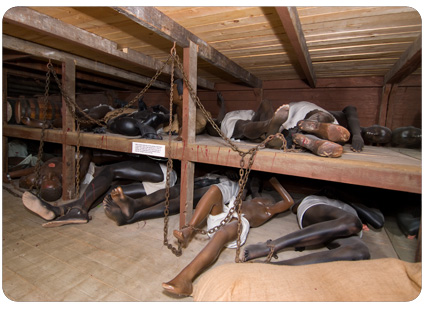
Soon after that meeting, the crew rolled up the ship’s luxury carpets and put away its library books in preparation for nearly 500 slaves. Each one was given a space that measured just 12 inches in width, 18 inches in height, and less than five feet in length — smaller than a typical slave ship.

Corrie purchased the slaves from a dealer and had them branded with a hot iron. During the return voyage, 80 slaves perished because of the harsh conditions below deck. Those that survived were unloaded in Georgia. After the Africans were spotted by locals, federal prosecutors started to build a case against the Wanderer’s owners.


Prosecutors soon found themselves up against the powerful, pro-slavery networks of Georgia. One of the ship’s owners, Charles Lamar, a wealthy Savannah resident, reminded witnesses that he could make life miserable for anyone who testified against him. Lamar was a “fire-eater” who wanted the slave trade to flourish and who hoped that the South would eventually split from the North. The nationally publicized trials of those implicated in the Wanderer scheme helped cause that rift.

“If they fail to hang the men,” wrote the New York Times of the South, “if their officials are so lax, or their juries so perjured, as to permit this trade to be carried on with impunity, in face of all our laws against it — they will suffer all the consequences of an actual complicity in the proceeding itself… . the entire population of the North will wage upon [the South] a relentless war of extermination.”

As Mr. Calonius notes, that prediction proved prophetic indeed. The defendants in the Wanderer trials were found not guilty, the abolitionist John Brown was hanged not long after and war soon broke out.

The threat of the Civil War looms throughout the narrative. In the 1850s, the South had not yet embraced the industrial revolution. Agricultural life, which depended on the labor of slaves, was idealized for its slow pace and comfortable lifestyle. At the same time, the South’s economy was slipping further and further behind the more industrialized North.


By 1860, New England was manufacturing three times as many goods as the South. In the meantime, the South, which had grown dependent on the cheap labor of slaves, had to deal with the reality that as fewer slaves were shipped from Africa, the cost of owning slaves increased. Few businesses, Mr. Calonius writes, were more profitable than the illegal transportation of slaves from Africa to the United States.

Mr. Calonius challenges the popular belief that most Southerners rallied to fight for slavery. According to him, the South seceded because a few powerful men wanted to keep slavery alive, and they persuaded many others to support their fight against what they saw as Northern interference.

Most farmers and merchants, he writes, had no stake in slavery whatsoever and even less interest in breaking up the country over it. In Savannah, the vast majority of residents did not own slaves. To garner support for slavery, the rich plantation owners who needed slaves to maintain their wealth started a campaign to convince people that if slaves were freed, they would plunder and steal throughout the region.

“It was not the first time in history that a group of radicals had overwhelmed the will of a weak and unfocused majority, nor would it be the last,” writes the author.


For most of the book, Mr. Calonius focuses on the saga of the ship and not the slaves themselves. But one of the most compelling tales comes at the end, when he recounts what happened to Cilucangy, a slave brought over on the Wanderer as a boy.

After the Civil War, Cilucangy worked in Georgia as a basket weaver. Despite his desire to return to Africa as an adult, he failed to amass the necessary funds. He started a family in Georgia, and his descendants include lawyers and teachers.

Margret Higgins, Cilucangy’s great-granddaughter, lives near the Uniondale exit of the Long Island Expressway. Her grandson was named Alexander Cilucangy Valenti, in honor of the courage and resiliency of his forebear. (source: The Washington Times)

Friday, March 16, 2012

Emanuel AME Church of Charleston

Mother Emanuel AME Church in Charleston, SC

Emanuel African Methodist Episcopal Church – Overview

The Gothic Revival building that houses the Emanuel AME Church in Charleston is a testament to the determination of the church's congregation and earliest founders. The present day structure with its signature steeple was built in 1891, replacing an earlier wooden church from 1872 that was damaged in the Charleston Earthquake of 1886. Many of the brick and marble panels were restored between 1949 and 1951.
EMANUEL AME CHURCH

Documenting the American South--The roots of the Emanuel AME Church date back to 1816, when Morris Brown organized a withdrawal of the Charleston Methodist Episcopal Church's black members over a burial ground dispute. The newly-formed congregation quickly established themselves as an African Methodist Episcopal church, a denomination that was founded earlier in Philadelphia.


Brown was eventually jailed for violating laws restricting free and enslaved blacks from holding religious gatherings without white supervision. Then, after the first incarnation of the church was burned under a cloud of suspicion over a suspected slave uprising, the congregation continued to worship until 1834, when all-black churches became officially outlawed. After a period of underground worship, the church formally reorganized publicly in 1865 and adopted the Hebrew name Emanuel, meaning "God is with us".

The church is the oldest AME church in the South and has the oldest black congregation south of Baltimore, Maryland. (http://www.sciway.net/tourism/emanuel-ame-church.html)

Tuesday, March 13, 2012

The Great Charleston Earthquake, 1886

Charleston City Paper's article, "Tracing discriminatory laws to the earthquake of 1886: The Birth of Jim Crow," by Will Moredock--We've seen it before: When disaster strikes, people pull together as friends and neighbors in a common cause — at least for a while. Then the old rivalries and social fissures reappear, more virulent than ever.

This was the pattern when Hurricane Katrina drowned New Orleans in 2005. A brief surge of unity and good will prevailed, then the old racial and class divisions reasserted themselves. Susan Millar Williams saw it in her McClellanville community in the wake of Hurricane Hugo in 1989. When relief goods started arriving, blacks and whites quarreled over who should receive them.


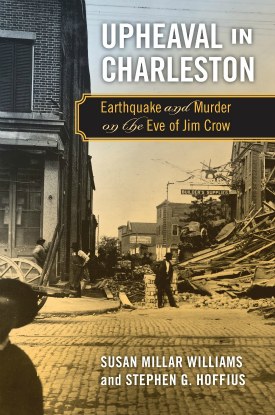
With this experience and what she had read about the 1886 Charleston earthquake in mind, Williams set out with fellow historian Stephen G. Hoffius to explore the social and political ramifications of that long-ago disaster. The recently released Upheaval in Charleston: Earthquake and Murder on the Eve of Jim Crow is the product of their 12 years of work, and the picture they paint of the Holy City is not flattering.

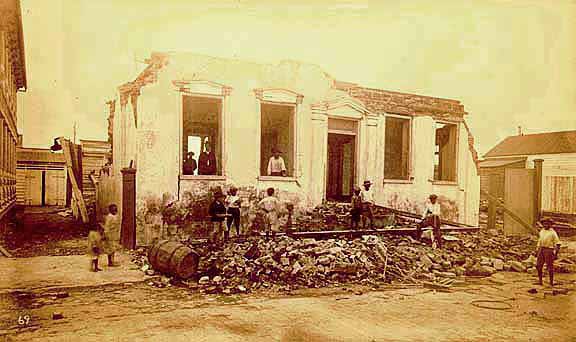
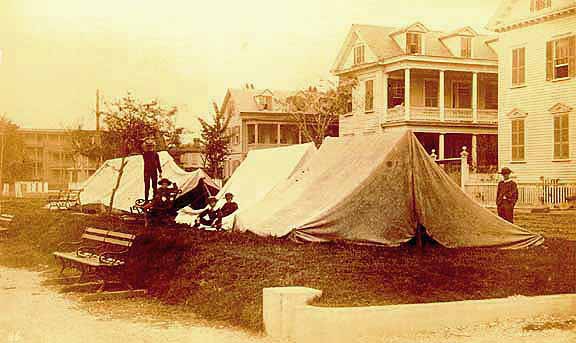
When buildings started swaying and toppling in the early evening of Aug. 31, 1886, the people of Charleston rushed into the streets, wailing and screaming, as fires broke out around the city. They headed instinctively toward Marion Square, where they would be safe from fire and falling buildings.


Blacks and whites set up camps on opposite sides of the square, Williams told me recently. "That first night ... blacks and whites joined in singing and praying together. It lasted about 24 hours."

In the immediate aftermath of the quake, Charlestonians sought to make sense of what had befallen them. Many middle-class and upper-class whites were happy to accept a rational explanation for the catastrophe, if only because it let them off the hook for any metaphysical responsibility. On the other hand, poor whites and blacks, steeped in their primitive religiosity, were eager to believe that this was God's punishment on a wicked city.

1886 Charleston, SC Earthquake Photo

But what sins had so outraged the Almighty? A white Methodist minister intoned to his congregation: "Ice cream gardens, music, and dancing are the popular amusements for the Sabbath afternoons in Charleston." Excursionists, he said, sailed about the harbor on Sundays in "gay and frivolous" abandon.

A white woman told a newspaperman that her sins had brought on her sudden homelessness. "Yes," she said. "I was very worldly. I loved fine dresses and dancing and good living, and this is my punishment."

Blacks, who at the time made up 60 percent of Charleston's population, had a very different understanding of God's wrath. They saw the destruction of this proud old city as its reward for centuries of slavery and oppression. Street preachers sang out and shouted warnings through the night. This quake was the harbinger of apocalypse and judgment. The world would soon be destroyed and Revelation fulfilled.

"The sounds of blacks preaching and singing could be extremely disconcerting to whites," the authors write. "Deprived of other ways to communicate freely, black men and women had long used worship services as a way to register protest ... Now, as the voices of freedmen and their descendants rang out across the city in 1886, whites looked for ways to silence them."


Believers sang and writhed on the ground, as preachers exhorted, "Oh, Gabriel, turn that horn to the land of Egypt on the miserable sinners and not on we."

Williams and Hoffius add, "For whites who couldn't escape such speeches day in and day out, it didn't take too much imagination to suspect that the 'miserable sinners' in question might not be Egyptian."

White citizens and police soon intimidated the preachers and singers into silence.

sc1
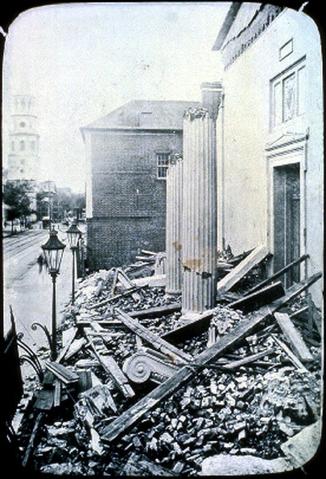
The damaged portico of Hibernian Hall, 105 Meeting St. - Charleston Library Society
(J. B. Macelwane archives, Saint Louis University)

There were other stresses to the fragile social fabric. As relief poured into the city from around the country, "Affluent whites insisted that providing free food and shelter to the poor would lead to moral breakdown," the authors write. And with the rebuilding of the city, black artisans and craftsmen were able to command high wages, acquiring wealth and status and threatening the social order. As Williams says, "Charlestonians wanted to preserve the status quo above all else. They did not want anyone to get ahead."

In fact, the authors argue in Upheaval in Charleston that the earthquake of 1886 ultimately helped bring out the Jim Crow laws a decade later.

"The earthquake stripped away the edifice of society. It hardened people's hearts," Williams says. "By the end of 1886, any hope of racial conciliation was over." (source:Charleston City Paper )

"Earthquake, August 31st, 1886. No. 634. Aiken and Vicinity. Wrecked at Langley." - Photographed by J.A. Palmer, Aiken, S.C.

The South Carolina Railway company train was washed from the track by a four-foot high wall of water when the earthquake burst the mill-dam at Langley Pond near Aiken, SC. The train's black fireman, a Mr. Ivie, died in the wreck. Another train owned by the same company was washed from the track near Horse Creek in Aiken County closer to Augusta, GA., when a mill-dam there also fractured because of the earthquake and sent an eight-foot-high wave of water surging against the locomotive, tender, and its train cars. (South Caroliniana Library Archives)

Charleston: "Upheaval in Charleston" Authors Susan Millar and Stephen Hoffius

British Tourist Visits The Low Country of Savannah and Charleston


From the UK Telegraph Travel section, by Nigel Richardson, on 27 August 2008: "American south: A black and white story: Behind the elegant facades of Savannah and Charleston lies the ugliness of slavery. Nigel Richardson hears a neglected view of history."

It was raining so hard in Savannah, Georgia, that the patrolmen of the Chatham County Sheriff’s Department wore plastic covers on their wide-brimmed hats. Noisy cones of white water geysered from sawn-off drainpipes, turning trousers into litmus paper, and the horse-drawn carriages remained stabled all day.

With its 18th-century squares and disconcerting air of England — an England twice filtered, through time and climate, into a tropical Georgiana — Savannah is one of the finest American cities to walk round. Finest cities anywhere to see on foot, come to that. But not today. Today was for indoors.

Off Martin Luther King Jr Boulevard, we stumbled into the Ralph Mark Gilbert Civil Rights Museum, shook down our raincoats and requested the restrooms (all that rain). But the WCs weren’t marked “Men” and “Women”. The signs on the doors said “White only” and “Coloured only”, which left us, two white-faced Europeans, red-faced and dumbfounded. This was the intended effect.


The history of black America — for white people at least — has always run on parallel, all-but-invisible tracks to the history promulgated in guidebooks and mainstream museums. Sure, we've heard of Dr King. But when white people come to beautiful Savannah and its Grace Kelly-like sister, Charleston, across the state line in South Carolina, they look for, and are fed, the history of white people.

These are embodied in the architecture, older and better preserved than that of most British cities. Savannah and Charleston are two of the oldest settlements in the United States, founded in 1733 and 1670 respectively. The adventurers who made fortunes here — in many cases on the back of slavery — built big and bold, borrowing from Europe and sticking knobs on: sweeping steps, deep porches, wrought-iron scrollwork and pillars like the Parthenon. There are knot gardens — the one at the Davenport House in Savannah was designed by Penelope Hobhouse — and magnolias, and climate completes the heady effect by draping swooning arms of Spanish moss from branch and balcony.


We loved walking in Savannah and Charleston, spotting, through tropical tangle, the ghostly cousins of a Chelsea mews or a Brighton seafront terrace, reading heritage plaques on reconditioned façades and visitors’ books in hallways that smelled of floor polish. (In the Eighties, at the Green-Meldrin House in Savannah, Mrs Thatcher had signed herself, with uncharacteristic wit, “A representative of the former colonial power”.)

It’s just that in a part of America with a significant black population, and in a year when the American people may just elect their first African-American as president, it felt timely to discover some neglected narratives and points of view. In the institutionally racist days of the Deep South, for example, when every aspect of life was segregated, from shops to drinking fountains, Savannah had “one of the most significant and effective civil rights movements in the US,” according to the curator in the civil rights museum, Heru Iman.


“It was the youth here in the Sixties who integrated Savannah — sitting in at the lunch counters, demonstrating, kneeling outside white churches praying to be let in,” he told us. Activists fanned out from the basement of the First African Baptist Church in Montgomery Street carrying out “wade-ins” at whites-only beaches and boycotting racist stores. The civil rights museum features a re-creation of the lunch counter at Levy’s department store — a particular target for protesters — in which a white waitress advises a black customer, “We don’t serve your kind here”.

The nerve centre of these protests, the First African Baptist Church, claims to have the oldest black congregation in North America, dating from 1775. The present church was completed in 1859 (having been built at night because during the day the men had to work in the cotton plantations).


Our “conductor” on a tour was a shy and proud young man called Johnnie McDonald. “Martin Luther King, Jesse Jackson and Coretta Scott King [Dr King’s widow] have all preached in that pulpit,” he said. In the balcony he pointed out scratch marks on the ends of some pews that were built by slaves in the late 1700s. For many years these marks were a puzzle, but it is now thought they may be cursive Hebrew. “The slaves who came from [West] Africa knew that language,” said Johnnie.


In the basement of the church he indicated a series of holes in the wooden floor and explained that they were part of the “underground railroad”, the network of routes by which runaway slaves were spirited to freedom. “These are air holes, so they could breathe,” he said. “There’s only four feet of crawling space. You’d crawl from here and exit by the Savannah River [a quarter of a mile away].”


There are 36 sets of these holes and they are configured in the same pattern, a combination of cross and diamond which Johnnie described as a “Congo cosmogram” — another link with the West African ancestry of Savannah’s slaves.

That ancestry has survived to a surprising extent in the marshy maze of islands and causeways known as the Lowcountry, which separates Savannah from Charleston, 100 miles up the coast. Here many descendants of West African slaves and plantation labourers continue to speak Gullah, which is a mixture of English and West African words (the word Gullah is also used to mean the culture of the people who speak it).


On St Helena Island, in the heart of the Lowcountry, is the Penn Centre Historic District, a campus of former school buildings where freed slaves once studied and which Martin Luther King used as a retreat in the Sixties. Nearby we ate lunch in a plain shack called Gullah Grub, which serves authentic Lowcountry food — catfish, crab, shrimp — using old African-influenced recipes.

Shrimp gumbo — knocked back with ”swampwater”, homemade lemonade served in jam jars — hit the spot and we were soon back on Highway 17 and barrelling into the antique Manhattan that is the Charleston historic district, squeezed between the Cooper and Ashley Rivers. The rain had passed, leaving bright sunshine on stucco facades and weatherboard porches. The suits of wedding revellers — there were many — left mothball whiffs on the humid air.


It is beautiful and affluent even now, but in the 1700s Charleston was the richest city in the United States. It was also the country’s biggest slave port and the city’s wealthy white merchants used their slaves to ape the imagined lifestyles of English aristocrats.

One of the architectural highlights of Charleston is the Aiken-Rhett House, a vast antebellum confection of pillared porches that was once the home of William Aiken, a rice planter. The house has scarcely changed since 1858, which means that the slave quarters, a handful of cubicle rooms situated above kitchen and stables, are intact.


The family owned 800 slaves, of whom between 10 and 20 worked and lived in the house (these included one Dorcas Richardson, her husband and five children). In the vast living rooms of the house, there were ciphers of bygone ways of thinking and behaving: a set of Sir Walter Scott’s Waverley novels in the library; a harp standing in the middle of the old ballroom, whose red fabric wallpaper had faded to the colour of dried blood.

These southern ways were not to last. “Blacks knew that once the [civil] war started, they were on their way to freedom,” said Al Miller into the microphone of his minibus. Al, smartly turned out in checked linen trousers and white shirt, runs Sites and Insights Tours around the Charleston area, acquainting black visitors with the often invisible history of their people. As the only whites on his minibus tour, we were swept up in this different perspective.


First, he drove us south-west, off the peninsula, to James Island. “During slavery there were over 20 plantations here,” he said. We passed the Macleod Plantation where the wooden, white-painted slave quarters, standing on brick stilts, have been preserved. Here slaves grew sea-island cotton, indigo, okra and sweet potatoes and lived on grits, shrimp and gravy.

“It was the black people’s dish, the poor people’s dish,” said Al. “You ever paid an arm and a leg for it?” The rest of the bus shook their heads and laughed in agreement.

In the early 1930s George Gershwin spent time on James Island, absorbing a history and atmosphere that inspired him to write Porgy and Bess. His folk opera, including Summertime and It Ain’t Necessarily So, was based on the novel Porgy by the Charleston writer, DuBose Heyward. Driving past the old plantations — avenues of live oak trees mark where the driveways were — Al got the bus rocking and clapping by enacting the Porgy and Bess story in a kind of baritone rap: “Here comes Bess/ a slut in a red dress/ She was selling holy dust which was like cocaine/ She kept it in her girdle, she kept her money in her bosom/ She was not well liked...”


We got off the bus at James Island Presbyterian Church, where there are two cemeteries — one for black folk, one for white — separated by shrubbery. “It’s like day and night,” said Al. In the black section is the grave of Samuel Smalls, “the goat man”, upon whom DuBose Heyward based the character of Porgy. In honour of Gershwin’s Jewishness, visitors had placed stones on the top of Smalls’s headstone.

“A lot of Gullah cheechee [people] are superstitious when it comes to cemeteries,” said Al. “If you point your finger at a tombstone, it will rot off. Don’t bring cemetery dirt into your car on your shoes. Where did these things come from? Africa.”

James Island Presbyterian Church - James Island, South Carolina
James Island Presbyterian Church

Back on the historic peninsula, we cruised the golden streets. But Al screened out the antebellum and Greek revival mansions, the city’s architectural setpieces, pointing out instead the alleys, lanes and courts once lived in by poor blacks. We passed 78 Church St, where Heyward was living when he wrote Porgy, and Catfish Row, which features in the novel and opera and would now fit seamlessly into a discreet corner of Knightsbridge. “Once this was a rundown slum area,” said Al. “Catfish Row was a black tenement. Especially when Porgy was written. Not any more.”

As he drove, Al told us things that white people would rather not think about. “The average black man sold for between 800 and 1,200 dollars, which was a lot of money,” he said. “Women were made to have 10 or 15 children. They were made to have sex blindfold by the slave owners and had multiple partners.”
Jenkins Orphan Band

One of our last ports of call was in Franklin Street where we paused outside the site of the Jenkins Orphanage. Here, in the 1920s, the resident band drew on Gullah rhythms and dance steps to invent the tune and dance craze that became known as The Charleston. A plaque marks the site of the orphanage but doesn’t mention The Charleston, let alone make Al Miller’s point that “they started it here. The white folk just stole it from us.” (source: UK Telegraph)


Thursday, March 8, 2012

Brown v. Board of Education


From the Library of Virginia:  Brown v. Board of Education was a group of five legal appeals that challenged the "separate but equal" basis for racial segregation in public schools in Kansas, Virginia (Dorothy Davis v. County School Board of Prince Edward), Delaware, South Carolina, and the District of Columbia. The appeals reached the Supreme Court about the same time, and because they all dealt with the same issues, the Court heard arguments on them together. Because the Kansas case arrived first, the combined appeal was known as Brown et al v. Board of Education of Topeka, Shawnee County, Kansas, et al. In each case, the legal office of the National Association for the Advancement of Colored People (NAACP) represented the plaintiffs, and NAACP lawyers, such as Spottswood Robinson, Oliver Hill, and Thurgood Marshall, argued that the black students' rights had been violated under the Equal Protection Clause of the Fourteenth Amendment. In all five cases, inequality in curriculum, school structures, and transportation were the key issues.


The lawyers for the NAACP Legal Defense and Educational Fund Inc. From left, Louis L. Redding, Robert L. Carter, Oliver W. Hill, Thurgood Marshall and Spottswood W. Robinson III..

Kansas

In 1951 Oliver Brown and twelve other parents, supported by the local chapter of the NAACP, filed suit against the Topeka, Kansas, Board of Education, after the board refused to allow their children attend the white school located in their neighborhoods. To reach their schools, the children rode buses to schools located several miles from their homes. Arguing that African American children attending a segregated school were made to feel interior to whites, Dr. Hugh W. Speer testified that if the colored children are denied the experience in school of associating with white children, who represent 90 percent of our national society in which these colored children must live, then the colored child’s curriculum is being greatly curtailed. The Topeka curriculum or any school curriculum cannot be equal under segregation. 


Standing outside a Topeka classroom in 1953 are the students represented in Oliver Brown et al. v. Board of Education of Topeka, Shawnee County, Kansas et al. From left: Vicki Henderson, Donald Henderson, Linda Brown (Oliver's daughter), James Emanuel, Nancy Todd, and Katherine Carper. Photo by Carl Iwasaki/Time Life Pictures/Getty Images
Attorneys for the Board of Education argued that attending segregated schools prepared children for the segregated society they would face as adults and offered key figures such as Frederick Douglass, Booker T. Washington, and George Washington Carver as examples of individuals who overcame racial barriers to achieve fame. Although agreeing with the plaintiff’s argument that segregation had a damaging effect on black schoolchildren, the justices relied on the legal precedent of Plessyto rule in favor of the Board of Education. Brown appealed to the U.S. Supreme Court on October 1, 1951.


South Carolina

In South Carolina, Harry Briggs and nineteen other parents filed suit against R. W. Elliot, president of the Clarendon County school board. Clarendon County provided bus transportation for white children but not for black students. The plaintiffs requested that the county provide buses for their children, but the petition was ignored. With Thurgood Marshall and Harold Boulware serving as counsel, Briggs v. Clarendon County went before the U.S. District Court for the District of South Carolina in May 1951. The justices ruled 2–1 against the parents but ordered the school board to equalize schools.


Delaware

Two cases—Belton v. Gebhart and Bulah v. Gebhart—involved bus tra nsportation and inferior school structures. In Belton v. Gebhart, black parents in Claymont petitioned for both a better school building and bus transportation. Sarah Bulah (Bulah v. Gebhart) asked for bus transportation for black children in Hockessin. Parents of eleven children joined Sarah Bulah’s suit. Argued before the Delaware Court of Chancery which found for the parents, the cases were combined and appealed to the U.S. Supreme Court by the Delaware Board of Education.


District of Columbia

Attempting to end segregated schools in the District of Columbia, Gardner Bishop and the Consolidated Parents Group, Inc., tried to enroll eleven African American students in the newly-completed John Philip Sousa Junior High School. The students were denied entrance. James Nabrit Jr., of Howard University, argued in the case Bolling v. Sharpe, that segregation itself was unconstitutional. The U. S. District Court dismissed the case, based on a Court of Appeals ruling in Carr v. Corning that segregated schools were constitutional. The U. S. Supreme Court included Nabrit’s appeal as part of Brown. Because the Fourteenth Amendment was not applicable to the District of Columbia, the Supreme Court gave a separate opinion on Bolling v. Sharpe, basing its decision on the equal protection clause of the Fifth Amendment. (source: Library of Virginia)

HOME

HOME
Click here to return to the US Slave Home Page