Anderson Elementary. One-room African-American school, circa 1939.
From the West Virginia Encyclopedia, an article discussing African-American Education in West Virginia by Ancella R. Bickley, on 19 October 2010 -- Early black education in West Virginia developed through a combination of forces: self-help efforts; the aid and support of benevolent white people; support from the U.S. Freedmen’s Bureau and missionary associations; and the activities of public school officials. By the middle of the 20th century, on the eve of desegregation, the state’s African-American schools had become a well-functioning, effective system.
When the first West Virginia legislature met in 1863, it agreed to educate ‘‘free colored children,’’ but the proposition was left unfunded. With the condition that white and black children should not be taught in the same schools, West Virginia’s second constitution in 1872 affirmed the state’s commitment to the education of African-American children. Although most school boards cooperated, court action sometimes had to be undertaken or threatened to force some to provide the needed support for black education.
Sumner School, the first school for black children in West Virginia, a self-help effort, opened in Parkersburg in 1862. After 1865, education for West Virginia’s black citizens was undertaken wherever there were enough students. Schools were under way in 18 communities by 1868, including Parkersburg, Wheeling, Clarksburg, Charleston, Lewisburg, Martinsburg, Charles Town, and Malden. These early schools were held wherever space could be found, sometimes in homes and churches. In some instances the schools were private and served both adults and children.
Among the major difficulties was the dearth of teachers. In the beginning, whites served, as did black teachers from neighboring states, particularly Ohio. The first formal effort to train black teachers in West Virginia came at Storer College in Harpers Ferry. The college was begun in 1865 by the Freewill Baptist Church. In 1881 the state agreed to contract with Storer to train African-American teachers. Until the state’s black land grant college, West Virginia Colored Institute (now West Virginia State University), was founded in 1891, Storer College was the only institution in the state preparing blacks for the teaching profession. Later, Bluefield Colored Institute (now Bluefield State College), established in 1895, joined the other two in this mission. These institutions also provided secondary education.
Widen School. African-American students outside school,
As the railroads and mines drew more black people into West Virginia in the late 19th and early 20th centuries, the need for public education increased. Initially, the school law permitted the establishment of a black school wherever there were 30 black students between the ages of six and 21. Over the years, this number was reduced until a school could be started with 10 students of school age. With this reduction in the number required, elementary schools sprang up in many areas. One of the earliest was the Clarksburg School, for which a construction bid was accepted in 1868. Statewide, there were 207 black schools and 278 teachers serving 7,886 students in 1902. By 1924, there were 453 elementary and junior high schools.
Black high school education began slowly. The first institution to offer such instruction was the Sumner School in Parkersburg, which added high school courses to its curriculum in 1885. This was followed by high schools in Clarksburg, Charleston, and Huntington. By 1923, the number of black high schools had increased to 21. In some cases, cooperative arrangements allowed African- American students to cross county lines to attend high school; for example Preston County students attended in Monongalia County. In other instances students either ended their education at the eighth grade, boarded with families in areas where there were high schools, or daily traveled long distances by train, bus, or streetcar.
Weston Colored School.
In addition to black public education, several private educational efforts were attempted. Storer College continued in Harpers Ferry until 1956; St. Phillips Academy was operated for a time by St. Phillips Episcopal Church in Charles Town; the Baptist State Association operated a school at Hilltop in Fayette County; and Catholics operated St. Peter Claver in Huntington.
In 1919 the state created the position of state supervisor of Negro schools and appointed a Negro Board of Education. In 1933 assistant superintendents of Negro education were appointed in counties having 50 or more black teachers. In addition to the push for more voice in the operation of their schools, blacks also struggled for adequate buildings and materials, for equal salaries for teachers, and for a full nine-month school year.
Weston Colored School.
By 1950, the West Virginia public school system provided separate education for more than 19,000 of the state’s black youth, grades 1–12. Included were schools for black students in institutional settings, including the deaf and blind. Higher education through the baccalaureate level was available at Bluefield State College and West Virginia State. Academics were enriched by strong extracurricular offerings such as dramatics, music, art, various clubs, and athletics. Statewide competitions, tournaments, and exhibitions helped to knit together black communities across West Virginia. The black colleges, elementary and junior and senior high schools, and their administrators and teachers are remembered and honored by their alumni for helping them to develop a strong educational background, basic values, community spirit, and lifelong friendships.
When the 1954 Brown v. Board of Education Supreme Court decision ended segregated schools in the United States, West Virginia began dismantling its system of black education. By the mid-1960s, the process was essentially complete, with African-American students and teachers participating in integrated public schools. [source: West Virginia Encyclopedia by Ancella R. Bickley. on October 19, 2010]
From UT San Diego, "Jim Crow era recalled in rail car project: Passenger car gives glimpse of country’s segregated past," by Karen Pearlman, on 8 February 2012 -- Thousands of miles were put on the Rockdale, Sandow & Southern #3 wooden railroad car, and with that, thousands of stories were no doubt told by the people who were part of its work in rural Texas.
Thousands of trips later, this brown beauty, one of the original “Jim Crow” rail cars that segregated black and white passengers, now sits on shiny metal wheels at the Pacific Southwest Railway Museum in rural San Diego County.
The museum obtained the car in 1976 and started restoring it in 1999.
Since then, a group of dedicated volunteers, led by Ted Kornweibel Jr., a professor emeritus in African American history at San Diego State University, worked countless hours to restore, rebuild and replace parts — and recapture part of the past through this rail car, which was built in 1886 in Pennsylvania.
In time for Black History Month, the museum will display this special car and a photographic exhibit free to the public. An inaugural ceremony is set for 1 p.m. Feb. 25 inside the museum’s display building at 750 Depot St., Campo.
This car may already be familiar to some.
For years its home was 20th Century Fox in Los Angeles, and the car had parts in several Hollywood movies, including the Otto Preminger-directed “Centennial Summer,” “The True Story of Jesse James” starring Robert Wagner, and Elvis Presley’s “Love Me Tender.”
But for Kornweibel, who taught at SDSU from 1977 through 2005 and has been a volunteer at the museum for more than 30 years, those stars have nothing on this rail car.
The San Carlos resident has a deep love in all aspects of this subject and is the author of “Railroads In The African-American Experience: A Photographic Journey.”
The book offers a detailed look (more than 500 pages, including 200 photos) at the history of the railroad business and the way it affected black Americans, many of whom created the tracks and many others of whom worked on board the trains.
This particular car made only 7-mile journeys, but it had all the hallmarks of trains that went longer distances, including partitions. The car has a section with eight seats for black passengers and a section with 22 seats for white passengers.
The bathroom and water fountain are both located in the white area, meaning that nonwhites had to go without either on their journey. On trains such as this, the dining area was also off limits to black passengers.
“Separate is not equal,” Kornweibel said, then adds, “I am just stoked anytime someone recognizes the issue of segregation. It’s now a fading memory, thankfully. Many black people have seen the car and said, ‘I didn’t experience that,’ but the oldsters... the stories that they can easily tell... ‘I remember visiting Grandma, we had to bring own food with us, sandwiches wrapped in string because they wouldn’t let us eat in the dining car.’ It breaks my heart to hear that but that’s how it was.”
Only a handful of museums display a restored segregated car, none west of the Mississippi, according to Kornweibel. No other museum has a fully restored car of this kind as well as the accompanying exhibit, which depicts a 180-year scope of black railroading.
The car has an open platform with hundreds of beautiful aquamarine squall glass panes that have a rosette design. Red plush upholstered walkover seats in the passenger area look inviting and comfortable.
Larry Rose, the museum’s facilities director, said it’s difficult for him to pick out his favorite part of the Jim Crow car — much less his favorite of the 80 cars and 20 locomotives on site — but he said he is proud of all the work that the volunteers do, even if few of the cars actually do any physical moving.
He also said he fears that the youth of today are losing interest in trains and has noticed fewer young visitors to the museum annually. He and volunteer Frank Stites say they hope that this exhibit will attract people of all ages.
Rose and Stites carpool to Campo from La Mesa and San Carlos almost daily to work on trains. Stites is a retired professor of American history who sees the big picture of how the trains are a part of every American’s past.
“A group of black storytellers came out here a couple of years ago,” Stites recalled. “I took them through the (Jim Crow) car and they told me how the car makes it real for them, how it’s much better than a picture, and tells more than 1,000 words. They know this is the real McCoy. We’re making it real. This is a great opportunity to illustrate the past and teach the present.” [source: http://www.utsandiego.com/news/2012/feb/08/jim-crow-era-recalled-in-rail-car-project/]
The Pacific Southwest Railway Museum in San Diego is restoring a vintage railroad car to its condition during a controversial period of American History. Built in 1886 in Pennsylvania the car was sold and used on the Rockdale, Sandow and Southern railroad as a "Jim Crow" car, segregating black from white passengers from 1936 to 1945 when it was sold to 20th Century-Fox. It was used in films that included "Love Me Tender" with Elvis Presley, ' Centenial Summer," "The True Story of Jesse James" and "Raid." The museum obtained the cars in 1976 and restoration started in 1999.
Fifty years ago, Ray Sprigle of the Post-Gazette posed as a black man to experience firsthand what life was like for 10 million people living under the system of legal segregation known as Jim Crow.
As he wrote in his 21-part series, "I Was a Negro in the South for 30 Days": "I quit being white, and free, and an American citizen when I climbed aboard that Jim Crow coach. . . . From then on, until I came up out of the South four weeks later, I was black, and in bondage — not quite slavery but not quite freedom, either.’’ -- Ray Springle
A Visit to a Jim Crow School, by Ray Sprigle -- Here on the outskirts of the pleasant, thriving little Georgia town of Bluffton in Clay county I go to school again. And what a school! This dilapidated, sagging old shack, leaning and lop-sided as its makeshift foundations give way, is the lordly white’s conception of a schoolhouse for Negroes.
This leaking old wreck of a shanty must be nearly half a century old. The warped old clapboards are falling off. Holes bigger than your hand give permanent cross-ventilation. There are no desks, no seats but rude benches. Two rough tables serve as desks. A few dog-eared school books are scattered on the tables. A "blackboard,"’ apparently home made, just a sheet of cardboard about two by three feet, is nailed to the bare studding.
Only redeeming feature of this thing called a school is the teacher. Tall and spare, gentle and soft spoken, earnest and intelligent, she reminds you of a typical New England school-marm with her sharp aquiline features - except for a deeper sun tan than one could ever get on a beach.
Has Taught Three Generations
For 27 years, she tells us, she has taught this little school. Three generations of little black American citizens have picked up the rudiments of an education under her kindly tutelage. She is actually proud of this school.
"The state furnishes us free school books now," she says. "When I started in 27 years ago the only text book we had was my Bible that I brought to school. Some of the children were able to buy text books as the years went on and the whole class used them."
There are 38 children in her school, divided into seven grades. She teaches them all. If all of her 38 scholars came to school at one time the little room would be crowded to suffocation. But now there is only a handful of little tots. All the bigger girls and boys are "excused." This is cotton chopping time and cotton is more important than learning. The bigger boys and girls are also "excused" at plowing and planting time and again in the fall when it’s time to pick the precious cotton. The school term is eight months, she says. But only the little tots ever see eight months of schooling.
Salary Is $112 a Month
Miss Minnie Dora Lee draws a salary of $112 a month. When she started and for many years afterward she got $20 a month. It has taken the full 27 years of her service to climb to that magnificent figure of $112.
Miss Minnie Dora Lee’s school is typical of Negro schools in Georgia and the deep South. We could have found many far worse and did. Some few are better. What sets her school ahead of most of the other one-room shanties in the South where little black children get their three R’s is Miss Minnie Dora Lee herself. In her 27 years as a school teacher, Miss Lee has learned, too. Hundreds of southern Negro schools have teachers who never went beyond the sixth or seventh grades and are wholly unfitted for teaching. I encountered more than one instance where the leading white cotton planter of the district appointed the teacher of the Negro school. Usually on the basis that her father raised more cotton "than any other nigger I’ve got on the place."
Catchword of your lordly, lily-white representative of white supremacy to justify all the phases of segregation with its inevitable train of discrimination, oppression, brutality and petty chicanery is the term "separate but equal."
A Brazen, Cynical Lie
So far as the education of little black American citizens is concerned, that "equal" in the South’s pet catch phrase is a brazen, cynical lie and every white man knows it.
No Negro school in all the South even begins to compare in any way with its companion white school. True enough, I didn’t check them all. But I did see scores of them. And I asked literally hundreds of Negroes to help me find at least one Negro school equal to a white one in the same area. Not only did none of them know of such an instance but even the most radical opponents of segregation didn’t even hope for, expect or ask for such a miracle. Any of them would be glad to settle for just ordinarily decent schools for their children.
Right here in Clay county is a typical illustration of the bitter, tragic hypocrisy of that "separate but equal" lying catchword. Ride with me about a thousand yards down the highway past Minnie Dora Lee’s disintegrating old rookery. On the edge of Bluffton is the school for the white folks - the last word in small town educational plants.
A neat brick structure, with a wing on either side - at least six rooms. Grounds beautifully landscaped, a spreading playground crowded with all the latest equipment that money can buy.
Minnie Dora Lee’s school couldn’t cost more than $1,000 even today. This white folks’ school didn’t cost a cent less than $100,000. "Separate but equal." It’s not even funny. --[source: Ray Springle, Post-Gazette]
From the Library of Virginia: Brown v. Board of Education was a group of five legal appeals that challenged the "separate but equal" basis for racial segregation in public schools in Kansas, Virginia (Dorothy Davis v. County School Board of Prince Edward), Delaware, South Carolina, and the District of Columbia. The appeals reached the Supreme Court about the same time, and because they all dealt with the same issues, the Court heard arguments on them together. Because the Kansas case arrived first, the combined appeal was known as Brown et al v. Board of Education of Topeka, Shawnee County, Kansas, et al. In each case, the legal office of the National Association for the Advancement of Colored People (NAACP) represented the plaintiffs, and NAACP lawyers, such as Spottswood Robinson, Oliver Hill, and Thurgood Marshall, argued that the black students' rights had been violated under the Equal Protection Clause of the Fourteenth Amendment. In all five cases, inequality in curriculum, school structures, and transportation were the key issues.
The lawyers for the NAACP Legal Defense and Educational Fund Inc. From left, Louis L. Redding, Robert L. Carter, Oliver W. Hill, Thurgood Marshall and Spottswood W. Robinson III..
Kansas
In 1951 Oliver Brown and twelve other parents, supported by the local chapter of the NAACP, filed suit against the Topeka, Kansas, Board of Education, after the board refused to allow their children attend the white school located in their neighborhoods. To reach their schools, the children rode buses to schools located several miles from their homes. Arguing that African American children attending a segregated school were made to feel interior to whites, Dr. Hugh W. Speer testified that if the colored children are denied the experience in school of associating with white children, who represent 90 percent of our national society in which these colored children must live, then the colored child’s curriculum is being greatly curtailed. The Topeka curriculum or any school curriculum cannot be equal under segregation.
Standing outside a Topeka classroom in 1953 are the students represented in Oliver Brown et al. v. Board of Education of Topeka, Shawnee County, Kansas et al. From left: Vicki Henderson, Donald Henderson, Linda Brown (Oliver's daughter), James Emanuel, Nancy Todd, and Katherine Carper. Photo by Carl Iwasaki/Time Life Pictures/Getty Images
Attorneys for the Board of Education argued that attending segregated schools prepared children for the segregated society they would face as adults and offered key figures such as Frederick Douglass, Booker T. Washington, and George Washington Carver as examples of individuals who overcame racial barriers to achieve fame. Although agreeing with the plaintiff’s argument that segregation had a damaging effect on black schoolchildren, the justices relied on the legal precedent of Plessyto rule in favor of the Board of Education. Brown appealed to the U.S. Supreme Court on October 1, 1951.
South Carolina
In South Carolina, Harry Briggs and nineteen other parents filed suit against R. W. Elliot, president of the Clarendon County school board. Clarendon County provided bus transportation for white children but not for black students. The plaintiffs requested that the county provide buses for their children, but the petition was ignored. With Thurgood Marshall and Harold Boulware serving as counsel, Briggs v. Clarendon County went before the U.S. District Court for the District of South Carolina in May 1951. The justices ruled 2–1 against the parents but ordered the school board to equalize schools.
Delaware
Two cases—Belton v. Gebhart and Bulah v. Gebhart—involved bus tra nsportation and inferior school structures. In Belton v. Gebhart, black parents in Claymont petitioned for both a better school building and bus transportation. Sarah Bulah (Bulah v. Gebhart) asked for bus transportation for black children in Hockessin. Parents of eleven children joined Sarah Bulah’s suit. Argued before the Delaware Court of Chancery which found for the parents, the cases were combined and appealed to the U.S. Supreme Court by the Delaware Board of Education.
District of Columbia
Attempting to end segregated schools in the District of Columbia, Gardner Bishop and the Consolidated Parents Group, Inc., tried to enroll eleven African American students in the newly-completed John Philip Sousa Junior High School. The students were denied entrance. James Nabrit Jr., of Howard University, argued in the case Bolling v. Sharpe, that segregation itself was unconstitutional. The U. S. District Court dismissed the case, based on a Court of Appeals ruling in Carr v. Corning that segregated schools were constitutional. The U. S. Supreme Court included Nabrit’s appeal as part of Brown. Because the Fourteenth Amendment was not applicable to the District of Columbia, the Supreme Court gave a separate opinion on Bolling v. Sharpe, basing its decision on the equal protection clause of the Fifth Amendment. (source: Library of Virginia)
Observations of John Steinbeck on the New Orleans desegregation crisis
Esteemed American novelist John Steinbeck traveled through New Orleans in late 1960 and witnessed firsthand the resistance to school desegregation. Steinbeck described his experiences in his 1962 book, Travels with Charley: In Search of America (New York: Viking Press, 1962), 189, 193–95.
While I was still in Texas, late in 1960, the incident most reported and pictured in the newspapers was the matriculation of a couple of tiny Negro children in a New Orleans school. Behind these small dark mites were the law’s majesty and the law’s power to enforce—both the scales and the sword were allied with the infants—while against them were three hundred years of fear and anger and terror of change in a changing world. I had seen photographs in the papers every day and motion pictures on the television screen. What made the newsmen love the story was a group of stout middle-aged women who, by some curious definition of the word “mother,” gathered every day to scream invectives at children. Further, a small group of them had become so expert that they were known as the Cheerleaders, and a crowd gathered every day to enjoy and to applaud their performance. . . .
As I walked toward the school I was in a stream of people all white and all going in my direction. They walked intently like people going to a fire after it has been burning for some time. They beat their hands against their hips or hugged them under coats, and many men had scarves under their hats and covering their ears.
Across the street from the school the police had set up wooden barriers to keep the crowd back, and they paraded back and forth, ignoring the jokes called to them. The front of the school was deserted but along the curb United States marshals were spaced, not in uniform but wearing armbands to identify them. Their guns bulged decently under their coats but their eyes darted about nervously, inspecting faces. It seemed to me that they inspected me to see if I was a regular, and then abandoned me as unimportant.
It was apparent where the Cheerleaders were, because people shoved forward to try to get near them. They had a favored place at the barricade directly across from the school entrance, and in that area a concentration of police stamped their feet and slapped their hands together in unaccustomed gloves.
John Steinbeck
Suddenly I was pushed violently and a cry went up: “Here she comes. Let her through. . . . Come on, move back. Let her through. Where you been? You’re late for school. Where you been, Nellie?”
The name was not Nellie. I forget what it was. But she shoved through the dense crowd quite near enough to me so that I could see her coat of imitation fleece and her gold earrings. She was not tall, but her body was ample and full-busted. I judge she was about fifty. She was heavily powdered, which made the line of her double chin look very dark.
AP PHOTO ORIGINAL CUTLINE Women crowd the sidewalk and jeer as Mrs. James Gabrielle, with police escort, walks her daughter home after day in integrated William Frantz school in New Orleans, November 30, 1960. Few white children are in the school which one black girl attends. Crowd wants total white boycott.
She wore a ferocious smile and pushed her way through the milling people, holding a fistful of clippings high in her hand to keep them from being crushed. Since it was her left hand I looked particularly for a wedding ring, and saw that there was none. I slipped in behind her to get carried along by her wave, but the crush was dense and I was given a warning too. “Watch it, sailor. Everybody wants to hear.” Nellie was received with shouts of greeting. I don’t know how many Cheerleaders there were. There was no fixed line between the Cheerleaders and the crowd behind them. What I could see was that a group was passing newspaper clippings back and forth and reading them aloud with little squeals of delight.
Now the crowd grew restless, as an audience does when the clock goes past curtain time. Men all around me looked at their watches. I looked at mine. It was three minutes to nine.
Ruby Bridges entering school.
The show opened on time. Sound of sirens. Motorcycle cops. Then two big black cars filled with big men in blond felt hats pulled up in front of the school. The crowd seemed to hold its breath. Four big marshals got out of each car and from somewhere in the automobiles they extracted the littlest Negro girl you ever saw, dressed in shining starchy white, with new white shoes on feet so little they were almost round. Her face and little legs were very black against the white.
The big marshals stood her on the curb and a jangle of jeering shrieks went up from behind the barricades. The little girl did not look at the howling crowd but from the side the whites of her eyes showed like those of a frightened fawn. The men turned her around like a doll, and then the strange procession moved up the broad walk toward the school, and the child was even more a mite because the men were so big. Then the girl made a curious hop, and I think I know what it was. I think in her whole life she had not gone ten steps without skipping, but now in the middle of her first skip the weight bore her down and her little round feet took measured, reluctant steps between the tall guards. Slowly they climbed the steps and entered the school.
Racist Cheerleaders
The papers had printed that the jibes and jeers were cruel and sometimes obscene, and so they were, but this was not the big show. The crowd was waiting for the white man who dared to bring his white child to school. And here he came along the guarded walk, a tall man dressed in light gray, leading his frightened child by the hand. His body was tensed as a strong leaf spring drawn to the breaking strain; his face was grave and gray, and his eyes were on the ground immediately ahead of him. The muscles of his cheeks stood out from clenched jaws, a man afraid who by his will held his fears in check as a great rider directs a panicked horse.
John Steinbeck
A shrill, grating voice rang out. The yelling was not in chorus. Each took a turn and at the end of each the crowd broke into howls and roars and whistles of applause. This is what they had come to see and hear. No newspaper had printed the words these women shouted. It was indicated that they were indelicate, some even said obscene. On television the sound track was made to blur or had crowd noises cut in to cover. But now I heard the words, bestial and filthy and degenerate. In a long and unprotected life I have seen and heard the vomitings of demoniac humans before. Why then did these screams fill me with a shocked and sickened sorrow? (source: http://www.fjc.gov/history/home.nsf/page/tu_bush_media.html)
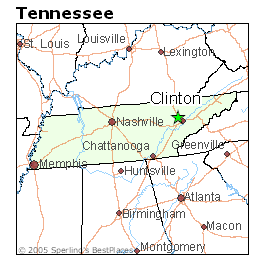
In 1956, Clinton High School in Clinton, Anderson County, Tennessee, was set to be the first high school in the South to be integrated after the Brown decision. Integration was progressing smoothly until John Kasper, leader of the White Citizens Council and a staunch segregationist, came to town. Protests and riots ensued from that day until early in December, when several white citizens escorted the African American students to class, as shown here. One of the escorts was badly beaten afterwards. As a result of the episode the school was closed on December 4, but reopened six days later without incident.
The Desegregation of Clinton, Tennessee
From PBS's History of Jim Crow, "The Desegregation of Clinton Senior High School: Trial and Triumph," by Clinton Beauchamp and Amanda Turner: In the early 1950s, Clinton, Tennessee, was the epitome of a typical southern small town--quiet, friendly, simple, and segregated. In 1956, however, violence over the desegregation of Clinton High School would rock this town to the core and leave an important legacy for years to come.
The trials began with a groundbreaking lawsuit, McSwain v. Anderson County. In 1950, five Negro children and their parents, backed by the NAACP, filed suit against the Anderson County Board of Education to gain entrance into Clinton High School. At that time, the law of Anderson County and the law of the State of Tennessee not only allowed but also required segregation in State high schools, and Negro students in Clinton were designated to attend either Rockwood High School in Rockwood or Austin High School in Knoxville. Presiding Judge Robert L. Taylor of the Federal District Court in Knoxville, Tennessee, dismissed the case on the grounds that Anderson County was providing equal or better educational facilities to the Negro students. The decision was appealed but was suspended pending a decision by the Supreme Court in the historic Brown v. Board of Education case. On January 4, 1956, the final decree issued by Judge Taylor was "...that in Anderson County, as to high school students, segregation be ended by not later than the fall term of 1956."
The Desegregation of Clinton, Tennessee
The faculty and staff of Clinton High School began preparing for integration. For instance, students were assigned papers on the coming integration and involved in numerous class discussions. In addition, news of the school's impending integration was circulated in the local newspaper The Clinton Courier and announced at school assemblies and town meetings. A Clinton High student at that time, Jerry Shattuck, believes, "...the student body and the town of Clinton was pretty well aware of and prepared to accept the desegregation; I don't think they necessarily supported it, but, nevertheless, it was the law of the land and we were going to abide by it." Things progressed relatively smoothly throughout the summer.
On registration day, the 12 Negro students to attend Clinton High School signed up for classes with no trouble. It seemed that the integration might be implemented without any trouble, but the weekend before school was to begin, John Kasper came to town. Kasper was an ardent segregationist and leader of his own group, the White Citizens Council. He came into town and began to "stir up trouble." Kasper clearly stated his views on segregation in an article, "Segregation or Death" (Virginia Spectator, May, 1959), in which he stated, "The only defect with segregation as a national policy, as a policy of the government, is that it does not go far enough." Kasper would play a pivotal role in causing the problems in Clinton over the next few months and would be arrested several times.
Clinton, Tennessee
With the stage thus set, on Monday, August 26, 1956, Clinton High School made history by becoming the first public high school in the South to desegregate. On the first day of school, Kasper and a few other citizens he recruited to his cause began picketing outside the school but were quickly disbanded. According to Mr. Shattuck, "They were gone in five minutes because they were embarrassed: it was sort of an unnatural activity carrying pickets here in a small town like this. Nevertheless, there was a big press contingent here that morning, so, by the time the afternoon newspapers came out or the evening television shows came on, it was all about this big protest in Clinton, Tennessee, over desegregation. Well, the great protest was five people carrying signs for five minutes; but, in my opinion, the press misrepresented what happened. The next morning, there were 15 people carrying pickets." The numbers kept increasing, and, by Thursday, the town was inundated with hundreds of outsiders "going up and down the streets and generally raising Cain." It soon became apparent that Clinton's two-man police force was woefully inadequate for the task at hand, so Mayor Lewallen was forced to organize a home guard of deputized citizens to supplement the police force and attempt to restore order to the town. The guard was also placed at the homes of prominent citizens who had been threatened by segregationists. Despite all this turmoil outside, classes went on relatively normally inside the school.
The Desegregation of Clinton, Tennessee
The atmosphere within the school environment at this time varies depending on whom you ask. Alfred Williams, a Negro student who attended the school during this time, says that there was a significant amount of harassment from the white students. "You couldn't possibly get anything learned or done, because you were constantly afraid that the white kid next to you was planning to kill you." Mr. Williams was eventually expelled after pulling a knife on a group of white students that were threatening to kill his brother, Charles.
However, Mr. Shattuck, a senior and captain of the football team and Student Council President at that time, disagrees with Williams, "No, actually the black students weren't harassed that much. They got to school without incident, because they came in the back of the school, and the mob was in the front...Once inside the school, they faced no harassment, neither was there any welcoming with open arms. Except in November, when Kasper came back to town and organized the Junior White Citizens Council, and then it was petty stuff like ink in lockers, tacks in seats, jostling in the hallway, and that sort of thing. But, the football team stationed itself at the hall corners, and we put a stop to that real quick.... We felt that this was the law of the land, and we were going to abide by it." Bobby Cain, Clinton's first Negro graduate, agrees with Shattuck that there wasn't any overt hostility, and he says, "I did manage to make a few friends." Despite the mostly peaceful atmosphere inside the school, problems continued to mount in town.
The Desegregation of Clinton, Tennessee
Friday, August 31 was the night of the big football rivalry game against Lake City. That night, even more cars poured into Clinton to see the game. Rumor spread that the segregationist groups were planning a cross-burning rally on the field at halftime. Although nothing happened at the game that night, the next night, Saturday night, was the night the State troopers and the National Guard were called into Clinton.
It started when a mob in the square in front of the Clinton courthouse got out of hand. The home guard, which had been inside the courthouse, began marching across the square in a line. It was then that the historic picture of the guard shown in newspapers and magazines across the country was taken. The guard was forced back into the courthouse by gunfire, and they called the governor. At that point it was decided that things were so out of hand that the State troopers were to be sent into the town. The story goes this way. Nearly 100 cars came over the bridge into town--with sirens blaring, they pulled up to the mob that had assembled between the courthouse and Hoskins, the local drugstore and soda fountain. Out of the lead, car climbed the six foot eight inch figure of Greg O'Rear, the head of the Highway Patrol, with a double-barreled shotgun slung over his shoulder. The story continues, that he stepped out and said to the assembled mob, "Alright, boys, it's all over." And, it was. The next day, the National Guard relieved the Highway Patrol and, from then through the end of September, policed Clinton.
The last major violent incident was on December 4, 1956, when the town held municipal elections. The White Citizens Council had put up a candidate for mayor who vowed to restore segregation if elected. On that day, three white citizens of Clinton decided to ensure that the Negro students going to Clinton High School arrived safely. Rev. Paul Turner, Sidney Davis, and Leo Burnett walked to the top of the hill and escorted ten of the 12 Negro students down the hill to the school. They got to the school safely, and, after the students went inside, the three men went their separate ways. However, when Rev. Turner turned to go to his church, First Baptist Church of Clinton, he was assaulted by a group of White Citizens Council members. While an elderly lady from a local flower shop managed to run the men off, Turner was, nevertheless, severely beaten. Although members of the White Citizens Council meant to scare citizens into supporting their candidate, he was soundly defeated.
Because of the assault on the Rev. Turner and numerous other incidents--including an attempt to enter the school where a student intervened to save Turner's wife, a Home Economics teacher, was saved from injury--Principal Brittain decided, that in the interest of the students' safety, he needed to act. So, the same day as the Reverend's attack, Brittain closed the school exactly two years after the Tennessee Supreme Court found segregation in education to be unconstitutional in Tennessee schools. Many of the seniors were terrified that they would be unable to graduate that year. "We could just see our senior year flying away," remarked one student. However, the violence could not hold Clinton High School down for long, and on December 10, six days after closing, the school was reopened.
Things remained quiet, and at the end of that year, Bobby Cain, the first Negro graduate of a desegregated public high school in the South, became a national news event. Members of the press from around the country attempted to talk to him. According to Jerry Shattuck, "Some of the senior boys got together and shielded him from the press that was trying to mob him." However, Mr. Cain's friend, Alfred Williams, remembers the event differently. "The night he graduated, they cut the lights out on him and hit him, then turned the lights back on. He never did find out who did it." After that year, major efforts by the segregationists in Clinton wound down. They felt that if one student could graduate, then more would follow, and indeed they did.
Principal Brittain resigned in the Spring of 1957. He and his wife had received countless threatening letters since the beginning of the school year and near constant harassment. A slight man of a 130 pounds, he lost 14 pounds, and had his life threatened no less than a dozen times during the school year. Earlier in the year, he had asked the student body to vote on whether or not they wanted him to resign; a similar ballot was taken home to the parents, and, except for six dissenting votes, the overwhelming majority believed that Brittain was doing a fine job and wanted him to remain. Nevertheless, by spring he had had enough and felt that it was time for him to resign. The problems had also taken their toll on the faculty of the high school.
By the beginning of the 1957-1958 school year, only seven of the school's teachers returned. Among them was Juanita Moser, who served as assistant principal and was a teacher. With a new principal, Mr. W.D. Human, school continued peacefully for the remainder of the year. It appeared to many that the worst was over, and that they had weathered the storm.
Two years later on Sunday, October 5, 1958, the peace of Clinton High School was once again shattered, this time by explosives. An estimated 75 to 100 sticks of dynamite ripped through the high school building in three successive blasts in the early morning hours. While the majority of the school was destroyed, no one was injured because the explosion's timing. The gym and the upper section of the school remained intact, but the rest of the building was in shambles with scarcely one stone remaining upon another. To this day, despite a Federal investigation, no one knows who was responsible for the bombing. To many, though, that really doesn't matter.
In the eyes of many people, the real story of the bombing and Clinton High School's integration is a story of a people united to preserve the peace and decency of a small town. Within three days of the bombing, Clinton High School students were attending classes in a borrowed school. Clinton High was moved seven miles away to the abandoned Linden Elementary School, which was donated by the Atomic Energy Commission, in Oak Ridge. While the old high school was salvaged for anything savable and, for the two years it took to complete the new Clinton High School building in 1960, students did their best to receive an education despite having to use chairs made for ten-year-olds and undersized lockers. Even the old rivalry of Clinton and Oak Ridge was put aside, and Clinton students arrived on their first day at Linden to the sounds of music from the Oak Ridge High School Marching Band.
Many people view the integration of Clinton High School as a success story. Although some may debate this view, most Clintonians will agree that it was successful. As Jerry Shattuck puts it, "The people in Clinton themselves made it happen. They needed help from the State, and they got it, and, later on, they needed help from the Federal marshals, and they got it, but nowhere else [in the country], in my opinion, did the people let it be known through their actions what their will was. And their will was not a commitment to integration. It was a commitment to ‘This is our decent, civilized little town, and we're going to obey the law of the land and not let it be messed up.' I think that this is the real success of the story." (source: PBS.org)
From the UK Guardian, "Obama should realise that segregation may be over, but exclusion lives on: African-Americans have been hit harder by this recession than others, and the president should be wary of lecturing them," by Gary Younge on 19 July 2009:
On 29 June, 65 children from the Creative Steps summer camp in Philadelphia took a trip to the private suburban Valley Club swimming pool for a dip. The Valley Club knew they were coming and how many there were because the camp had signed a contract and paid $1,950 in advance for weekly visits throughout the summer. But somehow the arrival of the mostly African-American and Latino children was still a shock. As the black and brown kids got into the pool, the white parents pulled their kids out.
One child overheard a woman ask: "What are those black kids doing here?" Another reportedly expressed fears that the children might steal something. A few days later the club revoked the contract and refunded the advance. When asked why, the club's president, John Duesler, said: "There is a lot of concern that a lot of kids would change the complexion … the atmosphere of the club."
The story broke on the national stage just in time for the centennial conference of the oldest US civil rights organisation, the National Association for the Advancement of Colored People. While some asked whether the NAACP was still relevant, others gathered outside the Valley Club with placards.
There is a perverse comfort many get from displays of blatant racial injustice. A simple morality play starring villains and victims always draws a bigger, more indignant crowd than the more involved narrative of structural inequality. With all laws and most voices in support of systematic racial exclusion gone, such incidents allow everyone to express their outrage – safe in the knowledge that nothing much need change in terms of systemic discrimination.
"It may sound odd to say, but in some ways rigid segregation was an ally," says the NAACP chairman, Julian Bond, "because things were so clear. There were signs, there were places where you knew you could not go if you were a person of colour. And having lost that clarity it's sometimes difficult to focus on who's the enemy, what's the ill here."
And so it has been in Philadelphia that a faceless enemy and a litany of institutional ills has long been paving the way for the clarity surrounding the situation at Valley Club.
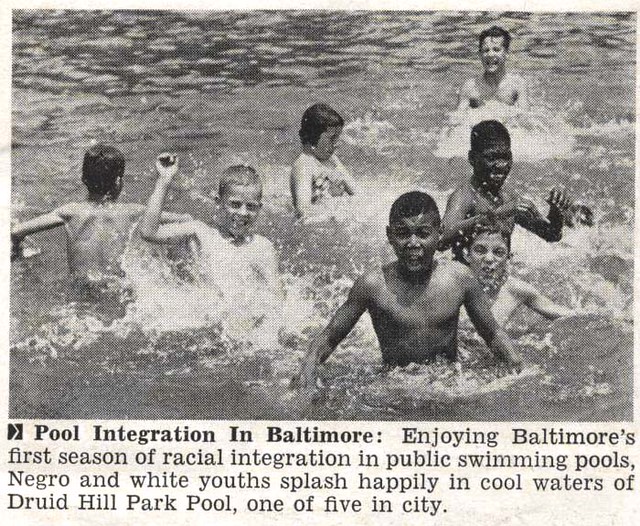
The Valley Club was founded in 1954, the year the supreme court ruled on Brown v Board of Education making racial segregation illegal. This was no coincidence. That decade had seen a rash of efforts to integrate pools, which had sparked white flight. "When pools were desegregated, white people abandoned them en masse," explains Jeff Wiltse, associate history professor at the University of Montana and author of Contested Waters: A Social History of Swimming Pools in America. "There was a boom in the construction of private pools where middle-class whites could still exclude non-whites … I don't know the details of the founding of the Valley Club, but both the time and the place in which it was built fits right into that story."
Meanwhile, the public facilities that remained catered for the poor and the non-white, and were rapidly downgraded. This year Philadelphia has closed more than a third of its pools owing to budget cuts. So the kids from Creative Steps did not make that trip by chance. Politics and economics brought them there – and then intolerance kept them out when they arrived.
When they got home, they had other problems to deal with. The stampede to the suburbs (Philadelphia has lost a quarter of its population since 1950) has left an impoverished "minority-majority", where one in five families lives in poverty. Unemployment, already in double figures, has risen by almost 50% in the last year.
According to the coalition to save libraries (the mayor had planned to close more than a fifth of those), this was already set to be a bleak summer in the "City of Brotherly Love". Further budget cuts mean there are 1,700 fewer positions for summer camps and 3,700 fewer summer programme slots for children, and 772 fewer recreational jobs and 400 fewer summer internships for young people this year. "These cuts are devastating for youth in our communities," says Sherrie Cohen, an organiser with the coalition. "With less structured opportunities in our neighbourhoods, kids are left to get into trouble."
These cuts are not specifically aimed at minorities. But they disproportionately affect the poor, and since minorities are disproportionately represented among the poor, they hit black and Latino families hardest. Herein lies the intersection between race and class – without an understanding of which little sense can be made, and no effective challenge mounted, against modern racism.
Given the large numbers of white people who are poor and the large numbers of black people who are not, it is not helpful to frame racial disadvantage purely in terms of isolated, dramatic events that humiliate black people. Poor white people in Philadelphia have little stake in whether black kids can swim in Valley Club or not, but they have a big interest in keeping pools open, which would benefit far more black kids than does admission to one suburban pool. In those connections lie the potential for class solidarity between races
It is this context that makes elements of Barack Obama's speech to the NAACP conference problematic. Having paid homage to the heroic role of the civil rights movement and recognized the inequalities bequeathed by segregation, he started on parenting. "We've got to say to our children, if you're African- American, the odds of growing up amid crime and gangs are higher," he said. "If you live in a poor neighborhood, you will face challenges that somebody in a wealthy suburb does not have to face. But that's not a reason to get bad grades; that's not a reason to cut class; that's not a reason to give up on your education and drop out of school. No one has written your destiny for you. Your destiny is in your hands – you cannot forget that. That's what we have to teach all of our children. No excuses. No excuses."
The audience lapped it up. Such admonitions are commonplace at any aspirant black American dinner table, where parents tell children they will have to work twice as hard as their white counterparts to get just as far. These are the mantras with which I was raised, and may well one day repeat. But I would not like to see them elevated to national policy. Nor was Obama speaking at a dinner table, but at an event that produce headlines like: "School the new cool. O to parents: It's not just about rap," in the New York Post; and "Obama tells fellow blacks: 'No excuses' for failure," in the New York Times.
A leader who has spent billions bailing out banks, bombing Afghanistan and occupying Iraq while poverty and unemployment rise should be wary of lecturing others on priorities. He, of all people, should understand that we can only play with the hand we're dealt.
It goes without saying that even those in the toughest circumstances have choices. But as the situation in Philadelphia illustrates, and as Obama pointed out elsewhere in his speech, those circumstances are becoming tougher and those choices fewer for black American families, who have been hit far harder by this recession than others.
If I'm looking for someone I don't know to give me advice on raising my kid, there's always Supernanny. What I want from a president are the resources that will enable any child to enjoy their summer where they please without having the doors closed on them by budget cuts or bigotry. No excuses. No excuses. (source: UK Guardian)