Showing posts with label Black Laws. Show all posts

Thursday, November 7, 2013

Charles J. Ogletree: Reparations


New York Times Article, "Litigating the Legacy of Slavery," by Charles J. Ogletree Jr, on 31 March 2002 -- Last Tuesday, a group of lawyers filed a federal class-action lawsuit in New York on behalf of all African-American descendants of slaves. The lawsuit seeks compensation from a number of defendants for profits earned through slave labor and the slave trade.

This lawsuit is limited to FleetBoston, Aetna, CSX and other to-be-named companies. The broader reparations movement seeks to explore the historical role that other private institutions and government played during slavery and the era of legal racial discrimination that followed. The goal of these historical investigations is to bring American society to a new reckoning with how our past affects the current conditions of African-Americans and to make America a better place by helping the truly disadvantaged.

The Reparations Coordinating Committee, of which I am a co-chairman, will proceed with its own plans to file wide-ranging reparations lawsuits late this autumn. The committee is a group of lawyers, academics, public officials and activists that has conducted extensive research and begun to identify parties to sue and claims to be raised.


The shape of a reparations strategy can already be seen. Among private defendants, corporations will be prominent, as last week's lawsuit shows. Other private institutions -- Brown University, Yale University and Harvard Law School -- have made headlines recently as the beneficiaries of grants and endowments traced back to slavery and are probable targets. Naming the government as a defendant is also central to any reparations strategy; public officials guaranteed the viability of slavery and the segregation that followed it.

A number of recent examples illustrate the possibilities for making reparations claims nationally and internationally. In South Africa, reparations have been part of the work of the Truth and Reconciliation Commission, which seeks to compensate people with clear material needs who suffered under apartheid because of their race. It was also in South Africa that, in the final documents of a racism conference sponsored by the United Nations, slavery was defined as a ''crime against humanity,'' a legal determination that may enable the reparations movement to extend its reach to international forums.

In the United States, just three years ago the federal government reached a consent decree with a class of over 20,000 black farmers to compensate for years of discrimination by the Department of Agriculture. The case represents the largest civil-rights settlement by the government ever, with a likely payout of about $2 billion. Previously, the government also approved significant compensation for Japanese-Americans interned during World War II and paid reparations to black survivors of the Rosewood, Fla., race riots.


Although these precedents differ from a slavery-based reparations claim in that they involved classes of individuals who were both alive and easily identified, they nonetheless indicate government willingness to acknowledge past wrongs and remedy them. It is important that in each case the government waived its immunity from suit, thereby lifting the ordinary bar that prevents lawsuits against a sovereign.

Bring the government into litigation will also generate a public debate on slavery and the role its legacy continues to play in our society. The opportunity to use expert witnesses and conduct extensive discovery, to get facts and documentation, makes the courtroom an ideal venue for this debate.

A full and deep conversation on slavery and its legacy has never taken place in America; reparations litigation will show what slavery meant, how it was profitable and how it has continued to affect the opportunities of millions of black Americans.
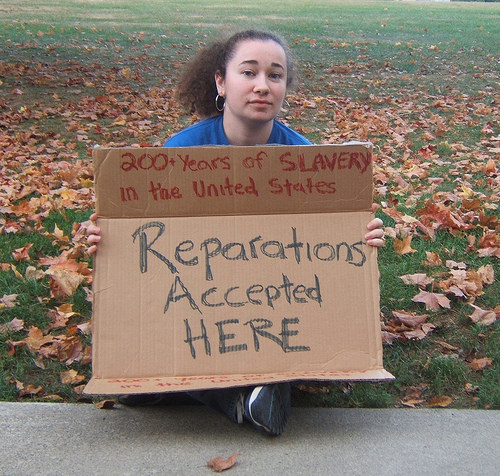

A full and deep conversation on slavery and its legacy has never taken place in America; reparations litigation will show what slavery meant, how it was profitable and how it has continued to affect the opportunities of millions of black Americans.

Litigation is required to promote this discussion because political accountability has not been forthcoming. In each Congressional session since 1989, Representative John Conyers has introduced a bill to study slavery reparations and it has quickly died each time.

Though claims for slavery reparations have moved near the front of national and international policy discussions in the past few years, the movement has deep historical roots. Those roots go back at least as far as the unkept promise in 1864 of ''40 acres and a mule'' to freed slaves, which acknowledged our country's debt to the newly emancipated.


Indeed, the civil rights movement has long been organized, in part, around the notion that slavery and the century of legal discrimination that followed have had enduring and detrimental effects on American minorities.

The reparations movement should not, I believe, focus on payments to individuals. The damage has been done to a group -- African-American slaves and their descendants -- but it has not been done equally within the group. The reparations movement must aim at undoing the damage where that damage has been most severe and where the history of race in America has left its most telling evidence. The legacy of slavery and racial discrimination in America is seen in well-documented racial disparities in access to education, health care, housing, insurance, employment and other social goods. The reparations movement must therefore focus on the poorest of the poor -- it must finance social recovery for the bottom-stuck, providing an opportunity to address comprehensively the problems of those who have not substantially benefited from integration or affirmative action.

The root of ''reparations'' is ''to repair.'' This litigation strategy could give us an opportunity to fully address the legacy of slavery in a spirit of repair.  [source: New York Times; Copyright 2013 The New York Times]


Wednesday, May 2, 2012

African-American Education in West Virginia

Anderson Elementary. One-room African-American school, circa 1939.


From the West Virginia Encyclopedia, an article discussing African-American Education in West Virginia by Ancella R. Bickley, on 19 October 2010 -- Early black education in West Virginia developed through a combination of forces: self-help efforts; the aid and support of benevolent white people; support from the U.S. Freedmen’s Bureau and missionary associations; and the activities of public school officials. By the middle of the 20th century, on the eve of desegregation, the state’s African-American schools had become a well-functioning, effective system.

When the first West Virginia legislature met in 1863, it agreed to educate ‘‘free colored children,’’ but the proposition was left unfunded. With the condition that white and black children should not be taught in the same schools, West Virginia’s second constitution in 1872 affirmed the state’s commitment to the education of African-American children. Although most school boards cooperated, court action sometimes had to be undertaken or threatened to force some to provide the needed support for black education.


Maben Grade School. African-American school, Widen.


Sumner School, the first school for black children in West Virginia, a self-help effort, opened in Parkersburg in 1862. After 1865, education for West Virginia’s black citizens was undertaken wherever there were enough students. Schools were under way in 18 communities by 1868, including Parkersburg, Wheeling, Clarksburg, Charleston, Lewisburg, Martinsburg, Charles Town, and Malden. These early schools were held wherever space could be found, sometimes in homes and churches. In some instances the schools were private and served both adults and children.

Among the major difficulties was the dearth of teachers. In the beginning, whites served, as did black teachers from neighboring states, particularly Ohio. The first formal effort to train black teachers in West Virginia came at Storer College in Harpers Ferry. The college was begun in 1865 by the Freewill Baptist Church. In 1881 the state agreed to contract with Storer to train African-American teachers. Until the state’s black land grant college, West Virginia Colored Institute (now West Virginia State University), was founded in 1891, Storer College was the only institution in the state preparing blacks for the teaching profession. Later, Bluefield Colored Institute (now Bluefield State College), established in 1895, joined the other two in this mission. These institutions also provided secondary education.


Widen School. African-American students outside school,

As the railroads and mines drew more black people into West Virginia in the late 19th and early 20th centuries, the need for public education increased. Initially, the school law permitted the establishment of a black school wherever there were 30 black students between the ages of six and 21. Over the years, this number was reduced until a school could be started with 10 students of school age. With this reduction in the number required, elementary schools sprang up in many areas. One of the earliest was the Clarksburg School, for which a construction bid was accepted in 1868. Statewide, there were 207 black schools and 278 teachers serving 7,886 students in 1902. By 1924, there were 453 elementary and junior high schools.

Black high school education began slowly. The first institution to offer such instruction was the Sumner School in Parkersburg, which added high school courses to its curriculum in 1885. This was followed by high schools in Clarksburg, Charleston, and Huntington. By 1923, the number of black high schools had increased to 21. In some cases, cooperative arrangements allowed African- American students to cross county lines to attend high school; for example Preston County students attended in Monongalia County. In other instances students either ended their education at the eighth grade, boarded with families in areas where there were high schools, or daily traveled long distances by train, bus, or streetcar.

Weston Colored School.

In addition to black public education, several private educational efforts were attempted. Storer College continued in Harpers Ferry until 1956; St. Phillips Academy was operated for a time by St. Phillips Episcopal Church in Charles Town; the Baptist State Association operated a school at Hilltop in Fayette County; and Catholics operated St. Peter Claver in Huntington.

In 1919 the state created the position of state supervisor of Negro schools and appointed a Negro Board of Education. In 1933 assistant superintendents of Negro education were appointed in counties having 50 or more black teachers. In addition to the push for more voice in the operation of their schools, blacks also struggled for adequate buildings and materials, for equal salaries for teachers, and for a full nine-month school year.

Weston Colored School.

By 1950, the West Virginia public school system provided separate education for more than 19,000 of the state’s black youth, grades 1–12. Included were schools for black students in institutional settings, including the deaf and blind. Higher education through the baccalaureate level was available at Bluefield State College and West Virginia State. Academics were enriched by strong extracurricular offerings such as dramatics, music, art, various clubs, and athletics. Statewide competitions, tournaments, and exhibitions helped to knit together black communities across West Virginia. The black colleges, elementary and junior and senior high schools, and their administrators and teachers are remembered and honored by their alumni for helping them to develop a strong educational background, basic values, community spirit, and lifelong friendships.

When the 1954 Brown v. Board of Education Supreme Court decision ended segregated schools in the United States, West Virginia began dismantling its system of black education. By the mid-1960s, the process was essentially complete, with African-American students and teachers participating in integrated public schools. [source: West Virginia Encyclopedia by Ancella R. Bickley.  on October 19, 2010]

Monday, May 16, 2011

Connecticut's "Black Law" (1833)


Lacking no legal means to prevent Prudence Crandall from opening her school, Andrew Judson, a local politician, pushed legislation through the Connecticut Assembly outlawing the establishment of schools "for the instruction of colored persons belonging to other states and countries." But the tide of abolitionism was turning, for five years later, in 1838, Connecticut's Black Law was repealed. Phillip Pearl, the chairman of the committee that had passed the Black Law, led the movement for its repeal, telling a friend, "I could weep tears of blood for the part I took in that matter--I now regard that law as utterly abominable." (Yale)

Connecticut's "Black Law" (1833)
An act in addition to an Act entitled "An Act for the admission and settlement of Inhabitants of Towns."
WHEREAS, attempts have been made to establish literary institutions in this State for the instruction of colored persons belonging to other states and countries, which would tend to the great increase of the colored population of the State, and thereby to the injury of the people: Therefore,

Sec. 1. Be it enacted by the Senate and House of Representatives, in General Assembly convened, That no person shall set up or establish in this State, any school, academy, or literary institution, for the instruction or education of colored persons who are not inhabitants of this State, nor instruct or teach in any school, academy, or literary Institution whatsoever in this State, or harbor. or board, for the purpose of attending or being taught or instructed in any such school, academy or literary institution, any colored person who is not an inhabitant of any town in this state, without the consent, in writing, first obtained of a majority of the civil authority, and also of the select men of the town in which such school, academy, or literary institution is situated; and each and every person who shall knowingly do any act forbidden as aforesaid, or shall be aiding or assisting therein; shall, for the first offence, forfeit and pay to the treasurer of state, a fine of one hundred dollars, and for the second offence shall forfeit and pay a fine of two hundred dollars, and so double for every offence of which he or she shall be convicted. And all informing officers are required to make due presentment of all breaches of this act. Provided, That nothing in this act shall extend to any district school established in any school society, under the laws of this state, or to any incorporated academy or incorporated school for instruction in this state.

Sec. 2. Be it further enacted, That any colored person, not an inhabitant of this state, who shall reside in any town therein for the purpose of being instructed as aforesaid, may be removed in the manner prescribed in the sixth and seventh sections of the act to which this is in addition.

Sec. 3. Be it further enacted, That any person, not an inhabitant of this state, who shall reside in any town therein, for the purpose of being instructed as aforesaid, shall be an admissible witness in all prosecutions under the first section of this act, and may be compelled to give testimony therein, notwithstanding any thing contained in this act, or the act last aforesaid.

Sec. 4. Be it further enacted, That so much of the seventh section of the act to which this is an addition, as may provide for the infliction of corporeal punishment, be, and the same is hereby repealed.

SAMUEL INGHAM, Speaker of the House of Representatives.
EBENEZER STODDARD, President of the Senate.
Approved, May 24, 1833.

(source: Yale)

HOME

HOME
Click here to return to the US Slave Home Page