Emanuel African Methodist Episcopal Church – Overview
The Gothic Revival building that houses the Emanuel AME Church in Charleston is a testament to the determination of the church's congregation and earliest founders. The present day structure with its signature steeple was built in 1891, replacing an earlier wooden church from 1872 that was damaged in the Charleston Earthquake of 1886. Many of the brick and marble panels were restored between 1949 and 1951.
EMANUEL AME CHURCH
Documenting the American South--The roots of the Emanuel AME Church date back to 1816, when Morris Brown organized a withdrawal of the Charleston Methodist Episcopal Church's black members over a burial ground dispute. The newly-formed congregation quickly established themselves as an African Methodist Episcopal church, a denomination that was founded earlier in Philadelphia.
Brown was eventually jailed for violating laws restricting free and enslaved blacks from holding religious gatherings without white supervision. Then, after the first incarnation of the church was burned under a cloud of suspicion over a suspected slave uprising, the congregation continued to worship until 1834, when all-black churches became officially outlawed. After a period of underground worship, the church formally reorganized publicly in 1865 and adopted the Hebrew name Emanuel, meaning "God is with us".
The church is the oldest AME church in the South and has the oldest black congregation south of Baltimore, Maryland. (http://www.sciway.net/tourism/emanuel-ame-church.html)
Charleston City Paper's article, "Tracing discriminatory laws to the earthquake of 1886: The Birth of Jim Crow," by Will Moredock--We've seen it before: When disaster strikes, people pull together as friends and neighbors in a common cause — at least for a while. Then the old rivalries and social fissures reappear, more virulent than ever.
This was the pattern when Hurricane Katrina drowned New Orleans in 2005. A brief surge of unity and good will prevailed, then the old racial and class divisions reasserted themselves. Susan Millar Williams saw it in her McClellanville community in the wake of Hurricane Hugo in 1989. When relief goods started arriving, blacks and whites quarreled over who should receive them.
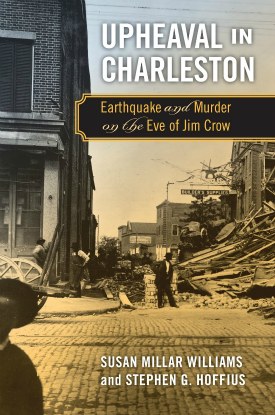
With this experience and what she had read about the 1886 Charleston earthquake in mind, Williams set out with fellow historian Stephen G. Hoffius to explore the social and political ramifications of that long-ago disaster. The recently released Upheaval in Charleston: Earthquake and Murder on the Eve of Jim Crow is the product of their 12 years of work, and the picture they paint of the Holy City is not flattering.
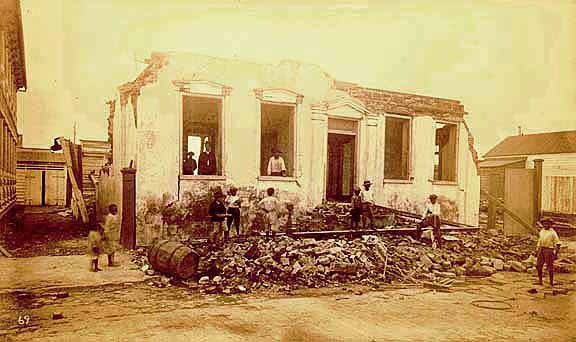
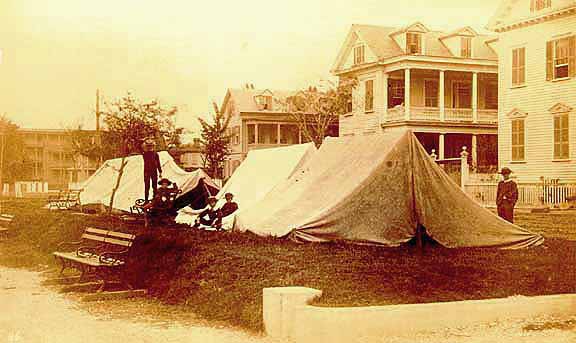
When buildings started swaying and toppling in the early evening of Aug. 31, 1886, the people of Charleston rushed into the streets, wailing and screaming, as fires broke out around the city. They headed instinctively toward Marion Square, where they would be safe from fire and falling buildings.
Blacks and whites set up camps on opposite sides of the square, Williams told me recently. "That first night ... blacks and whites joined in singing and praying together. It lasted about 24 hours."
In the immediate aftermath of the quake, Charlestonians sought to make sense of what had befallen them. Many middle-class and upper-class whites were happy to accept a rational explanation for the catastrophe, if only because it let them off the hook for any metaphysical responsibility. On the other hand, poor whites and blacks, steeped in their primitive religiosity, were eager to believe that this was God's punishment on a wicked city.
But what sins had so outraged the Almighty? A white Methodist minister intoned to his congregation: "Ice cream gardens, music, and dancing are the popular amusements for the Sabbath afternoons in Charleston." Excursionists, he said, sailed about the harbor on Sundays in "gay and frivolous" abandon.
A white woman told a newspaperman that her sins had brought on her sudden homelessness. "Yes," she said. "I was very worldly. I loved fine dresses and dancing and good living, and this is my punishment."
Blacks, who at the time made up 60 percent of Charleston's population, had a very different understanding of God's wrath. They saw the destruction of this proud old city as its reward for centuries of slavery and oppression. Street preachers sang out and shouted warnings through the night. This quake was the harbinger of apocalypse and judgment. The world would soon be destroyed and Revelation fulfilled.
"The sounds of blacks preaching and singing could be extremely disconcerting to whites," the authors write. "Deprived of other ways to communicate freely, black men and women had long used worship services as a way to register protest ... Now, as the voices of freedmen and their descendants rang out across the city in 1886, whites looked for ways to silence them."
Believers sang and writhed on the ground, as preachers exhorted, "Oh, Gabriel, turn that horn to the land of Egypt on the miserable sinners and not on we."
Williams and Hoffius add, "For whites who couldn't escape such speeches day in and day out, it didn't take too much imagination to suspect that the 'miserable sinners' in question might not be Egyptian."
White citizens and police soon intimidated the preachers and singers into silence.
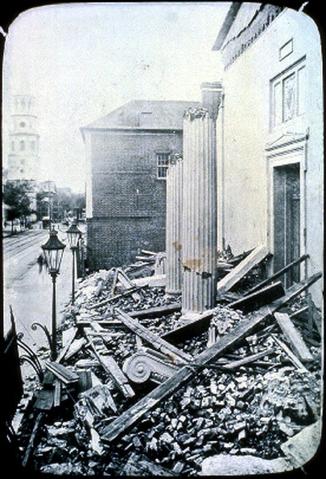
The damaged portico of Hibernian Hall, 105 Meeting St. - Charleston Library Society
(J. B. Macelwane archives, Saint Louis University)
There were other stresses to the fragile social fabric. As relief poured into the city from around the country, "Affluent whites insisted that providing free food and shelter to the poor would lead to moral breakdown," the authors write. And with the rebuilding of the city, black artisans and craftsmen were able to command high wages, acquiring wealth and status and threatening the social order. As Williams says, "Charlestonians wanted to preserve the status quo above all else. They did not want anyone to get ahead."
In fact, the authors argue in Upheaval in Charleston that the earthquake of 1886 ultimately helped bring out the Jim Crow laws a decade later.
"The earthquake stripped away the edifice of society. It hardened people's hearts," Williams says. "By the end of 1886, any hope of racial conciliation was over." (source:Charleston City Paper )
"Earthquake, August 31st, 1886. No. 634. Aiken and Vicinity. Wrecked at Langley." - Photographed by J.A. Palmer, Aiken, S.C.
The South Carolina Railway company train was washed from the track by a four-foot high wall of water when the earthquake burst the mill-dam at Langley Pond near Aiken, SC. The train's black fireman, a Mr. Ivie, died in the wreck. Another train owned by the same company was washed from the track near Horse Creek in Aiken County closer to Augusta, GA., when a mill-dam there also fractured because of the earthquake and sent an eight-foot-high wave of water surging against the locomotive, tender, and its train cars. (South Caroliniana Library Archives)
Charleston: "Upheaval in Charleston" Authors Susan Millar and Stephen Hoffius
Among the enslaved people who were sold at this particular auction in 1855, were 23 individuals that ranged from infants to 60 years old. Enslaved women represented an overwhelming majority of this sale (78%); Seventy percent (70%) were between the ages of 1-30 years old, 21% were between 31-40 years old and two 60 years old. This is a repeating pattern of the youthful skew of slaves who were sold at auction.
J.S. Ryan is the Old Slave Mart located in Charleston, South Carolina.
From the February 2003 edition of the Smithsonian Magazine, "Cast in Bondage Copper neck tags evoke the experience of American slaves hired out as part-time laborers," by Victoria Dawson:
It seems, at first glance, an innocuous if enigmatic artifact, a copper medallion 1.5 inches square, rough-edged and engraved with the words "Charleston. 571. Porter. 1856."
But the inscription—a city, a number, an occupation and a year—is stamped on a rare fragment of the past, known to scholars of the period as a slave hire badge, one of three in the cultural collection of the Smithsonian’s National Museum of American History. The tag likely hung from the neck of a slave for a calendar year, representing all that we will ever know of one man: a porter in Charleston, South Carolina, in 1856, industrious and trusted enough to be leased out by his master for short-term hire but required by law to be licensed and to wear or carry a metal identification tag at all times.
"Looking at a slave badge evokes an emotional reaction," says James O. Horton, Benjamin Banneker Professor of American Studies and History at George Washington University. "There is the realization that one person actually owned another."
Urban slavery just prior to the Civil War accounted for less than 5 percent of the slave population in the United States. "One reason a collectible like this is so compelling is that, given our dearth of knowledge about the badge system, there is room for speculation," says Michael Hodder, a numismatic consultant who researched the subject in 1993 when the New York coin-dealing firm Stacks offered 14 badges—the first large private collection ever sold. They commanded $60,000.
The badges, Hodder says, "evoke a personal history which is almost unfathomable: beatings, hardships, tears, pain, separation, loss, a terrible sense of abandonment." At the same time, he adds, "one can read into them a sense of hope and planning for the future—the slave working to earn as much money as possible, perhaps to purchase his freedom or the freedom of a family member."
Badge laws existed in several Southern cities, urban centers such as Mobile and New Orleans, Savannah and Norfolk; the practice of hiring out slaves was common in both the rural and urban South. But the only city known to have implemented a rigid and formal regulatory system is Charleston. Perhaps the statutes in other cities were never enforced; perhaps paper badges, inherently impermanent, were issued instead. All of today’s extant badges can be traced exclusively to Charleston. There, from the mid-18th century to the end of the Civil War, ordinances dealt with the matter of owners marketing the labor and skills of their slaves by arranging for them to work outside the home or plantation.
Perhaps a quarter to a third of white Southern families were slaveholders. The rest of the population, according to Horton, likely contracted to purchase slave labor on a part-time basis. "This was especially true if you needed a skilled craftsman," says Horton. "The process proved quite profitable for the master. The slave might accrue some portion of the fee—he might get it all or he might get nothing."
Such practices were inevitably fraught with tension. White laborers objected to what they saw as unfair competition. "There was a great deal of resentment," observes Harlan Greene, a Charleston scholar and coauthor, along with Harry Hutchins, of the forthcoming book Slavery’s Badge: A History of the Slave Hiring System of Charleston, SC, 1783-1865. "White artisans complained vehemently."
The system also created a category of slaves whose privileges threatened the status quo. "[Urban] slaves had more access to education, opportunities for self-hire and self-purchase, and the privilege of ‘live-out’ in separate sections of town, away from all the watchful eyes of masters," writes historian Theresa Singleton of Syracuse University in "The Slave Tag: An Artifact of Urban Slavery," a 1984 journal article. "All of these conditions tended to undermine masters’ control over slaves."
In the seaport of Charleston, one of the wealthiest and most important cities in the South, the city treasurer’s office issued all badges, with fees set according to the category and skill of the laborer. The most common occupations were servants and porters, though Charleston slaves also worked as skilled artisans (such as furniture makers and silversmiths), fishermen and fruit vendors.
Badges were made of copper alloy, cut or pressed from a mold, or occasionally fashioned by hand into various sizes and shapes, most typically squares or diamonds, ranging in size from about 1.5 square inches to 3 square inches. Each was punctured with a hole and was probably worn around the neck on a string or chain.
In addition to the three slave hire badges owned by the Smithsonian, another 100 or so, dating from 1800 to 1864, are in various museums around the country, and another few hundred are believed to be in the hands of private collectors. Prices for badges have soared in recent years, in part because of a burgeoning interest in African-American memorabilia. Recently, a huckster’s (fruit vendor’s) badge, dated 1803, fetched $26,450 at auction in Baltimore, Maryland.
Their power far transcends monetary value. "Imagine," Michael Hodder says, "this badge as it hung around the neck of a man. Imagine how it felt against his chest, how it felt to present it whenever someone demanded. At the end of the day, did the slave hang up the badge in his hut or did the master keep it? What happened if a slave lost his badge? What happened at the end of the year? Was the badge returned to the city marshal’s office, turned in, taken to a local mill, melted and then reused?" The only certainty is the profound inhumanity—and likely brutality—evoked by such an artifact.