Showing posts with label artists. Show all posts

Thursday, May 31, 2012

THE WANDERER: THE LAST AMERICAN SLAVE SHIP


THE WANDERER: THE LAST AMERICAN SLAVE SHIP AND THE CONSPIRACY THAT SET ITS SAILS , By Erik Calonius, REVIEWED BY KIMBERLY PALMER

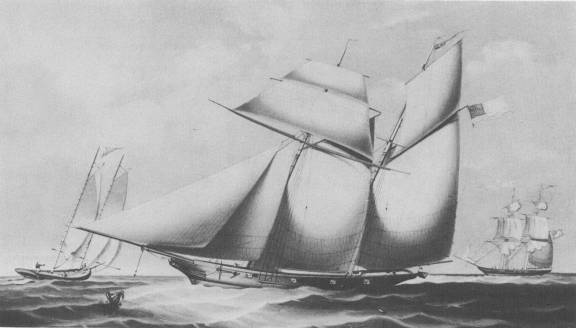
From the  The Washington Times -- On July 4, 1858, a ship called the Wanderer left Charleston, S.C., and set sail for the Congo. Disguised as a luxury cruise ship, the Wanderer had first raised suspicion when it docked in Long Island and loaded far more supplies than usual for a casual cruise. Officials surmised (correctly, as it turned out) that the ship was a slave ship.

In “The Wanderer,” Erik Calonius brings to light the tale of the last known ship that brought slaves to the United States from Africa. Using newspaper accounts, letters and legal documents, Mr. Calonius, formerly a London correspondent for the Wall Street Journal and Miami bureau chief for Newsweek, reconstructs the journey in painstaking detail.

Where little or no evidence remains of the Wanderer’s voyage — including the brief excursion into Africa and the slave market where the ship’s crew purchased the slaves — Mr. Calonius writes that he used eyewitness accounts of the slave trade to describe what the slaves and the crew of the Wanderer likely experienced.


The result is a compelling and heartrending record of a journey that helped push the nation to the brink of the Civil War.

Transporting slaves from Africa was outlawed in 1820, but nearly four decades later, the practice — profitable but risky — continued. The Wanderer’s crew eluded the law by charming officials who were not all that interested in enforcing it.

When the ship reached the 3,000-mile long African shoreline, patrolled by 28 British and American ships, one of the British patrol ships spotted it. The Wanderer’s captain — William C. Corrie, a well-connected Southerner — invited the crew aboard. “After months of tedious Africa duty, the British were more than happy to explore this luxury yacht,” writes Mr. Calonius.


Corrie invited the crew to stay for dinner as well as after-dinner champagne and cigars on the deck. The British patrollers said goodbye after deciding the Wanderer was simply a cruise ship and not a slaver.

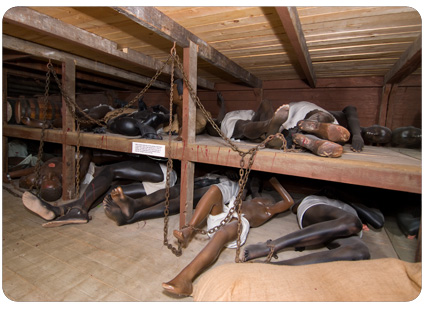
Soon after that meeting, the crew rolled up the ship’s luxury carpets and put away its library books in preparation for nearly 500 slaves. Each one was given a space that measured just 12 inches in width, 18 inches in height, and less than five feet in length — smaller than a typical slave ship.

Corrie purchased the slaves from a dealer and had them branded with a hot iron. During the return voyage, 80 slaves perished because of the harsh conditions below deck. Those that survived were unloaded in Georgia. After the Africans were spotted by locals, federal prosecutors started to build a case against the Wanderer’s owners.

Prosecutors soon found themselves up against the powerful, pro-slavery networks of Georgia. One of the ship’s owners, Charles Lamar, a wealthy Savannah resident, reminded witnesses that he could make life miserable for anyone who testified against him. Lamar was a “fire-eater” who wanted the slave trade to flourish and who hoped that the South would eventually split from the North. The nationally publicized trials of those implicated in the Wanderer scheme helped cause that rift.

“If they fail to hang the men,” wrote the New York Times of the South, “if their officials are so lax, or their juries so perjured, as to permit this trade to be carried on with impunity, in face of all our laws against it — they will suffer all the consequences of an actual complicity in the proceeding itself… . the entire population of the North will wage upon [the South] a relentless war of extermination.”

As Mr. Calonius notes, that prediction proved prophetic indeed. The defendants in the Wanderer trials were found not guilty, the abolitionist John Brown was hanged not long after and war soon broke out.

The threat of the Civil War looms throughout the narrative. In the 1850s, the South had not yet embraced the industrial revolution. Agricultural life, which depended on the labor of slaves, was idealized for its slow pace and comfortable lifestyle. At the same time, the South’s economy was slipping further and further behind the more industrialized North.


By 1860, New England was manufacturing three times as many goods as the South. In the meantime, the South, which had grown dependent on the cheap labor of slaves, had to deal with the reality that as fewer slaves were shipped from Africa, the cost of owning slaves increased. Few businesses, Mr. Calonius writes, were more profitable than the illegal transportation of slaves from Africa to the United States.

Mr. Calonius challenges the popular belief that most Southerners rallied to fight for slavery. According to him, the South seceded because a few powerful men wanted to keep slavery alive, and they persuaded many others to support their fight against what they saw as Northern interference.

Most farmers and merchants, he writes, had no stake in slavery whatsoever and even less interest in breaking up the country over it. In Savannah, the vast majority of residents did not own slaves. To garner support for slavery, the rich plantation owners who needed slaves to maintain their wealth started a campaign to convince people that if slaves were freed, they would plunder and steal throughout the region.

“It was not the first time in history that a group of radicals had overwhelmed the will of a weak and unfocused majority, nor would it be the last,” writes the author.


For most of the book, Mr. Calonius focuses on the saga of the ship and not the slaves themselves. But one of the most compelling tales comes at the end, when he recounts what happened to Cilucangy, a slave brought over on the Wanderer as a boy.

After the Civil War, Cilucangy worked in Georgia as a basket weaver. Despite his desire to return to Africa as an adult, he failed to amass the necessary funds. He started a family in Georgia, and his descendants include lawyers and teachers.

Margret Higgins, Cilucangy’s great-granddaughter, lives near the Uniondale exit of the Long Island Expressway. Her grandson was named Alexander Cilucangy Valenti, in honor of the courage and resiliency of his forebear. (source: The Washington Times)

Sunday, May 20, 2012

Fabrice Monteiro's Amazing Images of Brown. Fugitive Slaves In Slave Torture Devices

"Marrons. Les esclaves fugitifs" (Brown Runaway Fugitive Slaves) photographed by Fabrice Monteiro

"Brown. Fugitive Slave," is an article published in his newsletter Africultures is an evocation of runaways through the eyes of Fabrice Monteiro. An article that is timely to commemorate the 163 th anniversary of the abolition of slavery in Guadeloupe, 27 May 2011 .


"Marrons. Les esclaves fugitifs" (Brown Runaway Fugitive Slaves) photographed by Fabrice Monteiro

"Maroon" is a term borrowed from the Spanish "cimarron," meaning "living on the peaks."

It comes from a word "Arawak" defining domestic animals returned to the wild, and by extension, runaway slaves. The "Maroon" was a terrible threat to the colonial system, they were likely to provoke a civil war at any time. Fugitive slaves were monitored continuously and the sentences at the slightest deviation were particularly severe, they had to make an impression.

"Marrons. Les esclaves fugitifs" (Brown Runaway Fugitive Slaves) photographed by Fabrice Monteiro

Slaves who tried to escape suffering the punishment described by the law then they were made to wear a heavy iron necklace with long stems, which had the function to hang in the brush and hamper any escape. In the same spirit, they existed in shackles bells, can hear every movement of the slave. The slave who dared to speak a bit to his master suffered the punishment of the Iron Mask. Similarly, during the harvest of sugarcane, were put in iron masks to hungry and thirsty slaves to prevent them from tasting or eating the cane.


"Marrons. Les esclaves fugitifs" (Brown Runaway Fugitive Slaves) photographed by Fabrice Monteiro

During childhood in Benin, Fabrice Monteiro is marked by the cartoon "The Passengers of the Wind" of Bud Francis. Part of the adventure takes place in Ouidah, Benin, home village of his father's family. He is fascinated by the realism of images, it recognizes the scene drawn, the faces are familiar to him. It is in these pages he discovered these strange necklaces worn by some slaves to keep them from escaping. His father tells him the story of his family and why he wears a name like many other Portuguese Benin. His ancestor was named Ayedabo Adagoun Odo, his native Nigeria. He is enslaved by the Portuguese and sent to Brazil. He returned to Benin years later, freed by the name of Pedro Monteiro.

"Marrons. Les esclaves fugitifs" (Brown Runaway Fugitive Slaves) photographed by Fabrice Monteiro

Sensitive to the issue of the slave trade and the role of this small village on the coast of Benin, Fabrice decides to explore the subject photographically to contribute to the memory of slavery. From the * CODE BLACK, lithographs and of the few original photos of slaves, Fabrice plans reconstructs five models of barriers used to punish or deter the slaves of their escape. It is from these plans that two young blacksmiths Benin reproduce barriers staged in this photographic series. To obtain an effect of chiaroscuro, he chose a modern approach to treatment of light. He designed a black box, allowing a mobile studio to meet its models through the streets of Ouidah.

"Marrons. Les esclaves fugitifs" (Brown Runaway Fugitive Slaves) photographed by Fabrice Monteiro


* The BLACK CODE was developed by the French minister Jean-Baptiste Colbert (1616 - 1683) and promulgated in March 1685 by Louis XIV. [source: Fabrice Monteiro ( Article published by Africultures on 05/05/2011)]

"Marrons. Les esclaves fugitifs" (Runaway Fugitive Slaves) photographed by Fabrice Monteiro


"Marrons. Les esclaves fugitifs" (Runaway Fugitive Slaves) photographed by Fabrice Monteiro


"Marrons. Les esclaves fugitifs" (Runaway Fugitive Slaves) photographed by Fabrice Monteiro


RON'S COMMENTS:  Yes, these powerful images are disturbing.  It reminds us that human beings sit at the forefront of ALL enslavement.  The state-sponsored institutionalization of human trafficking and bondage for profit involves human beings.  Millions upon millions of nameless, faceless people who toiled for the enrichment of plutocrats, merchants, kings, queens, aristocrats, planters, shipbuilders, bankers, insurance brokers, shareholders and the like.  They were never paid, never thanked, even after emancipation never made whole.  I honor their spirit of survival.  

This small blog tries to offer a space to historically discuss and make sense of their inhuman bondage.  

BEN SAKOGUCHI;S ORANGE CRATE LABEL SERIES

BEN SAKOGUCHI
ORANGE CRATE LABEL SERIES

From the 1880's to the 1950's, California oranges were sent to market packed in wooden crates with big, milti-colored labels pasted on the ends. Among Ben Sakoguchi's early influences were the bold graphics and fanciful images on the orange crates that were stacked behind his parents' grocery store.

In the 1970's—after cardboard cartons had replaced wooden crates—beautifully printed labels that had long been stored in packing houses were being sold as collectors' items at the flea markets Sakoguchi frequented. He was attracted by the familiar orange crate label format, and started using it in a series of small paintings.

Just as the actual labels had depicted a wide variety of subjects—Sakoguchi's paintings sampled events, issues and attitudes of modern culture. He produced several hundred orange crate label paintings (1974 - 1981) before moving on to other projects.

In 1994, Sakoguchi revisited the orange crate label format, and has continued the series. The 218 paintings reproduced here date from 1994 to 2003. They are acrylic on canvas, 10 inches x 11 inches. (source: Ben Skoguchi)

Poston, Arizona USA 1945

Ben Sakoguchi was born in 1938, in San Bernardino California. During World War II, his family was incarcerated by the United States government because of their Japanese ancestry, so he spent his early childhood in an internment camp at Poston, Arizona. After the war, the Sakoguchis returned to San Bernardino, and with considerable difficulty, reopened their small grocery business. Ben attended public schools, including San Bernardino Valley College.

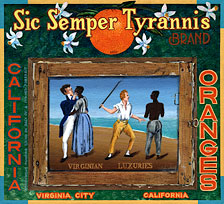
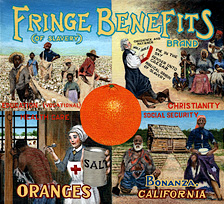
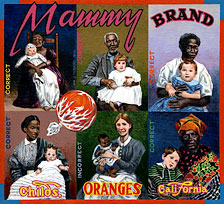
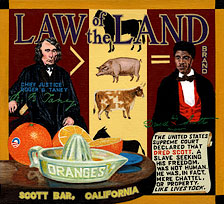
ORANGE CRATE LABEL SERIES: A BRIEF HISTORY OF SLAVERY

Ben Sakoguchi's 1974 - 1981 Orange Crate Label Series touched on the issue of race in America, and his continuation of the series (1994 - 2003) included a number of paintings that addressed the topic.

In Sakoguchi's Orange Crate Label Series: The Unauthorized History of Baseball, he followed the subject of race back to the beginnings of Major League ball. While working on those canvases in 2004, Sakoguchi also began directing his focus toward the "peculiar institution" of slavery.

The 59 paintings reproduced here were completed in 2008. They are acrylic on canvas, 10 inches x 11 inches.


sl-sakoguchi-025-sic-semper-tyrannis-virginia-luxuries-anonymous-painting-slavery

sl-sakoguchi-028-slavery-cotton-church-cabin-whippings

sl-sakoguchi-030-mammy-slave-williamm-j-hubbard-1840-nursemaid

sl-sakoguchi-032-henry-box-brown-slave-richmond-philadelphia-shipping-crate-escape

sl-sakoguchi-033-justice-taney-dred-scott-chattel

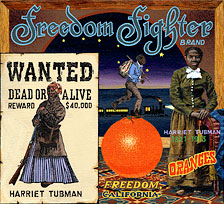
sl-sakoguchi-034-harriet-tubman-underground-nurse-spy-scout-40,000-reward-drinking-gourd-railroad

Tuesday, September 6, 2011

Alabama: Gee's Bend Quilters Collective History

The town’s women developed a distinctive, bold, and sophisticated quilting style based on traditional American (and African American) quilts, but with a geometric simplicity reminiscent of Amish quilts and modern art. The women of Gee’s Bend passed their skills and aesthetic down through at least six generations to the present. In 2002, the Museum of Fine Arts, Houston, in partnership with the nonprofit Tinwood Alliance, of Atlanta, presented an exhibition of seventy quilt masterpieces from the Bend.

The exhibition, entitled "The Quilts of Gee’s Bend," is accompanied by two companion books, The Quilts of Gee’s Bend, and the larger Gee’s Bend: The Women and Their Quilts, both published by Tinwood Media, as well as a documentary video on the Gee’s Bend quilters and a double-CD of Gee’s Bend gospel music from 1941 and 2002.
The town’s women developed a distinctive, bold, and sophisticated quilting style based on traditional American (and African American) quilts, but with a geometric simplicity reminiscent of Amish quilts and modern art. The women of Gee’s Bend passed their skills and aesthetic down through at least six generations to the present.
In 2002, the Museum of Fine Arts, Houston, in partnership with the nonprofit Tinwood Alliance, of Atlanta, presented an exhibition of seventy quilt masterpieces from the Bend. The exhibition, entitled "The Quilts of Gee’s Bend," is accompanied by two companion books, The Quilts of Gee’s Bend, and the larger Gee’s Bend: The Women and Their Quilts, both published by Tinwood Media, as well as a documentary video on the Gee’s Bend quilters and a double-CD of Gee’s Bend gospel music from 1941 and 2002.

The "Quilts of Gee’s Bend" exhibition has received tremendous international acclaim, beginning at its showing in Houston, then at the Whitney Museum of American Art in New York and the other museums...Art critics worldwide have compared the quilts to the works of important artists such as Henri Matisse and Paul Klee. The New York Times called the quilts "some of the most miraculous works of modern art America has produced." The Museum of Fine Arts, Houston, is currently preparing a second major museum exhibition and tour of Gee’s Bend quilts, to premiere in 2006.

In 2003, with assistance from the Tinwood organizations, all the living quilters of Gee’s Bend — more than fifty women — founded the Gee’s Bend Quilters Collective to serve as the exclusive means of selling and marketing the quilts being produced by the women of the Bend. The Collective is owned and operated by the women of Gee’s Bend.

Every quilt sold by the Gee’s Bend Quilt Collective is unique, individually produced, and authentic — each quilt is signed by the quilter and labeled with a serial number. Rennie Young Miller of Gee’s Bend is the Collective’s president. (source: The Quilts of Gee's Bend)

Tuesday, July 19, 2011

Gil Scott Heron - Washington D.C


Symbols of democracy, pinned up against the coast
Outhouse of bureaucracy, surrounded by a moat
Citizens of poverty are barely out of sight
Overlords escape in the evening with people of the night
Morning brings the tourists, peering eyes and rubber necks
To catch a glimpse of the cowboy making the world a nervous wreck
It’s a mass of irony for all the world to see
It’s the nation’s capital, it’s Washington D.C.

It’s the nation’s capital
It’s the nation’s capital, it’s Washington D.C.
(mmmm-hmmm)

May not have the glitter or the glamour of L.A.
May not have the history or the intrigue of Pompeii
But when it comes to making music, and sure enough making news
People who just don’t make sense and people making do
Seems a ball of contradictions, pulling different ways
Between the folks who come and go, and one’s who’ve got to stay
It’s a mass of irony for all the world to see
It’s the nation’s capital, it’s Washington D.C.

It’s the nation’s capital
It’s the nation’s capital, it’s Washington D.C.

Seems to me, it’s still in light time people knifed up on 14th street
Makes me feel it’s always the right time for them people showing up and coming clean
Did make the one seem kind of numb


Gil Scott Heron - Washington D.C

Friday, July 15, 2011

Betye Saar: The Liberation of Aunt Jemima


Betye Saar, "The Liberation of Aunt Jemima," 1972

"Unflattering images of African Americans have been common in popular culture over the past 150 years - for example, the pickaninny, Little Black Sambo, and Uncle Tom. Another is Aunt Jemima, a domestic servant whose title of 'aunt' was a commonly used term of subordination and familiarity for African American domestic servants, nannies, and maids. Aunt Jemima is a caricatured jolly, fat character who has been used recently to sell commercially prepared pancake mix. In the 1972 mixed-media piece 'The Liberation of Aunt Jemima,' Betye Saar used three versions of Aunt Jemima to question and turn around such images. The oldest version is the small image at the center, in which a cartooned Jemima hitches up a squalling child on her hip. In the background, the modern version shows a thinner Jemima with lighter skin, deemphasizing her Negroid features. The older one makes Jemima a caricature, while the new one implies she is more attractive if she appears less black.

"The middle Jemima is the largest figure and the most emphasized. Her checked and polka-dotted clothing is very bright and colorful. Her black skin makes her white eyes and teeth look like dots and checks, too. This Jemima holds a rifle and pistol as well as a broom. A black-power fist makes a strong silhouette shape in front of all the figures, introduing militant power to the image. The idea of Aunt Jemima, in any of its forms, can no longer seem innocuous. Saar enshrined these images in a shallow glass display box to make them venerable. Symmetry and pattern are strong visual elements." [source: Margaret Lazzari and  Dona Schlesier, "Exploring Art," p. 402. Belmont, CA: Thomson Wadsworth.]

Betye Saar: The Liberation of Aunt Jemima

Saturday, July 9, 2011

Degenerate Music

"Degenerate Music - a detailed statement by State Secretary Dr. Hans Severus Ziegler, general manager of the German National Theater in Weimar.
"
The Kampfbund für deutsche Kultur (KfDK, or Fighting League for German Culture) was founded in 1929 by Alfred Rosenberg, with the aim of promoting German culture while fighting the cultural threat of liberalism. Ironically, this organisation – best known for disrupting concerts and music classes, insulting and threatening artists, and distributing inflammatory and anti-Semitic pamphlets – was originally aimed at the nation’s elite. Hitler and other early Nazi leaders were searching for a way beyond mob-style violence, and decided to create a cultural organisation as a way to court the intelligentsia.

During the first years of its existence, the relatively small and regionally-organised KfdK attracted many intellectuals and, increasingly, musicians. With its conservative agenda of fighting ‘degenerative Jewish and Negro’ influences, it spent much energy promoting the ‘cleansing’ of museums, university faculties, and concert programmes of unwanted artists. In general, the KfdK appealed to radical nationalists and anti-Semites, to those who felt betrayed by defeat in World War I and by the Treaty of Versailles, and to those who felt outraged by the leftist, modernising and ‘cosmopolitan’ tendencies of the Weimar Republic.


The KfdK was initially not very aggressive, relying instead on lectures, intimidation and propaganda. After Hitler’s rise to power in 1933, it became increasingly violent, with the support of the Stormabteilung (SA, Storm Troopers, or brown shirts) changing both its techniques and its membership pool. The KfdK had its own orchestra, which was selected to perform a special concert for Hitler’s birthday. It also acquired control over the important music journal Die Musik, which gave it an official outlet for racist and nationalist opinions on music.
(http://holocaustmusic.ort.org/politics-and-propaganda/third-reich/kampfbund-fr-deutsch/)
Centre Section of the triptych Grosstadt, 1927-8, by Otto Dix (1891-1969). It is an evocation of the Gershwin (1898-1937) period - the Jazz Age. This age and the kind of music (Jazz) were condemned by the Nazis as decadent and racially degenerate
Indeed, the Nazis were so fearful of African and African-American culture (particularly jazz) that in 1930 a law was passed that was titled "Against Negro Culture." In other words, the Nazis were clearly aware of the potential for popular cultural forms to taint what they considered to be genuine Aryan culture—whether this taint was a result of marriage or of music. As a consequence, the Germans often conflated stereotypes of African-American musical performers with those of Jews and Africans into some of their most heinous propaganda pieces.
Two of the most infamous and well-known Nazi propaganda artworks were posters which advertised cultural events. In a poster advertising an exhibition of entartete musik (degenerate music), for example, the viewer is confronted with a dark-skinned man in a top hat with a large gold earring in his ear.
This distorted caricature of an African homosexual male in black face playing a saxophone has a Star of David clearly emblazoned on his lapel. To the National Socialists, the most polluting elements of modern culture were represented by this single individual. They were suggesting that anyone who listened to jazz (or enjoyed other forms of art that they judged to be degenerate) could be transformed into such a barbarous figure.

Nazi propaganda poster titled "LIBERATORS" that epitomizes many perennially-recurring themes of anti-Americanism, by the Dutch SS-Storm magazine that then belonged to a radical SS wing of the National Socialist Movement in the Netherlands (1944)
Toward the end of the war, the Nazis circulated posters in a somewhat desperate attempt to get their "white European brothers" to join their cause. In one infamous poster, the designer depicted a multi-armed monster clutching two white American women. Attached to his muscle-bound body are iconic references to the Ku Klux Klan, Judaism (the Star of David), boxing gloves, jazz dancing, and a lynching noose. At his middle is a sign that reads in English "Jitterbug—the Triumph of Civilization." This poster was directed at white European men, and it urged them to protect their wives and their culture against a coming invasion of primitive, inferior American men. As occurred in the poster that warned against jazz, this image conflated stereotypes of the Jew with that of the African in an attempt to frighten white (Aryan) Europe and America into joining their cause. The exaggerated racist stereotypes served to strengthen and amplify widely accepted attitudes regarding racial and ethnic superiority. With these images, the National Socialists were offering their justifications as to why certain groups should be feared and thus eliminated.
(http://www.enotes.com/genocide-encyclopedia/art-propaganda)

Wednesday, July 6, 2011

Southern Justice: Mississippi Murder by Norman Rockwell

Norman Rockwell: Southern Justice (a Mississippi Murder)

Norman Rockwell: a life By Laura P. Claridge states: "...Although Hulburt admired the preliminary oil sketch so much that he suggested publishing it, Rockwell insisted that the art director let him produce a finished painting as well. By the end of April, after Hulburt spent a few weeks deciding between the two renditions, he phoned Rockwell with the news that everyone at Look preferred the sketch, "quite a change," the illustrator notes in his calendar. For the first time in his career, both he and an art director agreed that the earlier oil sketch with its loose brushwork, delivered more impact than the finished oil, and so for the only time in Rockwell's career, the preliminary study was published while its completed counterpart was not.

Norman Rockwell: The Problem We All Live With

Southern Justice, a dramatic tableau of the Mississippi civil rights workers who were shot during the voting registration drive, appeared in Look on June 29, 1965. As he had with "The Problem We All Live With," Rockwell used the dramatic contrast of light and dark to further the theme of racial strife and potential harmony. The white shirt of the white man holding a dying black man contrasts not only with the slain worker's skin but with the bright blood splashed on the ground and covering the third participant. Painted in colors reminiscent of the old two-tone process --white, red and brown--the painting powerfully conveys the beauty of the ideals behind the ugly cost of their achievement. Rockwell "tried making [the] Civil Rights men heroic, influenced by Michel Angelo "as he had written in his calendar several months earlier."

Norman Rockwell: New Kids in the Neighborhood

Reactions among Rockwell's admirers has been mixed on the painting from its publication. Some believe the painting to be strained because, after all, this wasn't Rockwell's kind of thing, others find it masterful, a case of Rockwell finally applying his much-vaunted technique to a historically weighty subject. Even the working photos emphasize the new graphic realism for most settings, Rockwell preferred to use the natural light from his studio's large north window. But in both Southern Justice and the later New Kids in the Neighborhood, another racially themed painting, he now added floodlights to accentuate the contrast of light and dark, the artificial light heightening the sense of drams. (source: Google Books)

HOME

HOME
Click here to return to the US Slave Home Page