Showing posts with label Portuguese Slavery. Show all posts

Wednesday, April 3, 2013

Slave Life in Rio


Slave Auction, Rio de Janeiro, 1859-1861

Standing on a chair, the auctioneer dominates the scene while an enslaved woman with a child clinging to her arm is examined by a prospective buyer. Other Afro-Brazilians (slaves?) are also shown; various material goods, including household furniture and musical instruments, are apparently being sold at the same auction (see also Biard05). Biard, a French painter, lived in Brazil for two years, 1859-1861. His published account contains a number of images of slave life...


Returning from a Slave Sale, Rio de Janeiro, 1859-1861

The slave owner, leading his horse while smoking a cigar and carrying an umbrella, heads a group of four adults and one child. One of the men carries household goods, including a clock and a musical instrument while the two women, one holding onto a child, are behind; bringing up the rear is an enslaved (?) man who appears to be guarding the newly-bought slaves. The material goods shown suggest that the auction was not only for the purchase of slaves but household items as well (see also Biard04). Biard, a French painter, lived in Brazil for two years, 1859-1861.

Tuesday, March 20, 2012

The Story of The Legendary Icon Anastacia: Escrava Anastacia


Editor's note:  This story comes from the website, Artworks By Matt Branson. Finding Anastacia's story in English has been a challenge, but this author seems to be from the UK and has the essence of the story correct (my Portuguese is sketchy at best, but from what I've been able to translate his version of the story rings true).  I've seen this iconic image of the cruelties of slavery, but I haven't, until this day, been able to locate the backstory of the masked woman.  

From my understanding and research, it appears that the Portuguese/Brazilian slave holders possessed this strange propensity to mask their enslaved population.  One can just imagine the agony of wearing an iron bridle in the subtropic heat, day in and day out.  The utter misery and torment of enslavement coupled with an unbearable  torture devise like the "dirt eating mask" must have yielded untold suffering for those wearing these vile devices.  Add on to that the burdensome iron slave collar with prongs for extra torture, along with enslavement in perpetuity and the hopeless tyranny of enslavement seems too extreme to wrap your mind around.--Ron Edwards, US Slave Blog


Escrava Anastacia

So, on with the story from Matt Branson:  "I had lived in Rio De Janero for a few years. One day while out down town, I came across a little head of a black girl wearing an iron mask. I had already collected quite a few strange looking statues and thought she would fit in just fine with the rest of them. She pecked my curiosity and I wanted to know more about her."

The story I discovered concerning this new, small statue, was about a child named Anastacia. A black female slave brought from the west coast of Africa to Brazil. Her mother had been forcibly taken by her white owner for his physical pleasures. A child was conceived, the first black child to be born with blue eyes. The cruelty and guilt of this plantation owner drove him to have the baby sent far away, concealing from his wife his indiscretion as well as his violence.


"A man I had met in Rio first told me the tale of Anastacia and of the church in which her image is honored. The truth is that little remains to prove her existence. Two accounts exist, the one above and the following narrative, both of which explain my interest in this amazing woman. My experiences in life, and particularly in Brazil, leads me to believe she truly was a real person. " -MATTHEW BRANSON The Story of Anastacia - The Slave Girl

Based on oral tradition and translated from a Brazilian website Worshipped in Brazil as a saint and heroine, Anastacia is considered one of the most important woman in black history within the culture of Rio de Janeiro. "Her story still has the power to move us to awe and compassion and for that reason alone, I want to make her real to those that don't know about her."


Escrava Anastacia

Anastacia's birth is linked to the tale of Delminda. Some say Delminda was from the Bantu tribe (originating in about 2,000 B.C.E. in southern Nigeria and Cameroon), a daughter of the royal family of Galanga brought to Brazil in 1740 with a cargo of 112 slaves. One version of the story is as follows. Delminda was extremely pretty. She was sold in the harbour by Antonio Rodrigues Velho. She had been raped by a white man and was sold pregnant to Joaquina Pompeu. Delminda gave birth that same year on the 5th March to the blue eyed Anastacia. She was the first black girl with blue eyes in Brazil. It is at this point the two stories seem to merge. Whether or not she was separated from her mother or remained with Delminda, all seem to agree on what comes next. As she grew up Anasatcia became the obsession of the owner's son, Joaquin Antonio.


Very beautiful, It is said that all the white women around were jealous of her, so encouraged Joaquin to make her wear the slave mask. As a punishment for repeatedly refusing his advances, he raped her and condemned her to wear the iron mask for the rest of her life, only removing it once a day to eat. She lived for some years before the toxicity of the metal from the mask became poisonous.

Some accounts claim she was performing miracles toward the end of her life. It became gossip amongst the poor that she could heal because she had found it in her heart to forgive the torture she had suffered, and that she even healed her owner's son of some disease. At that moment she became a saint for many of the poor.


Some continue today petitioning Rome, to have her canonized as St. Anastacia of Rio. There is a statue and a place of worship in Vas Lobo, where pilgrims flock to worship her. She has more than twenty-eight million followers, though I was surprised to find that most of the Brazilian's I have met have never heard of her.


She is exclusive to the poor of Rio and the descendants of slaves. Some link her image with a number of paintings by Etienne Victor Arago (b. 1755 d. 1855), a French watercolourist who traveled in Brazil sometime between 1817-1820. His known works portrayed gold mining slaves who were also forced to wear iron masks, so as not to hide or swallow gold nuggets while they were digging.

She died in Rio after years of agony, her remains were housed in the Church of Rosario, in downtown Rio, but disappeared after a fire. Anastacia became a religious myth, performing miracles, even until today. Many people continue to pray to her when they are sick. Then they are healed.

Portrait - Face -  Painting - Punishment for Slaves 1839
Punishment for slaves. Painting of African person with neck shackled and mouth muzzled. Jacques Etienne Arago. Castigo de Escravos, 1839. English: Punishiment for slaves. Português: Castigo de Escravo. Museu Afro Brasil (São Paulo).

Her history was miraculously recovered in 1968, when an exhibition to celebrate 90 years of the abolition of slavery was held in the Church of Rosario. In the back of the church was found a portrait of her by Arago. "As you can see, there are a few different accounts of her existence, of Anastacia, the slave girl. She would have been forgotten entirely if it hadn't been for a portrait by Arago.

Mystery is part of her story as it is part of the life of this French painter who sailed the seas between Australia and South America. There are conflicting tales as to whether or not Arago is buried in Paris or in Rio itself.


Human Rights are for all of us and slavery is not a condition for humanity. I continuously lived in Brazil from 1985 to 1992. Around 1987, a television news broadcast in Rio said authorities had found a farmer in the middle of nowhere in rural Brazil, who operated his farm with all his workers in chains. He repeatedly advertised jobs through the press in Sao Paulo and when anyone arrived to work, he made a slave of them, one-hundred and ten years after the abolition of slavery. How can we be so unconscious as to not know about these things? How can we be apathetic to the conditions of others? I would like to put Anastacia into the history books, in Brazil and everywhere else. She represents the suffering of people that have been forgotten and are still being ignored today. I hope you see my point of view, and can appreciate my art, for her sake.

It wasn't until years later, that I discovered the meaning of the name Anastacia -- it means "Resurrection". (source: http://www.mattbranson.co.uk/page4.htm)


Monday, March 19, 2012

Manila The African Money Of The Slave Trade


MANILLAS: AFRICAN BRACELET MONEY

Copper was the "red gold" of Africa and had been both mined there and traded across the Sahara by Italian and Arab merchants. The early Portuguese explorers of the 1470s observed that copper bracelets and legbands were the principal money all along the west African coast. They were usually worn by women to display their husband's wealth. The Portuguese crown contracted with manufacturers in Antwerp and elsewhere to produce crescent rings with flared ends of wearable size which came to be called "manilla," after the Latin manus (hand) or from monilia, plural of monile (necklace).

While copper bracelets dating prior to 1600 AD which likely had some exchange function continue to be excavated around Jenne-Jeno and related sites, we can only guess today at what prototypes may have inspired the distinctive flare-ended crescent shape. One theory is that Europeans copied a splayed-end raffia cloth bracelet worn by women, another that the well-known Yoruba Mondua with its bulbous ends inspired the manilla shape. Much closer in form to modern manillas, however, is this type, excavated at Igbo-Ukwu. In "Die sog. Geldeifen aus Benin," Der Primitivgeldsammler #28/1, p.29-35, Rolf Denk summarizes what is known about heavy, faceted pieces with enlarged ends such as this one (25cm across and 4.5cm gauge) from the Museum für Volkerkunde in Vienna, which may predate European manillas.

PORTUGUESE MANILLAS (TACOIS).  Late Schetz Type(?), ca. 1524 Brass, slightly flared ends, average 306gms, 103 x 87mm size, and gauge increasing from 12mm at center to 22mm at ends, giving a "flare ratio" of 1.86. Found in ship wrecks, and best studied from a 1524 wreck in Guetaria Bay, Spain.

Records of a contract between the Portuguese government and Erasmus Schetz of Antwerp, who supplied the Portuguese factory at Mina with as many as 150,000 manillas per year, are widely quoted. The standard in 1529 was supposedly about 240m long, about 13m gauge, weighing 600 gram. However, no examples of torque-shaped bracelets in this weight range are known today, and a wreck dated to 1524 carried manillas of typical form but only slightly flared, averaging 306 grams. Do these heavy Schetz manillas even exist today, and if so, what do they look like? Duchateau, Royal Art of Benin, page 15 shows a plaque with a European holding two pieces with barely flared ends whose apparent size could match these specifications, while page 60 illustrates five pieces of conventional form, but without scale. Then, too, the Dutch participated in the trade. Did they get their manillas from nearby Antweerp as well, or did they use something different still?

Manillas from the 1524 wreck recently recovered from the Guetaria Bay off the Basque coast of Spain are described in detail in Der Primitivgeldsammler #26/1 p.9-12 (Manuel Artica). These brass manillas average 306gms, 103 x 87mm size, and gauge increasing from 12mm at center to 22mm at ends, giving a "flare ratio" of 1.86. The shape is thus more similar to the familiar French Popo manilla than the British, but even less pronounced in the flare. There was a falling out between the Portuguese and their supplier Schetz, with 1547 given as the date they switched their contracts to Cristoff Fugger. If correct, the Guetaria Bay finds would thus be Schetz products. The new Fugger pieces were called tacoais with different standards, of 284gm (Mina) and 241gm (Guinea), for the different trading areas.

BRITISH MANILLAS Birmingham

Four types of manillas lighter than the Guetaria Bay specimens are known. Their average weights match the Fuggers' Guinea specifications with two specimens (281, 294 grams) in the Mina range. Possibly earliest is the least flared, #937 with a modest 1.96 flare ratio and average weight of 241gm. Opitz p.213 upper left is likely this type. Other types with visibly greater end flares (#939-941) range from 226 to 294 grams, though to date few specimens have been studied. The earliest British manillas have flare ratios approaching 3.0. The Portuguese called the Fugger manillas tacois. An African name for the more flared Guinea pieces, at least, is Mkporo. As the manilla shrank in size over the centuries, the Mkporo were promoted from everyday trade use to burial money and a standard of wealth.

Although Gold was the primary and abiding merchandise sought by the Portuguese, by the early 16th century they were participating in the slave trade for bearers to carry manillas to Africa's interior, and gradually Manillas became the principal money of this trade. By the end of the 1500s the Portuguese had been shouldered aside by the British, French, and Dutch, all of whom had labor-intensive plantations in the West Indies, and later by the Americans whose southern states were tied to a cotton economy . A typical voyage took manillas and utilitarian brass objects such as pans and basins to West Africa, then slaves to America, and cotton back to the mills of Europe.

FRENCH (POPO) MANILLA Nantes

Early in the 18th century Bristol, and then Birmingham, became the most significant European brass manufacturing city. It is likely that most types of brass manillas were made there, including the "middle period" Nkobnkob-Onoudu whose weight apparently decreased over time, and the still lighter "late period" types such as Okpoho and those salvaged from the Duoro wreck of 1843. Among the late period types, specimen weights overlap type distinctions suggesting contemporary manufacture rather than a progression of types. The Popos, whose weight distribution places them at the transition point between Nkobnkob and Onoudu, were also made in Nantes, France, and possibly Birmingham as well. They are wider than the Birmingham types and have a gradual, rather than sudden, flare to the ends.

The Africans of each region had names for each variety of manilla, probably varying locally. They valued them differently, and were notoriously particular about the types they would accept. The price of a slave, expressed in manillas, varied considerably according to time, place, and the specific type of manilla offered. Internally, manillas were the first true general-purpose currency known in west Africa, being used for ordinary market purchases, bride price, payment of fines, compensation of diviners, and for the needs of the next world, as burial money. Cowrie shells, imported from Melanesia and valued at a small fraction of a manilla, were used for small purchases. In regions outside coastal west Africa and the Niger river a variety of other currencies, such as bracelets of more complex native design, iron units often derived from tools, copper rods, themselves often bent into bracelets, and the well-known Handa (Katanga cross) all served as special-purpose monies.

AFRICAN-MADE TRADE MANILLAS

As the slave trade wound down in the 19th century so did manilla production, which was already becoming unprofitable. By the 1890s their use in the export economy centered around the palm-oil trade. Although manillas were legal tender, they floated against British and French West African currencies and the palm-oil trading companies manipulated their value to advantage during the market season. Probably for this reason the British undertook a major recall dubbed "operation manilla" in 1948 to replace them with British West African currency at a rate of 3 Pence for the commonest type. The campaign was largely successful and over 32 million pieces were bought up and resold as scrap. The manilla, a lingering reminder of the slave trade, ceased to be legal tender in British West Africa on April 1, 1949.

An unanswered question is whether "manillas" were made in Africa by native smiths during the period when European types were imported. It is hard to believe that no such attempts were made. Offered for sale below and linked to scans are obvious counterfeits, but such pieces made of lead, or underweight pieces in impure brass are rather uncommon and it is unclear where they were made. More interesting is the group of horseshoe-shaped pieces as well as gleanings from several years' worth of poring over Africa Traders' stocks, looking for pieces with flared ends within the known manilla weight range. Are they proto-manillas, early European manillas, or African-made pieces during the period of European importation which - deliberately or coincidentally - resemble the European type? All are copper, rough with verdigris indicating some age.


Many other things are called manillas by authors and collectors. Commonly available are many distinctive regional bracelet forms of copper, brass, nickel, and iron made in Africa in the 19th-20th centuries with varying monetary functions and ranges of use. Legbands, collars, and coiled forms made of Calabar rod. Those with flared ends are often called manillas. Other flare-end forms of large size, called "King" and "Queen" manillas, are ceremonial rather than trade manillas, and from Zaire come large copper crescents in several distinctive shapes, sometimes including flared ends, which are likely forms of bullion storage (like the Katanga cross).

A Katanga cross, also called a handa, is a cast copper cross which was once used as a form of currency in parts of what is now the Democratic Republic of the Congo (DRC) in the 19th and early 20th centuries.
For more depth on bracelet monies in general see InfoSheet 62. There is a remarkable lack of academic interest in the tangible objects of the slave trade and African monies in general. Artica's Der Primitivgeldsammler bibliography references a to-be-published article in "Gaceta Numismatica" (Barcelona) by A. Benito and M. Ibanez. "Copper to Africa: Evidence for the international trade in metal with Africa" by P. T. Craddock and D. R.. Hook, p. 181-193 of British Museum Occasional Paper 109 (1995), notes that the British Museum is beginning to keep samples of trade goods found on dateable wrecks, but so far has manillas only from the Duoro of 1843, and The Charles of 1684. The Duoro pieces are well known, and I am trying to get a picture of the earlier type. Another well-researched article, which I have yet to digest, is R. L.. Leonard's "Manillas - Money of West Africa" published by the Chicago Coin Club in 1998. (source: Coins.com)

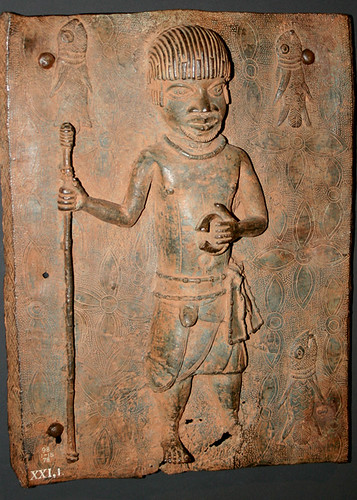
Benin bronze: Foreign trader surrounded by manillas. Photo: Ursula Kampmann.

African Ceremonial Manilas West Africa, large Mondua copper manilla

Manillas, alloyed copper in the shape of a bangle, are among the oldest forms of African gold ingots. Our piece is a Mondua manilla, a copper ring ingot from the province of Sokoto in Nigeria.

The first European manillas were transported by Portuguese boats to Africa, where traders exchanged them mainly for slaves and African pepper. The first written sources on this actually exist from the 14th/15th centuries. We know from one boat, which put into Benin in 1515 and had onloaded 13,000 manillas. No less interesting is the fact that in 1548 the agent of the king of Portugal entered into a contract for the delivery of brass manillas according to the instructions drawn up with the Fugger company.


We have, mainly from the kingdom of Benin, informative sources on how the exchange of goods between the Portuguese and the king's house was handled. The trade was a monopoly of the Oba, the ruler. The king decided to whom the market was to be opened and granted to deserving members of the king's house the privilege of trading with the Europeans. According to the king's instructions the copper that was bought was mostly turned into splendid works of art, which we know nowadays as Benin bronzes.

As so often happens, the competition among the importers undermined the value of the imported goods. It came to a kind of inflation: the price of a slave rose from 12 to 15 manillas at the beginning of the 16th century in 1517.

At the beginning of the 18th century this currency had outstripped itself in Benin. Nobody there was interested in it any longer, so that a whole load of manillas had to be sent away as unsaleable. (source: Coins Weekly)

Wednesday, February 29, 2012

Amazon Rubber Slavery


New York Times, "Empire of Savagery in the Amazon," by Greg Grandin, 12 February 2010 -- The 19th-century doctrine of progress held slavery and capitalism to be incompatible. Coercion, liberals believed, violated the ideals of natural rights and free labor. Wage work, Marxists thought, was more profitable than forced work, and that alone would doom slavery. Then in 1904, nearly four decades after Appomattox, Roger Casement, an Irish-born career diplomat in the British Foreign Office, wrote his Congo report, revealing that King Leopold of Belgium had enriched himself by presiding over a rubber trade founded on pure cruelty. “What has civilization itself been to them?” Casement asked of Leopold’s Congolese victims, 10 million of whom, by some estimates, had perished in but two decades. He himself had the answer: “A thing of horror.”


“The Devil and Mr. Casement,” by Jordan Goodman, the author of several works of history, reconstructs the Casement investigation in the Putumayo region of the Amazon rain forest that followed the Congo report. There, the Peruvian Julio César Arana ruled over a rubber empire of 10,000 square miles, and from 1910 to 1913, Casement exhausted himself trying to force the British government to take action against Arana and his London-incorporated Peruvian Amazon Company. He twice traveled to the Amazon, collecting evi­dence of whipping, torture, mass rape, mutilation, executions and the hunting of the region’s Indians, whose population Casement calculated had fallen to 8,000 in 1911 from 50,000 in 1906.


Goodman’s book adds to Casement’s reputation as a pioneer of the human rights movement’s tactics, including the on-the-spot investigation, the gathering of victims’ testimony and the leveraging of public outrage to spur reform. Casement was one of the first to use the phrase “crime against humanity,” and he judged Arana to be guilty of “not merely slavery but extermination” — what later would be called genocide.


But Casement’s moral trajectory ran opposite to that of many modern human rights activists. France’s current foreign minister, Bernard Kouchner, for example, dropped his youthful support for national liberation movements to embrace what some have criticized as “humanitarian imperialism.” Casement tried at first to use the services of a foreign office to ease suffering. Yet he veered off what he called the “high road to being a regular Imperialist jingo.” His time in Congo and the Amazon deepened his sense of anti­colonial solidarity. “I was looking at this tragedy,” he said of Congolese slavery, “with the eyes of another race” — the Irish — “a people once hunted themselves.” Knighted in 1911 for his humanitarian work, he was hanged by the British five years later for conspiring with the Germans on behalf of Irish independence.


Casement’s execution is not the climax of Goodman’s story, because this book doesn’t have a climax. It tapers off without resolution. The British directors of Arana’s company are interrogated by members of Parliament. Reports are issued, sermons are preached, politicians are outraged. Arana appears before Parliament’s committee on the Putumayo, after which he boards a steamer back to Peru untouched. The reader is left to ponder the fate of his indigenous victims.


This is an apt ending to a fine and meticulous book, for a kind of slavery still remains in force in the Amazon. Thousands of workers, for instance, trapped in conditions nearly as dismal as those documented a century ago in the Putumayo, make the charcoal used to forge pig iron, which is then purchased by international corporations to produce the steel used in everyday products, including popular makes of cars.


Arana ultimately lost his company and died broke. Yet the devil continues to get the better of Mr. Casement. (http://www.nytimes.com/2010/02/14/books/review/Grandin-t.html)

African Colonization: Serial Enslavers


As reported by the BBC "Slavery and the 'Scramble for Africa'" by Dr Saul David on 17 February 2011 -- What were the motives behind the European colonization of Africa at the end of the 19th century? Did the stamping out of slavery really play a part?


European colonisation

Until the 19th century, Britain and the other European powers confined their imperial ambitions in Africa to the odd coastal outpost from which they could exert their economic and military influence. British activity on the West African coast was centred around the lucrative slave trade.

Between 1562 and 1807, when the slave trade was abolished, British ships carried up to three million people into slavery in the Americas. In total, European ships took more than 11 million people into slavery from the West African coast, and European traders grew rich on the profits while the population of Africa's west coast was devastated.

As late as the 1870s, only 10% of the continent was under direct European control, with Algeria held by France, the Cape Colony and Natal (both in modern South Africa) by Britain, and Angola by Portugal. And yet by 1900, European nations had added almost 10 million square miles of Africa - one-fifth of the land mass of the globe - to their overseas colonial possessions. Europeans ruled more than 90% of the African continent.

One of the chief justifications for this so-called 'scramble for Africa' was a desire to stamp out slavery once and for all. Shortly before his death in May 1873 at Ilala in central Africa, the celebrated missionary-explorer David Livingstone had called for a worldwide crusade to defeat the slave trade controlled by Arabs in East Africa, that was laying waste the heart of the continent.

The only way to liberate Africa, believed Livingstone, was to introduce the 'three Cs': commerce, Christianity and civilization.


The Berlin Conference-- This was a period in history when few Europeans doubted their innate superiority over the 'lesser' races of the world.

The theory that all the peoples of Europe belonged to one white race which originated in the Caucasus (hence the term 'Caucasian') was first postulated at the turn of the 19th century by a German professor of ethnology called Johann Blumenbach.

Blumenbach's colour-coded classification of races - white, brown, yellow, black and red - was later refined by a French ethnologist, Joseph-Arthur Gobineau, to include a complete racial hierarchy with white-skinned people of European origin at the top.

Britons like Livingstone felt they had a duty to 'civilise' Africa.

Such pseudo-scientific theories were widely accepted at the time and motivated Britons like Livingstone to feel they had a duty to 'civilise' Africa.

The Berlin Conference of 1884-1885, convened by Otto von Bismarck to discuss the future of Africa, had the stamping out slavery high on the agenda. The Berlin Act of 1885, signed by the 13 European powers attending the conference, included a resolution to 'help in suppressing slavery'.

In truth, the strategic and economic objectives of the colonial powers, such as protecting old markets and exploiting new ones, were far more important.

The Berlin Conference began the process of carving up Africa, paying no attention to local culture or ethnic groups, and leaving people from the same tribe on separate sides of European-imposed borders.


British interests

Britain was primarily concerned with maintaining its lines of communication with India, hence its interest in Egypt and South Africa. But once these two areas were secure, imperialist adventurers like Cecil Rhodes encouraged the acquisition of further territory with the intention of establishing a Cape-to-Cairo railway.

Britain was also interested in the commercial potential of mineral-rich territories like the Transvaal, where gold was discovered in the mid-1880s, and in preventing other European powers, particularly Germany and France, from muscling into areas they considered within their 'sphere of influence'.

Tens of thousands of Herero men, women and children fell victim to von Trotha's infamous extermination order.

As a result, during the last 20 years of the 19th century, Britain occupied or annexed Egypt, the Sudan, British East Africa (Kenya and Uganda), British Somaliland, Southern and Northern Rhodesia (Zimbabwe and Zambia), Bechuanaland (Botswana), Orange Free State and the Transvaal (South Africa), Gambia, Sierra Leone, Nigeria, British Gold Coast (Ghana) and Nyasaland (Malawi). These countries accounted for more than 30% of Africa's population.


The other chief colonisers were France, Germany, Belgium, Italy, Portugal and Spain.

Germany had only been unified in 1871 and so was a late starter in imperial terms. Its first acquisition in 1884 was German South-West Africa (Namibia), which at the time was peopled by two semi-nomadic tribes, the Herero of the arid central plateau and the Nama of the still more arid steppes to the south.

When the two tribes went to war over cattle grazing, German traders and missionaries persuaded their government to intervene and fill the political vacuum.

A later Herero rebellion in 1904, provoked by the brutality of the German settlers, was put down by General Lothar von Trotha with savage efficiency, and tens of thousands of Herero men, women and children fell victim to his infamous 'Vernichtungsbefehl' (extermination order).

'Spirit of Berlin'

The philanthropic 'spirit of Berlin', however, was not entirely hollow. Once it became known that slavery was alive and well in the Congo, which was run as a personal fiefdom of Leopold, King of Belgium, an international anti-slavery conference was held in Brussels in 1889-1890.

By taking the women of Congolese villages hostage, Leopold had turned the men into forced labourers.

The man who exposed the existence of slavery in Leopold's Congo was a French missionary to Africa called Cardinal Charles Lavigerie. During a sermon at St Sulpice in Paris in 1888, Lavigerie had shocked his audience by describing the horrors of the Congo slave trade: villages surrounded and burnt; men captured and yoked together; women and children penned like cattle in the slave markets.

The upshot of the Brussels conference was that Leopold cynically agreed to stamp out Arab slavery in return for the right to tax imports. He thereby overturned one of the key resolutions of the Act of Berlin, which had guaranteed free trade for the region.

But while Leopold made all the right noises, his agents in the Congo used forced labour (slaves in all but name) to extract rubber, his single most profitable export. By 1902, rubber sales had risen 15 times in eight years, and were valued at 41 million francs (£1.64 million).


By taking the women of Congolese villages hostage, Leopold had turned the men into forced labourers, with a monthly quota of wild rubber to collect from the rain forest. The system was harsh. Many hostages starved to death and many male forced labourers were worked to death.

More people were killed as rebellions were brutally crushed. Demographers today estimate that the population of the Congo fell roughly by half over the 40-year period beginning in around 1880.

The truth behind the Congo's rubber trade - 'legalised robbery enforced by violence' - was finally exposed by Edmond Morel, an Anglo-French ex-shipping clerk, who wrote a series of accusatory articles in 'The Speaker' in 1900.

By arguing that Leopold's illegal state monopoly was robbing British merchants as well as African peasants, Morel was able to enlist the support of both businessmen and humanitarians. A British consul, Roger Casement, was sent to investigate, and the publication of his damning report in 1904 was, for Leopold, the beginning of the end.

In 1908, in return for £3.8 million, Leopold handed over control of the Congo to the Belgian state. But even then, the forced labour system continued. It took a different form during World War One, when tens of thousands of Congolese were conscripted as porters for the Belgian army.

The forced labour system significantly changed only in the early 1920s, when Belgian colonial authorities realised the population was dropping so rapidly that they soon might have no labour force left.

An end to African slavery?

The signatories of the General Act of the Brussels Conference of 1889-1890 had declared an intention to put an end to the traffic of African slaves. This was extended, by the Convention of St-Germain-en-Laye in 1919, to include the complete suppression of slavery in all its forms and of the slave trade by land and sea.

Under all the colonial powers, forced labour remained in place into the 1940s.

In September 1926, the International Slavery Convention was signed at Geneva under the auspices of the League of Nations 'to find a means of giving practical effect throughout the world to such intentions'.

It defined a slave as a 'person over whom any or all of the powers attaching to the right of ownership are exercised', and undertook 'to bring about, progressively and as soon as possible, the complete abolition of slavery in all its forms'.

But this was never applied against the practice of forced labour in colonial Africa, for example, requiring a village to provide men to work on roads and other public works. Under all the colonial powers, forced labour of one kind or another remained in place into the 1940s, and the imposition of taxes forced people into low-paid mining, industry or agribusiness jobs when they might otherwise have remained farmers.


The first practical consequence of the convention was that Ethiopia became the last African state to abolish slavery in 1932. All colonial regimes had long since done the same. Yet even today slavery is not unknown in Africa, particularly in countries such as the Sudan where law and order are often absent.

Nor have the colonists ever really gone away. White-owned businesses still dominate the mining of Africa's most valuable natural resources - particularly gold and diamonds - and in the eyes of some the continent has never stopped being plundered.
(source: BBC)

Sunday, February 26, 2012

Brazil Diamond Slavery

With mine officials nearby, Brazilian slaves wash the gravel from riverbeds to concentrate the denser minerals in which diamonds are found. Dependency on slave labor was an unfortunate part of early diamond mining in Brazil. "Diamond washing in Brazil." Published in 1884.

When diamonds were discovered by alluvial gold miners in Brazil in 1725, Indian diamond sources were near exhaustion and European demand for the stone continued unabated. From 1730 to 1870 Brazil was the world's major source of diamonds. Indeed, mining in Brazil was so active that by the late 1730s production far exceeded demand, and diamond prices fell by as much as 70%. Beginning in 1850, production rose again, following the discovery of rich deposits in Bahia, but after 1861 it rapidly declined as deposits were depleted, leading to a great shortage of rough diamonds in the European cutting centers in the late 1860s.  (source: American Museum of Natural History)
Slaves Diamond Mining in the Serro Frio Region, Minas Gerais, Brazil 


"Diamonds in Brazil"-- Until 1725, India was the world's only producer of diamonds. In that year, Brazilian natives tasked with washing sand as part of the gold panning process discovered the precious stones, prompting the Portuguese government to move the gold mining industry out en masse to make way for diamonds.

J. Willard Hershey, writing in his comprehensive history The Book of Diamonds, tells us that for the first few years after diamonds were discovered in Brazil, the Portuguese government allowed a few plantation owners to work the land for diamonds using slave labor. By the 1740s, the system had changed and contractors – usually in charge of teams of some 600 slaves – would receive exclusive rights to the diamonds in the land they were working. Most contractors sold the majority of their diamonds to the Portuguese crown.


In the second half of the 18th century, more diamond discoveries extended Brazil's diamond fields from Diamantia (formerly Tejuco, where the stones were first found) to Bahia in the north, Goyaz in the west, and Matto Grasso in the jungle.

As Brazilian diamonds began to infiltrate the European market, owners of Indian diamonds feared a glut that would devalue their own stones and began to spread erroneous rumors that Brazilian diamonds were inferior in quality. In fact, Brazilian diamonds – while small, averaging 1/4 to 1/2 carats – can match the quality of diamonds found anywhere, and have often been noted for their rich color. Brazil is also the only known source for black or carbonado diamonds.

Diamond Mining, Brazil, ca. 1770s

In 1772, the Portuguese government took over the diamond mining sector from the contractors, to no great success. In 1822, Brazil gained its independence and anyone who could afford to pay taxes was allowed to mine for diamonds. Slavery, however, was still legal and slaves did nearly all the actual diamond mining. Any slave who found a diamond was required to alert the overseer immediately. If the diamond was over 17 carats, the slave was handed not only his freedom, but the right to hunt for diamonds for himself. Slaves who found smaller diamonds were more modestly rewarded.

Slaves washing diamonds, Brazil

In 1818, Brazil's total diamond production stood at 3,240,000 carats. By 1850, the South American nation had produced some 10,000,000 carats. But in succeeding years, diamond production waned, and in 2009, according to the Kimberley Process Annual Global Summary, Brazil produced only 21,000 carats of rough diamonds valued at $830,000. (source: http://www.avipaz.com/DiamondsBrazil)

Wednesday, January 11, 2012

Cemetery for New African Slaves Unearthed in Rio, Brazil

According to the Hindu Times, on 23 Decemberr 2011, "," by Tom Phillips: Locals called it the cemetery of the new blacks, but it was a cemetery only in name. Devoid of headstones, wreaths or tearful mourners, this squalid harbour side burial ground was the final resting place for thousands of Africans shipped into slavery.

The new world greeted them with a lonely death in an unfamiliar land.

For decades the cemetery and those buried there between 1760 and 1830 were forgotten, hidden under layer after layer of urban development.

But 15 years after the cemetery's fortuitous discovery — during the renovation of Petrucio and Ana de la Merced Guimaraes's family home when builders unearthed a series of muddy skeletons — academics now believe they have evidence of the true reach of the slave trade.

The study of teeth from 30 partial skeletons has hinted that slaves arriving in Rio — many of whom were sold on to work in coffee and sugar plantations or gold mines — came from a much wider geographical region than once thought.


The figure is three million

Archaeologists and anthropologists studying bone and tooth fragments are shedding light on the horrors of a trade that saw at least three million slaves shipped from Africa to Brazil between 1550 and 1888, when the practice was officially abolished.

“It was ugly: a dump into which bodies were thrown and burned,” said Sheila Mendonca de Souza, a bio-archaeologist studying the cemetery in Rio de Janeiro, once one of the busiest slave ports in the Americas.

“People weren't buried in tombs, they were tossed away into mass graves.” Della Cook, a biological anthropologist from the University of Indiana working on the burial ground, said: “There is a lot of scholarship on slave cemeteries and the slave trade in North America but very little in South America, which is one of the things that makes this site fascinating.


Isotope analysis

“We have historical records but we haven't been able to look before at the people themselves.” Using strontium isotope analyses of tooth enamel — a technique that helps detect where a person was raised and has previously been used on samples from burial sites in the Caribbean and Mexico — academics were able to confirm the large area from where the “new blacks” came.

“What we got was essentially the entire range of strontium isotope values,” said Cook. “It surprised us that the spectrum was so broad.” The results indicated that slavers had “waded way into the interior” of Africa rather than restricting their search to coastal areas, Cook added.

Mendonca, who works for the national school of public health in Rio, said: “We were not able to pinpoint a specific place ... but we confirmed the diversity of origin of those [slaves] who were arriving in Rio de Janeiro. They came both from the Atlantic coast and east coast.” A parallel study of cosmetic tooth modifications, common in some regions of Africa, also underlined the scope of the slave trade.


Most were young people

Mendonca said her team had found tooth markings indicating some of the slaves were native to what are now Sudan and Mozambique, in northeastern and southern Africa. Archaeologists believe as many as 20,000 slaves may have been buried at the cemetery, mostly men aged 18-25 who died during the gruelling journey to Brazil or shortly after arriving.

“The majority were very young, principally young boys and girls who would adapt better to captivity than older people,” said Mendonca.

The dire conditions of the slave market and port, close to the cemetery, were captured by British writer Maria Graham, following a visit in the early 1820s.

Rescued slaves; Dated 1869, this picture is a rare snapshot of the terrible slave trafficking. The emaciated boys sit on the lower deck of a Royal Navy ship apparently have been taken from a slave vessel trading illegally off the African coast. The captain had instructions not to return the slaves. (Pictures copyright National Archives and partners.)

“Almost every house in this very long street is a depot for slaves ... In some places the poor creatures were lying on mats, evidently too sick to sit up,” she wrote.

“The number of ships from Africa that I see constantly entering the harbour, and the multitudes that throng the slave-houses in this street, convince me that the importation must be very great. The ordinary proportion of deaths on the passage is, I am told, about one in five.” The three million slaves who made the journey were previously thought to have come only from what is now Nigeria and from the Portuguese colonies of Angola and Cape Verde.

Some fled, forming autonomous cities known as quilombos. Several of Rio de Janeiro's favelas — among them the Morro da Coroa, the Morro dos Prazeres and Pereirao — are thought to have begun life as quilombos.

Impact of 2016 Olympics

With Rio undergoing a facelift for the 2016 Olympics, some archaeological discoveries have been made as the city renovates its decrepit downtown port.

In early 2010 archaeologists unearthed what they believe to be the remains of Rio's Valongo slave port, through which tens of thousands of African slaves were shipped.

Experts hope advancing redevelopment projects will help them rescue further clues about the identities of Brazil's “new blacks”, who were buried not far from the Valongo dock.

“When you start messing around with the landscape these things will appear,” said Dr Ricardo Ventura Santos, a bio-anthropologist from Brazil's Oswaldo Cruz Foundation, who is coordinating the cemetery research team.

Cook said she hoped redevelopment would permit further excavation and the inclusion of places such as the slave burial ground on the city's tourist trail, creating a “monument to the African experience in Brazil.” The excavation of a Roman cemetery under London's Spitalfields market, during the 1990s, could serve as a model, she added.

“Rio has very little history of the slave trade for either Brazilians or external tourists,” she said. (source: The Hindu)
1


The New World Cemetaary for the Esclaves de Rio


Black slaves of different nation in Brazil circa 1830.

Tom Phillips of the Sidney Morning Herald reported "Cemetery sheds light on slavery," on 27 December 2011: RIO DE JANEIRO: Locals called it the cemetery of the new blacks, but it was a cemetery only in name. Devoid of headstones, wreaths or tearful mourners, this squalid harbourside burial ground was the final resting place for thousands of Africans shipped into slavery.

The New World greeted them with a lonely death in an unfamiliar land. For decades the cemetery and those buried there between 1760 and 1830 were forgotten, hidden under layer after layer of urban development.

But 15 years after the cemetery's discovery - when builders unearthed a series of muddy skeletons - academics now believe they have evidence of the true reach of the slave trade.


The study of teeth from 30 partial skeletons has hinted that slaves arriving in Rio - many of whom were sold on to work in coffee and sugar plantations or goldmines - came from a much wider geographical region than once thought.

Archaeologists and anthropologists studying bone and tooth fragments are shedding light on the horrors of a trade in which at least 3 million slaves were shipped from Africa to Brazil between 1550 and 1888, when the practice was abolished.


''It was ugly: a dump into which bodies were thrown and burnt,'' said Sheila Mendonca de Souza, a bio-archaeologist studying the cemetery in Rio de Janeiro, once one of the busiest slave ports in the Americas.


Using strontium isotope analyses of tooth enamel, academics were able to confirm the large area from where the ''new blacks'' came.

The results indicated that slavers had ''waded way into the interior'' of Africa instead of restricting their search to coastal areas, said Della Cook, a biological anthropologist from the University of Indiana.


A parallel study of cosmetic tooth modifications, common in some regions of Africa, also underlined the scope of the slave trade.

Dr Mendonca said her team had found tooth markings indicating some of the slaves were native to what are now Sudan and Mozambique, in north-eastern and southern Africa.


Archaeologists believe as many as 20,000 slaves may have been buried at the cemetery, mostly men between 18 and 25 years of age, who died during the gruelling journey to Brazil or shortly after arriving.

The 3 million slaves who made the journey were previously thought to have come only from what is now Nigeria and from the Portuguese colonies of Angola and Cape Verde. (source: Sidney Morning Herlad)

HOME

HOME
Click here to return to the US Slave Home Page