Showing posts with label African History. Show all posts

Sunday, May 20, 2012

Real Crisis In Congo: Rwanda, Uganda


Betsy Pisik writes in the Washington Times, "Congo’s mineral wealth lures exploiters," on 8 September 2009 --The Democratic Republic of the Congo holds a treasure trove of valuable minerals that are at once the country’s greatest blessing and most enduring curse.

Second only to South Africa in mineral wealth, Congo has attracted rapacious exploiters from 19th-century Belgian colonialists to foreign-backed rebel groups.

Minerals help fuel vicious fighting in eastern Congo that has killed more than five million people in the past decade — the bloodiest conflict since World War II.

In an effort to stem the fighting, nongovernmental organizations and Africa activists are campaigning for legislation against the sale of “conflict minerals,” modeling their efforts on those against the illegal diamond trade that funded civil war in the West African country of Sierra Leone in the past decade.

At the Belgian Royal Institute of Natural Sciences in Brussels, about a thousand mineral varieties from Congo are represented, classified according to composition, color and radiance.


In 1885, Belgium’s King Leopold seized the vast territory — which if superimposed on a map of the United States, would stretch from the Atlantic Ocean to the Mississippi River — as a personal fiefdom and private jewel box.

More recently, Congo’s small but powerful eastern neighbor, Rwanda, has become entangled in the mineral grab. Rwandan Hutus who fled their homeland in 1994 after committing genocide against Rwandan Tutsis have morphed into the Democratic Forces for the Liberation of Rwanda, or FDLR, which finances itself by plundering Congo’s minerals.

Congo’s mineral resources are most plentiful in a north-south belt stretching from Katanga province in the southeast to Equateur and Orientale in the north and in North and South Kivu provinces in the east.


Minerals are extracted in part by forced labor. Trading houses based in the Kivus move the minerals through Rwanda and Burundi and on to Western or Asian buyers.

The mining takes place amid civilian bloodshed, pillage, rape and other cruelties.

Congo’s national army has become a partner in perfidy and cooperates in the illicit trade, according to John Prendergast, an Africa specialist and a co-founder of the Enough Project at the Center of American Progress, a Washington think tank.

Mr. Prendergast is focusing on minerals in high demand by the modern electronics industry. They include tin, tantalum and tungsten, which are used in cell phones, iPods and digital cameras.

The trade, he says, is worth more than $100 million annually. Congo also has gold mines that yield additional millions, he says.

Following the model of the “blood diamonds” campaign for Sierra Leone, Mr. Prendergast is encouraging Congress to take action on “conflict minerals” as a way to stem the bloodshed. (source: The Washington Times)

From the BBC -- The country's boasts huge reserves of gold, some 30% of the world's diamond reserves, more than 70% of the valuable coltan mineral - a vital ingredient in mobile phones - and vast deposits of cobalt, copper and bauxite.

But these huge riches have only attracted a series of looters - from Belgium's King Leopold, who declared the country his personal possession at the end of the 19th century, to long-time leader, Mobutu Sese Seko, and then a host of militias and armies from up to nine other African countries during the recent war.

With the Congolese people choosing their leader for the first time since independence in 1960, the hope is that all these riches will from now on be used for their benefit.

But after such an abysmal record of government, whoever wins the elections will not be overburdened by high expectations.

"If the next president has $5m, he should keep $1m for himself, give $1m to his ministers and use $3m to build this country," Erneste told me.

"But why not use all the money for the country?" I asked innocently.

"No, we have to be realistic, that is never going to happen." (source: BBC)

Cobalt


Sunday, May 13, 2012

James Island, Gambia


James Island is an island on the River Gambia. It is the site where European established a settlement as early as the 16th century. The earliest settlers were Baltic Germans who named it St Andrews Island. The settlers erected a fort which they named after Fort James, after James Kettler, Duke of Courland.

When the British took over the island in 1664, they renamed Fort James as well as James Island after James, the Duke of York, who later ascended the throne of England as King James II. In the subsequent centuries the fort changed hands between the British and the French. It served as an important trading post for African slaves until its abandonment in 1870. (source: World Heritage Site)

Saturday, April 21, 2012

Paris torture instruments auction suspended after protests

Hands crusher (Collection Fermand Meyssonnier/Etude Cornette de Saint Cyr)

According to the Lebanon Daily Star, "French torture device auction called off after outcry," 31 March 2012 -- PARIS: A French auction house Friday called off the planned sale of a collection of torture devices dating back three centuries, which had sparked outrage among rights groups and in Algeria.


Some 350 objects, from a hand-crusher to hanging ropes and written death sentences, collected by France's last executioner Fernand Meyssonnier until his death in 2008, had been slated to go on sale on Tuesday in Paris.

A former chief executioner in French-ruled Algeria, Meyssonnier carried out 198 executions between 1957 and the country's independence in 1962, devoting the rest of his life to retirement and his torture collection.


Tools used for torture and humiliation, part of a collection of some 250 items, are displayed at the Hotel Salomon de Rothschild in Paris March 31, 2012. (REUTERS/Gonzalo Fuentes)

French auction house Cornette de Saint Cyr was organizing the sale in Paris for the benefit of the Meyssonnier family. However, following the wave of protests, it said Friday it had cancelled the auction.

"Given the emotion aroused by this sale... we decided to suspend it so that all parties concerned can calmly examine the actual content of this collection," auctioneer Bertrand Cornette de Saint Cyr told AFP.

Culture Minister Frederic Mitterrand had in a statement voiced his "strong disapproval" and urged a cancellation of the sale of objects that were morbid, reflected barbarism raised "painful historical questions".

The Algerian press had also voiced strong disapproval of the auction.

"The minister called me to inform me of the emotion aroused by the sale, particularly in Algeria. The sale is legal but we made the decision to suspend it," another auctioneer, Arnaud Cornette de Saint Cyr, told AFP.

Rights groups on Wednesday attacked the planned auction as "shocking and immoral", according to a joint statement by the ACAT-France Christian anti-torture group, Amnesty International France, the Human Rights League, the Movement Against Racism (MRAP) and the Primo Levi association.


Denouncing what they called the "commercialisation of torture", they called on the French state -- which abolished the death penalty in 1981 -- to remove the lots from sale, if necessary by buying them for museums.

"What shocks us is that torture is still practiced in half of all countries," said Eleonore Morel, director of the Primo Levi association, calling the sale "extremely degrading for all the victims of torture".

Henri Pouillot of the MRAP told AFP the planned auction was "perverse and macabre". Pouillot said he was particularly alarmed by Meyssonnier's connection to Algeria, where French forces are acknowledged to have practiced torture during the war of independence from 1956 to 1962. (source: The Daily Star :: Lebanon News :: http://www.dailystar.com.lb)

A chastity belt is displayed as part of a collection of some 250 items used for torture and humiliation at the Hotel Salomon de Rothschild in Paris March 31, 2012. (REUTERS/Gonzalo Fuentes)

Monday, March 19, 2012

Manila The African Money Of The Slave Trade


MANILLAS: AFRICAN BRACELET MONEY

Copper was the "red gold" of Africa and had been both mined there and traded across the Sahara by Italian and Arab merchants. The early Portuguese explorers of the 1470s observed that copper bracelets and legbands were the principal money all along the west African coast. They were usually worn by women to display their husband's wealth. The Portuguese crown contracted with manufacturers in Antwerp and elsewhere to produce crescent rings with flared ends of wearable size which came to be called "manilla," after the Latin manus (hand) or from monilia, plural of monile (necklace).

While copper bracelets dating prior to 1600 AD which likely had some exchange function continue to be excavated around Jenne-Jeno and related sites, we can only guess today at what prototypes may have inspired the distinctive flare-ended crescent shape. One theory is that Europeans copied a splayed-end raffia cloth bracelet worn by women, another that the well-known Yoruba Mondua with its bulbous ends inspired the manilla shape. Much closer in form to modern manillas, however, is this type, excavated at Igbo-Ukwu. In "Die sog. Geldeifen aus Benin," Der Primitivgeldsammler #28/1, p.29-35, Rolf Denk summarizes what is known about heavy, faceted pieces with enlarged ends such as this one (25cm across and 4.5cm gauge) from the Museum für Volkerkunde in Vienna, which may predate European manillas.

PORTUGUESE MANILLAS (TACOIS).  Late Schetz Type(?), ca. 1524 Brass, slightly flared ends, average 306gms, 103 x 87mm size, and gauge increasing from 12mm at center to 22mm at ends, giving a "flare ratio" of 1.86. Found in ship wrecks, and best studied from a 1524 wreck in Guetaria Bay, Spain.

Records of a contract between the Portuguese government and Erasmus Schetz of Antwerp, who supplied the Portuguese factory at Mina with as many as 150,000 manillas per year, are widely quoted. The standard in 1529 was supposedly about 240m long, about 13m gauge, weighing 600 gram. However, no examples of torque-shaped bracelets in this weight range are known today, and a wreck dated to 1524 carried manillas of typical form but only slightly flared, averaging 306 grams. Do these heavy Schetz manillas even exist today, and if so, what do they look like? Duchateau, Royal Art of Benin, page 15 shows a plaque with a European holding two pieces with barely flared ends whose apparent size could match these specifications, while page 60 illustrates five pieces of conventional form, but without scale. Then, too, the Dutch participated in the trade. Did they get their manillas from nearby Antweerp as well, or did they use something different still?

Manillas from the 1524 wreck recently recovered from the Guetaria Bay off the Basque coast of Spain are described in detail in Der Primitivgeldsammler #26/1 p.9-12 (Manuel Artica). These brass manillas average 306gms, 103 x 87mm size, and gauge increasing from 12mm at center to 22mm at ends, giving a "flare ratio" of 1.86. The shape is thus more similar to the familiar French Popo manilla than the British, but even less pronounced in the flare. There was a falling out between the Portuguese and their supplier Schetz, with 1547 given as the date they switched their contracts to Cristoff Fugger. If correct, the Guetaria Bay finds would thus be Schetz products. The new Fugger pieces were called tacoais with different standards, of 284gm (Mina) and 241gm (Guinea), for the different trading areas.

BRITISH MANILLAS Birmingham

Four types of manillas lighter than the Guetaria Bay specimens are known. Their average weights match the Fuggers' Guinea specifications with two specimens (281, 294 grams) in the Mina range. Possibly earliest is the least flared, #937 with a modest 1.96 flare ratio and average weight of 241gm. Opitz p.213 upper left is likely this type. Other types with visibly greater end flares (#939-941) range from 226 to 294 grams, though to date few specimens have been studied. The earliest British manillas have flare ratios approaching 3.0. The Portuguese called the Fugger manillas tacois. An African name for the more flared Guinea pieces, at least, is Mkporo. As the manilla shrank in size over the centuries, the Mkporo were promoted from everyday trade use to burial money and a standard of wealth.

Although Gold was the primary and abiding merchandise sought by the Portuguese, by the early 16th century they were participating in the slave trade for bearers to carry manillas to Africa's interior, and gradually Manillas became the principal money of this trade. By the end of the 1500s the Portuguese had been shouldered aside by the British, French, and Dutch, all of whom had labor-intensive plantations in the West Indies, and later by the Americans whose southern states were tied to a cotton economy . A typical voyage took manillas and utilitarian brass objects such as pans and basins to West Africa, then slaves to America, and cotton back to the mills of Europe.

FRENCH (POPO) MANILLA Nantes

Early in the 18th century Bristol, and then Birmingham, became the most significant European brass manufacturing city. It is likely that most types of brass manillas were made there, including the "middle period" Nkobnkob-Onoudu whose weight apparently decreased over time, and the still lighter "late period" types such as Okpoho and those salvaged from the Duoro wreck of 1843. Among the late period types, specimen weights overlap type distinctions suggesting contemporary manufacture rather than a progression of types. The Popos, whose weight distribution places them at the transition point between Nkobnkob and Onoudu, were also made in Nantes, France, and possibly Birmingham as well. They are wider than the Birmingham types and have a gradual, rather than sudden, flare to the ends.

The Africans of each region had names for each variety of manilla, probably varying locally. They valued them differently, and were notoriously particular about the types they would accept. The price of a slave, expressed in manillas, varied considerably according to time, place, and the specific type of manilla offered. Internally, manillas were the first true general-purpose currency known in west Africa, being used for ordinary market purchases, bride price, payment of fines, compensation of diviners, and for the needs of the next world, as burial money. Cowrie shells, imported from Melanesia and valued at a small fraction of a manilla, were used for small purchases. In regions outside coastal west Africa and the Niger river a variety of other currencies, such as bracelets of more complex native design, iron units often derived from tools, copper rods, themselves often bent into bracelets, and the well-known Handa (Katanga cross) all served as special-purpose monies.

AFRICAN-MADE TRADE MANILLAS

As the slave trade wound down in the 19th century so did manilla production, which was already becoming unprofitable. By the 1890s their use in the export economy centered around the palm-oil trade. Although manillas were legal tender, they floated against British and French West African currencies and the palm-oil trading companies manipulated their value to advantage during the market season. Probably for this reason the British undertook a major recall dubbed "operation manilla" in 1948 to replace them with British West African currency at a rate of 3 Pence for the commonest type. The campaign was largely successful and over 32 million pieces were bought up and resold as scrap. The manilla, a lingering reminder of the slave trade, ceased to be legal tender in British West Africa on April 1, 1949.

An unanswered question is whether "manillas" were made in Africa by native smiths during the period when European types were imported. It is hard to believe that no such attempts were made. Offered for sale below and linked to scans are obvious counterfeits, but such pieces made of lead, or underweight pieces in impure brass are rather uncommon and it is unclear where they were made. More interesting is the group of horseshoe-shaped pieces as well as gleanings from several years' worth of poring over Africa Traders' stocks, looking for pieces with flared ends within the known manilla weight range. Are they proto-manillas, early European manillas, or African-made pieces during the period of European importation which - deliberately or coincidentally - resemble the European type? All are copper, rough with verdigris indicating some age.


Many other things are called manillas by authors and collectors. Commonly available are many distinctive regional bracelet forms of copper, brass, nickel, and iron made in Africa in the 19th-20th centuries with varying monetary functions and ranges of use. Legbands, collars, and coiled forms made of Calabar rod. Those with flared ends are often called manillas. Other flare-end forms of large size, called "King" and "Queen" manillas, are ceremonial rather than trade manillas, and from Zaire come large copper crescents in several distinctive shapes, sometimes including flared ends, which are likely forms of bullion storage (like the Katanga cross).

A Katanga cross, also called a handa, is a cast copper cross which was once used as a form of currency in parts of what is now the Democratic Republic of the Congo (DRC) in the 19th and early 20th centuries.
For more depth on bracelet monies in general see InfoSheet 62. There is a remarkable lack of academic interest in the tangible objects of the slave trade and African monies in general. Artica's Der Primitivgeldsammler bibliography references a to-be-published article in "Gaceta Numismatica" (Barcelona) by A. Benito and M. Ibanez. "Copper to Africa: Evidence for the international trade in metal with Africa" by P. T. Craddock and D. R.. Hook, p. 181-193 of British Museum Occasional Paper 109 (1995), notes that the British Museum is beginning to keep samples of trade goods found on dateable wrecks, but so far has manillas only from the Duoro of 1843, and The Charles of 1684. The Duoro pieces are well known, and I am trying to get a picture of the earlier type. Another well-researched article, which I have yet to digest, is R. L.. Leonard's "Manillas - Money of West Africa" published by the Chicago Coin Club in 1998. (source: Coins.com)

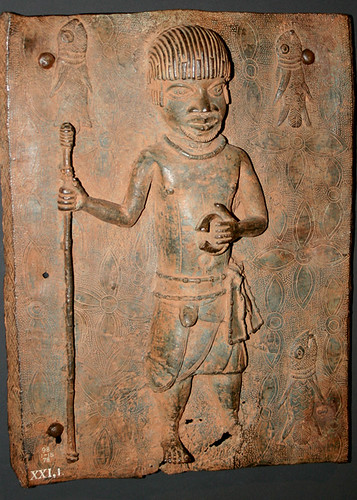
Benin bronze: Foreign trader surrounded by manillas. Photo: Ursula Kampmann.

African Ceremonial Manilas West Africa, large Mondua copper manilla

Manillas, alloyed copper in the shape of a bangle, are among the oldest forms of African gold ingots. Our piece is a Mondua manilla, a copper ring ingot from the province of Sokoto in Nigeria.

The first European manillas were transported by Portuguese boats to Africa, where traders exchanged them mainly for slaves and African pepper. The first written sources on this actually exist from the 14th/15th centuries. We know from one boat, which put into Benin in 1515 and had onloaded 13,000 manillas. No less interesting is the fact that in 1548 the agent of the king of Portugal entered into a contract for the delivery of brass manillas according to the instructions drawn up with the Fugger company.


We have, mainly from the kingdom of Benin, informative sources on how the exchange of goods between the Portuguese and the king's house was handled. The trade was a monopoly of the Oba, the ruler. The king decided to whom the market was to be opened and granted to deserving members of the king's house the privilege of trading with the Europeans. According to the king's instructions the copper that was bought was mostly turned into splendid works of art, which we know nowadays as Benin bronzes.

As so often happens, the competition among the importers undermined the value of the imported goods. It came to a kind of inflation: the price of a slave rose from 12 to 15 manillas at the beginning of the 16th century in 1517.

At the beginning of the 18th century this currency had outstripped itself in Benin. Nobody there was interested in it any longer, so that a whole load of manillas had to be sent away as unsaleable. (source: Coins Weekly)

Wednesday, February 29, 2012

African Colonization: Serial Enslavers


As reported by the BBC "Slavery and the 'Scramble for Africa'" by Dr Saul David on 17 February 2011 -- What were the motives behind the European colonization of Africa at the end of the 19th century? Did the stamping out of slavery really play a part?


European colonisation

Until the 19th century, Britain and the other European powers confined their imperial ambitions in Africa to the odd coastal outpost from which they could exert their economic and military influence. British activity on the West African coast was centred around the lucrative slave trade.

Between 1562 and 1807, when the slave trade was abolished, British ships carried up to three million people into slavery in the Americas. In total, European ships took more than 11 million people into slavery from the West African coast, and European traders grew rich on the profits while the population of Africa's west coast was devastated.

As late as the 1870s, only 10% of the continent was under direct European control, with Algeria held by France, the Cape Colony and Natal (both in modern South Africa) by Britain, and Angola by Portugal. And yet by 1900, European nations had added almost 10 million square miles of Africa - one-fifth of the land mass of the globe - to their overseas colonial possessions. Europeans ruled more than 90% of the African continent.

One of the chief justifications for this so-called 'scramble for Africa' was a desire to stamp out slavery once and for all. Shortly before his death in May 1873 at Ilala in central Africa, the celebrated missionary-explorer David Livingstone had called for a worldwide crusade to defeat the slave trade controlled by Arabs in East Africa, that was laying waste the heart of the continent.

The only way to liberate Africa, believed Livingstone, was to introduce the 'three Cs': commerce, Christianity and civilization.


The Berlin Conference-- This was a period in history when few Europeans doubted their innate superiority over the 'lesser' races of the world.

The theory that all the peoples of Europe belonged to one white race which originated in the Caucasus (hence the term 'Caucasian') was first postulated at the turn of the 19th century by a German professor of ethnology called Johann Blumenbach.

Blumenbach's colour-coded classification of races - white, brown, yellow, black and red - was later refined by a French ethnologist, Joseph-Arthur Gobineau, to include a complete racial hierarchy with white-skinned people of European origin at the top.

Britons like Livingstone felt they had a duty to 'civilise' Africa.

Such pseudo-scientific theories were widely accepted at the time and motivated Britons like Livingstone to feel they had a duty to 'civilise' Africa.

The Berlin Conference of 1884-1885, convened by Otto von Bismarck to discuss the future of Africa, had the stamping out slavery high on the agenda. The Berlin Act of 1885, signed by the 13 European powers attending the conference, included a resolution to 'help in suppressing slavery'.

In truth, the strategic and economic objectives of the colonial powers, such as protecting old markets and exploiting new ones, were far more important.

The Berlin Conference began the process of carving up Africa, paying no attention to local culture or ethnic groups, and leaving people from the same tribe on separate sides of European-imposed borders.


British interests

Britain was primarily concerned with maintaining its lines of communication with India, hence its interest in Egypt and South Africa. But once these two areas were secure, imperialist adventurers like Cecil Rhodes encouraged the acquisition of further territory with the intention of establishing a Cape-to-Cairo railway.

Britain was also interested in the commercial potential of mineral-rich territories like the Transvaal, where gold was discovered in the mid-1880s, and in preventing other European powers, particularly Germany and France, from muscling into areas they considered within their 'sphere of influence'.

Tens of thousands of Herero men, women and children fell victim to von Trotha's infamous extermination order.

As a result, during the last 20 years of the 19th century, Britain occupied or annexed Egypt, the Sudan, British East Africa (Kenya and Uganda), British Somaliland, Southern and Northern Rhodesia (Zimbabwe and Zambia), Bechuanaland (Botswana), Orange Free State and the Transvaal (South Africa), Gambia, Sierra Leone, Nigeria, British Gold Coast (Ghana) and Nyasaland (Malawi). These countries accounted for more than 30% of Africa's population.


The other chief colonisers were France, Germany, Belgium, Italy, Portugal and Spain.

Germany had only been unified in 1871 and so was a late starter in imperial terms. Its first acquisition in 1884 was German South-West Africa (Namibia), which at the time was peopled by two semi-nomadic tribes, the Herero of the arid central plateau and the Nama of the still more arid steppes to the south.

When the two tribes went to war over cattle grazing, German traders and missionaries persuaded their government to intervene and fill the political vacuum.

A later Herero rebellion in 1904, provoked by the brutality of the German settlers, was put down by General Lothar von Trotha with savage efficiency, and tens of thousands of Herero men, women and children fell victim to his infamous 'Vernichtungsbefehl' (extermination order).

'Spirit of Berlin'

The philanthropic 'spirit of Berlin', however, was not entirely hollow. Once it became known that slavery was alive and well in the Congo, which was run as a personal fiefdom of Leopold, King of Belgium, an international anti-slavery conference was held in Brussels in 1889-1890.

By taking the women of Congolese villages hostage, Leopold had turned the men into forced labourers.

The man who exposed the existence of slavery in Leopold's Congo was a French missionary to Africa called Cardinal Charles Lavigerie. During a sermon at St Sulpice in Paris in 1888, Lavigerie had shocked his audience by describing the horrors of the Congo slave trade: villages surrounded and burnt; men captured and yoked together; women and children penned like cattle in the slave markets.

The upshot of the Brussels conference was that Leopold cynically agreed to stamp out Arab slavery in return for the right to tax imports. He thereby overturned one of the key resolutions of the Act of Berlin, which had guaranteed free trade for the region.

But while Leopold made all the right noises, his agents in the Congo used forced labour (slaves in all but name) to extract rubber, his single most profitable export. By 1902, rubber sales had risen 15 times in eight years, and were valued at 41 million francs (£1.64 million).


By taking the women of Congolese villages hostage, Leopold had turned the men into forced labourers, with a monthly quota of wild rubber to collect from the rain forest. The system was harsh. Many hostages starved to death and many male forced labourers were worked to death.

More people were killed as rebellions were brutally crushed. Demographers today estimate that the population of the Congo fell roughly by half over the 40-year period beginning in around 1880.

The truth behind the Congo's rubber trade - 'legalised robbery enforced by violence' - was finally exposed by Edmond Morel, an Anglo-French ex-shipping clerk, who wrote a series of accusatory articles in 'The Speaker' in 1900.

By arguing that Leopold's illegal state monopoly was robbing British merchants as well as African peasants, Morel was able to enlist the support of both businessmen and humanitarians. A British consul, Roger Casement, was sent to investigate, and the publication of his damning report in 1904 was, for Leopold, the beginning of the end.

In 1908, in return for £3.8 million, Leopold handed over control of the Congo to the Belgian state. But even then, the forced labour system continued. It took a different form during World War One, when tens of thousands of Congolese were conscripted as porters for the Belgian army.

The forced labour system significantly changed only in the early 1920s, when Belgian colonial authorities realised the population was dropping so rapidly that they soon might have no labour force left.

An end to African slavery?

The signatories of the General Act of the Brussels Conference of 1889-1890 had declared an intention to put an end to the traffic of African slaves. This was extended, by the Convention of St-Germain-en-Laye in 1919, to include the complete suppression of slavery in all its forms and of the slave trade by land and sea.

Under all the colonial powers, forced labour remained in place into the 1940s.

In September 1926, the International Slavery Convention was signed at Geneva under the auspices of the League of Nations 'to find a means of giving practical effect throughout the world to such intentions'.

It defined a slave as a 'person over whom any or all of the powers attaching to the right of ownership are exercised', and undertook 'to bring about, progressively and as soon as possible, the complete abolition of slavery in all its forms'.

But this was never applied against the practice of forced labour in colonial Africa, for example, requiring a village to provide men to work on roads and other public works. Under all the colonial powers, forced labour of one kind or another remained in place into the 1940s, and the imposition of taxes forced people into low-paid mining, industry or agribusiness jobs when they might otherwise have remained farmers.


The first practical consequence of the convention was that Ethiopia became the last African state to abolish slavery in 1932. All colonial regimes had long since done the same. Yet even today slavery is not unknown in Africa, particularly in countries such as the Sudan where law and order are often absent.

Nor have the colonists ever really gone away. White-owned businesses still dominate the mining of Africa's most valuable natural resources - particularly gold and diamonds - and in the eyes of some the continent has never stopped being plundered.
(source: BBC)

Tuesday, February 28, 2012

Empire: From Conquest to Control

Empire: From Conquest to Control: Gresham College Professor Richard J Evans (24 January 2012)

In 1884, the Berlin Conference that set off the scramble for colonies in Africa and other parts of the world laid down the basic principle that in order to establish the formal right of rule over a colony, a European power had to establish ‘effective occupation’. This applied, however, only to coastal areas, which at the time were the main concern of most European powers in Africa. The hinterland of continental Africa, which was the subject of the main phase of the ‘scramble’, was a different matter. Here, European states drew straight lines across the map with complete disregard for geographical features, delimiting the territories they claimed from one another but leaving them still to be brought under real control. In many ways the story of colonization in the 1890s and 1900s is the story of how European empires tried to convert paper colonies into real colonies.

In my last lecture I noted how in some cases this attempt met with failure, most notably with the Italian invasion of Ethiopia in 1896. Similarly, the Boxer rebellion in China deterred European powers from converting treaty ports into hubs of real colonization. But these were exceptions. In most of Africa, and many parts of the Pacific, European powers moved from the 1890s onwards to establish their control over the land they now claimed as their own.

What drove them to do so were two separate but ultimately intermeshing influences. The first was ideological. The 1880s ushered in the age of empire, the decades of imperialism – a word that first entered the English language in the 1870s and was, as J. A. Hobson noted in 1900, ‘on everybody’s lips…used to denote the most powerful movement in the current politics of the western world’. Imperialism was propagated by governments keen to gain popular support for the principle of maintaining, usually at some cost, overseas possessions. The cult of empire began in Britain already in the 1870s with the proclamation of Queen Victoria as empress of India. Within a few years, British royal ceremonies, including Queen Victoria’s golden and diamond jubilees and the coronation of King Edward VII in 1902, were featuring maharajas and colonial troops. As the Daily Mail reported in 1897, the diamond jubilee procession displayed ‘new types, new realms at every couple of yards, an anthropological museum – a living gazetteer of the British Empire. With them came their English officers, whom they obey and follow like children’. Huge publicity was given to the ceremonies – durbars – held in India in 1877 to proclaim Queen Victoria Empress of India, and in 1902 and 1911 to celebrate the coronation of her successors. 1902 saw the inauguration of ‘Empire Day’ in Britain, especially directed at schools, and imperial propaganda could be found everywhere, on railway bookstalls, in political meetings, in novels, magazines and history books and even in the ‘empire plate’ manufactured for the Diamond Jubilee in 1897. The coronation of Edward VII in particular was given a strong imperial flavour, to celebrate, as a contemporary put it, ‘the recognition, by a free democracy, of a hereditary crown, as a symbol of the world-wide dominion of their race’.


International expositions, a tradition inaugurated by Britain’s Great Exhibition of 1851, began to include ‘colonial pavilions’ – 18 of them at the Paris exposition of 1889, clustering around the Eiffel Tower that had been specially built for the occasion.Colonial museums opened in most European countries to display looted artifacts, and most remarkably perhaps, zoos began to include ‘native villages’ among their exhibits. Hagenbeck’s Tierpark in Hamburg for example showed a series of African and other indigenous groups to gawping crowds of visitors who – at a safe distance, to avoid the danger of physical contact - could observe the ‘primitive world’ that Germany had conquered in Africa.


In Belgium in the 1880s and 1890s exhibitions were held including a typical Congolese village, where imported Africans were told to do what they normally did at home, which was mostly not much, since at home they would have been out hunting or in the fields. A pool was provided and stocked with fish, and spectators threw coins in for the Congolese to dive for. Sometimes they threw in bottles of gin and brandy too, to make them drunk. Sometimes stages were set up for the men to re-enact battles with spears and shields. The Congolese had to go around half-naked in a display of ‘authenticity’ and in cold weather many of them became ill. Such displays were put on to underline European superiority, so there was no interest in, for example, getting the villagers to make or display artworks or put on musical events. In a similar way, Buffalo Bill’s enormously popular Wild West Show, which toured Europe at this time, demonstrated the inferiority of Native Americans, doomed to extinction in battle with the better armed forces of civilization.

European notions of superiority were caricatured but also reaffirmed in cartoons of the time: here for example is one portraying a new governor of German East Africa as a ‘new idol’ replacing or perhaps just adding to the ones already worshipped by the native heathens.All this served to enlist the middle classes and potentially too the working classes in patriotic enthusiasm for the ideals of empire, a tactic that was more successful in some countries, notably Britain, than others. The press followed colonial campaigns closely and whipped up jingoistic sentiment, expressed in events such as the triumph of the British over the Ashanti in the 1870s.Imperial enthusiasm reached new heights with the emergence of mass-circulation newspapers like the Daily Mail, fuelling events such as the popular celebrations in London of the relief of Mafeking during the Boer War.The age of high imperialism coincided with the coming of the age of mass communications and the popular press, and both fed off each other.


The events of the Boer War pointed to the other major force apart from imperialist ideology driving forward European powers’ establishment of control over their colonies, and that was, the actions and policies of men on the ground, in the colonies themselves. For most of the nineteenth century it was missionaries, traders and explorers who brought in the colonizing state to further their interests or, more frequently, to rescue them when they got into trouble with indigenous peoples. In some colonies, however, in the age of high imperialism, European settlers began arriving in ever increasing numbers and, with or without the approval of the colonial state, seizing land for cattle farming or rubber or palm oil plantations. The clashes such actions sparked were among the most violent in the history of European empire. And nowhere were they more dramatic than in the German colony of South-west Africa, today’s Namibia.

South-west Africa had begun as a protectorate run by a limited company, but as early as 1888 the company failed and the state was obliged to take over. Much of the land was desert or semi-arid and was inhabited by nomadic cattle herders of the Herero and Nama tribes. During the 1890s German settlers moved in and began setting up cattle ranches, fencing off the land from the nomads, whose livelihood was also being undermined by an outbreak of a fatal cattle disease, Rinderpest, at the end of the 1890s. The rapidly mounting pace of land seizures by the colonial government in the early 1900s led eventually to attacks on German farmers, resulting in around 150 settler deaths by 1904, when the attacks reached a peak. Kaiser Wilhelm II took this as a provocation, even a personal insult. Germany was not going to be humiliated as Italy had been in Ethiopia in 1896.


14,000 German troops were dispatched from Berlin under General Lothar von Trotha, a hard-line Prussian army officer with previous colonial experience. ‘I know’ he said, ‘that African tribes yield only to violence. To exercise this violence with crass terrorism and even with gruesomeness was and is my policy.’ After defeating a Herero force at Waterberg, Trotha announced: ‘Any Herero found inside the German frontier, with or without a gun or cattle, will be executed.’ Herero cattle-herders caught in the action were shot or hanged on the spot, while the remaining men, along with Herero women and children, were driven into the desert and left to starve. The few who emerged alive were little more than skeletons, as this contemporary photograph shows (see powerpoint).The Chief of the General Staff in Berlin, Alfred von Schlieffen, in thrall, like all Prussian officers, to the supposedly Clausewitzian doctrine that the aim of a war must be the total annihilation of the enemy force, praised von Trotha’s campaign as ‘brilliant’, especially his use of the desert to complete what he called approvingly ‘the extermination of the Herero nation’. Popular commemorative books were printed celebrating the triumph of German arms in the war. (source: Gresham College, UK)

Empire: From Conquest to Control - Professor Richard J Evans FBA

Monday, February 27, 2012

Tintin's Racist Past


Traveling in a hammock, Belgian Congo [Photograph taken or provided by Émile Gorlia (1887-1966)] Hammocks carried by African porters were an important means of transportation for Europeans during the colonial period. Some African leaders also used palanquins and other carrying devices as symbols of their status.


From Forbes Magazine, "Tintin's Racist Past," by Lionel Laurent, on 23 July 2007 --LONDON - When British lawyer David Enright opened the pages of a comic book entitled Tintin In The Congo while in a shop with his wife and two young boys, he was probably expecting a benign adventure story full of fun for all the family.

Instead what he found was a "highly offensive" collection of racist caricatures of Africans, from superstitious natives to incoherent simpletons, and in a letter of complaint he demanded that the Borders bookstore in his hometown of St. Albans stop selling the comic book.

Tintin is Belgium's most famous export, with over 200 million copies of his adventures sold worldwide. In May Variety even reported that co-founder of DreamWorks Steven Spielberg and Peter Jackson were planning a Tintin trilogy, no doubt tempted by the $3 billion gross raked in by Jackson's Lord of the Rings movies. Could one angry British lawyer derail the reputation of a true comic book hero?


The incident has snowballed into a very British scandal, with the Commission for Racial Equality backing Enright and demanding that all Borders stores take Tintin's Congolese adventures off their shelves. Now even the police are involved, with the Hertfordshire police deciding to record Enright's complaint as a "racist incident."

Borders' response has been to move all copies of the comic to the "adult graphic" section of the store from the childrens' section, but the book seller refused to stop selling it outright.


It's not the first time accusations of racism have been leveled against Hergé, the late Belgian cartoonist who created the iconic orange-haired reporter known as Tintin. When the character first appeared in Tintin In The Land Of The Soviets at the end of the 1920s, he stood for conservative, Catholic values, showing up the godless credo of communism. It is no accident that in his second adventure in 1931, Tintin In The Congo, the intrepid reporter is saved from the snapping jaws of angry crocodiles by a bearded Catholic missionary dressed in white.

But Hergé himself regretted his early work, as well as his personal attachment to a Catholic abbot with fascist sympathies called Norbert Wallez. In an interview released in 1983, the artist said: "The fact is that while I was growing up, I was being fed the prejudices of the bourgeois society that surrounded me. It's true that Soviets and Congo were youthful sins. I'm not rejecting them. However, if I were to do it again, they would be different."

Democratic Republic of Congo (Belgian Congo) - Kuba King "Dr. William Henry Sheppard (1865-1927), an African American missionary for the American Presbyterian Congo Mission, who later became an outspoken critic of King Léopold's regime, was the first overseas visitor to reach the kingdom's capital in 1890. The Kuba, famous for their arts, subsequently attracted many visitors, ranging from anthropologists to photographers, who sought to depict the legendary kings, the visual splendor of the royal court and important chiefs, among them Chief Ndombe of Bieeng. Casimir Zagourski, who traveled through the royal capital in the 1930s, took a classic, often-published portrait of then ruler Kot Mabiinc (ruled 1919-1939), who was paralyzed. Eliot Elisofon (1911-1973), an American photographer who worked for Life magazine, followed in Zagourski's footsteps in 1947, creating evocative portraits of Kot Mabiinc's successor, Mbop Mabiinc maMbeky (ruled 1939-1969). Photographic encounters in the capital became commonplace and orchestrated--grand performances for the cameras of the Westerners. Kuba kings used the opportunity to further the reputation of the Kuba as the foremost artists in central Africa." (flicker)


Tintin In The Congo did not even make it to the U.K. until 2005, over 70 years after its first appearance in French, because of the controversy surrounding it. When the publisher Egmont finally released the English version, it billed it as an "essential volume for collectors," making sure to wrap a label around the comic that warned readers of its potentially "offensive" content.

And the huge divide between post-colonial Britain and Belgium in the 1930s, when the kingdom still owned the Congo, adds to the shock of today's reader discovering Tintin's adventure for the first time. The story is filled with witch doctors, lazy natives who need to be put to work and over-the-top violence against animals.


According to Mark Rodwell, representative of Moulinsart--the firm that manages Hergé's estate--this explains why children ignorant of the past don't have the same reaction.

"The criticism is that it's not suitable for children," he told Forbes.com. "But it's the adults that have the problem with it. It's a book of its time." (source: Forbes)

HOME

HOME
Click here to return to the US Slave Home Page