Showing posts with label French Slavery. Show all posts

Sunday, May 20, 2012

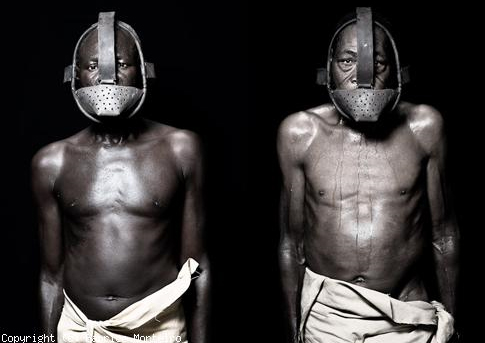
Fabrice Monteiro's Amazing Images of Brown. Fugitive Slaves In Slave Torture Devices

"Marrons. Les esclaves fugitifs" (Brown Runaway Fugitive Slaves) photographed by Fabrice Monteiro

"Brown. Fugitive Slave," is an article published in his newsletter Africultures is an evocation of runaways through the eyes of Fabrice Monteiro. An article that is timely to commemorate the 163 th anniversary of the abolition of slavery in Guadeloupe, 27 May 2011 .


"Marrons. Les esclaves fugitifs" (Brown Runaway Fugitive Slaves) photographed by Fabrice Monteiro

"Maroon" is a term borrowed from the Spanish "cimarron," meaning "living on the peaks."

It comes from a word "Arawak" defining domestic animals returned to the wild, and by extension, runaway slaves. The "Maroon" was a terrible threat to the colonial system, they were likely to provoke a civil war at any time. Fugitive slaves were monitored continuously and the sentences at the slightest deviation were particularly severe, they had to make an impression.

"Marrons. Les esclaves fugitifs" (Brown Runaway Fugitive Slaves) photographed by Fabrice Monteiro

Slaves who tried to escape suffering the punishment described by the law then they were made to wear a heavy iron necklace with long stems, which had the function to hang in the brush and hamper any escape. In the same spirit, they existed in shackles bells, can hear every movement of the slave. The slave who dared to speak a bit to his master suffered the punishment of the Iron Mask. Similarly, during the harvest of sugarcane, were put in iron masks to hungry and thirsty slaves to prevent them from tasting or eating the cane.


"Marrons. Les esclaves fugitifs" (Brown Runaway Fugitive Slaves) photographed by Fabrice Monteiro

During childhood in Benin, Fabrice Monteiro is marked by the cartoon "The Passengers of the Wind" of Bud Francis. Part of the adventure takes place in Ouidah, Benin, home village of his father's family. He is fascinated by the realism of images, it recognizes the scene drawn, the faces are familiar to him. It is in these pages he discovered these strange necklaces worn by some slaves to keep them from escaping. His father tells him the story of his family and why he wears a name like many other Portuguese Benin. His ancestor was named Ayedabo Adagoun Odo, his native Nigeria. He is enslaved by the Portuguese and sent to Brazil. He returned to Benin years later, freed by the name of Pedro Monteiro.

"Marrons. Les esclaves fugitifs" (Brown Runaway Fugitive Slaves) photographed by Fabrice Monteiro

Sensitive to the issue of the slave trade and the role of this small village on the coast of Benin, Fabrice decides to explore the subject photographically to contribute to the memory of slavery. From the * CODE BLACK, lithographs and of the few original photos of slaves, Fabrice plans reconstructs five models of barriers used to punish or deter the slaves of their escape. It is from these plans that two young blacksmiths Benin reproduce barriers staged in this photographic series. To obtain an effect of chiaroscuro, he chose a modern approach to treatment of light. He designed a black box, allowing a mobile studio to meet its models through the streets of Ouidah.

"Marrons. Les esclaves fugitifs" (Brown Runaway Fugitive Slaves) photographed by Fabrice Monteiro


* The BLACK CODE was developed by the French minister Jean-Baptiste Colbert (1616 - 1683) and promulgated in March 1685 by Louis XIV. [source: Fabrice Monteiro ( Article published by Africultures on 05/05/2011)]

"Marrons. Les esclaves fugitifs" (Runaway Fugitive Slaves) photographed by Fabrice Monteiro


"Marrons. Les esclaves fugitifs" (Runaway Fugitive Slaves) photographed by Fabrice Monteiro


"Marrons. Les esclaves fugitifs" (Runaway Fugitive Slaves) photographed by Fabrice Monteiro


RON'S COMMENTS:  Yes, these powerful images are disturbing.  It reminds us that human beings sit at the forefront of ALL enslavement.  The state-sponsored institutionalization of human trafficking and bondage for profit involves human beings.  Millions upon millions of nameless, faceless people who toiled for the enrichment of plutocrats, merchants, kings, queens, aristocrats, planters, shipbuilders, bankers, insurance brokers, shareholders and the like.  They were never paid, never thanked, even after emancipation never made whole.  I honor their spirit of survival.  

This small blog tries to offer a space to historically discuss and make sense of their inhuman bondage.  

Haitian History & Future Prospects


From History Whiz, "Slavery and the French Revolution" -- Even before 1789 critics had attacked the slave trade and slavery in the colonies. France had several colonies in the Caribbean, the most important of which was Saint Domingue (later called Haiti). There were 500,000 slaves there in 1789 and they provided the labor for sugar, coffee, and cotton plantations.

The behavior of slaves and the actions of slave owners in the colonies was regulated by a series of royal edicts, called the Code Noir, or slave code.

When the Revolution began in 1789 the free mulattos of Saint Domingue discussed the rights of free blacks. Vincent Ogé presented the views of his fellow mulatto property owners to a meeting of the white planters in 1789. Assembly of Colonists


JACOB LAWRENCE (1917–2000) The Life of Toussaint L'Ouverture:

Both groups sent their representatives to France to demand representation in the National Assembly. There were those in the National Assembly who believed in rights for blacks and worked for abolition of slavery. Some were members of the Society of the Friends of Blacks, a French abolition organization. However, there was not much support for aboliton among the revolutionaries. They also argued for full rights for free blacks - There were about 28,000 free blacks and mulattos in Haiti, many of whom owned slaves of their own. More radical revolutionaries continued to urge abolition. Olympe de Gouges, who also championed rights of women, wrote Reflections of Black People, a pamphlet urging improvement of the situations of slaves and free blacks.

Address to the National Assembly in Favor of the Abolition of the Slave Trade February 5, 1790 -Society of the Friends of Blacks

As they argued in France, the uncertainty created instability in the colonies. The free blacks and mulattos agitated for full rights. The planters feared that Paris might abolish slavery and take away their livelihood, and began to talk about independence.


JACOB LAWRENCE (1917–2000) The Life of Toussaint L'Ouverture:

Vincent Ogé presented the views of the mulatto property owners to a meeting of the white planter delegates who had come to Paris. In October 1790, 350 mulattos rebelled in Saint Domingue. The rebellion was put down, the rebels were arrested and the leaders, including James Ogé, were executed. On May 15th, the National Assembly succumbed to pressure and granted political rights to all free blacks and mulattos who were born of free mothers and fathers. It only affected a few hundred people but the planters were infuriated and refused to follow the law.

Just a few months later, on 22 August 1791, the slaves of Saint Domingue again rose up in rebellion, in what was eventually to become the first successful slave revolt in history. The National Assembly reacted by rescinding the rights of free blacks and mulattos on September 24th. Once again the slaves reacted with violence. They burned down plantations, murdered their white masters, and attacked the towns. The fighting went on even as the new


JACOB LAWRENCE (1917–2000) The Life of Toussaint L'Ouverture:

Legislative Assembly (it replaced the National Assembly in October 1791) met at the end of March 1792. On March 28th, the assembly voted to reinstate the political rights of free blacks and mulattos. Nothing was decided about slavery.

The slave rebellion continued. In the fall of 1792, as the Revolution in mainland France began to radicalize, the French government sent two agents to Saint Domingue to gain control of the slave revolt. The rebel slaves then made agreements with the British and Spanish in the area. The British and Spanish had promised freedom to those slaves who would join their armies. It was not a matter of principle - they did not intend to end slavery in their own colonies. But they saw an opportunity to weaken France.

JACOB LAWRENCE (1917–2000) The Life of Toussaint L'Ouverture:

The rebellion and invasions took their toll on Saint Dominique. The economy had nearly collapsed and drastic measures were needed. The National Convention (the more radical assembly of the Jacobins that replace the Legislative Assembly in France) finally voted to end slavery in all the French colonies on February 4, 1794. Thousands of whites fled the island, and even the Mulattoes were not pleased. Many owned slaves themselves and were opposed to the move.

The decree from faraway Paris did not solve the problems in the colonies. Some local officials disregarded the decree, others converted slavery into a forced labor system, and others took no action at all. The decree was never fully implemented.


A leader of the slaves had emerged in the conflicts. Toussaint L'Ouverture, a slave who had learned to read and write, embraced the enlightenment philosophy of equality and liberty. He was a brilliant general, and large areas of Saint Dominique came under his control.

Eventually the Jacobin government in France fell like those governments before it. When Napoleon took control in France, he attempted to put Saint Dominique on a sound footing. By 1800 the plantations were producing for France only one fifth of what they had in 1789. He reinstituted slavery in the colonies, and denied rights to free blacks. He send an expeditionary force to retake Saint Dominique. Through deception the French captured Toussaint and took back to France. Napoleon ordered that Toussaint be imprisoned in the Alps and murdered by lack of food and warmth. However, the fight went on and the slaves were finally successful in driving out the French. In 1804 Saint Dominique became the independent republic of Haiti. The first successful slave revolt in history was over. (source: History Whiz)

Haitian History & Future Prospects

Saturday, April 21, 2012

Paris torture instruments auction suspended after protests

Hands crusher (Collection Fermand Meyssonnier/Etude Cornette de Saint Cyr)

According to the Lebanon Daily Star, "French torture device auction called off after outcry," 31 March 2012 -- PARIS: A French auction house Friday called off the planned sale of a collection of torture devices dating back three centuries, which had sparked outrage among rights groups and in Algeria.


Some 350 objects, from a hand-crusher to hanging ropes and written death sentences, collected by France's last executioner Fernand Meyssonnier until his death in 2008, had been slated to go on sale on Tuesday in Paris.

A former chief executioner in French-ruled Algeria, Meyssonnier carried out 198 executions between 1957 and the country's independence in 1962, devoting the rest of his life to retirement and his torture collection.


Tools used for torture and humiliation, part of a collection of some 250 items, are displayed at the Hotel Salomon de Rothschild in Paris March 31, 2012. (REUTERS/Gonzalo Fuentes)

French auction house Cornette de Saint Cyr was organizing the sale in Paris for the benefit of the Meyssonnier family. However, following the wave of protests, it said Friday it had cancelled the auction.

"Given the emotion aroused by this sale... we decided to suspend it so that all parties concerned can calmly examine the actual content of this collection," auctioneer Bertrand Cornette de Saint Cyr told AFP.

Culture Minister Frederic Mitterrand had in a statement voiced his "strong disapproval" and urged a cancellation of the sale of objects that were morbid, reflected barbarism raised "painful historical questions".

The Algerian press had also voiced strong disapproval of the auction.

"The minister called me to inform me of the emotion aroused by the sale, particularly in Algeria. The sale is legal but we made the decision to suspend it," another auctioneer, Arnaud Cornette de Saint Cyr, told AFP.

Rights groups on Wednesday attacked the planned auction as "shocking and immoral", according to a joint statement by the ACAT-France Christian anti-torture group, Amnesty International France, the Human Rights League, the Movement Against Racism (MRAP) and the Primo Levi association.


Denouncing what they called the "commercialisation of torture", they called on the French state -- which abolished the death penalty in 1981 -- to remove the lots from sale, if necessary by buying them for museums.

"What shocks us is that torture is still practiced in half of all countries," said Eleonore Morel, director of the Primo Levi association, calling the sale "extremely degrading for all the victims of torture".

Henri Pouillot of the MRAP told AFP the planned auction was "perverse and macabre". Pouillot said he was particularly alarmed by Meyssonnier's connection to Algeria, where French forces are acknowledged to have practiced torture during the war of independence from 1956 to 1962. (source: The Daily Star :: Lebanon News :: http://www.dailystar.com.lb)

A chastity belt is displayed as part of a collection of some 250 items used for torture and humiliation at the Hotel Salomon de Rothschild in Paris March 31, 2012. (REUTERS/Gonzalo Fuentes)

Monday, March 19, 2012

Manila The African Money Of The Slave Trade


MANILLAS: AFRICAN BRACELET MONEY

Copper was the "red gold" of Africa and had been both mined there and traded across the Sahara by Italian and Arab merchants. The early Portuguese explorers of the 1470s observed that copper bracelets and legbands were the principal money all along the west African coast. They were usually worn by women to display their husband's wealth. The Portuguese crown contracted with manufacturers in Antwerp and elsewhere to produce crescent rings with flared ends of wearable size which came to be called "manilla," after the Latin manus (hand) or from monilia, plural of monile (necklace).

While copper bracelets dating prior to 1600 AD which likely had some exchange function continue to be excavated around Jenne-Jeno and related sites, we can only guess today at what prototypes may have inspired the distinctive flare-ended crescent shape. One theory is that Europeans copied a splayed-end raffia cloth bracelet worn by women, another that the well-known Yoruba Mondua with its bulbous ends inspired the manilla shape. Much closer in form to modern manillas, however, is this type, excavated at Igbo-Ukwu. In "Die sog. Geldeifen aus Benin," Der Primitivgeldsammler #28/1, p.29-35, Rolf Denk summarizes what is known about heavy, faceted pieces with enlarged ends such as this one (25cm across and 4.5cm gauge) from the Museum für Volkerkunde in Vienna, which may predate European manillas.

PORTUGUESE MANILLAS (TACOIS).  Late Schetz Type(?), ca. 1524 Brass, slightly flared ends, average 306gms, 103 x 87mm size, and gauge increasing from 12mm at center to 22mm at ends, giving a "flare ratio" of 1.86. Found in ship wrecks, and best studied from a 1524 wreck in Guetaria Bay, Spain.

Records of a contract between the Portuguese government and Erasmus Schetz of Antwerp, who supplied the Portuguese factory at Mina with as many as 150,000 manillas per year, are widely quoted. The standard in 1529 was supposedly about 240m long, about 13m gauge, weighing 600 gram. However, no examples of torque-shaped bracelets in this weight range are known today, and a wreck dated to 1524 carried manillas of typical form but only slightly flared, averaging 306 grams. Do these heavy Schetz manillas even exist today, and if so, what do they look like? Duchateau, Royal Art of Benin, page 15 shows a plaque with a European holding two pieces with barely flared ends whose apparent size could match these specifications, while page 60 illustrates five pieces of conventional form, but without scale. Then, too, the Dutch participated in the trade. Did they get their manillas from nearby Antweerp as well, or did they use something different still?

Manillas from the 1524 wreck recently recovered from the Guetaria Bay off the Basque coast of Spain are described in detail in Der Primitivgeldsammler #26/1 p.9-12 (Manuel Artica). These brass manillas average 306gms, 103 x 87mm size, and gauge increasing from 12mm at center to 22mm at ends, giving a "flare ratio" of 1.86. The shape is thus more similar to the familiar French Popo manilla than the British, but even less pronounced in the flare. There was a falling out between the Portuguese and their supplier Schetz, with 1547 given as the date they switched their contracts to Cristoff Fugger. If correct, the Guetaria Bay finds would thus be Schetz products. The new Fugger pieces were called tacoais with different standards, of 284gm (Mina) and 241gm (Guinea), for the different trading areas.

BRITISH MANILLAS Birmingham

Four types of manillas lighter than the Guetaria Bay specimens are known. Their average weights match the Fuggers' Guinea specifications with two specimens (281, 294 grams) in the Mina range. Possibly earliest is the least flared, #937 with a modest 1.96 flare ratio and average weight of 241gm. Opitz p.213 upper left is likely this type. Other types with visibly greater end flares (#939-941) range from 226 to 294 grams, though to date few specimens have been studied. The earliest British manillas have flare ratios approaching 3.0. The Portuguese called the Fugger manillas tacois. An African name for the more flared Guinea pieces, at least, is Mkporo. As the manilla shrank in size over the centuries, the Mkporo were promoted from everyday trade use to burial money and a standard of wealth.

Although Gold was the primary and abiding merchandise sought by the Portuguese, by the early 16th century they were participating in the slave trade for bearers to carry manillas to Africa's interior, and gradually Manillas became the principal money of this trade. By the end of the 1500s the Portuguese had been shouldered aside by the British, French, and Dutch, all of whom had labor-intensive plantations in the West Indies, and later by the Americans whose southern states were tied to a cotton economy . A typical voyage took manillas and utilitarian brass objects such as pans and basins to West Africa, then slaves to America, and cotton back to the mills of Europe.

FRENCH (POPO) MANILLA Nantes

Early in the 18th century Bristol, and then Birmingham, became the most significant European brass manufacturing city. It is likely that most types of brass manillas were made there, including the "middle period" Nkobnkob-Onoudu whose weight apparently decreased over time, and the still lighter "late period" types such as Okpoho and those salvaged from the Duoro wreck of 1843. Among the late period types, specimen weights overlap type distinctions suggesting contemporary manufacture rather than a progression of types. The Popos, whose weight distribution places them at the transition point between Nkobnkob and Onoudu, were also made in Nantes, France, and possibly Birmingham as well. They are wider than the Birmingham types and have a gradual, rather than sudden, flare to the ends.

The Africans of each region had names for each variety of manilla, probably varying locally. They valued them differently, and were notoriously particular about the types they would accept. The price of a slave, expressed in manillas, varied considerably according to time, place, and the specific type of manilla offered. Internally, manillas were the first true general-purpose currency known in west Africa, being used for ordinary market purchases, bride price, payment of fines, compensation of diviners, and for the needs of the next world, as burial money. Cowrie shells, imported from Melanesia and valued at a small fraction of a manilla, were used for small purchases. In regions outside coastal west Africa and the Niger river a variety of other currencies, such as bracelets of more complex native design, iron units often derived from tools, copper rods, themselves often bent into bracelets, and the well-known Handa (Katanga cross) all served as special-purpose monies.

AFRICAN-MADE TRADE MANILLAS

As the slave trade wound down in the 19th century so did manilla production, which was already becoming unprofitable. By the 1890s their use in the export economy centered around the palm-oil trade. Although manillas were legal tender, they floated against British and French West African currencies and the palm-oil trading companies manipulated their value to advantage during the market season. Probably for this reason the British undertook a major recall dubbed "operation manilla" in 1948 to replace them with British West African currency at a rate of 3 Pence for the commonest type. The campaign was largely successful and over 32 million pieces were bought up and resold as scrap. The manilla, a lingering reminder of the slave trade, ceased to be legal tender in British West Africa on April 1, 1949.

An unanswered question is whether "manillas" were made in Africa by native smiths during the period when European types were imported. It is hard to believe that no such attempts were made. Offered for sale below and linked to scans are obvious counterfeits, but such pieces made of lead, or underweight pieces in impure brass are rather uncommon and it is unclear where they were made. More interesting is the group of horseshoe-shaped pieces as well as gleanings from several years' worth of poring over Africa Traders' stocks, looking for pieces with flared ends within the known manilla weight range. Are they proto-manillas, early European manillas, or African-made pieces during the period of European importation which - deliberately or coincidentally - resemble the European type? All are copper, rough with verdigris indicating some age.


Many other things are called manillas by authors and collectors. Commonly available are many distinctive regional bracelet forms of copper, brass, nickel, and iron made in Africa in the 19th-20th centuries with varying monetary functions and ranges of use. Legbands, collars, and coiled forms made of Calabar rod. Those with flared ends are often called manillas. Other flare-end forms of large size, called "King" and "Queen" manillas, are ceremonial rather than trade manillas, and from Zaire come large copper crescents in several distinctive shapes, sometimes including flared ends, which are likely forms of bullion storage (like the Katanga cross).

A Katanga cross, also called a handa, is a cast copper cross which was once used as a form of currency in parts of what is now the Democratic Republic of the Congo (DRC) in the 19th and early 20th centuries.
For more depth on bracelet monies in general see InfoSheet 62. There is a remarkable lack of academic interest in the tangible objects of the slave trade and African monies in general. Artica's Der Primitivgeldsammler bibliography references a to-be-published article in "Gaceta Numismatica" (Barcelona) by A. Benito and M. Ibanez. "Copper to Africa: Evidence for the international trade in metal with Africa" by P. T. Craddock and D. R.. Hook, p. 181-193 of British Museum Occasional Paper 109 (1995), notes that the British Museum is beginning to keep samples of trade goods found on dateable wrecks, but so far has manillas only from the Duoro of 1843, and The Charles of 1684. The Duoro pieces are well known, and I am trying to get a picture of the earlier type. Another well-researched article, which I have yet to digest, is R. L.. Leonard's "Manillas - Money of West Africa" published by the Chicago Coin Club in 1998. (source: Coins.com)

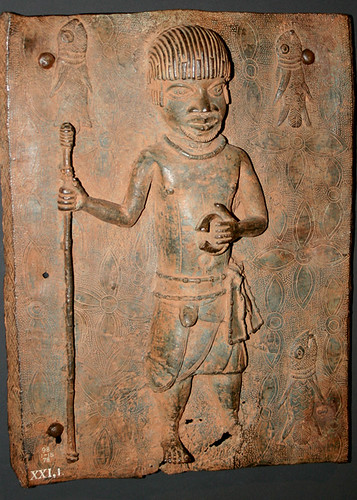
Benin bronze: Foreign trader surrounded by manillas. Photo: Ursula Kampmann.

African Ceremonial Manilas West Africa, large Mondua copper manilla

Manillas, alloyed copper in the shape of a bangle, are among the oldest forms of African gold ingots. Our piece is a Mondua manilla, a copper ring ingot from the province of Sokoto in Nigeria.

The first European manillas were transported by Portuguese boats to Africa, where traders exchanged them mainly for slaves and African pepper. The first written sources on this actually exist from the 14th/15th centuries. We know from one boat, which put into Benin in 1515 and had onloaded 13,000 manillas. No less interesting is the fact that in 1548 the agent of the king of Portugal entered into a contract for the delivery of brass manillas according to the instructions drawn up with the Fugger company.


We have, mainly from the kingdom of Benin, informative sources on how the exchange of goods between the Portuguese and the king's house was handled. The trade was a monopoly of the Oba, the ruler. The king decided to whom the market was to be opened and granted to deserving members of the king's house the privilege of trading with the Europeans. According to the king's instructions the copper that was bought was mostly turned into splendid works of art, which we know nowadays as Benin bronzes.

As so often happens, the competition among the importers undermined the value of the imported goods. It came to a kind of inflation: the price of a slave rose from 12 to 15 manillas at the beginning of the 16th century in 1517.

At the beginning of the 18th century this currency had outstripped itself in Benin. Nobody there was interested in it any longer, so that a whole load of manillas had to be sent away as unsaleable. (source: Coins Weekly)

Monday, March 12, 2012

Haitian Soldiers Memorialized At The Siege of Savannah Monument

Franklin SQ Monument

The Siege of Savannah--On Oct. 9, 1779, a Haitian regiment known as the Chasseurs Volontaires de Saint-Domingue served as a reserve unit to American and French forces fighting a British contingent. The unit was comprised of more than 500 free men of color from Haiti.

As battered American and French soldiers fell back, the Haitian troops moved in to provide a retreat. The battle resulted in the largest number of casualties the allies suffered in a single engagement.
Many of the Haitian soldiers later fought to win their country's own war of independence, crediting their military experience in Savannah. (Source: Haitian American Historical Society)


Haitians Want It Known That Haitian Heroes Aided American Revolution : Georgia: Display in museum depicts the 1779 Battle of Savannah and recalls the 'Chasseurs Volontaires'--infantry volunteers from Haiti. Placard salutes the bravest feat "ever performed by foreign troops in the American cause."(LA Times)

In the Los Angeles Times, Dan Sewell reported on 18 December 1994--SAVANNAH, Ga. — Among the Revolutionary War exhibits in this coastal city's history museum there stands a figure in 18th-Century dress, a figure much like the rest except for one major difference:

It is black.

The figure, part of displays depicting the 1779 Battle of Savannah, commemorates the "Chasseurs Volontaires"--infantry volunteers from Haiti who carried out what a placard calls "the most brilliant feat of the day, and one of the bravest ever performed by foreign troops in the American cause."


It is a rare American tribute to the heroism of Haitians who fought on U.S. soil for the independence of this nation, 215 years before U.S. troops landed in Haiti to help restore the elected president.

Little-known in this country, the battle is cited proudly by some Haitians in the aftermath of the U.S. intervention that ended three years of rule by an army junta.

"We, who stood side by side with you in the Battle of Savannah, Georgia, to fight for the independence of the United States, are happy that today you stand side by side with us to uphold democracy in Haiti," President Jean-Bertrand Aristide said in Washington shortly before his U.S.-enabled return to Haiti following three years in exile.

Most people probably didn't understand Aristide's reference, historians say.


"It's hardly known about at all," said John Kennington, a historian who works with the Coastal Heritage Society here.

For one thing, Kennington said, popular knowledge about the American Revolution usually centers around the Northeast and East--Paul Revere's midnight ride, the Battle of Bunker Hill, and the climactic fighting at Yorktown--even though it was also waged in the South.

Another reason the Battle of Savannah isn't a focal point of American histories: We lost.

A combined American-French force had laid siege to Savannah and British officers and Georgia civilian authorities were discussing surrender when reinforcements arrived from a Beaufort, S.C., garrison.

On Oct. 9, the allies launched a bloody frontal assault that was repelled. The British pursued the dazed allies, who suffered more than 1,000 dead or wounded.

But the bulk of the force lived to fight another day mainly because their retreat was covered by a rear-guard stand made by the Haitians, historians say.

About 800 Haitians, including 80 slaves who were rewarded with their freedom, had voluntarily joined the French force. Accounts of Haitian casualties vary, although most historians agree they were heavy and included at least a dozen deaths.

Haitian historians say the battle had a major impact upon Haiti's future. The Haitian volunteers returned home with battle experience and a new view of their colonial status.

"The Haitians who participated in those battles came back with an ideal; an ideal of freedom and liberty was developed," said Gerard Laurent, a Port-au-Prince historian and author of 19 books on his homeland's history.

Benjamin Franklin
Among the volunteers was teen-ager Henri Christophe, a general in the Haitian revolt that in 1804 established the Western Hemisphere's second republic and its first black-majority one.

Yet there was no sign of U.S. gratitude for the Savannah heroism, Haitian historians say. Instead, they supported the French against the Haitians and have been hostile or, at best, indifferent to their Caribbean neighbors during most of their history.

Americans continued to own slaves six decades after Haitian independence, and obviously feared any contacts that might encourage American blacks to rebel. Haiti was isolated or exploited by larger nations as it fell into the cycle of dictatorships and internal strife it was hoped would end when Aristide became its first freely elected president.

When Haitians today cite the Battle of Savannah, they may do so in a sense of long-delayed Haitian-American kinship, or in bitterness.

"Those who were in favor of the intervention say that we are finally rewarded for Savannah," said George Michel, another historian in Port-au-Prince. "Others against the intervention say: 'Look how we are being treated after we helped them with their independence.' "

At any rate, because of the latest milestone in Haitian-American relations, historians say, the Battle of Savannah may take on new significance. Laurent noted there is talk in Savannah of creating a battlefield park as an attraction for its thriving tourist industry.


"Then maybe the Americans will remember things they seem to have conveniently forgotten," Laurent said.

The Rev. Thomas Wenski, head of the Haitian Catholic Center in Miami's Little Haiti neighborhood, said such history is important for Haitian children struggling for acceptance as immigrants.

"It's something very important for Haitian kids growing up in the United States to know," Wenski said. "This is one of the ways for them to have pride in their heritage."

Savannah Swords

Wider knowledge of Savannah, Wenski suggested, would have led to a memorable landing cry in Haiti, just as World War I soldiers paid tribute to the French marquis who was a Revolutionary War hero.

"Like the Americans who said 'Lafayette, we are here!' They could have said when they landed in Haiti, 'Henri Christophe, we are here!' "

Franklin Square, City Market, Savannah, GA

Franklin Square was created in 1791 and was named in honor of Benjamin Franklin who was an agent for the Colony of Georgia from 1768 to 1775. In those days, the square was referred to as Water Tank Square, Water Tower Square and the Reservoir Square, because it was the site of the city’s water supply. The square is located at the Western End of City Market, where visitors can find distinctive shops, antiques and fabulous dining experiences. (source, Los Angeles Times, 1994)

Friday, October 21, 2011

An Exhibition Has Uncomfortable Echoes Of The French Colonial 'Human Zoos'


On Monday 2 May 2011, Charles Forsdick and David Murphy reported in the UK Guardian, "France must acknowledge its colonial past: An exhibition of the cultures of France's overseas territories has uncomfortable echoes of colonial 'human zoos": In 1931, the surrealists declared "Do not go to the Colonial Exhibition", and called on the French to boycott that vast display of imperialist propaganda in the east of Paris. The Exposition coloniale of 1931 placed the various peoples of France's empire on display in one of the final and perhaps the most significant examples of "human zoos", those ethnic exhibitions that accompanied the imperial projects of the mid-to-late 19th century.


Eighty years later, a year-long celebration of France's overseas territories (la France d'outre-mer) includes a month-long Jardin en outre-mer – which opened on 8 April – at which spectators can "visit" the cultures of these far-flung corners of the republic. Inexplicably, this garden is located in the Jardin d'Acclimatation , a site inextricably connected to the phenomenon of the human zoo, which has led scholars and activists to declare "We will not go to the Jardin d'Acclimatation".


The lack of sensitivity on the part of the organisers is remarkable, for the Jardin d'acclimatation was the major French site for the exhibition of "savages", starting in 1877 with a group of Nubians. In 1892, an exhibition of Amerindians from Guyana resulted in the death of many of the "exhibited". In total, 34 groups of "savages" or "freaks" were shown in these ethnic exhibitions. The last such exhibit was from New Caledonia in 1931, and among those exhibited were members of the family of the World Cup-winning footballer Christian Karembeu, who relates the story in his recent book, Kanak.


The decision to make 2011 the "year of the outre-mers" was taken by Nicolas Sarkozy in response to the 2009 crisis which saw widespread social protests in Guadeloupe and other overseas territories. Some of the events planned as part of the celebrations indicate a sensitive and informed approach to the culture of overseas France. Unfortunately, though, the scandal surrounding the exhibition at the Jardin d'acclimatation constitutes yet another reminder of the spectral and often undetected presence of the colonial past in France.


In the many articles spawned by the recent introduction of legislation in France outlawing the wearing of the burqa or niqab, for instance, many commentators failed to recognise that the forcible removal of the veil inevitably triggers other historical precedents and associated memories, not least those of women violently unveiled during the Algerian war of independence in the name of a "civilising mission" that deployed the promise of emancipation as an alibi for the retention of colonial rule. To borrow Henry Rousso's term describing the Vichy period, colonialism truly is "a past that has not passed".

Controversial legislation in 2005 attempted state intervention in memorial practices, imposing most notably an obligation on educators to teach the "positive role of the French presence overseas". The "year of the outre-mers" provides further evidence of these history wars regarding the colonial past. Christiane Taubira, MP for French Guyana and sponsor of the 2001 Taubira law recognising the slave trade and slavery as "crimes against humanity", has protested against the exhibition, but in response the minister for overseas territories, Marie-Luce Penchard, answered that "2011 must not serve as an occasion to reinterpret history."


The collective that has come together to declare "We will not go to the Jardin d'acclimatation" argues, on the contrary, that it is dangerous to ignore the past. We are not asking for repentance or refusing to imagine the future. Rather we are convinced that the valorisation of the cultural diversity of the overseas territories must include the knowledge of this past. It is possible for the problematic past of the Jardin d'acclimatation to be transcended by the events planned by the organisers, but only if that past is first acknowledged and not simply ignored.


Pressure from the "We will not go" collective has led the minister, on the very eve of the opening of the Jardin en outre-mer, to invite members of the collective to produce a report on the phenomenon of the human zoo in order to foster greater public awareness of this dark phase of French history. This may be a victory of sorts, but the memory wars show no sign of abating. In France, there is still no museum of colonisation, nor of the worlds born of slavery and colonisation. All that Sarkozy promises as his cultural legacy is the first national museum of French history, due to open in 2015. To reassert national narratives of the past at a time when there is increasing recognition of the transnational nature of history and memory seems profoundly retrograde. It is evident that colonialism and its afterlives will play little, if any, role in Sarkozy's plans. (source: UK Guardian)


1931 - Visit to the Exposition Coloniale

HOME

HOME
Click here to return to the US Slave Home Page