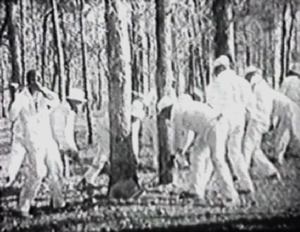
When master was first married he lived with old Mrs. Singleton, his wife's mother, and took care of her plantation. In rainy weather the slave women have some cotton weighed out for them to spin, and it is weighed when they return it, to see if they do not keep any part back. One day Mrs. Singleton said to her son William, "What's the reason Lucy's cotton does not hold out, as much as Hannah's and Affa's? I think she steals it and stuffs it into the cracks of her house, or knits it." He said he would go and see. He went and found her in the potato patch, and told her to bring out her broaches for him to see. He weighed them and found they fell short. Then he told her to cross her hands, but she was frightened, and instead of doing it, began to beg him not to whip her. He had a horse whip in his hand at the time, and struck her in the face with the butt-end of it, and knocked her eye out. We always have to cross our hand the first thing, when they call us out to whip us, or they beat us over the head and almost kill us. Lucy screamed that her eye was out, but he did not seem to notice it at all. He kept a beating because she held her hand to her eye, instead of doing as he wanted.--At last when he found her eye was out, he sent her to the house to have something done for it. His mother told her it was her own fault that her eye was out. It would teach her to cross her hands another time.
(source: http://docsouth.unc.edu/neh/runaway/runaway.html)

An ordinary day's work is two hundred pounds. A slave who is accustomed to picking, is punished, if he or she brings in a less quantity than that. There is a great difference among them as regards this kind of labor. Some of them seem to have a natural knack, or quickness, which enables them to pick with great celerity, and with both hands, while others, with whatever practice or industry, are utterly unable to come up to the ordinary standard. Such hands are taken from the cotton field and employed in other business. Patsey, of whom I shall have more to say, was known as the most remarkable cotton picker on Bayou Boeuf. She picked with both hands and with such surprising rapidity, that five hundred pounds a day was not unusual for her.
Each one is tasked, therefore, according to his picking abilities, none, however, to come short of two hundred weight. I, being unskillful always in that business, would have satisfied my master by bringing in the latter quantity, while on the other hand, Patsey would surely have been beaten if she failed to produce twice as much.
(http://docsouth.unc.edu/fpn/northup/northup.html)

The hands are required to be in the cotton field as soon as it is light in the morning, and, with the exception of ten or fifteen minutes, which is given them at noon to swallow their allowance of cold bacon, they are not permitted to be a moment idle until it is too dark to see, and when the moon is full, they often times labor till the middle of the night. They do not dare to stop even at dinner time, nor return to the quarters, however late it be, until the order to halt is given by the driver.
The day's work over in the field, the baskets are "toted," or in other words, carried to the gin-house, where the cotton is weighed. No matter how fatigued and weary he may be—no matter how much he longs for sleep and rest—a slave never approaches the gin-house with his basket of cotton but with fear. If it falls short in weight—if he has not performed the full task appointed him, he knows that he must suffer. And if he has exceeded it by ten or twenty pounds, in all probability his master will measure the next day's task accordingly. So, whether he has too little or too much, his approach to the gin-house is always with fear and trembling. Most frequently they have too little, and therefore it is they are not anxious to leave the field. After weighing, follow the whippings; and then the baskets are carried to the cotton house, and their contents stored away like hay, all hands being sent in to tramp it down. If the cotton is not dry, instead of taking it to the gin-house at once, it is laid upon platforms, two feet high, and some three times as wide, covered with boards or plank, with narrow walks running between them.

From the Turnage narrative:
Well the overseer began to weigh the cotton, and when he got around to them that didn't have cotton enough he told them to stand back until he got through weighing cotton and he would see what was the reason they could not pick more cotton. So when he got around to me he told me to stand back with the rest of them and he would see why I couldn't pick more cotton. Well when he got through weighing cotton, he took his cowhide and made one of the women lay down, and pulled her clothes over her head and made the other woman hold her and her clothes over her head. He give that woman about two hundred lashes and I thought that was enough except he was going to kill her. I could see the skin fly near about every lick he struck her. Then he made the woman that held the one he had whiped lay down and made the one he had whipped hold her clothes over her head. Then I thought if that was the kind of whipings he gave them I would not stay and take mine. So I saw my chance while he was whiping to make my escape, so I left. . . . I could hear him calling me, but I would not come back. So I was then in the woods with the wild animals and only about fifteen years of age. I suffered very much for some thing to eat.

An hour before day light the horn is blown. Then the slaves arouse, prepare their breakfast, fill a gourd with water, in another deposit their dinner of cold bacon and corn cake, and hurry to the field again. It is an offence invariably followed by a flogging, to be found at the quarters after daybreak. Then the fears and labors of another day begin; and until its close there is no such thing as rest. He fears he will be caught lagging through the day; he fears to approach the gin-house with his basket-load of cotton at night; he fears, when he lies down, that he will oversleep himself in the morning. Such is a true, faithful, unexaggerated picture and description of the slave's daily life, during the time of cotton-picking, on the shores of Bayou Boeuf.

The Cotton scale was a simple device that were hung from a tree limb. The sack was tied to the bottom of the scale and a "P", or weight, usually did the weighing and kept the records for each picker. The weight of the sack was deducted and the cotton was emptied into a wagon or truck with high side boards. (source: penhook.org)
It was rarely that a day passed by without one or more whippings. This occurred at the time the cotton was weighed. The delinquent, whose weight had fallen short, was taken out, stripped, made to lie upon the ground, face downwards, when he received a punishment proportioned to his offence. It is the literal, unvarnished truth, that the crack of the lash, and the shrieking of the slaves, can be heard from dark till bed time, on Epps' plantation, any day almost during the entire period of the cotton-picking season.
The number of lashes is graduated according to the nature of the case. Twenty-five are deemed a mere brush, inflicted, for instance, when a dry leaf or piece of boll is found in the cotton, or when a branch is broken in the field; fifty is the ordinary penalty following all delinquencies of the next higher grade; one hundred is called severe: it is the punishment inflicted for the serious offence of standing idle in the field; from one hundred and fifty to two hundred is bestowed upon him who quarrels with his cabin-mates, and five hundred, well laid on, besides the mangling of the dogs, perhaps, is certain to consign the poor, unpitied runaway to weeks of pain and agony.
Leadbelly - Pick A Bale Of Cotton