Showing posts with label African American Culture. Show all posts

Thursday, May 31, 2012

W.E.B. Du Bois and the 1900 Paris Exhibition

Horse-drawn carriage in front of corner drugstore. Georgia, ca. 1900

Included in an award-winning exhibit at the Paris Exposition, this photograph--one of 500--was part of the evidence collected under the direction of W. E. B. DuBois to illustrate the condition, education, and literature of African Americans at the turn of the twentieth century, only thirty-five years after the abolition of slavery. In his own description of the exhibit, DuBois noted that by 1900 African Americans owned one million acres of land and paid taxes on twelve million dollars worth of property. In addition to photographs about black-owned businesses like this one in Georgia, the exhibit included a number of images related to successful black businesses elsewhere. The related display in the foyer of the Library's John Adams Building features additional photographs of black businesses assembled for the Paris Exposition. [http://memory.loc.gov/ammem/aaohtml/aopart6.html]

An African American-owned drugstore in Georgia--CREDIT: "Interior view of Dr. McDougald's Drug Store." 1899 or 1900. W.E.B. Du Bois Albums of Photographs of African Americans in Georgia Exhibited at the Paris Exposition Universelle in 1900, Prints and Photographs Division, Library of Congress

Materials Compiled by W.E.B. Du Bois

At the turn of the century, W. E. B. Du Bois compiled a series of photographs for the "American Negro" exhibit at the 1900 Paris Exposition. He organized the 363 images into albums, entitled Types of American Negroes, Georgia, U.S.A. and Negro Life in Georgia, U.S.A..


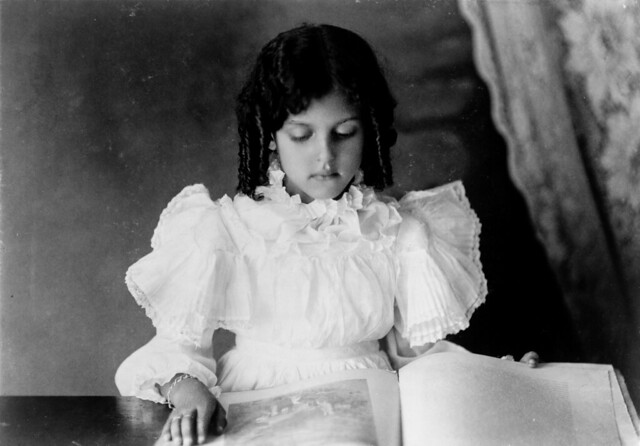
At the time, Du Bois was a professor of sociology at Atlanta University, committed to combating racism with empirical evidence of the economic, social, and cultural conditions of African Americans. He believed that a clear revelation of the facts of African American life and culture would challenge the claims of biological race scientists influential at the time, which proposed that African Americans were inherently inferior to Anglo-Americans. The photographs of affluent young African American men and women challenged the scientific "evidence" and popular racist caricatures of the day that ridiculed and sought to diminish African American social and economic success. Further, the wide range of hair styles and skin tones represented in the photographs demonstrated that the so-called "Negro type" was in fact a diverse group of distinct individuals. The one public statement Du Bois made concerning these photographs was that visitors to the American Negro exhibit would find "several volumes of photographs of typical Negro faces, which hardly square with conventional American ideas."

Du Bois's work for the American Negro exhibit was extensive and much praised. In the Spring of 1900, Paris Exposition judges awarded him a gold medal for his role as "collaborator" and "compiler" of materials for the exhibit. [http://www.loc.gov/pictures/collection/anedub/dubois.html]


NPR reported on 2 December 2003, "W.E.B. Du Bois' African-American Portraits: Collection Depicts Life for Blacks 35 Years After Civil War," by Michele Norris -- "Some foreigners will think we have nothing for the Negro but the bludgeon and revolver; we shall convince them otherwise." These are the words of B.D. Woodward, the assistant commissioner-general for the U.S.'s delegation to the 1900 Paris Exposition. He was referring to the "American Negro Exhibit," pulled together for the Paris Exposition by the young sociologist W.E.B. Du Bois.


Du Bois put on exhibit 500 photographs that symbolized black life in America 35 years after the end of slavery. And he chose with care. The photos, many of them portraits, show the trappings of middle- and upper-class life: ornate clothing, fancy hats, jewelry, confident poses. Du Bois intended the photographs to counteract stereotypes of blacks as poor, uneducated, or the victims of American racism.


Those photographs are now collected in a book, A Small Nation of People, published by the Library of Congress. Co-author and historian of photography Deborah Willis first heard about the photos during college. She didn't discover they still existed for years later. She says even today — in her 50s — she's still amazed by the stories the photos tell. NPR's Michele Norris, host of All Things Considered, talks with Willis about the collection. (source: NPR)

Friday, April 13, 2012

African American Railroad Workers: Gandy Dancers

gandy - gandy dancer - labor - rail - railroad - railroad spikes - railroad tracks - spike - spikes - track - tracks - work - worker

From Appalachia History, "Gandy Dancers" by Dave Tabler (7 January 2008) -- Before railroad work was completely mechanized in the 1950s, railroad calls were an everyday part of the track worker’s ritual. Most of these gandy dancers—the label applied to railway line workers who maintained railroad tracks and kept the rails straight—were African Americans who adapted the work call to railroad work. The term is said to be from the dance-like movements of the spikedriver, plus the name of Chicago-based Gandy Manufacturing Company, who supplied tracklining tools.


The physical movements of these railroad crew members were synchronized by a caller who sang the chants, ensuring safety and pacing while spiritually uplifting the men at their toil. Teams of eight to 14 men worked together to lay or care for the tracks. They had a rich repertoire of songs used for the many tasks required of them. Called lining track songs, these hollers are closely related to shanties. In the poetic words of folklorist Alan Lomax, the songs “sounded so wild and sweet that the mockingbirds in the nearby bushes stopped to listen, [as the] railroad moved into the Southern wilderness.”


Apparently women worked at track lining as well as men. There is a verse in one of the lining track songs that goes “Y’oughta been on the Brazos, 19-and-10, Buddy Russell drove the women like he drove the men.”

Gandy Dancers (railroad workers). Warren County, MS, August 1976.

Since the caller was never sure when the call had to stop, there was generally no narrative logic to the sequence of his calls. This transcribed lining track song verse, for example, recalls a biblical figure and is followed by several about present day women:

If I could I surely would,
Stand on the rock where Moses stood.
If I could (rap it, rap it!)
I surely would, Stand on the rock,
Where Moses stood.

I don’t know but I’ve been told,
Susie had a jelly roll.
I don’t know
But I’ve been told,
That Susie had,
A jelly roll.

Ida Red and Ida Blue,
got a gal named Ida too.
Oh boys over yonder (6 x)

Bluegrass legend Jimmie Rodgers picked up guitar, yodeling and much of the Negro country blues style from gandy dancers.

Sometimes Aaron Rodgers took his son with him out to the tracks and put him to work bringing water to the black work crews who repaired worn ties and damaged rails, cleared brush, and shoveled gravel ballast.
Jimmie Rodgers, the father of country music

The foreman sent along a command to a “caller,” who configured this order into cadences similar to what you might hear from a drillmaster. “If you really wanted to move that track, you made a sexy call,” a former gandy dancer named Cornelius Wright told the cultural researcher Maggie Holtzberg-Call. “And they had the language for it. Some callers would talk about the lingerie that a woman wore. Now that caused the crew to really shift that track.” —”In the Country of Country:People and Places in American Music” (source: http://www.appalachianhistory.net/2008/01/gandy-dancers.html)


Friday, March 16, 2012

The European Tourist And The Black Churches In Harlem


"Harlem churches see gospel tourist boom on Sundays," 9 March  2012, by Meghan Barr, Associated Press--NEW YORK (AP) — The stern warning issued from the pulpit was directed at the tourists — most of whom had arrived late — a sea of white faces with guidebooks in hand. They outnumbered the congregation itself: a handful of elderly black men and women wearing suits and dresses and old-fashioned pillbox hats.

"We're hoping that you will remain in place during the preaching of the Gospel," a church member said over the microphone at this Harlem church on a recent Sunday morning. "But if you have to go, go now. Go before the preacher stands to preach."

No one left then. But halfway through the sermon, a group of French girls made their way toward the velvet ropes that blocked the exit. An usher shook his head firmly, but they ignored him and walked out.


The clash between tourists and congregants plays out every Sunday at Mother African Methodist Episcopal Zion Church, the oldest black church in New York state. It's one of many Harlem churches that have become tourist attractions for visitors from all over the world who want to listen to soulful gospel music at a black church service. With a record number of tourists descending upon New York City last year, the crowds of foreigners are becoming a source of irritation among faithful churchgoers.

To preserve the sanctity of the service, pastors struggle to enforce strict rules of conduct. But the reality is that these visitors are often filling church pews that would otherwise remain empty — and filling the collection basket with precious dollar bills.

"Our building is in need of repair," church member Paul Henderson said after the service. "We need assistance. They're helping to sustain us."


The rules are simple enough: No photography, no flip-flops, no exiting during the sermon. They are printed on pamphlets and multilingual signs and announced at the start of every service. But they are often ignored. Ushers roamed the pews like security guards, stopping more than one person from filming on digital cameras.

"I understand that you're visiting and you want to have a memory of it," said Carlos Smith-Ramsay, who joined the church several years ago. "But when we ask you to stop and you continue to do so after the fact, that's disrespectful."


Some pastors quietly manage the crowds by requiring a written confirmation of guests from tour operators, refusing walk-in visitors. Some churches provide assigned seating for tourists, while others demand a list specifying which countries the tourists are from and whether they speak English.

And still more forbid the tour companies from advertising which churches are on the tour in hopes of curbing the number of unwanted visitors.

Tourists, mostly from Europe, outnumber congregants during a worship service Feb. 26 at the Mother AME Zion Church in New York. / Seth Wenig / Associated Press

The Rev. Gregory Robeson Smith, Mother AME Zion's pastor, refuses to work with tour operators. He doesn't even like to use the word "tourist," preferring instead to call them part of his "international congregation." And he won't turn anyone away.

"I refuse to commercialize the church worship experience," he said. "You don't pay people to experience the Lord, to come and pray. I think that's unconscionable."

Yet the tourists' presence is undeniable. At Mother AME Zion, there were nearly 200 of them, overwhelming the congregation by at least 5 to 1.

Harlem Church Tourism Is on the Rise

"They want to see what they've seen on television," said Larcelia Kebe, president of Harlem Your Way! Tours Unlimited. "They want to see what they've seen in the movies."

The gospel tour industry has exploded since it was born in the early 1980s. On a busy summer Sunday, Harlem Spirituals, one of the oldest and largest tour operators, might run 15 full buses, said Erika Elisabeth, a company vice president.

Ticket prices but can cost up to $55. Most churches get a cut of the profit. Others, like Mother AME Zion, make money by encouraging visitors to drop a suggested donation into the collection basket.

"Some of the tour operators really have made this whole thing about money," Kebe said. "It's created a problem. Because many of them are getting a lot of money from the tourists in order to get into a church. And there may be people in the church who are making a little money on the side."

During his sermon, Smith appealed to the congregation to help pay for repairs to the church's aging organ.
Harlem Church Tourism Is on the Rise
Tourists, top, outnumber congregants at the Mother AME Zion Church in New York. The New York City's Harlem churches have become popular tourist attractions for visitors from all over the world. / Seth Wenig / Associated Press

Tuesday, March 13, 2012

British Tourist Visits The Low Country of Savannah and Charleston


From the UK Telegraph Travel section, by Nigel Richardson, on 27 August 2008: "American south: A black and white story: Behind the elegant facades of Savannah and Charleston lies the ugliness of slavery. Nigel Richardson hears a neglected view of history."

It was raining so hard in Savannah, Georgia, that the patrolmen of the Chatham County Sheriff’s Department wore plastic covers on their wide-brimmed hats. Noisy cones of white water geysered from sawn-off drainpipes, turning trousers into litmus paper, and the horse-drawn carriages remained stabled all day.

With its 18th-century squares and disconcerting air of England — an England twice filtered, through time and climate, into a tropical Georgiana — Savannah is one of the finest American cities to walk round. Finest cities anywhere to see on foot, come to that. But not today. Today was for indoors.

Off Martin Luther King Jr Boulevard, we stumbled into the Ralph Mark Gilbert Civil Rights Museum, shook down our raincoats and requested the restrooms (all that rain). But the WCs weren’t marked “Men” and “Women”. The signs on the doors said “White only” and “Coloured only”, which left us, two white-faced Europeans, red-faced and dumbfounded. This was the intended effect.


The history of black America — for white people at least — has always run on parallel, all-but-invisible tracks to the history promulgated in guidebooks and mainstream museums. Sure, we've heard of Dr King. But when white people come to beautiful Savannah and its Grace Kelly-like sister, Charleston, across the state line in South Carolina, they look for, and are fed, the history of white people.

These are embodied in the architecture, older and better preserved than that of most British cities. Savannah and Charleston are two of the oldest settlements in the United States, founded in 1733 and 1670 respectively. The adventurers who made fortunes here — in many cases on the back of slavery — built big and bold, borrowing from Europe and sticking knobs on: sweeping steps, deep porches, wrought-iron scrollwork and pillars like the Parthenon. There are knot gardens — the one at the Davenport House in Savannah was designed by Penelope Hobhouse — and magnolias, and climate completes the heady effect by draping swooning arms of Spanish moss from branch and balcony.


We loved walking in Savannah and Charleston, spotting, through tropical tangle, the ghostly cousins of a Chelsea mews or a Brighton seafront terrace, reading heritage plaques on reconditioned façades and visitors’ books in hallways that smelled of floor polish. (In the Eighties, at the Green-Meldrin House in Savannah, Mrs Thatcher had signed herself, with uncharacteristic wit, “A representative of the former colonial power”.)

It’s just that in a part of America with a significant black population, and in a year when the American people may just elect their first African-American as president, it felt timely to discover some neglected narratives and points of view. In the institutionally racist days of the Deep South, for example, when every aspect of life was segregated, from shops to drinking fountains, Savannah had “one of the most significant and effective civil rights movements in the US,” according to the curator in the civil rights museum, Heru Iman.


“It was the youth here in the Sixties who integrated Savannah — sitting in at the lunch counters, demonstrating, kneeling outside white churches praying to be let in,” he told us. Activists fanned out from the basement of the First African Baptist Church in Montgomery Street carrying out “wade-ins” at whites-only beaches and boycotting racist stores. The civil rights museum features a re-creation of the lunch counter at Levy’s department store — a particular target for protesters — in which a white waitress advises a black customer, “We don’t serve your kind here”.

The nerve centre of these protests, the First African Baptist Church, claims to have the oldest black congregation in North America, dating from 1775. The present church was completed in 1859 (having been built at night because during the day the men had to work in the cotton plantations).


Our “conductor” on a tour was a shy and proud young man called Johnnie McDonald. “Martin Luther King, Jesse Jackson and Coretta Scott King [Dr King’s widow] have all preached in that pulpit,” he said. In the balcony he pointed out scratch marks on the ends of some pews that were built by slaves in the late 1700s. For many years these marks were a puzzle, but it is now thought they may be cursive Hebrew. “The slaves who came from [West] Africa knew that language,” said Johnnie.


In the basement of the church he indicated a series of holes in the wooden floor and explained that they were part of the “underground railroad”, the network of routes by which runaway slaves were spirited to freedom. “These are air holes, so they could breathe,” he said. “There’s only four feet of crawling space. You’d crawl from here and exit by the Savannah River [a quarter of a mile away].”


There are 36 sets of these holes and they are configured in the same pattern, a combination of cross and diamond which Johnnie described as a “Congo cosmogram” — another link with the West African ancestry of Savannah’s slaves.

That ancestry has survived to a surprising extent in the marshy maze of islands and causeways known as the Lowcountry, which separates Savannah from Charleston, 100 miles up the coast. Here many descendants of West African slaves and plantation labourers continue to speak Gullah, which is a mixture of English and West African words (the word Gullah is also used to mean the culture of the people who speak it).


On St Helena Island, in the heart of the Lowcountry, is the Penn Centre Historic District, a campus of former school buildings where freed slaves once studied and which Martin Luther King used as a retreat in the Sixties. Nearby we ate lunch in a plain shack called Gullah Grub, which serves authentic Lowcountry food — catfish, crab, shrimp — using old African-influenced recipes.

Shrimp gumbo — knocked back with ”swampwater”, homemade lemonade served in jam jars — hit the spot and we were soon back on Highway 17 and barrelling into the antique Manhattan that is the Charleston historic district, squeezed between the Cooper and Ashley Rivers. The rain had passed, leaving bright sunshine on stucco facades and weatherboard porches. The suits of wedding revellers — there were many — left mothball whiffs on the humid air.


It is beautiful and affluent even now, but in the 1700s Charleston was the richest city in the United States. It was also the country’s biggest slave port and the city’s wealthy white merchants used their slaves to ape the imagined lifestyles of English aristocrats.

One of the architectural highlights of Charleston is the Aiken-Rhett House, a vast antebellum confection of pillared porches that was once the home of William Aiken, a rice planter. The house has scarcely changed since 1858, which means that the slave quarters, a handful of cubicle rooms situated above kitchen and stables, are intact.


The family owned 800 slaves, of whom between 10 and 20 worked and lived in the house (these included one Dorcas Richardson, her husband and five children). In the vast living rooms of the house, there were ciphers of bygone ways of thinking and behaving: a set of Sir Walter Scott’s Waverley novels in the library; a harp standing in the middle of the old ballroom, whose red fabric wallpaper had faded to the colour of dried blood.

These southern ways were not to last. “Blacks knew that once the [civil] war started, they were on their way to freedom,” said Al Miller into the microphone of his minibus. Al, smartly turned out in checked linen trousers and white shirt, runs Sites and Insights Tours around the Charleston area, acquainting black visitors with the often invisible history of their people. As the only whites on his minibus tour, we were swept up in this different perspective.


First, he drove us south-west, off the peninsula, to James Island. “During slavery there were over 20 plantations here,” he said. We passed the Macleod Plantation where the wooden, white-painted slave quarters, standing on brick stilts, have been preserved. Here slaves grew sea-island cotton, indigo, okra and sweet potatoes and lived on grits, shrimp and gravy.

“It was the black people’s dish, the poor people’s dish,” said Al. “You ever paid an arm and a leg for it?” The rest of the bus shook their heads and laughed in agreement.

In the early 1930s George Gershwin spent time on James Island, absorbing a history and atmosphere that inspired him to write Porgy and Bess. His folk opera, including Summertime and It Ain’t Necessarily So, was based on the novel Porgy by the Charleston writer, DuBose Heyward. Driving past the old plantations — avenues of live oak trees mark where the driveways were — Al got the bus rocking and clapping by enacting the Porgy and Bess story in a kind of baritone rap: “Here comes Bess/ a slut in a red dress/ She was selling holy dust which was like cocaine/ She kept it in her girdle, she kept her money in her bosom/ She was not well liked...”


We got off the bus at James Island Presbyterian Church, where there are two cemeteries — one for black folk, one for white — separated by shrubbery. “It’s like day and night,” said Al. In the black section is the grave of Samuel Smalls, “the goat man”, upon whom DuBose Heyward based the character of Porgy. In honour of Gershwin’s Jewishness, visitors had placed stones on the top of Smalls’s headstone.

“A lot of Gullah cheechee [people] are superstitious when it comes to cemeteries,” said Al. “If you point your finger at a tombstone, it will rot off. Don’t bring cemetery dirt into your car on your shoes. Where did these things come from? Africa.”

James Island Presbyterian Church - James Island, South Carolina
James Island Presbyterian Church

Back on the historic peninsula, we cruised the golden streets. But Al screened out the antebellum and Greek revival mansions, the city’s architectural setpieces, pointing out instead the alleys, lanes and courts once lived in by poor blacks. We passed 78 Church St, where Heyward was living when he wrote Porgy, and Catfish Row, which features in the novel and opera and would now fit seamlessly into a discreet corner of Knightsbridge. “Once this was a rundown slum area,” said Al. “Catfish Row was a black tenement. Especially when Porgy was written. Not any more.”

As he drove, Al told us things that white people would rather not think about. “The average black man sold for between 800 and 1,200 dollars, which was a lot of money,” he said. “Women were made to have 10 or 15 children. They were made to have sex blindfold by the slave owners and had multiple partners.”
Jenkins Orphan Band

One of our last ports of call was in Franklin Street where we paused outside the site of the Jenkins Orphanage. Here, in the 1920s, the resident band drew on Gullah rhythms and dance steps to invent the tune and dance craze that became known as The Charleston. A plaque marks the site of the orphanage but doesn’t mention The Charleston, let alone make Al Miller’s point that “they started it here. The white folk just stole it from us.” (source: UK Telegraph)


Thursday, March 1, 2012

Freedmen's Bureau Marriage Records


Freedmen's Bureau Marriage Records

This microfilm series contains hundreds of marriage records of newly liberated African Americans in the post-Civil War era collected from 1861 through 1869 first by the Union Army and then the Freedmen's Bureau in its field offices in the Southern States and the District of Columbia, and sent to the Washington, DC, headquarters. Record types include unbound marriage certificates, marriage licenses, monthly reports of marriages, and other proofs of marriages. Record type and quantity varies with each state. (source: National Archives)

Freedmen’s Bureau Project

Installed in the Public Vault, “We the People,” this interactive lets the documents tell the story of the Bureau of Refugees, Freedmen, and Abandoned Lands—also known as the Freedmen’s Bureau. Visitors can select records grouped according to states or themes including labor, marriage, education, and land. The “Enhanced Record Viewer” lets visitors review every detail of the documents, turn pages, transcribe handwriting, and reveal interpretive hot spots that explain important elements and passages.


How to Order Microfilm Rolls

  • Online: Go to the National Archives online ordering.
  • Telephone: Credit card orders call toll free 1-800-234-8861 (301-837-2000 in the Washington, DC, metropolitan area), 8 a.m. - 4:30 p.m. EST. Visa, MasterCard, American Express, and Discover are accepted.
  • Fax: Fax your order to 301-837-3191.
  • Mail: Mail checks or money orders to the National Archives Trust Fund, P.O. Box 100793, Atlanta, GA 30384-0793. Include daytime telephone number with order.

Please identify the microfilm publication number (e.g., M1875) and the specific roll number(s) you are interested in.

Let No Man Put Asunder: Freedmen's Bureau Marriage Records

Tuesday, July 19, 2011

Gil Scott Heron - Washington D.C


Symbols of democracy, pinned up against the coast
Outhouse of bureaucracy, surrounded by a moat
Citizens of poverty are barely out of sight
Overlords escape in the evening with people of the night
Morning brings the tourists, peering eyes and rubber necks
To catch a glimpse of the cowboy making the world a nervous wreck
It’s a mass of irony for all the world to see
It’s the nation’s capital, it’s Washington D.C.

It’s the nation’s capital
It’s the nation’s capital, it’s Washington D.C.
(mmmm-hmmm)

May not have the glitter or the glamour of L.A.
May not have the history or the intrigue of Pompeii
But when it comes to making music, and sure enough making news
People who just don’t make sense and people making do
Seems a ball of contradictions, pulling different ways
Between the folks who come and go, and one’s who’ve got to stay
It’s a mass of irony for all the world to see
It’s the nation’s capital, it’s Washington D.C.

It’s the nation’s capital
It’s the nation’s capital, it’s Washington D.C.

Seems to me, it’s still in light time people knifed up on 14th street
Makes me feel it’s always the right time for them people showing up and coming clean
Did make the one seem kind of numb


Gil Scott Heron - Washington D.C

Saturday, July 9, 2011

Degenerate Music

"Degenerate Music - a detailed statement by State Secretary Dr. Hans Severus Ziegler, general manager of the German National Theater in Weimar.
"
The Kampfbund für deutsche Kultur (KfDK, or Fighting League for German Culture) was founded in 1929 by Alfred Rosenberg, with the aim of promoting German culture while fighting the cultural threat of liberalism. Ironically, this organisation – best known for disrupting concerts and music classes, insulting and threatening artists, and distributing inflammatory and anti-Semitic pamphlets – was originally aimed at the nation’s elite. Hitler and other early Nazi leaders were searching for a way beyond mob-style violence, and decided to create a cultural organisation as a way to court the intelligentsia.

During the first years of its existence, the relatively small and regionally-organised KfdK attracted many intellectuals and, increasingly, musicians. With its conservative agenda of fighting ‘degenerative Jewish and Negro’ influences, it spent much energy promoting the ‘cleansing’ of museums, university faculties, and concert programmes of unwanted artists. In general, the KfdK appealed to radical nationalists and anti-Semites, to those who felt betrayed by defeat in World War I and by the Treaty of Versailles, and to those who felt outraged by the leftist, modernising and ‘cosmopolitan’ tendencies of the Weimar Republic.


The KfdK was initially not very aggressive, relying instead on lectures, intimidation and propaganda. After Hitler’s rise to power in 1933, it became increasingly violent, with the support of the Stormabteilung (SA, Storm Troopers, or brown shirts) changing both its techniques and its membership pool. The KfdK had its own orchestra, which was selected to perform a special concert for Hitler’s birthday. It also acquired control over the important music journal Die Musik, which gave it an official outlet for racist and nationalist opinions on music.
(http://holocaustmusic.ort.org/politics-and-propaganda/third-reich/kampfbund-fr-deutsch/)
Centre Section of the triptych Grosstadt, 1927-8, by Otto Dix (1891-1969). It is an evocation of the Gershwin (1898-1937) period - the Jazz Age. This age and the kind of music (Jazz) were condemned by the Nazis as decadent and racially degenerate
Indeed, the Nazis were so fearful of African and African-American culture (particularly jazz) that in 1930 a law was passed that was titled "Against Negro Culture." In other words, the Nazis were clearly aware of the potential for popular cultural forms to taint what they considered to be genuine Aryan culture—whether this taint was a result of marriage or of music. As a consequence, the Germans often conflated stereotypes of African-American musical performers with those of Jews and Africans into some of their most heinous propaganda pieces.
Two of the most infamous and well-known Nazi propaganda artworks were posters which advertised cultural events. In a poster advertising an exhibition of entartete musik (degenerate music), for example, the viewer is confronted with a dark-skinned man in a top hat with a large gold earring in his ear.
This distorted caricature of an African homosexual male in black face playing a saxophone has a Star of David clearly emblazoned on his lapel. To the National Socialists, the most polluting elements of modern culture were represented by this single individual. They were suggesting that anyone who listened to jazz (or enjoyed other forms of art that they judged to be degenerate) could be transformed into such a barbarous figure.

Nazi propaganda poster titled "LIBERATORS" that epitomizes many perennially-recurring themes of anti-Americanism, by the Dutch SS-Storm magazine that then belonged to a radical SS wing of the National Socialist Movement in the Netherlands (1944)
Toward the end of the war, the Nazis circulated posters in a somewhat desperate attempt to get their "white European brothers" to join their cause. In one infamous poster, the designer depicted a multi-armed monster clutching two white American women. Attached to his muscle-bound body are iconic references to the Ku Klux Klan, Judaism (the Star of David), boxing gloves, jazz dancing, and a lynching noose. At his middle is a sign that reads in English "Jitterbug—the Triumph of Civilization." This poster was directed at white European men, and it urged them to protect their wives and their culture against a coming invasion of primitive, inferior American men. As occurred in the poster that warned against jazz, this image conflated stereotypes of the Jew with that of the African in an attempt to frighten white (Aryan) Europe and America into joining their cause. The exaggerated racist stereotypes served to strengthen and amplify widely accepted attitudes regarding racial and ethnic superiority. With these images, the National Socialists were offering their justifications as to why certain groups should be feared and thus eliminated.
(http://www.enotes.com/genocide-encyclopedia/art-propaganda)

Saturday, July 2, 2011

Mississippi Cotton Picker: Charlie Pride

Charlie Pride

One of 11 siblings born into a poor, Mississippi-based sharecropping family, Charley Pride was raised on a cotton farm, where he was forced to work for most of his childhood. At an early age he developed a passion for country music, purchasing his first guitar at the age of 14 and teaching himself to play by listening to radio broadcasts of the Grand Ole Opry. After turning seventeen he enrolled in a baseball training camp, eventually joining the American Negro League and playing for teams in Detroit, Memphis and Birmingham.

Two years in the army interrupted his baseball ambitions, but after his discharge in 1958 he resumed his involvement with semi-professional leagues, supporting himself during the day through various manual labor jobs. His hopes of moving into the major leauges were ultimately blocked by the racist attitudes pervasive at the time, and by 1962, after being denied a tryout for the New York Mets, he left the sport behind in favor of his music.
Charley Frank Pride was born in Sledge, Mississippi, on March 18, 1938. (population 489, from the 2010 US census)

Throughout his involvement in baseball, Pride had continued to develop his musical skills, performing on the bus between games for his teammates and occasionally joining different bands onstage. At the urging of country performers Red Sovine and Red Foley, he traveled to Nashville in 1963 and, despite initial disinterest from the locals, secured a management contract with Jack Johnson.
"I'm not a black man singing white man music, I am an American singing American music. I worked out those problem years ago, and everybody else will have to work their way out of it too."
A year later a demo was cut with producer Jack Clement, and the two songs -- The Snakes Crawl At Night and Atlantic Coastal Line -- attracted the attention of RCA Nashville chief Chet Atkins, who quickly signed the singer to a recording contract. Snakes was chosen as the first single in 1966, making a strong showing in the charts, as did its two follow-up releases later in the year, Before I Met You and Just Between You And Me. Due to concern about a backlash against a black country singer, Pride's skin color was kept concealed at the beginning of his career -- and live performances did result in some awkward moments when audiences saw him for the first time. In time the subject of his race became irrelevant, and Pride established himself as one of the leading country acts of his time, topping the country charts 36 times between 1969 and 1984.


In 1986 Pride discontinued his long association with RCA, which was now directing most of its resources towards young, up-and-coming performers. A deal was signed with the Opryland label 16th Avenue, with whom he released several reasonably successful records before the label ceased to exist. An arrangement was subsequently made with Honest Entertainment in the 1990s, but by this time Pride's recording career was largely over. Pride continued to be active as a performer, however, as well as pursuing numerous business interests, amongst which are the Charley Pride Theater in Missouri, majority holdings in the First Texas Bank, his publishing company The Pride Group, and a variety of real estate and broadcasting properties. An autobiography was published in 1994 (source: http://www.nndb.com/people/024/000023952/)


Charlie Pride: Cotton Fields


Charlie Pride: Mississippi cotton pickin' Delta town w/Lyrics

HOME

HOME
Click here to return to the US Slave Home Page