Showing posts with label Jim Crow. Show all posts

Wednesday, May 2, 2012

African-American Education in West Virginia

Anderson Elementary. One-room African-American school, circa 1939.


From the West Virginia Encyclopedia, an article discussing African-American Education in West Virginia by Ancella R. Bickley, on 19 October 2010 -- Early black education in West Virginia developed through a combination of forces: self-help efforts; the aid and support of benevolent white people; support from the U.S. Freedmen’s Bureau and missionary associations; and the activities of public school officials. By the middle of the 20th century, on the eve of desegregation, the state’s African-American schools had become a well-functioning, effective system.

When the first West Virginia legislature met in 1863, it agreed to educate ‘‘free colored children,’’ but the proposition was left unfunded. With the condition that white and black children should not be taught in the same schools, West Virginia’s second constitution in 1872 affirmed the state’s commitment to the education of African-American children. Although most school boards cooperated, court action sometimes had to be undertaken or threatened to force some to provide the needed support for black education.


Maben Grade School. African-American school, Widen.


Sumner School, the first school for black children in West Virginia, a self-help effort, opened in Parkersburg in 1862. After 1865, education for West Virginia’s black citizens was undertaken wherever there were enough students. Schools were under way in 18 communities by 1868, including Parkersburg, Wheeling, Clarksburg, Charleston, Lewisburg, Martinsburg, Charles Town, and Malden. These early schools were held wherever space could be found, sometimes in homes and churches. In some instances the schools were private and served both adults and children.

Among the major difficulties was the dearth of teachers. In the beginning, whites served, as did black teachers from neighboring states, particularly Ohio. The first formal effort to train black teachers in West Virginia came at Storer College in Harpers Ferry. The college was begun in 1865 by the Freewill Baptist Church. In 1881 the state agreed to contract with Storer to train African-American teachers. Until the state’s black land grant college, West Virginia Colored Institute (now West Virginia State University), was founded in 1891, Storer College was the only institution in the state preparing blacks for the teaching profession. Later, Bluefield Colored Institute (now Bluefield State College), established in 1895, joined the other two in this mission. These institutions also provided secondary education.


Widen School. African-American students outside school,

As the railroads and mines drew more black people into West Virginia in the late 19th and early 20th centuries, the need for public education increased. Initially, the school law permitted the establishment of a black school wherever there were 30 black students between the ages of six and 21. Over the years, this number was reduced until a school could be started with 10 students of school age. With this reduction in the number required, elementary schools sprang up in many areas. One of the earliest was the Clarksburg School, for which a construction bid was accepted in 1868. Statewide, there were 207 black schools and 278 teachers serving 7,886 students in 1902. By 1924, there were 453 elementary and junior high schools.

Black high school education began slowly. The first institution to offer such instruction was the Sumner School in Parkersburg, which added high school courses to its curriculum in 1885. This was followed by high schools in Clarksburg, Charleston, and Huntington. By 1923, the number of black high schools had increased to 21. In some cases, cooperative arrangements allowed African- American students to cross county lines to attend high school; for example Preston County students attended in Monongalia County. In other instances students either ended their education at the eighth grade, boarded with families in areas where there were high schools, or daily traveled long distances by train, bus, or streetcar.

Weston Colored School.

In addition to black public education, several private educational efforts were attempted. Storer College continued in Harpers Ferry until 1956; St. Phillips Academy was operated for a time by St. Phillips Episcopal Church in Charles Town; the Baptist State Association operated a school at Hilltop in Fayette County; and Catholics operated St. Peter Claver in Huntington.

In 1919 the state created the position of state supervisor of Negro schools and appointed a Negro Board of Education. In 1933 assistant superintendents of Negro education were appointed in counties having 50 or more black teachers. In addition to the push for more voice in the operation of their schools, blacks also struggled for adequate buildings and materials, for equal salaries for teachers, and for a full nine-month school year.

Weston Colored School.

By 1950, the West Virginia public school system provided separate education for more than 19,000 of the state’s black youth, grades 1–12. Included were schools for black students in institutional settings, including the deaf and blind. Higher education through the baccalaureate level was available at Bluefield State College and West Virginia State. Academics were enriched by strong extracurricular offerings such as dramatics, music, art, various clubs, and athletics. Statewide competitions, tournaments, and exhibitions helped to knit together black communities across West Virginia. The black colleges, elementary and junior and senior high schools, and their administrators and teachers are remembered and honored by their alumni for helping them to develop a strong educational background, basic values, community spirit, and lifelong friendships.

When the 1954 Brown v. Board of Education Supreme Court decision ended segregated schools in the United States, West Virginia began dismantling its system of black education. By the mid-1960s, the process was essentially complete, with African-American students and teachers participating in integrated public schools. [source: West Virginia Encyclopedia by Ancella R. Bickley.  on October 19, 2010]

Thursday, April 26, 2012

"Jim Crow" Passenger Railroad Car Comes Back to Life


From UT San Diego, "Jim Crow era recalled in rail car project: Passenger car gives glimpse of country’s segregated past," by Karen Pearlman, on 8 February 2012 -- Thousands of miles were put on the Rockdale, Sandow & Southern #3 wooden railroad car, and with that, thousands of stories were no doubt told by the people who were part of its work in rural Texas.

Thousands of trips later, this brown beauty, one of the original “Jim Crow” rail cars that segregated black and white passengers, now sits on shiny metal wheels at the Pacific Southwest Railway Museum in rural San Diego County.

Volunteer Frank Stites walked along the outside of 1886 Rockdale Sandow & Southern #3 "Jim Crow" railroad car that was restored by volunteers at the Pacific Southwest Railway Museum in Campo, CA..

The museum obtained the car in 1976 and started restoring it in 1999.

Since then, a group of dedicated volunteers, led by Ted Kornweibel Jr., a professor emeritus in African American history at San Diego State University, worked countless hours to restore, rebuild and replace parts — and recapture part of the past through this rail car, which was built in 1886 in Pennsylvania.

In time for Black History Month, the museum will display this special car and a photographic exhibit free to the public. An inaugural ceremony is set for 1 p.m. Feb. 25 inside the museum’s display building at 750 Depot St., Campo.

Volunteers Frank Stites, left, and Larry Rose, right, in the "white" section of the car.

This car may already be familiar to some.

For years its home was 20th Century Fox in Los Angeles, and the car had parts in several Hollywood movies, including the Otto Preminger-directed “Centennial Summer,” “The True Story of Jesse James” starring Robert Wagner, and Elvis Presley’s “Love Me Tender.”

But for Kornweibel, who taught at SDSU from 1977 through 2005 and has been a volunteer at the museum for more than 30 years, those stars have nothing on this rail car.

The San Carlos resident has a deep love in all aspects of this subject and is the author of “Railroads In The African-American Experience: A Photographic Journey.”

The book offers a detailed look (more than 500 pages, including 200 photos) at the history of the railroad business and the way it affected black Americans, many of whom created the tracks and many others of whom worked on board the trains.


This particular car made only 7-mile journeys, but it had all the hallmarks of trains that went longer distances, including partitions. The car has a section with eight seats for black passengers and a section with 22 seats for white passengers.

The bathroom and water fountain are both located in the white area, meaning that nonwhites had to go without either on their journey. On trains such as this, the dining area was also off limits to black passengers.

“Separate is not equal,” Kornweibel said, then adds, “I am just stoked anytime someone recognizes the issue of segregation. It’s now a fading memory, thankfully. Many black people have seen the car and said, ‘I didn’t experience that,’ but the oldsters... the stories that they can easily tell... ‘I remember visiting Grandma, we had to bring own food with us, sandwiches wrapped in string because they wouldn’t let us eat in the dining car.’ It breaks my heart to hear that but that’s how it was.”

Only a handful of museums display a restored segregated car, none west of the Mississippi, according to Kornweibel. No other museum has a fully restored car of this kind as well as the accompanying exhibit, which depicts a 180-year scope of black railroading.

The car has an open platform with hundreds of beautiful aquamarine squall glass panes that have a rosette design. Red plush upholstered walkover seats in the passenger area look inviting and comfortable.

Larry Rose, the museum’s facilities director, said it’s difficult for him to pick out his favorite part of the Jim Crow car — much less his favorite of the 80 cars and 20 locomotives on site — but he said he is proud of all the work that the volunteers do, even if few of the cars actually do any physical moving.

He also said he fears that the youth of today are losing interest in trains and has noticed fewer young visitors to the museum annually. He and volunteer Frank Stites say they hope that this exhibit will attract people of all ages.
photo

Rose and Stites carpool to Campo from La Mesa and San Carlos almost daily to work on trains. Stites is a retired professor of American history who sees the big picture of how the trains are a part of every American’s past.

“A group of black storytellers came out here a couple of years ago,” Stites recalled. “I took them through the (Jim Crow) car and they told me how the car makes it real for them, how it’s much better than a picture, and tells more than 1,000 words. They know this is the real McCoy. We’re making it real. This is a great opportunity to illustrate the past and teach the present.” [source: http://www.utsandiego.com/news/2012/feb/08/jim-crow-era-recalled-in-rail-car-project/]

Behind the "Colored" section of the train was the baggage area of the car.

The Pacific Southwest Railway Museum in San Diego is restoring a vintage railroad car to its condition during a controversial period of American History. Built in 1886 in Pennsylvania the car was sold and used on the Rockdale, Sandow and Southern railroad as a "Jim Crow" car, segregating black from white passengers from 1936 to 1945 when it was sold to 20th Century-Fox. It was used in films that included "Love Me Tender" with Elvis Presley, ' Centenial Summer," "The True Story of Jesse James" and "Raid." The museum obtained the cars in 1976 and restoration started in 1999.

Wednesday, April 18, 2012

A Visit to a Jim Crow School


Fifty years ago, Ray Sprigle of the Post-Gazette posed as a black man to experience firsthand what life was like for 10 million people living under the system of legal segregation known as Jim Crow.

As he wrote in his 21-part series, "I Was a Negro in the South for 30 Days": "I quit being white, and free, and an American citizen when I climbed aboard that Jim Crow coach. . . . From then on, until I came up out of the South four weeks later, I was black, and in bondage — not quite slavery but not quite freedom, either.’’ -- Ray Springle


A Visit to a Jim Crow School, by Ray Sprigle -- Here on the outskirts of the pleasant, thriving little Georgia town of Bluffton in Clay county I go to school again. And what a school! This dilapidated, sagging old shack, leaning and lop-sided as its makeshift foundations give way, is the lordly white’s conception of a schoolhouse for Negroes.

This leaking old wreck of a shanty must be nearly half a century old. The warped old clapboards are falling off. Holes bigger than your hand give permanent cross-ventilation. There are no desks, no seats but rude benches. Two rough tables serve as desks. A few dog-eared school books are scattered on the tables. A "blackboard,"’ apparently home made, just a sheet of cardboard about two by three feet, is nailed to the bare studding.


Only redeeming feature of this thing called a school is the teacher. Tall and spare, gentle and soft spoken, earnest and intelligent, she reminds you of a typical New England school-marm with her sharp aquiline features - except for a deeper sun tan than one could ever get on a beach.

Has Taught Three Generations

For 27 years, she tells us, she has taught this little school. Three generations of little black American citizens have picked up the rudiments of an education under her kindly tutelage. She is actually proud of this school.

"The state furnishes us free school books now," she says. "When I started in 27 years ago the only text book we had was my Bible that I brought to school. Some of the children were able to buy text books as the years went on and the whole class used them."

There are 38 children in her school, divided into seven grades. She teaches them all. If all of her 38 scholars came to school at one time the little room would be crowded to suffocation. But now there is only a handful of little tots. All the bigger girls and boys are "excused." This is cotton chopping time and cotton is more important than learning. The bigger boys and girls are also "excused" at plowing and planting time and again in the fall when it’s time to pick the precious cotton. The school term is eight months, she says. But only the little tots ever see eight months of schooling.


Salary Is $112 a Month

Miss Minnie Dora Lee draws a salary of $112 a month. When she started and for many years afterward she got $20 a month. It has taken the full 27 years of her service to climb to that magnificent figure of $112.

Miss Minnie Dora Lee’s school is typical of Negro schools in Georgia and the deep South. We could have found many far worse and did. Some few are better. What sets her school ahead of most of the other one-room shanties in the South where little black children get their three R’s is Miss Minnie Dora Lee herself. In her 27 years as a school teacher, Miss Lee has learned, too. Hundreds of southern Negro schools have teachers who never went beyond the sixth or seventh grades and are wholly unfitted for teaching. I encountered more than one instance where the leading white cotton planter of the district appointed the teacher of the Negro school. Usually on the basis that her father raised more cotton "than any other nigger I’ve got on the place."

Catchword of your lordly, lily-white representative of white supremacy to justify all the phases of segregation with its inevitable train of discrimination, oppression, brutality and petty chicanery is the term "separate but equal."


A Brazen, Cynical Lie

So far as the education of little black American citizens is concerned, that "equal" in the South’s pet catch phrase is a brazen, cynical lie and every white man knows it.

No Negro school in all the South even begins to compare in any way with its companion white school. True enough, I didn’t check them all. But I did see scores of them. And I asked literally hundreds of Negroes to help me find at least one Negro school equal to a white one in the same area. Not only did none of them know of such an instance but even the most radical opponents of segregation didn’t even hope for, expect or ask for such a miracle. Any of them would be glad to settle for just ordinarily decent schools for their children.

Right here in Clay county is a typical illustration of the bitter, tragic hypocrisy of that "separate but equal" lying catchword. Ride with me about a thousand yards down the highway past Minnie Dora Lee’s disintegrating old rookery. On the edge of Bluffton is the school for the white folks - the last word in small town educational plants.


A neat brick structure, with a wing on either side - at least six rooms. Grounds beautifully landscaped, a spreading playground crowded with all the latest equipment that money can buy.

Minnie Dora Lee’s school couldn’t cost more than $1,000 even today. This white folks’ school didn’t cost a cent less than $100,000. "Separate but equal." It’s not even funny. --[source:  Ray Springle, Post-Gazette]


Thursday, April 5, 2012

'Schoolhouse': Rosenwald Schools In The South

'Schoolhouse': Rosenwald Schools In The South

From NPR on March 11, 2012 -- Julius Rosenwald and Booker T. Washington came from vastly different backgrounds.

Rosenwald, president of Sears, Roebuck and Co., was one of the richest men in America; Washington rose out of slavery to become a civil rights leader. But their meeting led eventually to the construction of thousands of schools for black children in the segregated South.

Stephanie Deutsch tells the story of their friendship in her new book You Need a Schoolhouse: Booker T. Washington, Julius Rosenwald, and the Building of Schools for the Segregated South.


Author Stephanie Deutsch

When Rosenwald decided to start giving his money away, he started within the Jewish community — funding schools and hospitals. But Deutsch tells Guy Raz, host of weekends on All Things Considered, that a 1908 race riot in Rosenwald's hometown of Springfield, Ill., made him think twice about the treatment of African-Americans in the United States.

"In one of his speeches, he said, 'We like to look down on the Russians because of the way they treat the Jews, and yet we turn around, and the way we treat our African-Americans is not much better,'" Deutsch says.
Julius Rosenwald and Booker T. Washington

After they met, Washington suggested to Rosenwald the idea of constructing the new schools, Deutsch says.

"His big belief was that education was the building block on which people would build better lives and stronger lives," she says.

Beyond serving students, the schools became civic centers for the communities they served. Deutsch says they were built to be flexible.

"At a time when blacks were excluded from public libraries, public playgrounds, and many other public facilities, the Rosenwald school was really theirs," she says.

You Need a Schoolhouse

Building the schools was a joint effort.

"The idea of partnering with the community was very much in keeping with Rosenwald's thinking," Deutsch says.

Many of the communities served by the schoolhouses were already trying to get schools for their children, she says. So, they often contributed labor and materials.

Deutsch says when segregation ended, the consolidated school was usually placed in the formerly whites-only building. She says many of the schools were boarded up or left to fall apart. One even became the county dump. But Deutsch says there has been interest in recent years in renovating and restoring the schools.

"Alumni are looking at their schools and saying, I want to preserve that school that was such an important part of my life," Deutsch says. (source: NPR)

** Read more about the Rosenwald Schools on the US Slave Blog **

TCB - Stephanie Deutsch, Author - You Need a Schoolhouse - Segment 1


Wednesday, April 4, 2012

Disenfranchising American Voters Mississippi-style


In Mississippi, the method of controlling black votes and regulating their economic and public lives by full-scale and openly brutal violence was known as the First Mississippi Plan of 1875. Whites openly resorted to violence and fraud to control the black vote, shooting down black voters "just like birds." This ruthless and bloody revolution devastated the black vote in Mississippi, and fully 66 percent of the blacks registered to vote in the state failed to cast ballots in the presidential election of 1880. Of those who did vote, almost 50 percent voted Democratic rather than face the wrath of whites in the state. The white vigilantes made no attempt to disguise themselves as in the days of the Ku Klux Klan, and so complete was their victory that the Republican governor fled the state rather than face impeachment charges by the newly elected legislature.


When Mississippi began formally and legally to segregate and disfranchise blacks by changing its state constitution and passing supportive legislation in the 1890s, knowing observers referred to these legal moves as the Second Mississippi Plan. The principal difference between the two plans is that the latter did not resort to violence in order to eliminate the black vote. The Second Mississippi Plan did it by law. Other states followed suit to one degree or another, with only a few black gerrymandered districts in North Carolina, Alabama, and Mississippi witnessing significant and continuing black political autonomy up to 1900.


Almost all the southern states passed statutes restricting suffrage in the years from 1871 to 1889. Various registration laws, such as poll taxes, were established in Georgia in 1871 and 1877, in Virginia in 1877 and 1884, in Mississippi in 1876, in South Carolina in 1882, and in Florida in 1888. The effects were devastating. Over half the blacks who voted in Georgia and South Carolina in 1880 vanished from the polls in 1888. The drop in Florida was 27 percent. In places like Alabama, for example, where blacks equaled almost half the population, no African Americans were sent to the legislature after 1876. (source: Jim Crow History)

Friday, March 16, 2012

Emanuel AME Church of Charleston

Mother Emanuel AME Church in Charleston, SC

Emanuel African Methodist Episcopal Church – Overview

The Gothic Revival building that houses the Emanuel AME Church in Charleston is a testament to the determination of the church's congregation and earliest founders. The present day structure with its signature steeple was built in 1891, replacing an earlier wooden church from 1872 that was damaged in the Charleston Earthquake of 1886. Many of the brick and marble panels were restored between 1949 and 1951.
EMANUEL AME CHURCH

Documenting the American South--The roots of the Emanuel AME Church date back to 1816, when Morris Brown organized a withdrawal of the Charleston Methodist Episcopal Church's black members over a burial ground dispute. The newly-formed congregation quickly established themselves as an African Methodist Episcopal church, a denomination that was founded earlier in Philadelphia.


Brown was eventually jailed for violating laws restricting free and enslaved blacks from holding religious gatherings without white supervision. Then, after the first incarnation of the church was burned under a cloud of suspicion over a suspected slave uprising, the congregation continued to worship until 1834, when all-black churches became officially outlawed. After a period of underground worship, the church formally reorganized publicly in 1865 and adopted the Hebrew name Emanuel, meaning "God is with us".

The church is the oldest AME church in the South and has the oldest black congregation south of Baltimore, Maryland. (http://www.sciway.net/tourism/emanuel-ame-church.html)

Tuesday, March 13, 2012

The Great Charleston Earthquake, 1886

Charleston City Paper's article, "Tracing discriminatory laws to the earthquake of 1886: The Birth of Jim Crow," by Will Moredock--We've seen it before: When disaster strikes, people pull together as friends and neighbors in a common cause — at least for a while. Then the old rivalries and social fissures reappear, more virulent than ever.

This was the pattern when Hurricane Katrina drowned New Orleans in 2005. A brief surge of unity and good will prevailed, then the old racial and class divisions reasserted themselves. Susan Millar Williams saw it in her McClellanville community in the wake of Hurricane Hugo in 1989. When relief goods started arriving, blacks and whites quarreled over who should receive them.


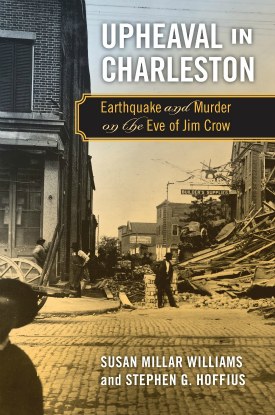
With this experience and what she had read about the 1886 Charleston earthquake in mind, Williams set out with fellow historian Stephen G. Hoffius to explore the social and political ramifications of that long-ago disaster. The recently released Upheaval in Charleston: Earthquake and Murder on the Eve of Jim Crow is the product of their 12 years of work, and the picture they paint of the Holy City is not flattering.

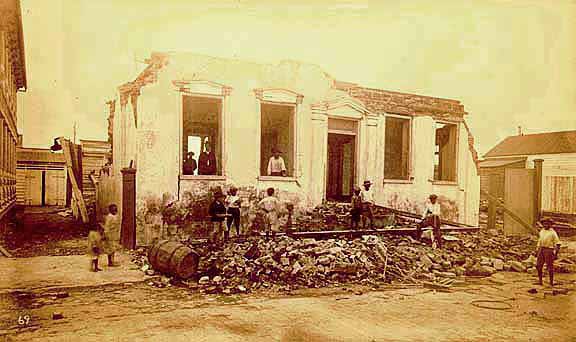
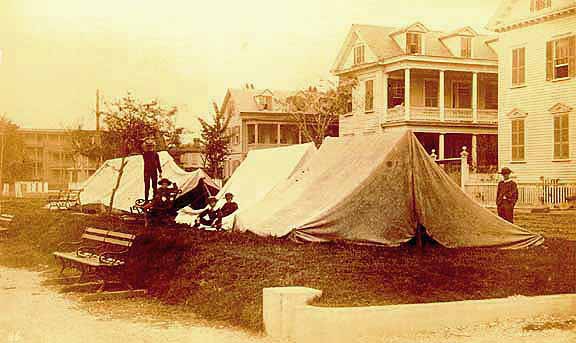
When buildings started swaying and toppling in the early evening of Aug. 31, 1886, the people of Charleston rushed into the streets, wailing and screaming, as fires broke out around the city. They headed instinctively toward Marion Square, where they would be safe from fire and falling buildings.


Blacks and whites set up camps on opposite sides of the square, Williams told me recently. "That first night ... blacks and whites joined in singing and praying together. It lasted about 24 hours."

In the immediate aftermath of the quake, Charlestonians sought to make sense of what had befallen them. Many middle-class and upper-class whites were happy to accept a rational explanation for the catastrophe, if only because it let them off the hook for any metaphysical responsibility. On the other hand, poor whites and blacks, steeped in their primitive religiosity, were eager to believe that this was God's punishment on a wicked city.

1886 Charleston, SC Earthquake Photo

But what sins had so outraged the Almighty? A white Methodist minister intoned to his congregation: "Ice cream gardens, music, and dancing are the popular amusements for the Sabbath afternoons in Charleston." Excursionists, he said, sailed about the harbor on Sundays in "gay and frivolous" abandon.

A white woman told a newspaperman that her sins had brought on her sudden homelessness. "Yes," she said. "I was very worldly. I loved fine dresses and dancing and good living, and this is my punishment."

Blacks, who at the time made up 60 percent of Charleston's population, had a very different understanding of God's wrath. They saw the destruction of this proud old city as its reward for centuries of slavery and oppression. Street preachers sang out and shouted warnings through the night. This quake was the harbinger of apocalypse and judgment. The world would soon be destroyed and Revelation fulfilled.

"The sounds of blacks preaching and singing could be extremely disconcerting to whites," the authors write. "Deprived of other ways to communicate freely, black men and women had long used worship services as a way to register protest ... Now, as the voices of freedmen and their descendants rang out across the city in 1886, whites looked for ways to silence them."


Believers sang and writhed on the ground, as preachers exhorted, "Oh, Gabriel, turn that horn to the land of Egypt on the miserable sinners and not on we."

Williams and Hoffius add, "For whites who couldn't escape such speeches day in and day out, it didn't take too much imagination to suspect that the 'miserable sinners' in question might not be Egyptian."

White citizens and police soon intimidated the preachers and singers into silence.

sc1
The damaged portico of Hibernian Hall, 105 Meeting St. - Charleston Library Society
(J. B. Macelwane archives, Saint Louis University)

There were other stresses to the fragile social fabric. As relief poured into the city from around the country, "Affluent whites insisted that providing free food and shelter to the poor would lead to moral breakdown," the authors write. And with the rebuilding of the city, black artisans and craftsmen were able to command high wages, acquiring wealth and status and threatening the social order. As Williams says, "Charlestonians wanted to preserve the status quo above all else. They did not want anyone to get ahead."

In fact, the authors argue in Upheaval in Charleston that the earthquake of 1886 ultimately helped bring out the Jim Crow laws a decade later.

"The earthquake stripped away the edifice of society. It hardened people's hearts," Williams says. "By the end of 1886, any hope of racial conciliation was over." (source:Charleston City Paper )

"Earthquake, August 31st, 1886. No. 634. Aiken and Vicinity. Wrecked at Langley." - Photographed by J.A. Palmer, Aiken, S.C.

The South Carolina Railway company train was washed from the track by a four-foot high wall of water when the earthquake burst the mill-dam at Langley Pond near Aiken, SC. The train's black fireman, a Mr. Ivie, died in the wreck. Another train owned by the same company was washed from the track near Horse Creek in Aiken County closer to Augusta, GA., when a mill-dam there also fractured because of the earthquake and sent an eight-foot-high wave of water surging against the locomotive, tender, and its train cars. (South Caroliniana Library Archives)

Charleston: "Upheaval in Charleston" Authors Susan Millar and Stephen Hoffius

British Tourist Visits The Low Country of Savannah and Charleston


From the UK Telegraph Travel section, by Nigel Richardson, on 27 August 2008: "American south: A black and white story: Behind the elegant facades of Savannah and Charleston lies the ugliness of slavery. Nigel Richardson hears a neglected view of history."

It was raining so hard in Savannah, Georgia, that the patrolmen of the Chatham County Sheriff’s Department wore plastic covers on their wide-brimmed hats. Noisy cones of white water geysered from sawn-off drainpipes, turning trousers into litmus paper, and the horse-drawn carriages remained stabled all day.

With its 18th-century squares and disconcerting air of England — an England twice filtered, through time and climate, into a tropical Georgiana — Savannah is one of the finest American cities to walk round. Finest cities anywhere to see on foot, come to that. But not today. Today was for indoors.

Off Martin Luther King Jr Boulevard, we stumbled into the Ralph Mark Gilbert Civil Rights Museum, shook down our raincoats and requested the restrooms (all that rain). But the WCs weren’t marked “Men” and “Women”. The signs on the doors said “White only” and “Coloured only”, which left us, two white-faced Europeans, red-faced and dumbfounded. This was the intended effect.


The history of black America — for white people at least — has always run on parallel, all-but-invisible tracks to the history promulgated in guidebooks and mainstream museums. Sure, we've heard of Dr King. But when white people come to beautiful Savannah and its Grace Kelly-like sister, Charleston, across the state line in South Carolina, they look for, and are fed, the history of white people.

These are embodied in the architecture, older and better preserved than that of most British cities. Savannah and Charleston are two of the oldest settlements in the United States, founded in 1733 and 1670 respectively. The adventurers who made fortunes here — in many cases on the back of slavery — built big and bold, borrowing from Europe and sticking knobs on: sweeping steps, deep porches, wrought-iron scrollwork and pillars like the Parthenon. There are knot gardens — the one at the Davenport House in Savannah was designed by Penelope Hobhouse — and magnolias, and climate completes the heady effect by draping swooning arms of Spanish moss from branch and balcony.


We loved walking in Savannah and Charleston, spotting, through tropical tangle, the ghostly cousins of a Chelsea mews or a Brighton seafront terrace, reading heritage plaques on reconditioned façades and visitors’ books in hallways that smelled of floor polish. (In the Eighties, at the Green-Meldrin House in Savannah, Mrs Thatcher had signed herself, with uncharacteristic wit, “A representative of the former colonial power”.)

It’s just that in a part of America with a significant black population, and in a year when the American people may just elect their first African-American as president, it felt timely to discover some neglected narratives and points of view. In the institutionally racist days of the Deep South, for example, when every aspect of life was segregated, from shops to drinking fountains, Savannah had “one of the most significant and effective civil rights movements in the US,” according to the curator in the civil rights museum, Heru Iman.


“It was the youth here in the Sixties who integrated Savannah — sitting in at the lunch counters, demonstrating, kneeling outside white churches praying to be let in,” he told us. Activists fanned out from the basement of the First African Baptist Church in Montgomery Street carrying out “wade-ins” at whites-only beaches and boycotting racist stores. The civil rights museum features a re-creation of the lunch counter at Levy’s department store — a particular target for protesters — in which a white waitress advises a black customer, “We don’t serve your kind here”.

The nerve centre of these protests, the First African Baptist Church, claims to have the oldest black congregation in North America, dating from 1775. The present church was completed in 1859 (having been built at night because during the day the men had to work in the cotton plantations).


Our “conductor” on a tour was a shy and proud young man called Johnnie McDonald. “Martin Luther King, Jesse Jackson and Coretta Scott King [Dr King’s widow] have all preached in that pulpit,” he said. In the balcony he pointed out scratch marks on the ends of some pews that were built by slaves in the late 1700s. For many years these marks were a puzzle, but it is now thought they may be cursive Hebrew. “The slaves who came from [West] Africa knew that language,” said Johnnie.


In the basement of the church he indicated a series of holes in the wooden floor and explained that they were part of the “underground railroad”, the network of routes by which runaway slaves were spirited to freedom. “These are air holes, so they could breathe,” he said. “There’s only four feet of crawling space. You’d crawl from here and exit by the Savannah River [a quarter of a mile away].”


There are 36 sets of these holes and they are configured in the same pattern, a combination of cross and diamond which Johnnie described as a “Congo cosmogram” — another link with the West African ancestry of Savannah’s slaves.

That ancestry has survived to a surprising extent in the marshy maze of islands and causeways known as the Lowcountry, which separates Savannah from Charleston, 100 miles up the coast. Here many descendants of West African slaves and plantation labourers continue to speak Gullah, which is a mixture of English and West African words (the word Gullah is also used to mean the culture of the people who speak it).


On St Helena Island, in the heart of the Lowcountry, is the Penn Centre Historic District, a campus of former school buildings where freed slaves once studied and which Martin Luther King used as a retreat in the Sixties. Nearby we ate lunch in a plain shack called Gullah Grub, which serves authentic Lowcountry food — catfish, crab, shrimp — using old African-influenced recipes.

Shrimp gumbo — knocked back with ”swampwater”, homemade lemonade served in jam jars — hit the spot and we were soon back on Highway 17 and barrelling into the antique Manhattan that is the Charleston historic district, squeezed between the Cooper and Ashley Rivers. The rain had passed, leaving bright sunshine on stucco facades and weatherboard porches. The suits of wedding revellers — there were many — left mothball whiffs on the humid air.


It is beautiful and affluent even now, but in the 1700s Charleston was the richest city in the United States. It was also the country’s biggest slave port and the city’s wealthy white merchants used their slaves to ape the imagined lifestyles of English aristocrats.

One of the architectural highlights of Charleston is the Aiken-Rhett House, a vast antebellum confection of pillared porches that was once the home of William Aiken, a rice planter. The house has scarcely changed since 1858, which means that the slave quarters, a handful of cubicle rooms situated above kitchen and stables, are intact.


The family owned 800 slaves, of whom between 10 and 20 worked and lived in the house (these included one Dorcas Richardson, her husband and five children). In the vast living rooms of the house, there were ciphers of bygone ways of thinking and behaving: a set of Sir Walter Scott’s Waverley novels in the library; a harp standing in the middle of the old ballroom, whose red fabric wallpaper had faded to the colour of dried blood.

These southern ways were not to last. “Blacks knew that once the [civil] war started, they were on their way to freedom,” said Al Miller into the microphone of his minibus. Al, smartly turned out in checked linen trousers and white shirt, runs Sites and Insights Tours around the Charleston area, acquainting black visitors with the often invisible history of their people. As the only whites on his minibus tour, we were swept up in this different perspective.


First, he drove us south-west, off the peninsula, to James Island. “During slavery there were over 20 plantations here,” he said. We passed the Macleod Plantation where the wooden, white-painted slave quarters, standing on brick stilts, have been preserved. Here slaves grew sea-island cotton, indigo, okra and sweet potatoes and lived on grits, shrimp and gravy.

“It was the black people’s dish, the poor people’s dish,” said Al. “You ever paid an arm and a leg for it?” The rest of the bus shook their heads and laughed in agreement.

In the early 1930s George Gershwin spent time on James Island, absorbing a history and atmosphere that inspired him to write Porgy and Bess. His folk opera, including Summertime and It Ain’t Necessarily So, was based on the novel Porgy by the Charleston writer, DuBose Heyward. Driving past the old plantations — avenues of live oak trees mark where the driveways were — Al got the bus rocking and clapping by enacting the Porgy and Bess story in a kind of baritone rap: “Here comes Bess/ a slut in a red dress/ She was selling holy dust which was like cocaine/ She kept it in her girdle, she kept her money in her bosom/ She was not well liked...”


We got off the bus at James Island Presbyterian Church, where there are two cemeteries — one for black folk, one for white — separated by shrubbery. “It’s like day and night,” said Al. In the black section is the grave of Samuel Smalls, “the goat man”, upon whom DuBose Heyward based the character of Porgy. In honour of Gershwin’s Jewishness, visitors had placed stones on the top of Smalls’s headstone.

“A lot of Gullah cheechee [people] are superstitious when it comes to cemeteries,” said Al. “If you point your finger at a tombstone, it will rot off. Don’t bring cemetery dirt into your car on your shoes. Where did these things come from? Africa.”

James Island Presbyterian Church - James Island, South Carolina
James Island Presbyterian Church

Back on the historic peninsula, we cruised the golden streets. But Al screened out the antebellum and Greek revival mansions, the city’s architectural setpieces, pointing out instead the alleys, lanes and courts once lived in by poor blacks. We passed 78 Church St, where Heyward was living when he wrote Porgy, and Catfish Row, which features in the novel and opera and would now fit seamlessly into a discreet corner of Knightsbridge. “Once this was a rundown slum area,” said Al. “Catfish Row was a black tenement. Especially when Porgy was written. Not any more.”

As he drove, Al told us things that white people would rather not think about. “The average black man sold for between 800 and 1,200 dollars, which was a lot of money,” he said. “Women were made to have 10 or 15 children. They were made to have sex blindfold by the slave owners and had multiple partners.”
Jenkins Orphan Band

One of our last ports of call was in Franklin Street where we paused outside the site of the Jenkins Orphanage. Here, in the 1920s, the resident band drew on Gullah rhythms and dance steps to invent the tune and dance craze that became known as The Charleston. A plaque marks the site of the orphanage but doesn’t mention The Charleston, let alone make Al Miller’s point that “they started it here. The white folk just stole it from us.” (source: UK Telegraph)


HOME

HOME
Click here to return to the US Slave Home Page