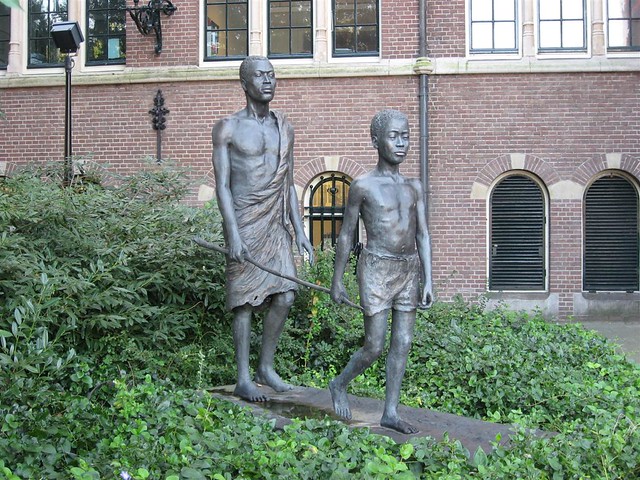
Showing posts with label Apartheid. Show all posts

Wednesday, May 9, 2012

Welcome to Buenaventura, Colombia: Bienvenidos a Buenaventura, Colombia

For years, 25,000 Afro-Colombian refugees and migrants have lived in a town on stilts over the sea [Oliver Schmieg]

On May 22, 2007, the New York Times article, "Cocaine Wars Make Port Colombia’s Deadliest City," by  Simon Romero reported -- BUENAVENTURA, Colombia, May 15 — Visitors to this city can be forgiven for thinking no place is safe here. Gunfire often echoes through the slums surrounding its port, the country’s most important on the Pacific coast. As larger cities have calmed, Buenaventura has emerged as the deadliest urban center in Colombia’s long internal war.

Soldiers search almost every car at checkpoints on the winding road from Cali. Guerrillas recently fired mortar shells at the police headquarters. The stately Hotel Estación, a neo-Classical gem built in 1928, where executives come to hammer out deals to import cars or export coffee, is guarded by dozens of soldiers in combat fatigues.

“It’s as if we have a little Haiti within Colombia,” said Lt. Nikolai Viviescas, 25, a police officer who was transferred from Bogotá six months ago. “It feels like another country.”

They are residents of Buenaventura on Colombia's Pacific Coast [Oliver Schmieg]

Although Bogotá, the capital, and other cities have become secure and prosperous enough that it is possible there to forget about this country’s four-decade-old civil conflict for a while, Buenaventura is a different story.

Killings in this city of about 300,000 climbed 30 percent last year, to 408, giving Buenaventura the nation’s highest homicide rate at 144 per 100,000, more than seven times the rate in Bogotá and four times that of Medellín. And this year, the police say, 222 people have been killed here.

A vast majority of the killings are the product of a narrow territorial conflict over control of the edge of the city’s slums, acres of wooden shacks built on stilts over the sea. From these makeshift wharves, police and naval officials say, fast boats depart with cocaine for points north. Buenaventura’s geography, crucial in connecting Colombia to the global flow of trade, also holds strategic cachet for drug traffickers.


But now the Colombian government is attempting to relocate the entire community [Oliver Schmieg]


Despite receiving more than $5 billion in antinarcotics and counterinsurgency aid from the United States this decade, making the country the largest recipient of American aid in the hemisphere, Colombia remains the world’s largest cocaine producer and the supplier of 90 percent of the cocaine consumed in the United States.

Drug lords, rebels and resurgent paramilitary gangs all draw on Buenaventura’s slum dwellers as their foot soldiers.

The police say that many of the combatants on the rebels’ side belong to the Manuel Cepeda Vargas Urban Front, a cell of the main rebel group FARC that is based in Cali and opposes the Autodefensas Campesinas del Pacífico, composed mostly of former paramilitary fighters.


It wants to move them to an island barrio [Oliver Schmieg]

“Nothing in this fight is about ideology,” said Antero Viveros, the head of a community group in Lleras, a large slum controlled by the guerrillas. “It is about drugs, with members of one ethnicity killing each other.”

Despite its emergence as Colombia’s most dangerous city, people displaced by fighting in the countryside still see Buenaventura as a refuge. About 42,000 refugees have arrived here since 1998, mostly Afro-Colombians from rural areas, according to the federal government. They swell the ranks of what may be Colombia’s poorest slums.

“If you’re hungry, you’ll do whatever imaginable to survive,” said Fernando Nuñez, 29, a Lleras resident who ekes out a living repairing old cellphones.


And to build a commerical port and tourist beaches in Buenaventura [Oliver Schmieg]

President Álvaro Uribe has forcefully criticized the violence here and sent new police and navy commanders to the city at the start of the year. About 2,000 soldiers and police officers, who also wear combat uniforms and carry semiautomatic weapons, patrol Buenaventura.

Still, critics say authorities have long neglected Buenaventura’s problems in part because Afro-Colombians receive scant federal attention. Nongovernmental groups say Afro-Colombians account for up to a quarter of the country’s population of 44 million, by some measures giving Colombia the largest black population in the Spanish-speaking world. And more than 80 percent of Buenaventura’s residents are black.

Community leaders are trying to resist the eviction; Or at least fight for decent compensation [Oliver Schmieg]


This month, when the president chose Paula Marcela Moreno Zapata as culture minister, was the first time an Afro-Colombian ascended to a cabinet position in the country’s history. Yet political analysts and black advocacy groups said the appointment was largely to appease Democrats in Washington who complain of racial exclusion in Colombia as they weigh a trade agreement.

“The war in Buenaventura is not going to be ended by symbolic actions from Bogotá,” said Rosaliano Riascos, a Buenaventura native who fled the city after a wave of paramilitary-led killings several years ago. Mr. Riascos, who heads an independent black advocacy group in Bogotá, said it had been a year since he returned to Buenaventura to visit family. “Buenaventura is a no-man’s land,” he said.


As the move would not only rob residents of their homes but of their main livelihood - fishing [Oliver Schmieg]


The entrance to Lleras looks like that of any shantytown elsewhere in Colombia, with cinder-block shacks and a few paved streets. But deeper into the slum, the structures are made from discarded wood, with newcomers squeezing into lean-tos alongside older houses. Rusted barrels collect rain from zinc roofs, the only source of fresh water.

Sewage bubbles down trash-strewn dirt roads before flowing into the sea. Stereos blare vallenato and reggaetón music. And precariously built homes are hoisted above the water on spindly pieces of wood.

Many of the residents of these hovels hesitate to offer their names out of fear of retaliation over what they might say. One middle-aged man, offering a visitor a cup of rum from the steps of his house, said he had worked as a stevedore at the port years ago before losing that job. “Now,” he said, “I do nothing.”

The vast majority of the residents of the area are black and many see the eviction in race terms [Oliver Schmieg]


Some economists hold up Buenaventura as an example of the risks of exposing certain areas of developing economies to market forces. María del Pilar Castillo, an economist at Valle University in Cali, said many residents lost economic security when the city’s port was privatized more than a decade ago, cutting its work force and reducing benefits.

With taxes on the imports flowing through Buenaventura’s port largely going directly to the central government, the city reaps few benefits from international trade, even as Colombia’s economy grows more than 6 percent a year. So the poor in Buenaventura, with an unemployment rate of about 28 percent, resort to the drug trade.


Map of Colombia

“There is no other viable industry here, so there are no other viable jobs,” said Ana María Mercedes Cano, director of Buenaventura’s Chamber of Commerce. “So we live in a situation with violence all around us.”

Civilians are increasingly caught in the cross-fire. Guerrillas were blamed for an attack earlier this year in which five people, including one police officer, were killed when a homemade mortar shell was fired at a police truck. Security officials here say laws that are lax on minors, who carry out many of the attacks, make it difficult to reduce the killings.


They argue that the Afro-Colombians have managed to acquire prime real estate and now the white and mixed race elite want to take it for themselves [Oliver Schmieg]


“We have a justice system designed for Switzerland, yet we have no Swiss here,” said Col. Yamil Moreno, the chief of police in Buenaventura. In the same breath, Colonel Moreno, who was transferred here from the north, callously described Buenaventura’s dying combatants.

“These vagabonds,” he said, “are good only for drinking, dancing and killing.” (source: The New York Times, 2007)


Monday, March 26, 2012

The Netherlands (Holland and Dutch) Slavers


Netherlands--The Netherlands despite being a small country, lacking in natural resources, was able in the 17th Century to become the centre for European overseas trade, including the trade in human beings. This 'Dutch Miracle' was a product of numerous innovations in navigation, manufacturing and finance, which allowed for slaves and slave produce to be transported at greater capacity and at lower cost. The first recorded trader sold 20 Africans to the colony of Virginia in North America in 1619, but the Dutch trade only really took off in response to labour shortage in the newly conquered sugar plantations of Northern Brazil in 1630. Wars with Portugal (1620-1655) left the Dutch in control of many of the slave depots on the West African coast, centred on modern Ghana, which by 1650 had dispatched 30,000 slaves to Brazil alone. After the return of the Brazilian colonies to Portugal in 1654, the Dutch traders were able to draw upon their network of forts to supply other European powers, dominating the supply to Spain until the 1690s. However the near constant warfare the Netherlands were waged in with other European nations, such as Spain, France and Britain, by Imperial Spain, did eventually sap its strength, and Dutch involvement in the trade declined in the 18th Century, and effectively ceased in 1795. When the final abolition of the trade and institution of slavery formally occurred in 1863, Dutch agents had brought 540,000 Africans to the Americas and cast the spectre of slavery east, from the Cape of Good Hope to the Indonesian archipelago.

Elmina Castle was erected by the Portuguese in 1482 as São Jorge da Mina

The Dutch-Portuguese Wars --Between 1620 and 1655 the Netherlands and Portugal were at war, a struggle that became increasingly dictated by the needs of the slave trade. The Dutch were late comers to Africa, and their attempts to establish trading posts inevitably led to confrontation with the Portuguese. The Dutch were initially chasing African gold, but after they captured the sugar plantations in northern Brazil, they turned to slavery to help realize its full potential. Plans made to conquer the Portuguese headquarters on the gold coast, São Jorge da Mina, to ensure a steady flow of slaves, were successful and it fell in 1637. The newly renamed Elmina, proved disappointing, but it drove them on to Angola, and the island depot of São Tomé, and gave Dutch slavers a taste of the profit had at the expense of human beings. When Brazil fell in 1654 the trade continued at a pace, with colonies like Curacou emerging as vast slave markets open to the whole Caribbean.


Amsterdam -- Amsterdam was the capital of the Holland, the largest and most important of the Seven Provinces that comprised the Netherlands. The city was already prosperous, but when the southern city of Antwerp fell to the Spanish in 1585, it benefited from a stream of enterprising merchants and wealthy refugees. By the mid 1600s it was the most important trading center in the world, providing a vital supporting role to Caribbean slavery.


West-Indisch Huis (West Indies House) in the centre of Amsterdam was the former headquarters of the Dutch West-Indische Compagnie (West India Company or WIC), which was probably the largest single slave trader in history. The company was chartered in 1621, and provided with a monopoly on the African slave trade that lasted until 1730. This building was occupied from 1621-1647, a period which saw the first of 30,000 slaves arriving in Dutch Brazil, arranged through the WIC.

Runaway black slaves are attacked by dogs by Louise.  Sculpture in carramarmer (to a plaster model of 1869), Nov sculptor Louis Samain. Original model in 1894 by the Belgian State acquired and donated to city of Brussels. In 1895, also date of signature, placed on Avenue Louise. Natural stone octagonal plinth walls with vaulted arch November E. Le Graive. The poignant scene - a black slave with his child being attacked by two watchdogs - is inspired by the famous novel Uncle Tom's Cabin by Harriet Beecher-Stowe (1851).
The slave routes required bulk warehousing and transportation for slave produce once it arrived back in the 'Old World', and Amsterdam developed accordingly. Its historic centre retains many of the original tall, narrow and deep warehouses that as part of the colonial boom once bulged with sugar, cotton and tobacco.


In the 17th Century most traded commodities passed through Amsterdam's canals and rested in its warehouses before being traded on. The Commodity Exchange (Beurs, pictured below) was built from 1608-1613 with this fact in mind, becoming so influential that merchants came from all over Europe to set their prices, and to speculate on the goods newly arrived from the Caribbean. These prices would in turn help shape the demand for bonded labour in the various sectors of the slave economy.


Amsterdam ranks as a European capital of slavery. While its mills processed almost all the sugar from the Portuguese colonies, its financiers bankrolled the Danish, Swedish and Brandenburg slave trade, and in turn Scandinavian and German sailors made up half its slaving crews. As home to the world's most sophisticated banking and insurance system, it was the natural home for the expensive and potentially risky business of slaving, and for this reason alone as many as 10,000 vessels were associated with the port.


The Dutch Golden Age--The17th Century has been widely described as the Netherlands' 'Golden Age.' The period saw the flowering of the arts and sciences. The average Dutchman was wealthier than his counterparts in any other country in the world and lived in a relatively tolerant country. This progress was achieved in part at an appalling human cost, and several of era's great advances helped tighten the noose around the African continent.


Amsterdam's Town Hall is perhaps the most significant building from this period, built from 1648-65 and by design the most ambitious and indeed the largest home to any city government in Europe.

The elaborate freeze on the western façade depicts the basis of Amsterdam's wealth. The female personification of the city reaches out for the treasures of Europe (on the left), Asia (on the right), America (far right) and Africa (far left). A cargo ship is shown bring this bounty to the port, the centre of the world, and above the statue of Atlas makes the nation's claim to carrying the world on it shoulders. The Golden Age was the high water mark of Dutch influence, its power and culture a product of these patterns of exploitation.

Zeeland --The ports of Vlissingen and Middleburg in the south-western State of Zeeland became dependent on the slave trade to an unparalleled degree, beating even Amsterdam as the main departure point for slavers. Ships from Zeeland made 672 journeys to Africa, transporting 278,476 people into a life of slavery, compared to the 173 recorded voyages from Amsterdam, carrying 73,476. The two ports were practically slaving communities, and official reports indicated that by 1750 the only significant commercial activity in Vlissingen was the slave trade. 

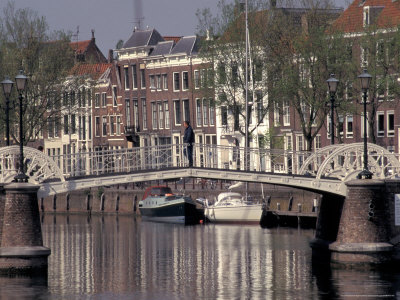
Middleburg Drawbridge 

This marked quite a transformation for the province, which in 1596 had steadfastly rejected the opening of a slave market in Middleburg, on the basis that Dutch law did not countenance slavery. The momentum that drove slavery brought on a transformation in attitudes within the area, and saw Middleburg ... become host to the largest independent slaving company in the Netherlands. The Middleburg Commercial Company (MCC) transported 31,095 Africans to the Americas between 1732 and 1803, of whom 27,344 survived the crossing. This period map of Middleburg shows the familiar network of canals and docks that marked it out as an efficient and prolific slave port.

In the movie "Pirates of the Caribbean," the Flying Dutchman was a fluyt.

The Fluyt -- Dutch innovation transformed shipbuilding. The Netherlands had to import almost all of its wood from abroad, and to save money found ways of making fast and efficient ships from cheap materials. The Fluyt or 'fly boat' was one such design, based on low quality wood and easily pre fabricated parts, and requiring a much smaller crew than the ships of foreign competitors. This ship became a familiar site throughout Europe, Africa and the Caribbean, and its vast cargo hold and shallow draft made it ideally suited for slave voyages. The nation's talent for shipbuilding encouraged countries across the continent to either borrow Dutch designs, or simply commission fleets to be constructed in Dutch ports. Thanks to vessels like the Fluyt come 1670 the Netherlands had more ships than England, France, Germany, Portugal, Spain and Scotland put together, boasting the most 'efficient' slave ships afloat.


Maroons of Suriname


The Dutch captured the British colony of Suriname during the Second Anglo-Dutch War(1667), and under the WIC it was developed as a plantation slave society. It was a primary destination for the Dutch slave trade, yet unusually it never experienced a general slave rebellion. The regime was one of extreme and deliberate brutality, even by the standards of the time. Mortality was so high that although 300,000 slaves were imported between 1668 and 1823, the ravaged population was never able to grow beyond a figure of 50,000. 'Maroonage' emerged as the main method of resistance. 


Fugitive slaves, 'Maroons' fled inland, and formed permanent communities. There is nothing unusual about this in any slave society, except for its scope. The Suriname Maroons numbered between 25-47 thousand in the 18th and 19th Centuries, and engaged the Dutch in over 50 years of gureilla warfare. The resistance proved so strong that the colonial government acknowlged their virtual independence in the 1760s. The Scottish-Dutch soldier John Gabriel Stedman witnessed the oppression of the slaves during a campaign against the maroons in 1774. His book a Narrative of a Five Years Expedition Against the Revolted Negroes of Surinam, with vivid illustrations by William Blake and Francesco Bartolozzi was taken to heart by abolitionists, through Stedman's real sympathies are thought to have been with reform rather than abolition.

Armed Maroon, Surinam, 1770s, from Narrative of a Five Years Expedition Against the Revolted Negroes of Surinam © The Atlantic Slave Trade and Slave Life in the Americas: A Visual Record

Coffy

The domestic slave Coffy led a rebellion in the Dutch Colony of Berbice (now British Guyana) in February 1763. An outbreak of yellow fever had left the white slave owners weakened and vulnerable, and the slaves saw a chance to rise. Taking arms, they almost succeeded in their first aim of driving all whites from the colony. Coffy had opted for peaceful coexistence with the former slave masters, and planned to broker a treaty with the authorities like the maroons of Surinam. He fell out with his fellow rebel leaders and committed suicide three months into the rebellion, but his followers continued fighting Dutch forces until April 1764.

New Netherlands (New Netherlands is present day New Jersey and New Holland is present day New York)

In 1623 the WIC were granted permission to establish the province of New Netherland in North America. The Dutch were largely unwilling to become settlers (thanks in part to their relatively comfortable position at home), and the colony developed with large numbers of European workers, particularly from England, Germany and what is now Belgium. The shortage inevitably led the colonists to turn to the slave trade, and in 1625 the first group of 11 African males arrived on Manhattan Island at fort New Amsterdam (now New York). The WIC pinned its hopes on the New Netherland after the loss of Brazil in 1654, and shipments markedly increased. By the 1660s the company was the largest single slave owner in New Amsterdam, forcing their 'property' to build roads, houses and defences. The large wooden perimeter wall they constructed has long since disappeared, but the American financial district 'Wall Street' takes its name and location from these slave craftsmen.


With large numbers of white migrants already working the fields, the demand for slaves came largely from the rapidly urbanising townships. The system was light compared to the extremes of the plantations, and skilled slaves were able to exploit the labour shortage to achieve more freedom. Many had already been specialists in Caribbean colonies, and veterans were able to achieve a state of 'half-freedom' in return for payment to the WIC. This suited the authorities, who were quite happy not to have to clothe and feed the half slaves themselves, but more than prepared to demand their work when they needed them. Because of this relaxed arrangement slaves were more easily assimilated into the colonial culture than elsewhere, but still they preserved and adapted many rituals originating in West Africa. The annual Festival of 'Pinkster' (the Dutch word for Pentecost) blended African and Christian traditions to celebrate the coming of the spring. It was a rare holiday for slaves, an opportunity for African music, dance and storytelling, but also for mockery, as the crowds would mimic the European manners of their masters and elect a king for a day.

Sojourner Truth was enslaved by the Dutch in New York.

The province of New Netherland was captured by Britain in 1664, its slaves having laid the foundations for settlements that would emerge as great cities: New York (New Amstersdam), Philadelphia (Fort Beversrede) and New Jersey (Fort Nassau).


Cape Colony -- The Dutch East India Company (Vereenigde Oostindische Compagnie, or VOC) was set up in 1602 to trade with Asia, and became the world's most powerful company over the 17th Century. It fed an insatiable European demand for spices, textiles and porcelain, and developed trading posts from throughout Asia, including Japan, China, Iran, India, and Indonesia, again frequently at the expense of the Portugese. It was not directly involved in the transatlantic slave routes (the West India Company's monopoly), but it did own large numbers of slaves. The company's regional headquarters in Batavia (now Jakarta) and Colombo (in Sri Lanka) had about a thousand slaves, mainly from the bay of Bengal. 

Chinese, Indian and European traders provided most of the VOCs bonded labour, but occasionally it organised its own voyages to the East African island of Madagascar for slave raids. The voyage to Asia usually headed around the African coast, and VOC established a refreshment station at the Cape of Good Hope to supply these crews. In 1652 a group under Jan van Riebeeck established the Cape Colony at Table Bay, near Table Mountain in modern South Africa. The VOC were anxious to keep the local Khoi and San populations on friendly terms, and in a matter of weeks van Riebeeck requested slave labour. The administrator favoured Angolans, but the rival WIC made it clear that West Africa and its population was its prize, so the VOC turned east. Slave expeditions left Cape Town for Madagascar and Mozambique, but most headed for Asia, particularly to the Indian coast, Sumatra, Java, the Celebes, Ternate and Timor.

The Castle of Good Hope is the oldest surviving building in South Africa, and was built and used to occupy slaves from 1666 onwards.


VOC slaves sometimes retained a version of their original names (usually with spelling errors by company clerks), but surnames were regularly changed to indicate the country of origin. Hence names like Lisbeth van Bengelen (Lisbeth of Bengal), and Abraham van Batavia, the first slave in South Africa, who was taken from the VOC headquarters. Subsequent generations would bear the name Van de Kaap, 'of the Cape.'


The VOC commissioned a Slave Lodge in 1679 to house around 600 of its slaves, who were forced to share the building with prisoners and the mentally ill. The tree that stood outside the lodge was thought to have been the sight where people from across Africa and Asia were sold into a life of slavery, and a small section of it has been preserved. It is unlikely that this 'Slave Tree' was ever home to a slave market, and some even doubt the remains of the tree are genuine, but it remains a potent symbol. The city of Cape Town planted a new tree in its place in 2002 as a mark of remembrance. (source: Old Anti-Slavery)


Tuesday, March 13, 2012

British Tourist Visits The Low Country of Savannah and Charleston


From the UK Telegraph Travel section, by Nigel Richardson, on 27 August 2008: "American south: A black and white story: Behind the elegant facades of Savannah and Charleston lies the ugliness of slavery. Nigel Richardson hears a neglected view of history."

It was raining so hard in Savannah, Georgia, that the patrolmen of the Chatham County Sheriff’s Department wore plastic covers on their wide-brimmed hats. Noisy cones of white water geysered from sawn-off drainpipes, turning trousers into litmus paper, and the horse-drawn carriages remained stabled all day.

With its 18th-century squares and disconcerting air of England — an England twice filtered, through time and climate, into a tropical Georgiana — Savannah is one of the finest American cities to walk round. Finest cities anywhere to see on foot, come to that. But not today. Today was for indoors.

Off Martin Luther King Jr Boulevard, we stumbled into the Ralph Mark Gilbert Civil Rights Museum, shook down our raincoats and requested the restrooms (all that rain). But the WCs weren’t marked “Men” and “Women”. The signs on the doors said “White only” and “Coloured only”, which left us, two white-faced Europeans, red-faced and dumbfounded. This was the intended effect.


The history of black America — for white people at least — has always run on parallel, all-but-invisible tracks to the history promulgated in guidebooks and mainstream museums. Sure, we've heard of Dr King. But when white people come to beautiful Savannah and its Grace Kelly-like sister, Charleston, across the state line in South Carolina, they look for, and are fed, the history of white people.

These are embodied in the architecture, older and better preserved than that of most British cities. Savannah and Charleston are two of the oldest settlements in the United States, founded in 1733 and 1670 respectively. The adventurers who made fortunes here — in many cases on the back of slavery — built big and bold, borrowing from Europe and sticking knobs on: sweeping steps, deep porches, wrought-iron scrollwork and pillars like the Parthenon. There are knot gardens — the one at the Davenport House in Savannah was designed by Penelope Hobhouse — and magnolias, and climate completes the heady effect by draping swooning arms of Spanish moss from branch and balcony.


We loved walking in Savannah and Charleston, spotting, through tropical tangle, the ghostly cousins of a Chelsea mews or a Brighton seafront terrace, reading heritage plaques on reconditioned façades and visitors’ books in hallways that smelled of floor polish. (In the Eighties, at the Green-Meldrin House in Savannah, Mrs Thatcher had signed herself, with uncharacteristic wit, “A representative of the former colonial power”.)

It’s just that in a part of America with a significant black population, and in a year when the American people may just elect their first African-American as president, it felt timely to discover some neglected narratives and points of view. In the institutionally racist days of the Deep South, for example, when every aspect of life was segregated, from shops to drinking fountains, Savannah had “one of the most significant and effective civil rights movements in the US,” according to the curator in the civil rights museum, Heru Iman.


“It was the youth here in the Sixties who integrated Savannah — sitting in at the lunch counters, demonstrating, kneeling outside white churches praying to be let in,” he told us. Activists fanned out from the basement of the First African Baptist Church in Montgomery Street carrying out “wade-ins” at whites-only beaches and boycotting racist stores. The civil rights museum features a re-creation of the lunch counter at Levy’s department store — a particular target for protesters — in which a white waitress advises a black customer, “We don’t serve your kind here”.

The nerve centre of these protests, the First African Baptist Church, claims to have the oldest black congregation in North America, dating from 1775. The present church was completed in 1859 (having been built at night because during the day the men had to work in the cotton plantations).


Our “conductor” on a tour was a shy and proud young man called Johnnie McDonald. “Martin Luther King, Jesse Jackson and Coretta Scott King [Dr King’s widow] have all preached in that pulpit,” he said. In the balcony he pointed out scratch marks on the ends of some pews that were built by slaves in the late 1700s. For many years these marks were a puzzle, but it is now thought they may be cursive Hebrew. “The slaves who came from [West] Africa knew that language,” said Johnnie.


In the basement of the church he indicated a series of holes in the wooden floor and explained that they were part of the “underground railroad”, the network of routes by which runaway slaves were spirited to freedom. “These are air holes, so they could breathe,” he said. “There’s only four feet of crawling space. You’d crawl from here and exit by the Savannah River [a quarter of a mile away].”


There are 36 sets of these holes and they are configured in the same pattern, a combination of cross and diamond which Johnnie described as a “Congo cosmogram” — another link with the West African ancestry of Savannah’s slaves.

That ancestry has survived to a surprising extent in the marshy maze of islands and causeways known as the Lowcountry, which separates Savannah from Charleston, 100 miles up the coast. Here many descendants of West African slaves and plantation labourers continue to speak Gullah, which is a mixture of English and West African words (the word Gullah is also used to mean the culture of the people who speak it).


On St Helena Island, in the heart of the Lowcountry, is the Penn Centre Historic District, a campus of former school buildings where freed slaves once studied and which Martin Luther King used as a retreat in the Sixties. Nearby we ate lunch in a plain shack called Gullah Grub, which serves authentic Lowcountry food — catfish, crab, shrimp — using old African-influenced recipes.

Shrimp gumbo — knocked back with ”swampwater”, homemade lemonade served in jam jars — hit the spot and we were soon back on Highway 17 and barrelling into the antique Manhattan that is the Charleston historic district, squeezed between the Cooper and Ashley Rivers. The rain had passed, leaving bright sunshine on stucco facades and weatherboard porches. The suits of wedding revellers — there were many — left mothball whiffs on the humid air.


It is beautiful and affluent even now, but in the 1700s Charleston was the richest city in the United States. It was also the country’s biggest slave port and the city’s wealthy white merchants used their slaves to ape the imagined lifestyles of English aristocrats.

One of the architectural highlights of Charleston is the Aiken-Rhett House, a vast antebellum confection of pillared porches that was once the home of William Aiken, a rice planter. The house has scarcely changed since 1858, which means that the slave quarters, a handful of cubicle rooms situated above kitchen and stables, are intact.


The family owned 800 slaves, of whom between 10 and 20 worked and lived in the house (these included one Dorcas Richardson, her husband and five children). In the vast living rooms of the house, there were ciphers of bygone ways of thinking and behaving: a set of Sir Walter Scott’s Waverley novels in the library; a harp standing in the middle of the old ballroom, whose red fabric wallpaper had faded to the colour of dried blood.

These southern ways were not to last. “Blacks knew that once the [civil] war started, they were on their way to freedom,” said Al Miller into the microphone of his minibus. Al, smartly turned out in checked linen trousers and white shirt, runs Sites and Insights Tours around the Charleston area, acquainting black visitors with the often invisible history of their people. As the only whites on his minibus tour, we were swept up in this different perspective.


First, he drove us south-west, off the peninsula, to James Island. “During slavery there were over 20 plantations here,” he said. We passed the Macleod Plantation where the wooden, white-painted slave quarters, standing on brick stilts, have been preserved. Here slaves grew sea-island cotton, indigo, okra and sweet potatoes and lived on grits, shrimp and gravy.

“It was the black people’s dish, the poor people’s dish,” said Al. “You ever paid an arm and a leg for it?” The rest of the bus shook their heads and laughed in agreement.

In the early 1930s George Gershwin spent time on James Island, absorbing a history and atmosphere that inspired him to write Porgy and Bess. His folk opera, including Summertime and It Ain’t Necessarily So, was based on the novel Porgy by the Charleston writer, DuBose Heyward. Driving past the old plantations — avenues of live oak trees mark where the driveways were — Al got the bus rocking and clapping by enacting the Porgy and Bess story in a kind of baritone rap: “Here comes Bess/ a slut in a red dress/ She was selling holy dust which was like cocaine/ She kept it in her girdle, she kept her money in her bosom/ She was not well liked...”


We got off the bus at James Island Presbyterian Church, where there are two cemeteries — one for black folk, one for white — separated by shrubbery. “It’s like day and night,” said Al. In the black section is the grave of Samuel Smalls, “the goat man”, upon whom DuBose Heyward based the character of Porgy. In honour of Gershwin’s Jewishness, visitors had placed stones on the top of Smalls’s headstone.

“A lot of Gullah cheechee [people] are superstitious when it comes to cemeteries,” said Al. “If you point your finger at a tombstone, it will rot off. Don’t bring cemetery dirt into your car on your shoes. Where did these things come from? Africa.”

James Island Presbyterian Church - James Island, South Carolina
James Island Presbyterian Church

Back on the historic peninsula, we cruised the golden streets. But Al screened out the antebellum and Greek revival mansions, the city’s architectural setpieces, pointing out instead the alleys, lanes and courts once lived in by poor blacks. We passed 78 Church St, where Heyward was living when he wrote Porgy, and Catfish Row, which features in the novel and opera and would now fit seamlessly into a discreet corner of Knightsbridge. “Once this was a rundown slum area,” said Al. “Catfish Row was a black tenement. Especially when Porgy was written. Not any more.”

As he drove, Al told us things that white people would rather not think about. “The average black man sold for between 800 and 1,200 dollars, which was a lot of money,” he said. “Women were made to have 10 or 15 children. They were made to have sex blindfold by the slave owners and had multiple partners.”
Jenkins Orphan Band

One of our last ports of call was in Franklin Street where we paused outside the site of the Jenkins Orphanage. Here, in the 1920s, the resident band drew on Gullah rhythms and dance steps to invent the tune and dance craze that became known as The Charleston. A plaque marks the site of the orphanage but doesn’t mention The Charleston, let alone make Al Miller’s point that “they started it here. The white folk just stole it from us.” (source: UK Telegraph)


HOME

HOME
Click here to return to the US Slave Home Page