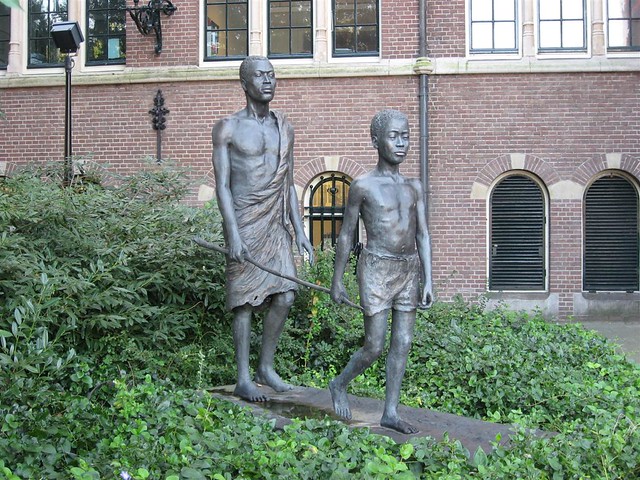
Showing posts with label Dutch slavery. Show all posts

Tuesday, May 15, 2012

A Dutch Slavery Remembrance Fund

jgstedmana13.jpg
Politicians positive about slavery remembrance fund

General  --  Tuesday, September 9, 2008 A Dutch fund in memory of the history of slavery come. That is historian Johannes Houwink ten Cate, during the first Day of Slavery, on 6 September in Amsterdam, approval received from the MPs Harry van Bommel (SP), Kathleen Ferrier (CDA) and CU (Christian Union).

Johannes Houwink ten Cate, professor of Holocaust and Genocide Studies at the University of Amsterdam, called the present politicians to generously with reparations to the descendants of African slaves in Suriname and the Antilles. "I think payout to individual victims is virtually impossible, but that precisely because of the long-term effects of slavery a good doped Dutch Foundation for the Remembrance of Slavery must be set."

During the ensuing debate between MPs from SP, CDA and Christian Union appeared to support this. "I'm not going to write a blank check," said Harry van Bommel (SP) "but I think it's an interesting idea." According to Kathleen Ferrier (CDA) would be a possible new fund should be integrated with the existing National Institute of Dutch slavery history and heritage (NiNsee).


Apologies  --  Van Bommel said in May this year, Prime Minister Balkenende on his visit to Suriname to intervene on behalf of the Dutch government officially apologize for the Dutch role in the slave trade. The Prime Minister gave to ignore this, but van Bommel announced 'it is not to leave. " Ferrier, daughter of the first President of Suriname and MP on behalf of the CDA, see nothing in an official apology. "By the former colonies to apologize, we create only a situation of inequality between our countries. We need to correct on the basis of equality with each other more. ' Voordewind find an official apology also counterproductive. However, he, like his fellow politicians, believes that considerable attention to the history of slavery in schools should be spent. For the idea of ​​a special fund he is therefore open.

femalenegroslavewithweightchainedtoherancle.jpg

Abolition  --  The Day of Slavery was organized by NiNsee and Historic Newspaper and had greater knowledge of the past to target. During an interview with Maartje Janse, a researcher at Leiden University and author of the thesis The abolitionists. Public opinion and political organization in the Netherlands, 1840-1880, came the painful question of why the Dutch abolished slavery in 1863 was over after England (1833), France (1848) and even Russia (1861).

According to Janse was the political culture in the Netherlands, which after the revolutionary years, mass movements were no longer part, an important responsibility for the late abolition. The political will was there, but the removal was a "civilized" way to happen. That the Netherlands in imitation of England in 1814 it abolished the slave trade, according to Janse was a prerequisite for the British government to the Netherlands and Belgium as a country to recognize. [SOURCE: by Maarten Muns]

Caption: Music on the Day of Slavery by Verno Romney & The TK Jive (photo Sander Heijne)

Monday, May 14, 2012

Dutch West India Company


Dutch West India Company trading and colonizing company, chartered by the States-General of the Dutch republic in 1621 and organized in 1623. Through its agency New Netherland was founded. The phenomenal success of the Dutch East India Company was an influential factor in its establishment. The United New Netherland Company, which had been trading around the mouth of the Hudson River for several years, was absorbed into the new company. By the terms of the charter no citizen of the Netherlands could trade with any point on the African coast between the Tropic of Cancer and the Cape of Good Hope or on the American coast between Newfoundland and the Straits of Magellan without the company's permission. 


The company was responsible to the States-General in larger matters, such as declaring war, but otherwise had almost complete administrative and judicial power in its territory. The company was initially interested taking Brazil from the Portuguese. After 30 years of warfare, however, Brazil was lost. By that time the company had built Fort Orange (1624) on the site of Albany, N.Y., Fort Nassau (1624) on the Delaware River, Fort Good Hope on the site of Hartford on the Connecticut River, and finally Fort Amsterdam (1626), on the southern tip of Manhattan Island, which was the nucleus of the settlement called New Amsterdam, now New York City. England could not then afford to antagonize the Dutch because of wars with France and Spain and so permitted the Dutch settlement to be made on lands that England claimed. New Netherland remained under the control of the company until the English finally conquered it in 1664 (see New York , state). The company's unsound financial condition led to its reorganization under a new charter in 1674. Thereafter it engaged primarily in the African slave trade, though it still possessed colonies in Guiana. In 1791 its charter expired and was not renewed. [source: "Dutch West India Company." The Columbia Encyclopedia, 6th ed.. 2011. Encyclopedia.com. 14 May. 2012 .]

Monday, March 26, 2012

The Netherlands (Holland and Dutch) Slavers


Netherlands--The Netherlands despite being a small country, lacking in natural resources, was able in the 17th Century to become the centre for European overseas trade, including the trade in human beings. This 'Dutch Miracle' was a product of numerous innovations in navigation, manufacturing and finance, which allowed for slaves and slave produce to be transported at greater capacity and at lower cost. The first recorded trader sold 20 Africans to the colony of Virginia in North America in 1619, but the Dutch trade only really took off in response to labour shortage in the newly conquered sugar plantations of Northern Brazil in 1630. Wars with Portugal (1620-1655) left the Dutch in control of many of the slave depots on the West African coast, centred on modern Ghana, which by 1650 had dispatched 30,000 slaves to Brazil alone. After the return of the Brazilian colonies to Portugal in 1654, the Dutch traders were able to draw upon their network of forts to supply other European powers, dominating the supply to Spain until the 1690s. However the near constant warfare the Netherlands were waged in with other European nations, such as Spain, France and Britain, by Imperial Spain, did eventually sap its strength, and Dutch involvement in the trade declined in the 18th Century, and effectively ceased in 1795. When the final abolition of the trade and institution of slavery formally occurred in 1863, Dutch agents had brought 540,000 Africans to the Americas and cast the spectre of slavery east, from the Cape of Good Hope to the Indonesian archipelago.

Elmina Castle was erected by the Portuguese in 1482 as São Jorge da Mina

The Dutch-Portuguese Wars --Between 1620 and 1655 the Netherlands and Portugal were at war, a struggle that became increasingly dictated by the needs of the slave trade. The Dutch were late comers to Africa, and their attempts to establish trading posts inevitably led to confrontation with the Portuguese. The Dutch were initially chasing African gold, but after they captured the sugar plantations in northern Brazil, they turned to slavery to help realize its full potential. Plans made to conquer the Portuguese headquarters on the gold coast, São Jorge da Mina, to ensure a steady flow of slaves, were successful and it fell in 1637. The newly renamed Elmina, proved disappointing, but it drove them on to Angola, and the island depot of São Tomé, and gave Dutch slavers a taste of the profit had at the expense of human beings. When Brazil fell in 1654 the trade continued at a pace, with colonies like Curacou emerging as vast slave markets open to the whole Caribbean.


Amsterdam -- Amsterdam was the capital of the Holland, the largest and most important of the Seven Provinces that comprised the Netherlands. The city was already prosperous, but when the southern city of Antwerp fell to the Spanish in 1585, it benefited from a stream of enterprising merchants and wealthy refugees. By the mid 1600s it was the most important trading center in the world, providing a vital supporting role to Caribbean slavery.


West-Indisch Huis (West Indies House) in the centre of Amsterdam was the former headquarters of the Dutch West-Indische Compagnie (West India Company or WIC), which was probably the largest single slave trader in history. The company was chartered in 1621, and provided with a monopoly on the African slave trade that lasted until 1730. This building was occupied from 1621-1647, a period which saw the first of 30,000 slaves arriving in Dutch Brazil, arranged through the WIC.

Runaway black slaves are attacked by dogs by Louise.  Sculpture in carramarmer (to a plaster model of 1869), Nov sculptor Louis Samain. Original model in 1894 by the Belgian State acquired and donated to city of Brussels. In 1895, also date of signature, placed on Avenue Louise. Natural stone octagonal plinth walls with vaulted arch November E. Le Graive. The poignant scene - a black slave with his child being attacked by two watchdogs - is inspired by the famous novel Uncle Tom's Cabin by Harriet Beecher-Stowe (1851).
The slave routes required bulk warehousing and transportation for slave produce once it arrived back in the 'Old World', and Amsterdam developed accordingly. Its historic centre retains many of the original tall, narrow and deep warehouses that as part of the colonial boom once bulged with sugar, cotton and tobacco.


In the 17th Century most traded commodities passed through Amsterdam's canals and rested in its warehouses before being traded on. The Commodity Exchange (Beurs, pictured below) was built from 1608-1613 with this fact in mind, becoming so influential that merchants came from all over Europe to set their prices, and to speculate on the goods newly arrived from the Caribbean. These prices would in turn help shape the demand for bonded labour in the various sectors of the slave economy.


Amsterdam ranks as a European capital of slavery. While its mills processed almost all the sugar from the Portuguese colonies, its financiers bankrolled the Danish, Swedish and Brandenburg slave trade, and in turn Scandinavian and German sailors made up half its slaving crews. As home to the world's most sophisticated banking and insurance system, it was the natural home for the expensive and potentially risky business of slaving, and for this reason alone as many as 10,000 vessels were associated with the port.


The Dutch Golden Age--The17th Century has been widely described as the Netherlands' 'Golden Age.' The period saw the flowering of the arts and sciences. The average Dutchman was wealthier than his counterparts in any other country in the world and lived in a relatively tolerant country. This progress was achieved in part at an appalling human cost, and several of era's great advances helped tighten the noose around the African continent.


Amsterdam's Town Hall is perhaps the most significant building from this period, built from 1648-65 and by design the most ambitious and indeed the largest home to any city government in Europe.

The elaborate freeze on the western façade depicts the basis of Amsterdam's wealth. The female personification of the city reaches out for the treasures of Europe (on the left), Asia (on the right), America (far right) and Africa (far left). A cargo ship is shown bring this bounty to the port, the centre of the world, and above the statue of Atlas makes the nation's claim to carrying the world on it shoulders. The Golden Age was the high water mark of Dutch influence, its power and culture a product of these patterns of exploitation.

Zeeland --The ports of Vlissingen and Middleburg in the south-western State of Zeeland became dependent on the slave trade to an unparalleled degree, beating even Amsterdam as the main departure point for slavers. Ships from Zeeland made 672 journeys to Africa, transporting 278,476 people into a life of slavery, compared to the 173 recorded voyages from Amsterdam, carrying 73,476. The two ports were practically slaving communities, and official reports indicated that by 1750 the only significant commercial activity in Vlissingen was the slave trade. 

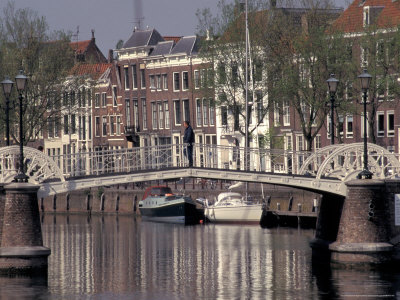
Middleburg Drawbridge 

This marked quite a transformation for the province, which in 1596 had steadfastly rejected the opening of a slave market in Middleburg, on the basis that Dutch law did not countenance slavery. The momentum that drove slavery brought on a transformation in attitudes within the area, and saw Middleburg ... become host to the largest independent slaving company in the Netherlands. The Middleburg Commercial Company (MCC) transported 31,095 Africans to the Americas between 1732 and 1803, of whom 27,344 survived the crossing. This period map of Middleburg shows the familiar network of canals and docks that marked it out as an efficient and prolific slave port.

In the movie "Pirates of the Caribbean," the Flying Dutchman was a fluyt.

The Fluyt -- Dutch innovation transformed shipbuilding. The Netherlands had to import almost all of its wood from abroad, and to save money found ways of making fast and efficient ships from cheap materials. The Fluyt or 'fly boat' was one such design, based on low quality wood and easily pre fabricated parts, and requiring a much smaller crew than the ships of foreign competitors. This ship became a familiar site throughout Europe, Africa and the Caribbean, and its vast cargo hold and shallow draft made it ideally suited for slave voyages. The nation's talent for shipbuilding encouraged countries across the continent to either borrow Dutch designs, or simply commission fleets to be constructed in Dutch ports. Thanks to vessels like the Fluyt come 1670 the Netherlands had more ships than England, France, Germany, Portugal, Spain and Scotland put together, boasting the most 'efficient' slave ships afloat.


Maroons of Suriname


The Dutch captured the British colony of Suriname during the Second Anglo-Dutch War(1667), and under the WIC it was developed as a plantation slave society. It was a primary destination for the Dutch slave trade, yet unusually it never experienced a general slave rebellion. The regime was one of extreme and deliberate brutality, even by the standards of the time. Mortality was so high that although 300,000 slaves were imported between 1668 and 1823, the ravaged population was never able to grow beyond a figure of 50,000. 'Maroonage' emerged as the main method of resistance. 


Fugitive slaves, 'Maroons' fled inland, and formed permanent communities. There is nothing unusual about this in any slave society, except for its scope. The Suriname Maroons numbered between 25-47 thousand in the 18th and 19th Centuries, and engaged the Dutch in over 50 years of gureilla warfare. The resistance proved so strong that the colonial government acknowlged their virtual independence in the 1760s. The Scottish-Dutch soldier John Gabriel Stedman witnessed the oppression of the slaves during a campaign against the maroons in 1774. His book a Narrative of a Five Years Expedition Against the Revolted Negroes of Surinam, with vivid illustrations by William Blake and Francesco Bartolozzi was taken to heart by abolitionists, through Stedman's real sympathies are thought to have been with reform rather than abolition.

Armed Maroon, Surinam, 1770s, from Narrative of a Five Years Expedition Against the Revolted Negroes of Surinam © The Atlantic Slave Trade and Slave Life in the Americas: A Visual Record

Coffy

The domestic slave Coffy led a rebellion in the Dutch Colony of Berbice (now British Guyana) in February 1763. An outbreak of yellow fever had left the white slave owners weakened and vulnerable, and the slaves saw a chance to rise. Taking arms, they almost succeeded in their first aim of driving all whites from the colony. Coffy had opted for peaceful coexistence with the former slave masters, and planned to broker a treaty with the authorities like the maroons of Surinam. He fell out with his fellow rebel leaders and committed suicide three months into the rebellion, but his followers continued fighting Dutch forces until April 1764.

New Netherlands (New Netherlands is present day New Jersey and New Holland is present day New York)

In 1623 the WIC were granted permission to establish the province of New Netherland in North America. The Dutch were largely unwilling to become settlers (thanks in part to their relatively comfortable position at home), and the colony developed with large numbers of European workers, particularly from England, Germany and what is now Belgium. The shortage inevitably led the colonists to turn to the slave trade, and in 1625 the first group of 11 African males arrived on Manhattan Island at fort New Amsterdam (now New York). The WIC pinned its hopes on the New Netherland after the loss of Brazil in 1654, and shipments markedly increased. By the 1660s the company was the largest single slave owner in New Amsterdam, forcing their 'property' to build roads, houses and defences. The large wooden perimeter wall they constructed has long since disappeared, but the American financial district 'Wall Street' takes its name and location from these slave craftsmen.


With large numbers of white migrants already working the fields, the demand for slaves came largely from the rapidly urbanising townships. The system was light compared to the extremes of the plantations, and skilled slaves were able to exploit the labour shortage to achieve more freedom. Many had already been specialists in Caribbean colonies, and veterans were able to achieve a state of 'half-freedom' in return for payment to the WIC. This suited the authorities, who were quite happy not to have to clothe and feed the half slaves themselves, but more than prepared to demand their work when they needed them. Because of this relaxed arrangement slaves were more easily assimilated into the colonial culture than elsewhere, but still they preserved and adapted many rituals originating in West Africa. The annual Festival of 'Pinkster' (the Dutch word for Pentecost) blended African and Christian traditions to celebrate the coming of the spring. It was a rare holiday for slaves, an opportunity for African music, dance and storytelling, but also for mockery, as the crowds would mimic the European manners of their masters and elect a king for a day.

Sojourner Truth was enslaved by the Dutch in New York.

The province of New Netherland was captured by Britain in 1664, its slaves having laid the foundations for settlements that would emerge as great cities: New York (New Amstersdam), Philadelphia (Fort Beversrede) and New Jersey (Fort Nassau).


Cape Colony -- The Dutch East India Company (Vereenigde Oostindische Compagnie, or VOC) was set up in 1602 to trade with Asia, and became the world's most powerful company over the 17th Century. It fed an insatiable European demand for spices, textiles and porcelain, and developed trading posts from throughout Asia, including Japan, China, Iran, India, and Indonesia, again frequently at the expense of the Portugese. It was not directly involved in the transatlantic slave routes (the West India Company's monopoly), but it did own large numbers of slaves. The company's regional headquarters in Batavia (now Jakarta) and Colombo (in Sri Lanka) had about a thousand slaves, mainly from the bay of Bengal. 

Chinese, Indian and European traders provided most of the VOCs bonded labour, but occasionally it organised its own voyages to the East African island of Madagascar for slave raids. The voyage to Asia usually headed around the African coast, and VOC established a refreshment station at the Cape of Good Hope to supply these crews. In 1652 a group under Jan van Riebeeck established the Cape Colony at Table Bay, near Table Mountain in modern South Africa. The VOC were anxious to keep the local Khoi and San populations on friendly terms, and in a matter of weeks van Riebeeck requested slave labour. The administrator favoured Angolans, but the rival WIC made it clear that West Africa and its population was its prize, so the VOC turned east. Slave expeditions left Cape Town for Madagascar and Mozambique, but most headed for Asia, particularly to the Indian coast, Sumatra, Java, the Celebes, Ternate and Timor.

The Castle of Good Hope is the oldest surviving building in South Africa, and was built and used to occupy slaves from 1666 onwards.


VOC slaves sometimes retained a version of their original names (usually with spelling errors by company clerks), but surnames were regularly changed to indicate the country of origin. Hence names like Lisbeth van Bengelen (Lisbeth of Bengal), and Abraham van Batavia, the first slave in South Africa, who was taken from the VOC headquarters. Subsequent generations would bear the name Van de Kaap, 'of the Cape.'


The VOC commissioned a Slave Lodge in 1679 to house around 600 of its slaves, who were forced to share the building with prisoners and the mentally ill. The tree that stood outside the lodge was thought to have been the sight where people from across Africa and Asia were sold into a life of slavery, and a small section of it has been preserved. It is unlikely that this 'Slave Tree' was ever home to a slave market, and some even doubt the remains of the tree are genuine, but it remains a potent symbol. The city of Cape Town planted a new tree in its place in 2002 as a mark of remembrance. (source: Old Anti-Slavery)


Wednesday, February 29, 2012

African Colonization: Serial Enslavers


As reported by the BBC "Slavery and the 'Scramble for Africa'" by Dr Saul David on 17 February 2011 -- What were the motives behind the European colonization of Africa at the end of the 19th century? Did the stamping out of slavery really play a part?


European colonisation

Until the 19th century, Britain and the other European powers confined their imperial ambitions in Africa to the odd coastal outpost from which they could exert their economic and military influence. British activity on the West African coast was centred around the lucrative slave trade.

Between 1562 and 1807, when the slave trade was abolished, British ships carried up to three million people into slavery in the Americas. In total, European ships took more than 11 million people into slavery from the West African coast, and European traders grew rich on the profits while the population of Africa's west coast was devastated.

As late as the 1870s, only 10% of the continent was under direct European control, with Algeria held by France, the Cape Colony and Natal (both in modern South Africa) by Britain, and Angola by Portugal. And yet by 1900, European nations had added almost 10 million square miles of Africa - one-fifth of the land mass of the globe - to their overseas colonial possessions. Europeans ruled more than 90% of the African continent.

One of the chief justifications for this so-called 'scramble for Africa' was a desire to stamp out slavery once and for all. Shortly before his death in May 1873 at Ilala in central Africa, the celebrated missionary-explorer David Livingstone had called for a worldwide crusade to defeat the slave trade controlled by Arabs in East Africa, that was laying waste the heart of the continent.

The only way to liberate Africa, believed Livingstone, was to introduce the 'three Cs': commerce, Christianity and civilization.


The Berlin Conference-- This was a period in history when few Europeans doubted their innate superiority over the 'lesser' races of the world.

The theory that all the peoples of Europe belonged to one white race which originated in the Caucasus (hence the term 'Caucasian') was first postulated at the turn of the 19th century by a German professor of ethnology called Johann Blumenbach.

Blumenbach's colour-coded classification of races - white, brown, yellow, black and red - was later refined by a French ethnologist, Joseph-Arthur Gobineau, to include a complete racial hierarchy with white-skinned people of European origin at the top.

Britons like Livingstone felt they had a duty to 'civilise' Africa.

Such pseudo-scientific theories were widely accepted at the time and motivated Britons like Livingstone to feel they had a duty to 'civilise' Africa.

The Berlin Conference of 1884-1885, convened by Otto von Bismarck to discuss the future of Africa, had the stamping out slavery high on the agenda. The Berlin Act of 1885, signed by the 13 European powers attending the conference, included a resolution to 'help in suppressing slavery'.

In truth, the strategic and economic objectives of the colonial powers, such as protecting old markets and exploiting new ones, were far more important.

The Berlin Conference began the process of carving up Africa, paying no attention to local culture or ethnic groups, and leaving people from the same tribe on separate sides of European-imposed borders.


British interests

Britain was primarily concerned with maintaining its lines of communication with India, hence its interest in Egypt and South Africa. But once these two areas were secure, imperialist adventurers like Cecil Rhodes encouraged the acquisition of further territory with the intention of establishing a Cape-to-Cairo railway.

Britain was also interested in the commercial potential of mineral-rich territories like the Transvaal, where gold was discovered in the mid-1880s, and in preventing other European powers, particularly Germany and France, from muscling into areas they considered within their 'sphere of influence'.

Tens of thousands of Herero men, women and children fell victim to von Trotha's infamous extermination order.

As a result, during the last 20 years of the 19th century, Britain occupied or annexed Egypt, the Sudan, British East Africa (Kenya and Uganda), British Somaliland, Southern and Northern Rhodesia (Zimbabwe and Zambia), Bechuanaland (Botswana), Orange Free State and the Transvaal (South Africa), Gambia, Sierra Leone, Nigeria, British Gold Coast (Ghana) and Nyasaland (Malawi). These countries accounted for more than 30% of Africa's population.


The other chief colonisers were France, Germany, Belgium, Italy, Portugal and Spain.

Germany had only been unified in 1871 and so was a late starter in imperial terms. Its first acquisition in 1884 was German South-West Africa (Namibia), which at the time was peopled by two semi-nomadic tribes, the Herero of the arid central plateau and the Nama of the still more arid steppes to the south.

When the two tribes went to war over cattle grazing, German traders and missionaries persuaded their government to intervene and fill the political vacuum.

A later Herero rebellion in 1904, provoked by the brutality of the German settlers, was put down by General Lothar von Trotha with savage efficiency, and tens of thousands of Herero men, women and children fell victim to his infamous 'Vernichtungsbefehl' (extermination order).

'Spirit of Berlin'

The philanthropic 'spirit of Berlin', however, was not entirely hollow. Once it became known that slavery was alive and well in the Congo, which was run as a personal fiefdom of Leopold, King of Belgium, an international anti-slavery conference was held in Brussels in 1889-1890.

By taking the women of Congolese villages hostage, Leopold had turned the men into forced labourers.

The man who exposed the existence of slavery in Leopold's Congo was a French missionary to Africa called Cardinal Charles Lavigerie. During a sermon at St Sulpice in Paris in 1888, Lavigerie had shocked his audience by describing the horrors of the Congo slave trade: villages surrounded and burnt; men captured and yoked together; women and children penned like cattle in the slave markets.

The upshot of the Brussels conference was that Leopold cynically agreed to stamp out Arab slavery in return for the right to tax imports. He thereby overturned one of the key resolutions of the Act of Berlin, which had guaranteed free trade for the region.

But while Leopold made all the right noises, his agents in the Congo used forced labour (slaves in all but name) to extract rubber, his single most profitable export. By 1902, rubber sales had risen 15 times in eight years, and were valued at 41 million francs (£1.64 million).


By taking the women of Congolese villages hostage, Leopold had turned the men into forced labourers, with a monthly quota of wild rubber to collect from the rain forest. The system was harsh. Many hostages starved to death and many male forced labourers were worked to death.

More people were killed as rebellions were brutally crushed. Demographers today estimate that the population of the Congo fell roughly by half over the 40-year period beginning in around 1880.

The truth behind the Congo's rubber trade - 'legalised robbery enforced by violence' - was finally exposed by Edmond Morel, an Anglo-French ex-shipping clerk, who wrote a series of accusatory articles in 'The Speaker' in 1900.

By arguing that Leopold's illegal state monopoly was robbing British merchants as well as African peasants, Morel was able to enlist the support of both businessmen and humanitarians. A British consul, Roger Casement, was sent to investigate, and the publication of his damning report in 1904 was, for Leopold, the beginning of the end.

In 1908, in return for £3.8 million, Leopold handed over control of the Congo to the Belgian state. But even then, the forced labour system continued. It took a different form during World War One, when tens of thousands of Congolese were conscripted as porters for the Belgian army.

The forced labour system significantly changed only in the early 1920s, when Belgian colonial authorities realised the population was dropping so rapidly that they soon might have no labour force left.

An end to African slavery?

The signatories of the General Act of the Brussels Conference of 1889-1890 had declared an intention to put an end to the traffic of African slaves. This was extended, by the Convention of St-Germain-en-Laye in 1919, to include the complete suppression of slavery in all its forms and of the slave trade by land and sea.

Under all the colonial powers, forced labour remained in place into the 1940s.

In September 1926, the International Slavery Convention was signed at Geneva under the auspices of the League of Nations 'to find a means of giving practical effect throughout the world to such intentions'.

It defined a slave as a 'person over whom any or all of the powers attaching to the right of ownership are exercised', and undertook 'to bring about, progressively and as soon as possible, the complete abolition of slavery in all its forms'.

But this was never applied against the practice of forced labour in colonial Africa, for example, requiring a village to provide men to work on roads and other public works. Under all the colonial powers, forced labour of one kind or another remained in place into the 1940s, and the imposition of taxes forced people into low-paid mining, industry or agribusiness jobs when they might otherwise have remained farmers.


The first practical consequence of the convention was that Ethiopia became the last African state to abolish slavery in 1932. All colonial regimes had long since done the same. Yet even today slavery is not unknown in Africa, particularly in countries such as the Sudan where law and order are often absent.

Nor have the colonists ever really gone away. White-owned businesses still dominate the mining of Africa's most valuable natural resources - particularly gold and diamonds - and in the eyes of some the continent has never stopped being plundered.
(source: BBC)

Thursday, December 22, 2011

Dutch Magazine Labels Rihanna as the "Ultimate Nigggabitch"

Robyn Rihanna Fenty

Rihanna is furious with Jackie. The Dutch glossy magazine called the world-famous singer a "nigga bitch". In a tweet Rihanna accused the magazine of racism. Jackie has issued its apologies for the "bad joke".


The offending item is headed The Nigga Bitch. The piece is meant as fashion advice for girls who want to dress like Rihanna: a good girl gone bad with a ghetto ass - in short, the ultimate nigga bitch. (source: http://www.rnw.nl/english/article/rihanna-furious-being-called-a-nigga-bitch)


Parlourmagazine.com translated the entire text of the Jackie magaine article which said,

"She has street cred, she has a ghetto ass and she has a golden throat. Rihanna, the good girl gone bad, is the ultimate niggabitch and displays that gladly, and for her that means: what's on can come off. If that means she'll be on stage half naked, then so be it. But Dutch winters aren't like Jamaican ones, so pick a clothing style in which your daughter can resist minus ten. No to the big sunglasses and the pornheels, and yes to the tiger print, pink shizzle and everything that glitters. Now let's hope she won't beat anybody up at daycare."


Ayana Byrd of the Daily Beast writes, "Racist Dutch Magazine Insults Rihanna and All Black Women Lose Out," on 22 December 2011: A Dutch magazine used a combination of two of the nastiest words you can call any black woman to describe Rihanna. She fired back, and the editor’s out of a job—but we’re out of a lot more, Ayana Byrd says.

Black women have had to endure a lot in the name of popular entertainment. We’ve been martyred mammies, oversexed nearly naked whores, wisecracking know-it-alls, and lazy welfare mothers in disproportionately higher numbers than even the most Republican-tainted report has ever claimed we were in real life. And for the most part, we could complain but not expect any change to come from the media powers-that-be, the ones making a lot of money off representations that kept us as caretakers or hypersexual stereotypes that sprung out of slavery. Things took a minor step in the right direction this week when an Internet-led, quick fire grassroots protest showed that black women—young, old, famous, and anonymous—were not going to be OK being casually cast as “niggabitches.”

What exactly is a niggabitch? Aside from being a combo of two of the vilest words you can call any black woman, it is the headline of a fashion story just published by the Dutch magazine Jackie. In an article on how to dress like “De Niggabitch” Rihanna, the story, translated by Parlour magazine, says, “She has street cred, she has a ghetto a-- and she has a golden throat. Rihanna, the good girl gone bad, is the ultimate niggabitch and displays that gladly, and for her that means: what’s on can come off. If that means she’ll be on stage half naked, then so be it.”


Let’s repeat what a niggabitch is, to underline why Rihanna went so on-the-record ballistic without any filter from a publicist: it is the vilest combination of words that you can call a black woman. It is not, as Hoeke claimed, “slang” pulled from American hip-hop vernacular and wittily included in her magazine. Even in an art form that at times seems to relish its misogyny, rappers do not call black women this. In a musical genre that often seems to have no lines to cross, here is one. We are only familiar with the word because we are familiar with the Ku Klux Klan, lynchings, slavery, and plantation rape. It is from this slice of American culture that Jackie magazine borrowed its slang.

Not surprisingly, Hoeke’s explanation and half-hearted apology didn’t soothe anyone, and within a day of Parlour’s article, Hoeke was left with little recourse but to step down over what she still insisted was a misunderstanding.

However, she’s not that sorry—she’s just out of a job. But black women are out of a lot more, namely the chance to believe that we’re seen as equals and deserving of more respect than a niggabitch could ever expect. (source: Daily Beast)


"I hope you can read English," Rihanna tweeted to Jackie editor-in-chief Eva Hoeke addressing the article, "because your magazine is a poor representation of the evolution of human rights! I find you disrespectful, and rather desperate!! You ran out of legit, civilized information to print! There are 1000's of Dutch girls who would love to be recognized for their contributions to your country, you could have given them an article. Instead, u paid to print one degrading an entire race! That's your contribution to this world! To encourage segregation, to mislead the future leaders to act in the past! You put two words together, with the intent of abasement, that made no sense..."NIGGA BITCH"?!....Well with all respect, on behalf of my race, here are my two words for you...FUCK YOU!!!" (source: The Montreal Gazette)


US Slave Note: Thank you for publishing your negrophobic propaganda this holiday season. This site usually features tattered unvarnished images of the degradation of human enslavement and subjugation. It is highly unusual to display images of beautiful black women and stay historically relevant. For your callously tin-ear on American pop culture and your insensitivity to the race and gender epithets, I'd like to say thank you for giving me a reason to post these gorgeous images of Rihanna. Merry Christmas from the US Slave blog!

Wednesday, August 17, 2011

The Transatlantic Slave Trade

The Ghanaian Times article "Less-Known Participating Nations In The Slave Trade,"from 26 February, 2011, by Godwin Yirenkyi, discusses the history of the transatlantic slave trade:

Recently I asked a Chilean journalist after a tour of the Cape Coast Castle whether there are black people, that is, descendants of the many African slaves taken there during the period as is the case in other South American countries. She answered no, apart from occasional visitors, adding that Chile never took part in that abominable trade. I showed her references to the contrary that slaves were taken there and she was surprised.

This short introduction is one reason behind the multi-national initiative led by UNESCO for more research and education to break a long silence surrounding the sordid story of to pave way for total healing, reconciliation and peace.


For even though you will not find forts and castles (infamous for their use as stations for the trafficking of African captives for use as slaves in the Americas between the 15th-19th ) belonging to nations like France, Spain and the United States on the Ghanaian coast where most of these relics are found in Africa, historical records show that these nations, and others shown in this article were, nevertheless, active participants in the slave trade.

Though contemporary history say that the Portuguese were the first to discovering Ghana (the then Gold Coast in 1471, the French historians claim their travelers were the first to have arrived in 1383, having founded two short-lived settlements named Petit Paris and Petit Dieppe somewhere along the western coastline as well as built a lodge at Takoradi. They say that the French trade had ended by the time the Portuguese arrived but until 1872 when Britain formally colonized the Gold Coast, the French navy never stopped foraging frequently along the coast.


The bastion de France

Fort William at Anomabu, for example, started was originally a French trading post built by them in 1751 but was captured two years later by the British. In retaliation, according to Reindorf, the French bombarded Cape Coast Castle and seized it from the British, thus enabling them to gain access to the gold and slave trade. In 1779 they captured Fort Orange, Sekondi, from the British but left soon afterwards. The French are also believed to have established a small fort at Amoku, 10 kilometers east of Anomabu on land purchased for 450 ounces of gold. They stayed at Christiansborg for some years and probably built a trading station at Ada that lasted for some time. France became the fourth largest slave trading nation and Nantes, in the Bay of Biscay became the slave trade capital just as Liverpool won disrepute as England's slave trade capital.


Ghanaian sailors have a legend that the frequent storms in the bay are the result of the many slave corpses dumped in the place by the slave ships.

Slave Trade maps show that the French sent many slaves from East Africa to the Seycheles, Mauritius and Madagascar.
Bunce Island, Serra Leone

Until the late 1700s the Spaniards, who started the trans-Atlantic slave trade with the Portuguese and later became the main buyers of slaves in the Americas, obtained their supplies from other Europeans without coming to the West African mainland. By the 1494 Treaty of Tordesillas, signed between Spain and Portugal, the African coast was awarded to Portugal by the Pope. Hence the Spaniards who got the New World did not feature prominently in direct trading activities in West Africa except for their enclaves of Equatorial Guinea and Sao Thome. Early records, however, indicate that they traded for sometime at Arguin in modern Mauritania in the 15th century.
The nearest that Spain ever came to settling in the former Gold Coast was in 1756 when the Danes sent an agent, Prof. Moldenhauer, to Madrid to negotiate, unsuccessfully, the exchange of their fort at Ada on the Volta River for the Spanish Crab Island, also known as Bisque, in the West Indies. By 1830, the Spaniards were visiting the country during the governorship of Captain George Maclean, and one of the charges brought against the governor by his opponents during investigations into his activities was that he allowed Spanish slavers to buy provisions on the coast. In 1848, the British warship Kingfisher and an American cruiser Yorktown attacked the last slave trading station run by the Spaniards at Cess River, in Liberia, and freed 3,000 captives.
Elmina Castle

The activities of the Portuguese, after they were driven away from Elmina Castle by the Dutch in 1637 is also not well known since it was generally assumed that they were driven away completely from the country after they ceded the rest of their possessions to the Dutch in a treaty in 1641. The treaty stipulated that they should not trade here and that if they wanted to trade on the Lower Coast, that is at Fida (Ouidah) and Porto Novo, they should first drop anchor first at the Dutch fort and pay a large tariff. Records, however, show that the Danes bought Christiansborg from them in 1660 and built another small fort called Fort Xavier in 1679 in the area from where they were driven off in 1683. Around this period they were also said to have put up another less-known trading lodge along the Accra coast which they named Ft. Vicente. Between 1811 and 1816, Portuguese vessels frequented Accra looking for captives to buy. During the abolition period, a notorious Portuguese slave trader by name Don Jose Mora continued buying slaves in the Keta area till he finally moved to Little Popo and Grand Popo in modern Benin after the Danes tried to arrest him.

Ft. Groot Fredericksburg at Princess Town, Ghana

The Portuguese stayed on in Guinea Bissau, Principe and Sao Thome where they had established large sugar plantations since the late 15th and 16th centuries. Sao Thome also served as an entreport for the slave trade to Europe and the Americas. Further down they held the monopoly in Angola where millions of captives were sent to Brazil from Fort San Miguel, and also along the East African coast where they operated from Mozambique, Zanzibar and Lamu Islands as well as Mombasa in Kenya. Their main legacy in Ghana today is the Elmina Castle, near Cape Coast. Linguists claim they also left a few words that have become part of the local Ghanaian vocabulary such as dash (gift), paano (bread), palava (meeting), fetish (idol) and sabola (onion). The word used for slave catching, panyarring was also believed to have come from the Portuguse word panyar, meaning catch.

Ft. Groot Fredericksburg at Princess Town, Ghana

Due to the name change, people often forget that the Brandenburgs, who in 1683 built Ft. Groot Fredericksburg at Princess Town, and two other lodges at Akwida (1685) and Takrama (1687), were Germans. Brandenburg was the name of East Germany before it was united with neighboring provinces to become Germany. In the 17th cenury they took over a Spanish station at Arguin in Senegal and were also present at Whydah, Benin, for sometime. However, the full extent of German involvement in the slave trade in West Africa and the Americas is not known. At one time they tried to acquire a part of the Virgin Islands, but Togo and Cameroon were the main centers of their activities in West Africa.
Ft. Groot Fredericksburg at Princess Town, Ghana

Virtually unknown among the European slave traders of West Africa were the Courlanders, a small Germanic nation (population 200,000) situated in the present Republic of Latvia in the Baltics. The Courlabders built a small fort on St. Andrews Island (James Island) in the Gambia in 1652 and colonized Tobago in the 17th century and established sugar, cotton and rum plantations wiith about 7,000 slaves. The British seized James Island in 1661.

Ft. Groot Fredericksburg at Princess Town, Ghana

It is not known how far Brazil which received the largest number of slaves participated in slave buying since most documents of the slave trade were purposely burnt in that country. But one Brazillian slave trader called Cossar Corquila Lima was known to have established a large trading post at Vodza, near Keta. After his death in 1862, his domestic slave and agent who inherited him renamed himself Geraldo Lima, married his wives and continued with the trade, causing much trouble with the Adas and their Danish allies.

Ft. Groot Fredericksburg at Princess Town, Ghana

West Africa was not the only place that suffered from the ravages of the slave trade. The huge Congo, for example, was owned by King Leopold II of tiny Belgium, who had no colonies in the New World yet sold thousands of slaves to the Americas and enslaved the natives at home in a manner far worse than what Arab slave traders were doing before the Belgians arrived.

According to the National Geographic (Sept. 1992) the greatest number of slaves taken to the Americas came from the Congo-Angola region while another report (March 1973) indicated that the Congo endured more than three centuries of slaving, losing hundreds of thousands of people to the labour-hungry New World. From Boma, 90km inland, the Flemish traders assembled the captives then moved them to Banana Island at the mouth of the Congo River their main slave port for shipment.

Simultaneously, the native population at home was brutally forced to collect ivory and rubber in what became known as the rubber atrocities, rigorously implemented by state agents long after the abolition of slavery. Belgium's Royal Museum of Central Africa has on display symbols of the shameful trade including shackles and collar rings that once bonded Congolese slaves. In the same museum can be seen life-size mannequins depicting Congolese slaves and Arab slave buyers.


Records indicate that American slavers in the 1700s took part directly in the buying of captives from Africa, which they called the Circuit trade as distinct from Triangular Slave Trade. The first American slavers dispatched by Boston merchants in 1644 included the Rainbow which took a number of captives to Barbados. Later they became more active and started using what became known as rum boats, which were smaller and faster than the European ones, to cross the Atlantic with cargoes of rum to intoxicate potential African slave traders, and then return to America via the West Indies to offload their captives and stock up with molasses to take home and make it into more rum. One hundred and fifteen gallons of rum bought a male captive and ninety-five for a female. Records indicate that about twenty rum boats were in service by 1758.
The Swedes played an active role in the slave trade within the brief 17 years that they spent in the Gold Coast. By 1638 they had founded a colony called New Sweden on the Christina River around present Wilmington in the Delaware River valley of the United States which they held till 1655 when it was abandoned owing to pressure by the Dutch who were staging a comeback after losing it previously to local Indians. In 1640 they constructed Fort Witsen at Takoradi then began another one at Anomabo. Ten years later the Swedish African Company led by Heinrich Caerlof constructed a short-lived lodge at Butre. In 1657 they made Carolusburg Castle, Cape Coast, their headquarters, before they lost it together with Christiansborg, Osu, to the Danes. They were not heard of again after they were driven off by the Danes shortly afterwards. In the West Indies they had one island, St. Barthelemy, for themselves from 1784-1877.
Sweden's eastern neighbour, Norway also took part in the slave trade jointly with Denmark of which it was then a part. That explains why a slave ship called the Fredensborg, named after an erstwhile fort at old-Ningo, near Tema, which was returning to its home port after discharging a cargo of slaves at St. Croix in the Caribbean sunk near the town of Arundel, Norway, in 1768. Dr. Paul Isert, a Danish surgeon who wrote extensively about the period stated how, for some inexplicable reason the climate seemed unsuitable for the Norwegians. When they arrive in this land, the surgeon wrote, even though they have never before in their lives been ill, they behave like a fresh-water fish that has been placed in salt water. They become misanthropic, fretful, and do not know why. First they complain of a headache, usually accompanied by vomiting; after 24 hours often follow convulsions, and the patient dies a man who had been perfectly healthy 48 hours earlier.
Another less-known aspect of the trans-Atlantic slave is the fact that besides the United States, Central America, the West Indies and Brazil which are often mentioned, several thousands slaves were also taken to Bolivia, Colombia, Peru, Chile, Argentina, Ecuador, Venezuela, Paraguay and Uruguay. Lima became a major redistribution center from where slaves, some brought directly from Africa around Cape Horn were sent into the interior of the continent never to be heard of again.

The atrocities of slavery were not limited to the black people of Africa. At the time of the abolition of the trans-Atlantic slave trade, the British, French and Australians were tricking and kidnapping thousands of Melanesian captives to work in the sugarcane fields of Australia, Fiji, New Caledonia and other Pacific colonies. Among the kidnappers, also known as the black birders was one Ross Lewin who often disguised himself as an Anglican bishop to trick islanders to come to his ship, while another called James Murray enticed villagers to paddle their canoes to his schooner with promises of trade in beads, pipes and tobacco and then took them by force and sold them.

(source: Ghanaian Times)

HOME

HOME
Click here to return to the US Slave Home Page