Standing on a chair, the auctioneer dominates the scene while an enslaved woman with a child clinging to her arm is examined by a prospective buyer. Other Afro-Brazilians (slaves?) are also shown; various material goods, including household furniture and musical instruments, are apparently being sold at the same auction (see also Biard05). Biard, a French painter, lived in Brazil for two years, 1859-1861. His published account contains a number of images of slave life...
Returning from a Slave Sale, Rio de Janeiro, 1859-1861
The slave owner, leading his horse while smoking a cigar and carrying an umbrella, heads a group of four adults and one child. One of the men carries household goods, including a clock and a musical instrument while the two women, one holding onto a child, are behind; bringing up the rear is an enslaved (?) man who appears to be guarding the newly-bought slaves. The material goods shown suggest that the auction was not only for the purchase of slaves but household items as well (see also Biard04). Biard, a French painter, lived in Brazil for two years, 1859-1861.
King Charles II -- On March 24, 1663, Charles II granted to the Lords Proprietors a slice of North America running from the Atlantic to the Pacific, lying between 36 degrees north latitude on the north and 31 degrees on the south. This huge section of continent was granted absolutely to the following men, to be financed by them, and for them to profit by, and to rule, with the help or interference of such a local government as they might permit. Above them was only the King. In the order named in Charles' charter they were: the Earl of Clarendon, the Duke of Albemarle, Lord Craven, Lord Berkeley, Lord Ashley, Sir George Carteret, Sir William Berkeley, and Sir John Colleton. The most important of these was Lord Ashley (Anthony Ashley Cooper), who specified the street plan for the new city and whose secretary, the philosopher John Locke, wrote the Fundamental Constitution of Carolina.
Two years later, the charter was amended to raise the north line 30 minutes and the south line by two degrees. In other words, the huge slice of North America that was Carolina included: the present states of North and South Carolina, Georgia, Tennessee, Alabama, Mississippi, Louisiana and Arkansas, a small part of Missouri, most of Oklahoma, Texas, New Mexico and Arizona, the southern half of California, the southern tip of Nevada, the north part of Florida, and a slice of northern Mexico.
Edward Hyde, Earl of Clarendon
George Monck, Duke of Albemarle
William, Lord Craven (Earl of Craven)
John Berkeley, Baron of Stratton
Anthony Ashley Cooper, Earl of Shaftesbury
Sir George Carteret
Sir William Berkeley
Sir John Colleton
King Charles II of England
English colonies have proliferated along the Atlantic coast, some formed by those fleeing religious persecution, others are seeking fortune in the New World. The growth has caused a shortage of good land around Jamestown and with the Virginia governor on the wrong side in the coup that costs Charles I his head, Virginia's ports are ordered blockaded by Oliver Cromwell... leaving the only route south into the rich lands of Carolina a swampy wilderness that borders Virginia. [Lindley Butler ]
But the lands of Carolina are populated by the Tuscarora, a successful people with both an agrarian and a hunter society, as well as a trading culture that carries them as far as the Great Lakes. And they are a tribe of warriors not to be taken lightly.
The Virginian English find cleared land theirs for the taking, at least in their perspective, as many of the Indians have died from diseases brought by the Europeans and town sites as well as cleared agricultural sites abound along the riverbanks. Still, expansion southward is slow, and only a few hundred settlers homestead among the Indians during the next decade.
George Monck, Duke of Albemarle
Civil war in England comes to an end in 1660 and Charles II is placed on the throne. He rewards eight of the men who helped him with huge land grants in Carolina and they become the Lords Proprietors. They quickly insist that their charter include the settled areas north of the Albemarle Sound. And suddenly, the people who thought of themselves as Virginians are now under new rulers, with the prospect of government and taxes a reality.
Edward Hyde, Earl of Clarendon
The Fundamental Constitutions of the Carolinas -- The Fundamental Constitutions of Carolina, a complicated document combining the old feudal land laws with liberal political notions, is handed down to the displeased settlers. Taxes will be collected, but an effort is made to give the landholders a voice in their own government. And religious freedom is confirmed in the new laws.
The Quakers are the first to establish a church in Carolina. And in this promising political environment, an effort is made to encourage fair treatment of the natives as well. [Clara Sue Kidwell ]
Anthony Ashley Cooper, Earl of Shaftesbury
Agitated colonists -- The efforts of the Lords Proprietors are not well-received in the Carolina colony. The colonists are an especially independent lot, self-sustaining and disdainful of outside government meddling. And there is more than just the rebellious spirit of the settlers that stands in the way of success for the Proprietors--the colony's lack of a deep-water port drives up the costs for shipping and there is general stagnation in the economy. [William Price ]
By 1670, there are really two colonies in Carolina, the one north of the Albemarle Sound and the second far to the south around the growing port of Charleston. The deepwater port there creates tremendous economic activity and the Proprietors begin to concentrate their efforts on the winning settlement, bringing still more wealth to the region.
Sugar slaves -- The Charleston area sees the emergence of a new cash crop, rice, and with it the need for labor. This need intensifies in Virginia as well, with the clearing of land and expanding tobacco plantations.
Slavery is already present in the Americas, brought by the Spanish, and soon the English colonists who can afford it turn to African slaves as a source of labor.
Indian slave being loaded onto boat
Slavery is legal in Carolina and there were slaves available, but the colony was, for the most part, not as wealthy as its neighbors to the south and north. Lack of ports meant less trade and, consequently, less money, holding the rise of slavery back in what is now North Carolina. But with the expansion of the colonies, the English settlers encourage their Indian trade partners to bring their captured neighbors to them as slaves, and many of the tribes seem more than eager to oblige.
Many of the enslaved Indians are destined, not for the plantations of Carolina, but to other colonies or to the Caribbean, and so they are taken from their native lands to faraway places, never to return.
Lawson surveying in woods -- Englishman John Lawson would have an impact on the colony's growth, following his arrival and early explorations in 1701. Lawson was a surveyor and a writer with a keen interest in the people, flora and fauna of this New World and he would write of his travels and observations in a successful publication called A New Voyage to Carolina.
John Berkeley, Baron of Stratton
After his journey, he settles on the Neuse River near the native village of Chattoka and he writes glowingly of his Indian neighbors, describing them as a kindly and considerate people. [John Lawson ]
Lawson helps to establish the town of Bath, North Carolina's first, and more settlers are attracted to the region, drawn both by his book and the availability of building lots on the Pamlico River.
Portrait of Baron de Graffenried
He convinces a Swiss Baron, Christopher de Graffenried, to settle a group of Palatines, German Protestants fleeing religious persecution, in the new Carolina colony. Lawson arranges a purchase of land at the point where the Trent and Neuse rivers join, and De Graffenried names the new settlement New Bern, after the capitol of Switzerland. The Baron would later accuse Lawson of selling land that belonged to the Tuscarora, but De Graffenried would be the only one around to tell the story. [source: http://www.unctv.org/birthofacolony/act4.php]
From Golden Isles Georgia, "The Wanderer: Georgia's Last Slave Ship" -- The vessel Wanderer, built as a racing schooner in 1857, instead achieved a notorious record in the brutal and illegal transport of slaves to America.
At 114 feet in length and 234 tons, the Wanderer was built for speed, winning its first regatta off the coast of Brunswick in 1858. Soon after, the vessel was sold to William Corrie of Charleston, SC, who, seeing a profit to be made in the outlawed slave trade, outfitted it for human cargo.
The Wanderer, Georgia's Last Slave Ship
In September of 1858, aided by its owner's trickery and deceit, the Wanderer sailed to the west coast of Africa and took on board some 490 slaves. With the speed to elude capture, the Wanderer reached American waters off Georgia's Cumberland Island and on November 28, 1858, the slave ship sailed into the St. Andrews Sound south of Jekyll Island. On board were roughly 400 enslaved Africans who were illegally imported to the United States in one of the most sensational and controversial moments in Jekyll Island history – and brought the island into the middle of the most heated moment in our country’s history. The captives aboard the slave ship Wanderer, which landed on the south end of Jekyll Island, GA in 1858, were one of the last known groups of enslaved Africans sold into captivity in America. From Jekyll Island, many were sold to South Carolina. Having received a large payment for the slaves (perhaps as much as $600 each), Corrie totally refurbished the vessel and outfitted it as a pleasure craft.
The Wanderer subsequently changed hands; first to Charles Lamar and then to David Martin, both of whom sought to profit by returning the craft to illegal slave-trading. However, the outbreak of the Civil War saw the Wanderer seized by the Union Army and outfitted with deck guns. Her huge fresh water tanks and remarkable speed, once so important to success in transporting slaves, were now used to supply blockade ships and for dispatching urgent messages. After the war, the Wanderer was briefly used in the West Indian fruit trade until she crashed against the rocks of Cape Maisi in Cuba in 1871 and sank.
Today, you can visit The Wanderer Memorial at St. Andrews Picnic Area on the south end of Jekyll Island. This memorial is dedicated to the roughly 400 enslaved Africans who were illegally imported upon the Wanderer to the United States in one of the most controversial moments in Jekyll Island history. (source: Golden Isles Georgia)
The Slave Ship Wanderer by Tom Jefferson Wells
On November 28, 1858, the Wanderer sailed into the St. Andrews Sound south of Jekyll Island. On board were roughly 400 enslaved Africans who were illegally imported to the United States in one of the most sensational and controversial moments in Jekyll Island history – and brought the island into the middle of the most heated moment in our country’s history.
The Wanderer Memorial includes a sculpture by artist Mario Schambon and three text panels describing this event, the sensational trial of the slave runners, and the fate and legacy of many of the enslaved Africans.
The Wanderer Memorial is located on the southern end of Jekyll Island in the St. Andrews Picnic area. It was dedicated on the 150th Anniversary of the ships landing in 2008. The Wanderer Memorial is made possible by the Jekyll Island Authority and the generosity of the Friends of Historic Jekyll Island. (source: Jekyll Island)
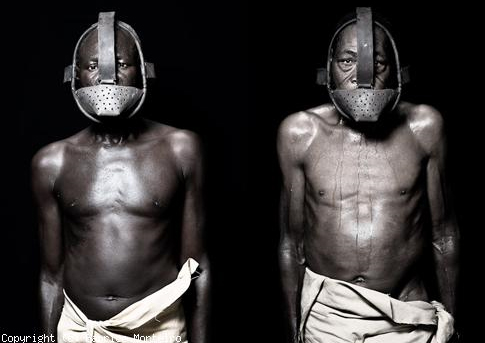
"Marrons. Les esclaves fugitifs" (Brown Runaway Fugitive Slaves) photographed by Fabrice Monteiro
"Brown. Fugitive Slave," is an article published in his newsletter Africultures is an evocation of runaways through the eyes of Fabrice Monteiro. An article that is timely to commemorate the 163 th anniversary of the abolition of slavery in Guadeloupe, 27 May 2011 .
"Marrons. Les esclaves fugitifs" (Brown Runaway Fugitive Slaves) photographed by Fabrice Monteiro
"Maroon" is a term borrowed from the Spanish "cimarron," meaning "living on the peaks."
It comes from a word "Arawak" defining domestic animals returned to the wild, and by extension, runaway slaves. The "Maroon" was a terrible threat to the colonial system, they were likely to provoke a civil war at any time. Fugitive slaves were monitored continuously and the sentences at the slightest deviation were particularly severe, they had to make an impression.
"Marrons. Les esclaves fugitifs" (Brown Runaway Fugitive Slaves) photographed by Fabrice Monteiro
Slaves who tried to escape suffering the punishment described by the law then they were made to wear a heavy iron necklace with long stems, which had the function to hang in the brush and hamper any escape. In the same spirit, they existed in shackles bells, can hear every movement of the slave. The slave who dared to speak a bit to his master suffered the punishment of the Iron Mask. Similarly, during the harvest of sugarcane, were put in iron masks to hungry and thirsty slaves to prevent them from tasting or eating the cane.
"Marrons. Les esclaves fugitifs" (Brown Runaway Fugitive Slaves) photographed by Fabrice Monteiro
During childhood in Benin, Fabrice Monteiro is marked by the cartoon "The Passengers of the Wind" of Bud Francis. Part of the adventure takes place in Ouidah, Benin, home village of his father's family. He is fascinated by the realism of images, it recognizes the scene drawn, the faces are familiar to him. It is in these pages he discovered these strange necklaces worn by some slaves to keep them from escaping. His father tells him the story of his family and why he wears a name like many other Portuguese Benin. His ancestor was named Ayedabo Adagoun Odo, his native Nigeria. He is enslaved by the Portuguese and sent to Brazil. He returned to Benin years later, freed by the name of Pedro Monteiro.
"Marrons. Les esclaves fugitifs" (Brown Runaway Fugitive Slaves) photographed by Fabrice Monteiro
Sensitive to the issue of the slave trade and the role of this small village on the coast of Benin, Fabrice decides to explore the subject photographically to contribute to the memory of slavery. From the * CODE BLACK, lithographs and of the few original photos of slaves, Fabrice plans reconstructs five models of barriers used to punish or deter the slaves of their escape. It is from these plans that two young blacksmiths Benin reproduce barriers staged in this photographic series. To obtain an effect of chiaroscuro, he chose a modern approach to treatment of light. He designed a black box, allowing a mobile studio to meet its models through the streets of Ouidah.
"Marrons. Les esclaves fugitifs" (Brown Runaway Fugitive Slaves) photographed by Fabrice Monteiro
"Marrons. Les esclaves fugitifs" (Runaway Fugitive Slaves) photographed by Fabrice Monteiro
"Marrons. Les esclaves fugitifs" (Runaway Fugitive Slaves) photographed by Fabrice Monteiro
"Marrons. Les esclaves fugitifs" (Runaway Fugitive Slaves) photographed by Fabrice Monteiro
RON'S COMMENTS: Yes, these powerful images are disturbing. It reminds us that human beings sit at the forefront of ALL enslavement. The state-sponsored institutionalization of human trafficking and bondage for profit involves human beings. Millions upon millions of nameless, faceless people who toiled for the enrichment of plutocrats, merchants, kings, queens, aristocrats, planters, shipbuilders, bankers, insurance brokers, shareholders and the like. They were never paid, never thanked, even after emancipation never made whole. I honor their spirit of survival.
This small blog tries to offer a space to historically discuss and make sense of their inhuman bondage.
From History Whiz, "Slavery and the French Revolution" -- Even before 1789 critics had attacked the slave trade and slavery in the colonies. France had several colonies in the Caribbean, the most important of which was Saint Domingue (later called Haiti). There were 500,000 slaves there in 1789 and they provided the labor for sugar, coffee, and cotton plantations.
The behavior of slaves and the actions of slave owners in the colonies was regulated by a series of royal edicts, called the Code Noir, or slave code.
When the Revolution began in 1789 the free mulattos of Saint Domingue discussed the rights of free blacks. Vincent Ogé presented the views of his fellow mulatto property owners to a meeting of the white planters in 1789. Assembly of Colonists
JACOB LAWRENCE (1917–2000) The Life of Toussaint L'Ouverture:
Both groups sent their representatives to France to demand representation in the National Assembly. There were those in the National Assembly who believed in rights for blacks and worked for abolition of slavery. Some were members of the Society of the Friends of Blacks, a French abolition organization. However, there was not much support for aboliton among the revolutionaries. They also argued for full rights for free blacks - There were about 28,000 free blacks and mulattos in Haiti, many of whom owned slaves of their own. More radical revolutionaries continued to urge abolition. Olympe de Gouges, who also championed rights of women, wrote Reflections of Black People, a pamphlet urging improvement of the situations of slaves and free blacks.
Address to the National Assembly in Favor of the Abolition of the Slave Trade February 5, 1790 -Society of the Friends of Blacks
As they argued in France, the uncertainty created instability in the colonies. The free blacks and mulattos agitated for full rights. The planters feared that Paris might abolish slavery and take away their livelihood, and began to talk about independence.
JACOB LAWRENCE (1917–2000) The Life of Toussaint L'Ouverture:
Vincent Ogé presented the views of the mulatto property owners to a meeting of the white planter delegates who had come to Paris. In October 1790, 350 mulattos rebelled in Saint Domingue. The rebellion was put down, the rebels were arrested and the leaders, including James Ogé, were executed. On May 15th, the National Assembly succumbed to pressure and granted political rights to all free blacks and mulattos who were born of free mothers and fathers. It only affected a few hundred people but the planters were infuriated and refused to follow the law.
Just a few months later, on 22 August 1791, the slaves of Saint Domingue again rose up in rebellion, in what was eventually to become the first successful slave revolt in history. The National Assembly reacted by rescinding the rights of free blacks and mulattos on September 24th. Once again the slaves reacted with violence. They burned down plantations, murdered their white masters, and attacked the towns. The fighting went on even as the new
JACOB LAWRENCE (1917–2000) The Life of Toussaint L'Ouverture:
Legislative Assembly (it replaced the National Assembly in October 1791) met at the end of March 1792. On March 28th, the assembly voted to reinstate the political rights of free blacks and mulattos. Nothing was decided about slavery.
The slave rebellion continued. In the fall of 1792, as the Revolution in mainland France began to radicalize, the French government sent two agents to Saint Domingue to gain control of the slave revolt. The rebel slaves then made agreements with the British and Spanish in the area. The British and Spanish had promised freedom to those slaves who would join their armies. It was not a matter of principle - they did not intend to end slavery in their own colonies. But they saw an opportunity to weaken France.
JACOB LAWRENCE (1917–2000) The Life of Toussaint L'Ouverture:
The rebellion and invasions took their toll on Saint Dominique. The economy had nearly collapsed and drastic measures were needed. The National Convention (the more radical assembly of the Jacobins that replace the Legislative Assembly in France) finally voted to end slavery in all the French colonies on February 4, 1794. Thousands of whites fled the island, and even the Mulattoes were not pleased. Many owned slaves themselves and were opposed to the move.
The decree from faraway Paris did not solve the problems in the colonies. Some local officials disregarded the decree, others converted slavery into a forced labor system, and others took no action at all. The decree was never fully implemented.
A leader of the slaves had emerged in the conflicts. Toussaint L'Ouverture, a slave who had learned to read and write, embraced the enlightenment philosophy of equality and liberty. He was a brilliant general, and large areas of Saint Dominique came under his control.
Eventually the Jacobin government in France fell like those governments before it. When Napoleon took control in France, he attempted to put Saint Dominique on a sound footing. By 1800 the plantations were producing for France only one fifth of what they had in 1789. He reinstituted slavery in the colonies, and denied rights to free blacks. He send an expeditionary force to retake Saint Dominique. Through deception the French captured Toussaint and took back to France. Napoleon ordered that Toussaint be imprisoned in the Alps and murdered by lack of food and warmth. However, the fight went on and the slaves were finally successful in driving out the French. In 1804 Saint Dominique became the independent republic of Haiti. The first successful slave revolt in history was over. (source: History Whiz)
The river Gambia is one of the most important transport arteries in West Africa, due to its proximity to America and Europe. 20 miles from its mouth there is a small island that lies close to the north bank.
The first European visitors to the island were the Portueguese. In 1455, an expedition under Luiz de Cadamosto stopped there to bury a sailor who had died of disease. They named it St. Andrews Island after him, but it was nearly 200 years before Europeans returned.
England claimed the island, but it was still uninhabited when settlers from the Duchy of Courland and Semigallia (modern day Latvia) arrived in 1651. The Courlanders built a fort at the mouth of the river (Fort Bayona, which was abandoned a few years later) and another fort on St. Andrews Island, called Fort Jakob.
Old slave trade building in Juffureh, Barry Williams
Sweden declared war against the Polish-Lithuanian Commonwealth (of which the Duchy of Courland was a vassal) in 1655. In 1659 the Dutch offered to garrison the Fort Jakob while its owners were on the defensive in Europe and they expelled the Courlanders.
Under the Dutch, Fort Jakob suffered an attack from French privateers in the pay of the Swedes. After this setback, the Dutch were forced out of the fort by local tribesmen, who prevented them from getting fresh water from the mainland.
Fort James
The Courlanders returned and finished repairing their fort in 1661. A few days later, an English expedition under Sir Robert Holmes arrived, demanding that the island be handed over to England. The outnumbered Courlanders surrendered without a fight.
Sir Robert Holmes' expedition was an undertaking of the Company of Royal Adventurers, who took over the fort, calling it Fort James after the Duke of York. Holmes also built a fort downriver on Dog Island, called Fort Charles, but it was abandoned in 1666. Courland's colonies in the Gambia were formally ceded to England in 1664.
Fort James was square with four bastions'and it contained the governors lodging and barracks. There was a three-storey tower with a platform on the roof for a lookout. This enabled the garrison to spot any ship coming up the river long before it arrived.
Outside the central fort there were various storehouses and other outbuildings, including accommodation for slaves. James Island played an important part in the slave trade, with slaves being kept there before being put on ships and taken to the West Indies. The Courlanders had begun to trade for slaves, shipping them to their colony on Tobago, but it was under the English (later the British) that the slave trade on the river Gambia took off.
The island's shoreline was stabilised with pilings in an attempt to fight against the erosion caused by the river flow and tides. There were three batteries on the shore outside the fort, two facing downriver and one facing upriver. These batteries, which mounted 4 or 5 guns each, were designed to give the garrison control of the river, denying access to rival nations or free traders. However, Fort James had a serious disadvantage in the fact that there was no fresh water on the island.
This strech of the Gambia is tidal and the water is salty, so the garrison had to make frequent trips to the mainland to obtain fresh water. So although Fort James could easily be defended because it was on an island, it was always dependant on friendly settlements on the river banks for drinking water.
In 1681 the French established a trading outpost at Albreda, on the north bank of the river opposite James Island. This marked the beginning of Anglo-French rivalry for control of the river Gambia. In 1688 the War of the Grand Alliance broke out and provided an opportunity for both nations to damage their rival's trade in West Africa. In 1692 the English successfully captured the French settlements of Saint Louis and the Ile Gorée, but these were quickly recoved by the French.
In 1695, after the recapture of Gorée, a French squadron of 6 ships sailed up the Gambia and attacked Fort James. The garrison was weakened by fever and the governor surrendered after just two shells had been fired into the fort. The French force slighted the fort, but later the French African company occupied the island and planned to repair it.
In the end Fort James was returned to England by the Treaty of Rijswijk'in 1697 before any work could be carried out. The fort was rebuilt between 1698 and 1701, to the same design as before. War broke out again in 1702 and this work was put to the test.
Fort James was attacked and ransomed by the French in 1702, damaged by fire in 1703, attacked (and ransomed) again in 1704, suffered a mutiny in 1708 and was finally captured, demolished and abandoned in 1709. In 1713, the Treaty of Utrecht'restored James Island to Britain.
Once back in British hands, the fort was rebuilt from 1714 to 1717. In 1719 it was captured by the pirate Howel Davis, who visited the governor, posing as a merchant. His men took the fort by surprise and looted it. In 1725, disaster struck again when the powder magazine'exploded.
Repairs to the fort included the construction of an annex called the spur. This building was two storeys high and was built against the south-east side of the fort. It contained storehouses and accommodation for the garrison.
However, the spur annex did not last long and was demolished by 1750, perhaps because it compromised the defence of the central fort. By this time erosion had taken its toll on the island's shore, especially on the south end, where the upriver battery was now underwater. The other outbuildings were often destroyed and rebuilt during the fort's history.
It was probably because of the explosion in 1725 that the powder magazine was moved to a better position under the east bastion. Expense magazines were placed in the south and west bastions, to hold shot close to the guns.
In the mid-18th century a cistern was built between the north and east bastions. The new cistern, which was divided into two sections, was much larger than the previous water storage facilities on the island, although it affected the defences.
Being situated between two bastions, it blocked some of the flanking fire across these bastions. However, the cistern was made with a angled exterior faces so that there was no dead ground. There was also a parapet around the top for soldiers.
In 1755 the fortifications on James Island were surveyed by an engineer called Watson. By this stage the two remaining curved batteries were in poor condition and a line of outbuildings formed the south-west edge of the island.
In accordance with Watson's recommendations, the two curved batteries, along with the straight 7-gun battery that had been established between them, were rebuilt in brick. This strengthened them against enemy fire but more importantly protected them from erosion.
Fort James Island
In 1757, during the Seven Years' War, the fort, assisted by nearby British vessels, repulsed an attack by French privateers. Albreda was burned and the British took the French colonies in Senegal. In 1765 Fort James was made the capital of British Senegambia.
This shows the strategic significance of the fort. Although it was not a complex fortification by European standards, its island position controlling the river Gambia made it one of the most important fortifications in West Africa.
In 1768 a Niumi interpreter was taken to the island and died there in mysterious circumstances. In revenge 500 Niumi tribesmen launched an attack against the fort. The Niumi attacked in canoes and approached the island from downriver.
Using the artillery in the batteries facing downriver, the heavily outnumbered garrison was able to prevent the attackers from landing, sinking a number of canoes and forcing the rest to retreat to the bank.
In 1778, during the American War of Independence, a flotilla of French ships arrived at Fort James, which surrendered without a shot being fired. This time the French slighted the fortifications much more thoroughly than on previous occasions. Mines were detonated beneath the bastions, the cistern and two of the curtains.
The buildings inside the central fort were also blown up and the other buildings on the island outside the central fort were burnt. The French destruction had its desired effect; when peace returned in 1783, the British decided that the fort would be too expensive to rebuild.
In 1807 the British government abolished slave trading and an effort was made to stop foreign slavers from using the river Gambia. This led to the founding of Bathurst (modern-day Banjul) in 1816 at the mouth of the river (where the Courlanders had their outpost, Fort Bayona). James Island was sporadically occupied by a small guard to keep watch over ships in the river, but the fort was never rebuilt. It was finally abandoned in 1829. (source: Fortified Places)
Gambia is in Western Africa surrounded by Senegal against the Atlantic Ocean and is the smallest country in continental Africa, and follows the flood plains of the Gambia River with some low hills. Independent from the UK in 1965 and briefly united with Senegal named Senegambia from 1982 until 1989, the Gambia has limited resources but a high concentration of birds, so agriculture and farming with light manufacturing and tourism make up the economy.
Politicians positive about slavery remembrance fund
General -- Tuesday, September 9, 2008 A Dutch fund in memory of the history of slavery come. That is historian Johannes Houwink ten Cate, during the first Day of Slavery, on 6 September in Amsterdam, approval received from the MPs Harry van Bommel (SP), Kathleen Ferrier (CDA) and CU (Christian Union).
Johannes Houwink ten Cate, professor of Holocaust and Genocide Studies at the University of Amsterdam, called the present politicians to generously with reparations to the descendants of African slaves in Suriname and the Antilles. "I think payout to individual victims is virtually impossible, but that precisely because of the long-term effects of slavery a good doped Dutch Foundation for the Remembrance of Slavery must be set."
During the ensuing debate between MPs from SP, CDA and Christian Union appeared to support this. "I'm not going to write a blank check," said Harry van Bommel (SP) "but I think it's an interesting idea." According to Kathleen Ferrier (CDA) would be a possible new fund should be integrated with the existing National Institute of Dutch slavery history and heritage (NiNsee).
Apologies -- Van Bommel said in May this year, Prime Minister Balkenende on his visit to Suriname to intervene on behalf of the Dutch government officially apologize for the Dutch role in the slave trade. The Prime Minister gave to ignore this, but van Bommel announced 'it is not to leave. " Ferrier, daughter of the first President of Suriname and MP on behalf of the CDA, see nothing in an official apology. "By the former colonies to apologize, we create only a situation of inequality between our countries. We need to correct on the basis of equality with each other more. ' Voordewind find an official apology also counterproductive. However, he, like his fellow politicians, believes that considerable attention to the history of slavery in schools should be spent. For the idea of a special fund he is therefore open.
Abolition -- The Day of Slavery was organized by NiNsee and Historic Newspaper and had greater knowledge of the past to target. During an interview with Maartje Janse, a researcher at Leiden University and author of the thesis The abolitionists. Public opinion and political organization in the Netherlands, 1840-1880, came the painful question of why the Dutch abolished slavery in 1863 was over after England (1833), France (1848) and even Russia (1861).
According to Janse was the political culture in the Netherlands, which after the revolutionary years, mass movements were no longer part, an important responsibility for the late abolition. The political will was there, but the removal was a "civilized" way to happen. That the Netherlands in imitation of England in 1814 it abolished the slave trade, according to Janse was a prerequisite for the British government to the Netherlands and Belgium as a country to recognize. [SOURCE: by Maarten Muns]
Caption: Music on the Day of Slavery by Verno Romney & The TK Jive (photo Sander Heijne)
Dutch West India Company trading and colonizing company, chartered by the States-General of the Dutch republic in 1621 and organized in 1623. Through its agency New Netherland was founded. The phenomenal success of the Dutch East India Company was an influential factor in its establishment. The United New Netherland Company, which had been trading around the mouth of the Hudson River for several years, was absorbed into the new company. By the terms of the charter no citizen of the Netherlands could trade with any point on the African coast between the Tropic of Cancer and the Cape of Good Hope or on the American coast between Newfoundland and the Straits of Magellan without the company's permission.
The company was responsible to the States-General in larger matters, such as declaring war, but otherwise had almost complete administrative and judicial power in its territory. The company was initially interested taking Brazil from the Portuguese. After 30 years of warfare, however, Brazil was lost. By that time the company had built Fort Orange (1624) on the site of Albany, N.Y., Fort Nassau (1624) on the Delaware River, Fort Good Hope on the site of Hartford on the Connecticut River, and finally Fort Amsterdam (1626), on the southern tip of Manhattan Island, which was the nucleus of the settlement called New Amsterdam, now New York City. England could not then afford to antagonize the Dutch because of wars with France and Spain and so permitted the Dutch settlement to be made on lands that England claimed. New Netherland remained under the control of the company until the English finally conquered it in 1664 (see New York , state). The company's unsound financial condition led to its reorganization under a new charter in 1674. Thereafter it engaged primarily in the African slave trade, though it still possessed colonies in Guiana. In 1791 its charter expired and was not renewed. [source: "Dutch West India Company." The Columbia Encyclopedia, 6th ed.. 2011. Encyclopedia.com. 14 May. 2012 .]