Showing posts with label torture devices. Show all posts

Sunday, May 20, 2012

Fabrice Monteiro's Amazing Images of Brown. Fugitive Slaves In Slave Torture Devices

"Marrons. Les esclaves fugitifs" (Brown Runaway Fugitive Slaves) photographed by Fabrice Monteiro

"Brown. Fugitive Slave," is an article published in his newsletter Africultures is an evocation of runaways through the eyes of Fabrice Monteiro. An article that is timely to commemorate the 163 th anniversary of the abolition of slavery in Guadeloupe, 27 May 2011 .


"Marrons. Les esclaves fugitifs" (Brown Runaway Fugitive Slaves) photographed by Fabrice Monteiro

"Maroon" is a term borrowed from the Spanish "cimarron," meaning "living on the peaks."

It comes from a word "Arawak" defining domestic animals returned to the wild, and by extension, runaway slaves. The "Maroon" was a terrible threat to the colonial system, they were likely to provoke a civil war at any time. Fugitive slaves were monitored continuously and the sentences at the slightest deviation were particularly severe, they had to make an impression.

"Marrons. Les esclaves fugitifs" (Brown Runaway Fugitive Slaves) photographed by Fabrice Monteiro

Slaves who tried to escape suffering the punishment described by the law then they were made to wear a heavy iron necklace with long stems, which had the function to hang in the brush and hamper any escape. In the same spirit, they existed in shackles bells, can hear every movement of the slave. The slave who dared to speak a bit to his master suffered the punishment of the Iron Mask. Similarly, during the harvest of sugarcane, were put in iron masks to hungry and thirsty slaves to prevent them from tasting or eating the cane.
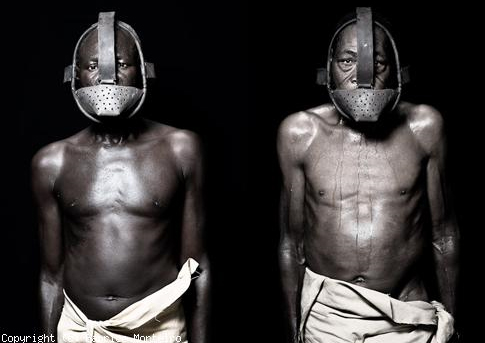

"Marrons. Les esclaves fugitifs" (Brown Runaway Fugitive Slaves) photographed by Fabrice Monteiro

During childhood in Benin, Fabrice Monteiro is marked by the cartoon "The Passengers of the Wind" of Bud Francis. Part of the adventure takes place in Ouidah, Benin, home village of his father's family. He is fascinated by the realism of images, it recognizes the scene drawn, the faces are familiar to him. It is in these pages he discovered these strange necklaces worn by some slaves to keep them from escaping. His father tells him the story of his family and why he wears a name like many other Portuguese Benin. His ancestor was named Ayedabo Adagoun Odo, his native Nigeria. He is enslaved by the Portuguese and sent to Brazil. He returned to Benin years later, freed by the name of Pedro Monteiro.

"Marrons. Les esclaves fugitifs" (Brown Runaway Fugitive Slaves) photographed by Fabrice Monteiro

Sensitive to the issue of the slave trade and the role of this small village on the coast of Benin, Fabrice decides to explore the subject photographically to contribute to the memory of slavery. From the * CODE BLACK, lithographs and of the few original photos of slaves, Fabrice plans reconstructs five models of barriers used to punish or deter the slaves of their escape. It is from these plans that two young blacksmiths Benin reproduce barriers staged in this photographic series. To obtain an effect of chiaroscuro, he chose a modern approach to treatment of light. He designed a black box, allowing a mobile studio to meet its models through the streets of Ouidah.

"Marrons. Les esclaves fugitifs" (Brown Runaway Fugitive Slaves) photographed by Fabrice Monteiro


* The BLACK CODE was developed by the French minister Jean-Baptiste Colbert (1616 - 1683) and promulgated in March 1685 by Louis XIV. [source: Fabrice Monteiro ( Article published by Africultures on 05/05/2011)]

"Marrons. Les esclaves fugitifs" (Runaway Fugitive Slaves) photographed by Fabrice Monteiro


"Marrons. Les esclaves fugitifs" (Runaway Fugitive Slaves) photographed by Fabrice Monteiro


"Marrons. Les esclaves fugitifs" (Runaway Fugitive Slaves) photographed by Fabrice Monteiro


RON'S COMMENTS:  Yes, these powerful images are disturbing.  It reminds us that human beings sit at the forefront of ALL enslavement.  The state-sponsored institutionalization of human trafficking and bondage for profit involves human beings.  Millions upon millions of nameless, faceless people who toiled for the enrichment of plutocrats, merchants, kings, queens, aristocrats, planters, shipbuilders, bankers, insurance brokers, shareholders and the like.  They were never paid, never thanked, even after emancipation never made whole.  I honor their spirit of survival.  

This small blog tries to offer a space to historically discuss and make sense of their inhuman bondage.  

Saturday, April 21, 2012

Branding Irons

Branding Irons

Human branding or stigmatising is the process in which a mark, usually a symbol or ornamental pattern, is burned into the skin of a living person, with the intention that the resulting scar makes it permanent. This is achieved using a very hot or very cold branding iron.

In criminal law, branding with a hot iron was a mode of punishment by which marking the subject as if goods or animals, sometimes concurrently with a reduction of status.

Brand marks have also been used as a punishment for convicted criminals, combining physical punishment, as burns are very painful, with public humiliation, especially if marked on a normally visible part of the body, providing an indelible criminal record

The punishment was adopted by the Anglo-Saxons, and the ancient law of England authorised the penalty. By the Statute of Vagabonds (1547) under King Edward VI, vagabonds and Gypsies were ordered to be branded with a large V on the breast, and brawlers with F for "fraymaker"; slaves who ran away were branded with S on the cheek or forehead. This law was repealed in England in 1550. From the time of Henry VII, branding was inflicted for all offences which received Benefit of clergy (branding of the thumbs was used around 1600 at Old Bailey to ensure that the accused who had successfully used the Benefit of Clergy defence, by reading a passage from the Bible, could not use it more than once), but it was abolished for such in 1822. In 1698 it was enacted that those convicted of petty theft or larceny, who were entitled to benefit of clergy, should be "burnt in the most visible part of the left cheek, nearest the nose." This special ordinance was repealed in 1707. James Nayler, a Quaker who in the year 1655 was accused of claiming to be the Messiah, convicted of blasphemy in a highly publicised trial before the Second Protectorate Parliament and had his tongue bored through and his forehead branded B for 'blasphemer'.

Scene on the Coast; Branding a female slave.

In the 16th century, German Anabaptists were branded with a cross on their foreheads for refusing to recant their faith and join the Roman Catholic Church.

In the North-American Puritan settlements of the 17th century, men and women sentenced for having committed acts of adultery were branded with an "A" letter on their chest (men) or bosom (women).
Silver slave brand, c. 1800.
Canon law sanctioned the punishment, and in France, in royal times, various offences carried the additional infamy of being branded with a fleur de lys. In Germany however, branding was illegal.

In the Lancaster criminal court a branding iron is still preserved in the dock. It is a long bolt with a wooden handle at one end and an M (malefactor) at the other; close by are two iron loops for firmly securing the hands during the operation. The brander would, after examination, turn to the judge and exclaim"A fair mark, milord." Criminals were formerly ordered to hold up their hands before sentence to show if they had been previously convicted.

Slave-branding.


In the 18th century, cold branding or branding with cold irons became the mode of inflicting the punishment on prisoners of higher rank. "When Charles Moritz, a young German, visited England in 1782 he was surprised at this custom, and in his diary mentioned the case of a clergyman who had fought a duel and killed his man in Hyde Park. Found guilty of manslaughter he was burnt in the hand, if that could be called burning which was done with a cold iron" (Markham's Ancient Punishments of Northants, 1886).

Such cases led to branding becoming obsolete, and it was abolished in 1829 except in the case of deserters from the army, which were marked with the letter D, not with hot irons but by tattooing with ink or gunpowder. [http://www.medievalwarfare.info/torture.htm]

Paris torture instruments auction suspended after protests

Hands crusher (Collection Fermand Meyssonnier/Etude Cornette de Saint Cyr)

According to the Lebanon Daily Star, "French torture device auction called off after outcry," 31 March 2012 -- PARIS: A French auction house Friday called off the planned sale of a collection of torture devices dating back three centuries, which had sparked outrage among rights groups and in Algeria.


Some 350 objects, from a hand-crusher to hanging ropes and written death sentences, collected by France's last executioner Fernand Meyssonnier until his death in 2008, had been slated to go on sale on Tuesday in Paris.

A former chief executioner in French-ruled Algeria, Meyssonnier carried out 198 executions between 1957 and the country's independence in 1962, devoting the rest of his life to retirement and his torture collection.


Tools used for torture and humiliation, part of a collection of some 250 items, are displayed at the Hotel Salomon de Rothschild in Paris March 31, 2012. (REUTERS/Gonzalo Fuentes)

French auction house Cornette de Saint Cyr was organizing the sale in Paris for the benefit of the Meyssonnier family. However, following the wave of protests, it said Friday it had cancelled the auction.

"Given the emotion aroused by this sale... we decided to suspend it so that all parties concerned can calmly examine the actual content of this collection," auctioneer Bertrand Cornette de Saint Cyr told AFP.

Culture Minister Frederic Mitterrand had in a statement voiced his "strong disapproval" and urged a cancellation of the sale of objects that were morbid, reflected barbarism raised "painful historical questions".

The Algerian press had also voiced strong disapproval of the auction.

"The minister called me to inform me of the emotion aroused by the sale, particularly in Algeria. The sale is legal but we made the decision to suspend it," another auctioneer, Arnaud Cornette de Saint Cyr, told AFP.

Rights groups on Wednesday attacked the planned auction as "shocking and immoral", according to a joint statement by the ACAT-France Christian anti-torture group, Amnesty International France, the Human Rights League, the Movement Against Racism (MRAP) and the Primo Levi association.


Denouncing what they called the "commercialisation of torture", they called on the French state -- which abolished the death penalty in 1981 -- to remove the lots from sale, if necessary by buying them for museums.

"What shocks us is that torture is still practiced in half of all countries," said Eleonore Morel, director of the Primo Levi association, calling the sale "extremely degrading for all the victims of torture".

Henri Pouillot of the MRAP told AFP the planned auction was "perverse and macabre". Pouillot said he was particularly alarmed by Meyssonnier's connection to Algeria, where French forces are acknowledged to have practiced torture during the war of independence from 1956 to 1962. (source: The Daily Star :: Lebanon News :: http://www.dailystar.com.lb)

A chastity belt is displayed as part of a collection of some 250 items used for torture and humiliation at the Hotel Salomon de Rothschild in Paris March 31, 2012. (REUTERS/Gonzalo Fuentes)

Tuesday, March 20, 2012

The Story of The Legendary Icon Anastacia: Escrava Anastacia


Editor's note:  This story comes from the website, Artworks By Matt Branson. Finding Anastacia's story in English has been a challenge, but this author seems to be from the UK and has the essence of the story correct (my Portuguese is sketchy at best, but from what I've been able to translate his version of the story rings true).  I've seen this iconic image of the cruelties of slavery, but I haven't, until this day, been able to locate the backstory of the masked woman.  

From my understanding and research, it appears that the Portuguese/Brazilian slave holders possessed this strange propensity to mask their enslaved population.  One can just imagine the agony of wearing an iron bridle in the subtropic heat, day in and day out.  The utter misery and torment of enslavement coupled with an unbearable  torture devise like the "dirt eating mask" must have yielded untold suffering for those wearing these vile devices.  Add on to that the burdensome iron slave collar with prongs for extra torture, along with enslavement in perpetuity and the hopeless tyranny of enslavement seems too extreme to wrap your mind around.--Ron Edwards, US Slave Blog


Escrava Anastacia

So, on with the story from Matt Branson:  "I had lived in Rio De Janero for a few years. One day while out down town, I came across a little head of a black girl wearing an iron mask. I had already collected quite a few strange looking statues and thought she would fit in just fine with the rest of them. She pecked my curiosity and I wanted to know more about her."

The story I discovered concerning this new, small statue, was about a child named Anastacia. A black female slave brought from the west coast of Africa to Brazil. Her mother had been forcibly taken by her white owner for his physical pleasures. A child was conceived, the first black child to be born with blue eyes. The cruelty and guilt of this plantation owner drove him to have the baby sent far away, concealing from his wife his indiscretion as well as his violence.


"A man I had met in Rio first told me the tale of Anastacia and of the church in which her image is honored. The truth is that little remains to prove her existence. Two accounts exist, the one above and the following narrative, both of which explain my interest in this amazing woman. My experiences in life, and particularly in Brazil, leads me to believe she truly was a real person. " -MATTHEW BRANSON The Story of Anastacia - The Slave Girl

Based on oral tradition and translated from a Brazilian website Worshipped in Brazil as a saint and heroine, Anastacia is considered one of the most important woman in black history within the culture of Rio de Janeiro. "Her story still has the power to move us to awe and compassion and for that reason alone, I want to make her real to those that don't know about her."


Escrava Anastacia

Anastacia's birth is linked to the tale of Delminda. Some say Delminda was from the Bantu tribe (originating in about 2,000 B.C.E. in southern Nigeria and Cameroon), a daughter of the royal family of Galanga brought to Brazil in 1740 with a cargo of 112 slaves. One version of the story is as follows. Delminda was extremely pretty. She was sold in the harbour by Antonio Rodrigues Velho. She had been raped by a white man and was sold pregnant to Joaquina Pompeu. Delminda gave birth that same year on the 5th March to the blue eyed Anastacia. She was the first black girl with blue eyes in Brazil. It is at this point the two stories seem to merge. Whether or not she was separated from her mother or remained with Delminda, all seem to agree on what comes next. As she grew up Anasatcia became the obsession of the owner's son, Joaquin Antonio.


Very beautiful, It is said that all the white women around were jealous of her, so encouraged Joaquin to make her wear the slave mask. As a punishment for repeatedly refusing his advances, he raped her and condemned her to wear the iron mask for the rest of her life, only removing it once a day to eat. She lived for some years before the toxicity of the metal from the mask became poisonous.

Some accounts claim she was performing miracles toward the end of her life. It became gossip amongst the poor that she could heal because she had found it in her heart to forgive the torture she had suffered, and that she even healed her owner's son of some disease. At that moment she became a saint for many of the poor.


Some continue today petitioning Rome, to have her canonized as St. Anastacia of Rio. There is a statue and a place of worship in Vas Lobo, where pilgrims flock to worship her. She has more than twenty-eight million followers, though I was surprised to find that most of the Brazilian's I have met have never heard of her.


She is exclusive to the poor of Rio and the descendants of slaves. Some link her image with a number of paintings by Etienne Victor Arago (b. 1755 d. 1855), a French watercolourist who traveled in Brazil sometime between 1817-1820. His known works portrayed gold mining slaves who were also forced to wear iron masks, so as not to hide or swallow gold nuggets while they were digging.

She died in Rio after years of agony, her remains were housed in the Church of Rosario, in downtown Rio, but disappeared after a fire. Anastacia became a religious myth, performing miracles, even until today. Many people continue to pray to her when they are sick. Then they are healed.

Portrait - Face -  Painting - Punishment for Slaves 1839
Punishment for slaves. Painting of African person with neck shackled and mouth muzzled. Jacques Etienne Arago. Castigo de Escravos, 1839. English: Punishiment for slaves. Português: Castigo de Escravo. Museu Afro Brasil (São Paulo).

Her history was miraculously recovered in 1968, when an exhibition to celebrate 90 years of the abolition of slavery was held in the Church of Rosario. In the back of the church was found a portrait of her by Arago. "As you can see, there are a few different accounts of her existence, of Anastacia, the slave girl. She would have been forgotten entirely if it hadn't been for a portrait by Arago.

Mystery is part of her story as it is part of the life of this French painter who sailed the seas between Australia and South America. There are conflicting tales as to whether or not Arago is buried in Paris or in Rio itself.


Human Rights are for all of us and slavery is not a condition for humanity. I continuously lived in Brazil from 1985 to 1992. Around 1987, a television news broadcast in Rio said authorities had found a farmer in the middle of nowhere in rural Brazil, who operated his farm with all his workers in chains. He repeatedly advertised jobs through the press in Sao Paulo and when anyone arrived to work, he made a slave of them, one-hundred and ten years after the abolition of slavery. How can we be so unconscious as to not know about these things? How can we be apathetic to the conditions of others? I would like to put Anastacia into the history books, in Brazil and everywhere else. She represents the suffering of people that have been forgotten and are still being ignored today. I hope you see my point of view, and can appreciate my art, for her sake.

It wasn't until years later, that I discovered the meaning of the name Anastacia -- it means "Resurrection". (source: http://www.mattbranson.co.uk/page4.htm)


Thursday, February 9, 2012

SLAVE WHIPPING AS A BUSINESS


SLAVE WHIPPING AS A BUSINESS.

Whipping was done at these markets, or trader's yards, all the time. People who lived in the city of Richmond would send their slaves here for punishment. When any one wanted a slave whipped he would send a note to that effect with the servant to the trader. Any petty offense on the part of a slave was sufficient to subject the offender to this brutal treatment. Owners who affected culture and refinement preferred to send a servant to the yard for punishment to inflicting it themselves. It saved them trouble, they said, and possibly a slight wear and tear of feeling. For this service the owner was charged a certain sum for each slave, and the earnings of the traders from this source formed a very large part of the profits of his business.


The yard I was in had a regular whipping post to which they tied the slave, and gave him "nine-and-thirty," as it was called, meaning thirty-nine lashes as hard as they could lay it on. Men were stripped of their shirts in preparation for the whipping, and women had to take off their dresses from the shoulders to the waist. These whippings were not so severe as when the slaves were stripped entirely of their clothes, as was generally the case on the plantations where slaves were owned by the dozen. I saw many cases of whipping while I was in the yard. Sometimes I was so frightened that I trembled violently, for I had never seen anything like it before. (http://docsouth.unc.edu/fpn/hughes/hughes.html)

Whipping Post, Delaware

Thursday, October 13, 2011

The Whipping Scars On The Back of The Fugitive Slave Named Gordon

Runaway Slave Gordon.

From the Smithsonian Photography Initiative, "Photography changes the way we record and respond to social issues," by Frank H. Goodyear, III, assistant curator of photographs at the National Portrait Gallery, suggests how mass produced and widely distributed images helped the abolitionist movement.

During the Civil War, photography heroicized the leading politicians and military officers, memorialized sites where the war was waged, and—remarkable for the time—revealed how violent and deadly the battles between Union and Confederate forces actually were. It also played an influential role in broadening the national debate about slavery. As this famous photograph suggests, photography was capable of communicating powerful ideas about the so-called “peculiar institution”—ideas that ultimately undermined the prevailing notion that slavery was a benign tradition.

Gordon As He Entered Our Lines

The photograph pictures the runaway slave Gordon exposing his scourged back to the camera of two itinerant photographers, William D. McPherson and his partner, Mr. Oliver. Gordon had received a severe whipping for undisclosed reasons in the fall of 1862. This beating left him with horrible welts on much of the surface of his back. While the plantation owner discharged the overseer who had carried out this vicious attack, for the next two months as Gordon recuperated in bed, he decided to escape.

In March 1863 he fled his home, heading east towards the Mississippi River. Upon learning of his flight, his master recruited several neighbors and together they chased after him with a pack of bloodhounds. Gordon had anticipated that he would be pursued and carried with him onions from the plantation, which he rubbed on his body to throw the dogs off-scent. Such resourcefulness worked, and Gordon—his clothes torn and his body covered with mud and dirt—reached the safety of Union soldiers stationed at Baton Rouge ten days later. He had traveled approximately eighty miles.

Runaway Slave Gordon under medical inspection.

While at this encampment Gordon decided to enlist in the Union Army. As President Lincoln had granted African Americans the opportunity to serve in segregated units only months earlier, Gordon was at the front of a movement that would ultimately involve nearly 200,000 African Americans. It was during his medical examination prior to being mustered into the army that military doctors discovered the extensive scars on his back. McPherson and Oliver were then in the camp, and Gordon was asked to pose for a picture that would reveal the harsh treatment he had recently received.


The photographic team mass-produced and sold copies of Gordon’s portrait in the small and popular format of the time, known as the carte-de-visite. The image provoked an immediate response as copies circulated quickly and widely. Samuel K. Towle, a surgeon with the 30th Regiment of the Massachusetts Volunteers working in Baton Rouge, sent a copy of the photograph to the Surgeon-General of the State of Massachusetts. In his accompanying letter he wrote: “Few sensation writers ever depicted worse punishments than this man must have received, though nothing in his appearance indicates any unusual viciousness—but on the contrary, he seems INTELLIGENT AND WELL-BEHAVED.” Within months commercial photographers in Philadelphia, New York, Boston, and London were issuing this image on their own studio mounts. This particular copy was made by the famous New York portrait photographer Mathew Brady.

Gordon the Runaway Slave
Harper's Weekly, July 4, 1863

Recognized as a searing indictment of slavery, Gordon’s portrait was presented as the latest evidence in the abolitionist campaign. An unidentified writer for the New York Independent wrote: “This Card Photograph should be multiplied by 100,000, and scattered over the States. It tells the story in a way that even Mrs. [Harriet Beecher] Stowe [author of the 1852 book, Uncle Tom’s Cabin] can not approach, because it tells the story to the eye.” Abolitionist leaders such as William Lloyd Garrison referred to it repeatedly in their work.

On July 4, 1863 Harper’s Weekly reproduced the image as a wood engraving with the article, “A Typical Negro.” Two other portraits of Gordon—one “as he entered our lines,” and the other “in his uniform as a U.S. soldier”—were also included. Together these three images and the accompanying article about his harrowing journey and the brutality of Southern slaveholders transformed Gordon into a symbol of the courage and patriotism of African Americans. His example also inspired many free blacks in the North to enlist.

Gordon in his uniform as a U.S. Soldier.

Records of Gordon’s military service during the Civil War are incomplete. Harper’s Weekly reported that he served as a Union guide in Louisiana, and that during one expedition he was taken captive by Confederate forces, beaten, and left for dead. Yet, he supposedly survived and returned to Union lines. The Liberator reported that he served as a sergeant in an African American regiment that fought bravely at the siege of Port Hudson, an important Confederate stronghold on the Mississippi River twenty miles north of Baton Rouge. This battle on May 27, 1863 marked the first time that African American soldiers played a leading role in an assault on a major Confederate position. Their heroism was widely noted and helped convince many skeptics to accept the enlistment of African Americans into the U.S. Army. There are no further records indicating what became of Gordon. Yet, this famous image of him lives on as a searing testament of slavery’s brutality and the fortitude displayed by so many African Americans during this period. (source: Smithsonian Photography Initiative)

Saturday, September 24, 2011

The Mimicking of the Slave System Structure in the Post-Emancipation Prison System

Kim Gilmore's "Slavery and Prison - Understanding the Connections," states: The transfer of power to the state signaled by the 13th Amendment profoundly reshaped the political landscape along with emancipation. By empowering the state to regulate relationships between private individuals, the state also gained the ability to determine the contours of freedom and unfreedom. The expansion of state jurisdiction thus had the dual effect of establishing legal rights for African Americans while paving the way for new, state-maintained structures of racism. Convict labor became increasingly racialized: it was assumed that blacks were more suitable for hard physical labor on Southern prison farms and on corporate railroad and construction company projects (Lichtenstein, 1996b). Contrary to popular representations of chain gang labor, not only black men, but also black women were forced to work on the lines and on hard labor projects, revealing how the slave order was being mirrored in the emerging punishment system. This mimicking of the slave system structure in the post-emancipation prison system, particularly in the South, suggested a belief that the performance of antebellum culture could bring the slave system back to life (Jackson, 1999). In Northern prisons, which had historically been structured around industrial rather than agricultural labor, racially based divisions were sharpened after emancipation as well. African Americans were criminalized for committing Black Code-type crimes and often were subject to tougher sentences than those imposed upon whites convicted of similar crimes (Du Bois, 1935).


Even though the efforts of ex-slaves and other abolitionists made it impossible to reinstall legalized chattel slavery, racialized labor arrangements persisted in the form of convict labor. Convict labor built the post-Civil War infrastructure in the U.S., not just in the South but also throughout the U.S., and the struggle to determine how free unfree labor would be continued. Labor unions, which had always been skeptical about prison labor, aggressively lobbied against the leasing of convicts to private corporations. Throughout the Depression years, unionists made it clear that an expanded use of prison labor would further imperil an already overfull work force and intervene in "free markets" in ways that threatened the stability of capitalism and laid bare its most excessive failures. Slowly, prisons and jails solved this problem by developing a "state-use" system in which prison labor was used solely for state projects. This solution eliminated the competition between convict labor and union labor, while still enabling convicts to offset their cost to the state (McGinn, 1993). The Prison Industries Reorganization Administration (PIRA), a New Deal project, conducted a massive study of prison labor in all 50 states and concluded by outlining this new state-use system. Citing overcrowding and inadequate facilities, the PIRA recommended the expansion of the prison system and the construction of new prisons in almost every state (Fraser and Gerstle, 1989). No clear statistics demonstrate that "crime," particularly violent crime, had increased during this period. Moreover, many of those who ended up in prison were criminalized for crimes stemming from unemployment, suggesting that if the state had had a handle on unemployment, there may not have been a need for more prisons. Thus, the PIRA embodied one of the many contradictions embedded in the "New Deal state" -- its inability (or unwillingness) to deal with its overabundance of labor. Thus, the PIRA, together with a racialized labor system that had roots in the slave system, cleared the path for the prison-industrial complex that has flourished in the post-World War II period.
Convicts picking cotton.

Given the links between the legacy of slavery and mass imprisonment of people of color in the U.S., it might be useful to examine how a few previous prison abolition movements positioned themselves in relation to this history. These groups were often led by Quakers or inspired by the Quaker abolitionists of the 19th century. One such group, the Committee to Abolish Prison Slavery (CAPS), was active in the late 1970s and early 1980s and saw the abolition of mass imprisonment as the key to completing the partial emancipation signaled by the 13th Amendment. According to CAPS, which produced Prison Slavery, their collaboratively authored book, the triumph of emancipation was not a total victory since the 13th Amendment legalized penal servitude as punishment for particular crimes, a stipulation that was incorporated into many state constitutions. Prison Slavery (Esposito and Wood, 1982:114) cites the significant 1871 court ruling from Ruffin v. Commonwealth. This landmark Virginia case--revealingly argued using the language of slavery -- set a precedent for state control of inmate bodies and labor:
United States Prisoners Picking Cotton

[1] For the time, during his term of service in the penitentiary, he is in a state of penal servitude to the State. He has, as a consequence of his crime, not only forfeited his liberty, but all his personal rights except those which the law in its humanity accords to him. He is for the time being a slave of the State. He is civiliter mortus; and his estate, if he has any, is administered like that of a dead man.

CAPS found much to admire in the 19th-century slave abolition movement, but viewed penal servitude as a new incarnation of slavery. The group critiqued the failure of abolitionists, particularly Quakers, who worked to overthrow the Southern slave regime but stopped short of eliminating the broader inequalities that were reflected in the prison system. CAPS was, essentially, struggling to define the continuing nature of unfree labor and was critical of the Quakers who preceded them for participating in class oppression.

Prison labor.

When Prison Slavery was published in 1982, many states still had clauses in their constitutions that deemed slavery and indentured servitude legal punishments or had no proviso about the legality or illegality of prison enslavement (some states eliminated any reference to slavery in the middle decades of this century). Since this 13th Amendment provision was, for CAPS, the legal cornerstone codifying prison slavery, they proposed a "new abolitionism" that would make the elimination of these clauses from all constitutions its goal. Their abolitionist strategies also included education campaigns to inform the public about prison conditions, an issue typically relegated to the sidelines of an individual's physical and psychic landscapes. The group also advocated boycotting consumer products made by prison labor, supporting alternatives to imprisonment, and working toward an acknowledgement of the class-based exploitation inherent in mass imprisonment. By circulating petitions that would amend state punishment clauses, CAPS created alliances between prisoners on the inside and activists on the outside. They learned of the brutalities that often occurred behind prison walls through testimonies from inmates who had developed their own analyses of prison system injustices, but frequently found themselves confined by the limited resources available to them, or constrained by criminal justice administrators and guards who threatened prisoners with violence for expressing their views and working for change. (source: History as a Weapon)

Torture Device: Pillory and Stocks


STOCKS


Stocks and pillories were regularly used to punish minor offences committed by slaves. Although whipping was also a common punishment, some owners were sparing with this for fear of damaging or killing valuable slaves. Here is a personal testimony made to the American Anti-Slavery Society in 1839:

The convict hangs by wrists and ankles two inches from the ground. He is left thus under the tropic sun. The position is excruciating torture which quickly produces unconsciousness.

"A planter, a professor of religion, in conversation upon the universality of whipping, remarked that a planter in G--, who had whipped a great deal, at length got tired of it, and invented the following excellent method of punishment, which I saw practised while I was paying him a visit. The negro was placed in a sitting position, with his hands made fast above his head, and feet in the stocks, so that he could not move any part of the body. The master retired, intending to leave him till morning, but we were awakened in the night by the groans of the negro, which were so doleful that we feared he was dying. We went to him, and found him covered with a cold sweat, and almost gone. He could not has lived an hour longer. Mr.--found the 'stocks' such an effective punishment, that it almost superseded the whip.” (source: Geocities)


Pillory and Stocks

The pillory was a wooden frame on a pole with holes through which a person's head and hands were placed. The frame was then locked and the person was subjected to humiliation and ridicule. Sometimes people also threw unpleasant objects at the person in the pillory. The stocks was a wooden frame with holes through which a person's feet were placed and they were humiliated in the same way. Use of the pillory and stocks went out of favour in the 19th century. The pillory was abolished in Britain in 1837 and the stocks was abolished in 1870 (source: Geocities)


Another personal testimony made to the American Anti-Slavery Society in 1839 concerning the fate of a slave who attempted to escape:


"On the return of his master, some of the slaves were sent for Harry. When he came home he was seized and confined in the stocks. The stocks were built in the barn, and consisted of two heavy pieces of timber, ten or more feet in length, and about seven inches wide; the lower one, on the floor, has a number of holes or places cut in it, for the ankles; the upper piece, being of the same dimensions, is fastened at one end by a hinge, and is brought down after the ankles are placed in the holes, and secured by a clasp and padlock at the other end. In this manner the person is left to sit on the floor. Harry was kept in the stocks day and night for a week, and flogged every morning. After this, he was taken out one morning, a log chain fastened around his neck, the two ends dragging on the ground, and he sent to the field, to do his task with the other slaves. At night he was again put in the stocks, in the morning he was sent to the field in the same manner, and thus dragged out another week."


Stocks and pillories were on occasions used with particular savagery, as the following illustrates:

“In the House of Commons on 1 July 1830, during the course of a speech on slavery in the colonies, an instance was mentioned of cruel treatment meted out by an English gentlewoman to a slave girl. On suspicion of being concerned in a theft, the young negress was imprisoned in the stocks for seventeen days, during which period she was deprived of sleep by rubbing red pepper into her eyes, and she was flogged repeatedly.” (“A History of Torture” by George Riley Scott)


Field stocks were much used as a means of punishing female offenders, when regulations substituting this form of punishment in place of female flogging came into force. These consisted of stocks for the victim’s hands which could be adjusted to any height above her head, while her feet were placed in horizontal stocks. The hand stocks could be raised and secured until only the victim’s toes could touch the ground. The whole weight of her body rested upon her wrists and toes. In Trinidad, to increase the punishment, leaden or iron weights were tied to the wrists.

HOME

HOME
Click here to return to the US Slave Home Page