Showing posts with label slave masks. Show all posts

Tuesday, March 20, 2012

The Story of The Legendary Icon Anastacia: Escrava Anastacia


Editor's note:  This story comes from the website, Artworks By Matt Branson. Finding Anastacia's story in English has been a challenge, but this author seems to be from the UK and has the essence of the story correct (my Portuguese is sketchy at best, but from what I've been able to translate his version of the story rings true).  I've seen this iconic image of the cruelties of slavery, but I haven't, until this day, been able to locate the backstory of the masked woman.  

From my understanding and research, it appears that the Portuguese/Brazilian slave holders possessed this strange propensity to mask their enslaved population.  One can just imagine the agony of wearing an iron bridle in the subtropic heat, day in and day out.  The utter misery and torment of enslavement coupled with an unbearable  torture devise like the "dirt eating mask" must have yielded untold suffering for those wearing these vile devices.  Add on to that the burdensome iron slave collar with prongs for extra torture, along with enslavement in perpetuity and the hopeless tyranny of enslavement seems too extreme to wrap your mind around.--Ron Edwards, US Slave Blog


Escrava Anastacia

So, on with the story from Matt Branson:  "I had lived in Rio De Janero for a few years. One day while out down town, I came across a little head of a black girl wearing an iron mask. I had already collected quite a few strange looking statues and thought she would fit in just fine with the rest of them. She pecked my curiosity and I wanted to know more about her."

The story I discovered concerning this new, small statue, was about a child named Anastacia. A black female slave brought from the west coast of Africa to Brazil. Her mother had been forcibly taken by her white owner for his physical pleasures. A child was conceived, the first black child to be born with blue eyes. The cruelty and guilt of this plantation owner drove him to have the baby sent far away, concealing from his wife his indiscretion as well as his violence.


"A man I had met in Rio first told me the tale of Anastacia and of the church in which her image is honored. The truth is that little remains to prove her existence. Two accounts exist, the one above and the following narrative, both of which explain my interest in this amazing woman. My experiences in life, and particularly in Brazil, leads me to believe she truly was a real person. " -MATTHEW BRANSON The Story of Anastacia - The Slave Girl

Based on oral tradition and translated from a Brazilian website Worshipped in Brazil as a saint and heroine, Anastacia is considered one of the most important woman in black history within the culture of Rio de Janeiro. "Her story still has the power to move us to awe and compassion and for that reason alone, I want to make her real to those that don't know about her."


Escrava Anastacia

Anastacia's birth is linked to the tale of Delminda. Some say Delminda was from the Bantu tribe (originating in about 2,000 B.C.E. in southern Nigeria and Cameroon), a daughter of the royal family of Galanga brought to Brazil in 1740 with a cargo of 112 slaves. One version of the story is as follows. Delminda was extremely pretty. She was sold in the harbour by Antonio Rodrigues Velho. She had been raped by a white man and was sold pregnant to Joaquina Pompeu. Delminda gave birth that same year on the 5th March to the blue eyed Anastacia. She was the first black girl with blue eyes in Brazil. It is at this point the two stories seem to merge. Whether or not she was separated from her mother or remained with Delminda, all seem to agree on what comes next. As she grew up Anasatcia became the obsession of the owner's son, Joaquin Antonio.


Very beautiful, It is said that all the white women around were jealous of her, so encouraged Joaquin to make her wear the slave mask. As a punishment for repeatedly refusing his advances, he raped her and condemned her to wear the iron mask for the rest of her life, only removing it once a day to eat. She lived for some years before the toxicity of the metal from the mask became poisonous.

Some accounts claim she was performing miracles toward the end of her life. It became gossip amongst the poor that she could heal because she had found it in her heart to forgive the torture she had suffered, and that she even healed her owner's son of some disease. At that moment she became a saint for many of the poor.


Some continue today petitioning Rome, to have her canonized as St. Anastacia of Rio. There is a statue and a place of worship in Vas Lobo, where pilgrims flock to worship her. She has more than twenty-eight million followers, though I was surprised to find that most of the Brazilian's I have met have never heard of her.


She is exclusive to the poor of Rio and the descendants of slaves. Some link her image with a number of paintings by Etienne Victor Arago (b. 1755 d. 1855), a French watercolourist who traveled in Brazil sometime between 1817-1820. His known works portrayed gold mining slaves who were also forced to wear iron masks, so as not to hide or swallow gold nuggets while they were digging.

She died in Rio after years of agony, her remains were housed in the Church of Rosario, in downtown Rio, but disappeared after a fire. Anastacia became a religious myth, performing miracles, even until today. Many people continue to pray to her when they are sick. Then they are healed.

Portrait - Face -  Painting - Punishment for Slaves 1839
Punishment for slaves. Painting of African person with neck shackled and mouth muzzled. Jacques Etienne Arago. Castigo de Escravos, 1839. English: Punishiment for slaves. Português: Castigo de Escravo. Museu Afro Brasil (São Paulo).

Her history was miraculously recovered in 1968, when an exhibition to celebrate 90 years of the abolition of slavery was held in the Church of Rosario. In the back of the church was found a portrait of her by Arago. "As you can see, there are a few different accounts of her existence, of Anastacia, the slave girl. She would have been forgotten entirely if it hadn't been for a portrait by Arago.

Mystery is part of her story as it is part of the life of this French painter who sailed the seas between Australia and South America. There are conflicting tales as to whether or not Arago is buried in Paris or in Rio itself.


Human Rights are for all of us and slavery is not a condition for humanity. I continuously lived in Brazil from 1985 to 1992. Around 1987, a television news broadcast in Rio said authorities had found a farmer in the middle of nowhere in rural Brazil, who operated his farm with all his workers in chains. He repeatedly advertised jobs through the press in Sao Paulo and when anyone arrived to work, he made a slave of them, one-hundred and ten years after the abolition of slavery. How can we be so unconscious as to not know about these things? How can we be apathetic to the conditions of others? I would like to put Anastacia into the history books, in Brazil and everywhere else. She represents the suffering of people that have been forgotten and are still being ignored today. I hope you see my point of view, and can appreciate my art, for her sake.

It wasn't until years later, that I discovered the meaning of the name Anastacia -- it means "Resurrection". (source: http://www.mattbranson.co.uk/page4.htm)


Friday, September 23, 2011

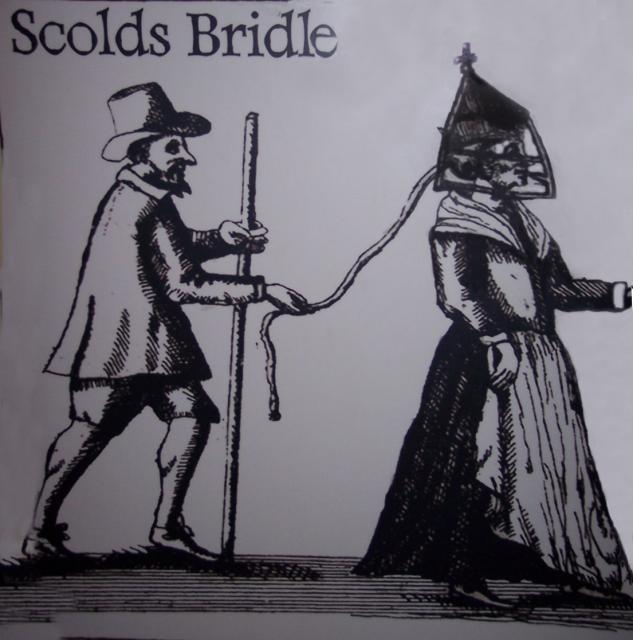
Slave Tortures: The Mask, Scold's Bridle, or Brank

Mulier taceat in ecclesia
- 'Let the woman be silent in church'
Let the Woman be Silent in Church: Over four centuries, thousands of women were subjected to the wearing of these contraptions. The main principle behind the scold's bridle was: let the woman be silent in church, though the word 'church' referred to the Parish community, or to be more precise; the male hierarchies of a community, rather than the building of bricks and mortar. Further translation would suggest more accurately - 'Let the woman be silent in the presence of the male'.

(Image source: Faganarms)

English or possibly Colonial American as these were used by the Puritan Pilgrims who severely punished offenses which violated their cultural or religious values. The concept and its predecessors originated in Scotland and were popular throughout England. Comprising a finely forged cage of four bars, sized for a woman’s head, the front shaped to accommodate the nose. The lower face enclosed by a plate with pin pierced ventilation holes and a small triangular opening at the mouth through which food and drink could be administered.

The back bar with a finely forged “pig tail” terminal. The sides with shackles meeting the back side bars with small holes for rivet fastening. This example is distinguished by its small feeding aperture and provision for rivet locking rather than padlocking. The former feature undoubtedly allowed for bread and water to sustain life and both features indicate its use for long term incarceration. Its fine rich stable patina is as found on examples preserved in museum collections. Height: 11 3/4” (source: Faganarms)


Scold's Bridle: This was a metal frame place over a woman's head. It had a bit that stuck in her mouth to prevent her talking. The scold's bridle or branks was used in Scotland by the 16th century and was used in England from the 17th century. It was last used in Britain in 1824


Source: Le Magasin Pittoresque (1846, Vol. 14), p. 229

Comments
Caption "Esclave Marron a Rio de Janeiro" (Fugitive/Runaway Slave in Rio de Janeiro), based on a drawing by a Mister Bellel. The engraving illustrates a brief article on fugitive slaves in Brazil, and is apparently derived from first-hand information. "Captured fugitives," the article notes, "are forced to do the hardest and roughest work. They are ordinarily placed in chains and are led in groups through the city's neighborhoods where they carry loads or sweep refuse in the streets. This type of slave is so frightful that, while they have lost all hope of fleeing again, they think of nothing but suicide. They poison themselves by drinking at one swallow a large quantity of strong liquor, or choke/suffocate themselves by eating dirt/earth. In order to deprive them of this way of causing their own deaths, they put a tin mask on their faces; the mask has only a very narrow slit in front of the mouth and a few little holes under the nose so they can breathe" (p. 229; our translation).


Slave Mask: Image Reference, NW0191. Source:Jacques Arago, Souvenirs d'un aveugle. Voyage autour du monde par M. J. Arago . . . (Paris, 1839-40), vol. 1, facing p. 119

Comments
Arago"s voyage took place between 1817 and 1820, during which time close to two months (early December to the end of January 1818) were spent in Brazil, particularly Rio de Janeiro. The engraving shown here, based on a sketch by Arago, is captioned "Chatiment des Esclaves, Brasil" (Punishment of Slaves). It shows an unidentified male and probably represents a composite of several enslaved Brazilians who Arago observed in the streets of Rio. This illustration is often confused and misidentified in secondary sources on slavery. Among other errors, such sources identify the subject as a woman, but Arago quite explicitly refers to the figure as a man. For a detailed discussion of this image and its historical context, see J. Handler and A. Steiner, "Identifying Pictorial Images of Atlantic Slavery: Three Case Studies," Slavery and Abolition 27 (2006), 56-62. The transformation of this image in Brazil in modern times to represent a martyred female slave is discussed in J. Handler and K. Hayes, "Escrava Anastacia: The Iconographic History of a Brazilian Popular Saint," African Diaspora: Journal of Transnational Africa in a Global World 2 (2009), 1-27


Image Reference BRIDG-4_IMG. Source: Richard Bridgens, West India Scenery...from sketches taken during a voyage to, and residence of seven years in ... Trinidad (London, 1836), plate 20. (Copy in Providence Atheneum, Rhode Island)

Comments: Caption, "Negro Heads, with punishments for Intoxication and dirt-eating." "The tin collar is a punishment for drunkenness in females," while the mask is "a punishment and preventative of . . . dirt eating." The illustration also shows facial and body scarification, or so-called "country marks," indicative of African origin; the man in the center right also displays filed or modified teeth, another indicator of African birth among West Indian slaves (see Jerome Handler, Determining African Birth from Skeletal Remains: A Note on Tooth Mutilation, Historical Archaeology [1994], vol. 28, pp. 113-119). There is no certain date of publication of Bridgens West India Scenery, though major libraries with copies of this work usually assign 1836 as a publication date. A sculptor, designer and architect, Bridgens was born in England in 1785. In 1825 he moved to Trinidad where his wife had inherited a sugar plantation. Although Bridgens apparently occasionally returned to England, he died in Port of Spain in 1846 (Brian Austen, Richard Hicks Bridgens [Oxford Art Online/Grove Art Online, http://www.oxfordartonline.com:80/subscriber/article/grove/art/T011315]; thanks to Sarah Thomas for her help). Bridgens’ racist perspectives on enslaved Africans and his defense of slavery are discussed in T. Barringer, G. Forrester, and B. Martinez-Ruiz, Art and Emancipation in Jamaica: Isaac Mendes Belisario and his Worlds [ Yale University Press, 2007], pp. 460-461.


Slave Mask Image Reference, NW0192. Source: Thomas Branagan, The Penitential Tyrant; or, slave trader reformed (New York, 1807), p. 271. (Copy in Library Company of Philadelphia; also Library of Congress, Prints and Photographs Division, LC-USZ62-31864)

Comments: Bound into this abolitionist work, but consecutively paginated with the title poem, is a separate essay, "The Method of Procuring Slaves on the Coast of Africa; with an account of their sufferings on the voyage, and cruel treatment in the West Indies" (pp. 252-274). This essay is accompanied by a number of engravings, including the one show here, which is described (on p. 270) as follows: "A front and profile view of an African's head, with the mouth-piece and necklace, the hooks round which are placed to prevent an escapee when pursued in the woods, and to hinder them from laying down the head to procure rest. At A [see letter over mouth of figure on the right] is a flat iron which goes into the mouth, and so effectually keeps down the tongue, that nothing can be swallowed, not even the saliva, a passage for which is made through holes in the mouth-plate." On the lower right is an enlarged view of this mouth piece which "when long worn, becomes so heated as frequently to bring off the skin along with it." The lower left shows leg shackles used on the slave ships; also, "spurs used on some plantations in Antigua" (placed on the legs to prevent slaves from absconding). Another illustration in the Penitential Tyrant, which does not appear to be present in all copies of this work (and is not shown on this website) shows a slave lashed to an upright ladder, which is leaning against a tree, while being whipped by another slave as the slavemaster looks on.


The Scold's Bridle

A scold's bridle is a British invention, possibly originating in Scotland, used between the 16th and 19th Century. It was a device used to control, humiliate and punish gossiping, troublesome women by effectively gagging them. Scold comes from the 'common scold': a public nuisance, more often than not women, who habitually gossiped and quarrelled with their neighbours, while the name bridle describes a part that fitted into the mouth. The scold's bridle was also known as the 'gossiping bridle' and the 'Brank(s)', and was commonly used by husbands on their nagging or swearing wives. The device was occasionally used on men; however, it was primarily used on women who agitated the male-dominated society of the era. (image source: Old Electronic Library)


The Scold's Bridle
Description:

Made by blacksmiths, the bridle was a cage-like device, made from iron. It was approximately nine inches high and seven inches wide, and was fitted to the woman's head. The most basic type was made of a band of iron, which was hinged at the side and had a protruding part, or tongue piece, that could be flat or with a spike, which went into the woman's mouth, to hold her tongue down. Another band of iron went over her head, the front of which was shaped for her nose to go through. Depending on the design, the bridle could be uncomfortable, painful or torturous, and scarring of the tongue was not uncommon. Some had a bell secured to a spring, which was attached to the bridle, so the wearer could be heard as she approached.


The Scold's Bridle or Branks
Judicial:

Some houses had a hook in the wall at the side of the fireplace where the wife would be chained, until she promised to behave herself and curb her tongue. Although sometimes fitted to a nagging wife by the local gaoler (jailer) at the request of her husband, or by the husband himself, it was more often a punitive sentence ordered by a magistrate. Judicial bridles were more elaborate than the basic type; they always had at least one spike and they could be locked. They also had a chain attached to the side of the bridle, with a ring on the end. This could be used to publicly humiliate the woman by leading her through the town, or staking her at a designated area for a set time period. The amount of time the bridle was worn could be from 30 minutes to several hours, depending on the seriousness of the offence, during which time the miscreant would not be able to eat or drink. It was also said to be used on witches to prevent them from chanting or casting spells.


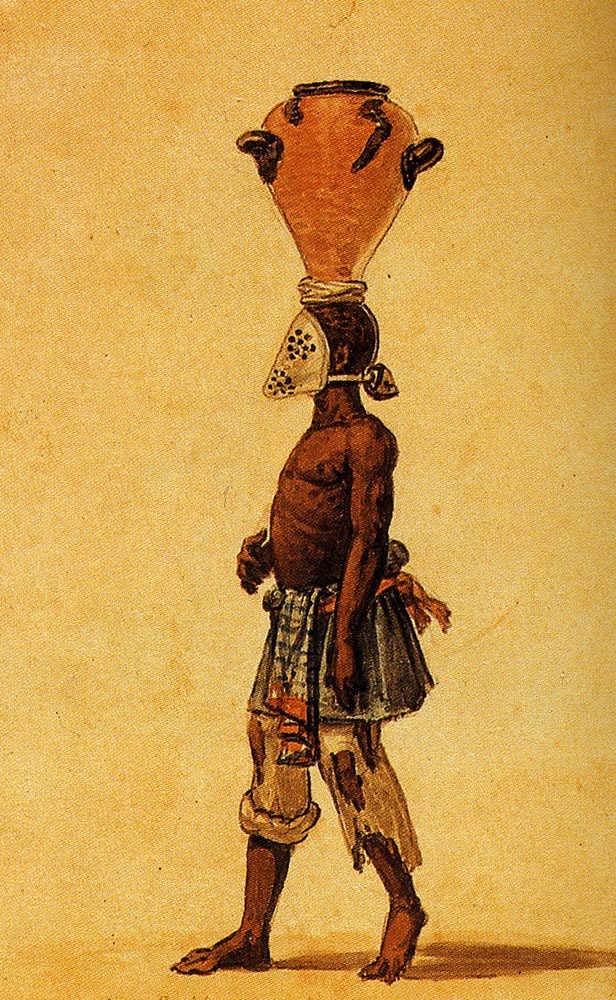
A water color by Jean Baptiste Debret (held by a museum in Rio de Janeiro); published in Ana Maria de Moraes, O Brasil dos viajantes (Sao Paulo and Rio de Janeiro, 1994), image 469, p. 93. Also published in Jean Baptiste Debret, Viagem Pitoresca e Historica ao Brasil (Editora Itatiaia Limitada, Editora da Universidade de Sao Paulo, 1989), p.128, a reprint of the 1954 Paris edition, edited by R. De Castro Maya). (source: University of Virginia)


Comments
Shows a slave wearing a tin mask over his face; he is "heading" a large ceramic jar. Brazilian slavemasters compelled slaves who were prone to eat earth or dirt to wear such masks. This illustration does not appear to have been published in Debret's, Voyage Pittoresque et Historique au Bresil (Paris,1834-39), although another slave, wearing such a mask, is illustrated in vol. 2, plate 10, captioned "une visite a la campagne" (the image is not shown on this website). For a description of this mask in Brazil, see image reference ewbank3. The engravings in this book were taken from drawings made by Debret during his residence in Brazil from 1816 to 1831. For watercolors by Debret of scenes in Brazil, some of which were incorporated into his Voyage Pittoresque, see Jean Baptiste Debret, Viagem Pitoresca e Historica ao Brasil (Editora Itatiaia Limitada, Editora da Universidade de Sao Paulo, 1989; a reprint of the 1954 Paris edition, edited by R. De Castro Maya).
Brank ( aka the Scold's Bridle) The Medieval period of the Middle Ages was violent, and blood thirsty. In these barbarous times the cruel and pitiless torturers were induced to inflict the horrors of tortures, including the Brank, on prisoners by restrictive. Torture methods, devices and instruments were used to inflict the deliberate, systematic, cruel and wanton infliction of physical and mental suffering. There were no laws or rules to protect the treatment of prisoners who faced torture, such as the Brank ( aka the Scold's Bridle) by restrictive. Torture was seen as a totally legitimate means for justice to extract confessions, obtain the names of accomplices, obtain testimonies or confessions.


Crimes which warranted the use of / Method of inflicting the Brank

Different types of torture were used depending on the victim's crime and social status. There were also different tortures used for men and women. The Brank was also known as the Scold's Bridle and it was specifically used as a torture for women to inflict humiliation and discomfort as opposed to pain. A scold was a term given to a gossip, shrew or bad tempered woman during the Middle Ages. A scold was defined as: "A troublesome and angry woman who by brawling and wrangling amongst her neighbours breaks the public peace, increases discord and becomes a public nuisance to the neighbourhood." The device was a locking iron muzzle, metal mask or cage which encased the head. There was an iron curb projecting into the mouth which rested on the top of the tongue. This device prevented the shrew from speaking. In some instances the iron curb was studded with spikes which inflicted pain if the victim spoke. Some branks had a bell built in which drew attention to the scold as she walked through the streets. The woman would be humiliated by the jeering and comments from other people.


Saturday, January 10, 2009

Slave Masks

Slaves were considered to be their master's property, wholly without rights to their bodies or their persons. As such, the white enslavers treated the slaves with unrequited cruelty. This picture shows an iron mask worn by an enslaved human being. This cruel mask was to stop slaves eating without permission!

HOME

HOME
Click here to return to the US Slave Home Page