Showing posts with label Afro-Colombian. Show all posts

Wednesday, May 9, 2012

Welcome to Buenaventura, Colombia: Bienvenidos a Buenaventura, Colombia

For years, 25,000 Afro-Colombian refugees and migrants have lived in a town on stilts over the sea [Oliver Schmieg]

On May 22, 2007, the New York Times article, "Cocaine Wars Make Port Colombia’s Deadliest City," by  Simon Romero reported -- BUENAVENTURA, Colombia, May 15 — Visitors to this city can be forgiven for thinking no place is safe here. Gunfire often echoes through the slums surrounding its port, the country’s most important on the Pacific coast. As larger cities have calmed, Buenaventura has emerged as the deadliest urban center in Colombia’s long internal war.

Soldiers search almost every car at checkpoints on the winding road from Cali. Guerrillas recently fired mortar shells at the police headquarters. The stately Hotel Estación, a neo-Classical gem built in 1928, where executives come to hammer out deals to import cars or export coffee, is guarded by dozens of soldiers in combat fatigues.

“It’s as if we have a little Haiti within Colombia,” said Lt. Nikolai Viviescas, 25, a police officer who was transferred from Bogotá six months ago. “It feels like another country.”

They are residents of Buenaventura on Colombia's Pacific Coast [Oliver Schmieg]

Although Bogotá, the capital, and other cities have become secure and prosperous enough that it is possible there to forget about this country’s four-decade-old civil conflict for a while, Buenaventura is a different story.

Killings in this city of about 300,000 climbed 30 percent last year, to 408, giving Buenaventura the nation’s highest homicide rate at 144 per 100,000, more than seven times the rate in Bogotá and four times that of Medellín. And this year, the police say, 222 people have been killed here.

A vast majority of the killings are the product of a narrow territorial conflict over control of the edge of the city’s slums, acres of wooden shacks built on stilts over the sea. From these makeshift wharves, police and naval officials say, fast boats depart with cocaine for points north. Buenaventura’s geography, crucial in connecting Colombia to the global flow of trade, also holds strategic cachet for drug traffickers.


But now the Colombian government is attempting to relocate the entire community [Oliver Schmieg]


Despite receiving more than $5 billion in antinarcotics and counterinsurgency aid from the United States this decade, making the country the largest recipient of American aid in the hemisphere, Colombia remains the world’s largest cocaine producer and the supplier of 90 percent of the cocaine consumed in the United States.

Drug lords, rebels and resurgent paramilitary gangs all draw on Buenaventura’s slum dwellers as their foot soldiers.

The police say that many of the combatants on the rebels’ side belong to the Manuel Cepeda Vargas Urban Front, a cell of the main rebel group FARC that is based in Cali and opposes the Autodefensas Campesinas del Pacífico, composed mostly of former paramilitary fighters.


It wants to move them to an island barrio [Oliver Schmieg]

“Nothing in this fight is about ideology,” said Antero Viveros, the head of a community group in Lleras, a large slum controlled by the guerrillas. “It is about drugs, with members of one ethnicity killing each other.”

Despite its emergence as Colombia’s most dangerous city, people displaced by fighting in the countryside still see Buenaventura as a refuge. About 42,000 refugees have arrived here since 1998, mostly Afro-Colombians from rural areas, according to the federal government. They swell the ranks of what may be Colombia’s poorest slums.

“If you’re hungry, you’ll do whatever imaginable to survive,” said Fernando Nuñez, 29, a Lleras resident who ekes out a living repairing old cellphones.


And to build a commerical port and tourist beaches in Buenaventura [Oliver Schmieg]

President Álvaro Uribe has forcefully criticized the violence here and sent new police and navy commanders to the city at the start of the year. About 2,000 soldiers and police officers, who also wear combat uniforms and carry semiautomatic weapons, patrol Buenaventura.

Still, critics say authorities have long neglected Buenaventura’s problems in part because Afro-Colombians receive scant federal attention. Nongovernmental groups say Afro-Colombians account for up to a quarter of the country’s population of 44 million, by some measures giving Colombia the largest black population in the Spanish-speaking world. And more than 80 percent of Buenaventura’s residents are black.

Community leaders are trying to resist the eviction; Or at least fight for decent compensation [Oliver Schmieg]


This month, when the president chose Paula Marcela Moreno Zapata as culture minister, was the first time an Afro-Colombian ascended to a cabinet position in the country’s history. Yet political analysts and black advocacy groups said the appointment was largely to appease Democrats in Washington who complain of racial exclusion in Colombia as they weigh a trade agreement.

“The war in Buenaventura is not going to be ended by symbolic actions from Bogotá,” said Rosaliano Riascos, a Buenaventura native who fled the city after a wave of paramilitary-led killings several years ago. Mr. Riascos, who heads an independent black advocacy group in Bogotá, said it had been a year since he returned to Buenaventura to visit family. “Buenaventura is a no-man’s land,” he said.


As the move would not only rob residents of their homes but of their main livelihood - fishing [Oliver Schmieg]


The entrance to Lleras looks like that of any shantytown elsewhere in Colombia, with cinder-block shacks and a few paved streets. But deeper into the slum, the structures are made from discarded wood, with newcomers squeezing into lean-tos alongside older houses. Rusted barrels collect rain from zinc roofs, the only source of fresh water.

Sewage bubbles down trash-strewn dirt roads before flowing into the sea. Stereos blare vallenato and reggaetón music. And precariously built homes are hoisted above the water on spindly pieces of wood.

Many of the residents of these hovels hesitate to offer their names out of fear of retaliation over what they might say. One middle-aged man, offering a visitor a cup of rum from the steps of his house, said he had worked as a stevedore at the port years ago before losing that job. “Now,” he said, “I do nothing.”

The vast majority of the residents of the area are black and many see the eviction in race terms [Oliver Schmieg]


Some economists hold up Buenaventura as an example of the risks of exposing certain areas of developing economies to market forces. María del Pilar Castillo, an economist at Valle University in Cali, said many residents lost economic security when the city’s port was privatized more than a decade ago, cutting its work force and reducing benefits.

With taxes on the imports flowing through Buenaventura’s port largely going directly to the central government, the city reaps few benefits from international trade, even as Colombia’s economy grows more than 6 percent a year. So the poor in Buenaventura, with an unemployment rate of about 28 percent, resort to the drug trade.


Map of Colombia

“There is no other viable industry here, so there are no other viable jobs,” said Ana María Mercedes Cano, director of Buenaventura’s Chamber of Commerce. “So we live in a situation with violence all around us.”

Civilians are increasingly caught in the cross-fire. Guerrillas were blamed for an attack earlier this year in which five people, including one police officer, were killed when a homemade mortar shell was fired at a police truck. Security officials here say laws that are lax on minors, who carry out many of the attacks, make it difficult to reduce the killings.


They argue that the Afro-Colombians have managed to acquire prime real estate and now the white and mixed race elite want to take it for themselves [Oliver Schmieg]


“We have a justice system designed for Switzerland, yet we have no Swiss here,” said Col. Yamil Moreno, the chief of police in Buenaventura. In the same breath, Colonel Moreno, who was transferred here from the north, callously described Buenaventura’s dying combatants.

“These vagabonds,” he said, “are good only for drinking, dancing and killing.” (source: The New York Times, 2007)


Saint Peter Claver's Ministry to African Slaves


"Saint Peter Claver's Ministry to African Slaves"

The capture and transport of Africans to work in the "new world" of the Americas as slaves is a tragic story of exploitation. Yet amidst tragedy, there are opportunities for heroism. One Christian hero in the sordid story of black slavery is St. Peter Claver. Born in Catalonia, Spain, he joined the Jesuits in 1605 in Barcelona, and came to work in the missions in 1610, landing in Cartagena, Colombia, the center of the slave trade in the new world. Appalled at the dehumanization of the whole dirty business of slave trading, he took a new vow in addition to those he made in his religious profession--until his death, he was to be advocate and servant of those sons and daughters of God whom others regarded as little more than advanced animals. He insisted that Black slaves were truly equal in worth and dignity to the Europeans and baptized and instructed over 300,000 of them before he died in 1654. During his lifetime, he was regarded as dangerous by many and even sacrilegious by others, who thought he profaned the sacraments by administering them to beasts. Nevertheless, his memory was honored and he was finally canonized by Pope Leo XIII in 1888. This excerpt from a letter of St. Peter Claver is used in the Roman Office of Readings for his feast day on September 9.

St. Peter Claver

Yesterday, May 30, 1627, on the feast of the Most Holy Trinity, numerous blacks, brought from the rivers of Africa, disembarked from a large ship. Carrying two baskets of oranges, lemons, sweet biscuits, and I know not what else, we hurried toward them. When we approached their quarters, we thought we were entering another Guinea. We had to force our way through the crowd until we reached the sick. Large numbers of the sick were lying on wet ground or rather in puddles of mud. To prevent excessive dampness, someone had thought of building up a mound with a mixture of tiles and broken pieces of bricks. This, then, was their couch, a very uncomfortable one not only for that reason, but especially because they were naked, without any clothing to protect them.


We lad aside our cloaks, therefore, and brought from a warehouse whatever was handy to build a platform. In that way we covered a space to which we at last transferred the sick, by forcing a passage through bands of slaves. Then we divided the sick into two groups: one group my companion approached with an interpreter, while I addressed the other group. There were two blacks, nearer death than life, already cold, whose pulse could scarcely be detected. With the help of a tile we pulled some live coals together and placed them in the middle near the dying men. Into this fire we tossed aromatics. Of these we had two wallets full, and we used them all up on this occasion. Then, using our own cloaks, for they had nothing of this sort, and to ask the owners for others would have been a waste of words, we provided for them a smoke treatment, by which they seemed to recover their warmth and the breath of life. The joy in their eyes as they looked at us was something to see.


This was how we spoke to them, not with words but with our hands and our actions. And in fact, convinced as they were that they had been brought here to be eaten, any other language would have proved utterly useless. Then we sat, or rather knelt, beside them and bathed their faces and bodies with wine. We made every effort to encourage them with friendly gestures and displayed in their presence the emotions which somehow naturally tend to hearten the sick.


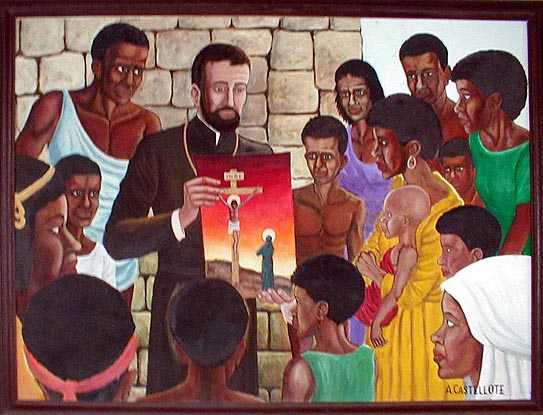
After this we began an elementary instruction about baptism, that is, the wonderful effects of the sacrament on body and soul. When by their answers to our questions they showed that they had sufficiently understood this, we went on to a more extensive instruction, namely, about the one God, who rewards and punishes each one according to his merit, and the rest. We asked them to make an act of contrition and to manifest their detestation of their sins. Finally, when they appeared sufficiently prepared, we declared to them the mysteries of the Trinity, the Incarnation and the Passion. Showing them Christ fastened to the cross, as he is depicted on the baptismal font on which streams of blood flow down from his wounds, we led them in reciting an act of contrition in their own language.
[http://www.crossroadsinitiative.com/library_article/979/saint_peter_claver_s_ministry_to_slaves.html]

St. Peter Claver: San Pedro Claver, El Esclavo De Los Esclavos

Image
San Pedro Claver, El Esclavo De Los Esclavos

Peter Claver Corberó known as St. Peter Claver, the slave of slaves, was a missionary priest and Jesuit Spanish born in Verdu ( Catalonia ) in June 1580 , and died in Cartagena de Indias on September 9th of 1654 . Passed to posterity for their commitment to alleviate the suffering of the slaves of slave port of Cartagena de Indias . It is the patron saint of slaves .

Image

Shy and simple, Catalan short and long words into deeds, Pedro Claver Corberó, is one of the most fascinating figures of Christianity and daring of the seventeenth century , whose life was developed in the context of colorful adventures, passions and injustices of the slave port of Cartagena de Indias . His self-sacrifice to the black muzzles of which the theologians of that time discussing even possess a soul, is an admirable example of the practice of Christian liberation and defense of human rights. It is considered a heroic example of what should be the Church's preferential commitment to the poor and marginalized.

Slave ministry

Whereas Sandoval visited the slaves where they worked, Claver preferred to head for the wharf as soon as a slave ship entered the port. Boarding the ship, he entered the filthy and diseased holds to treat and minister to their badly-treated, terrified human cargo who had survived a voyage of several months under horrible conditions. It was difficult to move around on the ships, because the slave traffickers filled them to capacity. The slaves were often told they were being taken to a land where they would be eaten. Claver wore a cloak, which he would lend to anyone in need; a legend says that whoever wore the cloak received lifetime health and was cured of all disease. After the slaves were herded from the ship and penned in nearby yards to be scrutinized by crowds of buyers, Claver joined them with medicine, food, bread, brandy, lemons and tobacco. With the help of interpreters and pictures which he carried with him, he gave basic instructions and assured the slaves of their human dignity and God's saving love.
Claver had conflicts with some of his Jesuit brothers, who accepted slavery. Claver saw the slaves as fellow Christians, encouraging others to do so as well. During his 40 years of ministry he catechized and baptized an estimated 300,000 slaves, following up on them to ensure that as Christians they received their Christian and civil rights. His mission extended beyond caring for slaves, however. He preached in the city square, to sailors and traders and conducted country missions, returning every spring to visit those he had baptized, ensuring that they were treated humanely. During these missions, whenever possible he avoided the hospitality of planters and overseers; instead, he would lodge in the slave quarters.

Claver's work on behalf of slaves did not prevent him from ministering to the souls of well-to-do members of society, traders and visitors to Cartagena (including Muslims and English Protestants) and condemned criminals, many of whom he prepared for death; he was also a frequent visitor at the city's hospitals. Through years of work and the force of his own unique personality, the slaves' situation slowly improved. In time he became a moral force, the apostle of Cartagena.

Image
Illness, death and legacy

Parkinsonism finally confined Claver to his room. He lingered four years, largely forgotten and neglected, and died September 9, 1654. The city magistrates, who had previously considered him a nuisance for his persistent advocacy on behalf of the slaves, ordered a public funeral and he was buried with pomp and ceremony. It was only after Claver's death that the vast scope of his ministry came to be realized; which was prodigious even before the astronomical number of people he baptized is added in. He was canonized in 1888, and Pope Leo XIII declared him the patron of missionary work among people of color. (source: Wikipedia)

Claver added a vow to his ordination signature: Latin: Petrus Claver, aethiopum siempre servus ("Peter Claver, slave of the Negro for ever").


HOME

HOME
Click here to return to the US Slave Home Page