Showing posts with label Catholic Church. Show all posts

Wednesday, May 9, 2012

Saint Peter Claver's Ministry to African Slaves


"Saint Peter Claver's Ministry to African Slaves"

The capture and transport of Africans to work in the "new world" of the Americas as slaves is a tragic story of exploitation. Yet amidst tragedy, there are opportunities for heroism. One Christian hero in the sordid story of black slavery is St. Peter Claver. Born in Catalonia, Spain, he joined the Jesuits in 1605 in Barcelona, and came to work in the missions in 1610, landing in Cartagena, Colombia, the center of the slave trade in the new world. Appalled at the dehumanization of the whole dirty business of slave trading, he took a new vow in addition to those he made in his religious profession--until his death, he was to be advocate and servant of those sons and daughters of God whom others regarded as little more than advanced animals. He insisted that Black slaves were truly equal in worth and dignity to the Europeans and baptized and instructed over 300,000 of them before he died in 1654. During his lifetime, he was regarded as dangerous by many and even sacrilegious by others, who thought he profaned the sacraments by administering them to beasts. Nevertheless, his memory was honored and he was finally canonized by Pope Leo XIII in 1888. This excerpt from a letter of St. Peter Claver is used in the Roman Office of Readings for his feast day on September 9.

St. Peter Claver

Yesterday, May 30, 1627, on the feast of the Most Holy Trinity, numerous blacks, brought from the rivers of Africa, disembarked from a large ship. Carrying two baskets of oranges, lemons, sweet biscuits, and I know not what else, we hurried toward them. When we approached their quarters, we thought we were entering another Guinea. We had to force our way through the crowd until we reached the sick. Large numbers of the sick were lying on wet ground or rather in puddles of mud. To prevent excessive dampness, someone had thought of building up a mound with a mixture of tiles and broken pieces of bricks. This, then, was their couch, a very uncomfortable one not only for that reason, but especially because they were naked, without any clothing to protect them.


We lad aside our cloaks, therefore, and brought from a warehouse whatever was handy to build a platform. In that way we covered a space to which we at last transferred the sick, by forcing a passage through bands of slaves. Then we divided the sick into two groups: one group my companion approached with an interpreter, while I addressed the other group. There were two blacks, nearer death than life, already cold, whose pulse could scarcely be detected. With the help of a tile we pulled some live coals together and placed them in the middle near the dying men. Into this fire we tossed aromatics. Of these we had two wallets full, and we used them all up on this occasion. Then, using our own cloaks, for they had nothing of this sort, and to ask the owners for others would have been a waste of words, we provided for them a smoke treatment, by which they seemed to recover their warmth and the breath of life. The joy in their eyes as they looked at us was something to see.


This was how we spoke to them, not with words but with our hands and our actions. And in fact, convinced as they were that they had been brought here to be eaten, any other language would have proved utterly useless. Then we sat, or rather knelt, beside them and bathed their faces and bodies with wine. We made every effort to encourage them with friendly gestures and displayed in their presence the emotions which somehow naturally tend to hearten the sick.


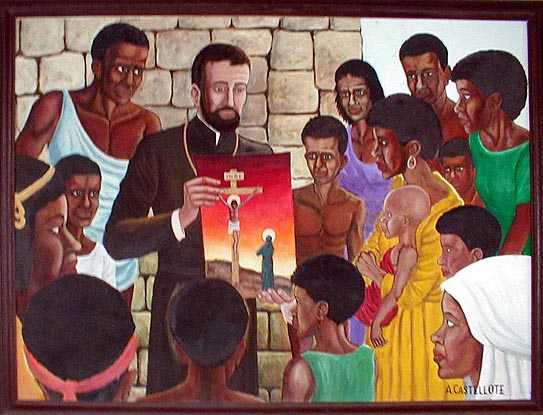
After this we began an elementary instruction about baptism, that is, the wonderful effects of the sacrament on body and soul. When by their answers to our questions they showed that they had sufficiently understood this, we went on to a more extensive instruction, namely, about the one God, who rewards and punishes each one according to his merit, and the rest. We asked them to make an act of contrition and to manifest their detestation of their sins. Finally, when they appeared sufficiently prepared, we declared to them the mysteries of the Trinity, the Incarnation and the Passion. Showing them Christ fastened to the cross, as he is depicted on the baptismal font on which streams of blood flow down from his wounds, we led them in reciting an act of contrition in their own language.
[http://www.crossroadsinitiative.com/library_article/979/saint_peter_claver_s_ministry_to_slaves.html]

St. Peter Claver: San Pedro Claver, El Esclavo De Los Esclavos

Image
San Pedro Claver, El Esclavo De Los Esclavos

Peter Claver Corberó known as St. Peter Claver, the slave of slaves, was a missionary priest and Jesuit Spanish born in Verdu ( Catalonia ) in June 1580 , and died in Cartagena de Indias on September 9th of 1654 . Passed to posterity for their commitment to alleviate the suffering of the slaves of slave port of Cartagena de Indias . It is the patron saint of slaves .

Image

Shy and simple, Catalan short and long words into deeds, Pedro Claver Corberó, is one of the most fascinating figures of Christianity and daring of the seventeenth century , whose life was developed in the context of colorful adventures, passions and injustices of the slave port of Cartagena de Indias . His self-sacrifice to the black muzzles of which the theologians of that time discussing even possess a soul, is an admirable example of the practice of Christian liberation and defense of human rights. It is considered a heroic example of what should be the Church's preferential commitment to the poor and marginalized.

Slave ministry

Whereas Sandoval visited the slaves where they worked, Claver preferred to head for the wharf as soon as a slave ship entered the port. Boarding the ship, he entered the filthy and diseased holds to treat and minister to their badly-treated, terrified human cargo who had survived a voyage of several months under horrible conditions. It was difficult to move around on the ships, because the slave traffickers filled them to capacity. The slaves were often told they were being taken to a land where they would be eaten. Claver wore a cloak, which he would lend to anyone in need; a legend says that whoever wore the cloak received lifetime health and was cured of all disease. After the slaves were herded from the ship and penned in nearby yards to be scrutinized by crowds of buyers, Claver joined them with medicine, food, bread, brandy, lemons and tobacco. With the help of interpreters and pictures which he carried with him, he gave basic instructions and assured the slaves of their human dignity and God's saving love.
Claver had conflicts with some of his Jesuit brothers, who accepted slavery. Claver saw the slaves as fellow Christians, encouraging others to do so as well. During his 40 years of ministry he catechized and baptized an estimated 300,000 slaves, following up on them to ensure that as Christians they received their Christian and civil rights. His mission extended beyond caring for slaves, however. He preached in the city square, to sailors and traders and conducted country missions, returning every spring to visit those he had baptized, ensuring that they were treated humanely. During these missions, whenever possible he avoided the hospitality of planters and overseers; instead, he would lodge in the slave quarters.

Claver's work on behalf of slaves did not prevent him from ministering to the souls of well-to-do members of society, traders and visitors to Cartagena (including Muslims and English Protestants) and condemned criminals, many of whom he prepared for death; he was also a frequent visitor at the city's hospitals. Through years of work and the force of his own unique personality, the slaves' situation slowly improved. In time he became a moral force, the apostle of Cartagena.

Image
Illness, death and legacy

Parkinsonism finally confined Claver to his room. He lingered four years, largely forgotten and neglected, and died September 9, 1654. The city magistrates, who had previously considered him a nuisance for his persistent advocacy on behalf of the slaves, ordered a public funeral and he was buried with pomp and ceremony. It was only after Claver's death that the vast scope of his ministry came to be realized; which was prodigious even before the astronomical number of people he baptized is added in. He was canonized in 1888, and Pope Leo XIII declared him the patron of missionary work among people of color. (source: Wikipedia)

Claver added a vow to his ordination signature: Latin: Petrus Claver, aethiopum siempre servus ("Peter Claver, slave of the Negro for ever").


Friday, July 15, 2011

Peruvian Government Apologies For Racism, Not Slavery


Amamda Todd of the Liberation reported, "Peruvian government apology for racism leaves out slavery," on 4 December 2009: The government of Peru has issued an apology to citizens of African descent for the first time. A public ceremony will be held for African Peruvians, who are 5 to 10 percent of the population.
Peruvian type: During the course of the slave trade, an estimated 95,000 slaves were brought into Peru from Africa. The last group arrived in 1850 and slavery was abolished in 1856.(Photographed by E. Maunoury of Lima.)

The statement admits that discrimination still exists, but makes no reference to slavery, referring instead only to the "abuse, exclusion and discrimination" of African Peruvians. The first Africans in Peru were the slaves of the Spanish conquistadors. More were brought over to work the land until slavery was abolished in 1854.

Not surprisingly, the apology did not mention what will or should be done to fix the racism and discrimination still present in society. Of course not. Racism is an institution that is part and parcel of capitalist society. Racism is a handy wedge to divide workers and keep them from banding together to fight for their common interest. It has been one of the most effective weapons against working-class struggle available to the rich. (source: The Liberation)

Thursday, May 19, 2011

Conquistadors Destroyer of Civilizations

Hernan Cortes and Dona Maria
1517-1519: First Contact

In the decade before the Spanish arrived in Mexico, Aztec Emperor Montezuma II and his people were filled with a sense of foreboding. A series of evil omens had foretold of calamities to come. A fiery comet crossed the sky. The temple of Huitzilopochtli, the god of war, burst into flames. The Lake of Mexico boiled and rose, flooding into houses. A weeping woman passed by in the middle of the night, crying "My children, we must flee far away from this city!" Fishermen discovered a bird that wore a strange mirror in the crown of its head. Montezuma looked into the mirror and saw a distant plain, with people making war against each other and riding on the backs of animals resembling deer.

An agitated Montezuma demanded that his soothsayers explain the meaning of these dire signs and was told that they prophesied the destruction of his kingdom. In fact, Montezuma had reason to be fearful - the Spanish had settled in Hispaniola and Cuba and were making their way toward his empire.

The Spanish had made several expeditions to the nearby Yucatan in 1517 and had returned with wonderous tales of a high-cultured Mayan civilization and gold riches. The news of these discoveries made an electrifying impression on the Spanish colonists in Cuba. Among these was Hernán Cortés, Chief Magistrate of Santiago. The Spanish governor of Cuba, Diego de Velásquez, told Cortés that he would provide two or three ships if Cortés would find the rest of the money, and lead the army. Cortés agreed and on October 23, 1518, Velásquez appointed him "captain-general" of a new expedition to the Yucatan.

Conquistadors - The fall of the Aztecs 1/5


Conquistadors - The fall of the Aztecs 2/5


Conquistadors - The fall of the Aztecs 3/5


Conquistadors - The fall of the Aztecs 4/5


Conquistadors - The fall of the Aztecs 5/5

HOME

HOME
Click here to return to the US Slave Home Page