Showing posts with label South Carolina Slave Code. Show all posts

Friday, March 16, 2012

Emanuel AME Church of Charleston

Mother Emanuel AME Church in Charleston, SC

Emanuel African Methodist Episcopal Church – Overview

The Gothic Revival building that houses the Emanuel AME Church in Charleston is a testament to the determination of the church's congregation and earliest founders. The present day structure with its signature steeple was built in 1891, replacing an earlier wooden church from 1872 that was damaged in the Charleston Earthquake of 1886. Many of the brick and marble panels were restored between 1949 and 1951.
EMANUEL AME CHURCH

Documenting the American South--The roots of the Emanuel AME Church date back to 1816, when Morris Brown organized a withdrawal of the Charleston Methodist Episcopal Church's black members over a burial ground dispute. The newly-formed congregation quickly established themselves as an African Methodist Episcopal church, a denomination that was founded earlier in Philadelphia.


Brown was eventually jailed for violating laws restricting free and enslaved blacks from holding religious gatherings without white supervision. Then, after the first incarnation of the church was burned under a cloud of suspicion over a suspected slave uprising, the congregation continued to worship until 1834, when all-black churches became officially outlawed. After a period of underground worship, the church formally reorganized publicly in 1865 and adopted the Hebrew name Emanuel, meaning "God is with us".

The church is the oldest AME church in the South and has the oldest black congregation south of Baltimore, Maryland. (http://www.sciway.net/tourism/emanuel-ame-church.html)

Tuesday, March 13, 2012

The Great Charleston Earthquake, 1886

Charleston City Paper's article, "Tracing discriminatory laws to the earthquake of 1886: The Birth of Jim Crow," by Will Moredock--We've seen it before: When disaster strikes, people pull together as friends and neighbors in a common cause — at least for a while. Then the old rivalries and social fissures reappear, more virulent than ever.

This was the pattern when Hurricane Katrina drowned New Orleans in 2005. A brief surge of unity and good will prevailed, then the old racial and class divisions reasserted themselves. Susan Millar Williams saw it in her McClellanville community in the wake of Hurricane Hugo in 1989. When relief goods started arriving, blacks and whites quarreled over who should receive them.


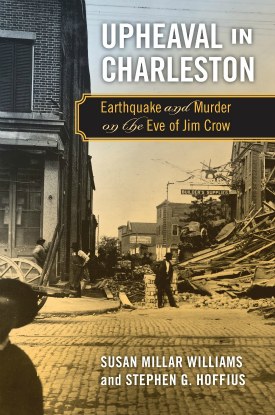
With this experience and what she had read about the 1886 Charleston earthquake in mind, Williams set out with fellow historian Stephen G. Hoffius to explore the social and political ramifications of that long-ago disaster. The recently released Upheaval in Charleston: Earthquake and Murder on the Eve of Jim Crow is the product of their 12 years of work, and the picture they paint of the Holy City is not flattering.

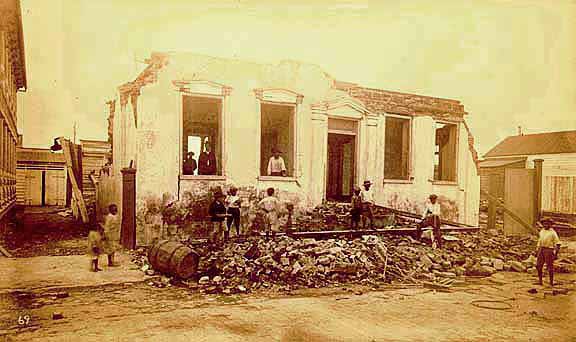
When buildings started swaying and toppling in the early evening of Aug. 31, 1886, the people of Charleston rushed into the streets, wailing and screaming, as fires broke out around the city. They headed instinctively toward Marion Square, where they would be safe from fire and falling buildings.


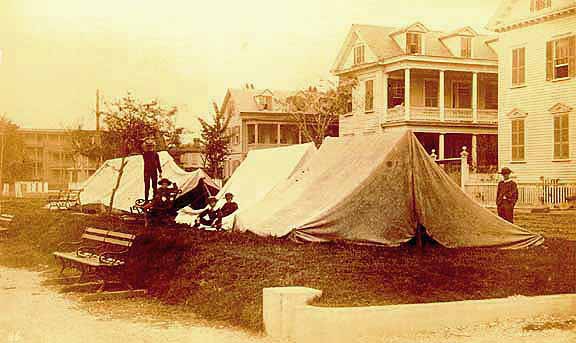
Blacks and whites set up camps on opposite sides of the square, Williams told me recently. "That first night ... blacks and whites joined in singing and praying together. It lasted about 24 hours."

In the immediate aftermath of the quake, Charlestonians sought to make sense of what had befallen them. Many middle-class and upper-class whites were happy to accept a rational explanation for the catastrophe, if only because it let them off the hook for any metaphysical responsibility. On the other hand, poor whites and blacks, steeped in their primitive religiosity, were eager to believe that this was God's punishment on a wicked city.

1886 Charleston, SC Earthquake Photo

But what sins had so outraged the Almighty? A white Methodist minister intoned to his congregation: "Ice cream gardens, music, and dancing are the popular amusements for the Sabbath afternoons in Charleston." Excursionists, he said, sailed about the harbor on Sundays in "gay and frivolous" abandon.

A white woman told a newspaperman that her sins had brought on her sudden homelessness. "Yes," she said. "I was very worldly. I loved fine dresses and dancing and good living, and this is my punishment."

Blacks, who at the time made up 60 percent of Charleston's population, had a very different understanding of God's wrath. They saw the destruction of this proud old city as its reward for centuries of slavery and oppression. Street preachers sang out and shouted warnings through the night. This quake was the harbinger of apocalypse and judgment. The world would soon be destroyed and Revelation fulfilled.

"The sounds of blacks preaching and singing could be extremely disconcerting to whites," the authors write. "Deprived of other ways to communicate freely, black men and women had long used worship services as a way to register protest ... Now, as the voices of freedmen and their descendants rang out across the city in 1886, whites looked for ways to silence them."


Believers sang and writhed on the ground, as preachers exhorted, "Oh, Gabriel, turn that horn to the land of Egypt on the miserable sinners and not on we."

Williams and Hoffius add, "For whites who couldn't escape such speeches day in and day out, it didn't take too much imagination to suspect that the 'miserable sinners' in question might not be Egyptian."

White citizens and police soon intimidated the preachers and singers into silence.

sc1
The damaged portico of Hibernian Hall, 105 Meeting St. - Charleston Library Society
(J. B. Macelwane archives, Saint Louis University)

There were other stresses to the fragile social fabric. As relief poured into the city from around the country, "Affluent whites insisted that providing free food and shelter to the poor would lead to moral breakdown," the authors write. And with the rebuilding of the city, black artisans and craftsmen were able to command high wages, acquiring wealth and status and threatening the social order. As Williams says, "Charlestonians wanted to preserve the status quo above all else. They did not want anyone to get ahead."

In fact, the authors argue in Upheaval in Charleston that the earthquake of 1886 ultimately helped bring out the Jim Crow laws a decade later.

"The earthquake stripped away the edifice of society. It hardened people's hearts," Williams says. "By the end of 1886, any hope of racial conciliation was over." (source:Charleston City Paper )

"Earthquake, August 31st, 1886. No. 634. Aiken and Vicinity. Wrecked at Langley." - Photographed by J.A. Palmer, Aiken, S.C.

The South Carolina Railway company train was washed from the track by a four-foot high wall of water when the earthquake burst the mill-dam at Langley Pond near Aiken, SC. The train's black fireman, a Mr. Ivie, died in the wreck. Another train owned by the same company was washed from the track near Horse Creek in Aiken County closer to Augusta, GA., when a mill-dam there also fractured because of the earthquake and sent an eight-foot-high wave of water surging against the locomotive, tender, and its train cars. (South Caroliniana Library Archives)

Charleston: "Upheaval in Charleston" Authors Susan Millar and Stephen Hoffius

Tuesday, February 21, 2012

Slavery in the South Carolina Rice Fields


From Slavery in America, "Rice and Slavery: A Fatal Gold Seede," by Jean M. West: -- On New Year's Day, many Americans, especially those with southern origins, eat a dish combining black-eyed peas and rice called "Hoppin' John." It's supposed to bring good luck since people who "eat poor New Year's Day, eat rich the rest of the year." Most would be surprised to learn that rice is not a plant native to the New World. They would be even more surprised to learn that the dish has roots in tragedy rather than in luck. In Alexander Falconbridge's 1788 narrative, An Account of the Slave Trade on the Coast of Africa, he describes food served during the Middle Passage and reports, "The diet of the negroes, while on board, consists chiefly of horse-beans, boiled to the consistence of pulp; boiled yams and rice, and sometimes a small quantity of beef or pork." How did rice come to the New World, and why is its New World history intertwined with slavery?
Ghana West African Rice Fields

Rice of the Old World

Rice is a tall annual grass that grows in a variety of conditions although it flourishes in wet, warm tropical climates. It is an ancient plant whose origins go back over 130 million years, hypothetically when South America, Africa, India, Australia, and India were joined in the southern hemisphere super-continent of Gondwanaland. When the continents broke up, a red rice of the species oryza glaberrima evolved in Africa, while today's dominant crop species, oryza sativa, evolved in Asia. People living along the Niger, Sine-Saloum, and Casamance Rivers began cultivating African wet rice around 2,000 to 3,000 years ago; archaeologists have discovered Asian rice grain imprints dating between 5,200 and 4,000 years ago in northern China, while Asian rice cultivation may have begun several thousand years earlier. It is believed that members of Alexander the Great's army brought the Asian variety of rice back from India, leading to its cultivation in the Mediterranean region, including Spain and Portugal.

Rice Growers in Sierra Leone, West Africa

Portuguese explorers reported African rice fields south of Cape Verde, probably along the Gambia River, as early as 1446. In the 1590s, André Alvares d'Almada reported that West African rice farmers, "construct dikes of earth for fear of the tide, but despite them the river breaks them frequently, flooding the rice fields. Once the rice has sprouted, they pull it out and transplant it...." West Africans learned to grow rice in the Niger River Delta and, from modern Senegal to Liberia, adapted different methods of production to different climatic conditions including tidal floodplains, inland wetlands, rain-fed Guinea uplands, and mangrove swamps along the Atlantic coast. Although different tribal groups divided rice cultivation work differently, women typically sowed the rice (covering the grains with clay before planting), milled rice using mortar and pestle, created coiled-grass fanner baskets to winnow rice as well as storage baskets for the cleaned rice, and cooked rice for their families. The Portuguese introduced Asian rice to Africa around the middle of the 16th century; by the height of the slave trade many Africans were familiar with the techniques of cultivating both the African and Asian species of rice.

South Carolina Low Country Rice Fields

Rice Comes to the New World

Early Spanish explorers introduced Asian rice to the Caribbean and South America; rice first arrived in Mexico in the 1520s at Veracruz, which was selected for its warm, wet, Gulf climate. Portuguese colonizers and their African slaves introduced Asian rice at about the same time to Brazil.


Tradition says that rice arrived in South Carolina around 1685 when sea captain John Thurber's ship was being repaired in Charleston. Thurber gave a sack of "Gold Seede" rice from Madagascar, a great rice-producing island off the east coast of Africa, either to Dr. Henry Woodward or Thomas Smith, who was a landgrave (governor of a major land grant). However, a bushel of rice had been sent to the colony on the supply ship William and Ralph as early as spring1672. By September 26, 1691, the General Assembly of South Carolina passed an act permitting colonists to pay their taxes in rice, as well as other commodities. According to Edward Randolph, the collector of customs, planters exported 330 tons of rice from Charles Town (Charleston) to England and English Caribbean colonies in 1700; the governor complained that they had produced more rice than there were ships on which to export the grain. While some of the red-colored rice in early South Carolina was the African oryza glaberrima and may have arrived on slave ships, planters quickly adopted two varieties of the Asian oryza sativa, "Carolina White" and the prized, high-yield "Carolina Gold." Rice cultivation was centered in the Low Country of South Carolina, with the Georgetown District emerging as a major production zone. North Carolina's Lower Cape Fear Region (from the 1720s onward), northeastern Spanish Florida, and coastal Georgia (after the 1750 repeal of the Trustee's ban on slavery) also produced rice throughout the colonial and antebellum eras.


Table 1: South Carolina Colonial Rice Exports
1698 | 5 tons
1700 | 330 tons
1726 | 5,000 tons
1730 | 10,000 tons
1740 | 25,000 tons
1763 | 35,000 tons
1764 | 40,000 tons
1770 | 42,000 tons

Many of early settlers of the Carolinas (both the Cape Fear settlers of 1663 and the Ashley River emigrants of 1670) came from Barbados. These experienced sugar planters were offered land incentives to bring slaves; for example, contracts from 1664 guaranteed emigrants from Barbados a bonus of 20 acres for every male slave and ten acres for every female slave they brought to the new colony. However, the Carolinas were too cold for the cultivation of sugar, and the exports of lumber, cattle, and deerskins provided slim profits.


Slavery in the Rice Fields

The English settlers began to enslave the region's Native Americans in large numbers, selling them in the slave trade and using them as laborers. African slaves were imported from the earliest days, as well. In 1671, Sir John Yeamans arrived at the Ashley River settlement (the future Charleston) with 200 African slaves. According to South Carolina's 1708 census, there were 3,000 African slaves and 1,400 Native American slaves in a total population of 9,500. However, smallpox and yellow fever killed many Native Americans and it was impossible to get enough European indentured slaves to provide the colony with adequate labor. Indeed, Charleston merchant Samuel Eveleigh asserted in 1735, "I am positive that the Commodity can't be produced by white people. Because the work is too laborious, the heat very intent, and the whites can't work in the wett at that season as Negrs do to week rice." By the 1730s Carolinian slavery was predominantly African.


From early on there was a close relationship between African slavery and rice cultivation. Planters buying slaves showed some preference for West Africans from the Gold Coast. In An Account on Life in the Carolinas in 1750, Johann Martin Bolzius claimed, "The best Negroes come from the Gold Coast in Africa, namely Gambia and Angolo." In the 1730s, roughly 12 percent of South Carolina's slaves were from the centers of rice-production (the Upper Guinea Coast, Senegambia, and the Windward Coast), but that number rose to 54 percent by mid-century, and 64 percent in the 1770s before receding in the 1780s; averaging 43 percent for the 18th century. Some slave brokers in coastal Africa apparently trained captives in African rice fields prior to selling them to slave traders bound for the Carolinas; the Charleston Evening Gazette of July 11, 1785, advertised "a choice cargo of Windward and Gold Coast Negroes, who have been accustomed to the planting of rice." These African slaves brought knowledge from their homelands of different modes of rice cultivation, soil and water management and milling, which they adapted to the rice plantations of the Southeast, such as using hollow cypress log "trunks" to control the flow of water from levees (embankments) into fields. (source: http://www.slaveryinamerica.org/history/hs_es_rice.htm)


Tuesday, January 31, 2012

Slavery at South Carolina College


Slavery at South Carolina College, 1801–1865:
The Foundations of the University of South Carolina
Students Engaging Slavery

Points of Interaction
In the years before emancipation, South Carolina College students interacted with slaves every day: at meals in Stewards Hall, in the tenements (their dormitories), and on the grounds. Between 1801 and 1860, the South Carolina College campus was small and close-knit. In 1808, for example, enrollment was 100 students, and there were only three professors and a tutor. There were 142 students by 1836 and 221 in 1848.

The young male students, many the sons of wealthy plantation-owning families, sang and recited poetry in the dormitories together, sometimes skipped chapel, classes, and recitations, and fought over food in Stewards Hall. Extending their misdeeds into town, they drank at taverns, sometimes to excess, and stole townspeople’s turkeys. To try to keep the students on campus, the college erected a brick wall, which still surrounds today’s Horseshoe. This did not solve the problem.


Students and Slaves in the Tenements

During the first few years, students could bring family slaves to campus to serve them, but the college forbade the practice after 1808. The college owned and hired slaves, and each student paid a servant fee each year. During their studies and social interaction in their rooms, the young men would have watched and sometimes spoken with the slaves who made their beds and swept their floors.

Slaves also washed students’ clothes; records document the hiring of a slave named Anna in 1846 who was a washerwoman. Sometimes slaves caught students disobeying college rules in their rooms. A Charleston senior named Frederick Belser beat a slave on one occasion because he believed the slave had told a professor about a card game in his room. Belser met with the faculty but was not punished for the misdemeanor because he apologized.


Student and Slave Interaction at Meals

Students spent a great deal of time in Stewards Hall, where they met daily at 8:00 a.m., 1:00 p.m., and 7:00 p.m. for required meals. The food was frequently below the students’ expectations: meat was salted rather than fresh, there was very little chicken or beef, few fresh vegetables, and the biscuits had vermin. Considering the fare, perhaps it is not surprising that two young men fought a duel over a dish of trout.

Students sometimes threatened the steward in person and bombarded him with letters demanding more wholesome food. Students complained that slaves who attended the dining hall were poor waiters and that there were not enough to take care of their needs. The young men grew angry with the slaves and, on occasion, threatened and hit the slaves who were serving the food. Although the college forbade such behavior, students generally went unpunished.


Students and Slaves in the Classroom

Students spent much of the day in lectures or recitations in one or two buildings. In the early days, Rutledge College was the single classroom building. Subjects included mathematics, moral philosophy, chemistry, history, political economy, logic, geology, mineralogy, Greek literature, and Latin literature. Eight to ten professors and three or four tutors instructed the students. Although many professors were loved and respected, such as Thomas Cooper and Francis Lieber, others were not, and students were regularly brought before the faculty to be disciplined for insulting professors.

Slaves cleaned the college classrooms, and one slave named Jack aided in the chemistry laboratory and in mathematics classes. Jack also hired himself out as a tutor to struggling math and chemistry students. After Jack’s death two slaves, both named Jim, were hired to assist in the chemistry department and in the mathematics and natural philosophy department. Gradually, new buildings and new subjects were added as the student body grew, but South Carolina College remained small, boasting only a few hundred students. (http://library.sc.edu/digital/slaveryscc/campus-slaves--slavery.html)


Slavery and the Origins of the University of South Carolina Welcome from Center for Digital Humanities at on Vimeo.

Wednesday, September 28, 2011

Black History In America: Boone Hall Plantation & Gardens in Mt. Pleasant, SC

Boone Plantation Slave Cabin

Boone Hall Plantation & Gardens in Mt. Pleasant, SC is proud to introduce a new groundbreaking addition to the Boone Hall experience. Visitors can now take a journey through our exciting new exhibit, "Black History In America."

Boone Plantation Slave Cabin

What really makes this exhibit unique is that this story will be told using eight of the original slave cabins located on Boone Hall Plantation. Each of the cabins on Slave Street present different themes in telling the black history story. Visitors are able to see the different aspects of daily life, how they worked and lived, struggles that were faced, as well as follow different periods of historical progression from the beginning all the way up to present day.

Boone Plantation Slave Cabin

Life size figures, pre-recorded narratives, audiovisual presentations, photos, pictures, biographical information, and actual historical relics, are interwoven and meshed together in displays throughout the cabins presenting this new exhibit.

Boone Plantation Slave Cabins

Themes for each cabin are as follows:
Boone Hall Plantation & Gardens in Mt. Pleasant, SC

Cabin 1 – Praise House
Cabin 2 – Slave Crafts
Cabin 3 – Their Life & Family
Cabin 4 – Archaeological Discoveries
Cabin 5 – Their Work and Life
Cabin 6 – Emancipation & Freedom
Cabin 7 – Struggle For Civil Rights
Cabin 8 – Heroes and Leaders
(http://boonehallplantation.com/beyond.php)

Boone Plantation Slave Cabin

The next part of our journey will take us past the original slave cabins along “the row of oaks,” as the driveway is referred to. For some people this part of the Boone Hall Plantation is their least favorite.
Boone Hall Plantation & Gardens in Mt. Pleasant, SC

As you approach the slave cabins you start to feel a sense of remorse that is, of course, unfounded. Nonetheless, you realize at this point that slavery was real in all its profound evil. As you peer into the blank windows of the cabins you see the meager living endured by thousands of slaves throughout time until abolishment.

Boone Plantation Slave Cabin

From the front door, to the right is usually the bed area, straight ahead is where food was often prepared and eaten, and finally off to the left is a small play or study area for the children. Along the way you come to some people that artistically recreate a craft originally brought over from Africa. That craft is basket weaving, which is very popular with the locals.

Boone Hall Plantation & Gardens in Mt. Pleasant, South Carolina

From the beginning all the way to the end of your tour, you will feel like you stepped into the past. You see what you might have done back then, in your mind. How life might have been, whether you would have liked to have been alive then, how the food would taste, all these things course through your mind like the Ashley River runs through the property. Sadness creeps up on you as you prepare to leave. As you turn back on the road leading away from the house, you know beyond a shadow of a doubt that you will return. (source: Hubpages)

Boone Hall Plantation & Gardens in Mt. Pleasant, SC

Boone Hall Plantation: Gullah Story About the Adam's Apple


Boone Hall Plantation in Mount Pleasant (boonehallplantation.com) has a walking tour of its slave cabin lane featuring different stories told in each of eight cabins – from the praise house churches, to the variety of jobs done by slaves, to the changed roles after emancipation, to the more recent struggle for civil rights. Boone Hall also puts on a live Gullah Theater presentation, celebrating the unique culture created by the slaves and their descendants along the sea islands.

Read more: The State

Boone Hall Plantation: Gullah Story About the Adam's Apple

Low Country Chapel Of Ease at St. Helena, South Carolina

During the Colonial period, chapels of ease were constructed by rice and cotton planters as houses of worship because their plantations were located so far from the churches in Beaufort. This tabby walled church was constructed between 1742 and 1747 for the planters of St. Helena Island. A forest fire destroyed most of it in 1886.

All that remain today are its tabby ruins and an adjacent cemetery. Tabby is a mixture of shell (an aggregate), lime (often made from burnt shells which serve as a cement), and water. It is put up in forms and allowed to harden. During the eighteenth and early nineteenth century, lowcountry planters used tabby to build not only their own dwellings, but also slave houses, dairies, barns, fences, and even some grave monuments. Tabby was used not because it was easy or particularly convenient, but because brick was in such short supply. Tabby tended to hold up very well, as long as its outer stucco "skin" was kept in good shape and as long as the building was "tied" together by internal timbers.

Chapel Of Ease at St. Helena, South Carolina

A quiet sea island in Beaufort County, St. Helena Island is perhaps best known for its historic connection to Gullah culture and language, still evident on the island today. The island is nestled between downtown Beaufort and the resort communities of Harbor Island and Fripp Island, so it enjoys the benefits of both rural and suburban life. The population of St. Helena (pronounced HEL-uh-nuh) hovers around 10,000. St. Helena is home to the Penn Center, a National Historic Landmark located on the site of one of the nation's first schools for freed slaves, which opened in 1862.

Chapel Of Ease's adjacent cemetery

Beaufort (pronounced "BU-fort") is the seat of Beaufort County, where Jean Ribault and his fellow Huguenots established Charlesfort in 1562. In French, "beau" means beautiful, handsome, lovely, or fine ... and after even the shortest of visits, you'll know both the city and county are aptly named. (Ironically, both are actually named for an Englishman, Henry Somerset, the Second Duke of Beaufort, who pronounced his name "BOW-fert," as in bow and arrow and Beaufort, North Carolina.)

Chapel of Ease


Monday, September 26, 2011

The State of South Carolina's Disdain Of The Value of Education

The State, South Carolina Homepage article "Nine ways the Civil War changed and continues to affect S.C.,"Sep. 25, 2011: 6. Disdain of the value of education

Before the Civil War, education in South Carolina was seen primarily as a private or religious affair. What value was there in educating a white farmhand or a black slave, which was, in fact, forbidden by law? On the eve of the war, only half the state’s white children had gone to school.
The state Constitution of 1868, written by African-Americans and Republicans during Reconstruction, established the right to a free public education for all for the first time. But, in impoverished post-war South Carolina, schools were poorly funded.

The post-war shift in the state’s limited wealth – from agricultural rural areas to industrial cities – accentuated the disparity between poor, inferior rural schools and better urban ones. South Carolina’s embrace of education also was slow and grudging. The state did not establish high schools until 1907, compulsory education until 1919 and a 12th grade until World War II, a move made after the military complained it had to reject too many S.C. draftees as uneducated or sickly.
South Carolina education lottery

In 1948, the state had 1,680 school districts. Funding ranged wildly from rural to urban schools, and black to white schools.

Then, black Clarendon County parents went to court, launching what would become the 1954 U.S. Supreme Court case that ended segregation. While education bills in the 1970s and 1980s sought to address school funding inequities, those issues remain unresolved, the subject of a more-than-decade-old court case, stuck in judicial limbo.

South Carolina education lottery

The passage of a lottery in 2000 was intended to help parents pay higher education costs. However, state funding of public colleges and universities – already among the lowest in the South – has dwindled. (source: The State, South Carolina Homepage)

Friday, August 26, 2011

South Carolina Slave Auction Advertisement: March 5, 1855


Among the enslaved people who were sold at this particular auction in 1855, were 23 individuals that ranged from infants to 60 years old. Enslaved women represented an overwhelming majority of this sale (78%); Seventy percent (70%) were between the ages of 1-30 years old, 21% were between 31-40 years old and two 60 years old. This is a repeating pattern of the youthful skew of slaves who were sold at auction.

J.S. Ryan is the Old Slave Mart located in Charleston, South Carolina.

Monday, August 22, 2011

The Liquidated Slaves Of The William Barnwell Plantation House, Beaufort, South Carolina

The William Barnwell House is a historic Building in Beaufort, South Carolina and is a part of the Beaufort Historic District. It was built in 1816 by the critically acclaimed Gibbes Brothers for their sister, Sarah Reeve Gibbes. The property got its name from her husband, though, William Wigg Barnwell, who came from the prominent Beaufort family connected to Major William Hazzard Wigg, a Revolutionary War hero.

The William Barnwell House stayed with the Barnwells until 1895. It was then when the property was given to the city. The local government then used it as a schoolhouse, and then transformed it to an apartment building before shutting it down for disrepair. It was then rescued by the Historic Beaufort Foundation in 1973 from threats of demolition.
Estate Sale! By Order Of Executor. By Louis D. DeSaussure

On Wednesday, 19th Inst. at 11 o'clock a.m. will be sold in Charleston, South Carolina at the Ryan and Son's Mart in Chalmers Street, by the order of the Executor of the late Mr. and Mr. and Mrs. William Barnwell. A Prime Gang of 67 Negroes. Accustomed to the culture of Sea Island Cotton and Provisions, in Beaufort District. Amongst whom are several House Servants.

Conditions--One-third Cash; balance by Bond, bearing interest from day of sale payable in two equal Annual Instaments, to be secured by a Mortgage of the Negroes, and approved Personal Security. Purchasers to pay for papers.


The liquidation of the enslaved population of the William Barnwell Estate in Beaufort, South Carolina. According to the "List of Negroes," 70.1% 26 years old and under.


0-12 years old 18 26.8%
13-26 years old 29 43.8%
27-54 years old 18 26.8%
55- 70 years old 2 2%


Among the 18 children to be orphaned by this sale that are between the ages of 0-12 years old are: "Hector age 7, Affy age 5, Infant #1 nameless, Venus age 2, Young Patty age 3, Infant #2 without a name, Annie age 5, Ellen age 3, Isaiah a little 5 year old boy with one eye, Cimon age 3, Infant Mariah, Adam age 12, Infant Rose, an unsound Infant, Young Tannah 3 years old, and Jim age 10.

There were 29 teenagers and young adults between the ages of 13-26 years old. Children and teenagers represented the bulk of the enslaved population of the William Barnwell Plantation.

There were 18 adults between the ages of 27-55 years old, and only two people that were 70 years old.

HOME

HOME
Click here to return to the US Slave Home Page