Showing posts with label domestic slave trade. Show all posts

Sunday, October 20, 2013

A New Book, Solomon Northup: The Complete Story


From Union College, "Twelve years a slave: Union professor co-authors new book on Solomon Northup," by Phillip Wajda, on 7 October 2013 -- n 1998, Clifford Brown was introduced to the story of Solomon Northup through Rachel Seligman. A friend had given Seligman a copy of Northup’s powerful memoir, Twelve Years a Slave.

The simple yet moving narrative, first published in 1853, is a compelling account of Northup’s life as free black man in Upstate New York who was kidnapped into slavery in Louisiana, rescued and returned to his wife and three children a dozen years later.

Then director of Union’s Mandeville Gallery, Seligman believed the story contained enough material for an exhibit and quickly convinced Brown, chair of the gallery committee.
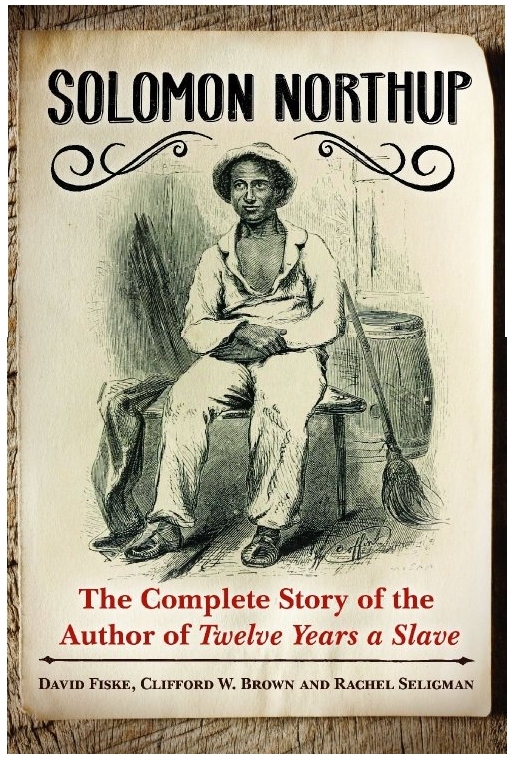
Book cover, Solomon Northup: The Complete Story of the Author of Twelve Years a Slave
“I read the book and found it utterly fascinating,” said Brown, the Robert Porter Patterson Professor of Government. “I couldn’t put it down. It’s a glimpse into life at that time, not only slavery, but also life as a free black man in the north. And it has such a ring of authenticity. He is just telling us what happened, mostly without a lot of flowery this and flowery that.”

With the help of some students, Brown spent months researching Northup’s life for Seligman’s exhibit. He traveled to Louisiana, Washington, D.C., and other places, collecting artifacts, documents and photos that authenticated Northup’s harrowing tale. The exhibit, which opened in January 1999, attracted thousands of visitors and renewed interest in Northup’s life.

Joined by David Fiske, a former senior librarian at the New York State Library, Brown and Seligman (now an assistant curator with the Tang Teaching Museum at Skidmore College) have teamed up again, for a new book, Solomon Northup: The Complete Story of the Author of Twelve Years a Slave.

The book coincides with an upcoming movie about Northup, “12 Years a Slave,” that has generated considerable buzz from film critics and audiences in pre-screenings. Written by John Ridley and directed by Steve McQueen, the film won the People’s Choice Award at last month’s Toronto International Film Festival.

Exhaustively researched, the book provides a fascinating look into Northup’s life, from his upbringing as the son of a former slave turned farmer, to his experiences after his rescue. Intended as a supplement to Northup’s memoir, which barely touched on his early life and what happened to him after the rescue, the biography delves deeper into all aspects, giving readers a wealth of new information.

“The book is a serious contribution because it’s the first,” said Brown, who continued to research and write about Northup for years after the exhibit.“There really is no other biography of Solomon Northup. Secondly, there is an enormous amount of archival research here culled from many different kinds of archives.”

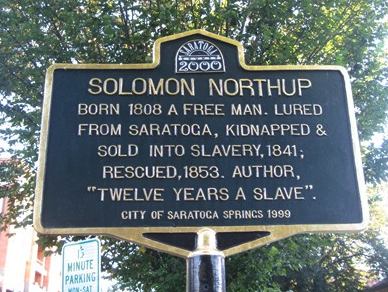
One example is the reconstruction of the kidnapping. Using city directories, maps and other documents, the authors were able to provide a detailed account of how Northup, an accomplished violinist, was lured from near his home in Saratoga to New York by two men who promised him work as a performer for a few days. From there, he was persuaded to accompany the men to Washington, D.C, where his drink was drugged at a tavern frequented by slave traders. He was shuttled off to a notorious slave pen and subjected to beatings for two weeks. He was eventually shipped to Louisiana and sold to plantation owners, enduring harsh and brutal conditions for the next 11 years, eight months and 26 days.

Saratoga Springs, NY Map

A chapter in the book, “Survival,” is particularly poignant, detailing the daily whippings and psychological abuse Northup and the other slaves faced during this period. Focusing on the physical, intellectual and emotional resources that Northup summoned to cope with his seemingly hopeless situation, the chapter is the turning point of the book.

Physically fit and with a sharp mind, Northup survived, the authors write, “because he had a will to survive. He didn’t let the system overwhelm him. He didn’t lose his own identity, despite four changes in his name. He never forgot who he was and that he had a home in the north. His recurrent thoughts about home could come at moments of despair, but the existence of a home offered hope of rescue to counterbalance that despair.”

Northup’s rescue was an “extraordinary achievement,” Brown notes, and the book provides rich details of the sympathetic white man and others who worked to free Northup. After the rescue, which attracted national attention, Northup spent his time with speaking engagements, wrote his book (collaborating with a local writer and attorney, David Wilson, Union Class of 1840) and even produced two plays.

Red River Parish, Louisiana Map

Drawing primarily on court documents, another chapter deals with the two kidnappers and their trial, at which Northup was accused of conspiring with them in order to make money. The authors make a strong case for the kidnappers’ guilt and scuttle any claims that Northup was involved in his own abduction.

“Since the kidnappers were never convicted, we felt we had to nail this down,” Brown said. “I don’t think it’s much in dispute that they were the kidnappers.”

Eventually, Northup’s fame faded, his speaking engagements dried up and his theatrical ventures dwindled, leaving him financially distressed. After the mid-1860s, he virtually disappeared, leaving no known trace of “how long he lived, where he died, or where he is buried.”

The authors present strong evidence that he may have gone to work on the Underground Railroad, helping other fugitive slaves escape what he experienced. Others suggested he may have been kidnapped again or that he went to England or to live with any of his grown children. Despite valiant efforts to determine how Northup spent his final years, “the mystery of his fate remains unsolved.”


The book has drawn praise from noted historian Henry Louis Gates Jr. of Harvard, a consultant to the movie and editor of a recent edition of Twelve Years a Slave, who called it an “indispensable source” and the “best current biography available. The facts they have uncovered are invaluable.”

Brown credited his co-authors, Seligman and Fiske, for their many contributions to the book, which came together in less than a year. He hopes readers develop a greater appreciation for Northup’s story.

“You should get a real sense of what a slave experience was and how difficult it was to rescue him,” Brown said.“But you also learn about his life before slavery and what he did after he returned to his life as a free man. It’s as intense an investigation of his life as is possible at this time. And yet, the story isn’t finished.”  (source: Union College- See more at: http://union.edu/news/stories/2013/10/twelve-years-a-slave-union-professor-co-authors-new-book-on-solomon-northup.php#sthash.5bLacYMs.dpuf)

Wednesday, April 25, 2012

The Forks of the Road Slave Market at Natchez, Mississippi


From Mississippi History Now, on February 2003, "The Forks of the Road Slave Market at Natchez," by Jim Barnett and H. Clark Burkett -- In the decades prior to the American Civil War, market places where enslaved Africans were bought and sold could be found in every town of any size in Mississippi.  Natchez was unquestionably the state’s most active slave trading city, although substantial slave markets existed at Aberdeen, Crystal Springs, Vicksburg, Woodville, and Jackson.


The 19th century slave trade in Mississippi was linked to the growth of the textile industry in England, which had created a voracious market for cotton by the end of the18th century. The invention of the cotton gin in 1793, the advent of the steamboat in 1811, and the introduction of the Mexican variety of cotton into the United States in the 1820s, all helped expand the plantation society in Mississippi after its statehood in 1817.

Cotton planters in Mississippi and in neighboring states quickly found that slave labor made their business a highly profitable enterprise. Although a federal law passed in 1807 prohibited the further importation of Africans, a potential slave labor force was already available in the older slave states. Many slaves were living on the century-old tobacco plantations in the Chesapeake Bay area, where agricultural productivity was declining while the slave population increased.

Natchez played a significant role in the southward movement of the existing slave population to the waiting cotton plantations of the Deep South. Slave sales at Natchez were held in a number of locations, but one market place soon eclipsed the others in the number of sales. This was the market known as “The Forks of the Road,” located at the busy intersection of Liberty Road and Washington Road about one mile east of downtown Natchez. (Today, Washington Road is named “D’Evereux Drive,” which changes to “St. Catherine Street” at the Liberty Road intersection.) The market site occupied a prominent knoll, straddling what was then the city's eastern corporation line.


Washington Road connected Natchez with the nearby town of Washington and with the Natchez Trace, a vital interstate route extending northeast into northern Alabama and Tennessee. Liberty Road, also known as “Old Courthouse Road” or “Second Creek Road,” linked Natchez with points to the east and southeast, and ultimately with the southern reaches of Alabama and Georgia. Although the Forks of the Road became best known as a slave market, livestock and other items were also sold there.

The Forks of the Road intersection appears in maps of the Natchez area as early as 1808. The earliest known map illustrating slave markets at that location is a plat of St. Catherine Street drawn in 1853 (see map). In the 1853 map, two “Negro Marts” are shown at the Forks of the Road intersection: one inside the angle of the fork and another across Old Courthouse Road (Liberty Road) to the southwest. The map also shows the City of Natchez “Corporation Line,” which intersected both slave markets and provides a way to accurately locate the market sites today.


The traders

The importance of the Forks of the Road as a slave market increased dramatically when Isaac Franklin of Tennessee rented property there in 1833. Franklin and his business partner, John Armfield of Virginia, were soon to become the most active slave traders in the United States. Franklin and Armfield were among the first professional slave traders to take advantage of the relatively low prices for slaves in the Virginia–Maryland area, and the profit potential offered by the growing market for slaves in the Deep South.

Armfield managed the firm’s slave pen in Alexandria, Virginia, while Franklin established and ran the firm’s markets at Natchez and New Orleans. By the 1830s, they were sending more than 1,000 slaves annually from Alexandria to their Natchez and New Orleans markets to help meet the demand for slaves in Mississippi and surrounding states.

Coffles and brigs

Franklin and Armfield sent an annual overland coffle, or slave caravan, from Virginia to their Forks of the Road market. These coffles usually left Alexandria for Natchez in mid - to late summer and traveled through Tennessee. From central Tennessee, the standard route to Natchez and the Forks of the Road was down the Natchez Trace. Entrepreneurial farmers along the route supplied the coffles with pork and corn. During the overland march, male slaves were usually manacled and chained together in double files, and were under the close supervision of mounted drivers. Women also walked, while children and injured slaves rode in the wagons that accompanied the coffle. The white men guarding the coffles were normally armed with both guns and whips.


Franklin and Armfield augmented their movement of slaves overland to the Natchez market by transporting them in ships to New Orleans. The partnership purchased a fleet of steam brigs capable of transporting cargoes of slaves from Virginia around the Florida Peninsula into the Gulf of Mexico. The brigs were capable of steaming up the Mississippi River to the docks at New Orleans. Slaves destined for the Natchez market were transferred to steamboats for the remainder of the trip. The steam brigs, which were equipped to carry between 75 and 150 slaves, normally operated between October and May to avoid excessive heat in the tightly packed slave quarters aboard ship.


The market

A distinctive characteristic of the Forks of the Road slave market was the manner in which sales were transacted. New England writer Joseph Holt Ingraham, who visited the Forks of the Road slave market about 1834, wrote, “[Slaves at the Forks of the Road] are not sold at auction, or all at once, but singly, or in parties, as purchasers may be inclined to buy.” Likewise, classified advertisements placed by Forks of the Road slave traders in Natchez newspapers simply announced the availability of slaves for purchase, indicating a casual, first-come-first-served approach to marketing slaves. Lacking the competitive, public spectacle atmosphere of an auction, individual buyers and sellers were free to quietly strike a bargain.


Ingraham’s narrative provides a description of the market, the behavior of the slaves, traders and buyers, and the way that business was conducted:

“A mile from Natchez we came to a cluster of rough wooden buildings, in the angle of two roads, in front of which several saddle horses, either tied or held by servants, indicated a place of popular resort. ‘This is the slave market,’ said my companion, pointing to a building in the rear; and alighting, we left our horses in charge of a neatly dressed yellow boy belonging to the establishment. Entering through a wide gate into a narrow courtyard, partially enclosed by low buildings, a scene of a novel character was at once presented. A line of negroes ... extended in a semicircle around the right side of the yard. There were in all about forty. Each was dressed in the usual uniform of slaves, when in market, consisting of a fashionably shaped, black fur hat, roundabout and trousers of coarse corduroy velvet, precisely such as are worn by Irish laborers, when they first ‘come over the water;’ good vests, strong shoes, and white cotton shirts, completed their equipment. This dress they lay aside after they are sold, or wear out as soon as may be; for the negro dislikes to retain the indication of his having recently been in the market. With their hats in their hands, which hung down by their sides, they stood perfectly still, and in close order, while some gentlemen were passing from one to another examining for the purpose of buying.”


The relaxed character of the Forks of the Road slave trade is also evident in free black businessman William Johnson’s diary entry for May 14, 1841: “I rode out this afternoon to the Forks of the Road to try and swop [sic] Stephen off for someone else, but could find no one that I like.” Stephen was one of the diarist’s slaves. Here we have a remarkable glimpse of a black slave-owner casually browsing through the Forks of the Road slave lot. The offhand way in which Johnson relates his visit to the Forks of the Road market indicates that he had no qualms about being in the midst of interstate slave dealers.

Local fears of incoming slaves bringing cholera to Natchez prompted passage of an 1833 city ordinance prohibiting interstate slave traders from housing their slaves within the city limits. Situated on the city’s eastern boundary line, the Forks of the Road market proved to be an ideal location for interstate slave sales without violating the 1833 ordinance. Slave traders operating at the Forks of the Road situated their holding pens just outside of the city limits. At peak business times, with as many as 500 slaves at the market, the intersection probably resembled a sprawling prison camp. Three prominent townhouse mansions, known today as “D'Evereux,” “Linden,” and “Monmouth,” were all within sight of the slave market.
The prices

Slave prices tended to rise and fall with the price of cotton and the degree to which expenses incurred by the interstate slave traders affected their margin of profit. Expenses incurred included the costs of the slaves' transportation to Natchez, food, housing, clothing, and medical treatment.

In the period between 1825 and 1830, the average price for young adult male slaves in Virginia was $400. In contrast, Isaac Franklin sold four slaves (sex unspecified) at the Forks of the Road in 1826-27 for $700, $600, $500, and $450. By early 1850, male slaves at Forks of the Road were advertised at $825 each, and females were priced at $700 and $600. By early 1861, with a civil war looming, prices for Virginia field hand slaves had climbed to an average of $1,200 each. Forks of the Road prices were correspondingly high during the early months of 1861 when field hands were advertised from $1,600 to $1,650.
The market closes

Franklin, who had formed a separate partnership with another Virginia slave trader, Rice Ballard, continued to do business as Ballard, Franklin and Company at the Forks of the Road market until late 1845. Subsequent owners of the lucrative market spaces leased their property to interstate traders such as Griffin & Pullum and Thomas G. James, who proclaimed in newspaper advertisements in the early 1850s that their leases at the Forks of the Road were “for a term of years.” In January 1853, the Forks of the Road intersection was especially busy, with James and Griffin & Pullum sharing market space with another longtime interstate slave trader, R. H. Elam. Business at the market continued to boom during the 1850s. In 1858, advertisements by Kentucky trader Tarlton Auterburn implied an endless supply of slaves for Mississippi:

“Negroes for Sale. I have arrived at my old stand (Forks of the Road) near Natchez, with a Lot of No. 1 Negroes, which I will sell as low, and on as good terms as any other Trader. I will also receive new lots of Negroes, and keep up a good supply during the trading season. Tarlton Auterburn.”


The last newspaper advertisements for slave sales at the Forks of the Road appeared in the Natchez Daily Courier during the early months of 1863. All slave trading had ceased in Natchez by the summer of 1863 when Union troops occupied the town. Today, the historic intersection, with its familiar “Y” configuration, remains to mark the location of the once-flourishing slave markets at the Forks of the Road. [source: Mississippi History NowFebruary 2003]


University of Maryland Distinguished University Professor Ira Berlin suggests that the unique circumstances of American slavery continue to shape the nation even today. Unlike most other slave-holding countries, the United States had a large indigenous slave population and one of the most stringent definitions of race-- the "one drop" rule"-- in the world. The result is a society whose very fabric is bound up in the legacy of human bondage.


Ira Berlin: Slavery in America

Ira Berlin: Slavery in America from The Gilder Lehrman Institute on Vimeo.

Wednesday, April 4, 2012

The Domestic Slave Trade in America

Slave auction block Green Hill Plantation, Virginia

The Domestic Slave Trade in America: The Lifeblood of the Southern Slave System

The domestic slave trade, in all its components, was very much the lifeblood of the southern slave system, and without it, the institution would have ceased to exist. By serving as the economic conduit between the upper South and the lower South, the interregional slave trade linked together the two main subregions within the South, and provided numerous benefits for both. Moreover, it helped to create a national slave market that resulted in an escalation of property values across the South. While this rise in slave prices often made it difficult for individuals who wished to purchase, it certainly proved beneficial for the region as a whole.


A stone auction block sits in front of the Planter’s Hotel in Fredericksburg, Virginia

Most important, it increased the monetary value of human property for everyone who owned it. Therefore, by linking the South's two main subregions into a common economic concern, and making the entire slaveholding class wealthier as a result, the creation of a national slave market solidified the region's commitment to the institution of chattel slavery. And it made the domestic slave trade an indispensable component in the southern slave system.


The slave trade's importance, however, was not confined to the South. It also had a major influence upon those outside the region, and especially within the antislavery movement that emerged in the 1830s. In fact, the abolitionists used the slave trade both as a tactical device in attracting new supporters and as a fundamental component in their ideology. Important to their argument was the abolitionists' acute understanding of regional differences within the South and the integral part that the interregional trade played in maintaining the institution of slavery. They realized that the interregional slave trade was the lynchpin that held the entire system together. Most important, they also recognized that this interstate trade was subject to congressional regulation, via the commerce clause of the U.S. Constitution, and it was here that they sought a political solution for abolishing slavery. (source: by Steven Deyle at UC Davis, Yale University)


The first historian to address the block was S.J. Quinn's 1908 History of the City of Fredericksburg, wrote:  "At the corner of Commerce and Charles streets, in front of this hotel, is a stone block about two and a half feet high and some two feet in diameter. It was placed there many years before the Civil war, it is said, for the sale and annual hire of slaves. The slave to be sold was required to stand on this block in the presence of the gathered traders, when he or she was “cried out” by the auctioneer to the highest bidder. Those slaves who were publicly hired out for the year also took their stand on this block and were hired out at the highest price bid. There is probably no relic in Fredericksburg that calls back more vividly the days of slavery than does this stone block."

The Antebellum Interstate Commerce In Human Beings


The Antebellum Slave Trade in Regional and Historical Perspective

From HNet Calvin Schermerhor writes: Robert Gudmestad has made at least two important contributions in A Troublesome Commerce. The first is to account for regional differences in perceptions of the antebellum interstate slave trade, and the second is to account for why southerners accepted the trade while simultaneously maintaining ambivalence toward traders. Gudmestad argues that by the mid-1830s, white southerners came to view the long-distance domestic slave trade as necessary to southern society rather than as an embarrassing practice that tore apart enslaved families, corrupted the morals of slaveholders, and flooded the Lower South with potentially seditious slaves. Gudmestad orients his reader to think of the interstate slave trade in terms of regional capitalist-economic development and explores its social ramifications.


Robert H. Gudmestad. A Troublesome Commerce: The Transformation of the Interstate Slave Trade. Baton Rouge: Louisiana State University Press, 2004

A Troublesome Commerce therefore adds to an historiography that includes Steven Deyle's Carry Me Back: The Domestic Slave Trade in American Life (2005), Walter Johnson's Soul By Soul: Life Inside the Antebellum Slave Market (1999), and Michael Tadman's Speculators and Slaves: Masters, Traders, and Slaves in the Old South (1989).


Gudmestad investigates the perceptions and practices of the speculator or trader as a way to connect slavery's economic expansion with its social significance. In contrast to a slaveholder who may have bought or sold slaves locally and for a variety of reasons, traders earned a living primarily by purchasing enslaved people from slaveholders in the Upper South and selling them to buyers in the Lower South. In the popular imagination, according to Gudmestad, "The trader broke up families, emphasized profit above piety, manipulated reality, and ruined paternalism. The stereotype had all the qualities that slaveowners were supposed to control" (p. 190). Gudmestad argues that "when [the slaveholder] could not meet this idea, the speculator was one way to explain their failure.... [slaveholders] blamed all others--banks, debt, abolitionists, the slaves themselves--for the slave trade because to admit their own culpability would have undermined the whole basis of their society" (p. 190). The idea that slaves represented cash above any supposed membership in a slaveholder's extended family upset southerners and inspired reactions, from moral outrage to regulatory legislation. In response, traders joined southern politicians and other proslavery apologists to sanitize the image of the slave trade so that by the mid-1830s, southerners could defend slavery and slave trading in the same breath. Gudmestad argues compellingly that southerners ended up agreeing to ignore the realities of speculation in the interstate slave trade in order to preserve the social order it supported.

Slave trafficker, Issac Franklin watches as caravans of slaves move from the upper south to the lower south.

By the early nineteenth century the interstate slave trade developed in reaction to regional settlement in the southwest. Gudmestad contends that speculation "was sporadic and uncertain at a time before there was a crush of labor in the Old Southwest" (p. 17). Profits from the production of cotton and other commodities attracted settlers. Planters in the Lower South states of Alabama, Arkansas, Florida, Georgia, Mississippi, and Louisiana increased demand for enslaved laborers, whom Gudmestad refers to most often as "bondservants" (p. 48, passim). Initially, planters moving to the cotton frontier forcibly transported slaves with them, but as white migration fell and established slaveholders sought to expand their holdings, more and more enslaved people were marched or shipped south in the interstate trade. "Rather than being relatively stable in the nineteenth century," Gudmestad argues, "the interstate slave trade increased in volume and proportion during the 1820s and 1830s as white migration declined and the demand for labor increased in the Lower South" (p. 20). Southern economic development and consequent demographic changes stand in the background in Gudmestad's narrative of what white southerners made of speculators' activities.


Slave auction.

Traders like Isaac Franklin and John Armfield, who had been in the transportation business before getting into the interstate slave trade, found a niche to exploit, transporting enslaved people on the Ohio and Mississippi rivers to Natchez before investing in ships for the coastwise trade to New Orleans. By the late 1820s, Gudmestad argues, traders published newspaper advertisements offering to pay cash for large numbers of slaves for the first time. The scale of the interstate trade is difficult to calculate with precision, but traders' activities began to account for the majority of forced migration by the 1830s. Significantly, that development was a catalyst for the slave trade's social transformation.
-

Slave Auction.

According to Gudmestad, the activities of speculators inspired resistance among potential victims of the trade and initially alarmed legislators in the nation's capital. In 1816, after a slave named Anna jumped from a third story window to avoid being sold away from her husband and children--shattering her arms and breaking her back--an outraged John Randolph of Virginia moved to regulate the slave trade in the District of Columbia. The measure failed, but his efforts represented the problems slave traders posed to white southerners' perceptions of slavery: the cash traders so prominently featured in advertisements belied an organic relationship between master and slave. "The irony," according to Gudmestad, "is that a business that labored mightily to reduce slaves to just another commodity accidentally promoted the fact of bondservants' humanity" (p. 48). In the 1810s and 1820s, men like Randolph anguished over what the slave trade did to the humanity of slaves and masters.

Separation of families at slave auctions.

Gudmestad explains regional differences regarding views of the slave trade by the 1820s: whites in the Upper South who were troubled by the effects of slave sales on the morals of masters, and whites in the Lower South who feared that their part of the country was becoming a dumping ground for rebellious slaves. "When southerners looked at the white image in the white mind," he contends, "they did not like what they saw" (p. 63). The dilemma confronting slaveholders in the Upper South concerned how to rationalize selling enslaved people away from their families to traders likely to transport them out of state. While many slaveholders tried to keep families together--or at least proffered that aim--the interstate trade tore families apart. Buyers in the Lower South, by and large, wanted individual laborers and not families. Observers in the Upper South who worried about the potential threats posed by a surplus slave population began to see the trade as a practical alternative to colonization. Evangelical Protestants, meanwhile, turned churches into the "'bulwark'" of slavery, at least in the minds of many abolitionists (p. 143). Gudmestad contends that churches solved the moral dilemma regarding the slave trade by shifting from opposition to noninterference in individual slaveholders' affairs. "By 1840 then," according to Gudmestad, "most southern evangelicals accepted the slave trade as a regular and necessary part of southern society" (p. 146). Ironically, the moral dilemmas slaveholders faced ended up strengthening slavery since slaveholders convinced themselves that they had no option but to sell slaves to traders. Perceived economic necessity became a solvent for moral guilt, as the interstate trade became an increasingly common and seemingly inescapable part of Upper South slavery by the mid-1830s.


The slave sale.

Citizens in the Lower South were not concerned about the moral health of masters and did not wait for religious leaders to come around to their position. Gudmestad contends, "residents there generally accepted the interstate slave trade--even with all its flaws--because of its importance in replenishing and augmenting the labor supply" (p. 95). Especially following the Turner Rebellion of 1831, Mississippi and Louisiana attempted to regulate traders' activities lest slaves become infected with the "contagion of rebellion" (pp. 104-105). Interstate slave traders found creative ways to evade restrictions on slave imports. If observers in the Upper South worried about moral decay among the slaveholding classes, whites in the Lower South worried about rebellion sweeping the country.


Interior of a slave jail.

Attitudes toward the trade in the Upper South caught up to those in the Lower South, and by the 1830s, "slave traders became a species of social workers who redeemed the dregs of society" (p. 171). Slave traders, who had been implicated in kidnappings, sexual abuse, and clandestinely dumping the bodies of dead slaves, used a variety of techniques to improve their image, including moving slave jails and auctions out of public view, keeping secret the details of their activities, and marching coffles of slaves out of cities under the cover of darkness. While abolitionists worked to publicize the terrors of family separation and the horrors of transportation at the hands of traders, traders represented themselves as respectable businessmen, which in Gudmestad's view "helped effect a change in opinions towards speculation from initial skepticism to grudging acceptance" (p. 164). Southern whites reacted to abolitionist criticisms by blaming the messenger and excusing slave traders for breaking up slave families. When southerners defended slavery, therefore, they had to defend traders' activities as well. At the issue's core, however, was the realization that there was little anyone could do to stem the interstate slave trade. Gudmestad concludes that "moralizing proved ineffective in blunting the force of economic and social considerations" (p. 177).


Slave traders Isaac Franklin and John Armfield office in Alexandria, Virginia.

A Troublesome Commerce contributes to an historiography in which the domestic slave trade stands at the center of antebellum southern politics and society rather than at the peripheries. Gudmestad's fresh perspective is interrupted by a section on "profits and piety," which revisits much familiar ground, and the reader may be seduced into ignoring broader historical and international contexts, such as the international slave trade (p. 118). Gudmestad is at his best narrating the values and business practices of traders and their observers, beginning and ending with the notorious trader Isaac Franklin, which makes this an interesting read, to lay readers and undergraduates, as well as to specialists. (source: H-Net, 2006)

Thursday, February 9, 2012

Virginia Slave Database

Girl

From CNN, "Long-lost identities of slaves uncovered in old Virginia papers," by Michael Martinez and Athena Jones, 6 February 2012 -- Richmond, Virginia (CNN) -- A historical society in Virginia, where slavery began in the American colonies in 1619, has discovered the identities of 3,200 slaves from unpublished private documents, providing new information for today's descendants in a first-of-its-kind online database, society officials say.


Many of the slaves had been forgotten to the world until the Virginia Historical Society received a $100,000 grant to pore over some of its 8 million unpublished manuscripts -- letters, diaries, ledgers, books and farm documents from Virginians dating to the 1600s -- and began discovering the long-lost identities of the slaves, said society president and CEO Paul Levengood.


The private, nonprofit historical society, the fourth-oldest in the nation, is assembling a growing roster of slaves' names and other information, such as the slaves' occupations, locations and plantation owners' names, said Levengood.

The free, public website also provides a high-resolution copy of the antique documents that identify the slave.

The database, which went online last September with 1,500 names, sets itself apart from the few other existing slave databases -- which limit themselves to specific plantations or to ship manifests that list the captives by their native African names, society officials said.


The "Unknown No Longer: A Database of Virginia Slave Names" website is the first online resource listing slaves' names across all of slaveholding Virginia, the nation's oldest state which had the largest enslaved population, numbering a half million people, at the outbreak of the Civil War in 1861, society officials said.
"Most slaves were by their owners' design and eventually by law forbidden to learn how to read and write, so they didn't leave us material that so many figures in the past did," Levengood said. "That's when you have to be creative."

So using a $100,000 corporate grant from Dominion, one of the nation's largest producers and transporters of energy, society researchers began examining some of its 8 million manuscripts that Virginia residents have been giving to the historical society since its founding in 1831.


Those Virginia families found the old, handwritten papers in attics, basements or desk drawers, Levengood said. The society stores the documents in an archive spanning thousands of square feet, he said.

The antique papers turned out to mention slaves.

"Often they appeared in the records of the owners who owned slaves as human property, which to us sounds so obscene and alien," said Levengood, who's also a historian. "But these people were writing down their inventory as if you would for insurance purposes. That's the kind of things that owners did with slaves. This was the most valuable property they owned, and they wanted to make sure it was recorded.

"Often there was a human connection, and they grew up with these people, and they recorded their birth dates and deaths. It's an incredibly complicated and tragic institution that we're just beginning to understand the dimensions of," Levengood said.


Documents citing slaves go back to the 1690s: "That's when slavery starts to grow fast in Virginia and other English colonies," Levengood said.

"Sometimes it's a real detective work. You have to read between the lines: Oh, they mention Amy in a letter, and then you have to read another letter in the collection to realize that Amy is a slave and not a family member," Levengood said.


The society Saturday held the first of four community workshops on how to use the online database at the organization's headquarters in Richmond, Virginia. While the online website is intuitive on how to use, the workshops are being held for users who need more guidance, Levengood said.

Some 80 people came to Saturday's workshop, including Gale Carter, a high school history teacher who flew in from East Chicago, Indiana for the event.


Carter said the original documents digitized on the site will help her uncover more of her own family's history in Virginia, as well as help her students learn about the era.

"I'm going to use this not only personally, but professionally," she said. "This is terrific. It's a model and I hope the rest of the states catch up real quickly."

Amateur genealogist Crasty Johnson of Richmond said she hopes the sites will help her trace her roots back to the 1800s.

"I need to know my history," she said, adding the site may help her prove or disprove many of the things she's heard about her family's past. "I wanted to really know. I wanted to be able to see and connect the dots."

When the United States banned the importation of slaves after 1807, Virginia became the largest provider in the nation's internal slave trade, Levengood said. Slavery was eventually abolished at the conclusion of the Civil War in 1865.


That means many American families with slave ancestors could have roots in Virginia, Levengood said.
"Slavery in Virginia is not just a Virginia story. It reaches across all of the slave South," Levengood said. "So you may not know you have Virginia ancestors, but you could."

The database features a public message board, filled with notes posted by users searching for ancestors who may have been slaves. The advanced search fields include the slave's first name or last name; gender; occupation; owner's last name; date range; and record type.

One user named "Treebranch02" wrote last September: "Well, I think I found the slave owner that owned my great, great, great grandfather but that is as far as I got. Nothing on my great grandfather and great grandmother who lived in Manquin, VA. This was good for me, however. Got me excited. Wonderful site."
Elsewhere in the database is a stark description of the sale of slaves and goods in a February 11, 1858, typed letter from slaveholder William Daniel Cabell of "Benvenue" in Nelson County, Virginia, to his wife, Elizabeth Nicholas Cabell.


"The corn we sold yesterday brought 3.15$ per barrel. We sold all the negros 43 in number at astonishingly large prices -- the whole amounting to $32016. Nearly every one of the negros were satisfied as they were bought by people in the country mostly, going ahead of the prices given by the traders," Cabell wrote his wife.

The letter continued: "Jane and three children brought $2795. and Mimy and three children $2505. My father gave $25. to Mr. Agee and then allowed Mr. Turner to take Mimy as he owned her husband. Old Mr. S. Turner bought Jane and children. Jane's husband exclaimed just as she was knocked out to his master "Glory to God on high, peace and good will to men on earth" and it seemed to pop from his very soul. Betsy brought $1400. and was bought for Miss Perking of Buckingham."

Robert Payne, who attended Saturday's workshop, said he's been researching his family for the past 15 years, but finding information about his ancestors wasn't easy. He's hoping his 12 grandchildren can benefit from his work.

"Researching black folk is difficult, so anytime you can find a new resource it's always good to investigate," he said. "It's a database for the ones that are coming up. They'll be able to take it and grow from that."


Wednesday, September 21, 2011

The Antebellum Domestic Slave Trade

The Antebellum Slave Trade in Regional and Historical Perspective


From HNet Calvin Schermerhor writes: Robert Gudmestad has made at least two important contributions in A Troublesome Commerce. The first is to account for regional differences in perceptions of the antebellum interstate slave trade, and the second is to account for why southerners accepted the trade while simultaneously maintaining ambivalence toward traders. Gudmestad argues that by the mid-1830s, white southerners came to view the long-distance domestic slave trade as necessary to southern society rather than as an embarrassing practice that tore apart enslaved families, corrupted the morals of slaveholders, and flooded the Lower South with potentially seditious slaves. Gudmestad orients his reader to think of the interstate slave trade in terms of regional capitalist-economic development and explores its social ramifications.

Robert H. Gudmestad. A Troublesome Commerce: The Transformation of the Interstate Slave Trade. Baton Rouge: Louisiana State University Press, 2004

A Troublesome Commerce therefore adds to an historiography that includes Steven Deyle's Carry Me Back: The Domestic Slave Trade in American Life (2005), Walter Johnson's Soul By Soul: Life Inside the Antebellum Slave Market (1999), and Michael Tadman's Speculators and Slaves: Masters, Traders, and Slaves in the Old South (1989).


Gudmestad investigates the perceptions and practices of the speculator or trader as a way to connect slavery's economic expansion with its social significance. In contrast to a slaveholder who may have bought or sold slaves locally and for a variety of reasons, traders earned a living primarily by purchasing enslaved people from slaveholders in the Upper South and selling them to buyers in the Lower South. In the popular imagination, according to Gudmestad, "The trader broke up families, emphasized profit above piety, manipulated reality, and ruined paternalism. The stereotype had all the qualities that slaveowners were supposed to control" (p. 190). Gudmestad argues that "when [the slaveholder] could not meet this idea, the speculator was one way to explain their failure.... [slaveholders] blamed all others--banks, debt, abolitionists, the slaves themselves--for the slave trade because to admit their own culpability would have undermined the whole basis of their society" (p. 190). The idea that slaves represented cash above any supposed membership in a slaveholder's extended family upset southerners and inspired reactions, from moral outrage to regulatory legislation. In response, traders joined southern politicians and other proslavery apologists to sanitize the image of the slave trade so that by the mid-1830s, southerners could defend slavery and slave trading in the same breath. Gudmestad argues compellingly that southerners ended up agreeing to ignore the realities of speculation in the interstate slave trade in order to preserve the social order it supported.
Issac Franklin watching slave caravans moving from the upper south to the lower south.

By the early nineteenth century the interstate slave trade developed in reaction to regional settlement in the southwest. Gudmestad contends that speculation "was sporadic and uncertain at a time before there was a crush of labor in the Old Southwest" (p. 17). Profits from the production of cotton and other commodities attracted settlers. Planters in the Lower South states of Alabama, Arkansas, Florida, Georgia, Mississippi, and Louisiana increased demand for enslaved laborers, whom Gudmestad refers to most often as "bondservants" (p. 48, passim). Initially, planters moving to the cotton frontier forcibly transported slaves with them, but as white migration fell and established slaveholders sought to expand their holdings, more and more enslaved people were marched or shipped south in the interstate trade. "Rather than being relatively stable in the nineteenth century," Gudmestad argues, "the interstate slave trade increased in volume and proportion during the 1820s and 1830s as white migration declined and the demand for labor increased in the Lower South" (p. 20). Southern economic development and consequent demographic changes stand in the background in Gudmestad's narrative of what white southerners made of speculators' activities.

Slave auction.

Traders like Isaac Franklin and John Armfield, who had been in the transportation business before getting into the interstate slave trade, found a niche to exploit, transporting enslaved people on the Ohio and Mississippi rivers to Natchez before investing in ships for the coastwise trade to New Orleans. By the late 1820s, Gudmestad argues, traders published newspaper advertisements offering to pay cash for large numbers of slaves for the first time. The scale of the interstate trade is difficult to calculate with precision, but traders' activities began to account for the majority of forced migration by the 1830s. Significantly, that development was a catalyst for the slave trade's social transformation.
-
Slave Auction.

According to Gudmestad, the activities of speculators inspired resistance among potential victims of the trade and initially alarmed legislators in the nation's capital. In 1816, after a slave named Anna jumped from a third story window to avoid being sold away from her husband and children--shattering her arms and breaking her back--an outraged John Randolph of Virginia moved to regulate the slave trade in the District of Columbia. The measure failed, but his efforts represented the problems slave traders posed to white southerners' perceptions of slavery: the cash traders so prominently featured in advertisements belied an organic relationship between master and slave. "The irony," according to Gudmestad, "is that a business that labored mightily to reduce slaves to just another commodity accidentally promoted the fact of bondservants' humanity" (p. 48). In the 1810s and 1820s, men like Randolph anguished over what the slave trade did to the humanity of slaves and masters.
Separation of families at slave auctions.

Gudmestad explains regional differences regarding views of the slave trade by the 1820s: whites in the Upper South who were troubled by the effects of slave sales on the morals of masters, and whites in the Lower South who feared that their part of the country was becoming a dumping ground for rebellious slaves. "When southerners looked at the white image in the white mind," he contends, "they did not like what they saw" (p. 63). The dilemma confronting slaveholders in the Upper South concerned how to rationalize selling enslaved people away from their families to traders likely to transport them out of state. While many slaveholders tried to keep families together--or at least proffered that aim--the interstate trade tore families apart. Buyers in the Lower South, by and large, wanted individual laborers and not families. Observers in the Upper South who worried about the potential threats posed by a surplus slave population began to see the trade as a practical alternative to colonization. Evangelical Protestants, meanwhile, turned churches into the "'bulwark'" of slavery, at least in the minds of many abolitionists (p. 143). Gudmestad contends that churches solved the moral dilemma regarding the slave trade by shifting from opposition to noninterference in individual slaveholders' affairs. "By 1840 then," according to Gudmestad, "most southern evangelicals accepted the slave trade as a regular and necessary part of southern society" (p. 146). Ironically, the moral dilemmas slaveholders faced ended up strengthening slavery since slaveholders convinced themselves that they had no option but to sell slaves to traders. Perceived economic necessity became a solvent for moral guilt, as the interstate trade became an increasingly common and seemingly inescapable part of Upper South slavery by the mid-1830s.
The slave sale.

Citizens in the Lower South were not concerned about the moral health of masters and did not wait for religious leaders to come around to their position. Gudmestad contends, "residents there generally accepted the interstate slave trade--even with all its flaws--because of its importance in replenishing and augmenting the labor supply" (p. 95). Especially following the Turner Rebellion of 1831, Mississippi and Louisiana attempted to regulate traders' activities lest slaves become infected with the "contagion of rebellion" (pp. 104-105). Interstate slave traders found creative ways to evade restrictions on slave imports. If observers in the Upper South worried about moral decay among the slaveholding classes, whites in the Lower South worried about rebellion sweeping the country.

Interior of a slave jail.

Attitudes toward the trade in the Upper South caught up to those in the Lower South, and by the 1830s, "slave traders became a species of social workers who redeemed the dregs of society" (p. 171). Slave traders, who had been implicated in kidnappings, sexual abuse, and clandestinely dumping the bodies of dead slaves, used a variety of techniques to improve their image, including moving slave jails and auctions out of public view, keeping secret the details of their activities, and marching coffles of slaves out of cities under the cover of darkness. While abolitionists worked to publicize the terrors of family separation and the horrors of transportation at the hands of traders, traders represented themselves as respectable businessmen, which in Gudmestad's view "helped effect a change in opinions towards speculation from initial skepticism to grudging acceptance" (p. 164). Southern whites reacted to abolitionist criticisms by blaming the messenger and excusing slave traders for breaking up slave families. When southerners defended slavery, therefore, they had to defend traders' activities as well. At the issue's core, however, was the realization that there was little anyone could do to stem the interstate slave trade. Gudmestad concludes that "moralizing proved ineffective in blunting the force of economic and social considerations" (p. 177).
Slave traders Isaac Franklin and John Armfield office in Alexandria, Virginia.

A Troublesome Commerce contributes to an historiography in which the domestic slave trade stands at the center of antebellum southern politics and society rather than at the peripheries. Gudmestad's fresh perspective is interrupted by a section on "profits and piety," which revisits much familiar ground, and the reader may be seduced into ignoring broader historical and international contexts, such as the international slave trade (p. 118). Gudmestad is at his best narrating the values and business practices of traders and their observers, beginning and ending with the notorious trader Isaac Franklin, which makes this an interesting read, to lay readers and undergraduates, as well as to specialists. (source: H-Net, 2006)

HOME

HOME
Click here to return to the US Slave Home Page