Showing posts with label Slave Catchers. Show all posts

Sunday, October 20, 2013

A New Book, Solomon Northup: The Complete Story


From Union College, "Twelve years a slave: Union professor co-authors new book on Solomon Northup," by Phillip Wajda, on 7 October 2013 -- n 1998, Clifford Brown was introduced to the story of Solomon Northup through Rachel Seligman. A friend had given Seligman a copy of Northup’s powerful memoir, Twelve Years a Slave.

The simple yet moving narrative, first published in 1853, is a compelling account of Northup’s life as free black man in Upstate New York who was kidnapped into slavery in Louisiana, rescued and returned to his wife and three children a dozen years later.

Then director of Union’s Mandeville Gallery, Seligman believed the story contained enough material for an exhibit and quickly convinced Brown, chair of the gallery committee.
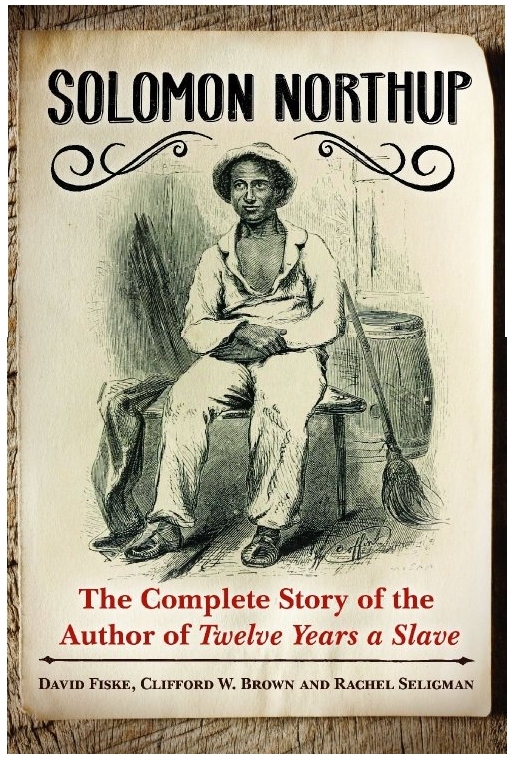
Book cover, Solomon Northup: The Complete Story of the Author of Twelve Years a Slave
“I read the book and found it utterly fascinating,” said Brown, the Robert Porter Patterson Professor of Government. “I couldn’t put it down. It’s a glimpse into life at that time, not only slavery, but also life as a free black man in the north. And it has such a ring of authenticity. He is just telling us what happened, mostly without a lot of flowery this and flowery that.”

With the help of some students, Brown spent months researching Northup’s life for Seligman’s exhibit. He traveled to Louisiana, Washington, D.C., and other places, collecting artifacts, documents and photos that authenticated Northup’s harrowing tale. The exhibit, which opened in January 1999, attracted thousands of visitors and renewed interest in Northup’s life.

Joined by David Fiske, a former senior librarian at the New York State Library, Brown and Seligman (now an assistant curator with the Tang Teaching Museum at Skidmore College) have teamed up again, for a new book, Solomon Northup: The Complete Story of the Author of Twelve Years a Slave.

The book coincides with an upcoming movie about Northup, “12 Years a Slave,” that has generated considerable buzz from film critics and audiences in pre-screenings. Written by John Ridley and directed by Steve McQueen, the film won the People’s Choice Award at last month’s Toronto International Film Festival.

Exhaustively researched, the book provides a fascinating look into Northup’s life, from his upbringing as the son of a former slave turned farmer, to his experiences after his rescue. Intended as a supplement to Northup’s memoir, which barely touched on his early life and what happened to him after the rescue, the biography delves deeper into all aspects, giving readers a wealth of new information.

“The book is a serious contribution because it’s the first,” said Brown, who continued to research and write about Northup for years after the exhibit.“There really is no other biography of Solomon Northup. Secondly, there is an enormous amount of archival research here culled from many different kinds of archives.”

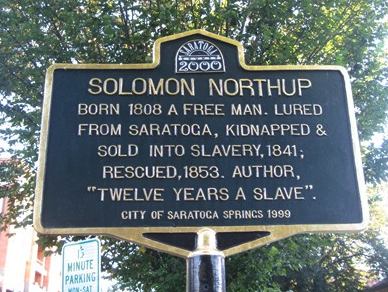
One example is the reconstruction of the kidnapping. Using city directories, maps and other documents, the authors were able to provide a detailed account of how Northup, an accomplished violinist, was lured from near his home in Saratoga to New York by two men who promised him work as a performer for a few days. From there, he was persuaded to accompany the men to Washington, D.C, where his drink was drugged at a tavern frequented by slave traders. He was shuttled off to a notorious slave pen and subjected to beatings for two weeks. He was eventually shipped to Louisiana and sold to plantation owners, enduring harsh and brutal conditions for the next 11 years, eight months and 26 days.

Saratoga Springs, NY Map

A chapter in the book, “Survival,” is particularly poignant, detailing the daily whippings and psychological abuse Northup and the other slaves faced during this period. Focusing on the physical, intellectual and emotional resources that Northup summoned to cope with his seemingly hopeless situation, the chapter is the turning point of the book.

Physically fit and with a sharp mind, Northup survived, the authors write, “because he had a will to survive. He didn’t let the system overwhelm him. He didn’t lose his own identity, despite four changes in his name. He never forgot who he was and that he had a home in the north. His recurrent thoughts about home could come at moments of despair, but the existence of a home offered hope of rescue to counterbalance that despair.”

Northup’s rescue was an “extraordinary achievement,” Brown notes, and the book provides rich details of the sympathetic white man and others who worked to free Northup. After the rescue, which attracted national attention, Northup spent his time with speaking engagements, wrote his book (collaborating with a local writer and attorney, David Wilson, Union Class of 1840) and even produced two plays.

Red River Parish, Louisiana Map

Drawing primarily on court documents, another chapter deals with the two kidnappers and their trial, at which Northup was accused of conspiring with them in order to make money. The authors make a strong case for the kidnappers’ guilt and scuttle any claims that Northup was involved in his own abduction.

“Since the kidnappers were never convicted, we felt we had to nail this down,” Brown said. “I don’t think it’s much in dispute that they were the kidnappers.”

Eventually, Northup’s fame faded, his speaking engagements dried up and his theatrical ventures dwindled, leaving him financially distressed. After the mid-1860s, he virtually disappeared, leaving no known trace of “how long he lived, where he died, or where he is buried.”

The authors present strong evidence that he may have gone to work on the Underground Railroad, helping other fugitive slaves escape what he experienced. Others suggested he may have been kidnapped again or that he went to England or to live with any of his grown children. Despite valiant efforts to determine how Northup spent his final years, “the mystery of his fate remains unsolved.”


The book has drawn praise from noted historian Henry Louis Gates Jr. of Harvard, a consultant to the movie and editor of a recent edition of Twelve Years a Slave, who called it an “indispensable source” and the “best current biography available. The facts they have uncovered are invaluable.”

Brown credited his co-authors, Seligman and Fiske, for their many contributions to the book, which came together in less than a year. He hopes readers develop a greater appreciation for Northup’s story.

“You should get a real sense of what a slave experience was and how difficult it was to rescue him,” Brown said.“But you also learn about his life before slavery and what he did after he returned to his life as a free man. It’s as intense an investigation of his life as is possible at this time. And yet, the story isn’t finished.”  (source: Union College- See more at: http://union.edu/news/stories/2013/10/twelve-years-a-slave-union-professor-co-authors-new-book-on-solomon-northup.php#sthash.5bLacYMs.dpuf)

Saturday, October 19, 2013

The Book, "Twelve Years A Slave," By Solomon Northup

Twelve Years a Slave: Narrative of Solomon Northup, a Citizen of New-York, Kidnapped in Washington City in 1841, and Rescued in 1853 [Auburn (NY): Derby and Miller, 1853.

Summary by Patrick E. HornTwelve Years a Slave:Narrative of Solomon Northup, a Citizen of New-York, Kidnapped in Washington City in 1841, and Rescued in 1853  --   Solomon Northup was born a free man in Minerva, New York, in 1808. Little is known about his mother, whom his narrative does not identify by name. His father, Mintus, was originally enslaved to the Northup family from Rhode Island, but he was freed after the family moved to New York. As a young man, Northup helped his father with farming chores and worked as a raftsman on the waterways of upstate New York. He married Anne Hampton, a woman of mixed (black, white, and Native American) ancestry, on Christmas Day, 1829. They had three children together. During the 1830s, Northup became locally renowned as an excellent fiddle-player. In 1841, two men offered Northup generous wages to join a traveling musical show, but soon after he accepted, they drugged him and sold him into slavery. He was subsequently sold at auction in New Orleans. Northup served a number of masters—some brutally cruel and others whose humanity he praised. After years of bondage, he came into contact with an outspoken abolitionist from Canada, who sent letters to notify Northup's family of his whereabouts. An official state agent was sent to Louisiana to reclaim Northup, and he was successful through a number of coincidences. After he was freed, Northup filed kidnapping charges against the men who had defrauded him, but the lengthy trial that followed was ultimately dropped because of legal technicalities, and he received no remuneration. Little is known about Northup's life after the trial, but he is believed to have died in 1863.

Illustration
SCENE IN THE SLAVE PEN AT WASHINGTON. (44a)

Twelve Years a Slave was recorded by David Wilson, a white lawyer and legislator from New York who claimed to have presented "a faithful history of Solomon Northup's life, as [I] received it from his lips" (p. xv). Dedicated to Harriet Beecher Stowe and introduced as "another Key to Uncle Tom's Cabin," Northup's book was published in 1853, less than a year after his liberation. It sold over thirty thousand copies. It is therefore not only one of the longest North American slave narratives, but also one of the best-selling.

The first two chapters of Twelve Years a Slave relate the Northup family history, Solomon's marriage to Anne, his employment as a raftsman, a farmer, and a fiddle-player, and his abduction. Promised "one dollar for each day's services" and three dollars for every show that he played, Northup travels willingly with the two con artists to New York City and then to Washington, D.C. (p. 30). Their ruse is thorough: the men perform a vaudeville show of sorts in Albany, and they convince Northup to obtain "free papers" before leaving New York. However, once in Washington, the men offer him a drink that causes him to become "insensible," and when Northup awakens, he is "alone, in utter darkness, and in chains" (p. 38). The narrative expresses his amazement at discovering "a slave pen within the very shadow of the Capitol!" (p. 43).

Northup is sold to the notorious Washington-based slave trader James H. Burch, who brutally whips him for protesting that he is a free man. While in the slave pen, he makes the acquaintance of several other slaves, including Eliza, whose sad history he relates in detail (pp. 50-54). The slaves are handcuffed and transported together via cars and steamboats to Richmond and then to New Orleans. Their experience aboard the steamboat is a miserable one: "sea-sickness rendered the place of our confinement loathsome and disgusting" (p. 68). Northup plans a mutiny with two of his fellow slaves, but the plan is foiled when one of them contracts smallpox and dies (pp. 69-72). Northup and the rest of "Burch's gang" are delivered to Theophilus Freeman, a New Orleans slave trader who informs Northup that his new name is "Platt" (p. 75).

Illustration
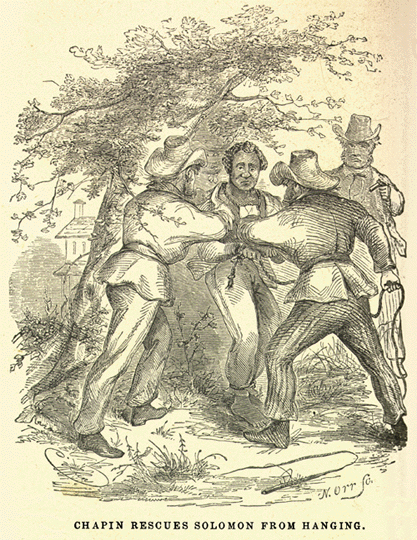
CHAPIN RESCUES SOLOMON FROM HANGING. (114a)

After surviving a bout of smallpox, Northup and Eliza are purchased by a Baptist preacher named William Ford. Touched by Eliza's pleas, Ford attempts to purchase her young daughter Emily as well, but Freeman refuses to sell her. Ford proves to be a kind master; Northup writes that "there never was a more kind, noble, candid, Christian man" (p. 90). Ford's plantation is located several hundred miles northwest of New Orleans, in the Great Pine Woods along Louisiana's Red River. Northup is put to work stacking and chopping logs at Ford's lumber mill, and he decides to reward his master's kindness. Realizing that Ford ships his lumber by land at great expense, Northup devises a set of rafts to deliver them by canal, greatly increasing Ford's profits. "I was the Fulton of Indian Creek," he recalls (p. 99). He also builds a loom for the plantation that "worked so well, I was continued in the employment of making looms" (p. 103).

Despite (or perhaps because of) his value as a laborer and de facto engineer, Northup is sold in the winter of 1842 to John Tibeats, a "quick-tempered" carpenter to whom Ford had become indebted (p. 103). Unlike Ford, Tibeats is "never satisfied," though he works his slaves "from earliest dawn until late at night" (p. 107). When Tibeats attempts to whip Northup for a dubious offense, Northup fights back, and with his foot on the master's neck, he whips Tibeats "until my right arm ached" (p. 111). When Tibeats and two associates attempt to lynch Northup, a kindly overseer (armed with pistols) intervenes and saves his life. Because he had not yet paid Ford the full amount for Northup, Tibeats is compelled to spare him for a time. Later, when he attacks Northup with a hatchet, the slave again bests the master, and this time he flees from the plantation, chased by hounds. Northup escapes by running and swimming through the "Great Pacoudrie Swamp," evading water moccasins and alligators (p. 139). He makes his way back to Ford's plantation, where he is protected from harm.

Persuaded by William Ford that killing Northup will only bring him the condemnation of his peers as well as financial loss, Tibeats hires Northup out to cut sugarcane in the "Big Cane Break" farther down the Red River. Around this time, Northup learns that Eliza has died of malnourishment and grief at the loss of her daughter (pp. 159-160). Soon afterwards, Tibeats sells Northup to Edwin Epps, a "repulsive and coarse" cotton planter whom Northup describes as being devoid of any redeeming qualities.(p. 162).
SCENE IN THE COTTON FIELD, SOLOMON DELIVERED UP (Facing page 304)

The second half of Northup's narrative is chiefly devoted to describing life on a cotton plantation. He provides detailed descriptions of the processes of planting, cultivating, and picking cotton (pp. 163-168), character sketches of his fellow slaves (pp. 185-190), and gradations of punishment for various offenses (pp. 179-180). As he was periodically hired out to sugar plantations as well, Northup describes the methods of planting, harvesting, and processing the cane in similar detail (pp. 208-213). Though his account reveals the misery and despair of field slaves, like many other slave narratives, it also reflects the wry humor with which Northup endured his situation. For example, in describing the meager rations allotted for each week's subsistence, he quips that "no slave of [Edwin Epps's] is ever likely to suffer from the gout, superinduced by excessive high living" (p. 169). Likewise, he begins his description of slave huts by stating that "the softest couches in the world are not to be found in the log mansion of the slave" (p. 170). Ironic metaphors and understatements such as these render Northup's account all the more compelling, leavening the extent of his degradation with a wry and persistent sense of humor.

Twelve Years a Slave occasionally ventures into nature writing and ethnography, as Northup describes southern flora, fauna, and culture from the perspective of a northern traveler. Narrating his relocation to work as a cane-clearer after his fights with Tibeats, Northup writes, "we were now in the midst of trees of enormous growth, whose wide-spreading branches almost shut out the light of the sun . . . The bay and the sycamore, the oak and the cypress, reach a growth unparalleled, in those fertile lowlands" (pp. 154-155). Northup seems to find the talk and behavior of Southerners equally interesting; he frequently quotes and explains colloquialisms, such as the verbs "allowed" (p. 153) and "toted" (p. 167). Remarkably, he compliments some aspects of (white) southern life: "whatever their faults may be, it is certain the inhabitants [of] the interior of Louisiana are not wanting in hospitality" (p. 159). He also repeatedly notes the abilities of female slaves in a manner that suggests a sort of proto-feminist sensibility. Northup praises the "lumberwomen" with whom he clears cane as "excellent choppers" who were "equal to any man" at piling logs (p. 156). On the cotton plantation, he observes that women plow the fields and tend their animals "precisely as do the ploughboys of the North" (p. 164). When it comes to picking cotton, Patsey is "queen of the field," for her fingers possess a "lightning-quick motion"—the very dexterity that Northup lacks (p. 188). Whether his subject is the Southern landscape or the Southerners themselves, Northup frequently writes with the bemused curiosity of an intellectual tourist.
Illustration
ARRIVAL HOME, AND FIRST MEETING WITH HIS WIFE AND CHILDREN (320)

Northup's first attempt to write a letter home—with a duck feather and ink that he produced from white maple bark—is thwarted when the white field-laborer in whom he confides exposes the plan to Edwin Epps. However, Northup had been savvy enough to request the favor without entrusting the letter, so he is able to deny the allegation and convince his master that it is spurious. Later, he meets a Canadian carpenter (and outspoken abolitionist) named Mr. Bass, who agrees to mail several letters for him. Both men realize the significance of the act: Northup notes that "my previous ill-fortune had taught me to be extremely cautious," and Bass advises him on "the great necessity of strict silence and secrecy" (p. 269, p. 271). Indeed, the letters that Bass writes for Northup inform the recipients that "he that is writing for me runs the risk of his life if detected" (p. 275). After a lengthy delay that causes Northup to despair of ever being rescued, he is found and liberated by Henry B. Northup, a member of the same white family that his father had served years before. Northup later learns the causes for the delay: first, his wife had to prove to the Governor of New York (Washington Hunt) that Solomon was a free man who had been abducted; next, Governor Hunt had appointed Henry Northup as an official state agent to rescue Solomon; Henry Northup had then negotiated with former Louisiana Senator Pierre Soulé, Supreme Court Justice Samuel Nelson, and Charles M. Conrad, U.S. Secretary of War, to provide federal support for his mission (pp. 290-292). Even after all of these careful arrangements, Henry Northup still struggled to locate Solomon, because no one in Louisiana knew him by his real name. It was only a chance encounter with the carpenter Bass that revealed Solomon's location—and that he was now called "Platt" (p. 298). With this knowledge and the help of a sympathetic sheriff, Henry Northup was able to rescue Solomon Northup. The final chapter outlines the legal proceedings that followed—in New Orleans, where the men received a legal pass to leave the state; in Charleston, South Carolina, where Henry was challenged by customs officials for not "registering" Solomon as a servant; and in Washington, where the two filed charges against Solomon's former captors (pp. 310-319). The narrative concludes with Solomon's reunion with Anne, his daughters, and a grandson whom he had never met. The child's name was Solomon Northup Staunton (p. 320). Patrick E. Horn[source: Documenting The American South]

TWELVE YEARS A SLAVE by Solomon Northup -- Audiobook

Monday, May 2, 2011

Slave Catchers


Barry Ray of Florida State University News writes, The program, "Slave Catchers, Slave Resisters," takes a look at a little-known aspect of the United States' ignominious history of slavery -- the brutal system of slave patrols that existed from the 1700s through the Civil War, and that helped give rise to the Ku Klux Klan during Reconstruction.

Much of the information in "Slave Catchers, Slave Resisters" is culled from "Slave Patrols: Law and Violence in Virginia and the Carolinas," a book published in 2001 by Sally E. Hadden. Hadden, an associate professor of history at FSU, was interviewed extensively for and appears in the documentary.

"Someone at the History Channel read my book and decided there was a story here," said Hadden, explaining how she came to be involved with the documentary in 2004. A production company was contacted, a "treatment" outlining the program was prepared, and the decision to move forward with "Slave Catchers, Slave Resisters" ultimately was made.

1859 RUNAWAY SLAVE PATROL BADGE N CAROLINA


"I went in and did about five or six hours of taping with them in August of last summer," Hadden added. Excerpts from those interviews appear prominently in the documentary.

In her book, Hadden analyzes the public regulation of slavery in Virginia and the Carolinas, focusing on the slave patrols that existed between roughly 1700 and 1865. The patrols were formed in response to white Southerners' fears of lawlessness and even insurrection on the part of the slaves, who outnumbered whites by almost two to one in some areas.

Such fears were based in part on real events such as the Stono Rebellion of 1739, in which dozens of slaves, most armed with knives and guns and drunk, set out from Stono, S.C., for freedom in Florida, murdering more than two dozen whites along the way. All of the slaves who willingly participated in the rebellion were either killed that day or later captured and executed.

Hadden shows how this and other rebellions led to a sense of paranoia that manifested itself in the form of ever-increasing restrictions on slaves throughout the South. Laws were passed requiring white males from each community to serve on armed slave patrols, which had the authority to enter slave owners' plantations without a warrant to monitor the activities of slaves; to stop unaccompanied slaves anywhere and require them to produce identification passes; and even to inflict violence, without penalty, on any slave found to be breaking the law.

"The relationship between master and slave was not the only nexus of violence," Hadden said, since "the state - through patrols - played an important role in legitimizing and using violence against slaves. Violence wasn't confined simply to slave masters, as most people think."

1858 SLAVE PATROL BADGE GEORGETOWN S CAROLINA SLAVE TAG


While much of "Slave Catchers, Slave Resisters" describes the system of slave policing, the documentary also looks at another often-overlooked aspect of the era - the strength and ingenuity of the enslaved. In the South, bounty hunters sometimes lost against the intelligence and fight-to-the-death courage of the runaway slaves they sought to recapture. And in the North, slave catchers sometimes were defeated by an organized and armed free black community. While the historical record doesn't contain many personal accounts by runaway slaves of their experiences, the documentary's producers did take pains to tell the slaves' stories of courage through the use of dramatic reenactments, archival material and interviews with scholars.

"Slave Catchers, Slave Resisters" closes in the aftermath of the Civil War, as the newly freed people work to build communities, farms, schools and churches. But the system of slave patrols had not disappeared entirely - it was soon reborn during Reconstruction in an even more violent form: the Ku Klux Klan.


"The Klan was an extension of slave patrols in most direct, obvious ways," said Hadden. "They've changed the names from patrols to Klan, they've put on sheets, but the activities and the purpose remain pretty much the same."

A member of FSU's history department since 1995, Hadden has taught on early and Revolutionary America and the Old South. She is currently working on a book that documents the cultural history of the legal system in 18th century America, focusing on the legal communities in Philadelphia, Boston and Charleston, S.C. (source: FSU News)


Slave Catchers Resistors 1 Deal with the Devil


Slave Catchers Resistors 2


Slave Catchers Resistors 3


Slave Catchers Resistors 4


Slave Catchers Resistors 6


Slave Catchers Resistors 7


Slave Catchers Resistors 8


Slave Catchers Resistors 9


Slave Catchers Resistors 10


HOME

HOME
Click here to return to the US Slave Home Page