Saturday, December 14, 2013

A Visit From Saint Nicholas, by Clement Moore

image
A VISIT FROM ST. NICHOLAS
By Clement Moore (1862); Illustrated from drawings by F.O.C. Darley

Twas the night before Christmas, when all through the house
Not a creature was stirring, not even a mouse;
The stockings were hung by the chimney with care,
In hopes that St. Nicholas soon would be there;
The children were nestled all snug in their beds,
While visions of sugar-plums danced in their heads;
And mamma in her kerchief, and I in my cap,
Had just settled our brains for a long winter's nap—

image

When out on the lawn there rose such a clatter,
I sprang from my bed to see what was the matter,
Away to the window I flew like a flash,
Tore open the shutters and threw up the sash.
The moon, on the breast of the new-fallen snow,
Gave a lustre of mid-day to objects below;
When, what to my wondering eyes should appear,
But a miniature sleigh, and eight tiny rein-deer,
With a little old driver, so lively and quick,
I knew in a moment it must be St. Nick.
More rapid than eagles his coursers they came,
And he whistled, and shouted, and called them by name;


image

"Now, Dasher! now, Dancer! now, Prancer and Vixen!
On! Comet, on! Cupid, on! Dunder and Blitzen—
To the top of the porch, to the top of the wall!
Now, dash away, dash away, dash away all!"
As dry leaves that before the wild hurricane fly,
When they meet with an obstacle, mount to the sky,
So, up to the house-top the coursers they flew,
With a sleigh full of toys—and St. Nicholas too.
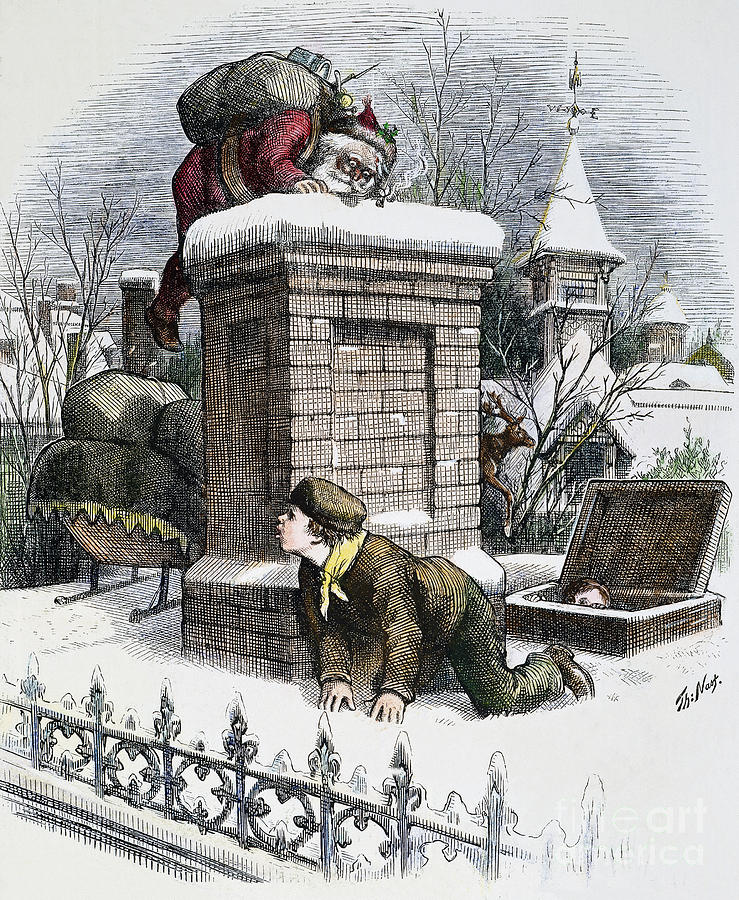
And then in a twinkling I heard on the roof,
The prancing and pawing of each little hoof.
As I drew in my head, and was turning around,
Down the chimney St. Nicholas came with a bound.


He was dressed all in fur from his head to his foot,
And his clothes were all tarnished with ashes and soot;
A bundle of toys he had flung on his back,
And he looked like a peddler just opening his pack;
His eyes how they twinkled! his dimples how merry!
His cheeks were like roses, his nose like a cherry;

image

His droll little mouth was drawn up like a bow,
And the beard on his chin was as white as the snow;
The stump of a pipe he held tight in his teeth,
And the smoke, it encircled his head like a wreath.
He had a broad face, and a little round belly
That shook when he laughed, like a bowl full of jelly.


image

He was chubby and plump—a right jolly old elf;
And I laughed when I saw him in spite of myself.
A wink of his eye, and a twist of his head,
Soon gave me to know I had nothing to dread.
He spoke not a word, but went straight to his work,
And filled all the stockings; then turned with a jerk,
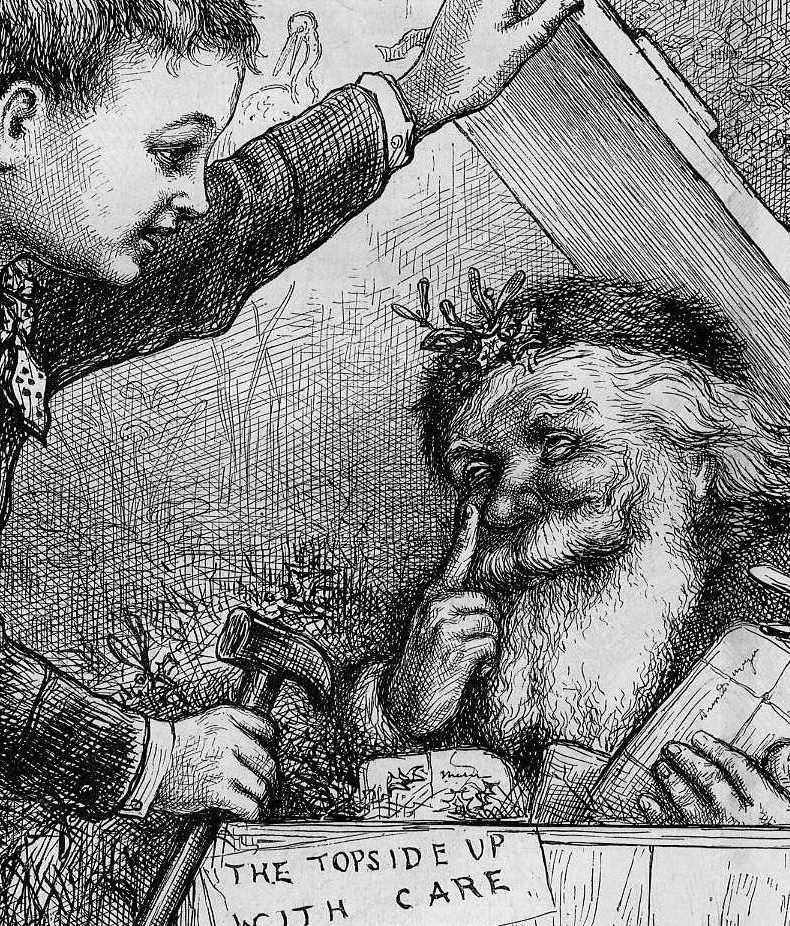
And laying his finger aside of his nose,
And giving a nod, up the chimney he rose.
He sprang to his sleigh, to his team gave a whistle,
And away they all flew like the down of a thistle;
But I heard him exclaim, ere he drove out of sight,
"Merry Christmas to all, and to all a good night!"

MERRY CHRISTMAS TO ALL


The History of Rudolph the Red-Nosed Reindeer


From the Gettysburg Times, on 22 December 1975, in an article entitled, "Robert May Tells How Rudolph The Red Nosed Reindeer, Came Into Being, by Robert May.  Robert May, of Evanston, Illinois asserts in his byline that, "Rudolph and I Were Something Alike." May describes how how he created the beloved Christmas icon Rudolph the Red Nosed Reindeer, while working as a copywriter at the now defunct Montgomery Wards Department Stores (1872-2000) --  An icy January blast tore at my coast as I hurried on my way to work. I noticed that the Christmas street decorations had been taken down, and in a way I was relieved. My wife was suffering from a long illness and I didn’t feel very festive.

I was glad to get inside the foyer of the Montgomery Ward building. In the elevator I leaned back and listened to the younger men eagerly discuss their work.

“And how are you starting the new year?” I glumly asked myself. Here I was, heavily in debt at age 35, still grinding out catalogue copy. Instead of writing the great American novel, as I’d once hoped, I was describing men’s white shirt. It seemed I’d always been a loser.

In the copy department a secretary called. “Bob, the boss wants to see you.”

What now? I wondered.


DECIDED TO TRY

Our department head stood at the window in his office. “Bob,” he barked, “I’ve got an idea. For years our stores have been buying those little Christmas giveaway coloring books from local peddlers. I think we can save a lot of money if we create one ourselves. Could you come up with a better booklet we could use?”

I started to answer but he kept right on talking. “I think it should be an animal story, with a main character like Ferdinand the Bill.”

Finally I said I’d try.

That night, I wondered about what kind of animal it should be. Christmas. Santa. Reindeer? Of course; it must be a reindeer – Barbara, my four-year-old daughter, loved the deer down at the zoo.


BRIGHT RED NOSE

But what could a little reindeer teach children?

Suppose he were an underdog – a loser, yet triumphant in the end. But what kind of underdog?

Certainly a reindeer’s dream would be to pull Santa’s sleigh.

Outside, the fog swirled in from Lake Michigan, dimming the street lights. Light. Something to help Santa find his way on a night like this.

Suddenly I had it! A nose! A bright red nose that would shine through fog like a floodlight.

[Paul+Wing-Rudolph+The+Red-Nosed+Reindeer-Inside-R-Smaller.jpg]
HE HAD FAITH

Rudolph the Red Nosed ReindeerThe next morning I enthusiastically presented my idea to the boss. “For gosh sakes, Bob, can’t you do better than that?”

I retreated to my desk and sat staring at the wall. I had faith in the reindeer I had by now named Rudolph. But how could I convince the boss? I prayed for inspiration.

An idea struck me. A bold, audacious idea. I walked over to the art department, where my friend Denver Gillen worked. “Denver, could you draw a deer with a big red nose and make him look appealing?”

He looked at me quizzically and I explained my idea. The following Saturday morning, Barbara, Denver and I met at the deer corral at Chicago’s Lincoln Park Zoo. As he sketched, I held Barbara up so she could better see those gentle creatures.

WE HAD SOMETHING

By afternoon we felt we had something.

On Monday morning we brought the sketches into the boss’s office. He studied them for a long time. “Bob,” he said softly, “forget what I said and put the story into finished form.”

I started writing:

“Twas the day before Christmas and all through the hills – The reindeer were playing . . . enjoying the spills . . .”

Spring slipped into summer. My wife’s parents came to stay with us to help. Suddenly her condition grew worse. Then in July she was gone.

At the office the boss put his hand on my shoulder. “Bob,” he said, his voice unusually gentle. “I can understand your not wanting to go on with the kids’ book. Give me what you’ve got and I’ll let someone else finish it.”

Bob May - author of Rudolph the Red-Nosed Reindeer
HIS REWARD

But I needed Rudolph now more than ever. Gratefully I buried myself in the writing. Finally, in late August, it was done. I called Barbara and her grandparents into the living room and read it to them.

In their eyes I could see that the story accomplished what I had hoped.

Today children all over the world read and hear about the little deer who started out in life as a loser, just as I did. But they learn that when he gave himself for others, his handicap became the very means through which he received happiness.

My reward is knowing that every year, when Christmas rolls around, Rudolph still brings that message to millions, both young and old.  (source: Gettysburg Times, 22 December 1975)

A Civil War Santa by Thomas Nast

http://www.stnicholascenter.org/media/images/t/time-1864a.jpg 
Santa Claus and His Works
Artist: Thomas Nast

From the New York Times, "On December 25, 1866, Harper's Weekly featured a cartoon about Santa Claus and Christmas," by Robert C. Kennedy (2001) -- This multi-framed illustration of “Santa Claus and His Works” was artist Thomas Nast’s first major depiction of Santa Claus in Harper’s Weekly (appearing in the postdated December 29, 1866 issue). Although other artists of the period sketched Santa Claus, Nast stands apart from the rest for his role in creating and popularizing the modern image of the Christmas figure. He contributed 33 Christmas drawings to Harper’s Weekly from 1863 through 1886, and Santa is seen or referenced in all but one. Nast’s full-page illustration of Santa Claus in 1881 quickly attained status akin to an official portrait, and is still widely reproduced today. Before Nast, different regions, ethnic groups, and artists in the United States presented Santa Claus in various ways. A sketch in Harper’s Weekly from 1858 shows a beardless Santa whose sleigh is pulled by a turkey. Nast was instrumental in standardizing and nationalizing the image of a jolly, kind, and portly Santa in a red, fur-trimmed suit delivering toys from his North Pole workshop. This was accomplished through his work in the pages of Harper’s Weekly, his contributions to other publications, and by Christmas-card merchants in the 1870s and 1880s who relied heavily upon his portraiture.

In the featured “Santa and His Works,” Nast adapts characteristics from his German heritage (he was born in Bavaria) and from Clement Clark Moore’s famous 1822 poem “A Visit From St. Nicholas” (commonly known as “Twas the Night Before Christmas”), but the artist adds other aspects developed from his own creative mind and talented pen. The effect is to unveil much of the mystery behind Santa Claus by presenting a more complete account of his life, mission, and home. Instead of depicting him merely delivering gifts, the entire process of his work is detailed from the preparation to the execution to the recovery. The centerpiece is what children hope for: Santa stuffing stockings hung on the fireplace, as toys lie on the floor. He is plump, white-bearded, red-nosed, dressed all in fur, carries the sack of a peddler (evoking earlier lore of Santa as a peddler), and is still the short elf of Moore’s poetic version (here, Santa needs a chair to reach the mantle).

http://blog.nyhistory.org/wp-content/uploads/2010/12/nyhs_harpers1.3.1863_001-de1.jpg

Along the sides, Nast adds parallel circular insets. To fulfill Santa’s traditional task of rewarding nice children and punishing naughty children, Santa uses a telescope to locate good children (upper-left), and records the behavior of children in an enormous account book (upper-right). On the center-left, he is seen in his workshop carefully crafting toys by hand (as opposed to the increasing reliance on factory production in America). On the center-right, he is taking a well-deserved post-Christmas rest in a rocking chair placed before a fireplace, as he holds a meerschaum pipe popular among Germans, Dutch, and their American descendents. On the lower-left, the diminutive Santa uses a ladder to decorate the Christmas tree (another German tradition), and on the lower-right, sews doll clothing by hand (rather than using a sewing machine). Three years later, in 1869, “Santa and His Works” was included in a new publication of Moore’s poem illustrated by Nast. At that time, Santa’s suit was changed to the red color for which it has thereafter been associated.

http://imagehost.vendio.com/preview/ha/haats/HW1885P856487.jpg

The origin of Santa’s home at the North Pole is uncertain, but in “Santa and His Works” Nast may have been the first illustrator to so identify the locale. (An 1857 illustration in Harper’s Weekly shows Santa preparing to leave a snowy but unnamed homeland.) In the late 1840s and the 1850s a series of expeditions to the Arctic captured public attention, and the area began to be discussed as the home of the elusive Santa Claus. Year-round the North Pole had the snow that was becoming associated in the popular image with Christmas (the American publishers of magazines, books, and cards carrying Christmas illustrations were headquartered in the snowy Northeast). Furthermore, the North Pole's geographic isolation permitted the jolly old elf to work without interruption, and the region’s independence from all nations allowed Santa to be a symbol of universal good will. The reference to the North Pole in the featured cartoon is on the curving border in the upper-right and reads “Santa Claussville, N. P.” The linkage of symbol and place was obviously common enough by 1866 that Nast realized he could simply abbreviate “North Pole.”

While setting the national standard, Nast’s own depiction of Santa Claus changed over the years. He began his almost-annual contribution of Christmas illustrations when he joined the staff of Harper’s Weekly in 1862 during the Civil War. His first Santa (in the postdated January 3, 1863 issue) is a small elf distributing Christmas presents to Union soldiers in camp. Santa dangles by the neck a comical jumping jack identified in accompanying text as Jefferson Davis, the Confederate president. There was no doubt in Nast’s illustration whose side Santa favors in the war. Besides the military context, the cartoon is set off from later ones in that the gift giving is for adults, not children (except for the drummer boys). The other two Christmas illustrations of Nast’s published during the Civil War emphasize family scenes, with Santa relegated to the background.

http://www.artprints.com/images/OWP/large/owp5905c.jpg

From 1866-1871, Nast continued to elaborate upon the image of Santa Claus portrayed in “Santa and His Works.” As in the featured cartoon, he also emphasized during this period Santa’s disciplinary role in judging whether the behavior of children during the past year warranted Christmas rewards or punishment. In an 1870 cartoon, Santa surprises two naughty children by jumping out as a jack-in-the-box clutching a switch for spanking. In 1871, Santa sits at his desk reading letter from parents chronicling their children’s good and bad acts, with the “letters from naughty children’s parents” far outnumbering the “letters from good children’s parents.” It is probably not coincidental that Nast was at that time the father of several young children (the eldest, Julia, was 9 years old in 1871). Whatever the reason, the cartoons helped revive the idea of Santa as reinforcing parental discipline, a notion that had waned since the publication of Moore’s poem in which Santa brought a “happy Christmas to all.”

Through the rest of the 1870s, Nast’s Santa Claus was no longer the disciplinarian, but, instead, played a cat-and-mouse game with children in which he tried not to be seen and they tried to catch him in the act of delivering presents. Again, the illustrations likely reflected the situation in Nast’s home, where he loved to wrap presents and celebrate the season, but at a time when his children had become old enough to try to find the gifts and nab the gift-giver. In “Santa Waiting for Children to Get to Sleep” (1874), Santa is forced to delay on a rooftop because children in the house below are still awake. A related poem blames the late-night hours of the family on the use of gas lighting in homes.

http://images.fineartamerica.com/images-medium-large/16-thomas-nast-santa-claus-granger.jpg

As Nast’s own children entered and left their teen years, knowing that Santa was really their father, the artist’s illustrations finally showed direct communication and interaction between Santa Claus and the pictured children. In a postdated January 1879 issue, a girl drops a letter to Santa in a mailbox (the first time the artist depicted a letter from a child to Santa), and in December 1884, Santa and a girl are able to speak with each other by using a relatively new invention, the telephone. In the January 1879 issue, another Nast cartoon portrays Santa Claus in the midst of a group of gleeful children who he embraces affectionately. Santa is now recognized as part of the family, whose shared love is the greatest gift. Nast’s Santa makes his last appearance in Harper’s Weekly the next year when the jolly old (man-size) elf offers himself as a present. Nast’s last two Christmas illustrations in Harper’s Weekly appeared in December 1886, when he resigned from the newspaper, but his impact on the popular image of Santa Claus continued and remains potent to this day.  (source: New York Times)


Thomas Nast exhibit from Will Hughes on Vimeo.

Friday, December 13, 2013

Civil War Christmas Song: I Heard the Bells on Christmas Day


As reported in the Washington Times, "The Civil War: beauty from tragedy, "I Heard the Bells on Christmas Day'" by Martha M. Boltz -- VIENNA, Va., December 22, 2011 — Many musicians and writers of poetry will admit that some of their finest work comes when they have experienced a death or a tragedy of some kind, that the writing of poetry has an almost cathartic effect on the writer.

Such is the case of one of the best known and most beloved carols associated with Christmas, “I Heard the Bells on Christmas Day,” which came from the pen of American poet Henry Wadsworth Longfellow (1807-1882) and was written on Christmas Day, 1864.

His had been a tortured life in last few years before that day. On July 11, 1861, his wife Fanny had clipped some long curls from the head of her seven-year-old daughter, Edith, and wanting to save them in an envelope, melted a bar of sealing wax with a candle to seal the envelope.

Somehow the thin fabric of her clothing caught fire, and she quickly ran to Longfellow’s nearby study for help. He immediately tried to extinguish the flames with a small rug, and when that failed, he threw his arms around Fanny to smother the flames, causing him to sustain serious burns on his face, arms, and hands. His heroic act did not suffice, and Fanny died the next morning of her injuries. Longfellow was unable to even attend the funeral.


Photographs of Longfellow taken or made after the fire usually show him with a full beard, since he was no longer able to shave properly due to the burns and scarring.

The coming of the holiday season in the Longfellow house became a time of grieving for his wife while trying to provide a happy time for the children left at home. It was during Christmas 1862 that he wrote in his journal, “A ‘merry Christmas’ say the children, but that is no more for me.”

He had also suffered another disappointment when his oldest son, Charles Appleton “Charley” Longfellow, quietly left their Cambridge, Mass. home, and enlisted in the Union Army much against the wishes of his father.

In mid-March, Longfellow had received word from Charles, saying, “I have tried hard to resist the temptation of going without your leave, but I cannot any longer.” The determined young man continued, “I feel it to be my first duty to do what I can for my country and I would willingly lay down my life for it if it would be of any good.”


He was 17 years old and went to Capt. W. H. McCartney, who was in charge of Battery A of the 1st Mass. Artillery, asking to be allowed to enlist. McCartney knew the boy and knew he did not have his father’s permission, so he contacted the senior Longfellow to see if he could obtain it on his behalf. Longfellow conceded and acceded to the request.

It was only a few months later that Charley came down with typhoid fever and malaria and was sent home to recover, not rejoining his unit until August 15, 1863.

Following the Gettysburg battle, which Charley had fortunately missed, the conflict made its way into Virginia, and it was at the Battle of New Hope Church, in Orange, VA., part of the Mine Run Campaign, that the young Lt. Longfellow sustained injuries, which seriously disabled him. He was hit in the shoulder and the ricocheting bullet took out some portions of several vertebrae. It was reported that he missed being paralyzed by less than one inch. Longfellow traveled to where his injured son was hospitalized and brought him home to Cambridge to recover.

The war for Charley was over.

And so at Christmas of 1864, a reflective and sad poet sat down and began to write the beautiful words that we sing each Christmas:


I Heard the Bells on Christmas Day
Their old familiar carols play,
And wild and sweet the words repeat
Of peace on earth, good will to men.

I thought how, as the day had come,
The belfries of all Christendom
Had rolled along the unbroken song
Of peace on earth, good will to men.

And in despair I bowed my head:
“There is no peace on earth,” I said,
“For hate is strong and mocks the song
Of peace on earth, good will to men.”

Then pealed the bells more loud and deep:
“God is not dead, nor doth he sleep;
The wrong shall fail, the right prevail,
With peace on earth, good will to men.”

Till, ringing, singing, on its way,
The world revolved from night to day,
A voice, a chime, a chant sublime,
Of peace on earth, good will to men!


Remembering that this was written during the Civil War, even though not published until 1872, we see the concerns of the War were much on Longfellow’s mind and heart. Thus there were two other verses that appeared in the original as verses four and five and are not song today, since they emphasize his feelings surrounding the War:
Then from each black accursed mouth
The cannon thundered in the South,
And with the sound,
The carols drowned
Of peace on earth, good-will to men!

It was as if an earthquake rent
The hearth-stones of a continent,
And made forlorn,
The households born
Of peace on earth, good-will to men!


Longfellow’s heartfelt words of loss and hope were published and well received. John Baptiste Calkin (1827-1905), an English composer, was similarly affected by the poem, and it was he who penned the music that we know and sing today, slightly rearranging the verses or stanzas as he did.

While he was an organist and a music teacher, Calkin probably is best known as the composer of the music for Longfellow’s poem.

It is a glorious carol and provides the enduring concept that despite tragedy, loss, and even warfare, there is within most of us the hope and wish for “peace on earth, good-will to men!”

A very Merry Christmas to all of you, good friends and readers. May the coming year of 2012 be filled with good times, good books, good friends, and good health! And peace on earth.  (source: Washington Times)


Thursday, December 12, 2013

Racist Mechanical Toys


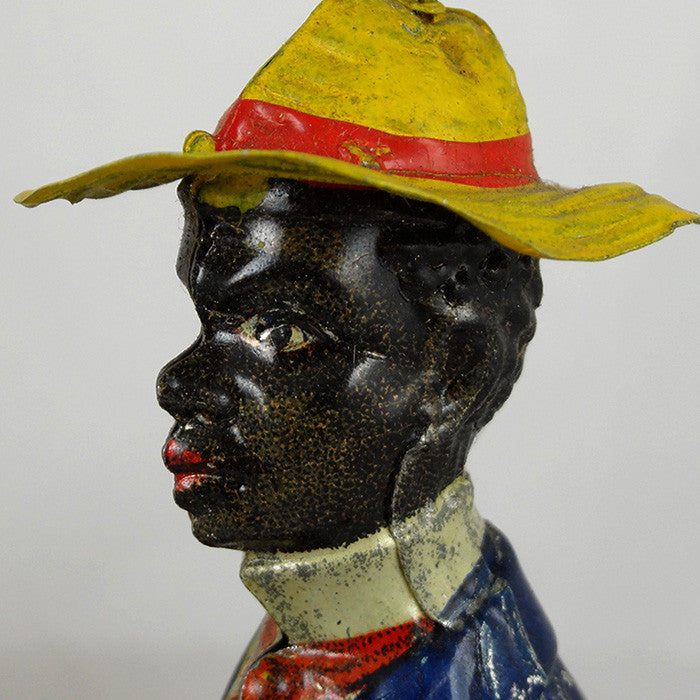
According to the  The Baltimore Sun, "Stereotyped toys are reminders of overt bigotry of the past," by Scott Ponemone, on 5 May 1991 -- Here are names of some toys that will make many reader squinch: Jazzbo Jim, Tombo Alabama Coon Jigger, Ham and Sam, and Somstepa Coon Jigger. They certainly don't represent the finest hour of American manufacturing history.

The fact is those names hail from the heyday of American bigotry. No one claims bigotry is dead in this racial and cultural amalgam of a nation, but it sure has become a lot more subtle.

These reminders of America's past, however unpleasant, are a big part of a booming market of black memorabilia collecting.


The names above belong to painted tin windup toys patented from 1910 to 1921. They all have moving parts. Jazzbo Jim, for instance, dances while a second figure saws on a fiddle. Ham plunks on an upright piano as Sam does a jig.

At a April 27 auction by the Gordon Auction Co. at the Frederick Fairgrounds, Jazzbo Jim with fiddler brought $425, Alabama Coon Jigger $550, Ham and Sam $475 and Somstepa Coon Jigger $525. (A fuller description of these and other black items from that sale follows this article.)

That some blacks collect these grossly stereotypical items and display them in their homes may come as a surprise. But Jeanette Carson, a pioneer in collecting black memorabilia, explains her decision to do so this way:

"I was offended too when I first got involved," she says, but she soon realized, "They don't represent the way black people look. They represent the mentality of the people who produced them.

"I consider the negative items the black holocaust. You cannot sweep it under the rug."


Similarly, Ronald Rooks, who began collecting black material in 1949, says, "Nobody's going to be offended." For him stereotypical images represent "a time and space in history that still exists in the back of some [white] people's minds. It's not us; it's the way they were looking at us."

Mrs. Carson, of Hyattsville, has been publishing a magazine, Black Ethnic Collectibles, for four years, while under the name Ethnic Treasures Inc., she produces shows of black memorabilia and collectibles. She also founded the Black Memorabilia Collectors Association, with 900 members across the United States.

"The whole purpose of our movement is to have black-specific shows," she says. "That's negative and positive and historical items that fall into the rubric of black memorabilia.

"I get a lot of flak [for showing stereotypicals], but I don't let it bother me. People are offended because they lack the proper education." Her magazine and collectible shows, she hopes, provide some of the necessary education.

However, she will not show reproductions: "I don't condone the reproduction of stereotypical items. That I do not approve of. That I consider the perpetuation of negativity. You can't erase history [the historically bigoted items], but you can prevent the continuation of the negative part of American history."


Mr. Rooks began collecting at age 16, first books and historical information, then small graphics such as postcards and trade cards, and later paintings and prints. For years he had a shop on Howard Street. Now his retail trade is limited to Sundays at Black Angus in Adamstown, Pa.

His acceptance of the ugly depictions of bigotry toward blacks comes in direct proportion to the strength of his own self-image. As he explains: "If you pass me by and think me below you, that's your problem."

His friendship with auctioneer Richard Opfer in Timonium led to Mr. Opfer becoming one of the first auction houses to feature black collectibles 10 years ago.

"Ronald had a big collection and knew lots of people with lots of things to sell," Mr. Opfer says. "I was a friend of his and an auctioneer, so I said let's do it."

The response at the 1981 sale was positive from both white and black collectors alike. Any fears Mr. Opfer had of offense being taken from his sale of stereotypical items were unwarranted. Was there ever any complaining? "I never had it."


At the first sale, he says, he was worried over a photograph, "a very racial piece," so he withdrew it from the sale. Afterwords he showed it to some black collectors, who not only weren't offended but expressed interest in the piece.

Little was available in the early '80s in the way of price guidelines for black collectibles. According to Mr. Opfer, that led to some strong prices for mediocre items at his first sale.

He says, "Over a period of years, they [collectors] found out how numerous some pieces were." Consequently, prices for common items have risen little since his 1981 sale.

Not so for the best pieces. "The very rare and best condition always go up," Mr. Opfer says. "Everything is governed by supply and demand and condition."

That basic premise of auctioneering will be tested yet again Saturday at his Timomium auction house, when one woman's 16-year collection of black memorabilia goes on the block.


Giving what he calls conservative estimates, he says he wouldn't be surprised if a British store display called Golliwog, 26 inches tall of molded rubber, brought $500 to 700; a sterling souvenir spoon from Atlanta, with enameled watermelon bowl and sculpted black face on the handle; $150 to 250; and the sheet music of a song called "Hot Lips" ("The finest sheet music graphically that we ever sold") $50 to 75.

He also gave these verbal estimates: a patchwork mammy hand towel, linen, $75 to 125; Brayton cookie jar, possible mismatch, 11 1/2 inches with minor chips to top, $150 to 250; Little Black Sambo target board, 23-inch lithographed image on tin, central crease with minor damage, $150 to 250; and duckpin set of nine cardboard and wood figures of boy holding a watermelon slice with ball, one head detached, $75 to 125.

The list for the 580-item sale, with some photographic illustrations, does not have price estimates. It costs $7.

The collection is broad-ranging, including many lots of sheet music and books, dolls, salt and pepper sets, advertising items, Currier and Ives lithographs and sculpture. There are some reproductions (so labeled on the item list), particularly mechanical banks. It comes on the market in part because its value has gone up so much.


Noni Strobel, whose collection it is, says that for her, escalating .. prices make collecting black memorabilia "not fun anymore." Prices have "gone haywire," she says. Cookie jars, for which she was paying about $100, are now "not under $300 to $400." And it was a cookie jar that "I thought was so whimsical" that started her collection 16 years ago.

The seeds of a decision to sell were sown when her father died and she called on Mr. Opfer to hold a sale of both her father's toy collection and her mother's doll collection. Soon after, she left her Ohio house for a smaller one in Western New York state.

Not wanting to leave things in boxes in the smaller house -- "It's a criminal waste to have something in a box just to maintain ownership" -- she decided to sell.

"You've had your fun," Mrs. Strobel says. "Let somebody else have the fun."  (source:" The Baltimore Sun)


Wednesday, December 11, 2013

Enslavement As Restraint


Here is an excerpt of Stephanie Camp's book, Closer To Freedom: Enslaved Women And Everyday Resistance In The Plantation South, Chapter One: "A Geography of Containment; The Bondage of Space and Time  --  The Principles of Restraint," by Stephanie M. H. Camp

The Principles of Restraint

At the heart of the process of enslavement was a spatial impulse: to locate bondpeople in plantation space and to control, indeed to determine, their movements and activities. Enslaved people in the nineteenth century were trapped in more than an exploitative labor relation; they were the captive losers in a battle for power that had begun centuries earlier in the Atlantic maritime world. As outsiders, heathens, perhaps even beasts, Africans were, unlike Europeans (no matter how debased), viewed as fundamentally enslaveable by the European merchants, planters, travelers, and adventurers who traversed the Atlantic world. Once enslaved, Africans were considered more like the captives of war to whom they were compared in the early, formative years of American slavery than to the indentured servants to whom they are sometimes compared now. In the minds of the earliest participants in and witnesses to the African slave trade, as historian Winthrop Jordan has put it, "enslavement was captivity."

Slavery's roots as a form of captivity lived into the nineteenth century. Enslavement in the American South meant cultural alienation, reduction to the status of property, the ever-present threat of sale, denial of the fruits of one's labor, and subjugation to the force, power, and will of another human being. It entailed the strictest control of the physical and social mobility of enslaved people, as some of the institution's most resonant accouterments-shackles, chains, passes, slave patrols, and hounds-suggest. These effects were as much a part of abolitionism's image-based protests against bondage as were depictions of the lash, the auction block, or stooped slaves in the field. These same images have persisted into our own visual culture of bondage, testaments to slavery's denial of a medley of freedoms. By the nineteenth century, lawmakers and slaveholders had laid out, in their statutes and in their plantation journals, a theory of mastery at the center of which was the restriction of slave movement. Passes, tickets, curfews, and roll calls all limited slave mobility. In his remarkable memoir of life in bondage, Charles Ball called the legal and day-to-day regulations that governed black movement "principles of restraint." "No slave dare leave" the plantation to which she or he belonged, Ball wrote, not for a "single mile" or a "single hour, by night or by day," except at the risk of "exposing himself to the danger of being taken up and flogged." Bondpeople everywhere were forbidden by law and by common practice to leave their owners' property without a pass, and slave patrols attempted to ensure obedience to the law and to plantation rules. Formerly enslaved people compared bondage to another form of confinement: "I was a slave," Henry Bibb wrote in his autobiography, "a prisoner for life." Fountain Hughes agreed, saying of enslavement that it was a "jail sentence, was jus' the same as we was in jail." Antebellum principles of restraint rested on a legal bedrock laid in the colonial and early national periods. Between the seventeenth and the early nineteenth centuries, as colonists and settlers seized and organized land that would become states, elites passed laws to govern the people who populated these new societies.


Slaveholders everywhere in the slave South shared a common interest in constricting black mobility; intraregional differences of crop, demographics, and culture modulated but did not fundamentally alter this investment. Virginia was the first colony to pass laws governing bondpeople's behavior. Among the colony's earliest slave laws was the act of 1680 "for preventing Negroes Insurrections." The concerns expressed in this ordinance indicate a sense of urgency in regard to controlling black mobility. To prevent "Negroes Insurrections," the colonial legislature prohibited enslaved people from possessing weapons and, in the same breath, from leaving their place of work without a pass, or "certificate." The law read: "It shall not be lawfull for any negroe or other slave to carry or arme himselfe with any club, staffe, gunn, sword or any other weapon of defence or offence, nor to goe or depart from of his masters ground without a certificate from his master, mistris or overseer, and such permission not to be granted but upon perticuler and necessary occasions." Judging independent slave movement to be akin to the possession of arms, the Virginia legislature banned both. This law also established the punishment for errant movement away from the "masters ground:" "twenty lashes on his bare back well layd on." From fairly early in colonial history, slaveholders' control depended on the confinement of slaves. Distinct kinds of runaway activity demanded recognition of their differences. Between 1748 and 1785 the Virginia Assembly passed a number of laws prohibiting and punishing "outlying" and "outlawed" activity. In 1748 Virginia's lawmakers distinguished between outlying runaways (short-term runaways, those historians now call "truants") and outlawed escapees (now known as "runaways" or "fugitives"). Surprisingly, it was not the outlawed that most concerned the assembly, but the outlying. In that year, in response to the "injuries" that lurking truants were said to cause, lawmakers went so far as to make outlying a capital offense. Revealing the anxiety that truants caused them, Virginia's elite authorized local authorities who captured outlying runaways to "dismember" and even to "kill and destroy" them. In 1772, on the eve of the American Revolution, lawmakers reconsidered. Punishments such as these were inconsistent with emerging theories of humanity, and "doubts have arisen" about the "method of proceeding against outlying slaves." Moreover, dismemberment or execution of the many outlying bondpeople meant financial loss for their owners who then clamored for compensation. For these reasons, lawmakers rescinded the blanket policy, authorizing death only when it could be demonstrated that the truant had been "doing mischief." Legislators also clarified the question of compensation: "The owner ... of such slave shall not be paid for such slave by the publick." A significant proportion of South Carolina's earliest slaveholders had migrated from Barbados, and when they established the colony in 1670, they founded a slave society slightly different from the rest of the U.S. South. Following a Barbadian legal grammar, in 1690 the colony began to regulate slave activity, implementing pass laws modeled on the Barbadian "ticket" prototype. The 1690 law prohibited slave owners and managers from allowing bondpeople to "go out of their plantations ... without a ticket" on pain of a forty-shilling fine. Enslaved people were permitted to move from one place to another only when they carried such a ticket or when "one or more white men" were "in their company." The ticket, lawmakers dictated, must "expre[ss] their names and numbers, and also, from and to what place [they] are intending for, and [the] time" granted by their owners. In 1690 permissible punishments for repeat offenders included whipping, burning "some place" in the face, and slitting the nose. "For the third offence" death or "any other punishment" was permitted. In 1712 lawmakers repeated that it was "lawful" to "beat, maim or assault" as well as to kill anyone who "refuse[d] to shew his ticket." The 1712 law also illegalized the harboring of runaways and required managers to search bondpeople's cabins "diligently and effectually, once every fourteen days" for escapees and weapons. Within this familiar framework, the young colony showed its Caribbean roots.


South Carolina's rice planters became the wealthiest in the British North American colonies and the owners of a usually large retinue of household laborers. To expedite the work of these domestic bondpeople (and perhaps to distinguish them from others of their caste even further than the livery they were expected to wear already did), in 1690 lawmakers made an exception from the ticket laws for those who "usually wait on [the] persons" of their owners. In 1712 legislators reminded colonists that every other "negro or slave that shall be taken hereafter out of his master's plantation, without a ticket, or leave in writing ... shall be whipped." Again, those who "wait[ed] upon" their owners "at home or abroad" or wore "livery" were exempted. By that same year lawmakers had become displeased with the amount of ticket writing, and they banned issuing a ticket to anyone on a Sunday and added more precision to the temporal and spatial contours of the few tickets that had to be granted on Sundays for unavoidable business. Tickets in general, for all days of the week, it was also stipulated, "shall particularly mention the name of every slave employed in the particular business, and to what place they are sent, and what time they return." Much of this formula became characteristic of ticket form. Elite South Carolinians were a metropolitan group who preferred to live in Charleston and leave their country estates to black and white management, an arrangement unique in the North American colonies. Consequently, some of South Carolina's earliest slave laws focused on Charleston, while the problems of urban slavery were of relatively little interest to most other colonial legislatures. South Carolina's particularity coexisted with the values it shared with the rest of the slave South, where common principles of restraint wove a continuous thread through the variations of regional space. Bondpeople everywhere were prohibited from leaving their workplaces without the knowledge and written consent of their owners and managers.

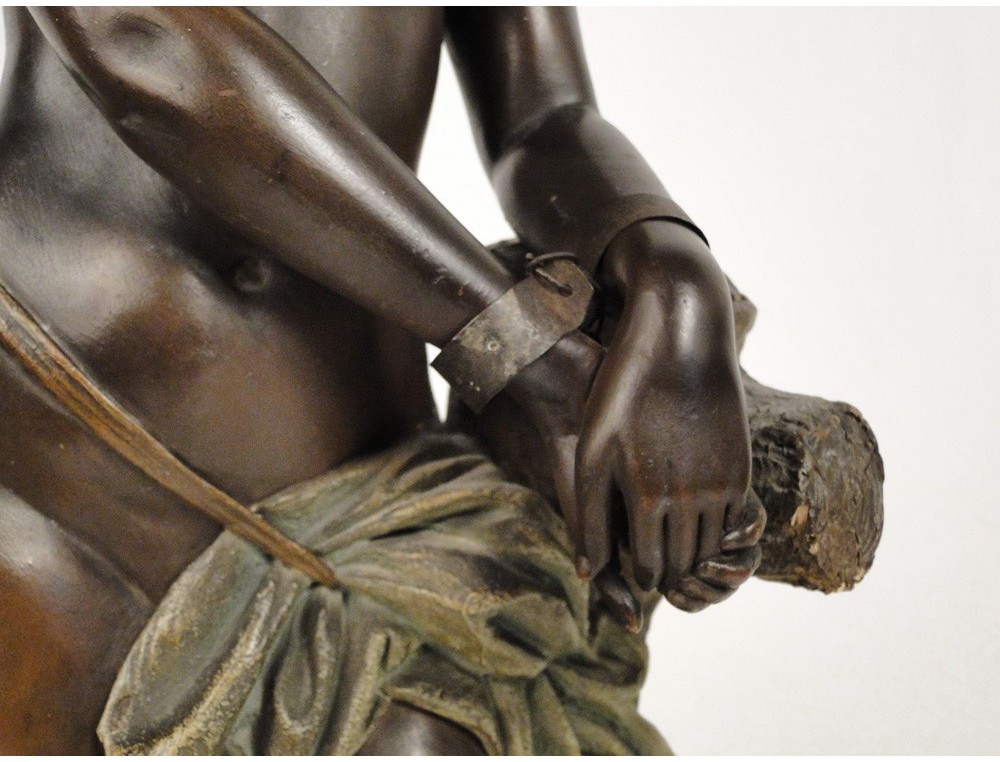
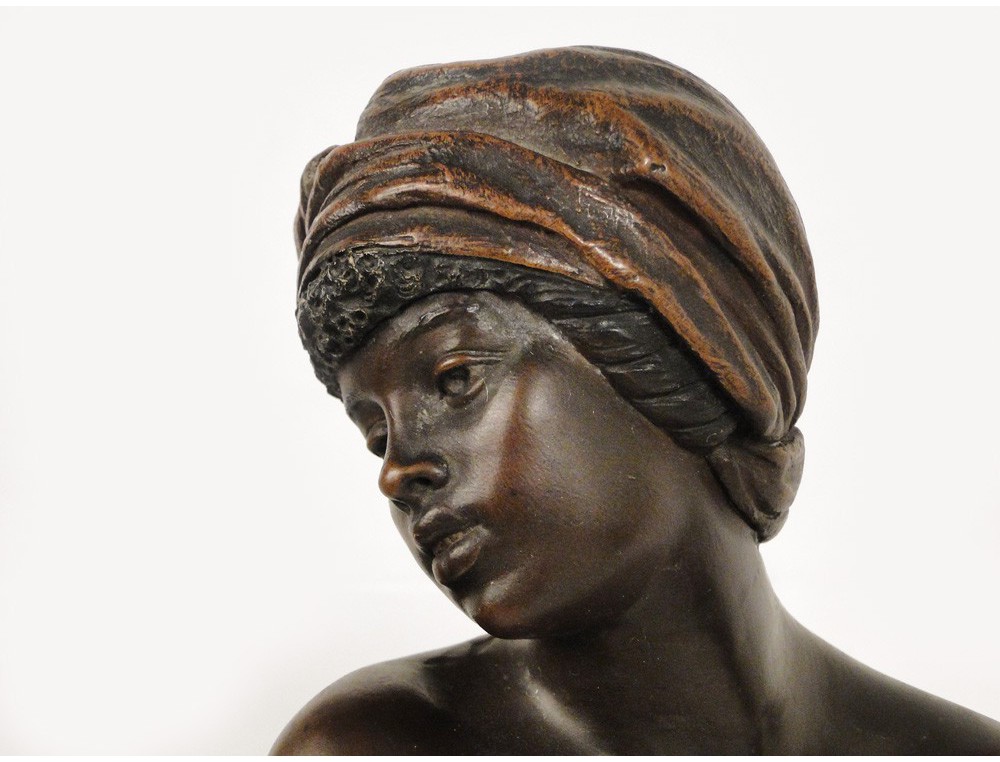
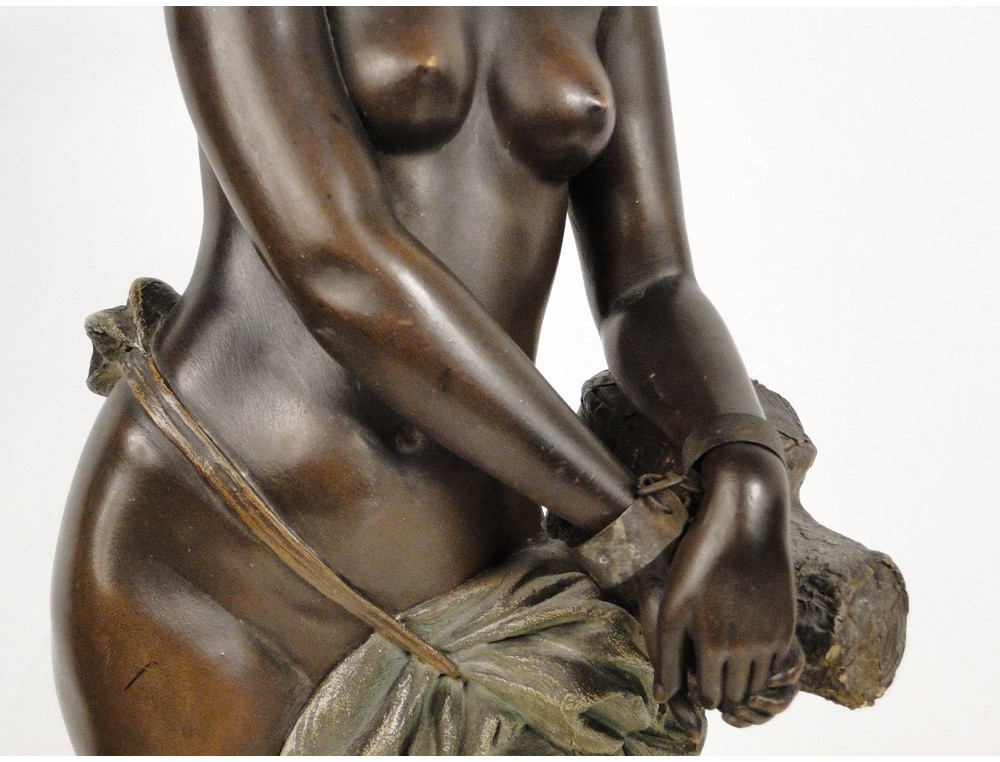
Black Slave Woman statue sculpture by 19th Goldscheider

Tickets were enormously powerful in South Carolina and elsewhere. No mere scraps of paper, passes and tickets were animated by the power of absent owners and overseers; they spoke for slave managers and acted on their behalf, directing and overseeing the movement of enslaved people. Throughout the early nineteenth-century South, the control of slave movement continued to be an issue of paramount importance. More than any other single slave activity-such as trading, learning to read, consuming alcohol, acquiring poisoning techniques, or plotting rebellions-slave movement was limited, monitored, and criminalized. Even topics such as the conditions and administration of manumission, sale, inheritance, and taxation received less attention than black mobility. Everywhere, enslaved people were barred from gathering for assemblies and from leaving their places of work for any reason. When they went, as Louisiana put it, "beyond certain limits" enslaved people were invariably required to obtain and carry written permission to do so. Lawmakers mandated that these written passes indicate the date of departure, the person's destination, and the date of his or her expected return. As the state of Georgia put it when it amended its patrol law in 1839, "written permits" must "set forth the time allowed for their [slaves'] absence, and distinctly designate the place or places where such slaves ... desire to visit." North Carolina went so far as to sketch the route that enslaved travelers were to take when it demanded that the bearers of passes "keep the most usual and accustomed road." Furthermore, legislatures defined and redefined types of runaways, outlined and revised minimum punishments for violations, drafted whites into compliance and enforcement, and occasionally devised ingenious punishments for runaways, such as putting them "in labor on the streets of said cities or towns, and on the highways and bridges adjacent," as frontier Mississippi did in 1829. Legislators also outlined procedures for capturing and returning runaways and enjoined blacks and whites alike from harboring them. Short- and long-term flight were not the only forms of movement that legislatures forbade. For instance, lawmakers commonly banned and reiterated bans on independent gatherings of bondpeople, and in some places enslaved people, except for boat and dockworkers, were strictly barred from traveling by water. In Georgia black sailors were "quarantined" after 1829 and were officially barred from setting foot on shore. Legal tinkering with pass laws slowed dramatically during the antebellum years, though it did not cease. Until the eve of the Civil War, lawmakers occasionally experimented with variations in language and content, perhaps hoping to find the right combination that would make the law's word stick. In 1856 Virginia warned whoever listened that enslaved people "found strolling" without passes would be "dealt with according to the law." Lawmakers created the state-backed principles of restraint that criminalized and enclosed slave movement, and slaveholders joined them in this work.

Closer to Freedom
Closer To Freedom: Enslaved Women And Everyday Resistance In The Plantation South, by Stephanie M. H. Camp

Geographies of Containment Antebellum slaveholders put the principles of restraint into practice in everyday life, adding to them their own plantation rules and building "geographies of containment" on their farms. Place functioned both metaphorically and literally in the Old South. Enslaved people's inferior and subjected position within the framework of antebellum southern society, their social "place," was reflected and affirmed by white control over their location in space, their literal place. Place, metaphorical and literal, came alive in the memories of slavery that some people carried with them in freedom. Only so long as "slaves stayed in deir places," Harriet Miller recalled, were they not "whipped or put in chains." As Andrew Boone said, "If you wus out widout a pass dey would shore git you. De paterollers shore looked after you. Dey would come to de house at night to see who wus dere. If you wus out of place, dey would wear you out." Slaveholders' power to define bondpeople's proper location illustrated slaveholding authority, and it did the same for the subjugation of the enslaved. By dictating bondpeople's locations, slaveholders made their plantations controlled and controlling landscapes that had a distinctly nineteenth-century cast. In the decades after the Revolution, proslavery ideology shifted subtly from the patriarchalism of the colonial period to paternalism, a form of social control more consistent with the humanitarian ideals of the age. During the colonial era, planters had not sought to convince enslaved people of the legitimacy of bondage. Before the success of the Revolution, elites had scarcely bothered to justify what seemed only natural, namely, hierarchical societies. Even if planters had desired control of the hearts and minds of African slaves, they could not have won it: language, meaning systems, and values all stood in the way. Rather than seeking to educate and convince their subordinates of the rightness of their world-as paternalist planters would do later-patriarchs sought simply to maintain their place in the social order.

New Orleans: Lawrence Powell's Accidental City

"Sunday in New Orleans, at the Market," an engraving by Alfred Waud, appears in Lawrence Powell's "The Accidental City," courtesy of The Historic New Orleans Collection

From NOLA, "Lawrence Powell packed his New Orleans history with fun facts and surprising figures," by Chris Waddington, on 15 April 2012  --  Lawrence Powell’s “The Accidental City” offers a continuous narrative of life in colonial New Orleans — and it’s also a treasure trove of interesting facts and figures. Here are some nuggets lifted from the text.

“From 1717 to 1720, Paris made deportation its official overseas policy, with Louisiana ... becoming the preferred destination. ... As many as one-fourth of the original male colonists of New Orleans were convicts, smugglers, and deserters, an estimate borne out by chronic complaints concerning the quality of early settlers.”

“New Orleans in 1791 had twice as many tavernkeepers as it did merchants. On a per-capita basis, the ratio of bars to people was off the charts ... If there was a wetter town anywhere in the Western Hemisphere, it had yet to be found.”

“Sunday was when marketing by slaves blazed to life. On Sundays, after Mass, they would spill into the public space of the Plaza d’Armas to display not only their wares but themselves. Sunday market was the time set aside for dressing to the nines, for showing off, with swagger and strut, up-to-the-moment fads in clothing and hairstyles, from turbans of many colors to rainbows of ribbons ... And almost everything had been accessorized to underscore not just vestiges of an African identity but an unvanquished individuality.”


“‘Gambling in New Orleans is reduced to a profession,’ observed an American officer during an official tour of the Louisiana territory shortly after its cession to the United States. That may explain why 54,000 packs of playing cards had been imported in 1802 into a town comprising scarcely more than 8,000 inhabitants.”

“From 1771 to 1777, the number of libres residents in New Orleans jumped from 97 to more than 300. In 1788 ... the number had leaped to 820 souls. Another seventeen years later, the free black population had almost doubled. The percentages were climbing as well: from 3 percent of the population in 1771, to 14 percent in 1788, to practically one-fifth in 1805.”  (source: NOLA)


Tuesday, December 10, 2013

The Accidental City: Improvising New Orleans

[Last+Streetcar.jpg]

From the Washington Post Book Review "'The Accidental City: Improvising New Orleans' by Lawrence N. Powell," reviewed by Jonathan Yardley, on 30 March 2012  --  “Long in the back of my mind was the thought of one day tackling a history of New Orleans,” Lawrence N. Powell writes, but Hurricane Katrina pushed him to turn possibility into reality. The calamitous storm of 2005 forced him “to think differently about the city,” offended as he was by “all those promiscuous statements about how my adopted hometown should be allowed to slide back into the primordial ooze.” People who knew little or nothing about New Orleans were asking: “Why rebuild a sinking metropolis on a site that shouldn’t have been selected in the first place?” Powell found the question “hurtful” but agreed that it “deserved a respectful answer.”

So now we have what Powell calls “a stab at an honest answer.” It is in fact a great deal more than that. Powell, who holds an endowed chair in history at Tulane University, has written in “The Accidental City” what should stand for years as the definitive history of New Orleans’s first century, the period that he regards as central to the city’s formation and its character. His study covers the time from its establishment in the famous southern crescent of the Mississippi River in the early 18th century to its sale by Napoleon to the United States, as part of the Louisiana Purchase, in 1803. Powell rounds out its century with a brief account of Andrew Jackson’s stunning victory over the British in the Battle of New Orleans in 1815, “a watershed in the young nation’s history . . . chiefly because the victory established once and for all that the United States was no longer a colony — not even in feeling, let alone in fact.”


The coming into being of New Orleans is a dramatic story but not an especially pretty one, populated as it is by rogues, scoundrels, opportunists, slavers and a vast congregation of ne’er-do-wells. Jean-Baptiste Le Moyne, Sieur de Bienville, the young French Canadian who chose the site and presided over its early development, never will enjoy the saintly status that for generations has been bestowed on the founding fathers. Bienville, though both a street and a hotel in the French Quarter are named in his honor, is a most unlikely candidate for canonization, given that the vast Le Moyne clan was deep into cronyism and nepotism, and that he “accumulated enemies the way some people collect coins.” He was canny, not unduly scrupulous, but also “an intrepid commander, a tough bureaucratic infighter, and an even more astute Indian diplomatist,” this last being especially important as peaceful relations with nearby Indian tribes were essential.

Bienville came to the French colony in the Lower Mississippi Valley as an adventurer but stayed to become its leading citizen. France wanted to wean its citizens from their addiction to English tobacco and hoped to establish tobacco as a crop in the colony. What eventually became known as the Mississippi Company was established to that end, and a search was begun for the location of its “company town.” Bienville got in on the ground floor of this operation — he was as avaricious as he was ambitious — and in time rather arbitrarily chose the site in the crescent. There were difficulties galore — the chief one being the river itself, “powerful and unstable, hard to enter at its mouth, harder still to navigate, because of its currents” — and there were other prospective sites that may or may not have been more feasible, but Bienville stood firm:

“The site was dreadful. It was prone to flooding and infested with snakes and mosquitoes. Hurricanes battered it regularly. Pestilence visited the town almost as often. But New Orleans’s situation — its strategic location near the mouth of one of history’s great arteries of commerce — was superb. Before the construction of canals and especially of railroads enabled farmers, millers, and manufacturers in the Midwest to ship their products directly to the East, the rivers floated their crops, goods, and wares to the Atlantic Coast and points beyond. . . . Geographers and historians give Bienville a lot of credit for recognizing New Orleans’s stupendous situational advantages early on, notwithstanding the swampy drawbacks of the site itself. Yet, in fact, it took almost two decades for Bienville, and the French generally, to act on his inspired foresight.”


After all the squabbling and shilly-shallying, the real difficulties got underway. The French had in mind to design a city that was “almost a textbook example of the Enlightenment mania for balance, order, and clarity,” and indeed the checkerboard grid of the original Vieux Carre, or French Quarter, is still clearly visible today. But the French did not reckon with the populace of New Orleans, from the outset “famous for ‘excessive stubbornness,’ ” not least because it included an impressive number of “convicts, smugglers, and deserters.” The orderly settlement envisioned in Paris quickly degenerated into an economy “steeped in smuggling; in fact, it thrived on contraband trade to a degree that is still underestimated.” Powell writes: “All the town’s pillars of respectability — governors, commandants, members of the Superior Council, from Bienville on down — connived at and joined in the contraband trade. . . . Simply put, smuggling was Louisiana’s lifeline, and New Orleans’s as well.”

France finally threw up its hands and in 1762 turned over the colony to Spain, a process that took years and kept the city “squirming on tenterhooks.” When the Spanish did take over, they proved in some ways more benign rulers than their predecessors — their policy on the manumission of slaves bordered on the liberal — but essentially New Orleans was impervious to governance. For a long time some slaves there were allowed to earn money on their own and to congregate voluntarily. This was an essential contribution to New Orleans’s emergence as a genuinely multi-racial city, though of course then as now discrimination, and much worse, prevailed.

The situation was further complicated by the emergence of the Creole community, direct descendants of the 18th-century settlers, some of them European in ancestry but many others of mixed race. Powell’s account of New Orleans’s racial history is extensive; he is especially good on the subject of the black militias that formed during the Spanish rule and helped strengthen the city’s community of free blacks.


Spain’s rule ended in 1802, when Napoleon “bullied Spain into secretly retroceding Louisiana to France,” but soon enough he gave up on his American possessions and sold “more than 500,000 acres . . . all or part of fifteen future states,” to the United States. With the departure of Spain and the absorption into the new republic, along with the rise in sugar production in Louisiana, came the imposition of furiously repressive new slave codes eagerly sought by the Louisiana aristocracy. As Powell puts it, “Under the aegis of republican self-rule, in short, New Orleans’s slaveholding elite had finally achieved an indivisible sovereignty over slaves — an authority they had scarcely dared dream of while subjects of the Spanish crown.”

In this as in so much else, the history of New Orleans is steeped in irony, paradox and confusion. As Powell writes about a canal that was planned but never dug in 1719: “But this was how things went in New Orleans before New Orleans officially became New Orleans, and long afterward, too: solutions to foreseeable problems usually surfaced as afterthoughts. The improvisational style was characteristic of many frontier communities. Early New Orleans raised it to an organizational principle.” It has remained one ever since.  (source: Washington Post)


'Soul by Soul: Life Inside the Antebellum Slave Market' by Walter Johnson:

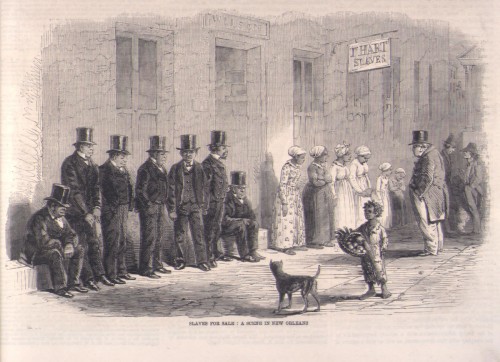
Slaves for Sale: A Scene in New Orleans (April 6, 1861)

From Salon Magazine Book Review of "'Soul by Soul: Life Inside the Antebellum Slave Market' by Walter Johnson: A historian plunges deep into the ugly business of buying and selling slaves," by Mathew Debord, on 24 February 2000  --  Compared with their European counterparts and their colleagues in literary studies, American historians are grinders, and they’re not usually showoffs. They tend to focus on the slow accumulation of documentary evidence rather than on madcap flights of speculation. So it’s surprising that Walter Johnson, an assistant professor of history at New York University, has written “Soul by Soul,” an account of life in the New Orleans slave market in the years before the Civil War that leaps from disengaged historical judgment to social and psychological conjecture about the lives of slaves and slaveholders alike.

At the center of Johnson’s book is the slave pen, a sort of jail modified for the peculiar needs of the trade and located in downtown New Orleans, surrounded by walls as high as 20 feet. Outside the pen, slaves were publicly displayed, dressed in blue suits and calico dresses in the hopes of attracting buyers. Within its confines, slavery was privately negotiated — and, according to Johnson, not merely in financial terms. Johnson’s central argument is that slavery was as much a socially and psychologically constructed institution as one that relied on overt physical bondage. “In the slave pens,” writes Johnson, “the yet-unmade history of antebellum slavery could be daily viewed in the freeze-frame view of a single transaction on its leading edge — a trader, a buyer, and slave making a bargain that would change the life of each.” Chains, in a manner of speaking, were always in the process of being imagined and reimagined, manacles broken and reattached in a three-way chattel dance among seller, master and slave.


What’s more, Johnson says, for Southern man circa 1840, slavery was much more than a way to get cotton harvested; it was a ticket to a better life, the antebellum South’s version of the NASDAQ. “Jefferson McKinney,” Johnson writes of one buyer, “had bought a slave in the hope of effecting the capitalist transformation of himself. McKinney’s was a fantasy of economic independence and bourgeois self-control.” From the slave pen flowed all those latter-day contradictions of Southern manhood — domestic virtue alternating with trips to the slave quarters to rape “fancy” black females; families bonded over homemade hooch; white boys playing Negro music — that we know well from William Faulkner, not to mention “The Dukes of Hazzard” and Lynyrd Skynyrd.

For the most part, this is an interesting and compelling argument, though it rests on the essentially unprovable notion that a social-climbing soap opera was being staged in the minds of white Southerners and their slaves. Of course, all Johnson has as evidence are documents — personal narratives, legal dockets, letters and posters advertising slaves — all of which are forced into the service of a pre-Freudian mass psychoanalysis.


Occasionally, Johnson goes over the top in turning slavery into an abstraction. In buying slaves who needed to be broken, he writes, “slaveholders boasted that their own mastery would inhabit their slaves’ every action. Their slaves would be extensions of themselves, the actions of the enslaved indistinguishable from the will of the enslavers. Slave breaking was a technology of the soul.” Slave breaking may have been a technology, but as much as it became one of the soul, it remained one of broken bodies, of an empirical difference between slaver and slave. Johnson avoids confronting the very concrete reality of slave suffering in favor of some rather fevered analogies. (“If necromancy was the slave market’s magic, race was its technology.”)


Where Johnson succeeds, ironically, is not in his desire to detail the daily dramas of the slave business but in the grander project of using the New Orleans slave market, its contents and its customers as a way to understand a culture that no longer exists. That culture produced a durable mythology of Southernness — admirably genteel but intolerantly patriarchal — and its racist heritage continues to tyrannize the post-Civil War South. For proof, one need only gaze at the Confederate battle flag fluttering atop the Capitol in Columbia, S.C. [source: Salon Magazine, Matthew DeBord is a contributing editor at Feed.]


Slave Children of New Orleans, 1863

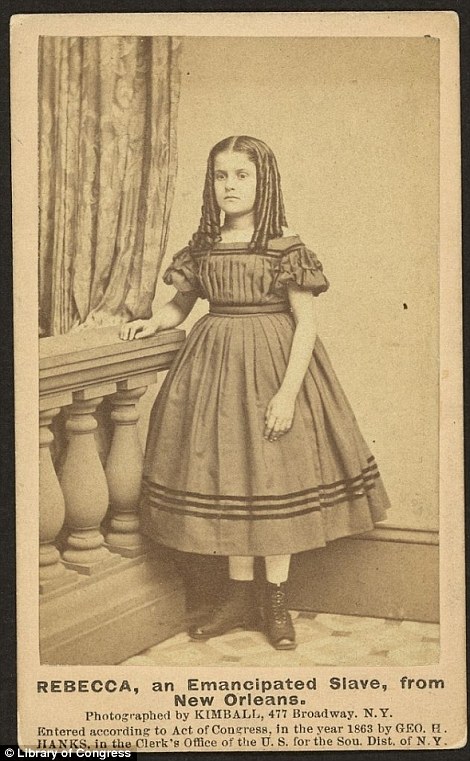
Slave Children of New Orleans, 1863: Rosa, Rebecca, Augusta.  Emancipated Slave Children from New Orleans

From the Gilder Lehrman Institute of American History at Yale University, "Slave Children of New Orleans, 1863," by Charles Paxson  --  Photographs of emancipated children were sold to raise money for the education of freed slaves in New Orleans. The children featured in this photograph drew attention to the fact that slavery was not solely a matter of color. If a child’s mother was a slave, then he or she was a slave as well.

The following article appeared in Harper’s Weekly on January 30, 1864. The short biographies contained in the article offer us a rare (and possibly unique) record of slave children.

[Transcript of the Harper’s Weekly article, January 30, 1864]  To the Editor of Harper’s Weekly:

The group of emancipated slaves whose portraits I send you were brought by Colonel Hanks and Mr. Phillip Bacon from New Orleans, where they were set free by General Butler. Mr. Bacon went to New Orleans with our army, and was for eighteen months employed as Assistant-Superintendent of Freedmen, under the care of Colonel Hanks. He established the first school in Louisiana for emancipated slaves, and these children were among his pupils. He will soon return to Louisiana to resume his labor.

Rebecca, and Emancipated Slave, from New Orleans

Rebecca Huger is eleven years old, and was a slave in her father’s house, the special attendant of a girl a little older than herself. To all appearance she is perfectly white. Her complexion, hair, and features show not the slightest trace of negro blood. In the few months during which she has been at school she has learned to read well, and writes as neatly as most children of her age. Her mother and grandmother live in New Orleans, where they support themselves comfortably by their own labor. The grandmother, an intelligent mulatto, told Mr. Bacon that she had “raised” a large family of children, but these are all that are left to her.
Rosa

Rosina Downs is not quite seven years old. She is a fair child, with blonde complexion and silky hair. Her father is in the rebel army. She has one sister as white as herself, and three brothers who are darker. Her mother, a bright mulatto, lives in New Orleans in a poor hut, and has hard work to support her family.


Charles Taylor is eight years old. His complexion is very fair, his hair light and silky. Three out of five boys in any school in New York are darker than he. Yet this white boy, with his mother, as he declares, has been twice sold as a slave. First by his father and “owner,” Alexander Wethers, of Lewis County, Virginia, to a slave-trader named Harrison, who sold them to Mr. Thornhill of New Orleans. This man fled at the approach of our army, and his slaves were liberated by General Butler. The boy is decidedly intelligent, and though he has been at school less than a year he reads and writes very well. His mother is a mulatto; she had one daughter sold into Texas before she herself left Virginia, and one son who, she supposes, is with his father in Virginia. These three children, to all appearance of unmixed white race, came to Philadelphia last December, and were taken by their protector, Mr. Bacon, to the St. Lawrence Hotel on Chestnut Street. Within a few hours, Mr. Bacon informed me, he was notified by the landlord that they must therefore be colored persons, and he kept a hotel for white people. From this hospitable establishment the children were taken to the “Continental,” where they were received without hesitation.

Wilson Chinn is about 60 years old, he was “raised” by Isaac Howard of Woodford County, Kentucky. When 21 years old he was taken down the river and sold to Volsey B. Marmillion, a sugar planter about 45 miles above New Orleans. This man was accustomed to brand his negroes, and Wilson has on his forehead the letters “V. B. M.” Of the 210 slaves on this plantation 105 left at one time and came into the Union camp. Thirty of them had been branded like cattle with a hot iron, four of them on the forehead, and the others on the breast or arm.

Augusta Boujey is nine years old. Her mother, who is almost white, was owned by her half-brother, named Solamon, who still retains two of her children.

Issac and Rosa, Slave Children of New Orleans

Mary Johnson was cook in her master’s family in New Orleans. On her left arm are scars of three cuts given to her by her mistress with a rawhide. On her back are scars of more than fifty cuts given by her master. The occasion was that one morning she was half an hour behind time in bringing up his five o’clock cup of coffee. As the Union army approached she ran away from her master, and has since been employed by Colonel Hanks as cook.

Isaac White is a black boy of eight years; but none the less intelligent than his whiter companions. He has been in school about seven months, and I venture to say that not one boy in fifty would have made as much improvement in that space of time.

Reverend Robert Whitehead, Rebecca Huger, and Rosina Downs

Robert Whitehead—the Reverend Mr. Whitehead perhaps we ought to style him, since he is a regularly-ordained preacher—was born in Baltimore. He was taken to Norfolk, Virginia, by a Dr. A. F. N. Cook, and sold for $1525; from Norfolk he was taken to New Orleans where he was bought for $1775 by a Dr. Leslie, who hired him out as house and ship painter. When he had earned and paid over that sum to his master, he suggested that a small present for himself would be quite appropriate. Dr. Leslie thought the request reasonable, and made him a donation of a whole quarter of a dollar. The reverend gentleman can read and write well, and is a very stirring speaker. Just now he belongs to the church militant, having enlisted in the United States army.

A large photograph of the whole group which you reproduce has been taken, and cartes de visite of the separate figures. They are for sale at the rooms of the National Freedman’s Relief Association, No. 1 Mercer Street, New York, or I will send them by mail on receipt of the price: $1 for the large picture, 25 cents each for the small ones. The profits to go to the support of the schools in Louisiana.  (source: Gilder Lehrman Institute of American History)

HOME

HOME
Click here to return to the US Slave Home Page