Showing posts with label lynching. Show all posts

Wednesday, April 4, 2012

Northern Lynchings: Presence of the Past in Duluth, Minnisota

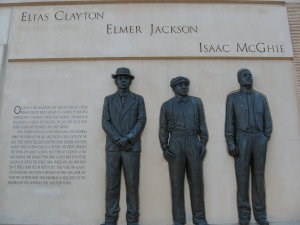
According to the Historical Marker Data Base from Duluth in Saint Louis County, Minnesota — The American Midwest (Upper Plains), "Clayton Jackson McGhie Memorial":  Elias Clayton • Elmer Jackson • Isaac McGhie

On June 15, 1920, following the alleged rape of a young woman, Duluth police locked up a number of men who worked for a travelling circus. That evening, thousands of Duluthians gathered outside the city jail. The police were under orders not to shoot, and they obeyed.


News Tribune, 1920

With timbers and rails as battering rams, the mob broke down the doors of the jail and staged a trial of six of the men. They convicted Elias Clayton, Elmer Jackson, and Isaac McGhie, who had been held as a witness. The crowd dragged the young men about a block, beat them as viciously as you may imagine, and hanged them from a light pole that stood diagonally across the street from where you are now. Some brave people spoke out in protest, but they were few against thousands. One man took a photograph that was later distributed as postcards. This memorial is dedicated to the memories of the murdered here and everywhere.

Lynch mob, Duluth, Minnesota

The graves are marked  -- An effort began to find the unmarked graves of the victims of the lynchings. Craig Grau, Sociology professor at UMD led this investigation. Park Hill cemetery had interred the bodies in unmarked graves in 1920. First Lutheran Church helped finance the marking of the graves on October 26, 1991. Vigils began to be held at the intersection where the lynching occurred in the 1990’s. In June, 2000, Heidi Bakk-Hansen published an article about the lynching in The Ripsaw, a weekly newspaper in Duluth. The Vigil held that year generated talk about getting a plaque at the site of the lynching to commemorate the 3 young men. A meeting was scheduled and over 30 people attended.

North Star - Duluth Lynchings: Presence of the Past

Wednesday, January 18, 2012

A 1916 lynching in Waco Texas


Texas State Historical Association: JESSE WASHINGTON LYNCHING. Of the 492 lynchings that occurred in Texas between 1882 and 1930, the incident that perhaps received the greatest notoriety, both statewide and nationally, was the mutilation and burning of an illiterate seventeen-year-old black farmhand named Jesse Washington by a white mob in Waco, Texas, on May 15, 1916-an event sometimes dubbed the "Waco Horror." Washington was arrested on May 8, 1916, and charged with bludgeoning to death fifty-three-year-old Lucy Fryer, the wife of a white farmer in Robinson, a small community seven miles south of Waco. After confessing that he had both raped and murdered Mrs. Fryer, Washington was transferred to the Dallas County Jail by McLennan county sheriff Samuel S. Fleming, who hoped to prevent mob action at least until the accused could have his day in court.

Washington's trial began in Waco on May 15, in the Fifty-fourth District Court, with Judge Richard I. Munroe presiding over a courtroom filled to capacity. After hearing the evidence, a jury of twelve white men deliberated for only four minutes before returning a guilty verdict against the defendant and assessing the death penalty. Before law officers could remove Washington from the courtroom, a group of white spectators surged forward and seized the convicted youth. They hurried him down the stairs at the rear of the courthouse, where a crowd of about 400 persons waited in the alley. A chain was thrown around Washington's neck, and he was dragged toward the City Hall, where another group of vigilantes had gathered to build a bonfire.

Jesse Washington's fingers were amputated for souvenirs and his fingernails taken for keepsakes. Finally all that was left was a charred torso, but Washington’s body parts were put in a bag so they could be dragged through downtown.
Upon reaching the city hall grounds, the leaders of the mob threw their victim onto a pile of dry-goods boxes under a tree and poured coal oil over his body. The chain around Washington's neck was thrown over a limb of the tree, and several men joined to jerk him into the air before lowering his body onto the pile of combustibles and igniting a fire. Two hours later several men placed the burned corpse in a cloth bag and pulled the bundle behind an automobile to Robinson, where they hung the sack from a pole in front of a blacksmith's shop for public viewing. Later that afternoon constable Les Stegall retrieved the remains and turned them over to a Waco undertaker for burial.

Though lynching violated Texas law, no members of the Waco mob were prosecuted. However, the foreman of the jury that convicted Washington criticised local law officers for failing to prevent the lynching, and a special committee of Baylor University faculty passed resolutions denouncing the mob. A black journalist, A. T. Smith, editor of the Paul Quinn Weekly, was arrested and convicted of criminal libel after he printed allegations that Lucy Fryer's husband had committed the murder. Other blacks in the Waco area condemned the Fryer killing and remained conciliatory toward the white population.

Onlookers with the Burned Body of Jesse Washington

Although the Nation, the New Republic, and the New York Times severely condemned the lynching, only a few Texas newspapers denounced the Waco mob. The Houston Post, Houston Express, Austin American, and San Antonio Express printed critical editorials, but the Dallas newspapers made few comments. The Waco Morning News expressed regret for the incident but resented the "wholesale denunciation of the South and of the people of Waco" by the national press. The most important demonstration of outrage emanated from the National Association for the Advancement of Colored People, which launched a full-scale investigation of the affair and employed the incident as a cause célèbre in the organisation's crusade for a federal antilynching bill. A photographer's pictures of the lynching strengthened the argument. Although the American entrance into World War I delayed the NAACP campaign until 1919, the "Waco Horror" remained a vivid indication that though the frequency of lynchings had begun to decline in the United States after 1900, those incidents that still occurred often were characterised by extreme barbarity. (source: Texas State Historical Association)

In the Wake of a Lynching. The remains of Jesse Washington's body after his lynching, Waco, Texas, 15 May 1916.

Oxford African American Studies Center: Waco's mayor John Dollins and chief of police Guy McNamara watched the entire proceeding from the mayor's second-floor office in City Hall, and the town's most prominent commercial photographer, Fred Gildersleeve, took pictures through the windows. Gildersleeve had been forewarned of the lynching and had set up his equipment in the mayor's office ahead of time.

When Washington was dead, his charred remains were lassoed by a man on a white horse and dragged around the city. The head fell off and small boys sold the teeth for five dollars apiece. Pieces of the chain sold for twenty-five cents. Spectators even gathered and carried off pieces of charred bone and bits of the hanging tree to be kept as souvenirs or sold to others.

Although local authorities tried immediately to hush up the event and the town's leading newspaper wrote the day after the lynching that it was “a closed incident,” the reaction of the national public was widespread and overwhelming. Waco was roundly condemned by editorials in Texas newspapers and in newspapers all over the country. The New York Times dubbed the incident “the Waco Horror.” Progressive magazines like the Nation, the Independent, and the New Republic, as well as black newspapers like the New York Age and the Chicago Defender, compared the incident at Waco unfavorably to the exploits of Mexican bandits, to the Turkish extermination of Armenians, to the excesses of the French Revolution, and to acts of brutality committed by German soldiers in Belgium at the beginning of World War I. (source: Oxford African American Studies Center)


BBC's Racism: History- A lynching in Texas in 1916

Saturday, September 10, 2011

Susan Smith White Woman Murders Her Children and Blames a Black Man

Susan Smith's mugshot

Dr. David Pilgrim writes: In 1994 Susan Smith, a young mother in Union, South Carolina, claimed that a man had commandeered her car with her two boys -- Alex, 14-month-old, and Michael, 3-year-old. She described the carjacker as a "Black male in his late 20s to early 30s, wearing a plaid shirt, jeans, and a toboggan-type hat." A composite of her description was published in newspapers, nationally and locally. Smith appeared on national television, tearfully begging for her sons to be returned safely. An entire nation wept with her, and the image of the Black brute resurfaced. The Reverend Mark Long, the pastor of the church where Smith's family attended services, said in reference to the Black suspect, "There are some people that would like to see this man's brains bashed in."
Susan Smith's fictitious black brute

After nine days of a gut-wrenching search and strained relations between local Blacks and Whites, there was finally a break in the case: Susan Smith confessed to drowning her own sons. In a two-page handwritten confession she apologized to her sons, but she did not apologize to Blacks, nationally or locally. "It was hard to be Black this week in Union," said Hester Booker, a local Black man. "The Whites acted so different. They wouldn't speak (to Blacks); they'd look at you and then reach over and lock their doors. And all because that lady lied."

Susan Smith

The false allegations of Charles Stuart and Susan Smith could have led to racial violence. In 1908, in Springfield, Illinois, Mabel Hallam, a White woman, falsely accused "a Black fiend," George Richardson, of raping her. Her accusations angered local Whites. They formed a mob, killed two Blacks chosen randomly, then burned and pillaged the local Black community. Blacks fled to avoid a mass lynching. Hallam later admitted that she lied about the rape to cover up an extramarital affair.

How many lynchings and race riots have resulted from false accusations of rape and murder leveled against so-called Black brutes? (source: Dr. David Pilgrim, Professor of Sociology, Ferris State University; Nov., 2000)

Chris Herbert Buys Gravemarker for Victim of the 1919 Omaha Race Riot

LETTER FROM CHRIS HEBERT
To the People of Omaha, Nebraska
Regarding William Brown and the riot of 1919
Chris Hebert. "I wanted to show there's still some decency left," said Chris Hebert, of Riverside, who gave $450 to buy a grave marker.
I was watching a TV show that was talking about the actor Henry Fonda. It mentioned that his life was greatly affected by a lynching that took place in Omaha, Nebraska, when he was a boy.

I guess I am just a curious person. I searched the words Henry Fonda and Lynching and found a story in Wikipedia, about William “Will” Brown.

You will never believe the impact that this had on my reading this story 90 years later.

I am a proud American. I am a person of color. An average guy who loves his wife, his family, and his country.

When I read Will Brown's story, I had tears in my eyes. We have come a long way since the riot of 1919. We witnessed this during the Presidential Election of 2008. I never thought in my lifetime that a black man would ever be president of this great country. Yet it has happened.

We all have rights guaranteed by our Constitution and legal system. We all can vote, worship at a church of our choice, work in a profession of our choosing. Sadly, this would not have come about without the Will Browns and Emmett Tills of the world.

Omaha, Nebraska lynch mob 1919

It is a shame that it took these deaths and others to raise public consciousness and effect the changes that we enjoy today. When I discovered that William Brown was buried in a pauper's grave, I did not want William Brown to be forgotten. I wanted him to have a headstone to let people know that it was because of people like him that we enjoy our freedoms today. The lesson learned from his death should be taught to all. That is, we cannot have the protections guaranteed by the Constitution without law. There is no place for vigilantism in our society.
William Brown, Omaha

The words of the Omaha World Herald after Will Brown's death said it best:

“There is the rule of the jungle in this world, and there is the rule of law. Under jungle rule no man's life is safe, no man's wife, no man's mother, sisters, children, home, liberty, rights or property. Under rule of law, protection is provided for all of these, and provided in proportion as law is efficiently and honestly administered and its power and authority respected and obeyed.
“Omaha has had an experience in lawlessness. We have seen, as in a nightmare, its awful possibilities. We have learned how frail is the barrier which divides civilization from the primal jungle — and we have been given to see clearly what that barrier is. It is the law! It is the might of the law, wisely administered. It is respect for the obedience to the law on the part of the members of society! May the lesson sink deep!” — Morning Omaha World-Herald September 30, 1919.
"Will" William Brown. Lynched in Omaha riot. September 28, 1919. Age 40. "Lest We Forget
"
I hope that people will stop by his headstone, read it, maybe say a prayer for Mr. Brown and reflect on what happened on the 28th of September 1919. We must never let ourselves sink again to this level of inhumanity.

Respectfully,
Chris Hebert

Elaine, Arkansas 1919 and the Struggle for Justice That Remade a Nation

White mob, Elaine Arkansas

Katherine Marino of the San Francisco Gate, reviews, 'On the Laps of Gods,' by Robert Whitaker, on 27 July 2008: In the summer of 1919, a wave of labor strikes, lynchings and anti-communist violence swept the nation's cities, from Omaha and Chicago to Washington, D.C. The nadir of this "red summer" occurred in Phillips County, Ark., in the small town of Elaine on the Mississippi Delta, where more than 100 black sharecroppers were brutally murdered over three days. Award-winning journalist Robert Whitaker unearths this tragedy and its legal aftermath in vivid detail in his compelling new book, "On the Laps of Gods: The Red Summer of 1919 and the Struggle for Justice that Remade a Nation."
African American sharecroppers being escorted by soldiers, Elaine Arkansas

The "Elaine Massacre" erupted when the town's black sharecroppers organized to secure a more equitable price for their cotton. To counteract the unjust debt peonage system that long victimized them, they formed the Progressive Farmers and Household Union and gathered to discuss legal counsel. Hearing that sharecropper union members were meeting for "communist" purposes in a church close to Elaine, the town sheriff and his agents arrived at the site, and opened fire on the men who stood guard. When a white man was shot, Elaine's residents retaliated fiercely, not only with gruesome mob violence, but also with machine-gun-wielding U.S. federal troops instructed to kill any black people who showed signs of resistance. In the end, five white men and almost 200 black men, women and children were dead.
Black Little Rock attorney Scipio Africanus Jones

The town indicted more than 100 black people for the murder of the white men, and the Arkansas state court sentenced 12 sharecroppers to death by electrocution. A five-year legal battle ensued, involving trials, hearings and disclosures of prisoner confessions induced by torture. The action was led by the NAACP, which sent reporter Walter White to investigate, and brilliant black Little Rock attorney Scipio Africanus Jones, who emerges as the real hero of Whitaker's story.
African America, Little Rock attorney Scipio Africanus Jones

Born a slave, Jones had "pulled himself up by his own bootstraps," becoming one of the country's most successful black lawyers. Using his professional clout to champion the equal rights of his race, he was driven by a life philosophy that fused the conflicting ideas of W.E.B. DuBois and Booker T. Washington. Jones recognized that the Elaine prisoners had not received their constitutionally guaranteed due process and protested the Arkansas state court's violation of the defendants' Fourteenth Amendment rights.


Despite the fact that the generally conservative U.S. Supreme Court had long distanced itself from state proceedings, and never before dismissed a verdict in a state criminal trial for "unfair" proceedings, Jones' last-ditch effort to file a writ of habeas corpus was, astoundingly, successful. Guided by Oliver Wendell Holmes, Moore v. Dempsey established the principle that a mob-dominated trial in a state court was invalid, and the 12 men were ultimately freed.

Elaine, Arkansas 1919

Whitaker reveals the great triumph and significance of this case by richly contextualizing its place in American legal history. He roots the massacre and its national trial into the larger story of the Supreme Court's shaping of national politics. Focusing especially on Reconstruction-era Supreme Court decisions, Whitaker demonstrates how a series of 1870s cases reduced the Fourteenth Amendment to a symbolic but largely meaningless gesture for social and civic equality, and paved the way for the state-sponsored terrorism in Arkansas. He also argues, somewhat simplistically, that the most substantial factors contributing to Reconstruction's demise were these Supreme Court cases, "after [which] the other causes of America's long decline ... lined up like dominoes," obscuring a more complex alchemy of political, economic, social and cultural forces that also importantly contributed to Reconstruction's end.
Elaine, Arkansas 1919

Nevertheless, Whitaker's book is a deeply researched and evocatively written history that deserves to be widely read. He has uncovered a long-overlooked story that challenges triumphalist narratives of U.S. democracy. "On the Laps of Gods" begs reconsideration, as well, of America's 1960s civil rights movement. Its roots, Whitaker suggests, can be found in the political activism of Elaine's organizing sharecroppers and in Jones, a visionary figure who successfully altered the course of American justice. (source: San Francisco Gate, by Katherine Marino)


On the Laps of Gods
The Red Summer of 1919 and the Struggle for Justice
That Remade a Nation

By Robert Whitaker
Tuesday, May 10, 2011

Ida B. Wells: The South's Position

Southern Horrors: Lynch Law in All Its Phases, by Ida B. Wells-Barnett

THE SOUTH'S POSITION
Ida B. Wells-Barnett

Henry W. Grady in his well-remembered speeches in New England and New York pictured the Afro-American as incapable of self-government. Through him and other leading men the cry of the South to the country has been "Hands off! Leave us to solve our problem." To the Afro-American the South says, "the white man must and will rule." There is little difference between the Antebellum South and the New South.

Marion, Indiana

Her white citizens are wedded to any method however revolting, any measure however extreme, for the subjugation of the young manhood of the race. They have cheated him out of his ballot, deprived him of civil rights or redress therefor in the civil courts, robbed him of the fruits of his labor, and are still murdering, burning and lynching him.

Tennessee National Guard troops stand between a crowd and Bedford County Courthouse in 1934.

The result is a growing disregard of human life. Lynch law has spread its insidious influence till men in New York State, Pennsylvania and on the free Western plains feel they can take the law in their own hands with impunity, especially where an Afro-American is concerned. The South is brutalized to a degree not realized by its own inhabitants, and the very foundation of government, law and order, are imperiled.

Texas

Public sentiment has had a slight "reaction" though not sufficient to stop the crusade of lawlessness and lynching. The spirit of Christianity of the great M.E. Church was aroused to the frequent and revolting crimes against a weak people, enough to pass strong condemnatory resolutions at its General Conference in Omaha last May. The spirit of justice of the grand old party asserted itself sufficiently to secure a denunciation of the wrongs, and a feeble declaration of the belief in human rights in the Republican platform at Minneapolis, June 7. Some of the great dailies and weeklies have swung into line declaring that lynch law must go. The President of the United States issued a proclamation that it be not tolerated in the territories over which he has jurisdiction. Governor Northern and Chief Justice Bleckley of Georgia have proclaimed against it. The citizens of Chattanooga, Tenn., have set a worthy example in that they not only condemn lynch law, but her public men demanded a trial for Weems, the accused rapist, and guarded him while the trial was in progress. The trial only lasted ten minutes, and Weems chose to plead guilty and accept twenty-one years sentence, than invite the certain death which awaited him outside that cordon of police if he had told the truth and shown the letters he had from the white woman in the case.

Col. A.S. Colyar, of Nashville, Tenn., is so overcome with the horrible state of affairs that he addressed the following earnest letter to the Nashville American.

Nothing since I have been a reading man has so impressed me with the decay of manhood among the people of Tennessee as the dastardly submission to the mob reign. We have reached the unprecedented low level; the awful criminal depravity of substituting the mob for the court and jury, of giving up the jail keys to the mob whenever they are demanded. We do it in the largest cities and in the country towns; we do it in midday; we do it after full, not to say formal, notice, and so thoroughly and generally is it acquiesced in that the murderers have discarded the formula of masks. They go into the town where everybody knows them, sometimes under the gaze of the governor, in the presence of the courts, in the presence of the sheriff and his deputies, in the presence of the entire police force, take out the prisoner, take his life, often with fiendish glee, and often with acts of cruelty and barbarism which impress the reader with a degeneracy rapidly approaching savage life. That the State is disgraced but faintly expresses the humiliation which has settled upon the once proud people of Tennessee. The State, in its majesty, through its organized life, for which the people pay liberally, makes but one record, but one note, and that a criminal falsehood, "was hung by persons to the jury unknown." The murder at Shelbyville is only a verification of what every intelligent man knew would come, because with a mob a rumor is as good as a proof.

These efforts brought forth apologies and a short halt, but the lynching mania was raged again through the past three months with unabated fury.

Tipton County, Tennessee Sheriff W.J. Vaughn Flashes Light on Lynching Victim Albert Gooden During Early Morning Hours of August 17, 1937

Albert Gooden was found in a drainage ditch after being lynched outside Covington, Tennessee on August 17, 1937.


The strong arm of the law must be brought to bear upon lynchers in severe punishment, but this cannot and will not be done unless a healthy public sentiment demands and sustains such action.
1915 Through the early morning hours, the lynch mob who had seized Leo Frank from Georgia State Prison in Milledgeville drove by back roads towards Marietta
.
The men and women in the South who disapprove of lynching and remain silent on the perpetration of such outrages, are particeps criminis, accomplices, accessories before and after the fact, equally guilty with the actual lawbreakers who would not persist if they did not know that neither the law nor militia would be employed against them. --Ida B. Wells-Barnett, Southern Horrors: Lynch Law in All Its Phases


(source: Southern Horrors: Lynch Law in All Its Phases, Wells-Barnett, Ida B.)

HOME

HOME
Click here to return to the US Slave Home Page