Showing posts with label American Studies. Show all posts

Saturday, October 19, 2013

The Book, "Twelve Years A Slave," By Solomon Northup

Twelve Years a Slave: Narrative of Solomon Northup, a Citizen of New-York, Kidnapped in Washington City in 1841, and Rescued in 1853 [Auburn (NY): Derby and Miller, 1853.

Summary by Patrick E. HornTwelve Years a Slave:Narrative of Solomon Northup, a Citizen of New-York, Kidnapped in Washington City in 1841, and Rescued in 1853  --   Solomon Northup was born a free man in Minerva, New York, in 1808. Little is known about his mother, whom his narrative does not identify by name. His father, Mintus, was originally enslaved to the Northup family from Rhode Island, but he was freed after the family moved to New York. As a young man, Northup helped his father with farming chores and worked as a raftsman on the waterways of upstate New York. He married Anne Hampton, a woman of mixed (black, white, and Native American) ancestry, on Christmas Day, 1829. They had three children together. During the 1830s, Northup became locally renowned as an excellent fiddle-player. In 1841, two men offered Northup generous wages to join a traveling musical show, but soon after he accepted, they drugged him and sold him into slavery. He was subsequently sold at auction in New Orleans. Northup served a number of masters—some brutally cruel and others whose humanity he praised. After years of bondage, he came into contact with an outspoken abolitionist from Canada, who sent letters to notify Northup's family of his whereabouts. An official state agent was sent to Louisiana to reclaim Northup, and he was successful through a number of coincidences. After he was freed, Northup filed kidnapping charges against the men who had defrauded him, but the lengthy trial that followed was ultimately dropped because of legal technicalities, and he received no remuneration. Little is known about Northup's life after the trial, but he is believed to have died in 1863.

Illustration
SCENE IN THE SLAVE PEN AT WASHINGTON. (44a)

Twelve Years a Slave was recorded by David Wilson, a white lawyer and legislator from New York who claimed to have presented "a faithful history of Solomon Northup's life, as [I] received it from his lips" (p. xv). Dedicated to Harriet Beecher Stowe and introduced as "another Key to Uncle Tom's Cabin," Northup's book was published in 1853, less than a year after his liberation. It sold over thirty thousand copies. It is therefore not only one of the longest North American slave narratives, but also one of the best-selling.

The first two chapters of Twelve Years a Slave relate the Northup family history, Solomon's marriage to Anne, his employment as a raftsman, a farmer, and a fiddle-player, and his abduction. Promised "one dollar for each day's services" and three dollars for every show that he played, Northup travels willingly with the two con artists to New York City and then to Washington, D.C. (p. 30). Their ruse is thorough: the men perform a vaudeville show of sorts in Albany, and they convince Northup to obtain "free papers" before leaving New York. However, once in Washington, the men offer him a drink that causes him to become "insensible," and when Northup awakens, he is "alone, in utter darkness, and in chains" (p. 38). The narrative expresses his amazement at discovering "a slave pen within the very shadow of the Capitol!" (p. 43).

Northup is sold to the notorious Washington-based slave trader James H. Burch, who brutally whips him for protesting that he is a free man. While in the slave pen, he makes the acquaintance of several other slaves, including Eliza, whose sad history he relates in detail (pp. 50-54). The slaves are handcuffed and transported together via cars and steamboats to Richmond and then to New Orleans. Their experience aboard the steamboat is a miserable one: "sea-sickness rendered the place of our confinement loathsome and disgusting" (p. 68). Northup plans a mutiny with two of his fellow slaves, but the plan is foiled when one of them contracts smallpox and dies (pp. 69-72). Northup and the rest of "Burch's gang" are delivered to Theophilus Freeman, a New Orleans slave trader who informs Northup that his new name is "Platt" (p. 75).
Illustration
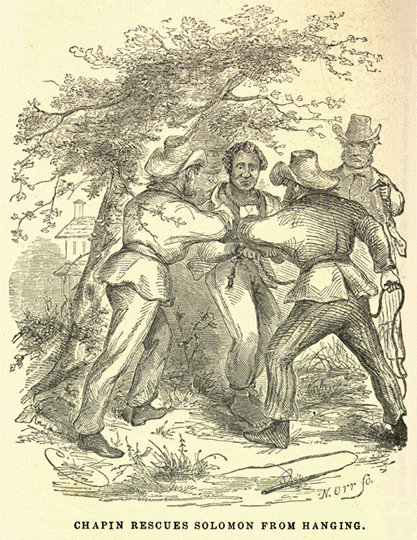
CHAPIN RESCUES SOLOMON FROM HANGING. (114a)

After surviving a bout of smallpox, Northup and Eliza are purchased by a Baptist preacher named William Ford. Touched by Eliza's pleas, Ford attempts to purchase her young daughter Emily as well, but Freeman refuses to sell her. Ford proves to be a kind master; Northup writes that "there never was a more kind, noble, candid, Christian man" (p. 90). Ford's plantation is located several hundred miles northwest of New Orleans, in the Great Pine Woods along Louisiana's Red River. Northup is put to work stacking and chopping logs at Ford's lumber mill, and he decides to reward his master's kindness. Realizing that Ford ships his lumber by land at great expense, Northup devises a set of rafts to deliver them by canal, greatly increasing Ford's profits. "I was the Fulton of Indian Creek," he recalls (p. 99). He also builds a loom for the plantation that "worked so well, I was continued in the employment of making looms" (p. 103).

Despite (or perhaps because of) his value as a laborer and de facto engineer, Northup is sold in the winter of 1842 to John Tibeats, a "quick-tempered" carpenter to whom Ford had become indebted (p. 103). Unlike Ford, Tibeats is "never satisfied," though he works his slaves "from earliest dawn until late at night" (p. 107). When Tibeats attempts to whip Northup for a dubious offense, Northup fights back, and with his foot on the master's neck, he whips Tibeats "until my right arm ached" (p. 111). When Tibeats and two associates attempt to lynch Northup, a kindly overseer (armed with pistols) intervenes and saves his life. Because he had not yet paid Ford the full amount for Northup, Tibeats is compelled to spare him for a time. Later, when he attacks Northup with a hatchet, the slave again bests the master, and this time he flees from the plantation, chased by hounds. Northup escapes by running and swimming through the "Great Pacoudrie Swamp," evading water moccasins and alligators (p. 139). He makes his way back to Ford's plantation, where he is protected from harm.

Persuaded by William Ford that killing Northup will only bring him the condemnation of his peers as well as financial loss, Tibeats hires Northup out to cut sugarcane in the "Big Cane Break" farther down the Red River. Around this time, Northup learns that Eliza has died of malnourishment and grief at the loss of her daughter (pp. 159-160). Soon afterwards, Tibeats sells Northup to Edwin Epps, a "repulsive and coarse" cotton planter whom Northup describes as being devoid of any redeeming qualities.(p. 162).
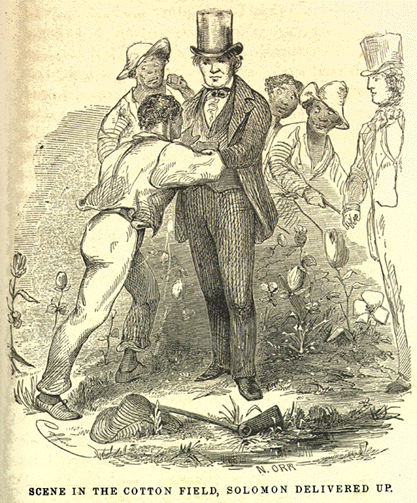
SCENE IN THE COTTON FIELD, SOLOMON DELIVERED UP (Facing page 304)

The second half of Northup's narrative is chiefly devoted to describing life on a cotton plantation. He provides detailed descriptions of the processes of planting, cultivating, and picking cotton (pp. 163-168), character sketches of his fellow slaves (pp. 185-190), and gradations of punishment for various offenses (pp. 179-180). As he was periodically hired out to sugar plantations as well, Northup describes the methods of planting, harvesting, and processing the cane in similar detail (pp. 208-213). Though his account reveals the misery and despair of field slaves, like many other slave narratives, it also reflects the wry humor with which Northup endured his situation. For example, in describing the meager rations allotted for each week's subsistence, he quips that "no slave of [Edwin Epps's] is ever likely to suffer from the gout, superinduced by excessive high living" (p. 169). Likewise, he begins his description of slave huts by stating that "the softest couches in the world are not to be found in the log mansion of the slave" (p. 170). Ironic metaphors and understatements such as these render Northup's account all the more compelling, leavening the extent of his degradation with a wry and persistent sense of humor.

Twelve Years a Slave occasionally ventures into nature writing and ethnography, as Northup describes southern flora, fauna, and culture from the perspective of a northern traveler. Narrating his relocation to work as a cane-clearer after his fights with Tibeats, Northup writes, "we were now in the midst of trees of enormous growth, whose wide-spreading branches almost shut out the light of the sun . . . The bay and the sycamore, the oak and the cypress, reach a growth unparalleled, in those fertile lowlands" (pp. 154-155). Northup seems to find the talk and behavior of Southerners equally interesting; he frequently quotes and explains colloquialisms, such as the verbs "allowed" (p. 153) and "toted" (p. 167). Remarkably, he compliments some aspects of (white) southern life: "whatever their faults may be, it is certain the inhabitants [of] the interior of Louisiana are not wanting in hospitality" (p. 159). He also repeatedly notes the abilities of female slaves in a manner that suggests a sort of proto-feminist sensibility. Northup praises the "lumberwomen" with whom he clears cane as "excellent choppers" who were "equal to any man" at piling logs (p. 156). On the cotton plantation, he observes that women plow the fields and tend their animals "precisely as do the ploughboys of the North" (p. 164). When it comes to picking cotton, Patsey is "queen of the field," for her fingers possess a "lightning-quick motion"—the very dexterity that Northup lacks (p. 188). Whether his subject is the Southern landscape or the Southerners themselves, Northup frequently writes with the bemused curiosity of an intellectual tourist.
Illustration
ARRIVAL HOME, AND FIRST MEETING WITH HIS WIFE AND CHILDREN (320)

Northup's first attempt to write a letter home—with a duck feather and ink that he produced from white maple bark—is thwarted when the white field-laborer in whom he confides exposes the plan to Edwin Epps. However, Northup had been savvy enough to request the favor without entrusting the letter, so he is able to deny the allegation and convince his master that it is spurious. Later, he meets a Canadian carpenter (and outspoken abolitionist) named Mr. Bass, who agrees to mail several letters for him. Both men realize the significance of the act: Northup notes that "my previous ill-fortune had taught me to be extremely cautious," and Bass advises him on "the great necessity of strict silence and secrecy" (p. 269, p. 271). Indeed, the letters that Bass writes for Northup inform the recipients that "he that is writing for me runs the risk of his life if detected" (p. 275). After a lengthy delay that causes Northup to despair of ever being rescued, he is found and liberated by Henry B. Northup, a member of the same white family that his father had served years before. Northup later learns the causes for the delay: first, his wife had to prove to the Governor of New York (Washington Hunt) that Solomon was a free man who had been abducted; next, Governor Hunt had appointed Henry Northup as an official state agent to rescue Solomon; Henry Northup had then negotiated with former Louisiana Senator Pierre Soulé, Supreme Court Justice Samuel Nelson, and Charles M. Conrad, U.S. Secretary of War, to provide federal support for his mission (pp. 290-292). Even after all of these careful arrangements, Henry Northup still struggled to locate Solomon, because no one in Louisiana knew him by his real name. It was only a chance encounter with the carpenter Bass that revealed Solomon's location—and that he was now called "Platt" (p. 298). With this knowledge and the help of a sympathetic sheriff, Henry Northup was able to rescue Solomon Northup. The final chapter outlines the legal proceedings that followed—in New Orleans, where the men received a legal pass to leave the state; in Charleston, South Carolina, where Henry was challenged by customs officials for not "registering" Solomon as a servant; and in Washington, where the two filed charges against Solomon's former captors (pp. 310-319). The narrative concludes with Solomon's reunion with Anne, his daughters, and a grandson whom he had never met. The child's name was Solomon Northup Staunton (p. 320). Patrick E. Horn[source: Documenting The American South]
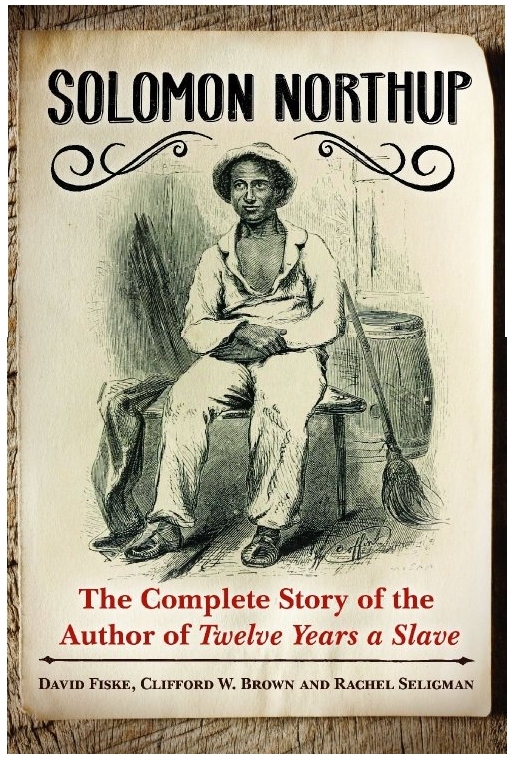
TWELVE YEARS A SLAVE by Solomon Northup -- Audiobook

Friday, April 13, 2012

African American Railroad Workers: Gandy Dancers

gandy - gandy dancer - labor - rail - railroad - railroad spikes - railroad tracks - spike - spikes - track - tracks - work - worker

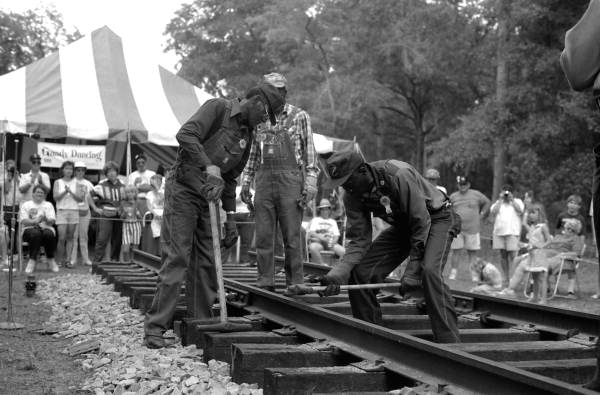
From Appalachia History, "Gandy Dancers" by Dave Tabler (7 January 2008) -- Before railroad work was completely mechanized in the 1950s, railroad calls were an everyday part of the track worker’s ritual. Most of these gandy dancers—the label applied to railway line workers who maintained railroad tracks and kept the rails straight—were African Americans who adapted the work call to railroad work. The term is said to be from the dance-like movements of the spikedriver, plus the name of Chicago-based Gandy Manufacturing Company, who supplied tracklining tools.


The physical movements of these railroad crew members were synchronized by a caller who sang the chants, ensuring safety and pacing while spiritually uplifting the men at their toil. Teams of eight to 14 men worked together to lay or care for the tracks. They had a rich repertoire of songs used for the many tasks required of them. Called lining track songs, these hollers are closely related to shanties. In the poetic words of folklorist Alan Lomax, the songs “sounded so wild and sweet that the mockingbirds in the nearby bushes stopped to listen, [as the] railroad moved into the Southern wilderness.”


Apparently women worked at track lining as well as men. There is a verse in one of the lining track songs that goes “Y’oughta been on the Brazos, 19-and-10, Buddy Russell drove the women like he drove the men.”

Gandy Dancers (railroad workers). Warren County, MS, August 1976.

Since the caller was never sure when the call had to stop, there was generally no narrative logic to the sequence of his calls. This transcribed lining track song verse, for example, recalls a biblical figure and is followed by several about present day women:

If I could I surely would,
Stand on the rock where Moses stood.
If I could (rap it, rap it!)
I surely would, Stand on the rock,
Where Moses stood.

I don’t know but I’ve been told,
Susie had a jelly roll.
I don’t know
But I’ve been told,
That Susie had,
A jelly roll.

Ida Red and Ida Blue,
got a gal named Ida too.
Oh boys over yonder (6 x)

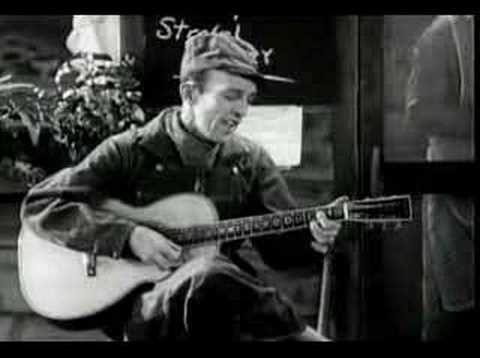
Bluegrass legend Jimmie Rodgers picked up guitar, yodeling and much of the Negro country blues style from gandy dancers.

Sometimes Aaron Rodgers took his son with him out to the tracks and put him to work bringing water to the black work crews who repaired worn ties and damaged rails, cleared brush, and shoveled gravel ballast.
Jimmie Rodgers, the father of country music

The foreman sent along a command to a “caller,” who configured this order into cadences similar to what you might hear from a drillmaster. “If you really wanted to move that track, you made a sexy call,” a former gandy dancer named Cornelius Wright told the cultural researcher Maggie Holtzberg-Call. “And they had the language for it. Some callers would talk about the lingerie that a woman wore. Now that caused the crew to really shift that track.” —”In the Country of Country:People and Places in American Music” (source: http://www.appalachianhistory.net/2008/01/gandy-dancers.html)


Thursday, March 29, 2012

Detroit's Deferred Dream

Hudson's Department Store

"A Dream Still Deferred," by Thomas J. Sugrue

AT first glance, the numbers released by the Census Bureau last week showing a precipitous drop in Detroit’s population — 25 percent over the last decade — seem to bear a silver lining: most of those leaving the city are blacks headed to the suburbs, once the refuge of mid-century white flight.

But a closer analysis of the data suggests that the story of housing discrimination that has dominated American urban life since the early 20th century is far from over. In the Detroit metropolitan area, blacks are moving into so-called secondhand suburbs: established communities with deteriorating housing stock that are falling out of favor with younger white homebuyers. If historical trends hold, these suburbs will likely shift from white to black — and soon look much like Detroit itself, with resegregated schools, dwindling tax bases and decaying public services.

National Bank of Detroit

Detroit is not the only American city to face persistent residential segregation, but it is among the worst: it has ranked among the 10 most segregated metropolitan areas in the United States since the mid-20th century (though the rate of black-white segregation there has fallen markedly in the last decade, as blacks have moved into once-exclusive white neighborhoods).

As Detroit’s black population skyrocketed during the Great Migration from the South, the city’s whites fought what they called the “Negro invasion” with every tool at their disposal. From 1945 to 1965 whites attacked at least 250 black families — usually the first or second to move into all-white neighborhoods — breaking windows, burning crosses and vandalizing homes.

Hudson's Department Store

When white Detroiters could not win by fighting, they fled to the suburbs. Indeed, for a half-century beginning in the 1950s, Detroit lost nearly half of its population, almost all whites.

Those who left the city cited various reasons: desire for a little green space, new housing, better schools, freedom from crime. Few of them acknowledged the racial motive behind white flight, that words like “freedom from crime” were code for moving away from blacks.

Thanksgiving Parade, Downtown Detroit

In fact, many believed that Detroit’s pattern of racial segregation was simply a matter of market forces. Or they attributed the whiteness of the suburbs to black racial inferiority: blacks, they said, did not have the discipline to own homes. Still others assumed that blacks didn’t move to the suburbs because they couldn’t afford it.

But those explanations were just convenient myths. Blacks and whites alike wanted to own their own homes and gardens, find better schools for their children and live on safe streets. But unlike whites, blacks did not have the freedom to move where they pleased. Detroit had many all-white suburbs with affordable housing, but qualified black homeowners could not get mortgages to move there.

Hudson's Department Store, 1976

Whites, meanwhile, benefited from enormous homeownership subsidies through the Federal Housing Administration and the Veterans Administration; blacks did not, at least until the late 1960s, when local, state and federal laws that forbade housing discrimination were passed.

The private sector played its part, too: loans and mortgages to minorities or for houses in racially mixed or black neighborhoods were deemed “actuarially unsound,” too risky an investment for lenders and builders. Even after the antidiscrimination laws of the late 1960s, real estate brokers surreptitiously maintained the color line in housing through “steering,” in which they directed whites to “white neighborhoods” and blacks to minority communities or places undergoing racial transition.

Santa waves to the children of Detroit from a platform in front of Hudson's

Nevertheless, by the 1970s the suburban dream had become a reality for a lucky few middle-class blacks from Detroit. In the post-civil rights era, their new white neighbors might greet them with cold shoulders rather than violence or vandalism. Still, when blacks moved in, whites soon moved out. Racially mixed towns stopped attracting white newcomers, especially those with school-aged children. Much to their chagrin, many new black suburbanites found that integration was just a phase between when the first blacks moved in and the last whites took their children out of the public schools.

Children's Barber Shop, Hudson's Department Store

What, then, accounts for blacks’ move to the suburbs in the last decade? Like whites, blacks have long looked for alternatives to Detroit, with its high crime, poor services and scarce job opportunities. But it was not until the economy of the entire metropolitan area slumped, thanks to the faltering auto industry and the foreclosure crisis, that black buyers finally found whites willing — desperate, in fact — to sell their suburban houses, especially in the working-class and lower-middle-class towns bordering the city.

So far, Detroit’s black suburbanization has followed a well-trodden path. Those blacks heading outward from Detroit aren’t moving to all suburbs equally. Rather, they move into places with older houses, rundown shopping districts and declining tax revenues. Such towns also typically have poorer services and fewer job opportunities than wealthier suburbs — where, despite strong antidiscrimination laws, it is still harder for blacks to find housing.

J.L. Hudson's Department Store, 1998

It’s not clear that this new migration is a positive step, even if it allows blacks to escape the city and its troubles. For whites, suburbs have often been a big step up — but as long as most blacks find themselves in secondhand suburbia, the American dream of security, prosperity and opportunity will remain harder to achieve. (http://www.nytimes.com/2011/03/27/opinion/27Sugrue.html?_r=1&pagewanted=print)


Thomas J. Sugrue, a professor of history and sociology at the University of Pennsylvania, is the author of “The Origins of the Urban Crisis: Race and Inequality in Postwar Detroit.”


Monday, March 12, 2012

Haitian Soldiers Memorialized At The Siege of Savannah Monument

Franklin SQ Monument

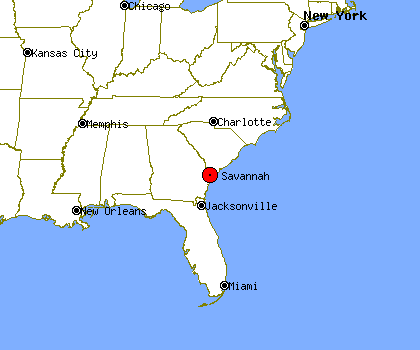
The Siege of Savannah--On Oct. 9, 1779, a Haitian regiment known as the Chasseurs Volontaires de Saint-Domingue served as a reserve unit to American and French forces fighting a British contingent. The unit was comprised of more than 500 free men of color from Haiti.

As battered American and French soldiers fell back, the Haitian troops moved in to provide a retreat. The battle resulted in the largest number of casualties the allies suffered in a single engagement.
Many of the Haitian soldiers later fought to win their country's own war of independence, crediting their military experience in Savannah. (Source: Haitian American Historical Society)


Haitians Want It Known That Haitian Heroes Aided American Revolution : Georgia: Display in museum depicts the 1779 Battle of Savannah and recalls the 'Chasseurs Volontaires'--infantry volunteers from Haiti. Placard salutes the bravest feat "ever performed by foreign troops in the American cause."(LA Times)

In the Los Angeles Times, Dan Sewell reported on 18 December 1994--SAVANNAH, Ga. — Among the Revolutionary War exhibits in this coastal city's history museum there stands a figure in 18th-Century dress, a figure much like the rest except for one major difference:

It is black.

The figure, part of displays depicting the 1779 Battle of Savannah, commemorates the "Chasseurs Volontaires"--infantry volunteers from Haiti who carried out what a placard calls "the most brilliant feat of the day, and one of the bravest ever performed by foreign troops in the American cause."


It is a rare American tribute to the heroism of Haitians who fought on U.S. soil for the independence of this nation, 215 years before U.S. troops landed in Haiti to help restore the elected president.

Little-known in this country, the battle is cited proudly by some Haitians in the aftermath of the U.S. intervention that ended three years of rule by an army junta.

"We, who stood side by side with you in the Battle of Savannah, Georgia, to fight for the independence of the United States, are happy that today you stand side by side with us to uphold democracy in Haiti," President Jean-Bertrand Aristide said in Washington shortly before his U.S.-enabled return to Haiti following three years in exile.

Most people probably didn't understand Aristide's reference, historians say.


"It's hardly known about at all," said John Kennington, a historian who works with the Coastal Heritage Society here.

For one thing, Kennington said, popular knowledge about the American Revolution usually centers around the Northeast and East--Paul Revere's midnight ride, the Battle of Bunker Hill, and the climactic fighting at Yorktown--even though it was also waged in the South.

Another reason the Battle of Savannah isn't a focal point of American histories: We lost.

A combined American-French force had laid siege to Savannah and British officers and Georgia civilian authorities were discussing surrender when reinforcements arrived from a Beaufort, S.C., garrison.

On Oct. 9, the allies launched a bloody frontal assault that was repelled. The British pursued the dazed allies, who suffered more than 1,000 dead or wounded.

But the bulk of the force lived to fight another day mainly because their retreat was covered by a rear-guard stand made by the Haitians, historians say.

About 800 Haitians, including 80 slaves who were rewarded with their freedom, had voluntarily joined the French force. Accounts of Haitian casualties vary, although most historians agree they were heavy and included at least a dozen deaths.

Haitian historians say the battle had a major impact upon Haiti's future. The Haitian volunteers returned home with battle experience and a new view of their colonial status.

"The Haitians who participated in those battles came back with an ideal; an ideal of freedom and liberty was developed," said Gerard Laurent, a Port-au-Prince historian and author of 19 books on his homeland's history.

Benjamin Franklin
Among the volunteers was teen-ager Henri Christophe, a general in the Haitian revolt that in 1804 established the Western Hemisphere's second republic and its first black-majority one.

Yet there was no sign of U.S. gratitude for the Savannah heroism, Haitian historians say. Instead, they supported the French against the Haitians and have been hostile or, at best, indifferent to their Caribbean neighbors during most of their history.

Americans continued to own slaves six decades after Haitian independence, and obviously feared any contacts that might encourage American blacks to rebel. Haiti was isolated or exploited by larger nations as it fell into the cycle of dictatorships and internal strife it was hoped would end when Aristide became its first freely elected president.

When Haitians today cite the Battle of Savannah, they may do so in a sense of long-delayed Haitian-American kinship, or in bitterness.

"Those who were in favor of the intervention say that we are finally rewarded for Savannah," said George Michel, another historian in Port-au-Prince. "Others against the intervention say: 'Look how we are being treated after we helped them with their independence.' "

At any rate, because of the latest milestone in Haitian-American relations, historians say, the Battle of Savannah may take on new significance. Laurent noted there is talk in Savannah of creating a battlefield park as an attraction for its thriving tourist industry.


"Then maybe the Americans will remember things they seem to have conveniently forgotten," Laurent said.

The Rev. Thomas Wenski, head of the Haitian Catholic Center in Miami's Little Haiti neighborhood, said such history is important for Haitian children struggling for acceptance as immigrants.

"It's something very important for Haitian kids growing up in the United States to know," Wenski said. "This is one of the ways for them to have pride in their heritage."

Savannah Swords

Wider knowledge of Savannah, Wenski suggested, would have led to a memorable landing cry in Haiti, just as World War I soldiers paid tribute to the French marquis who was a Revolutionary War hero.

"Like the Americans who said 'Lafayette, we are here!' They could have said when they landed in Haiti, 'Henri Christophe, we are here!' "

Franklin Square, City Market, Savannah, GA

Franklin Square was created in 1791 and was named in honor of Benjamin Franklin who was an agent for the Colony of Georgia from 1768 to 1775. In those days, the square was referred to as Water Tank Square, Water Tower Square and the Reservoir Square, because it was the site of the city’s water supply. The square is located at the Western End of City Market, where visitors can find distinctive shops, antiques and fabulous dining experiences. (source, Los Angeles Times, 1994)

Tuesday, October 11, 2011

Public Pools' Contentious Past: "Just Don't Touch the Water"


Excerpt: Contested Waters, "Just Don't Touch the Water"

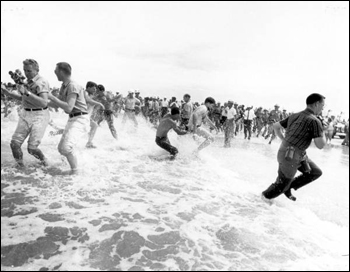
FORT LAUDERDALE July 4, 1961 a small group of other civil rights activists waded into the whites-only beach off Las Olas Boulevard. The "wade-ins" that started that day were a turning point in Fort Lauderdale history. A year later, a judge refused the city's request to stop the protests and the city decided to open the beaches to everyone.

INTRODUCTION--In 1898 Boston's mayor Josiah Quincy sent Daniel Kearns, secretary of the city's bath commission, to study Philadelphia's bathing pools. Philadelphia was the most prolific early builder of municipal pools, operating nine at the time. All but three were located in residential slums and, according to Kearns, attracted only "the lower classes or street gamins." City officials had built the austere pools during the 1880s and early 1890s—before the germ theory of disease transmission was popularly accepted—and intended them to provide baths for working-class men and women, who used them on alternating days. The facilities lacked showers, because the pools themselves were the instruments of cleaning. Armed with the relatively new knowledge of the microbe, Kearns was disturbed to see unclean boys plunging into the water: "I must say that some of the street gamins, both white and colored, that I saw, were quite as dirty as it is possible for one to conceive." While the unclean boys shocked Kearns, blacks and whites swimming together elicited no surprise. He commented extensively on the shared class status of the "street gamins" and their dirtiness but mentioned their racial diversity only in passing. Nor did racial difference seem to matter much to the swimmers, at least not in this social context. The pools were wildly popular. Each one recorded an average of 144,000 swims per summer, or about 1,500 swimmers per day.


Fifty-three years later, the scene at a municipal pool in Youngstown, Ohio, was quite different. A Little League baseball team had won the 1951 city championship and decided to celebrate at the local pool. The large facility was situated within the sylvan beauty of the city's Southside Park, not in a residential slum. The pool itself was surrounded by a broad deck and grassy lawn, both of which provided swimmers ample space to play games or lie in the sun. The pool was clearly intended to promote leisure, not cleanliness. To celebrate their baseball victory, coaches, players, parents, and siblings showed up at the pool, but not all were admitted. One player, Al Bright, was denied entrance because he was black. The lifeguards forced him to sit on the lawn outside the fence as everyone else played in the pool. The unwritten rule was clear, one guard told the coach, "Negroes are not permitted in the pool area." After an hour had passed, several parents pleaded with the guards to let Al into the pool for at least a couple of minutes. Finally, the supervisor relented; Al could "enter" the pool as long as everyone else got out and he sat inside a rubber raft. As his teammates and other bystanders looked on, a lifeguard pushed him once around the pool. "Just don't touch the water," the guard constantly reminded him, "whatever you do, don't touch the water."
Cairo, Illinois

How is it that so much had changed in those fifty years? At its heart, this book answers that question. It explains how and why municipal swimming pools in the northern United States were transformed from austere public baths—where blacks, immigrants, and native-born white laborers swam together, but men and women, rich and poor, and young and old did not—to leisure resorts, where practically everyone in the community except black Americans swam together. As the opening vignettes suggest, this social, cultural, and institutional transformation occurred during the first half of the twentieth century and involved the central developments of the period: urbanization, the erosion of Victorian culture, Progressive reform, the emergence of popular recreation, the gender integration and racial segregation of public space, and the sexualization of public culture. In short, the history of swimming pools dramatizes America's contested transition from an industrial to a modern society.

[Photographer unknown]

June, 1964. Black children integrate the swimming pool of the Monson Motel. To force them out, the owner pours acid into the water.
But the story does not end there. A second social transformation occurred at municipal swimming pools after midcentury. Black Americans challenged segregation by repeatedly seeking admission to whites-only pools and by filing lawsuits against their cities. Eventually, these social and legal protests desegregated municipal pools throughout the North, but desegregation rarely led to meaningful interracial swimming. When black Americans gained equal access to municipal pools, white swimmers generally abandoned them for private pools. Desegregation was a primary cause of the proliferation of private swimming pools that occurred after the mid-1950s. By the 1970s and 1980s, tens of millions of mostly white middle-class Americans swam in their backyards or at suburban club pools, while mostly African and Latino Americans swam at inner-city municipal pools. America's history of socially segregated swimming pools thus became its legacy.


Throughout their history, municipal pools served as stages for social conflict. Latent social tensions often erupted into violence at swimming pools because they were community meeting places, where Americans came into intimate and prolonged contact with one another. People who might otherwise come in no closer contact than passing on the street, now waited in line together, undressed next to one another, and shared the same water. The visual and physical intimacy that accompanied swimming made municipal pools intensely contested civic spaces. Americans fought over where pools should be built, who should be allowed to use them, and how they should be used.

Integrating St. Augustine's "white only" beaches. "I remember the wade-ins because the bump hasn't gone off my jaw yet. They started yelling obscenities at us, but we went on — myself and a group of teen-age girls. We were afraid but we felt we just had to go on." — Dorothy Cotton, SCLC.
This is a very different view of urban space than presented by historians John Kasson, Kathy Peiss, and David Nasaw. They characterize commercial amusements at the turn of the twentieth century—such as Coney Island, dance halls, and movie houses—as social melting pots that rather painlessly dissolved earlier class and gender divisions but reinforced racial distinctions. According to Nasaw, "'going out' meant laughing, dancing, cheering, and weeping with strangers with whom one might—or might not—have anything in common. . . . Only persons of color were excluded or segregated from the audience." Kasson makes essentially the same point when he concludes that commercial amusements "help[ed] to knit a heterogeneous audience into a cohesive whole."
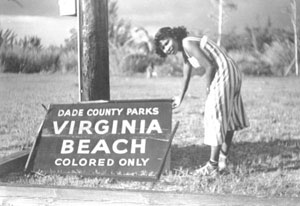
Woman by sign blown down during hurricane: Virginia Beach, Florida (1950)

Woman by sign blown down during hurricane: Virginia Beach, Florida (1950). Virginia Beach is off the coast of Miami in Dade County.

Just the opposite was true at swimming pools early in the twentieth century. Northerners' use of municipal pools throughout the Progressive Era reinforced class and gender divisions but not racial distinctions. Cities strictly segregated pools along gender lines, and people from different social classes almost never swam together. In many cases, middle-class northerners fought vigorously to ensure that working-class swimmers did not intrude upon their recreation spaces. By contrast, blacks and working-class whites commonly swam together, often without conflict.

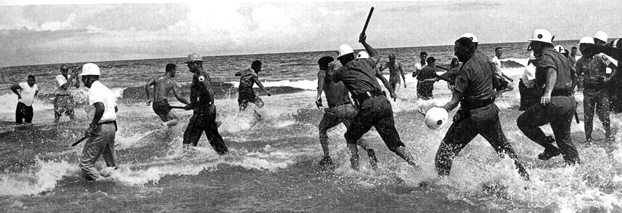
Segregationists trying to prevent blacks from swimming at a "White only" beach (June 25, 1964)

All this changed during the 1920s, when northerners redrew the lines of social division at municipal pools. Different social classes of whites and both sexes plunged into the same pools and simultaneously excluded black Americans. This social reconstruction had many causes. The Great Black Migration contributed to the onset of racial segregation at pools by intensifying residential segregation in northern cities and heightening perceptions of black- white racial difference. Conversely, economic prosperity and the decline in European immigration mitigated perceptions of class and ethnic difference. Middle-class northerners generally became willing to swim in the same pools with working-class whites because they did not seem as poor, foreign, or unhealthy as before. Also, municipal pools became more appealing to the middle class during the 1920s because cities redesigned them as leisure resorts and typically located them in open and accessible parks rather than residential slums. At the same time, municipal officials began permitting males and females to swim together because they intended the new resort pools to promote family and community sociability. The concerns about intimacy and sexuality that had necessitated gender segregation previously did not disappear during the 1920s; rather, they were redirected at black Americans in particular. Whites in many cases quite literally beat blacks out of the water at gender-integrated pools because they would not permit black men to interact with white women at such intimate public spaces. Thus, municipal pools in the North continued to be intensely contested after 1920, but the lines of social division shifted from class and gender to race.
Historians have largely ignored this racial contest over public space in northern cities after 1920, focusing instead on housing, work discrimination, and schools. John McGreevy, for example, recently concluded that "racial violence in the North centered on housing and not, for the most part, on access to public space." This book tells a different story. The imposition of racial segregation at municipal pools was a violent and contested process in the North. Blacks and whites battled one another with their fists as well as with bats, rocks, and knives. Racial segregation succeeded not because black Americans acquiesced, but because white swimmers steadfastly attacked black swimmers who entered pools earmarked for whites and because public institutions—namely the police and courts—enforced the prejudice of the majority rather than the rights of minority.
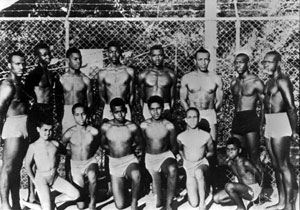
Tallahassee, Florida: Swim team at Robinson Trueblood Swimming Pool on Dade Street was built by the city in response to wade-ins by blacks at all white pools. It was the only pool where blacks could swim and train as lifeguards.

The social reconstruction of municipal pools between 1920 and 1940 marked a fundamental shift in northern social values and patterns of social interaction. During the Gilded Age and Progressive Era, the difference between people with "black" skin and those with "white" skin was a less significant social distinction than class. Furthermore, what we now think of as "race" was a less significant public social division than gender, class, and even generation. That changed during the 1920s, when race emerged as the most salient and divisive social distinction. Northern cities became fundamentally more integrated along class, gender, and generational lines, yet more segregated along racial lines. This racial division persisted throughout the rest of the twentieth century, despite court-ordered desegregation and the civil rights movement.

Savannah, Georgia Beach July 15, 1963: Two Negroes were arrested by local police and jeered and cursed by white people on the beach for swimming in the whites only water.

Northerners also contested public culture at municipal pools. During the late nineteenth century, working-class boys battled with Victorian public officials to determine the use and function of these new institutions. Public officials intended municipal pools to be used "seriously" as baths and fitness facilities. They were supposed to instill the working classes with middle-class values and habits of life. In defiance of these expectations, working-class boys transplanted their boisterous and pleasure-centered swimming culture from natural waters and defined municipal pools as public amusements. In doing so, they undermined Victorian public culture and helped popularize the pleasure-centered ethos that came to define modern American culture. During the 1920s and 1930s, swimmers refashioned attitudes about the body and cultural standards of public decency by what they wore and how they presented themselves at municipal pools. City officials attempted to dampen the sexual charge sparked by mixed-gender use and to limit exhibitionism and voyeurism by mandating conservative swimsuits. They could not, however, control popular demand. The acceptable size of swimsuits shrank during the interwar years and pools became eroticized public spaces. As a result, public objectification of the body became implicitly acceptable, and public decency came to mean exhibiting an attractive appearance rather than protecting one's modesty. The female nakedness and overt sexuality that pervade contemporary American culture originated, in part, at swimming pools. In these ways, ordinary Americans reshaped public culture by what they did and what they wore at municipal pools.
Civil Rights Series, Demonstrations at an "all-white" swimming pool in Cairo, Illinois, 1962
Municipal swimming pools were extraordinarily popular during the 1920s, 1930s, and 1940s. Cities throughout the country built thousands of pools—many of them larger than football fields—and adorned them with sand beaches, concrete decks, and grassy lawns. Tens of millions of Americans flocked to these public resorts to swim, sunbathe, and socialize. In 1933 an extensive survey of Americans' leisure-time activities conducted by the National Recreation Association found that as many people swam frequently as went to the movies frequently. In other words, swimming was as much a part of Americans' lives as was going to the movies. Furthermore, Americans attached considerable cultural significance to swimming pools during this period. Pools became emblems of a new, distinctly modern version of the good life that valued leisure, pleasure, and beauty. They were, in short, an integral part of the kind of life Americans wanted to live.

This story of tens of millions of Americans flocking to municipal pools, reshaping cultural standards, and redefining the meaning of the good life presents a very different view of modern American culture than offered by most historians. William Leach, Gary Cross, and Richard Fox and T. J. Jackson Lears are unanimous in arguing that consumption and commercialism became the dominant cultural ethos in twentieth-century America, effectively wiping out all competing public cultures. In their introduction to The Culture of Consumption, Fox and Lears claim that "consumption became a cultural ideal, a hegemonic 'way of seeing' in twentieth-century America." Additionally, many cultural historians characterize Americans as passive receivers of this consumer culture supposedly created and popularized by marketers, movie producers, merchants, and entrepreneurs. As William Leach argues in Land of Desire, "the culture of consumer capitalism may have been among the most non-consensual public cultures ever created . . . it was not produced by 'the people' but by commercial groups in association with other elites." This was not the case at municipal swimming pools, where ordinary Americans helped create a vibrant public culture not primarily focused on spending money and consuming goods.
1964 Racial Confrontation on St. Augustine Beach. A confrontation of black demonstrators and white segregationists at a white-only beach in St. Augustine. (Photo: Florida State Archives)
Finally, the history of swimming pools reveals changes in the quality of community life and the extent of civic engagement in modern America. From the 1920s to the 1950s, municipal pools served as centers of community life and arenas for public discourse. Hundreds and sometimes thousands of people gathered at these public spaces where the contact was sustained and interactive. Neighbors played, chatted, and flirted with one another, but they also fought with one another over who should and should not be allowed to swim and what sorts of activities and clothing were appropriate for this intimate public space. In short, community life was fostered, monitored, and disputed at municipal pools. The proliferation of private swimming pools after the mid-1950s, however, represented a retreat from public life. Millions of Americans abandoned public pools precisely because they preferred to pursue their recreational activities within smaller and more socially selective communities. Instead of swimming, socializing, and fighting with a diverse group of people at municipal pools, private-pool owners fenced themselves into their own backyards. The consequences have been, to a certain extent, atomized recreation and diminished public discourse.

This study focuses on the history of municipal swimming pools in the northern United States. I chose to focus on municipal pools because they enabled me to study the public lives of Americans from many different — and often overlapping—social groups: working-class whites, women, African Americans, immigrants, children, and the middle class. At one time or another, Americans from all these social groups frequented municipal pools and contested their use. This book also examines and interprets the history of private swimming pools, but mostly when that history is necessary for understanding what occurred at municipal pools. I chose to focus on the northern United States in order to make the research more manageable, and because I wanted to tell a coherent story rather than interpret regional variation. I have, however, defined the northern United States broadly, including cities such as Baltimore, Washington, D.C., and St. Louis. These cities certainly have a southern heritage, but the history of their municipal pools followed a very similar pattern to that of cities further north. Likewise, the pattern occurred not only in large cities but in smaller municipalities as well. It turns out that what happened at municipal pools, whether in St. Louis and Chicago or in Newton, Kansas, and Elizabeth, New Jersey, was all quite similar.

[From Contested Waters: A Social History of Swimming Pools in America by Jeff Wiltse. Copyright (c) 2007 by the University of North Carolina Press.]

Thursday, June 23, 2011

This Land Is Your Land: Woodie Guthrie

"Woody Guthrie: Natural born anti-fascist," by Stetson Kennedy
“Do you have any evidence of Woody having ever committed any disloyal act?” my lawyer/friend/neighbour asked the two FBI agents who had dropped into his office to ask if it were true that “one Woodrow Wilson Guthrie” was staying at my home on the outskirts of Jacksonville, Florida.

“Well, there’s this,” one of them replied, fishing from his briefcase an 8x10 photograph of Woody holding his guitar with the inscription writ large across its face, THIS MACHINE KILLS FASCISTS!

It did, too. From the very first moment that fascism reared its head on the world scene - first in Mussolini’s Italy, then aped in Hitler’s Nazi Germany, and then imposed by the two of them in Franco’s Falangist Spain - Woody was singing his heart out against it. And long after the Axis defeat in 1945, Woody remained a militant anti-fascist until he drew his last breath on 3 October 1967.
That figures, because fascism was the mortal enemy of everything Woody believed in - people, unions, democracy, human rights, justice, peace, world brotherhood, you name it.

So Woody didn’t have to wait until Mussolini gloated, “We fascists have ridden roughshod over the putrid corpse of parliamentary democracy, and will do so again if need be!” or for Il Duce’s son-in-law Count Ciano to report how “troops of Ethiopian horsemen blossomed like roses when bombed from the air”. Or for Hitler to spell out in Mein Kampf his master plan for 1,000 years of world dominion, and a “final solution for European Jewry”. Or the Axis-backed fascist overthrow of the republican government of Spain. Much less the tardy US declaration of war against the Axis.

Fact is, a lot of us cut our political wisdom teeth on the works of those British socialists, Sidney and Beatrice Webb, who ended one of their 1930s books with the question, “What are we to do?” and answered “Build the Popular Front against fascism!”

Like the book Hard-Hitting Songs for Hard-Hit People, which Woody put together with folk musicologist Alan Lomax in 1941, Woody’s life work consisted of making up and singing songs to strengthen the arm of the poor, and especially their unions, in their struggle to shake off the shackles of the rich. Since the function of fascism was the exact opposite, Woody was what you might call a natural-born anti-fascist.

But he said it - and sang it - best. During World War II the US Office of War Information hired him to write some “morale-building songs”, but his were so explicitly anti-fascist not one was ever released. (The War Department did put out a four-page booklet to tell servicemen what fascism was all about, but Congress made them recall it. Hasn’t been seen since.)

“There ain’t but two sides, the working people’s side and the big bosses’ side,” Woody wrote. “The union side and the Hitler side. The first thing that Hitler cracked down on when he took the Nazi Chamber was the Trade Unions. And it will be the Trade Unions that beat Hitler. The best job you can do for your country, next to being a good soldier for the working people.

“You don’t have to go to Europe to find plenty to do to beat Hitler, stick up for what’s right, freedom of speech, press, radio, meetings, collective bargaining, the right to get together for decent pay, hours, rent, prices … The biggest thing that’s happening right now in the United States is us.”

That was the stuff Woody’s songs were made of. He didn’t mind others singing about love and such, but as far as he was concerned, “A song that don’t say somethin ain’t worth nothin”. Of course, what his were worth, and what they fetched, were two very different things. I remember getting many a mimeographed, self-illustrated copy in the mail, scrawled over in Woody’s hand, “Here is my latest song. Hope you like it. If so, please send 25c.”

It was much the same when it came to collecting even the $25 honorarium Woody generally got for singing on stage.

“But it’s for a Good Cause!” protested one sponsor who wanted him to sing for free.

“I don’t sing for bad causes,” was Woody’s rejoinder.

Woody was never the armchair anti-fascist, mind you. When he received a wartime telegram saying “Got a dish-washing job on a Liberty Ship,” he jotted in his Notebook:

Woman a-cryin
and me a-flyin
out the door
and down the line!

According to his sidekick Cisco Houston, when one of those ships carrying material to Britain and the Soviets was torpedoed (despite Woody’s prayers against “tin-fish”) he grabbed his guitar and kept playing, in the heroic tradition of dance bands when fire breaks out in the ballroom.

And when a sister ship went down with all hands on board, Woody sang (as if in anticipation of all the names engraved on the Vietnam Memorial wall in Washington):

Tell me, what were their names, boys,
what wurrr their names?
Did you have a friend
On that good Reuben James?

Woody was rightfully proud of his membership in the National Maritime Union and kept paing his dues long after he came ashore.
Like all true folk philosophers he could say a lot in a few words, for example, “If we would just take the profit out of war, there wouldn’t be any”.

In a 4 March 1942 entry in his Notebook for a letter to his unborn son, Woody had this to say:

“Maybe I should talk to you about fascism. It is a big word and it hides in some pretty little places. It is nothing in the world but greed for profit and greed for the power to hurt and make slaves out of the people… But fascism can no more control the world than a bunch of pool hall gamblers and thugs can control America. Because all of the laws of man working in nature and history and evolution say for all human beings to come always closer and closer together…

“How come me launching into a talk about fascism to you - only 4 months on the way - not even here yet? Because in the whole big world… fascism and freedom are the only two sides battling… every other shades into the fight somewhere, I’m not worried about where you’ll be standing - but - how could I ever get this book wrote full unless some of it was cussing out facism?

Like Tom Joad said to his dying mother in Steinbeck’s Grapes of Wrath, “wherever working people are fighting for their rights, I’ll be there”. That was Woody, all the way…

We were all very confident back then - as Pete Seeger has never tired of singing - that there was “a better way on the way”. Woody often put it in terms of a great day coming in which we (the human race) would all be members of “One Big Union”.

One of the most everlasting of Woody’s countless contributions is his song, This Land Is Your Land, which has virtually replaced America (that rewrite of God Save the King) as the US national anthem. Its refrain:

This Land is your land,
This land is my land,
This land belongs to you and me…

This song has taken root in the heart of Americans of all ages - all the title deeds to the contrary not withstanding. That Woody was not unaware of this complication was evidenced by his gentle yet firm revolutionary admonition for us to “take it easy, but take it!”

That Woody’s prenatal exhortations against fascism did not fall on deaf ears is attested by Arlo Guthrie’s singing career. That word fascism may still be understood on the eastern side of the Atlantic, where it wreaked the most havoc, but it is still almost unheard of in the USA today. (Recently when a student-made transcript of an interview with me came back from the oral history archive at the University of Florida, it read, “Following the faddist invasion of Spain…”)

During the 1950s, when McCarthyite witch-hunting was at its peak, Alan Lomax was in London and I was in Budapest, and we both begged Woody to pack up his guitar and songbag and come to Europe. He never made it in the flesh, but as a legendary folk hero Woody Guthrie lives on in people’s struggles around the world.

Just for fun, before concluding let me speak to two apolitical components of the Legend of Woody Guthrie: that he slept with his boots on, and ate standing up. The former was often true, and I have concluded that the habit was acquired during his hoboing years, when one needed to be ready to run when aroused by a railroad cop. And he did on occasion rise from a dining table and take his plate to a shelf or mantlepiece. His own explanation: there were no tables in a hobo jungle, nor around the chuck wagons of the Dust Bowl refugees.


But the Legacy of Woody Guthrie, which will always stand mankind in good stead, is the necessity for solidarity in throwing off the yoke of oppressors, and building a better world of peace and justice.

One of my fondest memories of Woody is May Day 1947, when we marched together in the writers’ contingent of the parade of progressives in New York City. When we reached Union Square, Woody climbed up on a ledge protruding from a bank, the better to hear the speakers. A cop spotting him from the other side of the square came charging with his billystick and bellowing, “Get offa that bank!”

Woody climbed down with the utmost dignity, saying, “Very well officer, but a little courtesy please. Don’t forget I help pay your salary.”

Afterwards when the two of us were driving to upstate New York for some meeting, when Woody’s time came at the mike he plucked at his scalp (as he often did, as if for lice) and told the audience:

“On the way up here listening to the car radio we heard the announcer talking about what a fine May Day parade the Mayor and all the Big Shots and American Legion had down Fifth Avenue, and how all of us Lefties ‘got lost in the shuffle over on Eighth Avenue’ … The way I see it, that’s what we’ve gotta do - keep shufflin’ …” (source: Searchlight)

HOME

HOME
Click here to return to the US Slave Home Page