Showing posts with label race riots. Show all posts

Friday, March 30, 2012

Wartime Riots: Detroit, 1943

A flaming car sets fire to a streetcar station on Woodward in the early hours of the riot. The mob can be seen behind the streetcars.

"The 1943 Detroit race riots," by Vivian M. Baulch and Patricia Zacharias of the Detroit News on February 11, 1999:  Recruiters toured the South convincing whites and blacks to head north with promises of high wages in the new war factories. They arrived in such numbers that it was impossible to house them all.

Blacks who believed they were heading to a promised land found a northern bigotry every bit as pervasive and virulent as what they thought they had left behind in the deep south. And southern whites brought their own traditional prejudices with them as both races migrated northward.


The influx of newcomers strained not only housing, but transportation, education and recreational facilities as well. Wartime residents of Detroit endured long lines everywhere, at bus stops, grocery stores, and even at newsstands where they hoped for the chance to be first answering classified ads offering rooms for rent. Even though the city enjoyed full employment, it suffered the many discomforts of wartime rationing. Child-care programs were nonexistent, with grandma the only hope -- provided she wasn't already working at a defense plant.

An injured driver from Busy Bee Moving Company is detained by police after he attempted to drive through a picket line of angry white neighbors near the Sojourner Housing Project.


The prevailing 48-hour work week put lots of money into defense workers pockets, but there were few places to spend it and little to spend it on. Food and housing were either rationed or unavailable. Detroit's nickname was the "Arsenal of Democracy" but stressed-out residents often referred to it as the "arsehole" of democracy. Workers disgruntled by the long commute out to the Willow Run plane factory dubbed that operation "Will it Run."

Police try to disburse a crowd of blacks at Sojourner Truth Housing Project Feb. 28, 1942.

Times were tough for all, but for the Negro community, times were even tougher.


Blacks were excluded from all public housing except the Brewster projects. Many lived in homes without indoor plumbing, yet they paid rent two to three times higher than families in white districts. Blacks were also confronted with a segregated military, discrimination in public accommodations, and unfair treatment by police.

The summer of 1941 saw an epidemic of street corner fights involving blacks and Polish youths who were terrorizing black neighborhoods in Detroit and Hamtramck.

Early in June 1943, 25,000 Packard plant workers, who produced engines for bombers and PT boats, stopped work in protest of the promotion of three blacks. A handful of agitators whipped up animosity against the promotions. During the strike a voice outside the plant reportedly shouted, "I'd rather see Hitler and Hirohito win than work beside a nigger on the assembly line."
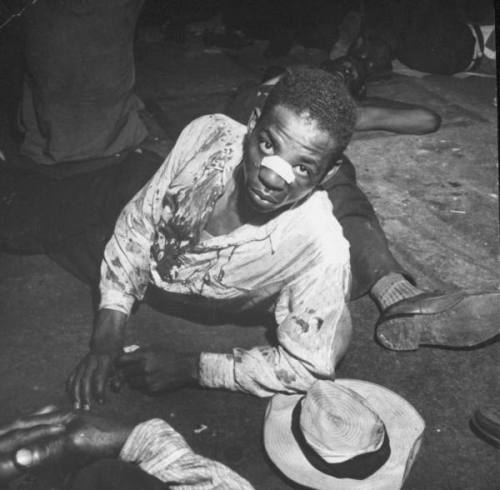

Whites resentful over working next to blacks caused many stoppages and slowdowns. Harold Zeck, a former Packard defense worker, recalls the time when a group of women engine workers tried to get the men on the assembly line to walk off the job to protest black female workers using the white restrooms. "They think their fannies are as good as ours," screamed one woman. The protest fizzled when the men refused to walk out.

An armed black homeowner protects his property and family from roving crowds near the Sojourner neighborhood.


Unions did their best to keep production figures up and to keep the lid on confrontations, even though the Ku Klux Klan and the feared Black Legion were highly organized and visible in the plants.


Overcrowded housing combined with government rent control further aggravated racial problems in the city. Once spacious flats were divided and then subdivided into tiny rooms to rent. Many living under these oppressive conditions relied on hopes for the future to get them through the long tiring days.

Even before the attack on Pearl Harbor, the federal government was concerned about providing housing for the workers who were beginning to pour into the area. On June 4, 1941, the Detroit Housing Commission approved two sites for defense housing projects--one for whites, one for blacks. The site originally selected by the commission for black workers was in a predominantly black area. But the federal government chose a site at Nevada and Fenelon streets, a white neighborhood.

The Rev. Horace White, the only black member of the Housing Commission, stated, "As much as I disagree with the site selection, the housing shortage in Detroit is so acute, particularly among Negroes, that I feel we should cooperate."


Detroit police arrest a group of blacks when one was found to be carrying a knife during the Febuary 1942 disturbances.

On Sept. 29, the project was named Sojourner Truth, in memory of the female Negro leader and poet of Civil War days. Despite being completed on Dec. 15, no tenants moved into the homes because of mounting opposition from the white neighborhood.

On Jan. 20, 1942, Washington informed the Housing Commission that the Sojourner Truth project would be for whites and another site would be selected for black workers. But when a suitable site for blacks could not be found, Washington housing authorities agreed to allow blacks into the finished homes.

On Feb. 27, with a cross burning in a field near the homes, 150 angry whites picketed the project vowing to keep out any black homeowners. By dawn the following day, the crowd had grown to 1,200, many of whom were armed.

The first black tenants, rent paid and leases signed, arrived at 9 a.m. but left the area fearing trouble. It wasn't long in coming. Fighting began when two blacks in a car attempted to run through the picket line. Clashes between white and black groups continued into the afternoon when 16 mounted police attempted to break up the fighting. Tear gas and shotgun shell were flying through the air. Officials announced an indefinite postponement of the move.

Detroit newspapers, union leaders, and many other whites campaigned for the government to allow the black workers to move into the homes. The families, having given up whatever shelter they had in anticipation of their new homes, were left with no place to go and were temporarily housed with other families in the Brewster Homes and other sites.


Finally, despite the simmering resentment, black families moved into the project at the end of April. Detroit Mayor Edward Jeffries ordered Detroit police and state troops to keep the peace during the move.

Walter Jackson, a 35-year-old defense worker, his wife and five children were the first to move in. "We are here now and let the bad luck happen," said Jackson. "I have only got one time to die and I'd just as soon die here."

Jackson, a short, wiry 130-pound former UAW-CIO shop steward, had taken an active part in the auto sit-down strikes of 1937.
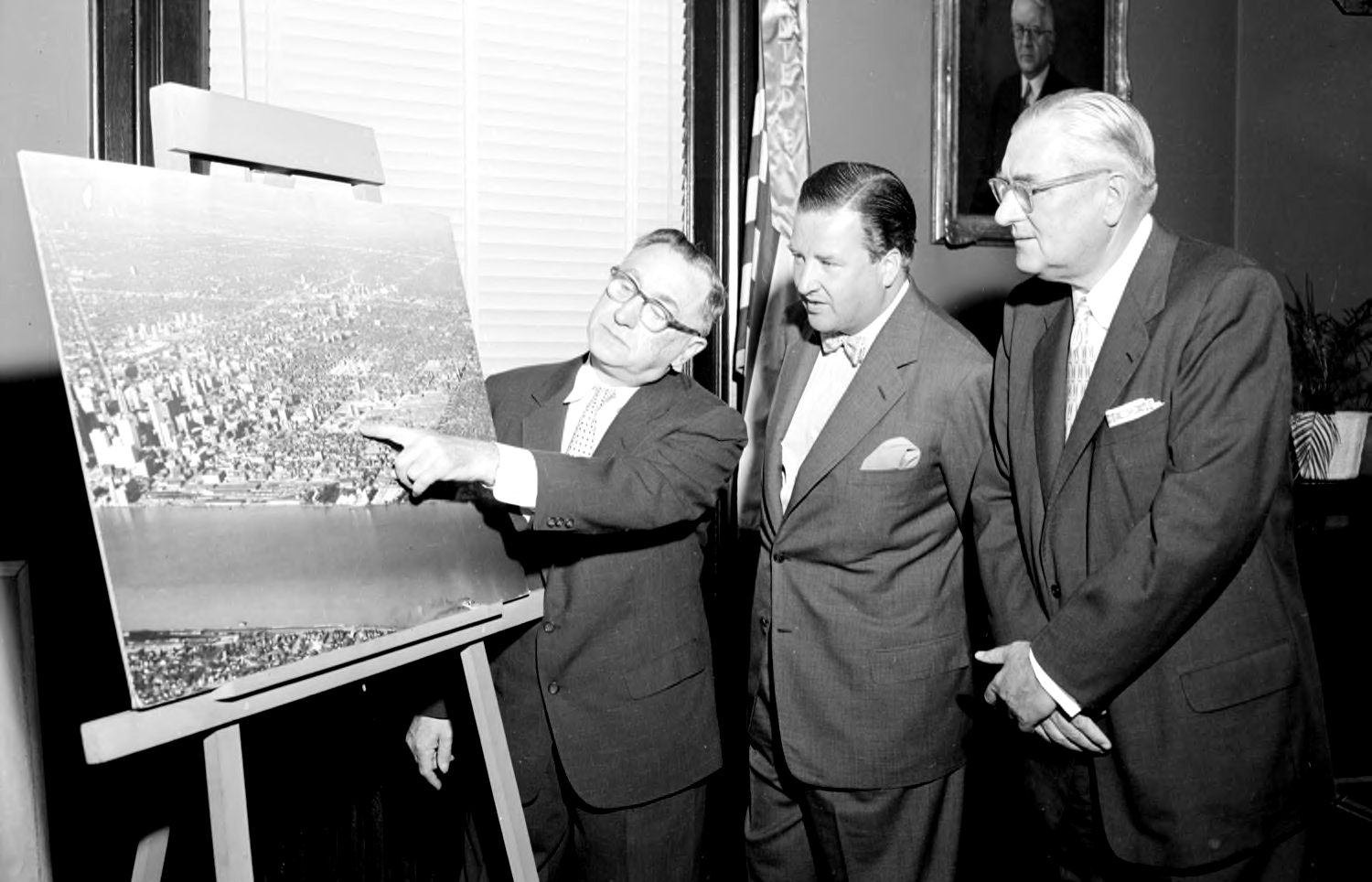
Detroit Mayor Edward Jeffries

White neighbors on the project's eastern boundary quizzed each passing white: "Which side are you on?" A score of white women, some pushing baby carriages, waved American flags and paraded briefly along Conley Avenue north of the project. They booed when the Rev. White appeared to show support for the new neighbors.

Although the Sojourner Truth riots resulted in no fatalities, the trouble was a warning of what was to come.

By 1943 the number of blacks in Detroit had doubled since 1933 to 200,000 and racial tensions in the city grew accordingly. To protest unfair conditions, some blacks began a "bumping campaign" -- walking into whites on the streets and bumping them off the sidewalks, or nudging them in elevators.

Local and national media anticipated trouble. Life Magazine called the situation dynamite. On June 20, blacks and whites clashed in minor skirmishes on Belle Isle. Two young blacks, angered that they had been ejected from Eastwood Park some five days previously, had gone to Belle Isle to try to even the score. Police began to search cars of blacks crossing to Belle Isle but they did not search cars driven by whites. Fighting on the island began around 10 p.m. and police declared it under control by midnight. More than 200 blacks and whites had participated in the free-for-all.


Rumors began to fly.

Leo Tipton and Charles (Little Willie) Lyons told a black crowd at the Forest Social Club, 700 Forest, that whites had thrown a black woman and her baby off the Belle Isle Bridge. More than 500 angry and fearful patrons swarmed onto the street. The angry crowd moved to Woodward, near Paradise Valley, breaking windows and looting stores.

Nearby, just west of Woodward in an area inhabited by southern whites, another rumor swept the neighborhood--blacks had raped and murdered a white woman on the Belle Isle Bridge.


An angry mob of whites spilled onto Woodward near the Roxy Theater around 4 a.m., beating blacks as they were getting off street cars.

At least six Detroit policemen were shot in the melees, and another 75 were injured.

Woodward was the dividing line between the roving black and white gangs. Whites took over Woodward up to Vernor and overturned and burned 20 cars belonging to blacks, looting stores as they went. The virtual guerrilla warfare overwhelmed the 2,000 city police officers and 150 state police troopers. A crowd of 100,000 spectators gathered near Grand Circus Park looking for something to watch.
A white mob moves up Woodward looking for trouble in the early hours of the 1943 riot. At least two overturned cars can be seen in the background.


The first death was a white pedestrian killed by a taxicab. Later four white youths shot and killed Moses Kiska, 58, a black man who was waiting for a bus at Mack and Chene.

The white Detroit police officers who patrolled Paradise Valley considered all blacks on Hastings Street looters. They reportedly told bystanders to "run and not look back." Some were shot in the back running from police.


Disregarding police warnings, a white doctor, Joseph De Horatiis, entered a black neighborhood on a house call. Within moments he was hit with a rock, pulled from his car and beaten to death by rioters. A monument to the Italian physician was dedicated in 1946 at East Grand and Gratiot.

A black man coming off a bus on Woodward was beaten by a white mob in front of four policemen who made no effort to protect the victim or arrest the whites.


Mayor Edward Jeffries Jr. and Governor Harry Kelly asked President Roosevelt for help in restoring order. Federal troops in armored cars and jeeps with automatic weapons moved down Woodward. The sight of the troops with their overwhelming firepower cooled the fervor of the rioters and the mobs began to melt away.

The toll was appalling. The 36 hours of rioting claimed 34 lives, 25 of them black. More than 1,800 were arrested for looting and other incidents, the vast majority black. Thirteen murders remained unsolved.

A white mob overturns a car belonging to a black man on Woodward. The whites running at right are chasing the driver.


Five black men received 80-day jail terms for disturbing the peace. Two were acquitted. Twenty-eight were charged and convicted on various charges including concealed weapons, destruction of property, assault, larceny. There was little arson, due to gasoline rationing, but more than a few cars were overturned and torched.

Tipton and Little, the two blacks linked to the original rumor, were sentenced to two-to-five years for inciting a riot.


The city's white police force was criticized for its "restraint" in dealing with the black rioters, despite the fact that only blacks -- 17 of them -- were killed by police.

Police Commissioner John H. Witherspoon defended his force and his refusal to issue shoot-to-kill orders, saying hundreds could have been killed. "All of those killed would not have been hoodlums or murderers--many would have been victims of mob psychology or innocent bystanders. If a shoot-to-kill policy was right, my judgment was wrong."

Mayor Jeffries praised the police and said he was "rapidly losing my patience with those Negro leaders who insist that their people do not and will not trust policemen." The mayor asked the Rev. White to search for 200 qualified Negroes to join the police force.

Thurgood Marshall, then with the NAACP, assailed the city's handling of the riot. He charged that police unfairly targeted blacks while turning their backs on white atrocities. He said 85 percent of those arrested were black while whites overturned and burned cars in front of the Roxy Theater with impunity while police watched.

"This weak-kneed policy of the police commissioner coupled with the anti-Negro attitude of many members of the force helped to make a riot inevitable," Marshall said.

Despite Detroit's history of problems, the Seal of the City of Detroit offers hopeful and timeless mottoes: "Speramus meliora" (We hope for better things) and "Resurget Cineribus" (It will rise from the ashes.)  [source:  Detroit News, 1999]

Sunday, September 25, 2011

Sons of Mississippi, Paul Hendrickson

"This photograph was taken in late September 1962, seven years after the killing of Emmett Till. The photograph, which isn't an icon image of the sixties—but should be—was recorded a few days before an all-night riot in Mississippi in which two died and hundreds were injured. It was made by an uncommonly brave and gifted white freelance photographer from Alabama named Charles Moore, on a Thursday afternoon, in a grove of elms and oaks and fine old catalpa trees, at Oxford, Mississippi, on the campus of a place known lovingly as Ole Miss. A week later this document was published in a double-truck spread in Life magazine with this small headline down in the left-hand corner: 'Local lawmen, getting ready to block the law.' There were a lot of other pictures in the story, but this was the one that stole your eyes...

Paul Hendrickson

"...Even now, after years of looking at it, examining it, carrying it, I can't precisely say what it was about the image that so took hold of me. It had an overwhelming storytelling clarity—and simultaneous confusion. It was only much later, with the research and reporting and interviews unfolding before me, that I found a certain corroboration for all I must have been imagining the first time I came across it."

—from Sons of Mississippi by Paul Hendrickson

From the April 2003 Washington Monthly, "Rising Sons: A review of Paul Hendrickson's Sons of Mississippi," by Wen Stephenson: On Sept. 27, 1962, in Oxford, Miss., among the elms and oaks and catalpa trees on the campus of Ole Miss, a gifted young freelancer snapped a photograph for Life magazine of seven Mississippi sheriffs having too good a time. It's not an icon of the 1960s, but it should be, says Paul Hendrickson. They're standing, "these seven faces of Deep South apartheid," around the hood of a squad car, and the handsome one in the middle--head of the state sheriffs' association, cigarette between his grinning teeth--is taking a practice swing with a billy club to the amusement and grim appreciation of his colleagues. It was three days before James Meredith would become the first African American to enroll at the University of Mississippi (accompanied by more than 500 federal marshals and several thousand U.S. troops), and these sheriffs, in their white shirts and dark ties, had come from all over the state to help keep their fellow Mississippian from setting foot on the sacred campus.
Paul Hendrickson

For Hendrickson, a former Washington Post reporter who was born in California but raised partly in the Deep South, that photograph contains an essential underlying story of the Battle of Oxford and the larger civil rights struggle, a story of race and its legacy that holds the key to much of the past 40 years. In Sons of Mississippi, Hendrickson takes a rare approach to this subject, focusing on the white supremacists themselves, rather than the familiar, and safer, heroic narrative of the people who rose up to defeat them. His driving impulse is to get beneath the surface and beyond the frame of that photograph in order to see these seven Southerners, and their children and grandchildren after them, as complex individuals rather than two-dimensional caricatures. He knows that racism--even in a time and place as benighted as Mississippi in 1962--is never monolithic, and is careful to highlight the nuances of racial feeling along a spectrum that runs from virulent bigotry to complacent (and complicit) passivity. He knows that the only way to understand the inhumanity in that photograph is to make the men who populate it human.
1962 Ole Miss University campus riot.

Two of those men were still alive when Hendrickson started the project; all of them are well remembered by family, friends, and colleagues. One of the deceased, the former sheriff of Pascagoula--alcoholic, viciously bigoted, and beloved of his men--has an FBI file on him big enough, yet maddeningly inconclusive enough (full of "redactions" pointing all the way to J. Edgar Hoover) to be the stuff of legend. For more than one of them, Hendrickson unearths evidence of Klan and Klan-related activities, though he's unable to prove anything, and none can be linked directly to any civil-rights crime.

The University of Mississippi, Oxford 1962.

But as Hendrickson states at the outset, his book isn't really about the men in the photograph. "Instead," he writes, "it's about what's deeply connected but is off the page, out of sight, past the borders. It's about what has come down from this photograph." And so the portraits of those men are followed by longer, more intimate profiles of some of the descendants, those he calls "the inheritors," in whose stories he finds "some modest surprises and small redemptions and blades of latter-day racial hope."

U.S. Border Control

There's Sheriff Tommy Ferrell, who succeeded his father as sheriff of Natchez (Adams County), keeps a portrait of Nathan Bedford Forrest--co-founder of the KKK--on his office wall, and has nonetheless risen to national prominence in his determination to modernize the image of Mississippi law enforcement. (And whose proud political demeanor conceals an edge of defensiveness about his father's role in the 1960s.) There's Tommy's son Ty Ferrell, a U.S. Border Patrol agent in Santa Teresa, N.M.--compassionate, painfully self-conscious, prone to tears--who seems to carry around with him the entire burden of the family's racial past. And there's John Cothran--grandson and namesake of Sheriff John Ed Cothran of infamous Greenwood (Leflore County) in the Delta--a "working stiff" whose good heart and bad temper have left him with four broken marriages, who works as a floor manager at Home Depot and a second job stocking shelves at the Kroger supermarket to pay child support for the kids he loves, and whose ambition is a double-wide trailer in an all-white development outside Senatobia. (And yet whose humanity toward, and willingness to stand up for, his black co-workers and friends give him a shot at redemption that is neither simple nor sentimental.)

Ole Miss was the scene of rioting that spilled over into the streets of Oxford, Mississippi (1962)
Hendrickson succeeds, movingly and compellingly, in these portraits of contemporary Southerners. But his feel for the deeper Southern past, and for the broader context of Southern politics, is less sophisticated and less satisfying. That is to say, Hendrickson gives us vivid pictures of who the men in that photograph were in 1962, and of what they passed on to their descendants, but he makes almost no effort to explain how they got that way--almost forgetting, it seems, that these men themselves were descendants, inheritors of the forces that shaped their South. Despite a central chapter in which he weaves a kind of historical essay on the events surrounding the Battle of Oxford and its aftermath, I found myself searching for some analysis of the social and political dynamics of race and class that run as an inescapable current through Southern history.
Ole Miss 1962

How, for example, did the poor and working-class backgrounds of these men, their lack of education, and their place within the stratified society of white Mississippi, affect their racial fear? How did white supremacism, and the populist politics of racial solidarity, offer them a kind of perverse security within that world? How did the tangled history of race and class in the Jim Crow South set the social boundaries and norms of behavior in their time and place? Hendrickson hints elusively at such questions, but fails to confront them. (source: Wen Stephenson, Washington Monthly)


click here to watch Paul Hendrickson on C-Span's Book TV

Saturday, September 17, 2011

Springfield Race Riots 1908

Springfield, Illinois monument to the 1908 race riots.


From the Wall Street Journal, "The Tangled Racial Roots of the Illinois Capital: Lincoln's Home of Springfield, an Early Haven for African-Americans, Erupted in Riots That It Has Only Recently Revisited," by Douglas A. Blackmon, on 20 January 2009: SPRINGFIELD, Ill. -- In a modest home on a street a few miles from the spot where Barack Obama began his bid to become the first black U.S. president, 85-year-old Charles Werner keeps tucked away a cardboard box of relics from his grandfather's tenure as county sheriff here a hundred years ago.

Among the old photographs and worn shackles is the brass casing of a rifle shell, fashioned into a lapel pin and engraved with the sheriff's name, the date of Aug. 14, 1908, and the words "Springfield Race War."


It was on that day that Springfield erupted in racial violence. For two days, thousands of white residents of a city that had been a key stop on the Underground Railroad and the hometown of Abraham Lincoln rampaged through the streets.

Enflamed after the arrest of two black men -- one for the murder of a white man and another for the alleged rape of a white woman -- they looted and destroyed the black business district, burned dozens of black-owned homes and attacked nearly every black man they encountered. Two African-American men with no connection to the alleged crimes were lynched. Stunned that such an event could have occurred in Springfield, a group of early civil-rights leaders organized the National Association for the Advancement of Colored People the following year.

The election of the nation's first African-American president has stirred some influential intellectuals -- black and white -- to argue that Mr. Obama's inauguration marks the moment when blacks in the U.S. should begin abandoning past grievances for slavery, discrimination and racial violence. On the campaign trail, even Mr. Obama and his aides often avoided extended discussion of race. They made it clear he didn't wish to be perceived simply as the first black major party candidate for the White House.


"It is simply no longer the case that the essence of black American life is racial victimization and disenfranchisement, a curse and a condemnation, a destiny based on color," wrote Charles Johnson, a National Book Award-winning English professor at the University of Washington in Seattle.
But Springfield has done precisely the opposite and revisited its past. After decades of mostly silence about 1908, thousands of city residents over the past year have banded together to mark the centennial of the most painful event in town history.


"We have to acknowledge when wrongs have been committed and do what we can to right those wrongs," said Kathryn Harris, a librarian at Springfield's Abraham Lincoln Presidential Library.

At the beginning of the 20th century, the allure of Lincoln's association and jobs in bustling coal mines and factories made Springfield a magnet for African-Americans fleeing deepening racial oppression across the Southern states. By 1900, Springfield had the highest percentage of black residents of any city in Illinois.

But the influx also stirred racial resentments among whites. On Aug. 14, 1908, after a white woman in Springfield claimed to have been raped by a black man, large crowds gathered outside the county jail, intent on lynching the man accused of the rape and another black prisoner charged with killing a local white man, according to historical accounts. The woman later admitted her allegation of rape was fabricated.

Without the crowd realizing what was happening, the sheriff -- Mr. Werner's grandfather, also named Charles Werner -- spirited the defendants to safety. After the mob learned the African-American prisoners were gone, thousands of whites swirled through the city for two days, looting and shooting within sight of the old state capitol building where Lincoln proclaimed 50 years earlier that "a house divided against itself cannot stand."

By the time 4,000 state militiamen re-established order, most of the black residential areas of the city were razed. More than 40 houses were burned. The African-American business district was gutted. A black barber was lynched when he tried to fight off attackers. Five white men had been killed in stampedes, unintentional shootings or militia gunfire.

The last person to die was an elderly black man named William Donnegan. He had once been a shoe maker and was reputed to have had a passing acquaintance with Abraham Lincoln. By 1908, he was one of the city's most prominent and prosperous African-Americans, with real-estate holdings, a large home and a white wife. On the second day of the attacks, a mob dragged him from his home, cut his throat and hung him from a tree.

Lincoln Family Home in Springfield, Illinois

The black community in Springfield struggled to recover. "Everyone was aware of it. But no one spoke of it," said Rudy Davenport, a longtime local NAACP leader. "It was sort of like...just silence."

According to many African-Americans, Springfield as late as the 1960s was still following racial practices similar to the South, including restrictions on where blacks could eat in restaurants, sit in theaters or use the city swimming pool. In the late 1980s, Mr. Davenport and others successfully sued to force greater representation of African-American voters in local elections. In recent years, black leaders pushed for more minority police officers and firemen. The city responded by adding special recruiters and changing its hiring process.

Abraham Lincoln's presidential library. Springfield, Illionis

As the 100th anniversary of the riot approached in 2007, many black residents began pushing for an event to mark the centennial. The mayor, Timothy J. Davlin, who is white, appointed a commission to coordinate a commemoration. "We all know our rich history here," Mr. Davlin said this month. "And it's not all pretty. But it's part of our history whether you like it or not."

Not everyone in Springfield was certain that was a good idea. Even some prominent black pastors had reservations about stirring up difficult memories, according to Rev. Wesley McNeese, pastor of New Mission Church of God.

Stories about the events in the local State Journal-Register attracted hostile commentary. One posting on the paper's Web site called the plans a "pathetic exercise in digging up the past." Another wrote that the commemoration "is just stirring up trouble and tension between groups of citizens. This happened 100 years ago!"

The backbone of the remembrance became a series of multiracial religious gatherings held at various churches each month. Dubbed "solemn assemblies," the services ended with prayer sessions at one of the riot sites.

A few minutes before the first assembly last spring, hardly any participants had arrived. Beverly Peters, one of the key organizers, worried that the plan might be a bust. At the last minute, several hundred Springfield residents showed up. As the year progressed, larger crowds appeared.
Illinois State Map

At the same time, other organizations began sponsoring additional events. Local Springfield College-Benedictine University hosted speeches and forums by historians and authors. The city renamed a stretch of streets through the riot area Reconciliation Way. On the anniversary of the start of the riot, a local civic club held a mock retrial of the man tried but acquitted of the murder in 1908.

When the final church service convened, Mayor Davlin surprised the crowd by issuing a formal apology to the African-American residents of the city for the 1908 riot. In early February, a $300,000 state-funded statue showing scenes of the riot will be unveiled.


Now that the commemoration is largely over, Springfield residents are debating what it accomplished. The answers aren't clear. Mayor Davlin says an honest accounting of the riot has helped ease the way for efforts to increase the number of black police officers and improve educational opportunities. He also says the commemorative markers and interest in the race riot helped set the stage for this year's bicentennial celebration of Lincoln's birth in 1809 -- and were good for tourism.

Mr. Davenport hopes the remembrance process will make it more likely that efforts to tackle issues facing African-Americans, such as lower pay, crime and academic performance in schools, will be viewed as problems facing the city -- not just African-Americans.

Charles Werner, the grandson of the sheriff, says he thinks the long discussion may finally put the riot to rest. "I think it's going to be dropped," he said. "Maybe it will come back up again in another 100 years." (source: Wall Street Journal, Douglas Blackmon)

Springfield Race Riots 1908


Saturday, September 10, 2011

Omaha Vice: The Lynching of Willie Brown

OMAHA
Omaha, Nebraska riot aftermath 1919

For forty years Omaha was ruled by a political, criminal gang that was perhaps the most lawless of any city of its size in the civilized world. There had grown up during that period, a powerful group who lived on the proceeds of organized vice and crime. These included about three hundred and eighty-four (384) houses of prostitution, together with saloons, pool halls, organized bank robbers, organized highway robbers, and professional "con" men and burglars.

Thomas Dennison and his second wife, 16-year-old Nevajo Truman, October, 1930.
Source — NSHS
Whenever a plan was made to have a election of officials, certain men in the community would assemble and hold a conference and they would decide what men it would be "safe" to elect, and they would give The Boss for his service a certain sum of money and control of the vice interests, the Police Department, the Police Court, the juries, and then proceed to elect public officials. This condition obtained, without interruption, from the early history of the city until 1908.


Reforms began in 1908 by an early closing law for saloons, followed by laws which took the control of juries and elections from the vice-ring. In 1916 statewide prohibition was carried.
We thus eliminated the whiskey interests which furnished the most of the money for election purposes, the control of the jury and election machinery, from the gang, and the actual disposition of public officers, but we had not eliminated all of the gang. There was still left the Omaha Bee which had been the mouth-piece of the vice-ring, the thugs and murderers who had ruled for years, and these combined to destroy the present city administration and regain control of the Police Department, which was absolutely necessary for the continuation of the reign and control of vice.
A mob of white men marched from South Omaha (rallied and led by a henchman of Dennison's) and converged on the Douglas County Courthouse, where the jail was. In the evening the crowd grew larger and set the courthouse on fire, forcing police to turn Brown over to them. They lynched him, hanging him from a lamppost on the south side of the courthouse, then dragging his body through the streets and burning it.

In order to accomplish this, the Omaha Bee, assisted at times by the other daily papers, began a campaign of slander and vituperation against the Police Department of the City of Omaha, and in order to make it effective they chose a line of propaganda to the effect that Negro men were attacking white women, assaulting them with intent to commit rape, and actually committing rape, with the connivance of the Police Department. They made a majority of the people in Omaha believe that all Negro men were disposed to commit the crime of rape on white women.

Rioters on the south side of Douglas County Courthouse, Omaha, Nebraska, September 28, 1919
For years there has been much illegal cohabitation of whites and blacks in Omaha, with about fifteen assignation houses where colored men met white prostitutes. Leading colored citizens asked the police to suppress these dens, but when this was begun, it only increased the slander and vituperation of the Omaha Bee, the organ of the vice-ring. This was kept up successfully until the people believed that the police were invading private property without warrant of law and arresting law-abiding citizens.
Tom Dennison. The reign of Omaha political boss Tom Dennison ended in 1933. For more than thirty-five years, he controlled gambling, drinking, prostitution and other criminal interests throughout Omaha, particularly in his seedy Sporting District. He controlled bootlegging operations in Little Italy through the Prohibition Era. He was closely allied with James Dahlman, Omaha's only eight-term mayor. Dennison was implicated in agitation of groups related to the Omaha Race Riot of 1919.

There was still left in the Police Department from the old regime a large percentage of the police officers protected by Civil Service, who were loyal to the old vice-ring, and they were doing everything within their power to hamper and discredit the honest efforts of the present city administration to enforce the law. The result of this was that together with the campaign of the newspapers, the morale of the Police Department was broken down and the city administration was unable, in the brief space of time that it had been in office, to get rid of these discordant elements.
The lynch mob white European-born immigrants and ethnic European Americans. The mayor attempted to intervene and was also hanged; he was saved only by a last-minute rescue by federal agents.
There was, furthermore, in connection with these men, fathered by these same influences, an organized gang determined to wreck the administration at any cost, and they deliberately organized a mob; they furnished it with money and liquor, and the leaders of the old vice-ring stood around in the mob, urging the men to go in and assist in wrecking the Court House, lynch the Negro, and kill the Mayor of the City and other officials.
The burning of Will Brown's body, Omaha, Nebraska, Sept. 28, 1919.
Both Brown, who was lynched, and the woman who accused him belonged to the under-world which met at the houses of assignation. They had quarreled and the woman "got back" at Brown by alleging attempted assault. It is said that at the time she was wearing a diamond ring given her by Brown.
United States Citizen, Willie Brown the lynching victim in Omaha, Nebraska, 1919.

(source: The Crisis)

Elaine, Arkansas 1919 and the Struggle for Justice That Remade a Nation

White mob, Elaine Arkansas

Katherine Marino of the San Francisco Gate, reviews, 'On the Laps of Gods,' by Robert Whitaker, on 27 July 2008: In the summer of 1919, a wave of labor strikes, lynchings and anti-communist violence swept the nation's cities, from Omaha and Chicago to Washington, D.C. The nadir of this "red summer" occurred in Phillips County, Ark., in the small town of Elaine on the Mississippi Delta, where more than 100 black sharecroppers were brutally murdered over three days. Award-winning journalist Robert Whitaker unearths this tragedy and its legal aftermath in vivid detail in his compelling new book, "On the Laps of Gods: The Red Summer of 1919 and the Struggle for Justice that Remade a Nation."
African American sharecroppers being escorted by soldiers, Elaine Arkansas

The "Elaine Massacre" erupted when the town's black sharecroppers organized to secure a more equitable price for their cotton. To counteract the unjust debt peonage system that long victimized them, they formed the Progressive Farmers and Household Union and gathered to discuss legal counsel. Hearing that sharecropper union members were meeting for "communist" purposes in a church close to Elaine, the town sheriff and his agents arrived at the site, and opened fire on the men who stood guard. When a white man was shot, Elaine's residents retaliated fiercely, not only with gruesome mob violence, but also with machine-gun-wielding U.S. federal troops instructed to kill any black people who showed signs of resistance. In the end, five white men and almost 200 black men, women and children were dead.
Black Little Rock attorney Scipio Africanus Jones

The town indicted more than 100 black people for the murder of the white men, and the Arkansas state court sentenced 12 sharecroppers to death by electrocution. A five-year legal battle ensued, involving trials, hearings and disclosures of prisoner confessions induced by torture. The action was led by the NAACP, which sent reporter Walter White to investigate, and brilliant black Little Rock attorney Scipio Africanus Jones, who emerges as the real hero of Whitaker's story.
African America, Little Rock attorney Scipio Africanus Jones

Born a slave, Jones had "pulled himself up by his own bootstraps," becoming one of the country's most successful black lawyers. Using his professional clout to champion the equal rights of his race, he was driven by a life philosophy that fused the conflicting ideas of W.E.B. DuBois and Booker T. Washington. Jones recognized that the Elaine prisoners had not received their constitutionally guaranteed due process and protested the Arkansas state court's violation of the defendants' Fourteenth Amendment rights.


Despite the fact that the generally conservative U.S. Supreme Court had long distanced itself from state proceedings, and never before dismissed a verdict in a state criminal trial for "unfair" proceedings, Jones' last-ditch effort to file a writ of habeas corpus was, astoundingly, successful. Guided by Oliver Wendell Holmes, Moore v. Dempsey established the principle that a mob-dominated trial in a state court was invalid, and the 12 men were ultimately freed.

Elaine, Arkansas 1919

Whitaker reveals the great triumph and significance of this case by richly contextualizing its place in American legal history. He roots the massacre and its national trial into the larger story of the Supreme Court's shaping of national politics. Focusing especially on Reconstruction-era Supreme Court decisions, Whitaker demonstrates how a series of 1870s cases reduced the Fourteenth Amendment to a symbolic but largely meaningless gesture for social and civic equality, and paved the way for the state-sponsored terrorism in Arkansas. He also argues, somewhat simplistically, that the most substantial factors contributing to Reconstruction's demise were these Supreme Court cases, "after [which] the other causes of America's long decline ... lined up like dominoes," obscuring a more complex alchemy of political, economic, social and cultural forces that also importantly contributed to Reconstruction's end.
Elaine, Arkansas 1919

Nevertheless, Whitaker's book is a deeply researched and evocatively written history that deserves to be widely read. He has uncovered a long-overlooked story that challenges triumphalist narratives of U.S. democracy. "On the Laps of Gods" begs reconsideration, as well, of America's 1960s civil rights movement. Its roots, Whitaker suggests, can be found in the political activism of Elaine's organizing sharecroppers and in Jones, a visionary figure who successfully altered the course of American justice. (source: San Francisco Gate, by Katherine Marino)


On the Laps of Gods
The Red Summer of 1919 and the Struggle for Justice
That Remade a Nation

By Robert Whitaker

HOME

HOME
Click here to return to the US Slave Home Page