Showing posts with label Mississippi slavery. Show all posts

Wednesday, April 25, 2012

The Forks of the Road Slave Market at Natchez, Mississippi


From Mississippi History Now, on February 2003, "The Forks of the Road Slave Market at Natchez," by Jim Barnett and H. Clark Burkett -- In the decades prior to the American Civil War, market places where enslaved Africans were bought and sold could be found in every town of any size in Mississippi.  Natchez was unquestionably the state’s most active slave trading city, although substantial slave markets existed at Aberdeen, Crystal Springs, Vicksburg, Woodville, and Jackson.


The 19th century slave trade in Mississippi was linked to the growth of the textile industry in England, which had created a voracious market for cotton by the end of the18th century. The invention of the cotton gin in 1793, the advent of the steamboat in 1811, and the introduction of the Mexican variety of cotton into the United States in the 1820s, all helped expand the plantation society in Mississippi after its statehood in 1817.

Cotton planters in Mississippi and in neighboring states quickly found that slave labor made their business a highly profitable enterprise. Although a federal law passed in 1807 prohibited the further importation of Africans, a potential slave labor force was already available in the older slave states. Many slaves were living on the century-old tobacco plantations in the Chesapeake Bay area, where agricultural productivity was declining while the slave population increased.

Natchez played a significant role in the southward movement of the existing slave population to the waiting cotton plantations of the Deep South. Slave sales at Natchez were held in a number of locations, but one market place soon eclipsed the others in the number of sales. This was the market known as “The Forks of the Road,” located at the busy intersection of Liberty Road and Washington Road about one mile east of downtown Natchez. (Today, Washington Road is named “D’Evereux Drive,” which changes to “St. Catherine Street” at the Liberty Road intersection.) The market site occupied a prominent knoll, straddling what was then the city's eastern corporation line.


Washington Road connected Natchez with the nearby town of Washington and with the Natchez Trace, a vital interstate route extending northeast into northern Alabama and Tennessee. Liberty Road, also known as “Old Courthouse Road” or “Second Creek Road,” linked Natchez with points to the east and southeast, and ultimately with the southern reaches of Alabama and Georgia. Although the Forks of the Road became best known as a slave market, livestock and other items were also sold there.

The Forks of the Road intersection appears in maps of the Natchez area as early as 1808. The earliest known map illustrating slave markets at that location is a plat of St. Catherine Street drawn in 1853 (see map). In the 1853 map, two “Negro Marts” are shown at the Forks of the Road intersection: one inside the angle of the fork and another across Old Courthouse Road (Liberty Road) to the southwest. The map also shows the City of Natchez “Corporation Line,” which intersected both slave markets and provides a way to accurately locate the market sites today.


The traders

The importance of the Forks of the Road as a slave market increased dramatically when Isaac Franklin of Tennessee rented property there in 1833. Franklin and his business partner, John Armfield of Virginia, were soon to become the most active slave traders in the United States. Franklin and Armfield were among the first professional slave traders to take advantage of the relatively low prices for slaves in the Virginia–Maryland area, and the profit potential offered by the growing market for slaves in the Deep South.

Armfield managed the firm’s slave pen in Alexandria, Virginia, while Franklin established and ran the firm’s markets at Natchez and New Orleans. By the 1830s, they were sending more than 1,000 slaves annually from Alexandria to their Natchez and New Orleans markets to help meet the demand for slaves in Mississippi and surrounding states.

Coffles and brigs

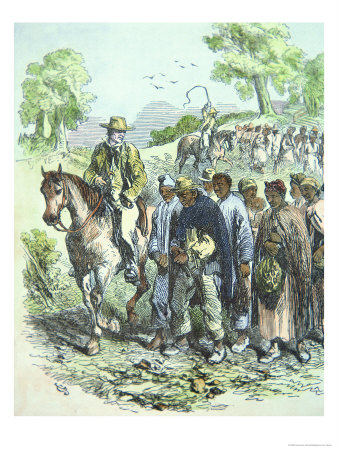
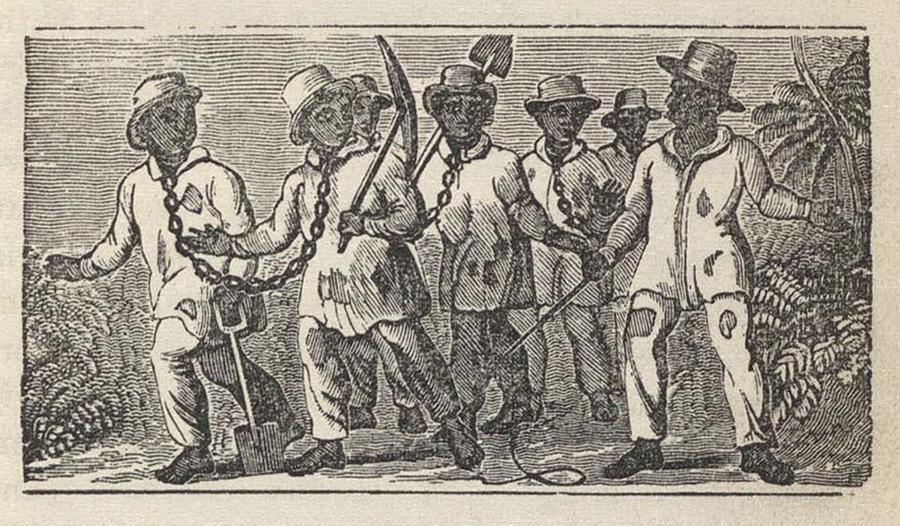
Franklin and Armfield sent an annual overland coffle, or slave caravan, from Virginia to their Forks of the Road market. These coffles usually left Alexandria for Natchez in mid - to late summer and traveled through Tennessee. From central Tennessee, the standard route to Natchez and the Forks of the Road was down the Natchez Trace. Entrepreneurial farmers along the route supplied the coffles with pork and corn. During the overland march, male slaves were usually manacled and chained together in double files, and were under the close supervision of mounted drivers. Women also walked, while children and injured slaves rode in the wagons that accompanied the coffle. The white men guarding the coffles were normally armed with both guns and whips.

Franklin and Armfield augmented their movement of slaves overland to the Natchez market by transporting them in ships to New Orleans. The partnership purchased a fleet of steam brigs capable of transporting cargoes of slaves from Virginia around the Florida Peninsula into the Gulf of Mexico. The brigs were capable of steaming up the Mississippi River to the docks at New Orleans. Slaves destined for the Natchez market were transferred to steamboats for the remainder of the trip. The steam brigs, which were equipped to carry between 75 and 150 slaves, normally operated between October and May to avoid excessive heat in the tightly packed slave quarters aboard ship.


The market

A distinctive characteristic of the Forks of the Road slave market was the manner in which sales were transacted. New England writer Joseph Holt Ingraham, who visited the Forks of the Road slave market about 1834, wrote, “[Slaves at the Forks of the Road] are not sold at auction, or all at once, but singly, or in parties, as purchasers may be inclined to buy.” Likewise, classified advertisements placed by Forks of the Road slave traders in Natchez newspapers simply announced the availability of slaves for purchase, indicating a casual, first-come-first-served approach to marketing slaves. Lacking the competitive, public spectacle atmosphere of an auction, individual buyers and sellers were free to quietly strike a bargain.

Ingraham’s narrative provides a description of the market, the behavior of the slaves, traders and buyers, and the way that business was conducted:

“A mile from Natchez we came to a cluster of rough wooden buildings, in the angle of two roads, in front of which several saddle horses, either tied or held by servants, indicated a place of popular resort. ‘This is the slave market,’ said my companion, pointing to a building in the rear; and alighting, we left our horses in charge of a neatly dressed yellow boy belonging to the establishment. Entering through a wide gate into a narrow courtyard, partially enclosed by low buildings, a scene of a novel character was at once presented. A line of negroes ... extended in a semicircle around the right side of the yard. There were in all about forty. Each was dressed in the usual uniform of slaves, when in market, consisting of a fashionably shaped, black fur hat, roundabout and trousers of coarse corduroy velvet, precisely such as are worn by Irish laborers, when they first ‘come over the water;’ good vests, strong shoes, and white cotton shirts, completed their equipment. This dress they lay aside after they are sold, or wear out as soon as may be; for the negro dislikes to retain the indication of his having recently been in the market. With their hats in their hands, which hung down by their sides, they stood perfectly still, and in close order, while some gentlemen were passing from one to another examining for the purpose of buying.”


The relaxed character of the Forks of the Road slave trade is also evident in free black businessman William Johnson’s diary entry for May 14, 1841: “I rode out this afternoon to the Forks of the Road to try and swop [sic] Stephen off for someone else, but could find no one that I like.” Stephen was one of the diarist’s slaves. Here we have a remarkable glimpse of a black slave-owner casually browsing through the Forks of the Road slave lot. The offhand way in which Johnson relates his visit to the Forks of the Road market indicates that he had no qualms about being in the midst of interstate slave dealers.

Local fears of incoming slaves bringing cholera to Natchez prompted passage of an 1833 city ordinance prohibiting interstate slave traders from housing their slaves within the city limits. Situated on the city’s eastern boundary line, the Forks of the Road market proved to be an ideal location for interstate slave sales without violating the 1833 ordinance. Slave traders operating at the Forks of the Road situated their holding pens just outside of the city limits. At peak business times, with as many as 500 slaves at the market, the intersection probably resembled a sprawling prison camp. Three prominent townhouse mansions, known today as “D'Evereux,” “Linden,” and “Monmouth,” were all within sight of the slave market.
The prices

Slave prices tended to rise and fall with the price of cotton and the degree to which expenses incurred by the interstate slave traders affected their margin of profit. Expenses incurred included the costs of the slaves' transportation to Natchez, food, housing, clothing, and medical treatment.

In the period between 1825 and 1830, the average price for young adult male slaves in Virginia was $400. In contrast, Isaac Franklin sold four slaves (sex unspecified) at the Forks of the Road in 1826-27 for $700, $600, $500, and $450. By early 1850, male slaves at Forks of the Road were advertised at $825 each, and females were priced at $700 and $600. By early 1861, with a civil war looming, prices for Virginia field hand slaves had climbed to an average of $1,200 each. Forks of the Road prices were correspondingly high during the early months of 1861 when field hands were advertised from $1,600 to $1,650.
The market closes

Franklin, who had formed a separate partnership with another Virginia slave trader, Rice Ballard, continued to do business as Ballard, Franklin and Company at the Forks of the Road market until late 1845. Subsequent owners of the lucrative market spaces leased their property to interstate traders such as Griffin & Pullum and Thomas G. James, who proclaimed in newspaper advertisements in the early 1850s that their leases at the Forks of the Road were “for a term of years.” In January 1853, the Forks of the Road intersection was especially busy, with James and Griffin & Pullum sharing market space with another longtime interstate slave trader, R. H. Elam. Business at the market continued to boom during the 1850s. In 1858, advertisements by Kentucky trader Tarlton Auterburn implied an endless supply of slaves for Mississippi:

“Negroes for Sale. I have arrived at my old stand (Forks of the Road) near Natchez, with a Lot of No. 1 Negroes, which I will sell as low, and on as good terms as any other Trader. I will also receive new lots of Negroes, and keep up a good supply during the trading season. Tarlton Auterburn.”


The last newspaper advertisements for slave sales at the Forks of the Road appeared in the Natchez Daily Courier during the early months of 1863. All slave trading had ceased in Natchez by the summer of 1863 when Union troops occupied the town. Today, the historic intersection, with its familiar “Y” configuration, remains to mark the location of the once-flourishing slave markets at the Forks of the Road. [source: Mississippi History NowFebruary 2003]


University of Maryland Distinguished University Professor Ira Berlin suggests that the unique circumstances of American slavery continue to shape the nation even today. Unlike most other slave-holding countries, the United States had a large indigenous slave population and one of the most stringent definitions of race-- the "one drop" rule"-- in the world. The result is a society whose very fabric is bound up in the legacy of human bondage.


Ira Berlin: Slavery in America

Ira Berlin: Slavery in America from The Gilder Lehrman Institute on Vimeo.

Wednesday, April 4, 2012

Disenfranchising American Voters Mississippi-style


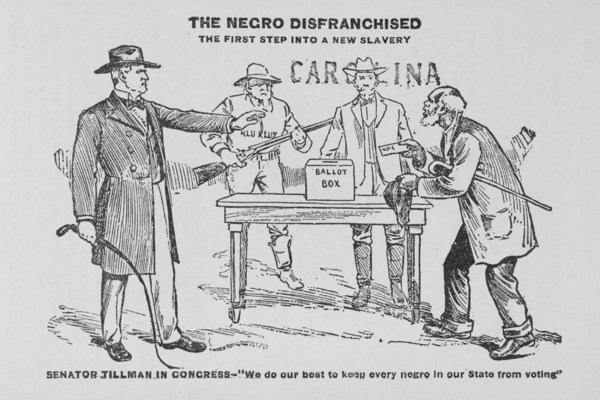
In Mississippi, the method of controlling black votes and regulating their economic and public lives by full-scale and openly brutal violence was known as the First Mississippi Plan of 1875. Whites openly resorted to violence and fraud to control the black vote, shooting down black voters "just like birds." This ruthless and bloody revolution devastated the black vote in Mississippi, and fully 66 percent of the blacks registered to vote in the state failed to cast ballots in the presidential election of 1880. Of those who did vote, almost 50 percent voted Democratic rather than face the wrath of whites in the state. The white vigilantes made no attempt to disguise themselves as in the days of the Ku Klux Klan, and so complete was their victory that the Republican governor fled the state rather than face impeachment charges by the newly elected legislature.


When Mississippi began formally and legally to segregate and disfranchise blacks by changing its state constitution and passing supportive legislation in the 1890s, knowing observers referred to these legal moves as the Second Mississippi Plan. The principal difference between the two plans is that the latter did not resort to violence in order to eliminate the black vote. The Second Mississippi Plan did it by law. Other states followed suit to one degree or another, with only a few black gerrymandered districts in North Carolina, Alabama, and Mississippi witnessing significant and continuing black political autonomy up to 1900.


Almost all the southern states passed statutes restricting suffrage in the years from 1871 to 1889. Various registration laws, such as poll taxes, were established in Georgia in 1871 and 1877, in Virginia in 1877 and 1884, in Mississippi in 1876, in South Carolina in 1882, and in Florida in 1888. The effects were devastating. Over half the blacks who voted in Georgia and South Carolina in 1880 vanished from the polls in 1888. The drop in Florida was 27 percent. In places like Alabama, for example, where blacks equaled almost half the population, no African Americans were sent to the legislature after 1876. (source: Jim Crow History)

Monday, March 19, 2012

"The Healing" by Jonathan Odell


From The Harvard Crimson, "Stereotypical but Stylish Identity Crisis in ‘The Healing’ "The Healing" by Jonathan Odell (Nan A. Talese)," by Aisha K. Down, on 5 March 2012:   “When I look up,” thinks the elderly former slave Granada in a dream, “there are women as far as I can see, standing in the river one behind the other, generations going back to beginning time, from the very womb of God.” Jonathan Odell’s coming-of-age story “The Healing” contains a breathtaking density of beautifully written dreams like these. Odell, through this rich language, explores symbolic threads of identity, womanhood, and mysticism, and manages to tie together a narrative that transitions through the memory and imagination of one remarkable woman’s life. Though little creativity exists in the novel’s structure—nearly every element of “The Healing” seems taken directly from a classic bildungsroman—the novel exhibits contemplative force and realistic emotion. Odell weaves a story that, while rather abrupt in its ending, is tender and thoughtful in its exploration of a gifted woman, her mysterious past, and the strange young black girl with a metronome-like head tic she looks after.

The story, which takes place in Mississippi in the era surrounding the Civil War, begins when the elderly healer Granada takes in the young girl Violet, whose mother died from a botched abortion attempt of her second child. Granada, who is unsure how to help Violet recover from the trauma of this recent experience, decides to bridge the gap between them by telling her ward stories of her own childhood on a plantation in antebellum Mississippi. It is in this murky past that most of the narrative unfolds.

Jonathan Odell, author of 'The Healing'

Granada’s story began when the plantation master’s wife took her from her enslaved parents. The woman, who was going insane, believed that Granada carried a piece of her own daughter’s soul because she was born at the same time that the dying girl succumbed to cholera. Granada subsequently underwent a complicated identity crisis, for her proximity to the plantation owners imbued her with great contempt for field slaves and additional prejudice against the darkest-skinned ones—including her own estranged mother. The catalyst for her transformation into a woman came from an old healer who arrived at the plantation to prevent another cholera outbreak. The woman selects Granada as her protégée after witnessing some hidden inner power in the girl. Odell weaves the story of their relationship with tenderness and wisdom; Granada eventually comes to find a place in a network of souls reaching back to her heritage in Africa and forward through generations.

While Odell for the most part does a commendable job navigating very charged topics—racism, womanhood, abortion, and the brutality of plantation owners—numerous aspects of the narrative remain disjointed. Granada breaks in and out of telling her recollections in order to interact with Violet, but there are points at which her lapses into memory appear contrived; for example, Violet points at masks on the wall to urge on an aspect of Granada’s story that seems naturally sequential, without need of prodding or reminder.


Another major flaw is Odell’s tendency to play the tropes of feminine “coming of age” and “wise women” too frequently—it becomes a literary crutch to rely on instead of exploring her character in further detail. Granada is selected as an assistant by the itinerant healer, but the reader never learns exactly what her cryptic “gift” entails. This omission replaces a potentially substantial exploration of her character with a nebulous cluster of readers’ preconceptions about exemplary children chosen for their “gifts.” Similarly, Odell later comes to rely on the supposed mystical aspects of womanhood to explain Granada’s shifting loyalties from the plantation owners to her fellow African-Americans. Hormonal upheavals aside, there are certainly many other reasons for a character to embrace her racial heritage. Here, it comes across as a hackneyed attempt to explain the workings of the female mind.

Stereotypes aside, however, “The Healing” draws strength from the power of its language as well as Granada’s emotional journey to reconcile her past with her present. “Throughout this season of signs, Granada learned to watch and to listen,” Odell writes. “She waited for the sight to burn bright, to light the way for her, to reveal her place in that river of souls.” Her enigmatic skills, coupled with descriptive and vivid language, enliven her story beyond its stereotypical boundaries. Her struggle to find her place in the world is poignant and relatable, even if this literary ground has been well-trod before.

“The Healing” is certainly not a groundbreaking work, but it does lend a moving perspective to an oft-told story. “The revelation was neither blinding nor thunderous,” Odell writes, as Granada finally connects to her past through healing another. In the end, Odell proves, stories about the human experience need not be revelations; the healing power of the human story is a truth that can be lovely with every retelling. (source: Aisha K. Down, Harvard Crimson)

Sunday, October 9, 2011

Mississippi's Rosenwald Schools

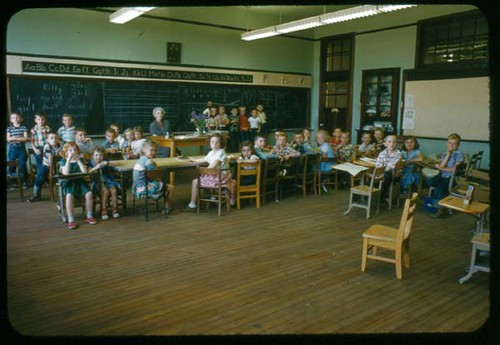
“Separate free schools shall be established for the education of children of African descent; and it shall be unlawful for any colored child to attend any white school, or any white child to attend a colored school,”--Mississippi.

Panola County - Batesville School District - 1st Grade Classroom - 1955. University of Mississippi Visual Collections, John Elon Phay Collection


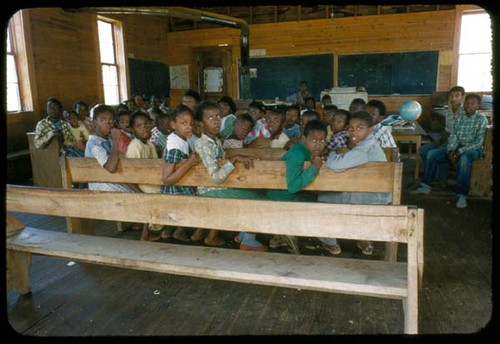
From the Mississippi History, "Rosenwald Schools in Mississippi," written by Jennifer Baughn: Public schooling in Mississippi did not become commonplace until after the American Civil War. After the United States Supreme Court decided in its 1896 Plessy v. Ferguson ruling that states could require separate public facilities for blacks and whites as long as they were equal (the so-called “separate but equal” doctrine), white-dominated school boards began concentrating more of their efforts and funding on schools for white children, rather than for black. By the early 1900s, while many white children studied their textbooks in new functional buildings, black students were often left to make do in churches, lodges, and poorly constructed buildings that barely kept out the wind and the rain.

Panola County - Eureka Springs School - All Grades- 1955, University of Mississippi Visual Collections, John Elon Phay Collection

Beginning in the 1910s, however, new school buildings for African Americans began to spring up on the Mississippi landscape. The schools, constructed as a partnership between the Julius Rosenwald Fund and local citizens, represented a leap forward for black southerners who wanted to ensure an education for their children. When the philanthropic program ended in 1932, a victim of the Great Depression, more than 5,000 school buildings had been constructed under its auspices in fourteen southern states. Mississippi’s Rosenwald program constructed six hundred and thirty-three schools and ancillary buildings and was the South’s second-largest state program.


The Rosenwald Fund — the product of an alliance between Booker T. Washington, president and founder of Tuskegee Institute in Alabama, and Julius Rosenwald, president and chief executive officer of Sears, Roebuck & Co. in Chicago — was the only philanthropic effort in the early 20th century to concentrate on improving the learning environment of black students in the South. The fund accomplished this by giving grants to black communities to cover about a third of the cost of a building. The communities were expected to match the Rosenwald money with either cash or in-kind contributions of labor and materials and to gain financial support from the public school system. While the communities gained a quality building, they also lost a measure of control over their children’s education when the school, which had usually been run by its own board of trustees, came under the control of the county superintendent of education.

Bynum School in Panola County, Mississippi

Begun at Tuskegee in 1912 and initially focused on the few counties surrounding that campus, the Rosenwald Fund’s fame grew through the extensive personal networks of southern blacks. By the end of the 1910s, several states surrounding Alabama had a few Rosenwald schools. But after Washington’s death in 1915, Rosenwald lost confidence in the fund’s new leaders at Tuskegee Institute. He moved the fund’s management away from Tuskegee and set up a new office run by foundation professionals in Nashville. During the 1920s, the Rosenwald Fund became increasingly standardized and efficient, approving thousands of grants in all of the southern states.

Julius Rosenwald founder of the Roesnwald schools.

In Mississippi, only a dozen or so schools obtained help in the early years under Tuskegee’s management. The early buildings were not built to standard plans and often were not much better planned than non-Rosenwald schools. A major shift occurred after the Rosenwald Fund’s reorganization in 1919-1920. By 1922, the Rosenwald Fund reported that one hundred and forty-one Rosenwald schools had been built in Mississippi, including fifty-eight three-teacher schools and five houses for teachers.
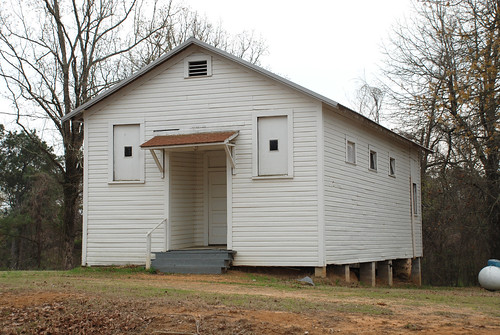
Built in 1926, the Bynum School in Panola County is the only surviving one-classroom Rosenwald school in Mississippi. Photograph by Jennifer Baughn. Courtesy Mississippi Department of Archives and History.
A NEW SCHOOL BUILDING: A primary focus of the newly reorganized Rosenwald Fund was the quality of the construction of school buildings that would be built with its funds. The fund wanted to build the most schools it could, but it also wanted them to meet current building standards and to be solidly constructed of good materials. Rosenwald also wanted to incorporate knowledge gained during a decade of careful study into lighting levels and ventilation. At the time, rural schools, and even some town schools, did not have electricity to provide lighting or heat. Thus, lighting needed to come into the building through windows, and studies had shown that schools needed many more windows than had previously been thought in order to give students sufficient light. In addition, new research showed that good ventilation prevented the spread of germs and diseases.


Using the findings from a survey of the existing Rosenwald schools by consultant Fletcher B. Dresslar, a recognized authority on the topic of school hygiene and good school planning, the fund, led by its new director Samuel L. Smith, drew a new set of standard plans that would be used to construct almost all Rosenwald schools in the 1920s. From 1920 onward, the Rosenwald Fund’s emphasis moved from funding “better schools” to encouraging “model schools” that could be standards for both black and white schools in the South.

Rosenwald plan, one-teacher school

Rosenwald plan for a one-teacher school. Courtesy Julius Rosenwald Fund, Community School Plans, Bulletin No. 3, Nashville, Tennessee, 1924.
The new plans allowed for a broad variety of schools, based on the number of teachers per school. Ranging from one-classroom structures with a gable front — a common school form in all areas of the country — to large twelve-classroom buildings with auditoriums, the plans relied on simple forms and construction techniques that would be accessible to the many volunteer laborers who built these schools. Several new features of the schools did in fact become models for school architecture in the 1920s, such as:

Prentiss Institute Rosenwald School, Prentiss, Jefferson Davis County

• One-story construction, which required slightly more land but was easier to build and was considered a safety improvement following several deadly school fires in two-story buildings.

• Large groupings of windows, concentrated on the east and west elevations of buildings, became the hallmark of schools for both black and white students in the 1920s. Previously, rural school buildings would have a few scattered windows, with windows on several walls of each classroom. Studies showed, however, that light from many directions caused a glare that could damage a student’s eyesight.


• Two school forms, the H-plan and the T-plan, became standard for rural and town schools alike in the 1920s. The Rosenwald standardized plans used these two forms almost exclusively for schools of four classrooms or more. Both plans contained an auditorium for school and community gatherings, but the H-plan was designed to face north or south, with its windows on the sides facing east and west, while the T-plan was designed to face east or west with its windows on the front and back. These simple but effective plans show the ingenuity and flexibility of the Rosenwald Fund’s program and the emphasis on quality even in difficult circumstances.

Prentiss Institute Rosenwald School, Prentiss, Jefferson Davis County

Only fifteen of the original five hundred and fifty-seven schools aided by the Rosenwald Fund are known to still stand in Mississippi. Of these, about half are either greatly altered or in a deteriorated state. The sole surviving one-classroom school is the Bynum School, built in 1926, in Panola County. Two good examples of the H-plan form are the concrete-block building (1926) at the Prentiss Institute in Jefferson Davis County, a six-classroom building constructed according to Rosenwald Plan #6-A, and the Brushy Creek School (circa 1930) in Copiah County, a clapboard Rosenwald Plan #4-A. The Drew Rosenwald school in Sunflower County began as a substantial T-plan Rosenwald, and grew over the years into a sprawling building with a large student population. The T-plan especially was popular because it could easily handle any needed expansion.
Brushy Creek School, 1930, in Copiah County, Mississippi

In addition to the known Rosenwald schools, Mississippi has some “ghost schools,” a group of schools that were supposed to have received Rosenwald Funds but the money was fraudulently diverted for personal use between 1923-1928. The Rosenwald agent at the Mississippi Department of Education, Bura Hilbun, who was responsible for overseeing the Rosenwald Fund in Mississippi and sending in final reports to the Nashville office, was later found to have falsified records and pocketed the money meant for certain schools. Hilbun’s fraud was found after he left the education department. He was convicted of embezzlement in 1931 in the Hinds County Circuit Court, after two hung juries. Hilbun appealed to the Mississippi Supreme Court but it upheld the lower court’s decision.


Poplar Hill School, Fayette vicinity, Jefferson County – (c. 1923) (National Register). Poplar Hill School in Jefferson County is a rare example of a rural school built in the early 20th century to serve the surrounding African American community. The one-story wood frame building with a side-gable metal roof was built c. 1923 and housed two classrooms. Two teachers were responsible for educating students from grades 1 through 8.

As a result of Hilbun’s falsified records, the historical records of the Rosenwald Fund at Fisk University Archives in Nashville list some schools that were not actually built, thus the “ghost schools.” One of those ghost schools has survived. Poplar Hill School is a rare two-classroom black school in rural Jefferson County, and while the school appears in the Rosenwald Fund database on the Fisk website, it is not, in fact, a Rosenwald plan and did not receive any Rosenwald funding. This was distressing news to a group of interested alumni who in 2009 pursued a National Register of Historic Places listing for the building as a Rosenwald school. Nonetheless, the building is still significant as a rare surviving rural African-American school, once one of thousands that dotted the Mississippi landscape.

Sherman Line School in Amite County, Mississippi, built in 1928. Photograph by Jennifer Baughn. Courtesy Mississippi Department of Archives and History.

BUILDING SCHOOL COMMUNITIES: The Rosenwald Fund did not stop with just building new classroom buildings for students. Located in rural areas with poor road systems, the schools came to be somewhat self-sufficient campuses, eventually including not only houses for teachers but also separate buildings for vocational and home economics education.

John White School teacher’s house (1925) in Forrest County

The Rosenwald Fund understood well the challenges of rural schools, and the first and most important one was attracting qualified teachers. School trustees often found it necessary to build a teacher’s house on the campus as a way to entice a principal who could oversee the school’s functioning. Not only did a teacher’s house keep principals and teachers longer at the school, but it provided security for the campus and an on-site alarm in case of fire. As it did with school plans, the fund offered several different house plans for teachers to accommodate families of various sizes. The Rosenwald Fund helped build fifty-eight teacher houses in the state, and many school boards built houses for teachers as well. At least two of the Rosenwald houses still stand in the state, the John White School teacher’s house (1925) in Forrest County and the former president’s house (circa 1930) at Coahoma Community College north of Clarksdale, a campus that began as one of only two agricultural high schools for African Americans. The other school was Hinds County Agricultural High School in Utica (1946).

Pope Chapel Elementary School, Panola County, 1955.

Vocational buildings or shops were also seen as a way to improve both the campus and the school’s educational program. The Rosenwald Fund emphasized vocational education not only because of its origins at Washington’s Tuskegee Institute but because training in agricultural and mechanical skills was thought to be the best way to educate rural children of both races for much of the first half of the 20th century. Indeed, backed by sufficient funding, white consolidated schools of the same period far outstripped black schools in providing buildings and teachers for vocational and home economics education and were considered better schools because of it. Only eighteen vocational buildings for black schools were constructed in Mississippi under the Rosenwald program, primarily because of lack of matching funds and because building a vocational building also meant hiring an extra teacher to teach the classes. This was often out of reach for the Rosenwald schools struggling to survive on limited funding from the public school boards.

Rose Hill School in Sharkey County, Mississippi, is a Rosenwald school.

By 1932, two years after Rosenwald’s death and three years after the stock market crash slashed the value of its endowment, the Rosenwald Fund ceased its building program, leaving southern blacks and southern progressives to find another solution for black education. (source: Mississippi History)

Sunday, September 25, 2011

Sons of Mississippi, Paul Hendrickson

"This photograph was taken in late September 1962, seven years after the killing of Emmett Till. The photograph, which isn't an icon image of the sixties—but should be—was recorded a few days before an all-night riot in Mississippi in which two died and hundreds were injured. It was made by an uncommonly brave and gifted white freelance photographer from Alabama named Charles Moore, on a Thursday afternoon, in a grove of elms and oaks and fine old catalpa trees, at Oxford, Mississippi, on the campus of a place known lovingly as Ole Miss. A week later this document was published in a double-truck spread in Life magazine with this small headline down in the left-hand corner: 'Local lawmen, getting ready to block the law.' There were a lot of other pictures in the story, but this was the one that stole your eyes...

Paul Hendrickson

"...Even now, after years of looking at it, examining it, carrying it, I can't precisely say what it was about the image that so took hold of me. It had an overwhelming storytelling clarity—and simultaneous confusion. It was only much later, with the research and reporting and interviews unfolding before me, that I found a certain corroboration for all I must have been imagining the first time I came across it."

—from Sons of Mississippi by Paul Hendrickson

From the April 2003 Washington Monthly, "Rising Sons: A review of Paul Hendrickson's Sons of Mississippi," by Wen Stephenson: On Sept. 27, 1962, in Oxford, Miss., among the elms and oaks and catalpa trees on the campus of Ole Miss, a gifted young freelancer snapped a photograph for Life magazine of seven Mississippi sheriffs having too good a time. It's not an icon of the 1960s, but it should be, says Paul Hendrickson. They're standing, "these seven faces of Deep South apartheid," around the hood of a squad car, and the handsome one in the middle--head of the state sheriffs' association, cigarette between his grinning teeth--is taking a practice swing with a billy club to the amusement and grim appreciation of his colleagues. It was three days before James Meredith would become the first African American to enroll at the University of Mississippi (accompanied by more than 500 federal marshals and several thousand U.S. troops), and these sheriffs, in their white shirts and dark ties, had come from all over the state to help keep their fellow Mississippian from setting foot on the sacred campus.
Paul Hendrickson

For Hendrickson, a former Washington Post reporter who was born in California but raised partly in the Deep South, that photograph contains an essential underlying story of the Battle of Oxford and the larger civil rights struggle, a story of race and its legacy that holds the key to much of the past 40 years. In Sons of Mississippi, Hendrickson takes a rare approach to this subject, focusing on the white supremacists themselves, rather than the familiar, and safer, heroic narrative of the people who rose up to defeat them. His driving impulse is to get beneath the surface and beyond the frame of that photograph in order to see these seven Southerners, and their children and grandchildren after them, as complex individuals rather than two-dimensional caricatures. He knows that racism--even in a time and place as benighted as Mississippi in 1962--is never monolithic, and is careful to highlight the nuances of racial feeling along a spectrum that runs from virulent bigotry to complacent (and complicit) passivity. He knows that the only way to understand the inhumanity in that photograph is to make the men who populate it human.
1962 Ole Miss University campus riot.

Two of those men were still alive when Hendrickson started the project; all of them are well remembered by family, friends, and colleagues. One of the deceased, the former sheriff of Pascagoula--alcoholic, viciously bigoted, and beloved of his men--has an FBI file on him big enough, yet maddeningly inconclusive enough (full of "redactions" pointing all the way to J. Edgar Hoover) to be the stuff of legend. For more than one of them, Hendrickson unearths evidence of Klan and Klan-related activities, though he's unable to prove anything, and none can be linked directly to any civil-rights crime.

The University of Mississippi, Oxford 1962.

But as Hendrickson states at the outset, his book isn't really about the men in the photograph. "Instead," he writes, "it's about what's deeply connected but is off the page, out of sight, past the borders. It's about what has come down from this photograph." And so the portraits of those men are followed by longer, more intimate profiles of some of the descendants, those he calls "the inheritors," in whose stories he finds "some modest surprises and small redemptions and blades of latter-day racial hope."

U.S. Border Control

There's Sheriff Tommy Ferrell, who succeeded his father as sheriff of Natchez (Adams County), keeps a portrait of Nathan Bedford Forrest--co-founder of the KKK--on his office wall, and has nonetheless risen to national prominence in his determination to modernize the image of Mississippi law enforcement. (And whose proud political demeanor conceals an edge of defensiveness about his father's role in the 1960s.) There's Tommy's son Ty Ferrell, a U.S. Border Patrol agent in Santa Teresa, N.M.--compassionate, painfully self-conscious, prone to tears--who seems to carry around with him the entire burden of the family's racial past. And there's John Cothran--grandson and namesake of Sheriff John Ed Cothran of infamous Greenwood (Leflore County) in the Delta--a "working stiff" whose good heart and bad temper have left him with four broken marriages, who works as a floor manager at Home Depot and a second job stocking shelves at the Kroger supermarket to pay child support for the kids he loves, and whose ambition is a double-wide trailer in an all-white development outside Senatobia. (And yet whose humanity toward, and willingness to stand up for, his black co-workers and friends give him a shot at redemption that is neither simple nor sentimental.)

Ole Miss was the scene of rioting that spilled over into the streets of Oxford, Mississippi (1962)
Hendrickson succeeds, movingly and compellingly, in these portraits of contemporary Southerners. But his feel for the deeper Southern past, and for the broader context of Southern politics, is less sophisticated and less satisfying. That is to say, Hendrickson gives us vivid pictures of who the men in that photograph were in 1962, and of what they passed on to their descendants, but he makes almost no effort to explain how they got that way--almost forgetting, it seems, that these men themselves were descendants, inheritors of the forces that shaped their South. Despite a central chapter in which he weaves a kind of historical essay on the events surrounding the Battle of Oxford and its aftermath, I found myself searching for some analysis of the social and political dynamics of race and class that run as an inescapable current through Southern history.
Ole Miss 1962

How, for example, did the poor and working-class backgrounds of these men, their lack of education, and their place within the stratified society of white Mississippi, affect their racial fear? How did white supremacism, and the populist politics of racial solidarity, offer them a kind of perverse security within that world? How did the tangled history of race and class in the Jim Crow South set the social boundaries and norms of behavior in their time and place? Hendrickson hints elusively at such questions, but fails to confront them. (source: Wen Stephenson, Washington Monthly)


click here to watch Paul Hendrickson on C-Span's Book TV

Thursday, September 8, 2011

Enslavement After Emancipation

On the local level, most southern towns and municipalities passed strict vagrancy laws to control the influx of black migrants and homeless people who poured into these urban communities in the years after the Civil War. In Mississippi, for example, whites passed the notorious "Pig Law" of 1876, designed to control vagrant blacks at loose in the community. This law made stealing a pig an act of grand larceny subject to punishment of up to five years in prison. Within two years, the number of convicts in the state penitentiary increased from under three hundred people to over one thousand.
It was this law in Mississippi that turned the convict lease system into a profitable business, whereby convicts were leased to contractors who sub-leased them to planters, railroads, levee contractors, and timber jobbers.
Almost all of the convicts in this situation were blacks, including women, and the conditions in the camps were horrible in the extreme. It was not uncommon to have a death rate of blacks in the camps at between 8 to 18 percent. In a rare piece of journalism, the Jackson Weekly Clarion, printed in 1887 the inspection report of the state prison in Mississippi:
"We found [in the hospital section] twenty-six inmates, all of whom have been lately brought there off the farms and railroads, many of them with consumption and other incurable diseases, and all bearing on their persons marks of the most inhuman and brutal treatment. Most of them have their backs cut in great wales, scars and blisters, some with the skin pealing off in pieces as the result of severe beatings.
Their feet and hands in some instances show signs of frostbite, and all of them with the stamp of manhood almost blotted out of their faces.... They are lying there dying, some of them on bare boards, so poor and emaciated that their bones almost come through their skin, many complaining for the want of food.... We actually saw live vermin crawling over their faces, and the little bedding and clothing they have is in tatters and stiff with filth.

As a fair sample of this system, on January 6, 1887, 204 convicts were leased to McDonald up to June 6, 1887, and during this six months 20 died, and 19 were discharged and escaped and 23 were returned to the walls disabled and sick, many of whom have since died."

(Creating Jim Crow: In-Depth Essay, by Ronald L. F. Davis, Ph. D.)

HOME

HOME
Click here to return to the US Slave Home Page