Showing posts with label Maryland Slavery. Show all posts

Wednesday, February 8, 2012

The Drug War On The Wire

Felicia "Snoop" Pearson played a lethal killer in the Wire TV series

Time Magazine's article, "The Wire's War on the Drug War," on 5 March 2008: We write a television show. Measured against more thoughtful and meaningful occupations, this is not the best seat from which to argue public policy or social justice. Still, those viewers who followed The Wire — our HBO drama that tried to portray all sides of inner-city collapse, including the drug war, with as much detail and as little judgment as we could muster — tell us they've invested in the fates of our characters. They worry or grieve for Bubbles, Bodie or Wallace, certain that these characters are fictional yet knowing they are rooted in the reality of the other America, the one rarely acknowledged by anything so overt as a TV drama.

These viewers, admittedly a small shard of the TV universe, deluge us with one question: What can we do? If there are two Americas — separate and unequal — and if the drug war has helped produce a psychic chasm between them, how can well-meaning, well-intentioned people begin to bridge those worlds? (source: Time)


And for five seasons, we answered lamely, offering arguments about economic priorities or drug policy, debating theoreticals within our tangled little drama. We were storytellers, not advocates; we ducked the question as best we could.

Yet this war grinds on, flooding our prisons, devouring resources, turning city neighborhoods into free-fire zones. To what end? State and federal prisons are packed with victims of the drug conflict. A new report by the Pew Center shows that 1 of every 100 adults in the U.S. — and 1 in 15 black men over 18 — is currently incarcerated. That's the world's highest rate of imprisonment. (source: Time)


The drug war has ravaged law enforcement too. In cities where police agencies commit the most resources to arresting their way out of their drug problems, the arrest rates for violent crime — murder, rape, aggravated assault — have declined. In Baltimore, where we set The Wire, drug arrests have skyrocketed over the past three decades, yet in that same span, arrest rates for murder have gone from 80% and 90% to half that. Lost in an unwinnable drug war, a new generation of law officers is no longer capable of investigating crime properly, having learned only to make court pay by grabbing cheap, meaningless drug arrests off the nearest corner. (source: Time)

Joseph "Proposition Joe" Stewart (often referred to as Prop Joe) is a fictional character on the HBO drama The Wire played by actor Robert F. Chew.

What the drugs themselves have not destroyed, the warfare against them has. And what once began, perhaps, as a battle against dangerous substances long ago transformed itself into a venal war on our underclass. Since declaring war on drugs nearly 40 years ago, we've been demonizing our most desperate citizens, isolating and incarcerating them and otherwise denying them a role in the American collective. All to no purpose. The prison population doubles and doubles again; the drugs remain.

Our leaders? There aren't any politicians — Democrat or Republican — willing to speak truth on this. Instead, politicians compete to prove themselves more draconian than thou, to embrace America's most profound and enduring policy failure. (source: Time)


Detective James "Jimmy" McNulty is a fictional character on the HBO drama The Wire, played by British actor Dominic West.

"A long habit of not thinking a thing wrong, gives it a superficial appearance of being right," wrote Thomas Paine when he called for civil disobedience against monarchy — the flawed national policy of his day. In a similar spirit, we offer a small idea that is, perhaps, no small idea. It will not solve the drug problem, nor will it heal all civic wounds. It does not yet address questions of how the resources spent warring with our poor over drug use might be better spent on treatment or education or job training, or anything else that might begin to restore those places in America where the only economic engine remaining is the illegal drug economy. It doesn't resolve the myriad complexities that a retreat from war to sanity will require. All it does is open a range of intricate, paradoxical issues. But this is what we can do — and what we will do. (source: Time)

If asked to serve on a jury deliberating a violation of state or federal drug laws, we will vote to acquit, regardless of the evidence presented. Save for a prosecution in which acts of violence or intended violence are alleged, we will — to borrow Justice Harry Blackmun's manifesto against the death penalty — no longer tinker with the machinery of the drug war. No longer can we collaborate with a government that uses nonviolent drug offenses to fill prisons with its poorest, most damaged and most desperate citizens. (source: Time)

Omar Devone Little is a fictional character on the HBO drama The Wire, portrayed by Michael K. Williams.

Jury nullification is American dissent, as old and as heralded as the 1735 trial of John Peter Zenger, who was acquitted of seditious libel against the royal governor of New York, and absent a government capable of repairing injustices, it is legitimate protest. If some few episodes of a television entertainment have caused others to reflect on the war zones we have created in our cities and the human beings stranded there, we ask that those people might also consider their conscience. And when the lawyers or the judge or your fellow jurors seek explanation, think for a moment on Bubbles or Bodie or Wallace. And remember that the lives being held in the balance aren't fictional. (source: Time)

David Simon

The people most affected by this are black and brown and poor. It’s the abandoned inner cores of our urban areas. As we said before, economically, we don’t need those people; the American economy doesn’t need them. So as long as they stay in their ghettos and they only kill each other, we’re willing to pay for a police presence to keep them out of our America. And to let them fight over scraps, which is what the drug war, effectively, is. (source: Outside The Beltway)

David Simon: "The Audacity of Despair"

Tuesday, January 31, 2012

Medical Ethics: The Cells of Henrietta Lacks


From the SECOND OPINION in The New York Times, on 2 February 2010, "A Lasting Gift to Medicine That Wasn’t Really a Gift," by Denise Grady: Fifty years after Henrietta Lacks died of cervical cancer in the “colored” ward at Johns Hopkins Hospital, her daughter finally got a chance to see the legacy she had unknowingly left to science. A researcher in a lab at Hopkins swung open a freezer door and showed the daughter, Deborah Lacks-Pullum, thousands of vials, each holding millions of cells descended from a bit of tissue that doctors had snipped from her mother’s cervix.


Ms. Lacks-Pullum gasped. “Oh God,” she said. “I can’t believe all that’s my mother.”

When the researcher handed her one of the frozen vials, Ms. Lacks-Pullum instinctively said, “She’s cold,” and blew on the tube to warm it. “You’re famous,” she whispered to the cells.

Minutes later, peering through a microscope, she pronounced them beautiful. But when she asked the researcher which were her mother’s normal cells and which the cancer cells, his answer revealed that her precious relic was not quite what it seemed. The cells, he replied, were “all just cancer.”


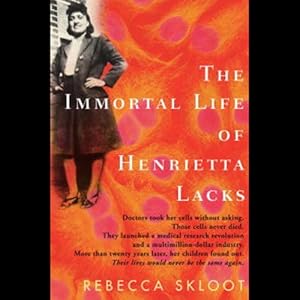
The vignette comes from a gripping new book, “The Immortal Life of Henrietta Lacks” (Crown Publishers), by the journalist Rebecca Skloot. The story of Mrs. Lacks and her cells, and the author’s own adventures with Mrs. Lacks’s grown children (one fries her a pork chop, and another slams her against a wall) is by turns heartbreaking, funny and unsettling. The book raises troubling questions about the way Mrs. Lacks and her family were treated by researchers and about whether patients should control or have financial claims on tissue removed from their bodies.

The story began in January 1951, when Mrs. Lacks was found to have cervical cancer. She was treated with radium at Johns Hopkins, the standard of care in that day, but there was no stopping the cancer. Her doctor had never seen anything like it. Within months, her body was full of tumors, and she died in excruciating pain that October. She was 31 and left five children, the youngest just a year old. She had been a devoted mother, and the children suffered terribly without her.

Neither Mrs. Lacks nor any of her relatives knew that doctors had given a sample of her tumor to Dr. George Gey, a Hopkins researcher who was trying to find cells that would live indefinitely in culture so researchers could experiment on them. Before she came along, his efforts had failed. Her cells changed everything: they multiplied like crazy and never died.


A cell line called HeLa (for Henrietta Lacks) was born. Those immortal cells soon became the workhorse of laboratories everywhere. HeLa cells were used to develop the first polio vaccine, they were launched into space for experiments in zero gravity and they helped produce drugs for numerous diseases, including Parkinson’s, leukemia and the flu. By now, literally tons of them have been produced.

Dr. Gey did not make money from the cells, but they were commercialized. Now they are bought and sold every day the world over, and they have generated millions in profits.

The Lacks family never got a dime. They were poor, with little education and no health insurance, and some had serious physical or mental ailments. But they didn’t even know that tissue had been taken or that HeLa cells even existed until more than 20 years after Mrs. Lacks’s death. And they found out only by accident, when her daughter-in-law met someone from the National Cancer Institute who recognized her surname and said he was working with cells from “a woman named Henrietta Lacks.”


The daughter-in-law rushed home and told Mrs. Lacks’s son, Lawrence, “Part of your mother, it’s alive!”

When they learned that their mother’s cells had saved lives, the family felt proud. But they also felt confused, a bit frightened, used and abused. It had never occurred to anyone to ask permission to take their mother’s tissue, tell them that her cells had changed scientific history or even to say thank you. And certainly no one had ever suggested that they deserved a share of the profits.

Some of the Lackses later gave blood to Hopkins researchers, thinking they were being tested for cancer, when really the scientists wanted their genetic information to help determine whether HeLa cells were contaminating other cultures. When Ms. Lacks-Pullum asked a renowned geneticist at the hospital, Victor McKusick, about her mother’s illness and the use of her cells, he gave her an autographed copy of an impenetrable textbook he had edited, and, Ms. Skloot writes, “beneath his signature, he wrote a phone number for Deborah to use for making appointments to give more blood.”


The bounds of fairness, respect and simple courtesy all seem to have been breached in the case of the Lacks family. The gulf between them and the scientists — race, class, education — was enormous and made communication difficult.

A less charitable view is that it might have made the Lackses easier to ignore. When the family’s story became known in the black community in Baltimore, Ms. Skloot writes, it was seen as the case of a black woman whose body had been exploited by white scientists.

Ideas about informed consent have changed in the last 60 years, and the forms now given to people having surgery or biopsies usually spell out that tissue removed from them may be used for research. But Ms. Skloot points out that patients today don’t really have any more control over removed body parts than Mrs. Lacks did. Most people just obediently sign the forms.

Which is as it should be, many scientists say, arguing that Mrs. Lacks’s immortal cells were an accident of biology, not something she created or invented, and were used to benefit countless others. Most of what is removed from people is of no value anyway, and researchers say it would be too complicated and would hinder progress if ownership of such things were assigned to patients and royalties had to be paid.

But in an age in which people can buy songs with the click of a mouse, that argument may become harder to defend.


So far, the courts have sided with scientists, even in a case in the 1980s in which a leukemia patient’s spleen and other tissues turned out to be a biomedical gold mine — for his doctor. The patient, John Moore, sued his doctor after discovering that the doctor had filed for a patent on his cells and certain proteins they made, and had created a cell line called Mo with a market value estimated at $3 billion. Mr. Moore ultimately lost before the California Supreme Court.

As Ms. Skloot writes in her last chapter, this issue is not going away. If anything, it may become increasingly important, because the scale of tissue research is growing, and people are becoming savvier about the money to be made and also the potential for abuse if tissue samples are used to ferret out genetic information.

The notion of “tissue rights” has inspired a new category of activists. The question that comes up repeatedly is, if scientists or companies can commercialize a patient’s cells or tissues, doesn’t that patient, as provider of the raw material, deserve a say about it and maybe a share of any profits that result? Fewer people these days may be willing to take no for an answer. (source: SECOND OPINION in The New York Time)


Monday, January 30, 2012

Medical Ethics: HeLa Cells from Henrietta Lacks

Henrietta Lacks (1920-1951)

In the New York Times Book Review, from 2 February 2010, reviewer Dwight Garner writes: The woman who provides this book its title, Henrietta Lacks, was a poor and largely illiterate Virginia tobacco farmer, the great-great-granddaughter of slaves. Born in 1920, she died from an aggressive cervical cancer at 31, leaving behind five children. No obituaries of Mrs. Lacks appeared in newspapers. She was buried in an unmarked grave.

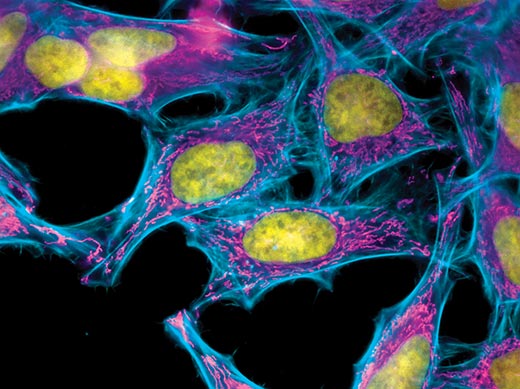
To scientists, however, Henrietta Lacks almost immediately became known simply as HeLa (pronounced hee-lah), from the first two letters of her first and last names. Cells from Mrs. Lacks’s cancerous cervix, taken without her knowledge, were the first to grow in culture, becoming “immortal” and changing the face of modern medicine. There are, Ms. Skloot writes, “trillions more of her cells growing in laboratories now than there ever were in her body.” Laid end to end, the world’s HeLa cells would today wrap around the earth three times.

Because HeLa cells reproduced with what the author calls a “mythological intensity,” they could be used in test after test. “They helped with some of the most important advances in medicine: the polio vaccine, chemotherapy, cloning, gene mapping, in vitro fertilization,” Ms. Skloot writes. HeLa cells were used to learn how nuclear bombs affect humans, and to study herpes, leukemia, Parkinson’s disease and AIDS. They were sent up in the first space missions, to see what becomes of human cells in zero gravity.

Bought and sold and shipped around the world for decades, HeLa cells are famous to science students everywhere. But little has been known, until now, about the unwitting donor of these cells. Mrs. Lacks’s own family did not know that her cells had become famous (and that people had grown wealthy from marketing them) until more than two decades after her death, after scientists had begun to take blood from her surviving family members, without their informed consent, in order to better study HeLa.

Ms. Skloot, a young science journalist and an indefatigable researcher, writes about Henrietta Lacks and her impact on modern medicine from almost every conceivable angle and manages to make all of them fascinating. She reports, for example, on the history and science of cellular research, about its pioneers and its calumnies. But “The Immortal Life of Henrietta Lacks” resonates most as a complex and vital human document and a searching moral inquiry into greed and blinkered lives.

Ms. Skloot tells the story of Mrs. Lacks’s life, from those tobacco fields in small-town Clover, Va., to the “colored” ward of Johns Hopkins Hospital in Baltimore in the 1950s, where she was treated for her cancer, and where her cells were harvested. She follows the members of Mrs. Lacks’s family to East Baltimore, where many of them live today, still struggling with her complicated legacy. As one of Mrs. Lacks’s sons says: “She’s the most important person in the world, and her family living in poverty. If our mother so important to science, why can’t we get health insurance?”
Elsie Lacks, Henrietta's older daughter

“The Immortal Life of Henrietta Lacks” is packed with memorable characters, from quirky if brilliant early researchers to Nobel Prize-winning Nazi sympathizers to long-haired Rolling Stone reporters in the 1970s to a con artist known as Sir Lord Keenan Kester Cofield. (Just when you think things can’t get weirder, Judge Joseph Wapner — the “People’s Court” television judge — makes a cameo.)

Ms. Skloot is a memorable character herself. She never intrudes on the narrative, but she takes us along with her on her reporting, as she moves around the country in her battered, muffler-free black Honda. Her most complicated job is to get Mrs. Lacks’s family, who are tired of white people trying to pry information from them, to speak with her. She does eventually win them over. And Mrs. Lacks’s daughter Deborah is dead-on when she says to Ms. Skloot: “Get ready, girl. You got no idea what you gettin’ yourself into.”

Ms. Skloot writes with particular sensitivity and grace about the history of race and medicine in America. Black oral history, she points out, is full of stories about “night doctors,” men who could pluck black patients off the streets to experiment on their bodies. There was some truth behind those tales.


The author traces events like the infamous Tuskegee syphilis study, in which poor and uneducated black men with syphilis were recruited and then allowed to die terrible and entirely preventable deaths, while doctors lied to them and kept life-saving penicillin from them. Ms. Skloot makes it abundantly clear why, when Henrietta Lacks’s family learned that her cells were still living, the images that ran through their minds were straight out of science-fiction horror movies.

Mrs. Lacks had another daughter, Elsie, who was deaf and mute and possibly retarded. Elsie was shipped off at a young age to Crownsville State Hospital in Maryland, formerly known as the Hospital for the Negro Insane, and died there at 15. Perhaps the most devastating moment in this book comes when Ms. Skloot, along with Deborah, finds a grim photograph of Elsie in the hospital’s records and uncovers some of the horrors of what life there must have been like.

“The Immortal Life of Henrietta Lacks” is also, from first page to last, a meditation on medical ethics — on the notion of informed consent, and on the issue of who owns human cells. When they’re in your body, it’s obvious — they’re yours. But once they’ve been removed? All bets are clearly off. (source: The New York Times)


Wednesday, October 26, 2011

Watkins Slave Cemetery, Maryland

The Mt. Tabor Church, where the remains were reburied, is located at 1421 St. Stephens Church Road in Crownsville, Maryland
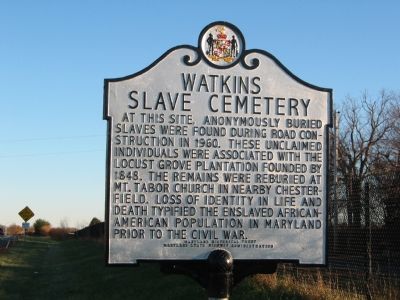
At this site, anonymously buried slaves were found during road construction in 1960. These unclaimed individuals were associated with the Locust Grove plantation founded by 1848. The remains were reburied at Mt. Tabor Church in nearby Chesterfield. Loss of identity in life and death typified the enslaved African-American population in Maryland prior to the Civil War.

Watkins Slave Cemetary Marker Photo, Click for full size

Wednesday, October 12, 2011

Rare daguerreotype offers insight into urban slavery

test4Rare daguerreotype
Rare daguerreotype

On October 11, 2011 the Community Times reported: The rare tintype of Baltimore slave Martha Ann “Patty” Atavis and Alice Lee Whitridge, the young girl she cared for, was probably taken in 1860.

The Maryland Historical Society acquired at auction recently a rare daguerreotype of Baltimore slave, Martha Ann "Patty" Atavis, and a tintype of the same woman holding Alice Lee Whitridge, the daughter of Dr. John Whitridge of Baltimore.

The items are from circa 1845-1860. The photographs and supporting documents illuminate the realities of urban slavery in Baltimore during the Civil War era.

"This acquisition is incredibly important for the Maryland Historical Society and will further help us understand urban slavery in Baltimore," Mark Letzer, of the Maryland Historical Society, said in a statement.

Letzer acquired the images for the museum at the Crocker Farm Auction House in Sparks.

About 5 percent of slaves lived in urban areas at the eve of the Civil War, according to the historical society. In Baltimore, that totaled about 5,000, with two thirds of them being women. Most of the women were in domestic service like Atavis. She stayed in the service of the same family until her death a decade after the abolition of slavery.

The pictures will be on display in the Maryland Historical Society library starting, Wednesday, Oct. 12, from 10 a.m. to 5 p.m., Wednesday through Saturday. (source: The Community Times)

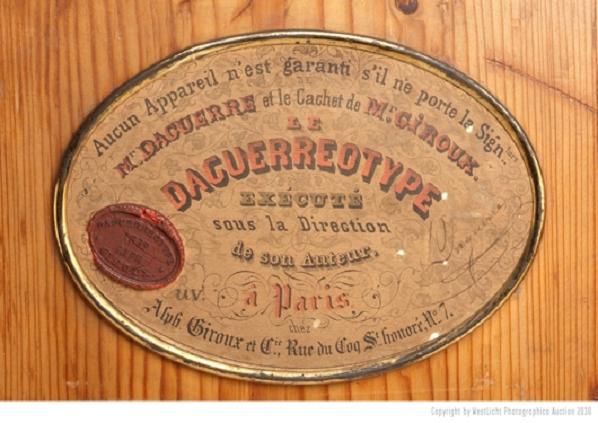
giroux daguerreotype Giroux Daguerreotype The First Cam In The World To See The Hammer


The Daguerreotype

Louis-Jacques-Mandé Daguerre invented the daguerreotype process in France. The invention was announced to the public on August 19, 1839 at a meeting of the French Academy of Sciences in Paris. American photographers quickly capitalized on this new invention, which was capable of capturing a "truthful likeness." Daguerreotypists in major cities invited celebrities and political figures to their studios in the hopes of obtaining a likeness for display in their windows and reception areas. They encouraged the public to visit their galleries, which were like museums, in the hope that they would desire to be photographed as well. By 1850, there were over 70 daguerreotype studios in New York City alone.

Popularity of the daguerreotype declined in the late 1850s when the ambrotype, a faster and less expensive photographic process, became available. A few contemporary photographers have revived the process.

The Cameras

The earliest cameras used in the daguerreotype process were made by opticians and instrument makers, or sometimes even by the photographers themselves. The most popular cameras utilized a sliding-box design. The lens was placed in the front box. A second, slightly smaller box, slid into the back of the larger box. The focus was controlled by sliding the rear box forward or backwards. A laterally reversed image would be obtained unless the camera was fitted with a mirror or prism to correct this effect. When the sensitized plate was placed in the camera, the lens cap would be removed to start the exposure.


giroux daguerreotype 1 Giroux Daguerreotype The First Cam In The World To See The Hammer

Friday, September 30, 2011

American Apartheid Education


Baltimore City Paper, "Dire Education: Jonathan Kozol’s The Shame of the Nation Fires Off a Crucial Wake-Up Call For Rapidly Resegregating Public School Systems—Such as Baltimore’s," by Michael Corbin:


When you walk into a classroom of almost any Baltimore City public school this fall you immediately face the facts of 21st-century educational apartheid. The white children are absent. They left a while ago and won’t be coming back.


Standing in these classrooms you might think that you stumbled upon some remnant of white supremacy, some exemplar of American democratic, public institutions before 1954. What is striking is not the fact of segregation in America, but rather that we no longer care that segregation in public education matters to our democracy. In Baltimore, for instance, the generations-long struggle to integrate public education no longer has a place in public discourse. We complain mightily about the school system’s many woes, but we no longer remark that going to the city’s dysfunctional schools is almost exclusively a black thing.

“Why Segregation Matters: Poverty and Educational Inequality,” a 2002 report (reaffirmed in 2005) from Harvard University’s Civil Rights Project, ranked Baltimore City schools No. 1 in “black isolation.” That is, it found that students who attend Baltimore City schools have the “lowest exposure to whites” in the 239 school districts in the U.S. with a total enrollment greater than 25,000. The white children who still attend a Baltimore City public school are huddled in a diminishing number of schools and are often isolated within specific classrooms in those particular schools.


This isolation is not just the case for Baltimore. After several decades of incremental desegregation following the 1954 Brown v. Board of Education Supreme Court decision, U.S. public schools are more than a decade into the process of resegregation. According to the Civil Rights Project, that resegregation has increased “to levels not seen in three decades.” Close to three-quarters of America’s black and Latino students attend schools that are predominately minority.

It is this demographic fact of racial segregation and its absence from our political concerns that Jonathan Kozol examines in his important new book Shame of a Nation: The Restoration of Apartheid Schooling in America. After visiting 60 schools in 11 states over a five-year period, Kozol attempts to be both polemical and empirical about this reality of U.S. education. Apartheid has become the norm in many U.S. school districts, and Kozol wants us to name it, to acknowledge that we’ve abandoned the democratic project of integration. His book is at minimum a call for us to at least be honest that we operate in an America with a Plessy v. Ferguson reality while claiming the moral absolution of Brown v. Board of Education and its destruction of the lie of “separate but equal.”

Kozol has spent more than 40 years and written numerous books weighing the democratic promise of public schools in America. In books such as The Night Is Dark and I am Far From Home, Amazing Grace: The Lives of Children and the Conscience of a Nation, and Savage Inequalities, Kozol has produced a body of work that stands as a singular arraignment and censure of what we often do to kids in the name of schooling. Shame of a Nation is a full-frontal jeremiad. There is an almost painful sense of exasperated urgency in the book, an angry sense that the sacrifice and struggle of the civil-rights movement is not only being dismantled but, in an Orwellian perversion, that same sacrifice and struggle is claimed as honorific imprimatur to our racially segregated schools.


For example, Kozol notes, go into any U.S. city and look for the school named after a prominent figure in the struggle for civil rights and racial equality. There you will find “bastions of segregation.” In Baltimore, for instance, we have two schools named for Thurgood Marshall, the native son architect of the Brown decision and first African-American Supreme Court justice. Thurgood Marshall High is 98.2 percent African-American. Last school year there were six white kids enrolled. Thurgood Marshall Middle is 97.7 percent African-American, with 10 white kids on roll. Kozol also points to the Thurgood Marshall Elementary in a Seattle neighborhood “where approximately half the families were Caucasian,” but “95 percent of the students [attending the school] were black, Hispanic, Native American or of Asian origin.”


The strength of Kozol’s work is always the time he spends with kids in their schools and in their neighborhood, listening to them and letting them do the talking. Shame of a Nation is no different. He renders in poignant, detail the stories of children whom he has literally watched grow up in the dysfunctional schools he has analyzed. “I walk into a class of 25 or 30 students and I look around me at the faces of children, some whom in New York City I have known since they were born, and look into their eyes . . . and I cannot discern the slightest hint that any vestige of the legal victory embodied in Brown v. Board of Education or the moral mandate that a generation of activists and young idealists lived and sometimes died for has survived within these schools and neighborhoods.”

Similarly, Baltimore City students in their hypersegregated schools simply have no expectation that they operate in the same world as white kids. Going to such segregated schools, argued the Supreme Court in 1954, “generates a feeling of inferiority as to [black students’] status in the community that may affect their hearts and minds in a way unlikely ever to be undone. . . . Separate educational facilities are inherently unequal.” Today, we wonder at the lure for Baltimore school kids of the corner, of the street and a thug life, but many simply see no value in these separate and unequal institutions of educational apartheid. There is not only the so-called achievement gap that politicians hand-wring over, but there is clearly an opportunity gap as well, and black kids often make a rational calculus about what the real deal is in America. The 2001 study “Labor Market Conditions Among 16-24 Year-Old Young Adults in Maryland and Baltimore,” from the Institute for Policy Studies at Johns Hopkins University, puts the dropout rate for African-American males from Baltimore City schools at a staggering 76 percent.


Most people simply have no idea what goes on in segregated city schools. However, because we go to such great lengths to maintain the pernicious facade of “separate but equal,” we become blind to what school has become for many black kids in Baltimore and in the segregated schools across the United States. Kozol dissects these perversions of education in what he calls the “Ordering Regime”—“an architecture of adaptive strategies that promise incremental gains within the limits inequality allows.” Kozol describes the “new vocabularies of stentorian determination, new systems of incentive, and new modes of castigation. . . . Curriculum materials that are alleged to be aligned with governmentally established goals and standards and particularly suited to what are regarded as ‘the special learning styles’ of low-income urban children . . . relentless emphasis on raising test scores . . . a new empiricism and imposition of unusually detailed lists of named and numbered ‘outcomes’ for each isolated parcel of instruction.”

Simply put, in the name of marginally increasing test scores, the under- and miseducated children of apartheid schools are subjected a kind of Dickensian, quasi-militaristic intellectual indoctrination. If we could just get these kids, we seem to think, to chant every morning, “We Are Somebody,” get them to write formulaic paragraphs and memorize the “Seven Habits of Highly Effective Black Teens,” then we can claim progress. We can claim that it’s not the obvious fact that the schools are different, it’s just those ghetto kids who can’t seem to get with the program.


No parent with options, black or white, would send their kids to such schools, Kozol says. Those without options are constantly told that the failed schools are being “reformed,” and the “ordering regime” is precisely what passes for “reform” of Baltimore City schools. This fall, for instance, Baltimore begins a reform of middle schools where, according to the city school system’s own analysis, “less than 3% of eighth graders can analyze text and extend information.” That reform consists mainly of mandating a uniform class structure and curriculum, hiring a consultant, and disallowing teachers to transfer out because of the hundreds of vacancies at city middle schools. Those same city middle-school students will matriculate to high school, reading on average at the fifth-grade level, and yet this year’s high-school freshmen will be the first required to pass the new Maryland High School Assessment exams to graduate.

One has to read Kozol’s powerful rendering or spend time in city classrooms to see what this “architecture of adaptive strategies” leads to for kids. What young Baltimoreans regularly get are classrooms and, indeed, whole schools where curiosity, relevance, beauty, and meaningful inquiry into their lives exist only at the margins of what passes for education, if they are there at all. It’s no wonder so many drop out.


Shame of a Nation is no manifesto. Kozol provides no systematic political program in response. He does provide an interesting review of the few and little publicized successes of interdistrict school desegregation in the U.S., and he invokes the success of many black people who, because of Brown, had access to institutions they otherwise wouldn’t have. He makes some vague gestures at saying a new movement is necessary. But Kozol’s brief against apartheid is a moral one. He wants us to be ashamed. This vocabulary of moral outrage is more associated with the conservative right these days in the struggle over things such as abortion, gay marriage, and the proverbial “family values.” In some measure, because of such rhetorical infidelity, Kozol’s moral vocabulary falls a bit flat.

Also importantly absent from Kozol’s analysis are any of the voices of intellectuals, activists, or even the kids from the so-called hip-hop generation. Like the kids in our segregated classrooms, analysts such as Michael Eric Dyson, Adolph Reed, bell hooks, and Bakari Kitwana, among others, challenge the invocation of the great civil-rights struggle and its moral vocabulary when it doesn’t acknowledge much less ameliorate the current crisis and lived experience of contemporary educational apartheid in places such as Baltimore City.


Nevertheless, Shame of the Nation is a moving and necessary testimony. It is both documentary evidence of the unredeemed promise of Brown and an indictment of the rhetorical bombast about equal educational opportunities in this country. Today, in Baltimore and in cities across America, kids sit in classrooms in deeply separate and unequal schools. And we don’t appear to give a damn about it anymore. If we take seriously the role of public education in our democracy, then we should be ashamed.

--Michael Corbin teaches English and literacy at the Academy for College and Career Exploration, an “innovative” public high school in Baltimore City. (source: Baltimore City Paper)


This Is America - Jonathan Kozol Part 1


HOME

HOME
Click here to return to the US Slave Home Page