Michelle Alexander is a highly acclaimed civil rights lawyer, advocate, and legal scholar.
Excerpt from Michele Alexander's The New Jim Crow: Mass Incarceration In The Age of Colorblindness: Like many civil rights lawyers, I was inspired to attend law school by the civil rights victories of the 1950s and 1960s. Even in the face of growing social and political opposition to remedial policies such as affirmative action, I clung to the notion that the evils of Jim Crow are behind us and that, while we have a long way to go to fulfill the dream of an egalitarian, multiracial democracy, we have made real progress and are now struggling to hold on to the gains of the past. I thought my job as a civil rights lawyer was to join with the allies of racial progress to resist attacks on affirmative action and to eliminate the vestiges of Jim Crow segregation, including our still separate and unequal system of education. I understood the problems plaguing poor communities of color, including problems associated with crime and rising incarceration rates, to be a function of poverty and lack of access to quality education—the continuing legacy of slavery and Jim Crow. Never did I seriously consider the possibility that a new racial caste system was operating in this country. The new system had been developed and implemented swiftly, and it was largely invisible, even to people, like me, who spent most of their waking hours fighting for justice.
I first encountered the idea of a new racial caste system more than a decade ago, when a bright orange poster caught my eye. I was rushing to catch the bus, and I noticed a sign stapled to a telephone pole that screamed in large bold print: The Drug War Is the New Jim Crow. I paused for a moment and skimmed the text of the flyer. Some radical group was holding a community meeting about police brutality, the new three-strikes law in California, and the expansion of America’s prison system. The meeting was being held at a small community church a few blocks away; it had seating capacity for no more than fifty people. I sighed, and muttered to myself something like, “Yeah, the criminal justice system is racist in many ways, but it really doesn’t help to make such an absurd comparison. People will just think you’re crazy.” I then crossed the street and hopped on the bus. I was headed to my new job, director of the Racial Justice Project of the American Civil Liberties Union (ACLU) in Northern California.
The New Jim Crow: Mass Incarceration in the Age of Colorblindness
When I began my work at the ACLU, I assumed that the criminal justice system had problems of racial bias, much in the same way that all major institutions in our society are plagued with problems associated with conscious and unconscious bias. As a lawyer who had litigated numerous class-action employment-discrimination cases, I understood well the many ways in which racial stereotyping can permeate subjective decision-making processes at all levels of an organization, with devastating consequences. I was familiar with the challenges associated with reforming institutions in which racial stratification is thought to be normal—the natural consequence of differences in education, culture, motivation, and, some still believe, innate ability. While at the ACLU, I shifted my focus from employment discrimination to criminal justice reform and dedicated myself to the task of working with others to identify and eliminate racial bias whenever and wherever it reared its ugly head.
By the time I left the ACLU, I had come to suspect that I was wrong about the criminal justice system. It was not just another institution infected with racial bias but rather a different beast entirely. The activists who posted the sign on the telephone pole were not crazy; nor were the smattering of lawyers and advocates around the country who were beginning to connect the dots between our current system of mass incarceration and earlier forms of social control. Quite belatedly, I came to see that mass incarceration in the United States had, in fact, emerged as a stunningly comprehensive and well-disguised system of racialized social control that functions in a manner strikingly similar to Jim Crow.
"Masked Racism: Reflections on the Prison Industrial Complex," by Angela Davis 10 September 1998: Imprisonment has become the response of first resort to far too many of the social problems that burden people who are ensconced in poverty. These problems often are veiled by being conveniently grouped together under the category “crime” and by the automatic attribution of criminal behavior to people of color. Homelessness, unemployment, drug addiction, mental illness, and illiteracy are only a few of the problems that disappear from public view when the human beings contending with them are relegated to cages.
Prisons thus perform a feat of magic. Or rather the people who continually vote in new prison bonds and tacitly assent to a proliferating network of prisons and jails have been tricked into believing in the magic of imprisonment. But prisons do not disappear problems, they disappear human beings. And the practice of disappearing vast numbers of people from poor, immigrant, and racially marginalized communities has literally become big business.
The seeming effortlessness of magic always conceals an enormous amount of behind-the-scenes work. When prisons disappear human beings in order to convey the illusion of solving social problems, penal infrastructures must be created to accommodate a rapidly swelling population of caged people. Goods and services must be provided to keep imprisoned populations alive. Sometimes these populations must be kept busy and at other times — particularly in repressive super-maximum prisons and in INS detention centers — they must be deprived of virtually all meaningful activity. Vast numbers of handcuffed and shackled people are moved across state borders as they are transferred from one state or federal prison to another.
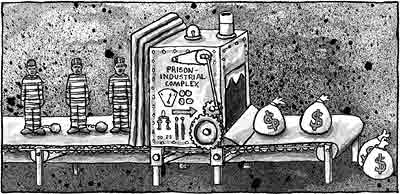
All this work, which used to be the primary province of government, is now also performed by private corporations, whose links to government in the field of what is euphemistically called “corrections” resonate dangerously with the military industrial complex. The dividends that accrue from investment in the punishment industry, like those that accrue from investment in weapons production, only amount to social destruction. Taking into account the structural similarities and profitability of business-government linkages in the realms of military production and public punishment, the expanding penal system can now be characterized as a “prison industrial complex.”
The Color of Imprisonment
Almost two million people are currently locked up in the immense network of U.S. prisons and jails. More than 70 percent of the imprisoned population are people of color. It is rarely acknowledged that the fastest growing group of prisoners are black women and that Native American prisoners are the largest group per capita. Approximately five million people — including those on probation and parole — are directly under the surveillance of the criminal justice system.
Three decades ago, the imprisoned population was approximately one-eighth its current size. While women still constitute a relatively small percentage of people behind bars, today the number of incarcerated women in California alone is almost twice what the nationwide women’s prison population was in 1970. According to Elliott Currie, “[t]he prison has become a looming presence in our society to an extent unparalleled in our history — or that of any other industrial democracy. Short of major wars, mass incarceration has been the most thoroughly implemented government social program of our time.”
To deliver up bodies destined for profitable punishment, the political economy of prisons relies on racialized assumptions of criminality — such as images of black welfare mothers reproducing criminal children — and on racist practices in arrest, conviction, and sentencing patterns. Colored bodies constitute the main human raw material in this vast experiment to disappear the major social problems of our time. Once the aura of magic is stripped away from the imprisonment solution, what is revealed is racism, class bias, and the parasitic seduction of capitalist profit. The prison industrial system materially and morally impoverishes its inhabitants and devours the social wealth needed to address the very problems that have led to spiraling numbers of prisoners.
As prisons take up more and more space on the social landscape, other government programs that have previously sought to respond to social needs — such as Temporary Assistance to Needy Families — are being squeezed out of existence. The deterioration of public education, including prioritizing discipline and security over learning in public schools located in poor communities, is directly related to the prison “solution.”
Profiting from Prisoners
As prisons proliferate in U.S. society, private capital has become enmeshed in the punishment industry. And precisely because of their profit potential, prisons are becoming increasingly important to the U.S. economy. If the notion of punishment as a source of potentially stupendous profits is disturbing by itself, then the strategic dependence on racist structures and ideologies to render mass punishment palatable and profitable is even more troubling.
Prison privatization is the most obvious instance of capital’s current movement toward the prison industry. While government-run prisons are often in gross violation of international human rights standards, private prisons are even less accountable. In March of this year, the Corrections Corporation of America (CCA), the largest U.S. private prison company, claimed 54,944 beds in 68 facilities under contract or development in the U.S., Puerto Rico, the United Kingdom, and Australia. Following the global trend of subjecting more women to public punishment, CCA recently opened a women’s prison outside Melbourne. The company recently identified California as its “new frontier.”
Wackenhut Corrections Corporation (WCC), the second largest U.S. prison company, claimed contracts and awards to manage 46 facilities in North America, U.K., and Australia. It boasts a total of 30,424 beds as well as contracts for prisoner health care services, transportation, and security.
Currently, the stocks of both CCA and WCC are doing extremely well. Between 1996 and 1997, CCA’s revenues increased by 58 percent, from $293 million to $462 million. Its net profit grew from $30.9 million to $53.9 million. WCC raised its revenues from $138 million in 1996 to $210 million in 1997. Unlike public correctional facilities, the vast profits of these private facilities rely on the employment of non-union labor.
The Prison Industrial Complex
But private prison companies are only the most visible component of the increasing corporatization of punishment. Government contracts to build prisons have bolstered the construction industry. The architectural community has identified prison design as a major new niche. Technology developed for the military by companies like Westinghouse is being marketed for use in law enforcement and punishment.
Moreover, corporations that appear to be far removed from the business of punishment are intimately involved in the expansion of the prison industrial complex. Prison construction bonds are one of the many sources of profitable investment for leading financiers such as Merrill Lynch. MCI charges prisoners and their families outrageous prices for the precious telephone calls which are often the only contact prisoners have with the free world.
Many corporations whose products we consume on a daily basis have learned that prison labor power can be as profitable as third world labor power exploited by U.S.-based global corporations. Both relegate formerly unionized workers to joblessness and many even wind up in prison. Some of the companies that use prison labor are IBM, Motorola, Compaq, Texas Instruments, Honeywell, Microsoft, and Boeing. But it is not only the hi-tech industries that reap the profits of prison labor. Nordstrom department stores sell jeans that are marketed as “Prison Blues,” as well as t-shirts and jackets made in Oregon prisons. The advertising slogan for these clothes is “made on the inside to be worn on the outside.” Maryland prisoners inspect glass bottles and jars used by Revlon and Pierre Cardin, and schools throughout the world buy graduation caps and gowns made by South Carolina prisoners.
“For private business,” write Eve Goldberg and Linda Evans (a political prisoner inside the Federal Correctional Institution at Dublin, California) “prison labor is like a pot of gold. No strikes. No union organizing. No health benefits, unemployment insurance, or workers’ compensation to pay. No language barriers, as in foreign countries. New leviathan prisons are being built on thousands of eerie acres of factories inside the walls. Prisoners do data entry for Chevron, make telephone reservations for TWA, raise hogs, shovel manure, make circuit boards, limousines, waterbeds, and lingerie for Victoria’s Secret — all at a fraction of the cost of ‘free labor.’”
Devouring the Social Wealth
Although prison labor — which ultimately is compensated at a rate far below the minimum wage — is hugely profitable for the private companies that use it, the penal system as a whole does not produce wealth. It devours the social wealth that could be used to subsidize housing for the homeless, to ameliorate public education for poor and racially marginalized communities, to open free drug rehabilitation programs for people who wish to kick their habits, to create a national health care system, to expand programs to combat HIV, to eradicate domestic abuse — and, in the process, to create well-paying jobs for the unemployed.
Since 1984 more than twenty new prisons have opened in California, while only one new campus was added to the California State University system and none to the University of California system. In 1996-97, higher education received only 8.7 percent of the State’s General Fund while corrections received 9.6 percent. Now that affirmative action has been declared illegal in California, it is obvious that education is increasingly reserved for certain people, while prisons are reserved for others. Five times as many black men are presently in prison as in four-year colleges and universities. This new segregation has dangerous implications for the entire country.
By segregating people labeled as criminals, prison simultaneously fortifies and conceals the structural racism of the U.S. economy. Claims of low unemployment rates — even in black communities — make sense only if one assumes that the vast numbers of people in prison have really disappeared and thus have no legitimate claims to jobs. The numbers of black and Latino men currently incarcerated amount to two percent of the male labor force. According to criminologist David Downes, “[t]reating incarceration as a type of hidden unemployment may raise the jobless rate for men by about one-third, to 8 percent. The effect on the black labor force is greater still, raising the [black] male unemployment rate from 11 percent to 19 percent.”
Hidden Agenda
Mass incarceration is not a solution to unemployment, nor is it a solution to the vast array of social problems that are hidden away in a rapidly growing network of prisons and jails. However, the great majority of people have been tricked into believing in the efficacy of imprisonment, even though the historical record clearly demonstrates that prisons do not work. Racism has undermined our ability to create a popular critical discourse to contest the ideological trickery that posits imprisonment as key to public safety. The focus of state policy is rapidly shifting from social welfare to social control.
Black, Latino, Native American, and many Asian youth are portrayed as the purveyors of violence, traffickers of drugs, and as envious of commodities that they have no right to possess. Young black and Latina women are represented as sexually promiscuous and as indiscriminately propagating babies and poverty. Criminality and deviance are racialized. Surveillance is thus focused on communities of color, immigrants, the unemployed, the undereducated, the homeless, and in general on those who have a diminishing claim to social resources. Their claim to social resources continues to diminish in large part because law enforcement and penal measures increasingly devour these resources. The prison industrial complex has thus created a vicious cycle of punishment which only further impoverishes those whose impoverishment is supposedly “solved” by imprisonment.
Therefore, as the emphasis of government policy shifts from social welfare to crime control, racism sinks more deeply into the economic and ideological structures of U.S. society. Meanwhile, conservative crusaders against affirmative action and bilingual education proclaim the end of racism, while their opponents suggest that racism’s remnants can be dispelled through dialogue and conversation. But conversations about “race relations” will hardly dismantle a prison industrial complex that thrives on and nourishes the racism hidden within the deep structures of our society.
The emergence of a U.S. prison industrial complex within a context of cascading conservatism marks a new historical moment, whose dangers are unprecedented. But so are its opportunities. Considering the impressive number of grassroots projects that continue to resist the expansion of the punishment industry, it ought to be possible to bring these efforts together to create radical and nationally visible movements that can legitimize anti-capitalist critiques of the prison industrial complex. It ought to be possible to build movements in defense of prisoners’ human rights and movements that persuasively argue that what we need is not new prisons, but new health care, housing, education, drug programs, jobs, and education. To safeguard a democratic future, it is possible and necessary to weave together the many and increasing strands of resistance to the prison industrial complex into a powerful movement for social transformation. (source: Colorlines)
Slavery and the Prison Industrial Complex - Angela Davis
Felicia "Snoop" Pearson played a lethal killer in the Wire TV series
Time Magazine's article, "The Wire's War on the Drug War," on 5 March 2008: We write a television show. Measured against more thoughtful and meaningful occupations, this is not the best seat from which to argue public policy or social justice. Still, those viewers who followed The Wire — our HBO drama that tried to portray all sides of inner-city collapse, including the drug war, with as much detail and as little judgment as we could muster — tell us they've invested in the fates of our characters. They worry or grieve for Bubbles, Bodie or Wallace, certain that these characters are fictional yet knowing they are rooted in the reality of the other America, the one rarely acknowledged by anything so overt as a TV drama.
These viewers, admittedly a small shard of the TV universe, deluge us with one question: What can we do? If there are two Americas — separate and unequal — and if the drug war has helped produce a psychic chasm between them, how can well-meaning, well-intentioned people begin to bridge those worlds? (source: Time)
And for five seasons, we answered lamely, offering arguments about economic priorities or drug policy, debating theoreticals within our tangled little drama. We were storytellers, not advocates; we ducked the question as best we could.
Yet this war grinds on, flooding our prisons, devouring resources, turning city neighborhoods into free-fire zones. To what end? State and federal prisons are packed with victims of the drug conflict. A new report by the Pew Center shows that 1 of every 100 adults in the U.S. — and 1 in 15 black men over 18 — is currently incarcerated. That's the world's highest rate of imprisonment. (source: Time)
The drug war has ravaged law enforcement too. In cities where police agencies commit the most resources to arresting their way out of their drug problems, the arrest rates for violent crime — murder, rape, aggravated assault — have declined. In Baltimore, where we set The Wire, drug arrests have skyrocketed over the past three decades, yet in that same span, arrest rates for murder have gone from 80% and 90% to half that. Lost in an unwinnable drug war, a new generation of law officers is no longer capable of investigating crime properly, having learned only to make court pay by grabbing cheap, meaningless drug arrests off the nearest corner. (source: Time)
Joseph "Proposition Joe" Stewart (often referred to as Prop Joe) is a fictional character on the HBO drama The Wire played by actor Robert F. Chew.
What the drugs themselves have not destroyed, the warfare against them has. And what once began, perhaps, as a battle against dangerous substances long ago transformed itself into a venal war on our underclass. Since declaring war on drugs nearly 40 years ago, we've been demonizing our most desperate citizens, isolating and incarcerating them and otherwise denying them a role in the American collective. All to no purpose. The prison population doubles and doubles again; the drugs remain.
Our leaders? There aren't any politicians — Democrat or Republican — willing to speak truth on this. Instead, politicians compete to prove themselves more draconian than thou, to embrace America's most profound and enduring policy failure. (source: Time)
Detective James "Jimmy" McNulty is a fictional character on the HBO drama The Wire, played by British actor Dominic West.
"A long habit of not thinking a thing wrong, gives it a superficial appearance of being right," wrote Thomas Paine when he called for civil disobedience against monarchy — the flawed national policy of his day. In a similar spirit, we offer a small idea that is, perhaps, no small idea. It will not solve the drug problem, nor will it heal all civic wounds. It does not yet address questions of how the resources spent warring with our poor over drug use might be better spent on treatment or education or job training, or anything else that might begin to restore those places in America where the only economic engine remaining is the illegal drug economy. It doesn't resolve the myriad complexities that a retreat from war to sanity will require. All it does is open a range of intricate, paradoxical issues. But this is what we can do — and what we will do. (source: Time)
If asked to serve on a jury deliberating a violation of state or federal drug laws, we will vote to acquit, regardless of the evidence presented. Save for a prosecution in which acts of violence or intended violence are alleged, we will — to borrow Justice Harry Blackmun's manifesto against the death penalty — no longer tinker with the machinery of the drug war. No longer can we collaborate with a government that uses nonviolent drug offenses to fill prisons with its poorest, most damaged and most desperate citizens. (source: Time)
Omar Devone Little is a fictional character on the HBO drama The Wire, portrayed by Michael K. Williams.
Jury nullification is American dissent, as old and as heralded as the 1735 trial of John Peter Zenger, who was acquitted of seditious libel against the royal governor of New York, and absent a government capable of repairing injustices, it is legitimate protest. If some few episodes of a television entertainment have caused others to reflect on the war zones we have created in our cities and the human beings stranded there, we ask that those people might also consider their conscience. And when the lawyers or the judge or your fellow jurors seek explanation, think for a moment on Bubbles or Bodie or Wallace. And remember that the lives being held in the balance aren't fictional. (source: Time)
David Simon
The people most affected by this are black and brown and poor. It’s the abandoned inner cores of our urban areas. As we said before, economically, we don’t need those people; the American economy doesn’t need them. So as long as they stay in their ghettos and they only kill each other, we’re willing to pay for a police presence to keep them out of our America. And to let them fight over scraps, which is what the drug war, effectively, is. (source: Outside The Beltway)
"American Gangster, American Stereotype," NAM, Commentary, by Earl Ofari Hutchinson, on 7 Nov 2007"
Editor's Note: "American Gangster" is brilliant cinema that unfortunately gives the wrong impression that blacks are the main players in America's drug problems. NAM Associate Editor Earl Ofari Hutchinson is an author and political analyst. His new book is "The Latino Challenge to Black America: Towards a Conversation between African Americans and Hispanics" (Middle Passage Press).
"American Gangster" is a big, brash and brilliant cinema tour de force. But it also reinforces a glaring stereotype one of America's most enduring stereotypes that the drug problem and drug kingpins come with a black face.
There are two telling scenes in "American Gangster" that drive that point home with a tormenting vengeance.
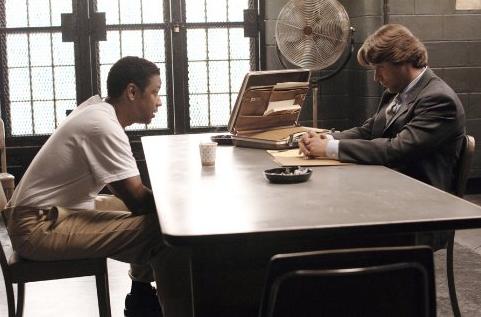
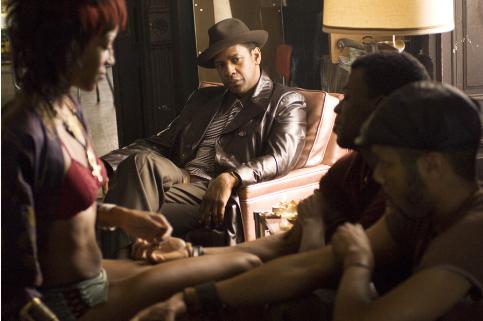
The first is near the end of the film when intrepid cop Richie Roberts (Russell Crowe), whose sole mission is to nail black drug lord Frank Lucas (Denzel Washington), faces off with the busted Lucas in a police interrogation room. He indignantly lectures Lucas that his dope peddling has spread death and destruction that wrecked and ruined hundreds of lives. In the second scene there is a fleeting glimpse of a white soldier shooting up heroin in a servicemen's hangout in Bangkok, Thailand. Other than that scene and a quick look at a white junkie getting whacked by Lucas, there's no hint that the drug racket and the gangsters that run it bribing cops and politicians, and putting an army of small time dealers and bagmen and women on the street are anything but African Americans.
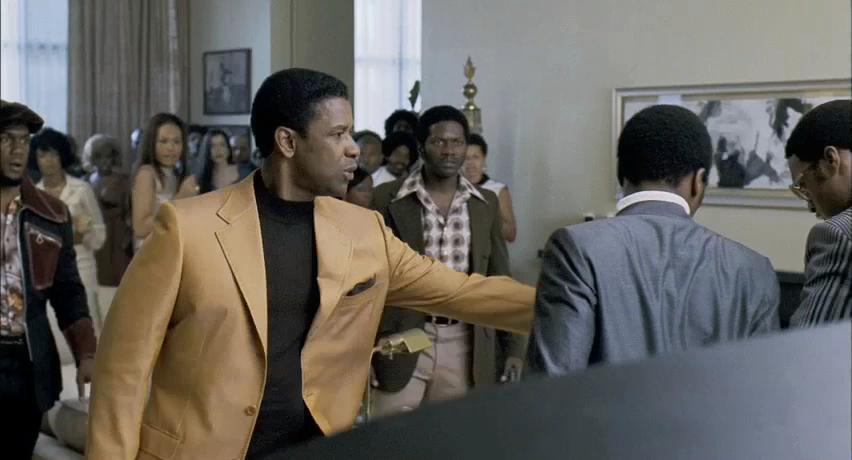
Washington invests in Lucas a chilling mix of charm, business savvy and raw brutality. That further reinforces the notion that a black man can be bigger, smarter, and more audacious than the organized crime racketeers that in decades past ran and still largely run the drug trade in America. They are the ones who hold an iron grip on the foreign growers and suppliers, the transport, street distribution, and the network of banks that launder the dirty money.
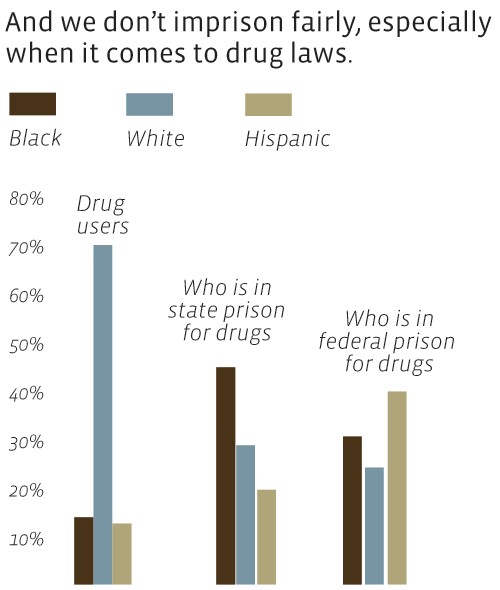
The Centers for Disease Control and Prevention's survey on the sex and drug habits of Americans last June further tossed the ugly glare on who controls and uses drugs in America. The survey found that whites are much more likely to peddle and use drugs than blacks. Non-Hispanic whites had a higher percentage of using cocaine or street drugs (23.5 percent) than blacks (18 percent).
Other studies have found roughly equal rates of drug use by blacks and whites. But what made the CDC survey more eye-catching is that it didn't solely measure generic drug use, but singled out the use of cocaine and street drugs the kind of drugs depicted in "American Gangster."
The findings fly in the face of the conventional drug war wisdom that blacks use and deal street drugs while whites use trendy, recreational designer drugs, and that these presumably include powder cocaine. That once more calls into question the gaping disparity in drug sentencing between whites and blacks.
More than 70 percent of those prosecuted in federal courts for drug possession and sale (mostly small amounts of crack cocaine) and given stiff mandatory sentences are blacks. Though the Supreme Court recently agreed to review the disparities in drug sentencing, it hasn't ruled yet and won't for many months. The majority of those who deal and use crack cocaine aren't violent gang members, but poor, and increasingly female, young blacks. They need help, not jailing.
But that's the morality tale theme that heavily underpins "American Gangster." If you're black and you use drugs you'll either die, become a walking zombie, or rot behind bars. And more than likely the guy that sells the junk will skip away scot-free, live a princely lifestyle, retire with fabulous wealth and, if unlucky enough to get popped, cut a deal to rat out crooked cops or competitors. Lucas did just that and, considering the very real death and destruction that he spread, he waltzed away with a relative hand slap sentence. Then he gives the supreme self-serving rationale for the dirty dealing by wailing that if he didn't do it, somebody else would.
However, the real drug boss rarely looked like him. In fact, Lucas and his black competitor Nicky Barnes (who has a cameo role in the film and is the subject of a recently release documentary, "Mr. Untouchable") are the rarest of rare birds. In the movie, Lucas is portrayed as a black drug boss who supposedly topped the mafia for control of the drug business in Harlem. Through cunning and dumb luck, he found an opening in the Vietnam War, a willing, strategically placed accomplice among the black soldiers in Vietnam, and a supplier to get him the drugs and help with the transport.
It all adds up to one thing: The public scapegoat of blacks for America's drug problem during the past two decades has been relentless, and the at-all-costs hunting down by Richie (Crowe) of Lucas (Washington) in "American Gangster" is a stark testimony to that relentlessness.
The greatest fallout from the nation's hopelessly flawed and failed drug hunt for scapegoats is that it makes it easy for on-the-make politicians to grab votes, garner press attention, and bloat state prison budgets to jail more black offenders, while continuing to feed the illusion that the drug war is winnable. Unfortunately, "American Gangster" won't do anything to change that illusion. (source: http://news.newamericamedia.org/news/view_article.html?article_id=a2edb50c78631dd445454a00ce410d87)
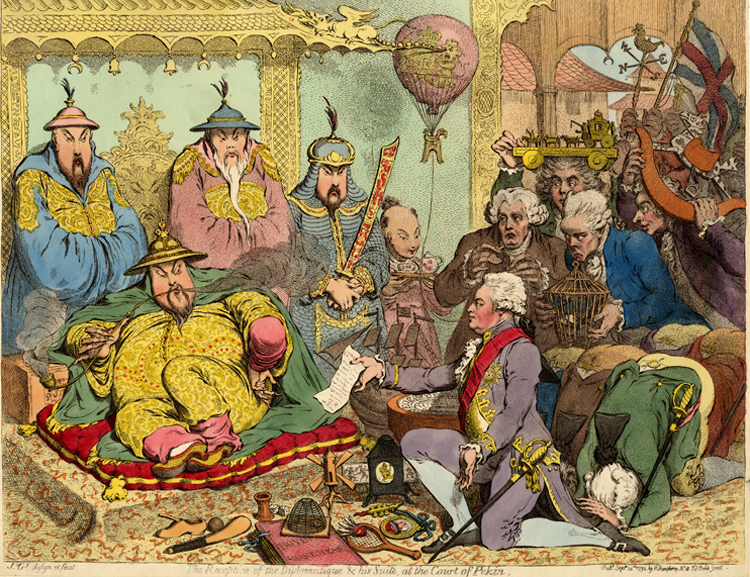
Qian Long [Ch'ien Lung], (r. 1735-1795) ruled China for much of the 18th century, the last period in which China was strong enough to resist, or better, disdain external influence. Here is letter he sent in response to a request from George III of Britain (r. 1760-1820) for trade privileges. In 1793, while Britain was in the midst of the French Revolutionary situation in Europe, China retained its freedom to act as it wished. But within 50 years, all was to change. By the 1840s the British were able to sail into China's rivers and destroy its fleets.
China's Emperor Qianlong
You, O King, live beyond the confines of many seas, nevertheless, impelled by your humble desire to partake of the benefits of our civilisation, you have dispatched a mission respectfully bearing your memorial. Your Envoy has crossed the seas and paid his respects at my Court on the anniversary of my birthday. To show your devotion, you have also sent offerings of your country's produce.
I have perused your memorial: the earnest terms in which it is couched reveal a respectful humility on your part, which is highly praiseworthy. In consideration of the fact that your Ambassador and his deputy have come a long way with your memorial and tribute, I have shown them high favour and have allowed them to be introduced into my presence. To manifest my indulgence, I have entertained them at a banquet and made them numerous gifts. I have also caused presents to be forwarded to the Naval Commander and six hundred of his officers and men, although they did not come to Peking, so that they too may share in my allembracing kindness.
As to your entreaty to send one of your nationals to be accredited to my Celestial Court and to be in control of your country's trade with China, this request is contrary to all usage of my dynasty and cannot possibly be entertained. It is true that Europeans, in the service of the dynasty, have been permitted to live at Peking, but they are compelled to adopt Chinese dress, they are strictly confined to their own precincts and are never permitted to return home. You are presumably familiar with our dynastic regulations. Your proposed Envoy to my Court could not be placed in a position similar to that of European officials in Peking who are forbidden to leave China, nor could he, on the other hand, be allowed liberty of movement and the privilege of corresponding with his own country; so that you would gain nothing by his residence in our midst.
SET OF 4 EARLY QIANLONG FAMILLE ROSE PLATES. China, c1745
Moreover, our Celestial dynasty possesses vast territories, and tribute missions from the dependencies are provided for by the Department for Tributary States, which ministers to their wants and exercises strict control over their movements. It would be quite impossible to leave them to their own devices. Supposing that your Envoy should come to our Court, his language and national dress differ from that of our people, and there would be no place in which to bestow him. It may be suggested that he might imitate the Europeans permanently resident in Peking and adopt the dress and customs of China, but, it has never been our dynasty's wish to force people to do things unseemly and inconvenient. Besides, supposing I sent an Ambassador to reside in your country, how could you possibly make for him the requisite arrangements? Europe consists of many other nations besides your own: if each and all demanded to be represented at our Court, how could we possibly consent? The thing is utterly impracticable. How can our dynasty alter its whole procedure and system of etiquette, established for more than a century, in order to meet your individual views? If it be said that your object is to exercise control over your country's trade, your nationals have had full liberty to trade at Canton for many a year, and have received the greatest consideration at our hands. Missions have been sent by Portugal and Italy, preferring similar requests. The Throne appreciated their sincerity and loaded them with favours, besides authorising measures to facilitate their trade with China. You are no doubt aware that, when my Canton merchant, Wu Chao-ping, who was in debt to foreign ships. I made the Viceroy advance the monies due, out of the provincial treasury, and ordered him to punish the culprit severely. Why then should foreign nations advance this utterly unreasonable request to be represented at my Court? Peking is nearly two thousand miles from Canton, and at such a distance what possible control could any British representative exercise?
If you assert that your reverence for Our Celestial dynasty fills you with a desire to acquire our civilisation, our ceremonies and code of laws differ so completely from your own that, even if your Envoy were able to acquire the rudiments of our civilisation, you could not possibly transplant our manners and customs to your alien soil. Therefore, however adept the Envoy might become, nothing would be gained thereby.
English: by James Gillray, published 14 September 1792.
Swaying the wide world, I have but one aim in view, namely, to maintain a perfect governance and to fulfil the duties of the State: strange and costly objects do not interest me. If I have commanded that the tribute offerings sent by you, O King, are to be accepted, this was solely in consideration for the spirit which prompted you to dispatch them from afar. Our dynasty's majestic virtue has penetrated unto every country under Heaven, and Kings of all nations have offered their costly tribute by land and sea. As your Ambassador can see for himself, we possess all things. I set no value on objects strange or ingenious, and have no use for your country's manufactures. This then is my answer to your request to appoint a representative at my Court, a request contrary to our dynastic usage, which would only result in inconvenience to yourself. I have expounded my wishes in detail and have commanded your tribute Envoys to leave in peace on their homeward journey. It behoves you, O King, to respect my sentiments and to display even greater devotion and loyalty in future, so that, by perpetual submission to our Throne, you may secure peace and prosperity for your country hereafter. Besides making gifts (of which I enclose an inventory) to each member of your Mission, I confer upon you, O King, valuable presents in excess of the number usually bestowed on such occasions, including silks and curios-a list of which is likewise enclosed. Do you reverently receive them and take note of my tender goodwill towards you! A special mandate.
In the same letter, a further mandate to King George III dealt in detail with the British ambassador's proposals and the Emperor's reasons for declining them.
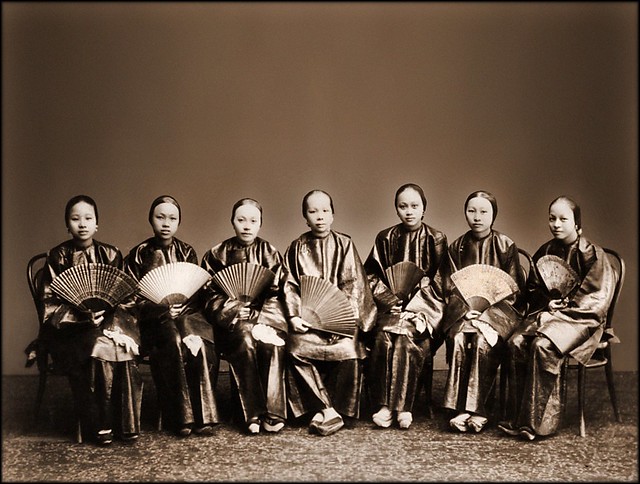
Hong Kong School Boy, 1874
You, O King, from afar have yearned after the blessings of our civilization, and in your eagerness to come into touch with our converting influence have sent an Embassy across the sea bearing a memorial. I have already taken note of your respectful spirit of submission, have treated your mission with extreme favour and loaded it with gifts, besides issuing a mandate to you, O King, and honouring you with the bestowal of valuable presents. Thus has my indulgence been manifested.
Yesterday your Ambassador petitioned my Ministers to memorialise me regarding your trade with China, but his proposal is not consistent with our dynastic usage and cannot be entertained. Hitherto, all European nations, including your own country's barbarian merchants, have carried on their trade with our Celestial Empire at Canton. Such has been the procedure for many years, although our Celestial Empire possesses all things in prolific abundance and lacks no product within its own borders. There was therefore no need to import the manufactures of outside barbarians in exchange for our own produce. But as the tea, silk and porcelain which the Celestial Empire produces, are absolute necessities to European nations and to yourselves, we have permitted, as a signal mark of favour, that foreign hongs [merchant firms] should be established at Canton, so that your wants might be supplied and your country thus participate in our beneficence. But your Ambassador has now put forward new requests which completely fail to recognise the Throne's principle to "treat strangers from afar with indulgence," and to exercise a pacifying control over barbarian tribes, the world over. Moreover, our dynasty, swaying the myriad races of the globe, extends the same benevolence towards all. Your England is not the only nation trading at Canton. If other nations, following your bad example, wrongfully importune my ear with further impossible requests, how will it be possible for me to treat them with easy indulgence? Nevertheless, I do not forget the lonely remoteness of your island, cut off from the world by intervening wastes of sea, nor do I overlook your excusable ignorance of the usages of our Celestial Empire. I have consequently commanded my Ministers to enlighten your Ambassador on the subject, and have ordered the departure of the mission. But I have doubts that, after your Envoy's return he may fail to acquaint you with my view in detail or that he may be lacking in lucidity, so that I shall now proceed . . . to issue my mandate on each question separately. In this way you will, I trust, comprehend my meaning....
(3) Your request for a small island near Chusan, where your merchants may reside and goods be warehoused, arises from your desire to develop trade. As there are neither foreign hongs nor interpreters in or near Chusan, where none of your ships have ever called, such an island would be utterly useless for your purposes. Every inch of the territory of our Empire is marked on the map and the strictest vigilance is exercised over it all: even tiny islets and farlying sandbanks are clearly defined as part of the provinces to which they belong. Consider, moreover, that England is not the only barbarian land which wishes to establish . . . trade with our Empire: supposing that other nations were all to imitate your evil example and beseech me to present them each and all with a site for trading purposes, how could I possibly comply? This also is a flagrant infringement of the usage of my Empire and cannot possibly be entertained.
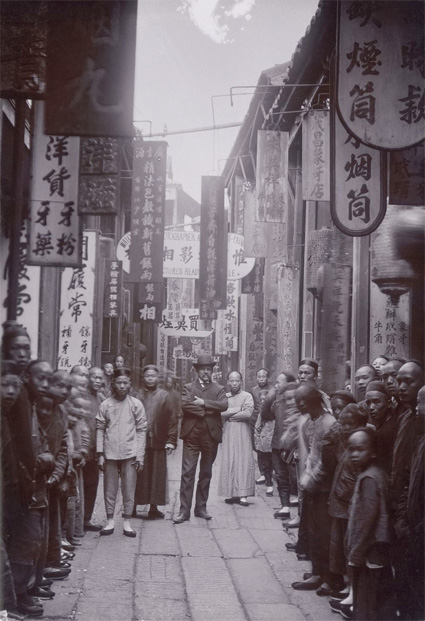
Children in Canton City, 1900
(4) The next request, for a small site in the vicinity of Canton city, where your barbarian merchants may lodge or, alternatively, that there be no longer any restrictions over their movements at Aomen, has arisen from the following causes. Hitherto, the barbarian merchants of Europe have had a definite locality assigned to them at Aomen for residence and trade, and have been forbidden to encroach an inch beyond the limits assigned to that locality.... If these restrictions were withdrawn, friction would inevitably occur between the Chinese and your barbarian subjects, and the results would militate against the benevolent regard that I feel towards you. From every point of view, therefore, it is best that the regulations now in force should continue unchanged....
(7) Regarding your nation's worship of the Lord of Heaven, it is the same religion as that of other European nations. Ever since the beginning of history, sage Emperors and wise rulers have bestowed on China a moral system and inculcated a code, which from time immemorial has been religiously observed by the myriads of my subjects. There has been no hankering after heterodox doctrines. Even the European (missionary) officials in my capital are forbidden to hold intercourse with Chinese subjects; they are restricted within the limits of their appointed residences, and may not go about propagating their religion. The distinction between Chinese and barbarian is most strict, and your Ambassador's request that barbarians shall be given full liberty to disseminate their religion is utterly unreasonable.
It may be, O King, that the above proposals have been wantonly made by your Ambassador on his own responsibility, or peradventure you yourself are ignorant of our dynastic regulations and had no intention of transgressing them when you expressed these wild ideas and hopes.... If, after the receipt of this explicit decree, you lightly give ear to the representations of your subordinates and allow your barbarian merchants to proceed to Chêkiang and Tientsin, with the object of landing and trading there, the ordinances of my Celestial Empire are strict in the extreme, and the local officials, both civil and military, are bound reverently to obey the law of the land. Should your vessels touch the shore, your merchants will assuredly never be permitted to land or to reside there, but will be subject to instant expulsion. In that event your barbarian merchants will have had a long journey for nothing. Do not say that
From E. Backhouse and J. O. P. Bland, Annals and Memoirs of the Court of Peking (Boston: Houghton Mifflin, 1914), pp. 322331 (sources: Fordham University)
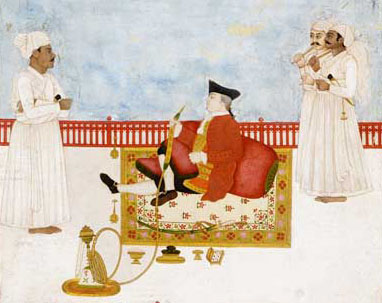
From BBC News on 23 June 2008, 'Opium financed British rule in India,' Leading Indian writer Amitav Ghosh's critically acclaimed new novel Sea of Poppies is set during a time when opium trade out of India was flourishing during British rule.
The novel spans three continents and close to two centuries and is the first in a planned historical trilogy set in the 19th century.
Ghosh, a trained anthropologist and historian with a doctorate from Oxford University, spoke to the BBC's Soutik Biswas on the colonial opium trade.
Sea of Poppies is a historical novel. Is it the fact that the British were the world's biggest opium suppliers two centuries ago that led you into this story?
Ghosh: I should correct you. It was not two centuries ago. Under the British Raj, an enormous amount of opium was being exported out of India until the 1920s.
And no, the opium story was not really the trigger for the novel. What basically interested me when I started this book were the lives of the Indian indentured workers, especially those who left India from the Bihar region.
“ Before the British came, India was one of the world's great economies. For 200 years India dwindled and dwindled into almost nothing ”
But once I started researching into it, it was kind of inescapable - all the roads led back to opium. The indentured emigration [out of India] really started in the 1830s and that was [around the time of] the peak of the opium traffic. That decade culminated in the opium wars against China.
Also all the indentured workers at that time came from all the opium growing regions in the Benares and Ghazipur areas. So there was such an overlap there was no escaping opium.
When and how did you end up researching and learning more about the British opium trade out of India?
Ghosh: I was looking into it as I began writing the book about five years ago. Like most Indians, I had very little idea about opium.
I had no idea that India was the largest opium exporter for centuries. I had no idea that opium was essentially the commodity which financed the British Raj in India.
It is not a coincidence that 20 years after the opium trade stopped, the Raj more or less packed up its bags and left. India was not a paying proposition any longer.
What did you discover in the course of your research? How big was the trade?
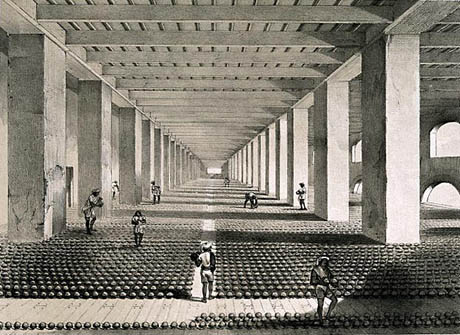
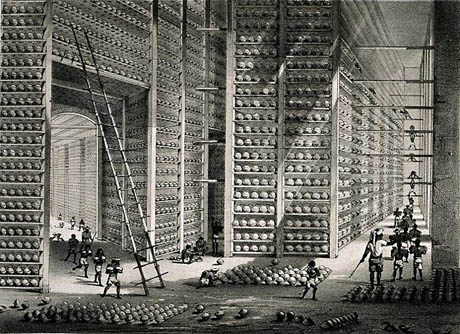
Ghosh: Opium steadily accounted for about 17-20% of Indian revenues. If you think in those terms, [the fact that] one single commodity accounted for such an enormous part of your economy is unbelievable, extraordinary.
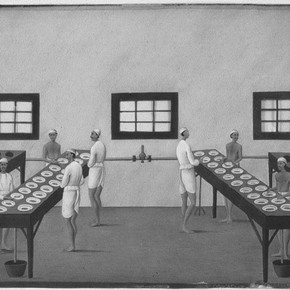
In fact the revenues don't account for entire profits generated [out of opium trade] -there was shipping, there were so many ancillary industries around opium.
How and when did opium exports out of India to China begin?
Ghosh: The idea of exporting opium to China started with Warren Hastings (the first governor general of British India) in 1780.
The situation was eerily similar to [what is happening] today. There was a huge balance of payments problem in relation to China. China was exporting enormous amounts, but wasn't interested in importing any European goods. That was when Hastings came up with idea that the only way of balancing trade was to export opium to China.
In the 1780s he sent the first shipment of opium to China. It was a small shipment and they could hardly get rid of it. There wasn't much demand. [But], within 10 years, demand for opium increased by factors of magnitude. It was incredible - within a period of 10-30 years how much the opium trade spread and increased.
In the period that Hastings started exporting opium in the 1780s until about 1809-1810, most of the opium in India was grown in the Bengal presidency (in eastern India).
After that the Malwa region in western India began growing opium. Finally twice as much opium was growing in western India and there was a huge export from that region. What do you think the major princely states lived off?
What kind of human devastation did opium growing wreak on the Indians?
Ghosh: I can't say I have an accurate picture. Whether it was devastation or not we don't know. There is so little we know [about this aspect].
Some reformers were trying to stop the opium trade and we know from their petitions and letters that there was fair amount of resistance. There seem to have been a lot of difficulties for peasants - they were switching to an agricultural monoculture, and that was causing problems.
With so much poppy being grown, didn't local people get addicted to it?
Ghosh: It happened. One of the curious things I was not aware of was that there are many different ways of consuming opium. One of the ways was to eat it in a bowl. This was somehow the commonest way of taking opium in India - either eating it or dissolving it in water.
East of India and eastwards through China there was a different way of consuming it which was by smoking it. That was very much more addictive.
It was not traditionally the case that people smoked opium in India. Opium also was a part of social life - it was offered during certain ceremonies. So it was a very complex picture.
If there was any direct damage to India, it lay in the disruption of the agricultural timetable. But the damage that was done to China was incalculable.
Both Indian and British history appear to have glossed over this part of colonial rule.
Ghosh: Absolutely. Opium was the fundamental undergirding of our economy for centuries. It is strange that [even] for someone like me who studied history and knew a fair amount about Indian history, I was completely unaware of it.
Why do you think that happened?
Ghosh: I think the reason is some sort of whitewashing of the past.
On the Indian side, there is a sort of shame, I suppose. Also, just a general unawareness. I mean how many people are aware that the Ghazipur opium factory [in India] continues to be one of the single largest opium producers in the world? It is without a doubt the largest legitimate opium factory in the world.
Don't you find it ironic that the tables have turned in a sense with Afghanistan becoming the world's biggest opium producer with most of it sold in the affluent West?
Ghosh: It is strange. But it's an irony in which no one can take any comfort. Opium is a destructive thing for anyone, anywhere.
And it remains a potent driver of economies, at least in a place like Afghanistan..
Ghosh: And, before that in Burma.
Sea of Poppies appears to be a scathing critique of British colonialism. Do you think colonialism has had a pretty easy ride in India and there is not enough examination of the extent of how it affected the country adversely?
Ghosh: It's such an ironic thing. Before the British came, India was one of the world's great economies. For 200 years India dwindled and dwindled into almost nothing. Fifty years after they left we have finally begun to reclaim our place in the world.
All the empirical facts show you that British rule was a disaster for India. Before the British came 25% of the world trade originated in India. By the time they left it was less than 1%.
Lot of Indians believe that the British built institutions, the police, bureaucracy.
Ghosh: I don't know what people think about when they say such things.
When they talk about [the British building] modern institutions it amazes me.
Was there no police force in India before the British came? Of course there was. There were darogas (policemen), there were chowkis (police stations). In fact the British took the word chowki and put it into English. So to say such things is absurd. (source: BBC)