Showing posts with label Medical Experiments. Show all posts

Tuesday, January 31, 2012

Medical Ethics: The Cells of Henrietta Lacks


From the SECOND OPINION in The New York Times, on 2 February 2010, "A Lasting Gift to Medicine That Wasn’t Really a Gift," by Denise Grady: Fifty years after Henrietta Lacks died of cervical cancer in the “colored” ward at Johns Hopkins Hospital, her daughter finally got a chance to see the legacy she had unknowingly left to science. A researcher in a lab at Hopkins swung open a freezer door and showed the daughter, Deborah Lacks-Pullum, thousands of vials, each holding millions of cells descended from a bit of tissue that doctors had snipped from her mother’s cervix.


Ms. Lacks-Pullum gasped. “Oh God,” she said. “I can’t believe all that’s my mother.”

When the researcher handed her one of the frozen vials, Ms. Lacks-Pullum instinctively said, “She’s cold,” and blew on the tube to warm it. “You’re famous,” she whispered to the cells.

Minutes later, peering through a microscope, she pronounced them beautiful. But when she asked the researcher which were her mother’s normal cells and which the cancer cells, his answer revealed that her precious relic was not quite what it seemed. The cells, he replied, were “all just cancer.”


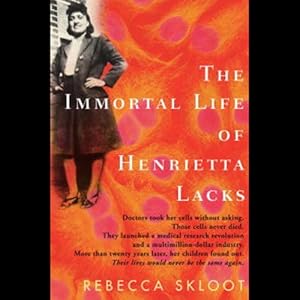
The vignette comes from a gripping new book, “The Immortal Life of Henrietta Lacks” (Crown Publishers), by the journalist Rebecca Skloot. The story of Mrs. Lacks and her cells, and the author’s own adventures with Mrs. Lacks’s grown children (one fries her a pork chop, and another slams her against a wall) is by turns heartbreaking, funny and unsettling. The book raises troubling questions about the way Mrs. Lacks and her family were treated by researchers and about whether patients should control or have financial claims on tissue removed from their bodies.

The story began in January 1951, when Mrs. Lacks was found to have cervical cancer. She was treated with radium at Johns Hopkins, the standard of care in that day, but there was no stopping the cancer. Her doctor had never seen anything like it. Within months, her body was full of tumors, and she died in excruciating pain that October. She was 31 and left five children, the youngest just a year old. She had been a devoted mother, and the children suffered terribly without her.

Neither Mrs. Lacks nor any of her relatives knew that doctors had given a sample of her tumor to Dr. George Gey, a Hopkins researcher who was trying to find cells that would live indefinitely in culture so researchers could experiment on them. Before she came along, his efforts had failed. Her cells changed everything: they multiplied like crazy and never died.


A cell line called HeLa (for Henrietta Lacks) was born. Those immortal cells soon became the workhorse of laboratories everywhere. HeLa cells were used to develop the first polio vaccine, they were launched into space for experiments in zero gravity and they helped produce drugs for numerous diseases, including Parkinson’s, leukemia and the flu. By now, literally tons of them have been produced.

Dr. Gey did not make money from the cells, but they were commercialized. Now they are bought and sold every day the world over, and they have generated millions in profits.

The Lacks family never got a dime. They were poor, with little education and no health insurance, and some had serious physical or mental ailments. But they didn’t even know that tissue had been taken or that HeLa cells even existed until more than 20 years after Mrs. Lacks’s death. And they found out only by accident, when her daughter-in-law met someone from the National Cancer Institute who recognized her surname and said he was working with cells from “a woman named Henrietta Lacks.”


The daughter-in-law rushed home and told Mrs. Lacks’s son, Lawrence, “Part of your mother, it’s alive!”

When they learned that their mother’s cells had saved lives, the family felt proud. But they also felt confused, a bit frightened, used and abused. It had never occurred to anyone to ask permission to take their mother’s tissue, tell them that her cells had changed scientific history or even to say thank you. And certainly no one had ever suggested that they deserved a share of the profits.

Some of the Lackses later gave blood to Hopkins researchers, thinking they were being tested for cancer, when really the scientists wanted their genetic information to help determine whether HeLa cells were contaminating other cultures. When Ms. Lacks-Pullum asked a renowned geneticist at the hospital, Victor McKusick, about her mother’s illness and the use of her cells, he gave her an autographed copy of an impenetrable textbook he had edited, and, Ms. Skloot writes, “beneath his signature, he wrote a phone number for Deborah to use for making appointments to give more blood.”


The bounds of fairness, respect and simple courtesy all seem to have been breached in the case of the Lacks family. The gulf between them and the scientists — race, class, education — was enormous and made communication difficult.

A less charitable view is that it might have made the Lackses easier to ignore. When the family’s story became known in the black community in Baltimore, Ms. Skloot writes, it was seen as the case of a black woman whose body had been exploited by white scientists.

Ideas about informed consent have changed in the last 60 years, and the forms now given to people having surgery or biopsies usually spell out that tissue removed from them may be used for research. But Ms. Skloot points out that patients today don’t really have any more control over removed body parts than Mrs. Lacks did. Most people just obediently sign the forms.

Which is as it should be, many scientists say, arguing that Mrs. Lacks’s immortal cells were an accident of biology, not something she created or invented, and were used to benefit countless others. Most of what is removed from people is of no value anyway, and researchers say it would be too complicated and would hinder progress if ownership of such things were assigned to patients and royalties had to be paid.

But in an age in which people can buy songs with the click of a mouse, that argument may become harder to defend.


So far, the courts have sided with scientists, even in a case in the 1980s in which a leukemia patient’s spleen and other tissues turned out to be a biomedical gold mine — for his doctor. The patient, John Moore, sued his doctor after discovering that the doctor had filed for a patent on his cells and certain proteins they made, and had created a cell line called Mo with a market value estimated at $3 billion. Mr. Moore ultimately lost before the California Supreme Court.

As Ms. Skloot writes in her last chapter, this issue is not going away. If anything, it may become increasingly important, because the scale of tissue research is growing, and people are becoming savvier about the money to be made and also the potential for abuse if tissue samples are used to ferret out genetic information.

The notion of “tissue rights” has inspired a new category of activists. The question that comes up repeatedly is, if scientists or companies can commercialize a patient’s cells or tissues, doesn’t that patient, as provider of the raw material, deserve a say about it and maybe a share of any profits that result? Fewer people these days may be willing to take no for an answer. (source: SECOND OPINION in The New York Time)


Monday, January 30, 2012

Medical Ethics: HeLa Cells from Henrietta Lacks

Henrietta Lacks (1920-1951)

In the New York Times Book Review, from 2 February 2010, reviewer Dwight Garner writes: The woman who provides this book its title, Henrietta Lacks, was a poor and largely illiterate Virginia tobacco farmer, the great-great-granddaughter of slaves. Born in 1920, she died from an aggressive cervical cancer at 31, leaving behind five children. No obituaries of Mrs. Lacks appeared in newspapers. She was buried in an unmarked grave.

To scientists, however, Henrietta Lacks almost immediately became known simply as HeLa (pronounced hee-lah), from the first two letters of her first and last names. Cells from Mrs. Lacks’s cancerous cervix, taken without her knowledge, were the first to grow in culture, becoming “immortal” and changing the face of modern medicine. There are, Ms. Skloot writes, “trillions more of her cells growing in laboratories now than there ever were in her body.” Laid end to end, the world’s HeLa cells would today wrap around the earth three times.

Because HeLa cells reproduced with what the author calls a “mythological intensity,” they could be used in test after test. “They helped with some of the most important advances in medicine: the polio vaccine, chemotherapy, cloning, gene mapping, in vitro fertilization,” Ms. Skloot writes. HeLa cells were used to learn how nuclear bombs affect humans, and to study herpes, leukemia, Parkinson’s disease and AIDS. They were sent up in the first space missions, to see what becomes of human cells in zero gravity.

Bought and sold and shipped around the world for decades, HeLa cells are famous to science students everywhere. But little has been known, until now, about the unwitting donor of these cells. Mrs. Lacks’s own family did not know that her cells had become famous (and that people had grown wealthy from marketing them) until more than two decades after her death, after scientists had begun to take blood from her surviving family members, without their informed consent, in order to better study HeLa.

Ms. Skloot, a young science journalist and an indefatigable researcher, writes about Henrietta Lacks and her impact on modern medicine from almost every conceivable angle and manages to make all of them fascinating. She reports, for example, on the history and science of cellular research, about its pioneers and its calumnies. But “The Immortal Life of Henrietta Lacks” resonates most as a complex and vital human document and a searching moral inquiry into greed and blinkered lives.

Ms. Skloot tells the story of Mrs. Lacks’s life, from those tobacco fields in small-town Clover, Va., to the “colored” ward of Johns Hopkins Hospital in Baltimore in the 1950s, where she was treated for her cancer, and where her cells were harvested. She follows the members of Mrs. Lacks’s family to East Baltimore, where many of them live today, still struggling with her complicated legacy. As one of Mrs. Lacks’s sons says: “She’s the most important person in the world, and her family living in poverty. If our mother so important to science, why can’t we get health insurance?”
Elsie Lacks, Henrietta's older daughter

“The Immortal Life of Henrietta Lacks” is packed with memorable characters, from quirky if brilliant early researchers to Nobel Prize-winning Nazi sympathizers to long-haired Rolling Stone reporters in the 1970s to a con artist known as Sir Lord Keenan Kester Cofield. (Just when you think things can’t get weirder, Judge Joseph Wapner — the “People’s Court” television judge — makes a cameo.)

Ms. Skloot is a memorable character herself. She never intrudes on the narrative, but she takes us along with her on her reporting, as she moves around the country in her battered, muffler-free black Honda. Her most complicated job is to get Mrs. Lacks’s family, who are tired of white people trying to pry information from them, to speak with her. She does eventually win them over. And Mrs. Lacks’s daughter Deborah is dead-on when she says to Ms. Skloot: “Get ready, girl. You got no idea what you gettin’ yourself into.”

Ms. Skloot writes with particular sensitivity and grace about the history of race and medicine in America. Black oral history, she points out, is full of stories about “night doctors,” men who could pluck black patients off the streets to experiment on their bodies. There was some truth behind those tales.


The author traces events like the infamous Tuskegee syphilis study, in which poor and uneducated black men with syphilis were recruited and then allowed to die terrible and entirely preventable deaths, while doctors lied to them and kept life-saving penicillin from them. Ms. Skloot makes it abundantly clear why, when Henrietta Lacks’s family learned that her cells were still living, the images that ran through their minds were straight out of science-fiction horror movies.

Mrs. Lacks had another daughter, Elsie, who was deaf and mute and possibly retarded. Elsie was shipped off at a young age to Crownsville State Hospital in Maryland, formerly known as the Hospital for the Negro Insane, and died there at 15. Perhaps the most devastating moment in this book comes when Ms. Skloot, along with Deborah, finds a grim photograph of Elsie in the hospital’s records and uncovers some of the horrors of what life there must have been like.

“The Immortal Life of Henrietta Lacks” is also, from first page to last, a meditation on medical ethics — on the notion of informed consent, and on the issue of who owns human cells. When they’re in your body, it’s obvious — they’re yours. But once they’ve been removed? All bets are clearly off. (source: The New York Times)


Medical Ethics: "Deadly Monopolies"


The Forbes Magazine's article, "Biological Shock Treatment: A Discussion with "Deadly Monopolies" Author Harriet A. Washington," by Michael Charles Tobias on 20 December 2011 interviews author Harriet Washington:

Michael Tobias: An earlier portion of your book focuses on how the primacy of commercial interests stymie or block medical access to needed medications.

Harriet Washington: Drug companies buy or license the patents of medically important entities that were developed in universities with our tax dollars, then they charge enormous prices that in the US are unfettered by government price controls. It’s my opinion that some corporations halt the testing of medications that they fear will not be profitable blockbusters earning at least $1 billion a year, as PolPharma did with the promising liver cancer drug PI-88; or some companies repurpose drugs for more profitability, if more trivial uses, as when the sleeping sickness drug eflornithine – which few of the afflicted Africans could afford – was pressed into service as a facial depilatory for women at $50 a month.

Companies also ignore or under-develop drugs for scourges of poor people in the developing world such as cholera, malaria, tuberculosis and sleeping sickness even as they pursue profitable drugs for common but relatively trivial disorders such as erectile dysfunction and gastric distress.


Michael Tobias: In your work you’ve referenced a huge discrepancy between pharmaceutical investments in critical versus non-critical drugs, and the line tends to divide straight down the middle of the developed versus developing world.

Harriet Washington: Harvard economist Michael Kremer tells us that of the 1,233 medications developed by the pharmaceutical industries between 1975 and 1997, only 4 targeted the diseases that strike people in the developing world. We’ve had 14 drugs for erectile dysfunction since 1996, although it kills no one. The one new drug for fatal sleeping sickness which threatens 60 million Africans, was withdrawn after five years in which its patent-holder could make no profit.

High prices separate people from the drugs they need as well and in Deadly Monopolies I detail how the industry’s claim that such high prices are necessitated by billions in research and development costs for each new drug is simply untrue. In the West, expensive drugs bankrupt patients: in the developing world, the untreated patients simply die. New cures are often generated from biologicals found among poor native peoples and are often tested in Third World clinics. But once perfected, these medications tend to be priced out of the reach of the communities that made them possible.

Continue reading the entire interview here at Forbes.com

"Deadly Monopolies": Medical Ethicist Harriet Washington on How Firms are Taking Over Life Itself

Black Women and Reproductive Rights


DOROTHY ROBERTS: In contemporary America there is a prevalent belief that poor black women shouldn't have children. And that their having children is the cause of black people's problems, well, indeed, of America's problems. I think for a long time the denigration of black women's reproduction was just ignored by mainstream feminists because they had the image of the white mother in mind. Even though there are restrictions on white mothers, it's a fundamentally different kind of regulation. And then there are other feminists who are so wedded to abortion rights as the most important issue and to abortion as the be all and end all of reproductive freedom that there s a resistance to seeing coercive birth control policies as also being oppressive. They don't get that distributing Norplant and Depo-Provera in poor communities and telling women, "This is what you should use," could be oppressive. (source: MS Magazine)


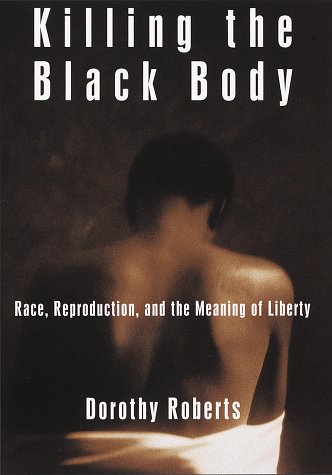
Killing the Black Body: Race, Reproduction, and the Meaning of Liberty


DOROTHY ROBERTS: A perfect example is sterilization. In the seventies, a group of feminists opposed waiting periods and rigid informed consent procedures for sterilization. Women of color said, "Let's put limits on sterilization because doctors are guilty of abuse." But this just didn't register with some of the mainstream reproductive rights groups that had been pushing for greater access to sterilization for white, middle-class women. While poor black women were, in some cases, forcibly sterilized, sometimes without their knowledge, let alone consent, white women had a hard time getting sterilized. There were all sorts of formulas to figure out if you should allow a white woman to be sterilized. This exemplifies how diametrically opposed the experience of the struggle for reproductive rights has been for these two groups. (source: MS Magazine)


DOROTHY ROBERTS: And now there is this boom in popularity for the fertility business, which was primarily designed to help white, middle-class couples have children. That seems like a fundamental moral contradiction that people should be grappling with. We need to think about whether there should be limits on the fertility industry. It's virtually unregulated. The multiple births that result from these technologies point to the contradiction of a public not willing to pay the expenses of one additional child born to a welfare mother, yet willing to support seven children born to a white couple. (source: MS Magazine)

Between 1929 and 1974 over 7,600 people were sterilized by the state of North Carolina.

DOROTHY ROBERTS: Why shouldn't we be able to at least think about, debate, and consider whether there should be limits on the fertility business, which requires public expense so that a particular group of people can have children? But white men, especially, get very upset when you start questioning their right to have children. I can't tell you the number of red faces I've encountered. People get very defensive when you suggest that their decisions about having children might have some racial implications. The response I get all the time is, "This has nothing to do with racism. I just want children like me." (source: MS Magazine)


DOROTHY ROBERTS: The thing about reproduction is that, more than anything else, it tells you how a society values people. When many black groups read my book and invite me to speak, their focus is on genocide. I actually don't claim that these are policies designed to eliminate black people. I think it functions more on the ideological level to support a whole host of policies that keep blacks at the bottom. But I'm not so sanguine as to say that they couldn't have that aim at some point. There is a danger that when the public gets used to policies that use reproduction as a solution to social problems, they might be more amenable in the future to actual policies of genocide. Around the time Norplant came out, an editorial in the Philadelphia Inquirer suggested it was a solution to black poverty. The paper did issue an apology, but a lot of people supported it. And there was legislation proposed all over the country to use Norplant to keep poor black women from having children. And then there's CRACK, Children Requiring a Caring Kommunity, a private organization that offers women who use drugs and alcohol $200 to be sterilized. People jumped on that as the solution to drug use during pregnancy. It is scary that people will leap to these drastic solutions involving reproduction when we dont have adequate health care or drug treatment. These policies support high incarceration rates for black people, high removal rates of black children from their homes by the child welfare system, and a horrible education system. They say we don't need to spend money on social welfare programs or figure out racism and poverty; the solution is to keep these people from having children. (source: MS Magazine)


DOROTHY ROBERTS: I am a firm believer that you start with the experiences of the most oppressed people. It expands our view of what reproductive liberty is. And the [job of feminists] has to be to expand the way we think about reproductive freedom. I've had lots of debates with activists who argue that the way to appeal to a broad white audience is to place white middle-class women's issues at the forefront, because those women are more likable and empathetic. One example is in the prosecution of substance abuse during pregnancy. Even though most of the prosecutions were against poor black women who smoked crack, the strategy in California, for example, was to make this about the infringement on the liberties of white middle-class women. They tried to make the argument that if this kind of policy keeps going on, in time, you wont be able to drink coffee while you re pregnant. But you don't get any fundamental change this way. You have to focus on the people who are being hit the hardest and figure out an agenda that centers on them. The difficult question is, how do you get around the fact that many white Americans won't do anything that they see as benefiting black people? (source: MS Magazine)

Tuesday, January 24, 2012

Federal Medical Advisers Want To Medically Abuse Black Prisoners Again

Several government agencies and private companies tested pharmaceuticals on inmates at Holmesburg prison in Philadelphia from 1951 to 1974.

The New York Times article, "Panel Suggests Using Inmates in Drug Trials," by Ian Urbina, on 13 August 2006: PHILADELPHIA, Aug. 7 — An influential federal panel of medical advisers has recommended that the government loosen regulations that severely limit the testing of pharmaceuticals on prison inmates, a practice that was all but stopped three decades ago after revelations of abuse.

The proposed change includes provisions intended to prevent problems that plagued earlier programs. Nevertheless, it has dredged up a painful history of medical mistreatment and incited debate among prison rights advocates and researchers about whether prisoners can truly make uncoerced decisions, given the environment they live in.


Supporters of such programs cite the possibility of benefit to prison populations, and the potential for contributing to the greater good.

Until the early 1970’s, about 90 percent of all pharmaceutical products were tested on prison inmates, federal officials say. But such research diminished sharply in 1974 after revelations of abuse at prisons like Holmesburg here, where inmates were paid hundreds of dollars a month to test items as varied as dandruff treatments and dioxin, and where they were exposed to radioactive, hallucinogenic and carcinogenic chemicals.

In addition to addressing the abuses at Holmesburg, the regulations were a reaction to revelations in 1972 surrounding what the government called the Tuskegee Study of Untreated Syphilis in the Negro Male, which was begun in the 1930’s and lasted 40 years. In it, several hundred mostly illiterate men with syphilis in rural Alabama were left untreated, even after a cure was discovered, so that researchers could study the disease.

“What happened at Holmesburg was just as gruesome as Tuskegee, but at Holmesburg it happened smack dab in the middle of a major city, not in some backwoods in Alabama,” said Allen M. Hornblum, an urban studies professor at Temple University and the author of “Acres of Skin,” a 1998 book about the Holmesburg research. “It just goes to show how prisons are truly distinct institutions where the walls don’t just serve to keep inmates in, they also serve to keep public eyes out.”

Critics also doubt the merits of pharmaceutical testing on prisoners who often lack basic health care.


Alvin Bronstein, a Washington lawyer who helped found the National Prison Project, an American Civil Liberties Union program, said he did not believe that altering the regulations risked a return to the days of Holmesburg.

“With the help of external review boards that would include a prisoner advocate,” Mr. Bronstein said, “I do believe that the potential benefits of biomedical research outweigh the potential risks.”

Holmesburg closed in 1995 but was partly reopened in July to help ease overcrowding at other prisons.


Under current regulations, passed in 1978, prisoners can participate in federally financed biomedical research if the experiment poses no more than “minimal” risks to the subjects. But a report formally presented to federal officials on Aug. 1 by the Institute of Medicine of the National Academy of Sciences advised that experiments with greater risks be permitted if they had the potential to benefit prisoners. As an added precaution, the report suggested that all studies be subject to an independent review.

“The current regulations are entirely outdated and restrictive, and prisoners are being arbitrarily excluded from research that can help them,” said Ernest D. Prentice, a University of Nebraska genetics professor and the chairman of a Health and Human Services Department committee that requested the study. Mr. Prentice said the regulation revision process would begin at the committee’s next meeting, on Nov. 2.

The discussion comes as the biomedical industry is facing a shortage of testing subjects. In the last two years, several pain medications, including Vioxx and Bextra, have been pulled off the market because early testing did not include large enough numbers of patients to catch dangerous problems.


And the committee’s report comes against the backdrop of a prison population that has more than quadrupled, to about 2.3 million, over the last 30 years and that disproportionately suffers from H.I.V. and hepatitis C, diseases that some researchers say could be better controlled if new research were permitted in prisons.

For Leodus Jones, a former prisoner, the report has opened old wounds. “This moves us back in a very bad direction,” said Mr. Jones, who participated in the experiments at Holmesburg in 1966 and after his release played a pivotal role in lobbying to get the regulations passed.

In one experiment, Mr. Jones’s skin changed color, and he developed rashes on his back and legs where he said lotions had been tested.

“The doctors told me at the time that something was seriously wrong,” said Mr. Jones, who added that he had never signed a consent form. He reached a $40,000 settlement in 1986 with the City of Philadelphia after he sued.

“I never had these rashes before,” he said, “but I’ve had them ever since.”


Holmesburg Prison

The Institute of Medicine report was initiated in 2004 when the Health and Human Services Department asked the institute to look into the issue. The report said prisoners should be allowed to take part in federally financed clinical trials so long as the trials were in the later and less dangerous phase of Food and Drug Administration approval. It also recommended that at least half the subjects in such trials be nonprisoners, making it more difficult to test products that might scare off volunteers.

Dr. A. Bernard Ackerman, a New York dermatologist who worked at Holmesburg during the 1960’s trials as a second-year resident from the University of Pennsylvania, said he remained skeptical. “I saw it firsthand,” Dr. Ackerman said. “What started as scientific research became pure business, and no amount of regulations can prevent that from happening again.”

Others cite similar concerns over the financial stake in such research.

“It strikes me as pretty ridiculous to start talking about prisoners getting access to cutting-edge research and medications when they can’t even get penicillin and high-blood-pressure pills,” said Paul Wright, editor of Prison Legal News, an independent monthly review. “I have to imagine there are larger financial motivations here.”


Holmesburg Guard Tower

The demand for human test subjects has grown so much that the so-called contract research industry has emerged in the past decade to recruit volunteers for pharmaceutical trials. The Tufts Center for the Study of Drug Development, a Boston policy and economic research group at Tufts University, estimated that contract research revenue grew to $7 billion in 2005, up from $1 billion in 1995.

But researchers at the Institute of Medicine said their sole focus was to see if prisoners could benefit by changing the regulations.

The pharmaceutical industry says it was not involved. Jeff Trewitt, a spokesman for the Pharmaceutical Research and Manufacturers of America, a drug industry trade group, said that his organization had no role in prompting the study and that it had not had a chance to review the findings.

Dr. Albert M. Kligman, who directed the experiments at Holmesburg and is now an emeritus professor of dermatology at the University of Pennsylvania Medical School, said the regulations should never have been written in the first place.

“My view is that shutting the prison experiments down was a big mistake,” Dr. Kligman said.


Holmesburg Prison

While confirming that he used radioactive materials, hallucinogenic drugs and carcinogenic materials on prisoners, Dr. Kligman said that they were always administered in extremely low doses and that the benefits to the public were overwhelming.

He cited breakthroughs like Retin A, a popular anti-acne drug, and ingredients for most of the creams used to treat poison ivy. “I’m on the medical ethics committee at Penn,” he said, “and I still don’t see there having been anything wrong with what we were doing.”

From 1951 to 1974, several federal agencies and more than 30 companies used Holmesburg for experiments, mostly under the auspices of the University of Pennsylvania, which had built laboratories at the prison. After the revelations about Holmesburg, it soon became clear that other universities and prisons in other states were involved in similar abuses.

In October 2000, nearly 300 former inmates sued the University of Pennsylvania, Dr. Kligman, Dow Chemical and Johnson & Johnson for injuries they said occurred during the experiments at Holmesburg, but the suit was dismissed because the statute of limitations had expired.

“When they put the chemicals on me, my hands swelled up like eight-ounce boxing gloves, and they’ve never gone back to normal,” said Edward Anthony, 62, a former inmate who took part in Holmesburg experiments in 1964. “We’re still pushing the lawsuit because the medical bills are still coming in for a lot of us.”

Daniel S. Murphy, a professor of criminal justice at Appalachian State University in Boone, N.C., who was imprisoned for five years in the 1990’s for growing marijuana, said that loosening the regulations would be a mistake.

“Free and informed consent becomes pretty questionable when prisoners don’t hold the keys to their own cells,” Professor Murphy said, “and in many cases they can’t read, yet they are signing a document that it practically takes a law degree to understand.”
Holmesburg Prison

During the Holmesburg experiments, inmates could earn up to $1,500 a month by participating. The only other jobs were at the commissary or in the shoe and shirt factory, where wages were usually about 15 cents to 25 cents a day, Professor Hornblum of Temple said.

On the issue of compensation for inmates, the report raised concern about “undue inducements to participate in research in order to gain access to medical care or other benefits they would not normally have.” It called for “adequate protections” to avoid “attempts to coerce or manipulate participation.’’

Holmesburg Prison

The report also expressed worry about the absence of regulation over experiments that do not receive federal money. Lawrence O. Gostin, the chairman of the panel that conducted the study and a professor of law and public health at Georgetown University, said he hoped to change that.

Even with current regulations, oversight of such research has been difficult. In 2000, several universities were reprimanded for using federal money and conducting several hundred projects on prisoners without fully reporting the projects to the appropriate authorities.


Holmesburg Prison South Gate

Professor Gostin said the report called for tightening some existing regulations by advising that all research involving prisoners be subject to uniform federal oversight, even if no federal funds are involved. The report also said protections should extend not just to prisoners behind bars but also to those on parole or on probation.

Professor Murphy, who testified to the panel as the report was being written, praised those proposed precautions before adding, “They’re also the parts of the report that faced the strongest resistance from federal officials, and I fear they’re most likely the parts that will end up getting cut as these recommendations become new regulations.”

Saturday, November 26, 2011

Medical Ethics and Dr. Wouter Basson

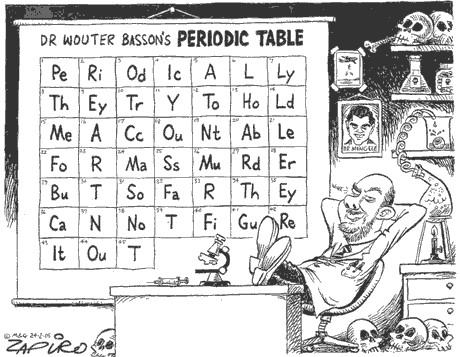
Wouter Basson ran the apartheid-era regime's germ and chemical warfare program, Project Coast. He is charged with manufacturing dangerous drugs, some of which allegedly were used on activists.
From the Los Angeles Times, on 27 September 2011, by Robyn Dixon: Reporting from Johannesburg, South Africa — In South Africa, they call him "Dr. Death."

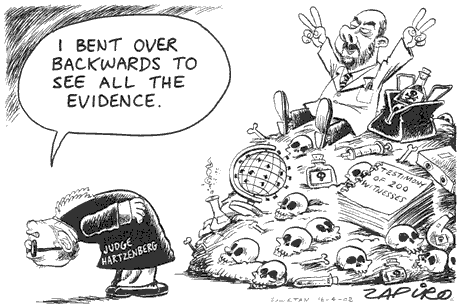
Wouter Basson, who ran the apartheid government's secret germ and chemical warfare program, Project Coast, once was accused of trying to create poisons that were lethal only to blacks. He was acquitted by a judge in 2002 of charges that included murder and drug possession.


But more than 20 years after he ran Project Coast, Basson's quiet life as a cardiologist in Cape Town is being threatened.

He is facing an inquiry by the Health Professions Council of South Africa for unethical conduct. If found guilty, he could be struck off the medical roll and lose his right to practice.

Basson is charged with manufacturing dangerous drugs in the 1980s and '90s, some of which allegedly were used on antiapartheid activists abducted by security forces.
He has acknowledged that he was given a free hand and almost unlimited budget to run Project Coast, which designed, tested, manufactured and deployed toxic weapons. He traveled the world, researching biological weapons.

Steven Miles, a medical ethics expert at the University of Minnesota, told a council hearing Tuesday in Pretoria that Basson's work on chemical and germ warfare had violated medical ethics and breached the laws of humanity. Basson's work was repugnant to the conscience of humankind, Miles said.


"The ethical core of medicine is to promote health. Dr. Basson's work risked causing disabilities, deaths and permanent brain damage," Miles said, adding that a doctor's moral duty to save lives was the same in times of peace and war.

Much of what Basson did was top secret. He ran a unit called Delta G, a secret chemical warfare facility that tested 24 different incapacitating agents during his tenure, according to evidence at his 2002 trial.


Basson said at his trial that he had no moral problem creating weapons with tear gas or drugs. But he argued that he was only following orders during the years he worked for the apartheid military, from 1981 to '93.

The health council has dropped several charges against Basson for lack of evidence, including some stemming from the alleged use of South African troops to test drugs such as Mandrax, ecstasy, tear gas and an incapacitating agent, BZ.


He still faces charges before the council involving thousands of mortar bombs allegedly equipped with tear gas, to be sent to Angola, cyanide capsules that would enable apartheid operatives to commit suicide and drugs aimed at disorienting prisoners.

Miles said Basson acted unethically by supplying a paralyzing drug to agents for use in abductions of antiapartheid activists outside South Africa. It was known at the time that the drug, scoline, could cause respiratory failure, muscle damage and kidney failure, he said.


An article Tuesday in the South African newspaper, Daily Maverick, criticized Basson for what it called his lack of remorse.

"He stands up and says he would do it all again, if confronted with the same decisions. As historical figures go, he's pretty unique on that score," the article says. "Because as a man who provided the drugs, the biological weapons, for the apartheid regime, what he did was really horrendous. It was he who literally ran the whole show in the theatre of horror."


Basson told reporters Monday that he just wanted to get on with his job as a doctor.

"I closed this chapter 20 years ago," he said. "All I want is to continue serving the country as a medical professional." (source: Los Angeles Times)


South Africa's Doctor Death, Cardiologist Wouter Basson

From the Irish Times, "South Africa's 'Dr Death' would like the past to stay in the past," by Bill Corcoran on October 2011: CAPE TOWN LETTER: Anti-apartheid activists considered him one of their most ghoulish adversaries but Wouter Basson wants to be let run his medical practice

THE MAN nicknamed “Dr Death” by the South African media over a decade ago for his role as head of the apartheid government’s germ warfare programme began a fight to retain his life as a medical practitioner last week.

Doctor Death, Cardiologist Wouter Basson


Cardiologist Wouter Basson does not strike fear into the heart of most South Africans anymore, but there was a time throughout the 1980s when anti-apartheid activists would have considered him one of their most ghoulish adversaries.

Between 1981 and 1993, Basson was head of Project Coast, the South African army’s top secret biological and chemical warfare programme, where he allegedly oversaw the development of poisons and biological weapons for use against enemies of the state.


Among numerous other things, the 61-year-old was accused of being involved in the creation of poisons that targeted black people, and of administering sedatives to dozens of anti-apartheid fighters then thrown from a plane to their deaths.

In the mid-1990s, when South Africa’s Truth and Reconciliation Commission started to investigate his role in Project Coast as part of its efforts to find out what happened security forces’ victims, Basson refused to participate in the process. However, in 1999, he was forced to reveal the extent of his involvement after a total of 67 different criminal charges were brought against him.


The charges related to 229 murders – 200 of which were carried out in Namibia – and conspiracy to commit murder, drug possession, drug trafficking, fraud and the embezzlement of €36 million. During his trial, Basson admitted heading up Project Coast, and that the programme had developed “24 different incapacitating substances . . . over the years”. But he was adamant he was innocent of any wrongdoing, arguing he acted under orders of the South African Defence Force.

Much to the dismay of state prosecutors, after a marathon 30-month trial, Basson was acquitted of all the charges against him and was granted amnesty. In relation to the 200 deaths in Namibia, the judge ruled a South African court did not have jurisdiction to prosecute crimes committed in other countries.


After the trial, Basson established a private practice in Durbanville, a small town outside of Cape Town, and it appeared that one of South Africa’s most infamous individuals would be allowed to put his past behind him and live out his life in relative peace and quiet.

However, the Health Professions Council of South Africa had other ideas. In 2007, the body brought six charges against Basson relating to whether he breached the medical code of ethics while overseeing Project Coast.


They included allegations that he manufactured mandrax, ecstasy and other drugs to sedate apartheid-era prisoners of the South African Defence Forces.

In addition, he is charged with providing cyanide capsules to security force members for the purposes of committing suicide if captured, and with “weaponising thousands of 120mm mortars with tear gas for use in Angola”.

It has taken the health professions council four years to get Basson to appear before the inquiry, due to his ongoing efforts to thwart the process.


Last year, the Pretoria high court dismissed an application by Basson to have the inquiry halted. Basson wanted the hearing to be found unlawful, unreasonable and unfair. During a break last Monday on the first day of the medical inquiry in Pretoria, he told reporters gathered outside the hearing that, as far as he was concerned, the past should stay in the past. “I closed this chapter 20 years ago,” he said. “All I want is to continue serving the country as a medical professional.”

Whether he gets to do this or not now depends on the council’s ruling in the inquiry. If he is found guilty, the body has the power to revoke his medical licence.

On Monday, Basson confirmed he co-ordinated research for Project Coast, but said he never crossed the ethical boundaries of his profession.


“The accused denies that any unlawful conduct of any nature and/or research or conduct contrary to any relevant convention or rule of the relevant national or international authorities was ever pursued or executed in the project,” he stated in a written explanation.

While a full week of witness evidence has unfolded in the hearing, observers say there is a strong likelihood the case could drag on for months, if not longer, as the ins and outs of medical ethics are presented by witnesses for both sides.

So will Basson’s past eventually catch up with him? Only time will tell. But until the inquiry is finalised, he remains free to continue in the medical profession. (source: Irish Times)

HOME

HOME
Click here to return to the US Slave Home Page