Tuesday, November 12, 2013

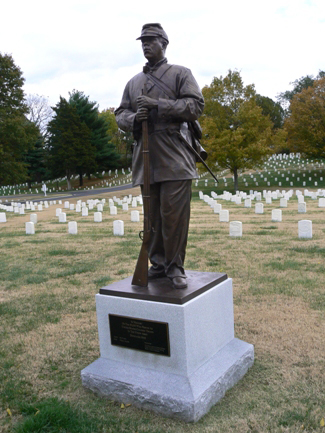
A Statue Honoring US Colored Troops At The Nashville National Cemetary


According to the Civil War News, "New Statue At Nashville Cemetery Honors USCT [United States Colored Troops] Troops," by Gregory L. Wade, on April 2006  --  NASHVILLE, Tenn. - On a brutally cold February morning, about 200 people from diverse walks of life attended the dedication of an African American infantryman statue in Nashville's National Cemetery in honor of U.S. Colored Troops buried there.

The local and national officials, reenactors, church choir members and others had one thing in common - they shivered in the unusually bitter cold to witness the recognition deservedly being given to Tennessee's Civil War soldiers of color.

Concerning the cold, State Senator Thelma Harper was heard saying, "Later we can get back to our warm cars. Those soldiers long ago had to endure much more than this for their cause."


The nine-foot cast bronze statue, created by Middle Tennessee artist Roy Butler, is one of a very few "freestanding monuments to African American soldiers in the country and the only one in a national facility," according to Norm Hill, chairman of the Tennessee Historical Commission.

The project was coordinated by the African American Cultural Alliance of Nashville. The funds for the $80,000 project came from a variety of area contributors, while the Tennessee Historical Commission contributed $15,000.

"This was a grassroots effort which included church contributions, individual citizens, businesses and other Civil War groups including the Sons of Confederate Veterans (SCV)," said Hill. "This isn't about North or South. That was then. Today this is about honoring our fallen soldiers."

He related that they went down to Shiloh National Military Park a few months earlier to help the SCV dedicate the new Tennessee Confederate monument "and they are here today to help us."

The idea for the memorial came up a few years ago during Black History Month at a Nashville university. Kwame Leo Lillard of the African American Cultural Alliance had longed for such recognition for years.


"I wanted us to never forget those men, most who fled slavery to fight and die for freedom," he told the crowd. The contribution of the USCTs to the war deserves greater visibility, especially the role of the Tennesseans in the conflict, he pointed out.

It is believed Tennessee contributed about 20,000 black troops to the Union cause during the war. More than 400 "unknown" African American troops are among some 1,500 buried in the Nashville cemetery.

Most of them came from Middle Tennessee and Kentucky battles including the Battles of Nashville and Franklin. They were reinterred from at least 251 burial sites, according to cemetery documents.

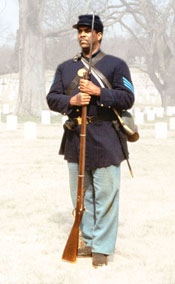
Bill Radcliff, a Nashville firefighter and reenactor with the 13th U.S. Colored Troops, served as the model for the statue. For many years Radcliff went to Fort Negley in Nashville on the anniversary date of the battle of Nashville to sit and meditate.

"After awhile others came and joined him and now an entire group goes every anniversary to reflect on what those men did," according to Patricia Floyd, Radcliff's fiancˆ©e and period reenactor herself. Because of that dedication he was chosen as the model.

"Bill would not look at the statue until it was unveiled," says Floyd. "When the covering came down we both broke down with emotion. It was quite an honor."

William Tuerk, Under Secretary for Memorial Affairs in the Department of Veterans Affairs, was keynote speaker. Also speaking were Lillard, Hill, Radcliff and Michael Crutcher as black abolitionist Frederick Douglass. In honor of Radcliff, several members of the Nashville fire department attended, including former Chief Buck Dozier.


Darlene Richardson, Historian for the National Cemetery Administration, U.S. Department of Veterans Affairs, said, "The USCT memorial at Nashville National Cemetery is a beautiful and well done tribute to the U.S. Colored Troops - a commemoration that was long overdue."

After the presentations, a short procession took the crowd across the snowy and windswept grounds to the veiled statue. Despite the cold, few left until the canvas covering was removed to reveal the likeness that will stand watch over the soldiers buried there "for at least another 100 years," said Hill.

The Nashville National Cemetery was established as a U.S. Military Cemetery in January 1867. There are 16,485 Union troops interred there and today it contains a total of 33,258 graves. The cemetery has records of 12,769 Civil War era soldiers available.  (source: Civil War News)


African Americans in the Civil War

African Americans in the Civil War: Equality Earned With Blood

"Freedom to the slave should now be proclaimed from the Capitol, and should be seen above the smoke and fire of every battle field, waving from every loyal flag."
—Frederick Douglass, 1861

From the National Geographic Magazine, "African Americans in the Civil War: Equality Earned With Blood," by Shelley Sperry  --  America's Civil War battlefields are sacred in large measure because on that soil a war to preserve the Union became a war to end human slavery. But through the course of the conflict, a new cause emerged, one that anticipated the next century's great struggle as African-American soldiers who fought on those bloody fields demanded not only freedom but equality. In December 1861, less than a year after the guns began firing, Secretary of War Simon Cameron suggested that slaves should be freed and recruited as laborers and soldiers for the Union cause. President Abraham Lincoln responded with a new job for the secretary, who was soon on his way to St. Petersburg as the minister to Russia. A few months earlier two Union generals had attempted to free slaves in areas under Federal control, but superiors nullified their orders. Despite these rebukes, African Americans and their white allies kept emancipation and the right of all Americans to serve in the military at the forefront of public debate about the war.

By July 1862, Lincoln announced to his Cabinet that he would soon be using his war powers to free slaves in the rebellious states. In the same month the Militia Act allowed the Army and Navy to employ "persons of African descent," and, in some cases, granted freedom to the families of those who served. Although designed mainly to let escaped slaves become laborers for Yankee forces occupying the South, the act produced black Army units in New Orleans and the Sea Islands of South Carolina.

Secretary of War Simon Cameron

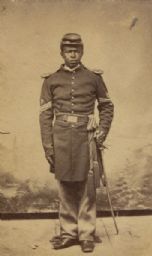
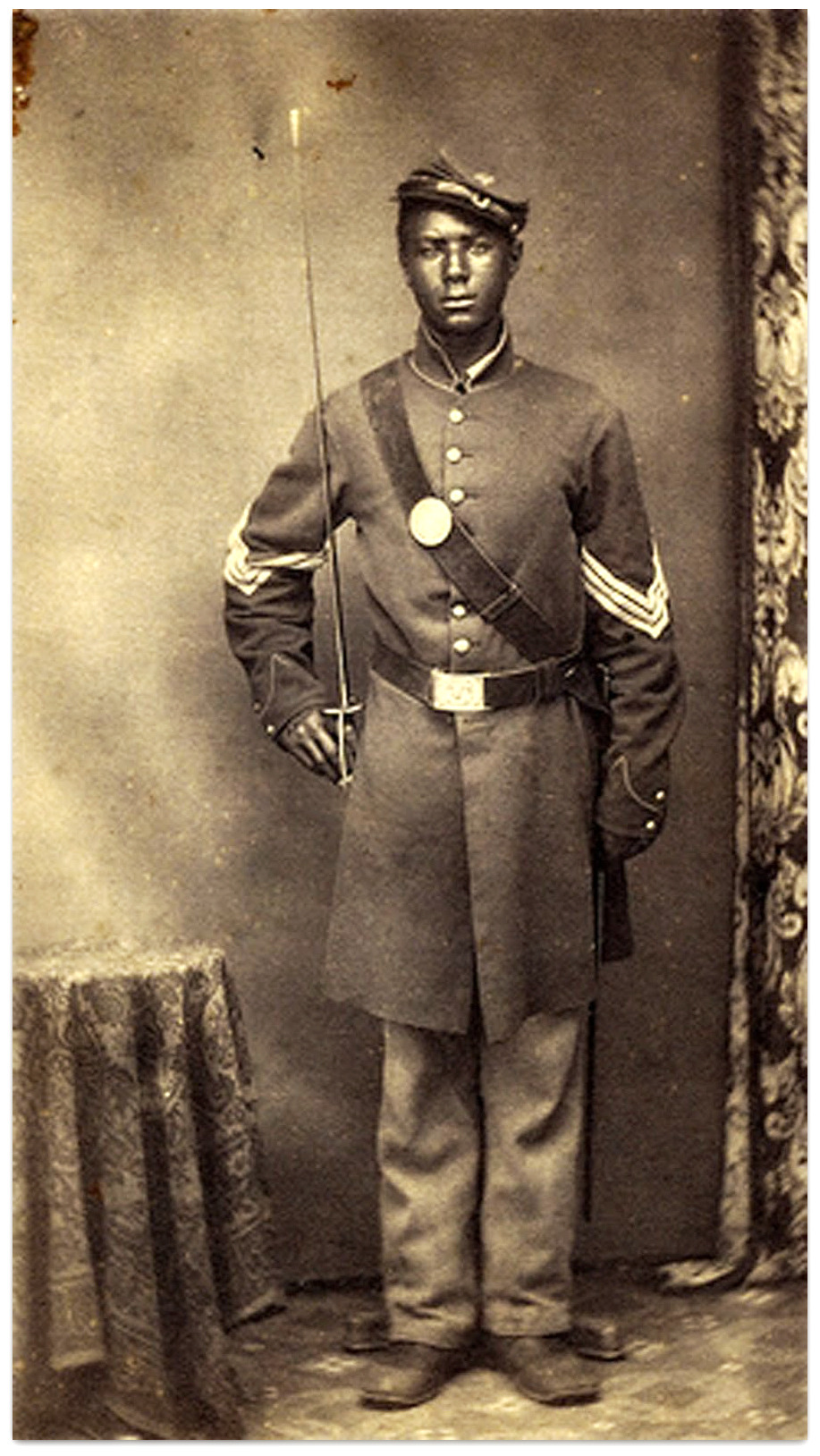
Once Lincoln's Emancipation Proclamation went into effect in January 1863—formally allowing the Union Army to recruit African Americans—a wave of volunteers flooded the North. A few months later a new Bureau of Colored Troops began overseeing the segregated units. In key battles at Port Hudson, Louisiana, and Fort Wagner, South Carolina, black soldiers stunned once skeptical white officers with their courage and fighting skills.

But beyond the blood and smoke of the battlefields, African-American soldiers were also engaged in a dramatic fight for equality with their white comrades on two fronts: They wanted to be treated as equals by the enemy as well as by their own government.


"Never let them sell our colored soldiers for slaves"

As soon as African Americans appeared in uniform, the Confederate government declared that captured black soldiers would not be considered prisoners of war but would be treated as fugitive slaves, even if the men had been free upon entering the Army. Many Northerners feared this would mean torture or even murder. Indeed, some Southern officers immediately executed captured black soldiers. A July 1863 letter from Hannah Johnson, mother of an African-American soldier who fought with the 54th Massachusetts Infantry at Fort Wagner, urged the President to act fairly and protect men like her son:
Excellent Sir
. . . I know that a colored man ought to run no greater risques than a white . . . So why should not our enemies be compelled to treat him the same. . . . they said Mr. Lincoln will never let them sell our colored soldiers for slaves, if they do he will get them back quck he will rettallyate and stop it. Now Mr. Lincoln don't you think you oght to stop this thing and make them do the same by the colored men.
Shortly before he received the letter, Lincoln pledged that the Union Army would indeed retaliate against Confederates if the South did not accord black prisoners the same treatment as whites. Yet the North offered no retaliation for Rebel atrocities at Fort Pillow, Tennessee, where scores of black soldiers were massacred in April 1864.

"We have done a Soldiers Duty. Why cant we have a Soldiers pay?"

While the controversy over prisoners of war raged, the U.S. government was using the Militia Act of 1862 to justify paying all black soldiers—whom it regarded as laborers—less than half the monthly wages of white soldiers. African Americans earned ten dollars a month, from which three dollars was deducted for clothing. White soldiers of the same rank received $13 a month plus clothing or cash worth more than three dollars. The Militia Act primarily applied to former slaves who worked as laborers for the Union Army, and many free blacks who had enlisted to serve their country deeply resented treatment that equated them with slaves. In September 1863, Cpl. James Henry Gooding wrote to President Lincoln to state the case of his comrades as clearly as possible:
Now the main question is. Are we Soldiers, or are we LABOURERS. We are fully armed, and equipped, have done all the various Duties, pertaining to a Soldiers life, have conducted ourselves, to the complete satisfaction of General Officers, who, were if any, prejudiced against us, but who now accord us al the encouragement, and honour due us. . . . have dyed the ground with blood, in defense of the Union, and Democracy. . . . We have done a Soldiers Duty. Why cant we have a Soldiers pay?
The men of the 54th Massachusetts Infantry continued to serve, but refused to accept any pay at all until the U.S. government—the institution they were fighting to preserve—treated them as equal to their white comrades. What could be more absurd than accepting demeaning wages and treatment based on their race, while sacrificing their lives to end race-based slavery? In response, the governor of Massachusetts convinced the state legislature to make up the difference between the black and white soldiers' pay, but the soldiers refused it. It was a matter of pride. As one declared: "We did not come to fight for money . . . [but for the principle] that made us men when we enlisted."


In November 1863 Sgt. William Walker of the 3rd South Carolina Volunteers led a group of men to lay down their arms in Jacksonville, Florida, and resign from the Army in protest, arguing that they had been promised equal treatment when they enlisted. Walker's case prompted increased public discussion of the issue, and in December Secretary of War Edwin Stanton asked that the pay of all soldiers be equalized. The families of black soldiers suffered as opposition and long debates in Congress delayed the action. In February 1864 Sergeant Walker was court-martialed and shot for mutiny.

Finally, in June 1864 Congress passed legislation giving black soldiers equal pay, retroactive to January 1, 1864, for all soldiers and to the time of enlistment for those who had been free men when they joined. The question of just how the military would determine who was and wasn't a free man upon enlistment was solved creatively by officers who wanted to provide fair compensation for as many as possible. They accepted each man's personal oath about whether he had been free or not and encouraged a "Quaker oath," in which soldiers could declare that by God's law (even if not by human law) they had been free men. By December 1865 the 13th Amendment had abolished slavery throughout the United States.
[http://ngm.nationalgeographic.com/ngm/0504/feature5/online_extra.html]

Saturday, November 9, 2013

Gary May on The Long Assault on Our Voting Rights


From Salon Magazine, "Reconstruction 3.0: Can Moral Monday help counteract SCOTUS? In the wake of the Voting Rights Act decision, there may be a new generation willing to sacrifice for civil rights," by Gary May, on 5 August 2013  --  “We must know and understand our heritage and our history,” Justice Anthony Kennedy told an audience at the Chautauqua Institution on July 29, 2013. The words sound a bit hollow coming from the man who cast the deciding vote in Shelby County v. Holder, which gutted the historic Voting Rights Act.

Yet it is hard to deny the importance of his words — and August 6, 2013, the 48th anniversary of the signing of the act into law, provides an opportunity to reflect on our history, to determine whether it provides a guide for those who wish to undo what the court did on June 25, 2013.

To those who know the history of the African American struggle to win the right to vote, the Shelby decision was not a surprise.


That history is unique. African Americans are the only Americans to be denied the right to vote because they were defined as property, the first group of Americans to be given the vote through constitutional amendments with the passage of the 13th, 14th, and 15th amendments during and after the Civil War. For 15 precious years, they were able to vote, and did so enthusiastically. Then, when Reconstruction ended, Southern state governments stole away their right to vote. It took more than sixty years until the 1965 Voting Rights Act restored it. While most high school histories teach the expansion of voting rights as an ever forward march, for African Americans it has been two steps forward, one step back, seesawing through history.

The Voting Rights Act codified into binding, enforceable law the promises of the 14th and 15th amendments, and gave millions of African Americans the right to vote.

In the years after 1965, that step forward was continually challenged in the courts and the Congress, each time the temporary provisions of the Act came up for reauthorization. Four times, in 1970, 1975, 1982, and 2006, Congress renewed the Act by overwhelming majorities. Nevertheless, the struggle has continued, especially after the Republican Party, now the Party of the South, won control of 24 state legislatures in 2010. The result was a series of laws requiring voter ID, reducing early voting periods, obstructing the ability of organizations like the League of Women Voters to register new voters, and more.

But the greatest blow to voting rights came this summer, when five members of the Supreme Court found Section 4 of the Voting Right Act unconstitutional, ushering in a time that some pessimists are calling “Jim Crow 2.0.”

Bending Toward Justice: The Voting Rights Act and the Transformation of American Democracy
by Gary May


Having recently written a book on the Voting Rights Act called Bending Toward Justice: The Voting Rights and the Transformation of American Democracy, I prefer a different description: Reconstruction 3.0. The history that Justice Kennedy wants us to know and understand provides a strategy to restore the Voting Rights Act to its former glory — collective action to achieve change.

In January, 1965, Martin Luther King, Jr. launched a voting rights campaign in Selma, Alabama, at the request of city leaders who had been fighting for civil rights for decades. Local authorities led by Jim Clark, the notoriously brutal sheriff of Dallas County, attacked and jailed demonstrators, some of them children. Clark’s savagery culminated on what came to be called Bloody Sunday, March 7, 1965. Alabama State troopers and vigilantes beat and tear gassed marchers on the Edmund Pettus Bridge and pursued them as they ran for their lives. It was all caught on camera. The national uproar forced President Lyndon B. Johnson to send a strong voting rights bill to the Congress. The Voting Rights Act became law forty eight years ago today.


The Act came about not simply because of the efforts of Dr. King and President Johnson. We must not forget the extraordinary courage of so many men, women, and children, who risked everything— their jobs, their homes, and even their lives – to win the right to vote.

Remember Selma’s teachers. At first they were reluctant to become involved in demonstrations, in part because white school board members could have them fired. But when their students asked them how they could teach civics if they could not vote, they took to the streets. On January 22, 1965, dressed as if they were going to church, they marched on the registrar’s office, waving toothbrushes, a sign that they were willing to go to jail, knowing it might cost them their jobs.

Remember too Annie Lee Cooper, a fifty-three-year-old Alabamian who had voted when she lived in Kentucky, Pennsylvania, and Ohio, but when she returned to Selma in 1962 to care for her ailing mother, discovered she had become a second-class citizen. She tried to register several times in 1964. Her boss was so angry he fired her.


On Monday, January 25, 1965, Cooper joined the protestors in line at the courthouse, again hoping to register. Suddenly Sheriff Clark appeared and pushed Cooper with a force that almost knocked her down. “Don’t jerk me like that,” she snapped. Clark backhanded her. She reared up and punched Clark in the eye, then punched him again. Stunned, Clark fell back and yelled for help.

It took three deputies to subdue and handcuff her. Clark himself drove Cooper to jail, on the way repeatedly asking, “How much is that damned Martin Luther King paying you?” She spent eleven hours in a cell, nursing her wounds and singing spirituals while Clark drank himself into a stupor. Near midnight the jailer, fearful that the drunken sheriff might actually kill her, let her go.

Many dismiss these stories as meaningless tales from the past. Not true, says Courtney Ritter, an Alabamian who now lives in North Carolina, a state which has become a huge battleground in the new voting rights war. Earlier this summer, Mrs. Ritter joined the Moral Monday Movement, a broadly based racial and social justice movement, led by the NAACP’s Reverend William Barber. Moral Mondays are dedicated to fighting Republican efforts to suppress minority voting as well programs calling for tax cuts for the rich, the elimination of federal unemployment benefits for nearly 200,000 unemployed, and allowing people to buy guns without a background check and carry them in public places.

“I felt a moral obligation to all of those people in the civil rights movement who had put their lives and jobs on the line,” Mrs. Ritter explained in this excellent article by Ari Berman. “I wanted them to know that what they did mattered.” She joined her many colleagues in Monday protests at North Carolina’s capitol building and went proudly to jail.

Whether the Moral Monday Movement will spread to other states and create a new civil rights movement remains to be seen. What is encouraging is that there may be a new generation willing to sacrifice and struggle for voting rights, just as did the one that brought forth the Voting Rights Act. The protestors of the Moral Monday movement, and its emerging cousins around the nation, are men and women who, in Justice Kennedy’s words, “know and understand our heritage and our history.”  (source: Salon Magazine)


Gary May on The Long Assault on Our Voting Rights

Thursday, November 7, 2013

Voting Rights At Risk in Georgia


As reported by the Rolling Stone, "Voting Rights At Risk in Georgia: After the Supreme Court's controversial decision, civil rights advocates say voting in the state is under attack, by Spencer Woodman, on 4 November 2013-- In June, the Supreme Court's Shelby v. Holder decision disarmed Section 5 of the Voting Rights Act, freeing nine states – mostly in the South – from having to submit election procedure changes for the Justice Department's approval. The vast majority of voting laws that the department objected to as discriminatory came from towns and counties, rather than the state level. Since the ruling, such localities have seen both quiet changes to election code and also deep uncertainties among civil rights advocates who long relied on this key provision of the Voting Rights Act.

The state of Georgia alone offers many examples. The city of Athens, for instance, is considering a proposal to eliminate nearly half of its 24 polling sites in favor of creating two early voting centers – both located inside police stations. Madelyn Clare Powell, a longtime civil rights activist in Athens, worries that some voters cannot regard police stations as neutral territory. "There is a major intimidation factor here – these police stations are seen by some in the community as hostile territory," says Powell, citing historical tension between white police forces and minority communities in the region. Local activists also fear that the poll closures disproportionally impact neighborhoods with higher shares of minorities and college students, requiring three-hour bus rides for some public-transit dependent voters.

African Americans in Milledgeville wait in line to vote following the Civil Rights Act of 1957. The act created both the Civil Rights Division of the Justice Department and a commission to investigate racial or religious discrimination during voter registrations and elections. [Richard B. Russell Library for Political Research and Studies, University of Georgia Libraries]

"With the popularity of advance voting, election day lines have subsided and we can serve voters with fewer election day polling places," says Gail Schrader, Athens' Supervisor of Elections and Voter Registration. Schrader also notes that police stations are among the few spaces that could accommodate early voting sites for weeks at a time, and that the proposal could annually save taxpayers tens of thousands of dollars.

Several miles from Athens, heavily rural Greene County implemented a redistricting plan directly following the Shelby ruling. The Justice Department, which blocked another redistricting plan in the same county just last year, had been reviewing the new plan before the Supreme Court ruling, and the ACLU had strongly denounced the plan as discriminatory. In August, the new districts stirred a small demonstration in the town of Greensboro.

Voters lining up outside the polling station in Peachtree, Alabama, in 1966, a year after the Voting Rights Act was passed. Photo: Getty Images

Adjacent to Greene County is Morgan County, which in July considered a proposal to eliminate over half of its polling sites. City Councilman Michael Naples believed the plan could disenfranchise low-income, minority voters who lack access to automobiles. "Although [Section 5] preclearance is no longer a requisite, you gentlemen and ladies are still required to have a clear conscience relative to any decisions you make relative to voting," Naples told the Board of Elections in a July meeting. The county ultimately voted to eliminate just over a third of polling sites.

Outside Atlanta, in the suburban community of Druid Hills, Henry Carey – a political science professor at Georgia State University, who has worked observing elections in Haiti, El Salvador, Nicaragua and elsewhere – voted in a special charter school election in August. He was appalled at what he saw: The poll workers were overtly partisan, wearing t-shirts supporting the charter effort up for vote. The polling site was open for only four hours and was in a heavily white neighborhood, although the school district is majority black. "Nowhere on earth have I ever seen such an utterly illegal election," says Carey.

Last month, the NAACP implored Baker County, located in Georgia's southwest corner, to explain the rationale behind a proposal to eliminate four out of five of its polling places. The civil rights group argued the move could hinder voting access across the county – especially for poorer residents who are disproportionately black. Baker County responded with a brief letter simply stating that the plan was still under consideration.


Just days after the Shelby decision, a newspaper in the town of Augusta reported that local officials are considering reintroducing a plan – struck down as discriminatory by federal authorities last year – to shift the city's elections from November to the summertime, when the city's black turnout is typically lower. In 2012, the Justice Department asserted that state officials had not provided a convincing explanation for the date change beyond voter suppression.

Augusta has a long, fraught history with voting. "It's is one of these cities that has continually come up with new strategies to suppress turnout," says Leah Aden, an attorney with the NAACP Legal Defense Fund, which is scrambling to establish a network to discover and challenge problematic voting proposals in the Justice Department's absence. Although the Supreme Court argued that the formula determining Section 5's jurisdiction was outdated, Aden contends that the provision still broadly targeted regions with uniquely recurrent voting issues, enabling authorities to swat down discriminatory proposals before they became law (and thus far harder to challenge).

"It's very hard to keep up with this through case-by-case litigation," says Aden. "But we're going to try."
[http://www.rollingstone.com/politics/news/voting-rights-at-risk-in-georgia-20131104#ixzz2jyjnn8G8]

Charles J. Ogletree: Reparations


New York Times Article, "Litigating the Legacy of Slavery," by Charles J. Ogletree Jr, on 31 March 2002 -- Last Tuesday, a group of lawyers filed a federal class-action lawsuit in New York on behalf of all African-American descendants of slaves. The lawsuit seeks compensation from a number of defendants for profits earned through slave labor and the slave trade.

This lawsuit is limited to FleetBoston, Aetna, CSX and other to-be-named companies. The broader reparations movement seeks to explore the historical role that other private institutions and government played during slavery and the era of legal racial discrimination that followed. The goal of these historical investigations is to bring American society to a new reckoning with how our past affects the current conditions of African-Americans and to make America a better place by helping the truly disadvantaged.

The Reparations Coordinating Committee, of which I am a co-chairman, will proceed with its own plans to file wide-ranging reparations lawsuits late this autumn. The committee is a group of lawyers, academics, public officials and activists that has conducted extensive research and begun to identify parties to sue and claims to be raised.


The shape of a reparations strategy can already be seen. Among private defendants, corporations will be prominent, as last week's lawsuit shows. Other private institutions -- Brown University, Yale University and Harvard Law School -- have made headlines recently as the beneficiaries of grants and endowments traced back to slavery and are probable targets. Naming the government as a defendant is also central to any reparations strategy; public officials guaranteed the viability of slavery and the segregation that followed it.

A number of recent examples illustrate the possibilities for making reparations claims nationally and internationally. In South Africa, reparations have been part of the work of the Truth and Reconciliation Commission, which seeks to compensate people with clear material needs who suffered under apartheid because of their race. It was also in South Africa that, in the final documents of a racism conference sponsored by the United Nations, slavery was defined as a ''crime against humanity,'' a legal determination that may enable the reparations movement to extend its reach to international forums.

In the United States, just three years ago the federal government reached a consent decree with a class of over 20,000 black farmers to compensate for years of discrimination by the Department of Agriculture. The case represents the largest civil-rights settlement by the government ever, with a likely payout of about $2 billion. Previously, the government also approved significant compensation for Japanese-Americans interned during World War II and paid reparations to black survivors of the Rosewood, Fla., race riots.


Although these precedents differ from a slavery-based reparations claim in that they involved classes of individuals who were both alive and easily identified, they nonetheless indicate government willingness to acknowledge past wrongs and remedy them. It is important that in each case the government waived its immunity from suit, thereby lifting the ordinary bar that prevents lawsuits against a sovereign.

Bring the government into litigation will also generate a public debate on slavery and the role its legacy continues to play in our society. The opportunity to use expert witnesses and conduct extensive discovery, to get facts and documentation, makes the courtroom an ideal venue for this debate.

A full and deep conversation on slavery and its legacy has never taken place in America; reparations litigation will show what slavery meant, how it was profitable and how it has continued to affect the opportunities of millions of black Americans.


A full and deep conversation on slavery and its legacy has never taken place in America; reparations litigation will show what slavery meant, how it was profitable and how it has continued to affect the opportunities of millions of black Americans.

Litigation is required to promote this discussion because political accountability has not been forthcoming. In each Congressional session since 1989, Representative John Conyers has introduced a bill to study slavery reparations and it has quickly died each time.

Though claims for slavery reparations have moved near the front of national and international policy discussions in the past few years, the movement has deep historical roots. Those roots go back at least as far as the unkept promise in 1864 of ''40 acres and a mule'' to freed slaves, which acknowledged our country's debt to the newly emancipated.


Indeed, the civil rights movement has long been organized, in part, around the notion that slavery and the century of legal discrimination that followed have had enduring and detrimental effects on American minorities.

The reparations movement should not, I believe, focus on payments to individuals. The damage has been done to a group -- African-American slaves and their descendants -- but it has not been done equally within the group. The reparations movement must aim at undoing the damage where that damage has been most severe and where the history of race in America has left its most telling evidence. The legacy of slavery and racial discrimination in America is seen in well-documented racial disparities in access to education, health care, housing, insurance, employment and other social goods. The reparations movement must therefore focus on the poorest of the poor -- it must finance social recovery for the bottom-stuck, providing an opportunity to address comprehensively the problems of those who have not substantially benefited from integration or affirmative action.

The root of ''reparations'' is ''to repair.'' This litigation strategy could give us an opportunity to fully address the legacy of slavery in a spirit of repair.  [source: New York Times; Copyright 2013 The New York Times]


The Cost of Slavery, The Cost of Reparations


According to the New York Times Opinion, "The Cost of Slavery," by Dalton Conley, on 15 February 2003  --  Marching across the South in 1865, Union soldiers seized up to 900,000 acres of ''abandoned property.'' Some radical Northerners hoped to use this land to provide freed slaves with the now-legendary ''40 acres and a mule'' as restitution for slavery. Their hopes were obviously dashed. But the argument for reparations lives on nearly 140 years later.

While few doubt that slavery was a great wrong, the challenge before us is how to make things right through financial restitution. But just how would we devise a practical formula to determine who gets what?

Most assessments start with the notion of payment for lost wages. One researcher took 1860's prices for slaves as an estimate of their labor value and applied compound interest. The result: $2 trillion to $4 trillion. Six generations after slavery's demise, such approaches present serious difficulties. There are issues of what to do with whites (and blacks) who immigrated here after slavery ended. What about descendants of blacks who lived freely during the antebellum period? Does someone who is born to a white parent and a black parent cancel out? It would take Solomon to solve this.

Perhaps the issue needs to be looked at differently. One way is to recognize slavery as an institution upon which America's wealth was built. If we take this view, it is not important whether a white family arrived in 1700 or in 1965. If you wear cotton blue jeans, if you take out an insurance policy, if you buy from anyone who has a connection to the industries that were built on chattel labor, then you have benefited from slavery. Likewise, if you are black -- regardless of when your ancestors arrived -- you live with slavery's stigma.

Extending the reparations argument this broadly frees one to move beyond the issue of lost wages and seek out other factors on which to base a formula. If there were one statistic that captured the persistence of racial inequality, it would be net worth.


The typical white family enjoys a net worth that is more than eight times that of its black counterpart, according to the economist Edward Wolff. Even at equivalent income levels, gaps remain large. Among families earning less than $15,000 a year, the median African-American family has a net worth of zero, while the corresponding white family has $10,000 in equity. The typical white family earning $40,000 annually has a nest egg of around $80,000. Its black counterpart has about half that amount.

This equity inequity is partly the result of the head start whites enjoy in accumulating and passing on assets. Some economists estimate that up to 80 percent of lifetime wealth accumulation results from gifts from earlier generations, ranging from the down payment on a home to a bequest by a parent. If the government used such net-worth inequality as a basis, and then factored in measures like population size, it could address reparations by transferring about 13 percent of white household wealth to blacks. A two-adult black family would receive an average reparation of about $35,000.


What would be the effect of wealth redistribution on such a vast scale? My own research -- using national data to follow black and white adolescents into adulthood -- shows that when we compare families with the same net worth, blacks are more likely to finish high school than whites and are equally likely to complete a bachelor's degree. Racial differences in welfare rates disappear. Thus, one generation after reparations were paid, racial gaps in education should close -- eliminating the need for affirmative action.

The unpopularity of this radical plan would no doubt be unprecedented. There are also no guarantees that reparations would be a magic bullet for lingering racial problems. That said, it remains vital, especially during Black History Month, to explore formulas and keep the reparations debate alive. It is important because each resulting dollar amount implies a theory of race, history and equal opportunity. That includes the figure implicit in our current policy -- zero -- which rests on the most absurd assumption of all: that slavery didn't matter.  [source: New York Times Opinion; Dalton Conley, associate professor of sociology and director of the Center for Advanced Social Science Research at New York University, is author of ''Being Black, Living in the Red: Race, Wealth and Social Policy in America'' and ''Honky.'']


Georgia's Post-Reconstruction Populist Tom Watson Statue Moves


According to the Columbia County News and Times, "Watson and Miller traveled a similar path," by Tom Crawford, on 29 October 2013 --  The 12-foot-high statue of Tom Watson that has dominated the western front of Georgia’s capitol for more than eight decades will be gone in just a few weeks.

The bronze figure of the fiery old populist shaking his clenched fist at the sky is being moved as part of a major renovation of the capitol steps. It will not be returned to that location when the work is completed.

The statue’s impending move from such a prominent spot is a reminder of how drastically a person’s political beliefs and place in history can change.

Watson has always been one of the most fascinating figures in Georgia politics. When he served in the Legislature and then in Congress during the 1880s and 1890s, the Thomson attorney was a liberal populist fighting for impoverished sharecroppers, both black and white, against the powerful business, banking and railroad interests.


He was able to get the nation’s first rural free delivery of mail instituted and in 1896 was the vice presidential candidate on the Populist Party ticket with William Jennings Bryan.

After the turn of the century, Watson’s views changed rather dramatically and he became a white supremacist whose newspaper published poisonous attacks on blacks, Jews and Catholics. His anti-semitic diatribes helped instigate the lynching of Leo Frank in 1915, one of the most shameful incidents in the state’s history.

Watson was elected to a U.S. Senate seat in 1920 but died unexpectedly in 1922, with his statue erected in front of the capitol 10 years later.

Civil rights groups often objected to the statue because of Watson’s history as a race-baiting bigot, but now it will move to a plaza across the street from the capitol, where it will stand near the statue of Herman Talmadge. Gov. Nathan Deal, to his credit, quietly signed an executive order Oct. 4 that authorized the relocation.

Watson’s career arc is similar in many ways to the path traveled by Zell Miller, the former governor and senator who is now living out his retirement years in the Georgia mountains.

While he was governor, Miller worked hard for such liberal goals as making a college education more affordable through the HOPE scholarship and giving more children access to health insurance coverage through PeachCare.

At the 1992 Democratic convention in New York, Miller delivered a moving speech that talked about the things government can do to give hope to struggling families.

“We can't all be born rich and handsome and lucky,” Miller said. “My family would still be isolated and destitute if we had not had FDR’s Democratic brand of government. I made it because Franklin Delano Roosevelt energized this nation. I made it because Harry Truman fought for working families like mine. I made it because John Kennedy’s rising tide lifted even our tiny boat.”

A decade later, after Miller left the governor’s office and had been appointed to the Senate, his political attitudes changed greatly.

Miller became much more conservative and turned on the Democratic Party with a vengeance. He fully embraced the positions of President George W. Bush and denounced his former colleagues whenever he could get in front of a TV camera.

Where Miller had once devoted his energies to promoting education and healthcare for those who couldn’t afford it, he now was more concerned with enacting tax cuts for the wealthy.

Miller, like Watson, had done a back-flip in his political beliefs. He also had his own kind of Tom Watson experience.

At Manuel’s Tavern in Atlanta, where political activists have gathered for more than 50 years, a portrait of Miller was once displayed in a place of honor near the front bar.


After Miller launched a scathing attack on Democrats at the Republican National Convention in 2004, his painting was exiled to a less prominent location in a back room at the insistence of the bar’s patrons.

Politicians change, and the way we perceive them changes as well.

Every 100 years or so, Georgia’s political landscape seems to be dominated by an angry populist who veers sharply from one end of the ideological spectrum to the other.

We’ve had Tom Watson and Zell Miller stride across the public stage. I wonder who the next one will be?  (source: Columbia County News and Times)


Wednesday, November 6, 2013

The State of Georgia Hoists the Confederate Battle Flag After the Brown v. Board Decision


1956 The Secretary of the Senate sent S.B. 98 (which would change Georgia's state flag by adding the Confederate battle flag) to Gov. Marvin Griffin, who immediately signed it into law in a ceremony attended by flag designer John Sammons Bell and state senators Jefferson Lee Davis, and Sen. Willis Harden (who were the bill's primary sponsors).

The same day, by a 39-0 vote, the full Senate adopted H.R. 185, which declared that Georgia was interposing its sovereign power and declaring the U.S. Supreme Court's Brown v. Board of Education decisions null and void. (source: Georgia Information)

The Post-King Civil Rights Movement Political Tailspin (1980)


According to an article from Southern Changes Magazine (Volume 3, Number 1, 1980), entitled "A Defeated Herman Talmadge and the Black Vote," by Betty Norwood Chaney and Steve Suitts --  Because no one before or since his death is remembered by Blacks with as much reverence as Dr. Martin Luther King, Jr., his ideals have become the political yardsticks by which the activity of others is measured. Every election year in Atlanta conflicts crop up between Coretta Scott King, wife of the slain leader, and some other Black leadership—often the Southern Christian Leadership Conference, the organization he founded—over who measures the candidates most accurately by Dr. King's standards.

This campaign year was no exception. In late October, SCLC's former president and executive director, Ralph Abernathy and Hosea Williams, endorsed Ronald Reagan for president, to the horror of many Black leaders. Ms. King was shocked and reminded the public that her husband once called Reagan a second-rate actor and a warmonger. Williams retorted that if the Carter administration had given him as much federal money as it had supplied Ms. King's non-profit center he also might have supported Carter.

While spotlighted nationally, this crack in Black leadership was a slight tremor when compared to the split that graphically was played out in Georgia's senatorial campaign with U.S. Senator Herman Talmadge. In fact, the senate race may have been the clearest example of what has happened to King's vision of Blacks in Southern politics.

Back in the summer, Atlanta Mayor Maynard Jackson, known for his oratory, endorsed Lt. Gov. Zell Miller for the U.S. Senate, making the statement that any Black voters who supported incumbent Herman Talmadge "might as well walk down Auburn Avenue and spit on King's grave." Talmadge, who was denounced by the Senate in October 1979 for reprehensible conduct that "tends to bring the Senate into dishonor and disrepute," has long been considered a staunch segregationist by many. "All that King fought for was opposed by Herman Talmadge and is opposed by Herman Talmadge," Jackson said, with the agreement of others such as Julian Bond. Talmadge never supported one piece of civil rights legislation in his 23 years in the Senate.

Talmadge, whose election as governor back in 1948 was considered the "No. 1 job of all Georgia Klansmen," has been referred to as "Klan loving 'Hummon' Talmadge." One of the laws he signed as governor required every voter in the state to "re-register," in an attempt to reduce the number of Blacks registered to vote.

Talmadge's positions on human rights are clearly worse than Miller's. Miller supports the extension of the 1965 Voting Rights Act. Talmadge has voted against the original bill and its extension. Miller worked to pass the Georgia Fair Employment Practices Act, which makes discrimination in employment illegal, while in 1955 Talmadge wrote that the establishment of the Federal Employment Practices Commission "would steal away our birthright of freedom and put all of us at the complete mercy of such organizations as the NAACP." Miller supports affirmative action programs which attempt to correct past injustices. On June 28, 1977, Talmadge voted against the use of federal funds to administer affirmative action programs in hiring, promotions and school admissions.

Georgia House Speaker Tom Murphy (2nd from right) with (left to right) Mrs. Alveda King Beal (state rep. 28th Dist.), Rev. Martin L. King Senior, Dr. Benjamin Mayes, and Coretta Scott King.

A few days after Jackson's statement, however, State Rep. Alveda King Beal, granddaughter of the Rev. Martin Luther King, Sr., now in her first term as a state legislator from Atlanta, announced her support of Herman Talmadge. In a prepared statement she said, "People may ask why I'm endorsing Sen. Talmadge. I ask why not. For those who say Herman Talmadge fought against civil rights, I say he had a lot of company...We must believe that men can change. I believe in change. Today Herman Talmadge is fighting for all Georgians, Black and White."

In thanking Beal for her support, Talmadge referred to the fact that he was a close and personal friend of her grandfather, the Rev. Martin Luther King, Sr. The senior King did have kind words to say about the senator throughout most of the campaign, but had always stopped short of endorsing him. Then in a surprise move, during the weekend before the primary, King lined up with 50 to 60 other Black ministers in Atlanta in support of Zell Miller. He offered a motion that the group back Miller and promote his candidacy from their pulpits on Sunday morning. The motion passed unanimously.

King was unavailable for comment later that day. Then the very next day in Savannah he urged Black churchgoers there to "follow the leadership," referring to a group of ministers who had lined up with Talmadge.

King finally declared he would not endorse anybody. He told the Savannah group he could only "suggest" that they follow the leadership of the pastors and ministers who were trying to do the best for them.

In the meantime, Coretta King thought that she had better clarify her position amid all the confusion and announced her support of Miller. However, another respected Black leader, Jesse Hill, president of the Atlanta Life Insurance Company, a member of the King Center board, and former Atlanta Chamber of Commerce president, barely stopped short of an endorsement of Talmadge. Days before the election Hill held a news conference for the sole purpose of offering high words of praise for Talmadge, calling him "one of the most effective, hard-working senators serving us in the United States Senate."
Some other Black leaders across the state were more direct. For example, one of the first Black elected officials of Dawson, Georgia, Robert Albritten, distributed a letter endorsing Talmadge, citing the funds the senator had helped secure for Black colleges and his influential position in Congress.

Thus, what at the outset appeared a clear choice for Black voters in Georgia's 1980 senatorial election—a choice between the son of Eugene Talmadge, the state's most notorious racist, who had grown up to be called a friend of the Klan and author of a well-known treatise endorsing segregation, and a host of other contenders, one considered a liberal—was anything but that.

The election returns showed signs of the Talmadge Black support. Although Miller was able to secure nearly 25 percent of the total vote in the first primary and forced the veteran senator into a runoff for the first time in his 30-year political career, Talmadge came back to claim a resounding victory over Miller with almost 60 percent of the vote. Miller's campaign had been banking on a heavy turnout of Black voters to overtake Talmadge in the runoff. An examination of 14 predominantly Black precincts around Atlanta following the election showed only 25.9 percent of the electorate voted in the runoff election whereas the statewide turnout of all voters was over 40 percent. Moreover, from 20 to 25 percent of the Black precincts voted for Herman Talmadge. In short, the incumbent won with noticeable Black support.

When Zell Miller conceded the Democratic primary and went off to the local theater to see a Willie Nelson film he had missed while campaigning, Mack Mattingly reminded the Georgia press that he was the Republican challenger. Not impressed, Senator Talmadge refused an invitation to debate and went on back to Washington after thanking his friends and supporters for their victory. Mattingly, who lived on the Georgia coast, had never held public office. He had run a small campaign in an unsuccessful bid for a congressional seat earlier but had earned little public recognition and not many votes.

The Republican campaign had begun earlier in the summer when Mattingly became the party's nominee in a primary where less than 100,000 Republicans voted. Handsome and energetic, Mattingly traveled the state walking the cafes of small south Georgia county seats and competing with grocery handbills in Atlanta suburban shopping centers.

As November approached, Talmadge began considering his opponent more seriously. He gathered his colleague from the Senate, Sam Nunn, and Governor George Busbee as cheerleaders for his campaign. He also once again activated without fanfare his efforts with Black leaders who had supported him in the primary.

Mattingly did not court the Black vote perhaps because his contacts and association with Black leaders across the state and in Atlanta could be counted on one hand. He did appear at a political forum at predominantly Black Atlanta University but, under questioning from students, had difficulty identifying exactly which country was Zimbabwe. Before an older crowd of Black businessmen and preachers at Atlanta's Hungry Club, Mattingly admitted his performance at Atlanta University had not been his best and assured the audience that he was sensitive and concerned about their problems.

The campaign ended with a flurry of television ads by both candidates. Mattingly's spots hammered away at Talmadge's poor attendance during important votes in Washington while Talmadge reminded people of his accomplishments for Georgia in the last three decades. Black leaders throughout the state did not become visible in the campaign and were concentrating on the presidential race where many responded to the Abernathy-Williams endorsement of Ronald Reagan.

By early evening November 4, as votes came in to the Talmadge headquarters where Alveda King Beal and others gathered to celebrate Talmadge's victory, wire services and television networks quickly projected a victory for the senior senator. From the earliest moment, Talmadge himself was more cautious and would say for the TV cameras only that "I want to see some arithmetic."

And so he should. By 10:30 on the morning of November 5 after the Talmadge campaign had declared victory, the Atlanta Journal contradicted its sister morning paper, the Constitution, with bold two-inch headlines: MATTINGLY WINS. Georgia's preeminent politician had lost to a Republican who only six months earlier was unknown to probably 99.9 percent of the Georgia public.


The voting returns in the general election are an apparent contradiction of the Democratic primary in urban and suburban areas. Among the 10 metropolitan counties in Georgia in the Democratic primary Talmadge won seven and received no less than 40 percent of the vote in the remaining three. In the general election, Talmadge won only two of the 10 counties (see Chart #1).

For example, Talmadge carried Cobb County, bordering Atlanta on the northwest, with about 54 percent of the vote, against Lt. Gov. Miller. Against Mattingly, Talmadge picked up less than 30 percent of the vote.

The voting within Atlanta followed the same contradictory pattern. Almost every precinct which Talmadge carried in the Democratic primary, he lost in the general election; moreover, the predominantly Black precincts in the city switched from majority opposition to majority support for Talmadge. The majority White precincts in the city flipped the other way: from majority support to majority opposition of Talmadge (see Chart #2).

The Black support for Talmadge on November 4 was not without some defection across the board in almost every precinct. For example, while Miller carried the Black precinct at Collier Heights School in Atlanta by 78 percent, the flip gave Talmadge only about 64 percent of the vote in his race against Mattingly.

In south and middle Georgia counties outside the metropolitan area, Talmadge maintained much of the same White support against Mattingly as he had had against Miller. Indications are, however, that in many of the largely Black populated counties, voters also reversed from primarily opposing Talmadge in the Democratic run-off to supporting him in the general election.

Although some north Georgia counties deserted the Talmadge column on November 4 after giving him a majority in the Democratic run-off, the Black voters were probably the only ones who, as a group, actually voted against Talmadge in the run-off and two months later went back to the polls and voted for him in the general election. Georgia's voter turnout in the two-party contest was almost twice that of the run-off. In the metropolitan areas which Talmadge lost to Mattingly, the increases were mammoth. In Cobb County two-anda-half times more than the 40,000 voters in the Democratic run-off came out to vote in the general election. These new voters—suburban, predominantly White —chose Mattingly in overwhelming numbers.

In the White urban precincts of Atlanta the turnout also increased—by a little less than twice as much as the run-off—and most of these new voters probably favored Mattingly. In these precincts Talmadge actually received a few less votes than he did in the run-off with the lower voter turnout. At Christ the King Church in a White section of Atlanta, Talmadge received 366 of the 608 votes in the Democratic run-off but only 281 votes of the total 1,121 in the general election.

Black precincts also increased their turnout although not in numbers like the suburbs. Yet, even if all the new Black voters who came out only in the general election had supported Talmadge, some Blacks who voted in both elections had to flip-flop for Talmadge. Blacks more than any other group tried to save Talmadge by changing their vote.


The supreme irony of Herman Talmadge's defeat has to be the fact that, more than anyone else, Black voters tried to save him. While the Black precincts gave Talmadge almost one in five votes against Miller in the Democratic run-off, they provided Talmadge with his strongest support, about 70 percent of their vote, in the general election.

In the race against Miller, Talmadge's support in the Black community is said to have come from the power of incumbency and seniority.

Some political observers believe that the political IOU's of Talmadge's 30 years of service in Georgia allowed him to collect the Black support he received. His assistance, for instance, in helping the Martin Luther King, Jr. Center for Social Change obtain federal funding probably did have something to do with the King family's vacillation. (Since the Democratic primary the property surrounding the King Center has been designated a national historic park by Congress.) Also, because of his support for Morris Brown College, the AME ministers who run the school gave him the Man of the Year Award and their endorsement.

There are other examples. Talmadge interceded on behalf of the Wheat Street Baptist Church with HUD on problems they were having with a highrise for the elderly. "I have met a lot of White politicians who say they are for equal rights, but then they fail to deliver when it comes to equal opportunity. Herman Talmadge has delivered. He has never hesitated to use his seniority and his influence in fighting for minority business development," says the Rev. William Holmes Borders, pastor of Wheat Street Baptist Church and a veteran civil rights advocate. Borders is highly esteemed in the Black community and when he says that "Herman Talmadge has delivered," it becomes gospel to a large number of people.
...
Evelyn Broadus, a former employee of Zell Miller, was a paid staff member at Talmadge's Atlanta headquarters. Her decision to support Talmadge over Miller was due to no shortcoming on the lieutenant governor's part, she said, but simply because she felt we needed someone with seniority. "He has been in office and he knows how to get his way," she said. Betty Stevens, a counselor with the Atlanta Board of Education, agreed. "It's just common sense," she said. "It takes experience and seniority to be effective. Talmadge has shown he has some clout."

Stevens, however, like several other Blacks interviewed, also expressed a dislike for Miller. "If the only bad thing people can say about Talmadge is that back in 1945 or so he was a segregationist, well, it hasn't been 15 years ago since Zell Miller was Lester Maddox's right-hand man. Miller was executive secretary to Maddox during the former governor's term of office. Maddox was elected governor after his segregationist stands were widely publicized."

Savannah Alderman Roy Jackson voiced a similar opinion: "Some say that Talmadge was a segregationist leader 25 years ago," Jackson said. "I say he had a lot of company. The leader of the pack was Zig-zag Zell, who we are being asked to vote for on the basis that he is not a segregationist. Zig-zag Zell kept Gov. Lester Maddox's office while Maddox was away making axe handles."

He went on to question, "If Zig-zag Zell is not a racist, why did he call Martin Luther King a communist? If Zell Miller is a great friend of the Black and poor people, why in his 1968 campaign for Congress did he say all the federal funds being used to help the Black and poor people should be used to investigate communist infiltration of the NAACP?"


These sentiments may have played a part in the general election. Probably more certain, Blacks in Georgia voted a straight Democratic ticket on November 4 and Talmadge was in that column. In addition, Mattingly was an unknown candidate who had no public record of sensitivity to Blacks and was a member of the party of Ronald Reagan whom Georgia Blacks rejected in overwhelming percentages at the polls.

By any arithmetic, the voting returns in the Senate race show that Black voters lost. Their candidates lost because their choices were muddled by divisions among Black political leadership during the Democratic primary and because in the general election they had no where else to go than to Talmadge. Black voters also lost because there never was an opportunity to coalesce with White voters on any of the candidates. When the Black voters chose one Senatorial candidate, overwhelming numbers of Whites in the state chose the other.

Sixteen years after the Voting Rights Act and Blacks' first unfettered opportunity to vote, Black voting is becoming more pluralistic and divided. In many ways a natural development, this division has come about at a time when White voting appears more unified both in the Democratic primaries and the general election. If the trend continues, the power of the Black's ballot, which King envisioned as the strongest weapon of change, will be reduced to supporting seniority and incumbency, the old tools of the status quo, as the best, if inadequate, means for change in Southern politics.
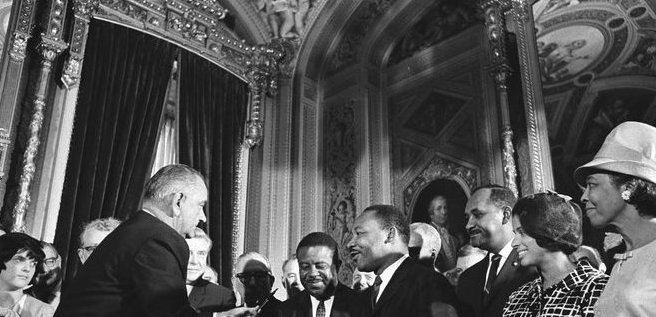

The trend of declining Black voter turnout is nothing new, as Leslie Dunbar, formerly director of the Field Foundation, noted the Southwide, historic development earlier this year. "In each presidential election from 1964-1976, the proportion of Blacks casting their ballots was lower in the South than in the North and West... What we have," Dunbar said, "is a nation that in these years takes voting less and less seriously, with Black Southerners being the least interested of all .... I see no reason to expect voter interest, including that of Black Southerners, to rise unless the issues at contest become stronger and differences between parties and candidates more real."

For Southern politicians, the Miller-Talmadge contest shows clearly some of the results of trends Dunbar observes. With almost every viable White politicians' record spoiled by at least a moment or two of racism (if not usually considerably more), the yardstick for more and more Black leaders will be the "here and now" politics of who can offer real help. The past will be for them little indication of the real political differences. And until those differences between candidates are so contrasting and real to the Black electorate that there is really only one choice again, the present is the future for more and more Black voters regardless of the candidate's past.  [source: Southern Changes Magazine, Vol. 3, No. 1, 1980, pp. 6-8, 22-23; Betty Norwood Chaney is senior editor of Southern Changes magazine. ]

Tuesday, November 5, 2013

Republican Don Yelton A North Carolina Voter Suppressionist


As reported by the Asheville [North Carolina] Citizen-Times, "GOP activist slammed for 'Daily Show' comments. Yelton: 'There's nothing I would take back'," by John Boyle, on 25 October 2013 -- ASHEVILLE — Local gadfly and Republican activist Don Yelton says he has no regrets about remarks he made on “The Daily Show” with Jon Stewart, even though the comments ignited a national firestorm of criticism and allegations of racism — and cost Yelton his position as a precinct chairman.
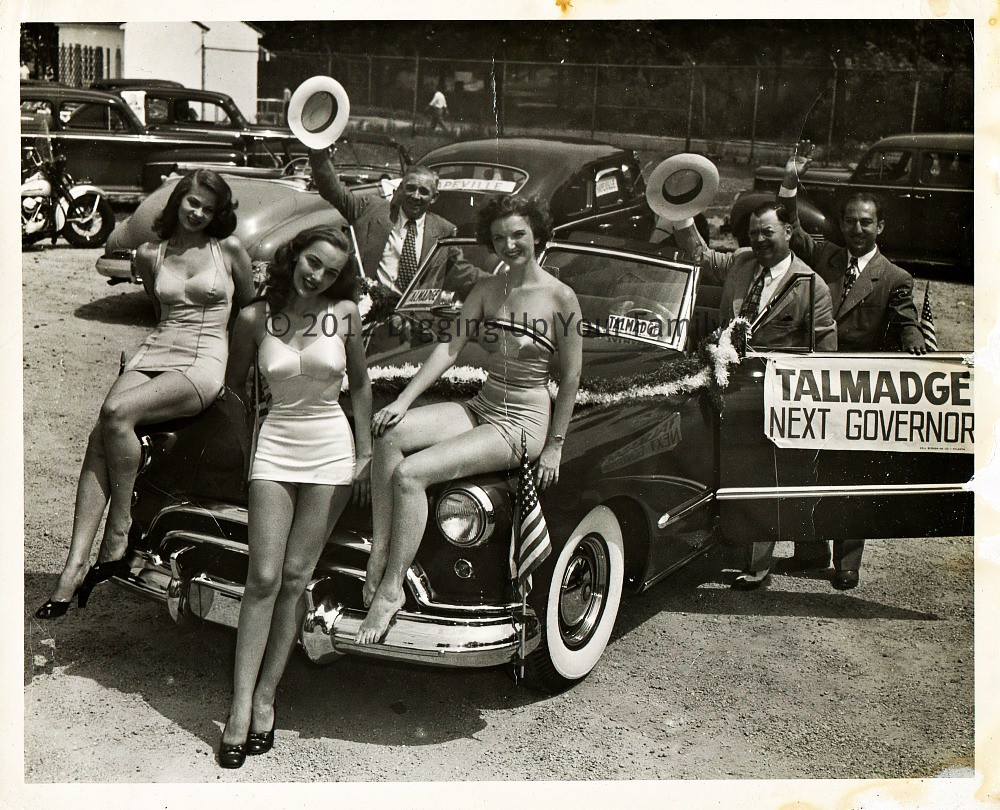
“I don’t know of anything that I said that I would take back,” Yelton said Thursday. “But I would prefer to discuss it and explain it at length.”

The Buncombe County GOP needed little time for that explanation, asking Yelton to resign as a precinct chairman just as video from the interview was getting increasing attention on news and other websites around the country. Yelton later agreed to step down.

The segment about voter suppression and North Carolina’s new voting law aired on Comedy Central Wednesday night. Daily Show staffer Aasif Mandvi interviewed Yelton a few weeks ago in Asheville, and the North Buncombe resident had plenty to say, remarking at one point that it’s racist for black people to use the N-word.

He also told Mandvi, “I had a picture one time of Obama sittin’ on a stump as a witch doctor and I posted that on Facebook. I was making fun of the white half of Obama, not the black half.”

Joe Coscarelli of New York Magazine listed that comment as No. 3 in his list of Yelton’s “Top 5 Racist Remarks Delivered in Front of a Camera.” No. 2 was Yelton’s statement that “If (North Carolina’s new voter ID law) hurts the whites so be it. If it hurts a bunch of lazy blacks that want the government to give them everything, so be it.”

The article was titled, “Don Yelton, GOP Precinct Chair, Delivers Most Baldly Racist Daily Show Interview of All Time.” Topping Coscarelli’s list was this Yelton remark about African-Americans’ use of the N-word: “Now you have a black person using the term (N-word) this and (N-word) that and it’s okay for them to do it.”

Democrats statewide denounced Yelton’s comments, and the organization Buncombe County Young Democrats held a viewing party Thursday night to watch and discuss the segment.

In an interview with the Citizen-Times, Yelton defended his remarks Thursday.

“Whoa, whoa, whoa, whoa, whoa...What did I say about the N-word?” Yelton said, then repeating the racial slur three times. “I said when a (N-word) can call a (N-word) a (N-word), it is not a problem. That’s racist. That’s the worst form of racism I’ve ever seen in this country, and it proves it’s racism. That I stand by.”

NAACP, local GOP respond  --  The N.C. NAACP State Conference found Yelton’s comments outrageous, but the civil rights group also claimed they provided a window into Republicans’ thought processes.

“I was disgusted, but not surprised, by Don Yelton’s arrogant remarks about North Carolina’s voter suppression law,” the Rev. Dr. William J. Barber II, president of the North Carolina NAACP State Conference, said in a statement. “This Republican executive committee member laid bare everything that we know politicians are trying to do through this legislation — which is to manipulate our voting laws, making it harder for certain communities to participate, in order to unfairly win elections. This shameful law is not about stopping voter fraud; it’s about stopping voting.”

The General Assembly this year passed a multifaceted voting law that requires a photo identification to vote, shortens early voting and ends registration of high school students, among other provisions.


Yelton, a former Democrat who switched to the Republican Party, ran unsuccessfully for local political office three times. In 2004 he ran as a Democrat for chairman of the Buncombe County Board of Commissioners, followed by a 2006 campaign as a Republican for Clerk of Superior Court. He also ran for a county Board of Commissioners seat in 2008.

“Hopefully, Don Yelton can find another political party other than the Buncombe County GOP,” current County Commissioner David King said via Twitter on Thursday.

The county GOP quickly distanced itself from Yelton on Thursday, with Chairman Henry Mitchell stating the party would force his removal “from any and all positions at any level within the state,” if Yelton didn’t resign as precinct chair.

Yelton previously served as a vice chairman of the county party, and he was removed from his position as precinct chairman for a period of time in 2012-13, Mitchell said.

Yelton is well-known for his sometimes over-the-top comments at commissioners’ meetings, as well as memorable dust-ups with local leaders.

The Buncombe GOP issued a statement Thursday expressing its “sincerest regrets and disappointment in the comments made by Don Yelton” on the Daily Show.


“Let me make it very clear, Mr. Yelton’s comments do not reflect the belief or feelings of Buncombe Republicans, nor do they mirror any core principle that our party is founded upon,” Mitchell said. “This mentality will not be supported or propagated within our party.”

Alex Fisher, president of the Buncombe County Young Democrats, said she was contacted by Daily Show producers and asked to help line up some interviewees for a segment on the Voter ID bill several weeks ago, though that part of the segment was cut for time.

“I was definitely not expecting what I saw, and what I saw was blatant racism,” Fisher said. “My mouth was open the entire time. I just… it was just horrifying. You can’t just drop the N-word and think that’s OK. I think it sheds a lot of light on how much work we still have to do.”


Yelton holds firm  --  While he agreed to step down as precinct chair, Yelton said he made valid points on the show and will not be cowed by any political organization. He also has no concerns that the segment made him look bad.

“The Democrat Party in Buncombe tried to make me look bad for a long time,” Yelton said. “I’m used to that. It’s just made me tough. And the Republican Party has made me tough. I’m sick and tired of people who don’t stand up for what they believe.”

Yelton appeared on local television and radio Thursday, but he said no other national media had approached him.

Mitchell said in an interview that he heard from media from across the country Thursday, some of whom thought Yelton was the local party chairman.

“We’re trying to straighten all that out,” Mitchell said.


The Daily Show had contacted Mitchell and done a telephone interview with him, Mitchell said, but he never heard back from them. He only found out last week that Yelton had done the extensive interview.

“He didn’t run anything by us,” Mitchell said. “I would have told him not to do it. They interviewed a lot of Democrats in Asheville, too, but the only person they showed was Don Yelton.”

While Yelton acknowledged and took responsibility for all his comments on the show, he did say Mandvi “cut and pasted” some remarks to make him look worse. Mitchell was unmoved by that argument.

“They can cut and past and clip all they want to, but the bottom line is he said it,” Mitchell said. “In the long run, it’s going to benefit the party with Don not being a part of it.”

Yelton had been chairman of the North Buncombe precinct, where he lives. Mitchell said Yelton was replaced Thursday by Michael Cline.


Yelton said he knew the left-leaning Daily Show, which airs at 11 p.m., often makes sport of Republicans and likely would try to make him look foolish. The producer told him they had seen Yelton’s comments at a hearing in Raleigh on the voting legislation and wanted to talk to him.

“I knew going in what was going to happen, and nothing happened that I was surprised at,” Yelton said. “If you and I disagree and we never communicate, are we ever going to accomplish anything?”

Yelton’s remarks also made news on the websites Gawker and Huffington Post. Gawker noted that Mandvi “appeared to have been caught off-guard by just how hilariously oblivious his interviewee was.”

After Yelton had said his best friend is a black man, made the comment about the Obama witch doctor picture and delved into the N-word issue, a seemingly stunned Mandvi said, “You know that we can hear you, right?”

The day after the bit aired, Yelton laughed heartily at times in recounting the interview.

“There’s nothing I said that I would take back. So be it,” Yelton, 66, said. “The activity going on across the state today proves what I said is true — the Democrats are jumping on it like flies after honey.”


Yelton said the entire interview lasted two hours, with the footage cut down to just a few minutes. He says he spoke the truth about new voting laws hurting Democrats, but he also notes that years ago, when Democrats enacted early voting and other measures, they said it would help them win elections.

A part-time environmental sciences teacher who worked for Buncombe County’s recycling program in the early 1990s, Yelton said he isn’t angry about the interview, even though he’s heard from a lot of people who’ve asked him why he did it.

Every media outlet has its “purpose and direction,” Yelton said, and such interviews often aren’t about discussing the underlying issues.

“It’s the same old (excrement),” Yelton said. “Just another pile.” (Asheville Citizen-Times)

HOME

HOME
Click here to return to the US Slave Home Page