Monday, September 10, 2012

Voter Disenfranchisement Mississippi-style


Mississippi elections had always been violent as whites tried to prevent blacks from voting, and many courageous blacks and whites who opposed Democratic rule were murdered. To end this violence, a compromise was reached between the planters and their challengers. Blacks would be constitutionally disfranchised and corruption and violence at the polls would stop. A constitutional convention was called to theoretically legally disfranchise all illiterate voters. But everyone knew the real purpose. James Kimble Vardaman, later Governor of the state, boasted of the obvious purpose of the convention. "There is no use to equivocate or lie about the matter. Mississippi's constitutional convention was held for no other purpose than to eliminate the nigger from politics; not the ignorant -- but the nigger." 
James Kimble Vardaman:  "There is no use to equivocate or lie about the matter. Mississippi's constitutional convention was held for no other purpose than to eliminate the nigger from politics; not the ignorant -- but the nigger." 

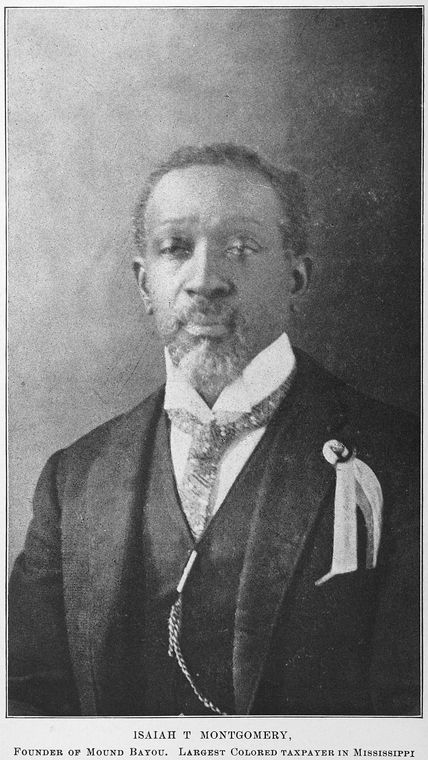
Whites warned blacks not to interfere in the change. Marsh Cook, a white Republican in Jasper County, courageously challenged the Democrats for a seat to the Constitutional Convention in spite of death threats. Cook was ambushed and murdered on a lonely country road -- one of the first whites to be killed after Reconstruction for advocating the black vote, according to his great-great-granddaughter Kitty Cook Hoyt. Isaiah Montgomery, founder of Mound Bayou and the only African American delegate to the convention, had been invited because he was willing to support disfranchisement. Blacks were outraged at Montgomery's speech. They called Montgomery a "traitor" and "Judas" for not challenging disfranchisement. The delegates rewrote the constitution. It required all voters to take a literacy test if they tried to vote.


"On and after the first day of January, A. D. 1892, every elector shall, in addition to the foregoing qualifications, be able to read any section of the constitution of this state; or he shall be able to understand the same when read to him, or give a reasonable interpretation thereof." Power was given to registrars to interpret the test. Since all registrars were white and politically appointed, it was highly unlikely they would allow any black to pass the test on his own merits. The Supreme Court chose to disregard the fact that the new law was aimed at disfranchising blacks. "Besides, the operation of the constitution and laws is not limited by their language or effects to one race. They reach weak and vicious white men as well as weak and vicious black men, and whatever is sinister in their intention, if anything, can be prevented by both races by the exertion of that duty which voluntarily pays taxes and refrains from crime." Once the court gave the Mississippi constitution its blessing, other states adopted the same means to disfranchise blacks.  (source: PBS)

The Political Sellout Isaiah T. Montgomery

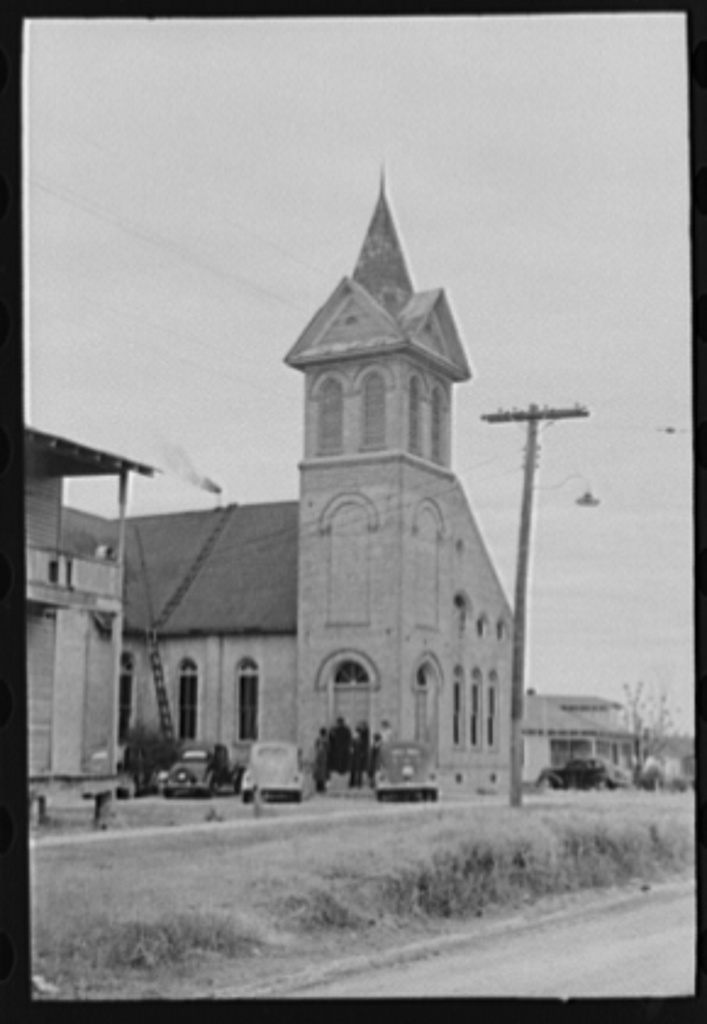
Street Scene in Mound Bayou, Mississippi

From Mississippi History Now, " The Political Life of Isaiah T. Montgomery:  Isaiah T. Montgomery, 1847-1924 (Part II)," by Neil R. McMillen, Ph.D., on February 2007 --  Isaiah T. Montgomery might be called Mississippi’s Booker T. Washington. Though Montgomery was not as famous or as influential, his life and work in many other respects closely paralleled that of the great educator at Tuskegee Institute, a college for black people in Alabama. They were both thought by influential whites to be conservatives, “safe and sensible” African-American leaders who understood that if the freed slaves and their descendents were to get along in the Jim Crow South, they must go along with racial separation and black political disfranchisement. Both were regarded by contemporary black “militants” (few of whom lived in the South) as faithless collaborators who sold out their people in the darkest hours of post-Civil War radical white racism.

Booker T. Washington speaking in Mound Bayou, Mississippi

In fact, though Montgomery spent most of his adult life overshadowed by Washington, it was he, not the Tuskegean, who first won public prominence as the architect of an unequal bargain that seemed to trade the civic aspirations of blacks for the empty white assurance of racial harmony. Half a decade before Washington offered his “olive branch,” his famous “Atlanta Compromise Address” of 1895, Montgomery delivered up his “peace bush,” his conciliatory speech to the Mississippi Constitutional Convention of 1890, in which he accepted wholesale black disfranchisement as the essential “beginning of the end of the great race question.” As historians now know, neither Washington nor Montgomery was what he then seemed. Both were in fact complicated pragmatists who were misread by their white admirers and misunderstood by their black detractors.
Isaiah T. Montgomery, founder of Mound Bayou; Largest Colored taxpayer in Mississippi.
Race statesman (or race traitor?)

History would remember Montgomery not just as a town builder, but also as a conservative “race statesman” who pursued racial harmony through accommodation. In some respects he was an unlikely advocate of black disfranchisement as a path to peace. He himself had regularly voted since the early days of Reconstruction at Davis Bend when the freedmen first won the right to vote. His father and brother both held minor offices and were very likely the first blacks to hold public office in Mississippi and perhaps the entire South. After Reconstruction, Montgomery was well-known and active in Bolivar County Republican circles, and his beloved Mound Bayou remained a faithful island of Republican loyalty in a sea of white Democrats. He served for a time as the town’s mayor, and he later took more than a little pride in the fact that it elected its own public officials. He was elected as a Republican delegate to the Mississippi Constitutional Convention in 1890, and he later accepted a federal political patronage job as a collector of government monies.
But Montgomery was also an astute political observer and he understood the realities of power in his time and place. Enfranchised by the Fifteenth Amendment to the United States Constitution and technically allowed an equal opportunity to both vote and hold public office under the Mississippi Constitution of 1868, blacks outnumbered whites in every decade from 1840 to 1940. Clearly, in this black majority state of Mississippi, the first requirement of unchallenged white rule was black disfranchisement. Having re-established white control by force and fraud in 1875, the “white line Democrats” — or “Redeemers” as they styled themselves — intended to dominate the political life of Mississippi by any means necessary. With an accommodating federal government increasingly willing to purchase North-South reconciliation by looking the other way, no prudent black Mississippian could ignore that fact.

And Isaiah Montgomery, like his father before him, was nothing if not prudent. His father, Ben, chose his battles carefully. Eager to avoid racial conflicts that he could not hope to win, he had made it his life-long practice to cultivate friendships with influential whites. Ben set whites at ease by downplaying black political aspirations, by affirming that voting was of “doubtful and remote utility” to the freedmen. Discussions of the “suffrage question,” he publicly asserted, are “more likely to produce contention and idleness than harmony.” These were calculated and soothing words, suggesting to whites, as one approving white newspaper editor put it, that Ben was a “sensible darky” and a “good citizen” who “attends to his own business [and] does not dabble in politics.”

Isaiah too was a skillful actor in the ceremony of submission required of any African American who would “stay right” with whites. “This is a white man’s country,” Montgomery said more than once, “let them run it.” His advice to black Mississippians who still demanded a citizen’s right to vote was equally direct: “The farther you stay away from the white people’s politics, the better.” It was not surprising, then, that Montgomery, alone among black Republicans, was allowed to represent his race and his party at the state Constitutional Convention of 1890. He was an “elected” delegate from Bolivar County, of course, but even casual observers of the Mississippi political scene could no longer have illusions about the integrity of the ballot box. According to one prominent judge, J. J. Chrisman — himself a leading member of the constitutional convention — it was “no secret that there has not been a full vote and a fair count in Mississippi since 1875.”


Once assembled, the convention’s over-riding purpose was plain to see. “We came here to exclude the Negro,” S. S. Calhoon, the body’s president, announced. “Nothing short of this will answer.” Montgomery was assigned to the Committee on Elective Franchise and he spoke eloquently in favor of, and voted for, a measure to “purify the ballot” by restricting it to literate adult males, those he called the “stable, thoughtful, and prudent element of our citizens.” The burden of a literacy restriction, as he well knew, would fall most heavily on a people so recently freed from slavery. But he also knew that, through education, illiteracy could eventually be eradicated and he dared to hope that, in the meantime, voter requirements would apply equally to both races and that such disfranchisement that would come to the Negro would come “because he is ignorant” not “because he is black.” He was then just forty- three years old, but it would prove to be his defining moment and the single most controversial act of his long and complicated life.

But why? Why was Montgomery “elected” as a delegate? Why was he willing to serve? Why did he support disfranchisement? His presence at the convention is perhaps most easily explained: his conservative ideas were well known to powerful white political leaders eager to point to his example as proof that the convention was “fair” and that blacks, too, favored white supremacy. In a word, Montgomery provided “cover,” a measure of “legitimacy,” as Mississippi enacted the “legal” measures to subvert the Fifteenth Amendment.


Montgomery’s own motivations and behavior are more complex and have defied easy answers for more than a century. Some conservative black contemporaries applauded his tone of racial sacrifice, his singular “act of statesmanship.” But others recoiled in shock and horror, dismissing him as a “great disappointment,” a “traitor,” the “Judas of his people.” It was said that he was either so blinded by ambition or so eager for white approval that he traded his vote for the empty favor of a seat at the convention. Or that he bought immunity from white interference in the affairs of Mound Bayou with the coin of black suffrage. Or, more frequently, that his actions were simply “inexplicable,” an “unfathomable” mystery wrapped in a “jangle of contrarieties.”

Yet, examined in the context of his life and his times, his role at the convention seems neither treasonous nor puzzling nor inconsistent. By supporting a white supremacist initiative, he offered a way to end the “grave dangers” of racial conflict, “bridge” an ever-widening and deepening racial “chasm,” and “inaugurate an era of progress.” The black right to vote in Mississippi, as he reasoned, had already been nullified by electoral fraud and by physical and economic coercion. By giving away rights they could no longer exercise anyway, Afro-Mississippians might gain the personal security and economic freedom necessary to advance themselves. Thus, given a “man’s chance,” having been allowed to prove their worth through right living, hard work, and practical education, the former slaves and their descendents could expect someday to re-enter the body politic as equal citizens, free from the burden of racial prejudice.


Or so Montgomery dared to hope. It was a long shot, but it was, in all fairness, the only shot Montgomery thought he had. The suffrage restrictions of the new constitution, as he informed a northern newspaper just two weeks after his fateful vote, “did not wholly suit me . . . but it was the best that could be done. We had to take the best that we could get.” Of course, Montgomery’s “peace bush,” his “fearful sacrifice laid upon the burning alter of liberty,” was not the beginning of the end of the race problem. It did not, as he hoped, open the way in Mississippi for political divisions “upon some basis other than that of color or race.” Clearly, his faith in ultimate white good intentions was misguided. But to suggest that Montgomery’s strategy of “giving up to gain” was fundamentally ill-conceived is not to prove that he had other realistic options.


In time, Montgomery had second thoughts about his “sublime sacrifice” of 1890. He lived another thirty-four years, long enough to admit privately — though never in public — to a sense of betrayal, to a recognition that white supremacists in Mississippi sought “nothing less than a retrogression of the Negro back towards serfdom and slavery.” In a letter to Booker T. Washington, he acknowledged that white talk of “pure government” was a sham, that only armed federal intervention could restore color-blind democracy to Mississippi. To have said that openly would have been to speak against the very grain of his being; not least, it would have risked swift and certain retribution for himself and his town. But by remaining publicly silent, he opened the way to the misunderstandings and the calumny that have dogged his reputation for more than a century. When Montgomery died in 1924 he was eulogized by a conservative white planter-politician, Walter Sillers Sr., and laid to rest in a tomb paid for by white subscription. Outside his circle of family and friends, however, he was largely unmourned. By that date he was, in the words of a northern missionary, “more hated by Negroes” than any other Mississippian of his race.

Last thoughts and speculations

Isaiah Thornton Montgomery’s story tells us, if it tells anything, that human lives can only be examined in the larger context of their own times. Montgomery was assuredly not a man for all seasons. He did not speak for aspiring freedmen of his own generation who still found hope for full citizenship in the forgotten promises of Reconstruction. Nor did he speak for unborn generations who in a more opportune age after World War II would help pull down the morally corrupt house of Jim Crow. Rather, like most other mortals, he was a man of his own era, in his case a dark era of diminishing black opportunities. Among the earliest of the great black accommodators, he came of age amid the confusions of the American Civil War and Reconstruction, and he spent the middle and later years of his life awash in a rising tide of radical white racism.

Montgomery enjoyed some astonishing successes. In his personal life, as both slave and citizen, he defied white stereotypes. Though slight and small of stature (weighing perhaps 135 pounds in middle age), he was every inch an aristocrat, an educated, articulate, prosperous planter-businessman. Finding his people locked out of the American mainstream, he built in the form of the small but symbolically important city of Mound Bayou a separate and promising all-black world. If, through the thicket of racial hate and violence that was Jim Crow Mississippi, he did not find a path that balanced black dignity and progress with interracial harmony, it must be said that no other leader of his generation did either.

http://www.havescripts.com/1923_Isaiah_and_Martha_Robb_Montgomery_50th_Anniversary_594KB_op_422x600.jpg

Perhaps, given the daunting constraints of his time and place, Montgomery’s story should end with a question: Had he been born the year he died, soon after World War I, had he lived to experience the liberating forces that flowed across the American landscape after World War II, could anyone say with confidence that this gifted mortal would today be remembered as Mississippi’s Booker T. Washington, its Great Accommodator? (source: Mississippi History Now)

Isaiah T. Montgomery Endorses the Disenfranchisement of Blacks

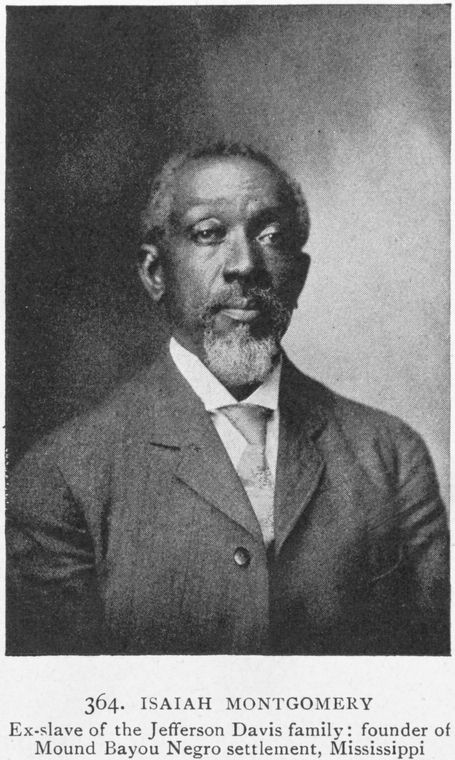
Isaiah Montgomery, former slave of the Confederate President Jefferson Davis and founder of the Mound Bayou Negro settlement in Mississippi. 

From the JRank Encyclopedia --  Isaiah T. Montgomery was active in local and state politics. A Republican, he was the only black delegate elected to the Mississippi constitutional convention in 1890. Montgomery and his family had for a long time become skilled in pleasing whites and in receiving their patronage. He believed, however, that blacks needed a segregated colony where they could promote their own interest. It was at that convention that efforts to disenfranchise blacks were put in motion. While Montgomery had the confidence of many whites, clearly he was acquainted with the racial climate in late nineteenth and early twentieth-century Mississippi. Since he was a man with accommodationist sympathies and beliefs, he saw nothing wrong in delivering an hour-long speech in which he conceded that it would be in the best interests of both races to reduce black vote to a total far less than that of whites. He saw nothing wrong with disenfranchising 123,000 blacks and some 12,000 whites. This would help race relations, he thought, and blacks would have to increase their education and acquire property, then reenter politics themselves. The amendment also imposed a poll tax as a requirement to vote and exclude those who were illiterate or who were convicted of certain crimes. Montgomery’s action brought mixed reaction from black leaders: Abolitionist Frederick Douglass thought that he had been tricked into taking such a stance; New York lawyer T. McCants Stewart called his advocacy a move to enfranchise illiterate whites and disfranchise illiterate blacks; and Mississippi Republican John R. Lynch called his action more dishonest than the practice of stuffing ballot boxes, which Mississippi knew well.


The state adopted the amendment, and by 1915 other former Confederate states followed. Within a twenty-year period after the convention, Montgomery admitted that all was not well in his state. Hermann quotes his prediction that “the dominant spirit of the south will be satisfied with nothing less than a retrogression of the Negro back towards serfdom and slavery.” And clearly, by 1904, he admitted to the work of whites who terrorized and intimidate black Mississippians.


Montgomery resigned as mayor of Mound Bayou in 1902 when, on endorsement from Booker T. Washington, President Theodore Roosevelt, who forgave him for his political transgression, appointed him as receiver of public funds in Jackson, Mississippi. Sometime in 1903, he was accused of placing $5,000 of government money into his own account. He met secretly with Washington’s secretary in New Orleans in 1903, who told him that he must resign his post. Montgomery stayed in office a few months longer, then resigned and returned to Mound Bayou. He had been reluctant to accept the post in the first place, but deferred to the wishes of his friend Washington. His primary concern had been for the development of his colony, Mound Bayou, and he had considered Washington his connection to northern white philanthropy to fund more ambitious projects and businesses there. He also faced hostility from his white staff in Jackson. Continuing in politics, however, in 1904 he was Mississippi delegate to the Republican National Convention.


Isaiah and Martha Robb Montgomery, who married in 1871, had twelve children, eight of whom reached adulthood. One daughter, Mary Booze, became a committee-woman for the national Republican Party. Martha Montgomery, who had become an important business partner, died in 1923, seven months before Montgomery’s death in Mound Bayou on March 6, 1924. The Montgomerys’ residence is listed on the National Register of Historic Places; it is one of the nation’s most historic black culture sites.


To his credit, Montgomery had been involved in nearly every project of interest to the Mound Bayou area; he also worked diligently to promote black self-sufficiency and to enhance the quality of life, especially for those blacks who lived in Mound Bayou. But, as Hermann wrote, Montgomery finally admitted that he could not forgive himself for standing by, “consenting and assisting in striking down the rights and liberties of 123,000 freedmen.” [Read more: Endorses the Disenfranchisement of Blacks - Montgomery, Mississippi, Mound, and Whites - JRank Articles http://encyclopedia.jrank.org/articles/pages/4383/Endorses-the-Disenfranchisement-of-Blacks.html#ixzz264XXjLZy]

Political Disenfranchisement Southern-style


White Protective Associations

  • Traditionalists, such as the Dunning School, argued that white protective associations arose in response to the tragedy of "Negro rule."
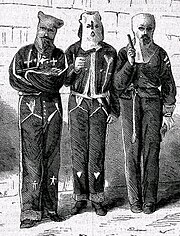
  • The most significant groups were the Knights of the White Camelia and Knights of the Ku Klux Klan. They arose shortly after the end of the war, and quickly turned into a paramilitary force that served the interests of Democrats, planters, and white supremacy. They often focused their attacks on leaders of the African American community, and involved members of all classes of white society.
  • The goals were to exercise complete authority and control over blacks in their midst, to enforce white supremacy, to destroy the Republican party in the South, and to exercise home rule.
  • Their primary methods included intimidation and violence. In many ways the followed the pattern of guerilla warfare common in the western theater of the war, as well as drawing on the larger American vigilante tradition. Thus, they were often well-informed in the tactics of intimidation and violence.
  • These groups were larger in the popular imagination, both then and now, than in actual numbers. Indeed, much of their effectiveness came from their overall mental effect.
  • Throughout the South, violence was used to keep blacks tied to land or deprive them of their rights. In the Midwest and North, violence was used to simply keep them out. Thus, similar means were used for different ends.

Enforcement Acts

  • Federal legislation was passed to curb terrorist violence in the South. White terrorist groups were seen as threats to national sovereignty.
  • Enforcement Acts made it illegal to prevent the exercise of the franchise on the basis of race, and the President was authorized to have agents bring cases into the federal courts.
  • The Ku Klux Klan Act of 1871 made the crimes of individual vigilantes subject to federal law (and federal attorneys and courts). Thus, federal and not just state power reached the individual.
  • These acts were called the "Force Acts" by white southerners, who saw the acts as political manipulation of power by Republicans, designed to further oppress the vanquished South. They saw it as a violation of home rule.
  • Under the acts some Klansmen were indicted and convicted, but only a tiny percentage of those who actually committed crimes.

The fall of the Republican South

  • The commonly accepted date for the end of Reconstruction is 1877, for that is when Rutherford B. Hayes took office. He had promised to remove troops from the South and offered federal subsidies for internal improvements, all as part of the compromise that allowed him to become president.
  • As support for Reconstruction waned in the North, southern whites found that they did have some means at their disposal to control their society. Their principal tool was the vote.
  • Almost immediately, the Democrats took office in all but a few states.
  • What was needed was for almost complete control by whites in order to ensure Democratic victory. They began the process of disenfranchisement.
  • Disenfranchisement was a way of emasculating African American men and took the place of slavery as a means to differentiate between the status of black and white men.
  • At the same time that southern communities found ways to delimit black access to the polls, they enlarged the opportunity for yeoman and landless whites. Consequently, white men had greater access to the political process than they had before the war.
  • In effect, whites were able to regain the political position that they had lost during and after the war.


Disenfranchisement

  • Achieved through three principal means: 1) violence and intimidation -- white protective associations attacked black political leaders and kept blacks from voting; 2) deception -- moving polling place, changing dates of voting, closing polls early, etc.; 3) edict (rare until late 19th c.) -- gerrymandering of districts, reapportionment of voters
  • Blacks retained the right to vote well beyond the formal end of Reconstruction, despite white efforts to limit their political participation. By 1880, there were still no laws specifically keeping blacks from the polls.
  • Once blacks were removed from political office, which preceded their loss of the franchise, the white community began to split along class lines.


Agricultural Depression and the Populist Moment

  • Drought, the boll weevil, and economic depression hit the South in the 1880s and 1890s, devastating farmers, particularly those on small to moderate sized farms. A number of organizations, including the Grange and the Farmers Alliance, arose to help farmers cope with the depression.
  • By 1889, the Southern Farmers Alliance had branches in every southern state. The SFA did not admit blacks, but they helped create the Colored Farmers National Alliance and Cooperative Union in 1886, which had similar goals.
  • During the last two decades of the 19th c., white and black farmers drifted closer together due to common economic interests, and white solidarity was harder to maintain.
  • In 1892, the People's Party (a.k.a. Populists), worked to capitalize on the black vote, which had begun to be limited by legal restrictions in many southern states. However, by 1892, only one state (Mississippi) had enacted stringent legal restrictions to black voting, so blacks still had significant political power. The Populists were most successful in North Carolina in merging the interests of black and white farmers. They assumed power and immediately began removing restrictions to blacks voting.
  • Blacks thus become an important swing constituency in the late 1880s and early 1890s. Prior to disenfranchisement, most whites had a common goal -- to rid themselves of Republicanism. When Democrats regained control throughout the South, other issues began to divide them, and the various classes among whites did not have the same interests.
  • The "Populist moment" was a brief moment of opportunity for blacks and poor whites to create an interracial alliance.
  • Democrats undermined the fledgling interracial, class-based alliance of farmers by an explicit appeal to race. Some of the most virulent race-baiting in American politics came in the 1890s South, as Democrats sought to turn poor whites against blacks and Populists and retain them in the Democratic fold. Their methods, however distasteful, were extremely effective at destroying the political power of both Populists and blacks.

Legal Disenfranchisement

  • By the 1890s, Democrats held power in virtually all southern states and had learned their lesson. They had to remove the threat of Populism, and an interracial alliance of farmers, before it spread to urban whites. Their most effective means of resistance was to codify efforts to disenfranchise blacks.
  • The most common methods of disenfranchisement were the poll tax (aimed at reducing poor voters), literacy requirements and understanding clauses (again targeting the poor, but also a subjective means of weeding out undesirable voters), and grandfather clauses (which specifically appealed to whites).
  • Disenfranchisement laws were put in place where the proportion of black residents was the highest: Mississippi (1886), South Carolina (1895), Louisiana (1898). By 1910, restrictive legislation was in place in every southern state. The impact of the law in just one state, Louisiana, is represented in Table 1, below.
  • It represented a victory for Democratic political interests, and effectively made the South a one-party region, particularly with the defeat of the Populists.
  • Racial politics took a significant voting group out of political life, which resulted in a shift to the political right and an era of marked political conservatism. The conservative mood weakened the prospects of progressive legislation; Progressives made their biggest gains in the industrial North in the early 20th c.
  • Racial politics hindered the South's development because it maintained the position of the elites and took away a natural economic ally of poorer whites.
  • By the turn of the 20th century, white supremacy was firmly in place by law and social custom. There were 214 lynchings in the first two years of the 20th c., and no one was punished for any of them.
  • The goal of the white protective associations had been to assert white supremacy. By 1900, the law, the courts, the schools, and almost every institution in the South favored whites. White supremacy was in place.

[source: Lecture Notes, University of Notre Dame]


Sunday, September 9, 2012

The Gilded Age Railroad-Building


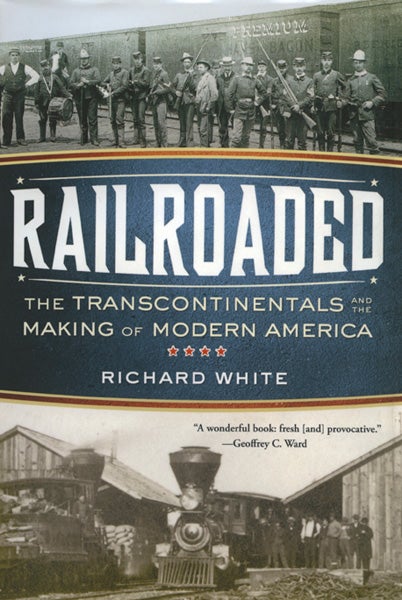
From Slate, "The Transcontinental Travesty: What Gilded Age railroad-building frenzy reveals about American greed," by Donald Worster, on 6 June 2011 -- The corporate raider Gordon Gekko, in the 1987 film Wall Street, distilled the essential philosophy of the Reagan era, when we were supposed to get back to basic principles: "Greed, for lack of a better word, is good. Greed is right. Greed works." Although almost every ethical philosopher or religious leader of the past came out against greed as an emotion that distorts judgment and corrupts society, the Gekko-Reagan creed has usually been an easy sell in America. Running against that tradition, Richard White, in his new book Railroaded: The Transcontinentals and the Making of Modern America, doggedly persists in challenging the notion of greed as either rational or virtuous. He has a big job on his hands. No matter how many dot-com crashes or overleveraged credit debacles we go through, the core faith in greed as the engine of American greatness seems all but unshakable.


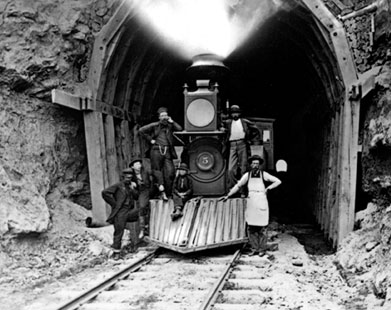
One legendary moment of greatness was the completion of the first transcontinental. There is a legend-making photo taken at Promontory Summit, Utah, May 1869, when the Union Pacific and Central Pacific joined tracks and reunited a war-divided people. After that came the Northern Pacific; the Great Northern; the Atchison, Topeka, and Santa Fe; * and other lines that brought a transportation revolution to the West. White debunks the legend, arguing that the achievement was shoddy and chaotic and benefited the nation very little. The money that built those lines did not come from the railroad men themselves—Leland Stanford, Collis Huntington, Henry Villard, James J. Hill, and Thomas Scott. Instead, they persuaded Congress to lay out enormous subsidies.


The Union Pacific alone raked in $43 million in interest subsidies on federal loans, and railroads east and west of the Mississippi River received more than 131 million acres in free land. White explains that largesse as a result of political corruption. But then why did so many investors, including shrewd Germans and Brits, throw money into these enterprises as well? Not until the 20th century would there be enough white settlement and shipping traffic in the West to justify such investments. No rational need existed for decades, yet a railroad-building frenzy went on and on. The builders made a lot of money for themselves, but why did so many people give them so much capital?


Other government subsidies came in the form of stifling, with armed force, any resistance from Indians or any move on the part of immigrant laborers to try to make the railroads serve their needs. White describes in brilliant detail the infamous Pullman strike of 1893, when the government blatantly took the side of the corporations. "By and large, the western railroads remained what they had been before the strike—bloated, ill managed, heavily indebted, and corrupt. … Many were now wards of the federal courts, and all of them depended on the might of the federal government to control their own workers."


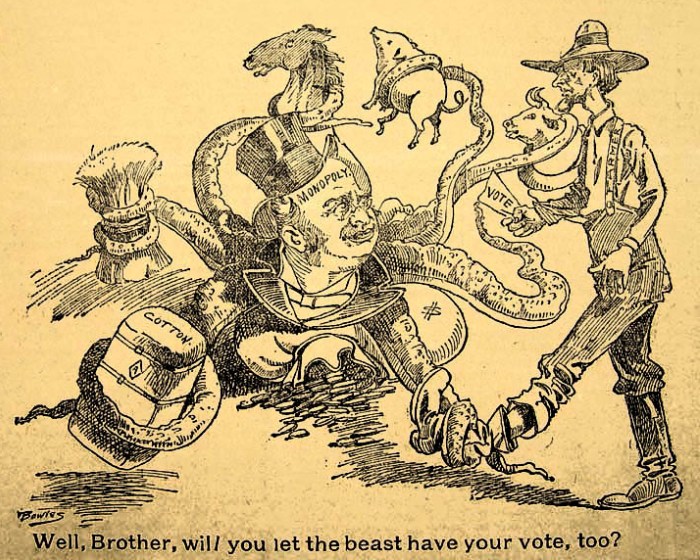
The dean of business historians Alfred Chandler Jr., in The Visible Hand(1977), described the 19th-century railroad corporation as the harbinger of order, rationality, and efficient organization. White scoffs at such an image. These corporations were made up of "divided, quarrelsome, petulant, arrogant, and often astonishingly inept men." And instead of the conventional leftist picture of a ruthless, soulless, but all-powerful business that crushed its opponents, the infamous Octopus of novelist Frank Norris, he finds "a group of fat men in an Octopus suit." They were morally challenged men, dripping with hypocrisy, mean-spirited, and grasping.


But White, who is a master of invective, describes them also as stupid and incompetent. Their only claim to genius was their ability "to find occasions for profit in their own ineptitude." Leland Stanford, for example, was well-known to his companions as dim-witted, careless, selfish, lazy, and yet filled with "immense self-regard." That tone of criticism appears all through the era. The Massachusetts railroad executive Charles Francis Adams, dismissed his fellow businessmen as creatures of "low instincts, … essentially unattractive and uninteresting." This is essentially White's view also, and he finds their success more than reprehensible; that such reptilian types ever gained so much power and wealth is bewildering. That their descendants still command so much authority is beyond understanding.


Richard White is a Thorstein Veblen for our times. Veblen (1857-1929) was an academic economist too radical for his own day. He and White share contempt for the business community; it was Veblen who invented such phrases as "conspicuous consumption" and "businesslike mismanagement." There are differences: White is a more engaging writer than Veblen, less given to windy circumlocutions, and he grounds his charges in deep and thorough research. Dripping with venom, this book is nonetheless a model of the historian's use of primary sources, narrative skill, and insightful reinterpretation of the Gilded Age. It is easily the best business history I have read, and it carries a weight of argument and evidence that cannot be denied. Another difference is that Veblen was dismissed by Stanford University for his "immorality" and unpopular views, while White is one of that university's most honored professors.


Unlike Veblen, White strongly identifies with the Indians who were dispossessed in part by the railroads and with the railroad workers who did the dirty and dangerous jobs for low pay and little freedom. White is emphatically on the side of those he calls the "anti-monopolists," contesting corporate authority, though he admits that most of them were racists who blamed immigrant Chinese workers for their precarious economic situation as much or more than they blamed the bosses. A society based on class and ethnic equality is closer to White's ideal than to Veblen's, who in turning away from the underdogs of society threw in with the technocrats, trained in rational analysis and management of modern technology and enterprise. In his book The Engineers and the Price System (1921), Veblen called for a "soviet of technicians" to run the railroads and factories of industrial America. That's not White's solution, but then what is his alternative to a society run by capitalists? What other choices did Americans have in the past or now? Whom should they trust?
The story of the transcontinentals, White writes, "is more than just a phase, the unruly youth of corporate capitalism." It represents the beginning of "a deeper mystery of modernity: how so many powerful and influential people are so ignorant and do so many things so badly and how the world still goes on." Why do the "unfit" seem always to triumph? I don't find his answer very clear or satisfactory. Leland Stanford and his fellow railroad men did not make America; it was America that made them, and it was foreign as much as domestic investors who gave them money. Voters and investors, workers and capitalists, all wanted to see the West "civilized" as quickly as possible. They dreamed of human empire over nature, and in that dreaming they didn't bother about balancing costs and benefits. The conquest was worth whatever it cost, in lost economic opportunity, in injustice, and in environmental destruction.


Call it greed if you like, but often it was not personal greed so much as it was desire to see whatever was wild and nonhuman brought under control. After the railroads came massive water-engineering projects (White does not discuss the role of the railroads in promoting that boondoggle that went on through the New Deal). Those likewise dramatically altered the ecology of the West, and they made no more economic sense than the railroads did. The water projects were easily sold to a public that wanted to see the world under "civilized" control. Until we confront more directly that rage for domination, we will never understand how men like the robber barons ever got into power. Or why they have left so many descendants today.


White ends his book with this judgment: "The issue is not whether railroads should have been built. The issue is whether they should have been built when and where they were built. And to these questions the answer seems no." But would a delay of a few decades have really mattered? Would it have brought a different group of people into power? Would the goal of civilizing the West have been more humane, environmentally restrained, or economically sensible? Perhaps. This book convinces me that the railroads helped create both "dumb growth and environmental catastrophe." A greater capacity for delay and restraint might have moderated both outcomes. But still we are left with the conundrum of modernity: Who is both smart and decent enough to be in charge of the enormous powers we have unleashed on the earth? I don't have much confidence in businessmen, but neither do I have confidence in engineers, workers, or college professors. Least of all do I have confidence in the state when it begins to subsidize and promote whatever entrepreneurs want to do.(source: Slate)


Thursday, September 6, 2012

Ben Tillman, Forgotten Founding Father of Reform


The Gilded Age politics that follow the Civil War, offer a more complex view of the political landscape of money, race, and class.

This post isn't meant to be a "stand alone post," rather a continuing discussion that is accompanied by several posts demonstrating how disenfranchisement, voter suppression, and class division of the post-Civil War shaped the political landscape of the USA. Make no mistakes, I am NOT a supporter of Pitchfork Ben Tillman, he was a racist, evil, political bully, but even a broke clock can be right at least for 1 minute.

The post-Reconstruction Progressive Movement race-baited to gain power -- some searing examples are Woodrow Wilson, Tom Watson, Ben Tillman, the Red Shirts, the KKK, the Knights of the White Camilla, the list just goes on and on and on. That being said, by 1907, the black vote in the south did not exist.


By the turn of the century, black southerners were living by the Dred Scott Decision: "A black man had no rights that the white man was bound to respect." That was the law of the land in the USA until the mid 1960's. The Constitution of the USA did NOT APPLY to black citizens, period. Therefore, the campaign reforms of the Gilded Age were NEVER about race -- race was a NON-FACTOR. The ONLY votes were cast by white men -- no other race, no other gender. Just white men.

Now, given that just white men were the southern voters, what was their REAL PROBLEM. Blacks are easily scapegoated, but with a population with absolutely zero power, who was REALLY causing your pain and misery...one white man, one white male vote. But, some white men's votes counted more, because they had money.

The Campaign Finance Reform of 1907 was designed to limit the political payoffs, quid-pro-quo, bribery, graft, and other political-payola machinery. Justice Thomas hasn't done his homework. -- Ron Edwards, US Slave Blog


From Campaign Freedom, "Justice Thomas Comments on Ben Tillman, the Forgotten Founding Father of Campaign Finance Reform," 4 February 2010, by Brad Smith -- Earlier this week, Justice Clarence Thomas, speaking at Stetson Law School in Florida, defended the Court’s decision in Citizens United v. FEC, which struck down the Tillman Act, banning corporate spending in political campaigns, on First Amendment grounds. Said Thomas:


“Go back and read why Tillman introduced that legislation. Tillman was from South Carolina, and as I hear the story he was concerned that the corporations, Republican corporations, were favorable toward blacks and he felt that there was a need to regulate them.”

That made us decide it might be a timely moment to recirculate our post from 2006 on “Ben Tillman, Forgotten Founding Father of Reform.”


Ben Tillman: Forgotten Founding Father of “Reform”, Originally published December 1, 2006:
The Tillman Act, the first federal campaign finance law, turns 100 next year. The anticipation is already building. For years, reformers have eagerly cloaked their endeavours in the mantle of Teddy Roosevelt and – for the erudite – Elihu Root. But Ben Tillman – well, Ben Tillman is one they’d like to forget. In a soon-to-be forthcoming post, we’ll talk a bit about the continued viability of the Tillman Act. But first, if for no other reason than because we enjoy a less theoretical post on Friday, let’s take a quick look at Ben Tillman, the Founding Father of “Reform” that self-styled reformers prefer to forget.


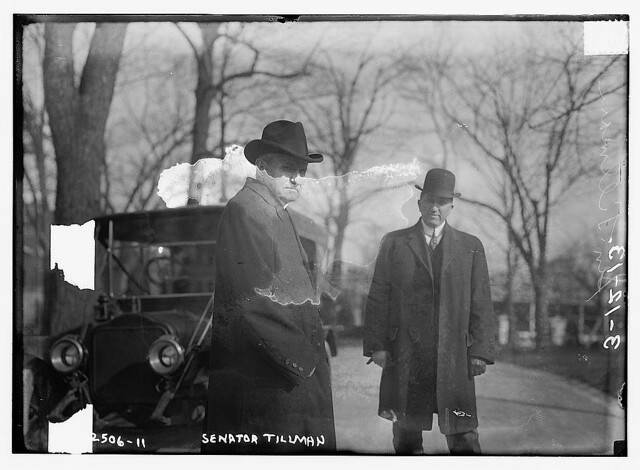
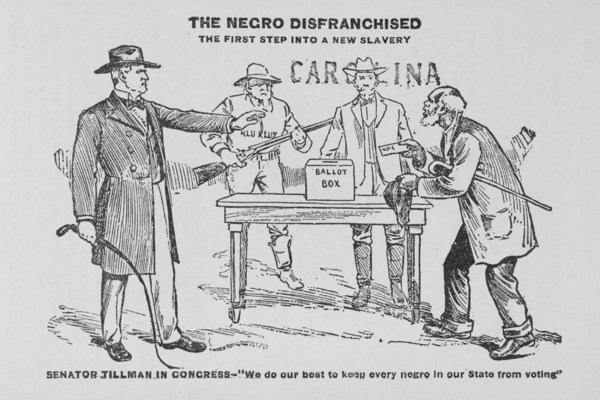
The Tillman Act, passed in 1907, banned corporate contributions in federal political races. The Act is named for Senator Benjamin Ryan “Pitchfork Ben” Tillman (1847-1918) (D- SC), one of the most despicable men ever to serve in the U.S. Senate and a man who, it can fairly be said, did more to put in place the Jim Crow system in the South than any other single person. As a young man coming of age in the post-War South, Tillman was a leader of the “Red Shirts,” a terrorist paramilitary group organized to attack and intimidate Republicans and blacks. In 1876, the Red Shirts’ campaign of murder, violence, and fraud led to the defeat of South Carolina’s integrated reconstruction Republican government. Arguing that, “The negro must remain subordinated or be exterminated,” Tillman openly called for the murder of blacks in order to, ”keep the white race at the top of the heap.” Tillman was elected South Carolina Governor in 1890, and created South Carolina’s first literacy test for voters, as well as promoting various property and educational requirements for voting. While in office, he once pledged to personally “lead a mob in lynching a negro.” After all, “the negro,” he claimed, was “a fiend in human form.” For his services, South Carolina sent him to the U.S. Senate, where he served from 1895 until his death in 1918.


For Tillman, though, it was not enough to be the primary architect of Jim Crow in South Carolina. Tillman spoke far and wide around the South, urging the suppression of blacks. He went to North Carolina 1898 to aide in the violent overthrow of the racially tolerant city government of Wilmington. Responding to an editorial by the mixed-race editor of the Wilmington Record, Tillman taunted, “Why don’t you lynch the n****r editor…? Send him to South Carolina, let him publish such offensive stuff, and he will be killed.”


Tillman was offensive in many ways beyond his attitudes on race and voting rights – for example, in 1902 the Senate censured Tillman for assaulting Senator John McLauren on the Senate floor. But it was race where he made his mark.


Does all this have anything to do with the substance of what may be Tillman’s most enduring legacy, the Tillman Act? Not in any obvious way, although the Tillman Act aimed to cut the power of northern industrialists, whom Tillman hated in part because of their more liberal attitudes on race. But we don’t see why the so-called “reform” community, which relies heavily on smear tactics and vague accusations of corruption in its own campaigns, should be able to claim Teddy Roosevelt and Elihu Root as its godfathers, but ignore its other founding father, Ben Tillman. (Tillman had his good side, after all – he was instrumental in founding Clemson and Winthrop Universities). Besides, it’s not really clear why Elihu Root’s musings on the role of contributions, in amounts exceeding $1 million in inflation adjusted dollars, are terribly relevant to the justification of the complete ban on corporate political contributions, either. While race was at the core of Tillman’s political philosophy, we don’t think for a minute that race motivates today’s denisons of reform. We are sure that they find Tillman as disgusting as we do – which is why he’s the “founding father of reform” who never gets mentioned. Wouldn’t want to tarnish the good guy image.


But there is another part of Tillman’s philosophy that is directly relevant to efforts to regulate political speech today. Nearing the end of his career, Tillman commented in 1916, “I have come to doubt that the masses of the people have sense enough to govern themselves.”

[Theodore Roosevelt with Benjamin 'Pitchfork Ben' Tillman]

As we have often noted, and will explore in other posts about the Tillman Act, today’s reformers, with their restrictions on campaign giving and spending, largely share this distrust in the ability of the electorate to discern good arguments from bad and to vote for the policies they prefer. And because they don’t trust the electorate to make good decisions, today’s “reformers” feel compelled to try to shape the opinions people can hear, to gently guide the “masses” to the proper conclusions. Ben Tillman may be forgotten – sorry Ben, you’re just not presentable enough any more to be the spokesman for the cause - but his distrust of the citizenry lives on. (source: Campaign Freedom)

Wednesday, September 5, 2012

The South Carolina Constitutional Convention of 1895


In the 1892 gubernatorial election, Benjamin “Pitchfork' Tillman gathered much support from the growing number of poor farmers and was successfully re-elected, despite the fact that opposing candidates attempted to push blacks to the poles to vote against Tillman. Once his two year term as governor ended, Tillman was elected to the United States Senate in 1894. After having nearly lost the governors race due to the black vote, Tillman feared that blacks could take control of the split white state senate, and thus urged the state to draft a new constitution to disenfranchise African-Americans.


On September 10, 1895, Senator Tillman got his wish as Secretary of State Tompkins and Governor Evans called the state's delegates to the State Capital in Columbia to draft a new South Carolina Constitution. Although many changes were made during the three month period, the most significant changes centered on the right to vote. In order to vote under the new constitution, a person must own at least 300 dollars worth of property, pass a literacy test, and pay a poll tax 6 months before elections, The constitution also prohibited all citizens that were convicted of bigamy, burglary, arson, robbery from voting because the delegates thought that these crimes were mainly committed by African-Americans. All of these new voting regulations effectively disenfranchised the entire African American population in South Carolina. The black population was further penalized as the state established segregated schools and barred interracial marriages. In addition, Cora S. Lott appealed to the delegates to extend suffrage to women, but the motion gained little support. The delegates did, on the other hand, give women the right to own and control property.


The Constitution of 1895, which was ratified on December 4, 1895, essentially laid the ground work for Jim Crow in South Carolina, since almost the entire African American population was disenfranchised, which further strengthen the white control over the state of South Carolina. The disenfranchisement and Jim Crow laws continued to thrive in the state until the Civil Rights Movement of the 1960's. (source: History Engine)

HOME

HOME
Click here to return to the US Slave Home Page