
"The Promised Land II," by Nicholas Lemann (Vintage Press, 1992):Before World War II, the cotton planters of the Delta were absolutely opposed to black migration to the North. Hortense Powdermaker, enumerating the whites’ "creed of racial relations" in 1939, wrote that one of its main tenets was, "Negroes are necessary to the South, and it is desirable that they should stay there and not migrate to the North."

Whites kept the black school system in Mississippi inferior in part because they didn’t want sharecroppers’ children to have career options beyond sharecropping. Senator James K. Vardaman once said that educating the black man "simply renders him unfit for the work which the white man has prescribed, and which he will be forced to perform . . . the only effect is to spoil a good field hand and make an insolent cook." In the 1920s, Clarksdale was supposed to become the site of a new black college called Delta State, but the white planters succeeded in having it moved to the town of Cleveland, fifty miles away, because they didn’t want new opportunities for blacks opening up in town.
The Hopson Plantation in the Mississippi Delta
The relocation of Delta State was a well-remembered story in black Clarksdale, and there were lots of rumors about other enterprises the planters had kept out.As late as the early 1940s, the owners of the King & Anderson plantation, an enormous spread of seventeen thousand acres just west of Clarksdale that was reputed to be the largest family plantation in Mississippi, sent two of their white managers to Chicago to see if they could get some of the sharecroppers who had left to come back home. The managers first met with John H. Jackson, the pastor of the magnificent yellow-brick Olivet Baptist Church, which was well on its way to becoming the largest black congregation in America. Jackson is probably best known now for having been the leading enemy of Martin Luther King within the black Baptist church; when the city of Chicago changed the name of South Parkway, the boulevard on which Olivet stands, to King Drive after King’s death, Jackson changed the address of the church to Thirty-first Street so he wouldn’t have to have King’s name on his letterhead. In the 1940s Jackson was willing to entertain two white plantation managers, but he said he couldn’t urge members of his flock to move back South until conditions for blacks improved there.

The King and Anderson Plantation sharecropper's children deprived of education
Then the managers held a long meeting with former King & Anderson sharecroppers in an apartment on the South Side. The managers announced that the plantation had undertaken a series of reforms, including electrifying sharecropper cabins and providing sharecroppers with regular written statements of their accounts so they would not be surprised at the settle. The former sharecroppers said they already knew all that, along with all the other recent news from the plantation; the Mississippi-Chicago grapevine was very active. They complained about having been swindled on King & Anderson and other plantations, and about having been abused, degraded, and beaten by plantation managers and policemen. They showed no interest in coming home.

King and Anderson Plantation in the Mississippi Delta
When the managers got back to Clarksdale and told the owners of the plantation what had happened, the owners arranged a meeting in Clarksdale to discuss the situation. After the meeting, the white leaders of Clarksdale asked the black leaders of Clarksdale to draw up a list of grievances, which they did. No good jobs. Cheating at the settle. Lynchings. Being denied the courtesy titles of "Mister" and "Missus." Poor schools. No hospitals. No sidewalks, gutters, or garbage collection in the black neighborhoods. Confronted with all this, the whites did nothing; the list of grievances could have been resubmitted virtually intact in the early 1960s.

King and Anderson Plantation sharecroppers
When word got around about the demonstration of the mechanical cotton picker on the Hopson plantation, though, the attitude of the whites toward black migration changed almost instantly. A plantation didn’t need hundreds of field hands any more; a handful would do. It didn’t matter if sharecroppers moved to Chicago. In fact, it helped to solve the problem of where the sharecroppers would go after their jobs were abolished.

Besides, the more far-sighted whites in the Delta had begun to detect a slight crumbling in the citadel of segregation. The New Deal was a generation old by now, and while politically it represented an accommodation between Northern liberals and Southern segregationists, the Delta’s planters perceived Franklin Roosevelt as a threatening figure. During his reign, various critics of the sharecropper system who at least raised segregation as an issue had emerged, and millions of Northern blacks had been recruited into the Democratic coalition. World War II had exposed thousands of young black men from the Delta to places where segregation didn’t exist, and, having fought for their country, they seemed to feel entitled to things they didn’t have in Mississippi. In Greenville, just after the end of the war, four black veterans went to the county courthouse and said they wanted to register to vote. The registrar said they hadn’t paid their poll tax for 1944. They came back with the money the next day, and the next, and the next, and every day they got a different excuse. Finally they filed a complaint with the FBI in Washington, and two agents came down to Greenville, interviewed the veterans, had them sign a complaint, and got them registered.

The implications of blacks voting were not happy ones for Mississippi whites, especially in the Delta, which was three-quarters black. In 1935, there were more black people living in Coahoma County alone than in the states of Montana, Idaho, Wyoming, Colorado, New Mexico, Arizona, Utah, and Nevada combined. Most middle-aged whites had been raised on their parents’ and grandparents’ horror stories about life during Reconstruction, when blacks were enfranchised. By the 1940s, the school-desegregation issue had reached the notice of white planters, as well as Aaron Henry. A few civil rights activities had started to pop up here and there. All in all, the idea of getting the numbers of blacks and whites in the Delta a little closer to equilibrium began to seem attractive to whites on Political as well as economic grounds. The best, the only, means to that end was black migration to the North. As Aaron Henry puts it, "They wished we’d go back to Africa, but Chicago was close enough."

On the Hopson plantation, the idea of a looming civil rights crisis was very much on the mind of the Hopson family; it gave a new urgency to the long-running efforts to get the mechanical cotton picker ready for full-scale production. Howell Hopson’s brother Richard, who ran the plantation office, wrote a long, impassioned letter to the local cotton industry association in April 1944, a few months before the public demonstration of the picker, which makes clear the plantation’s thinking on the picker’s political implications. He wrote (via registered mail – an indication that he meant to make an important statement): "I am confident that you are aware of the acute shortage of labor which now exists in the Delta and the difficult problem which we expect to have in attempting to harvest s cotton crop this fall and for several years to come. I am confident that you are aware of the serious racial problem which confronts us at this time and which may become more serious as time passes." After a little more discussion, he arrived at the solution: "I strongly advocate the farmers of the Mississippi Delta changing as rapidly as possible from the old tenant or sharecropping system of farming to complete mechanized farming….Mechanized farming will require only a fraction of the amount of labor which is required by the share crop system thereby tending to equalize the white and negro population which would automatically make our racial problem easier to handle.

Within a few years after the end of World War II, the mechanical picker was coming into general use on the plantations, and the share-cropper system was ending. Usually a plantation would build up its stock of machines until it had enough to harvest the whole crop, and then it would announce to the sharecroppers that it was switching over to an all-day-labor system to handle the shopping, which was still done by hand. One by one the plantation commissaries were closed down. The more established and paternalistic planters, such as King and Anderson and the Stovalls in Clarksdale and the Percys in Greenville, allowed their sharecroppers to stay in the cabins if they wanted to, but not to make a crop of their own.

A lucky few got salaried jobs as tractor drivers; the rest who stayed had to work as day laborers, get jobs in town, or retire. Some planters forced their sharecroppers out by informing them that the garden spots they used for raising vegetables and keeping livestock would now have to be plowed over and planted to cotton. The smaller and rougher planters simply kicked out their sharecroppers and lift them to fend for themselves. Often, when a sharecropper family left, the planter would bulldoze the cabin and grow cotton where it had stood. Sharecropper cabins were understandably not in demand as housing. If the cabin wasn’t on arable land, it usually just sat unoccupied, slowly sagging and giving way to vines. The Delta today is dotted with nearly spectral sharecropper cabins, their doors and windows gone, their interior walls lined with newspapers from the 1930s and 1940s that once served as insulation. They are humbler than what you’d ordinarily think of as the ruins of a vanished civilization, but that is certainly what they are.
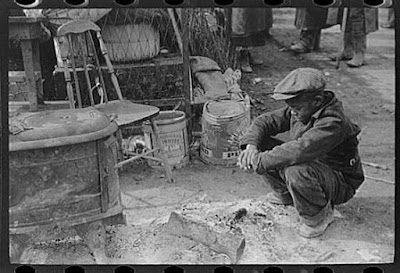
Evicted sharecropper on the side of the highway
The sharecroppers who left the plantations sometimes moved directly to Chicago. More often they settled first in the town of Clarksdale, either in preparation for the second phase of their migration or to become day laborers and continue to work in the cotton fields. Day labor as a large scale employment base was doomed in the long run, though, because in the late 1950s the cotton planters embarked on a second phase of their industrial revolution that was just as significant as the introduction of the mechanical picker: the development of chemicals that killed the weeds between cotton plants so reliably as to make hand chopping unnecessary. Within ten years, virtually all the former sharecroppers had to find some entirely new way to live.

Mass evictions of sharecroppers
The white people in the Delta were well aware that a massive displacement of people was under way, and that it would have enormous consequences – not necessarily for them, since the consequences would be played out largely in the North. Writing in 1947, David Cohn issued the following dire prediction, which, to say the least, did not rivet the attention of a nation that was consumed with resuming a normal life after the war and wasn’t inclined in any case to pay much heed to jeremiads issued by an obscure Southern apologist:
Evicted Southern Sharecroppers
The coming problem of agricultural displacement in the Delta and the whole South is of huge proportions and must concern the entire nation. The time to prepare for it is now, but since we as a nation rarely act until catastrophe is upon us, it is likely we shall muddle along until it is too late. The country is upon the brink of a process of change as great as any that has occurred since the industrial Revolution….Five million people will be removed from the land within the next few years. They must go somewhere. But where? They must do something. But what? They must be housed. But where is the housing?

Mass evictions of sharecroppers
Most of this group are farm Negroes totally unprepared for urban, industrial life. How will they be industrially absorbed? What will be the effect of throwing them upon the labor market? What will be their reception at the hands of white and Negro workers whose jobs and wages they threaten?

There are other issues involved here of an even greater gravity. I f tens of thousands of Southern Negroes descend upon communities totally unprepared for them psychologically and industrially, what will the effect be upon race relations in the United States? Will the Negro problem be transferred from the South to other parts of the nation who have hitherto been concerned with it only as carping critics of the South? Will the victims of farm mechanization become the victims of race conflict?

There is an enormous tragedy in the making unless the United States acts, and acts promptly, upon a problem that affects millions of people and the whole social structure of the nation.
A few years earlier Richard Wright, who viewed the situation from the completely different perspective of a black man, a migrant to the North, and a Communist, sounded an uncannily similar, and similarly unheeded warning:
Perhaps never in history has a more utterly unprepared folk wanted to go to the city; we were barely born as a folk when we headed for the tall and sprawling centers of steel and stone. We, who were landless upon the land; we, who had barely managed to live in family groups; we, who needed the ritual and guidance of institutions to hold our atomized lives together in lines of purpose; we, who had known only relationships to people and not relationships to things; we, who had had our personalities blasted with two hundred years of slavery and had been turned loose to shift for ourselves – we were such a fold as this when we moved into a world that was destined to test all we were, that threw us into the scales of competition to weigh our mettle.
(continued....)
An interview with Nick Lemann
Nick Lemann talks about "The Promised Land", a book about the migration of African-Americans from the South to northern cities, which is being made into a documentary film for the Discovery Channel


 There is an enormous tragedy in the making unless the United States acts, and acts promptly, upon a problem that affects millions of people and the whole social structure of the nation.

 State Sen. David Jordan says the state or private investors should buy the dilapidated building and rehabilitate it. But Jordan says the man who now owns the property is asking an exorbitant price.


 “He was a hell of a fine fellow and brother. He was gentle as a lamb and helped a lot of people that never paid him back.”


