Showing posts with label slave quarters. Show all posts

Saturday, February 25, 2012

South Carolina's Magnolia Plantation & Gardens

The Magnolia Plantation House, Charleston, South Carolina, U.S.A.

From The National Trust for Historic Preservation: Plantation and Gardens in Charleston, S.C., may be famous for its gardens, but it's also notable as one of the few places in America where black people have been living and working for more than three centuries. From 1679 until the 1990s, African Americans have been living in cabins there, tending Magnolia's grounds.

Now, for the first time ever, the five remaining cabins, built between 1850 and 1900, have been restored. On Feb. 28, the plantation will hold a grand opening, and tours of the new exhibit, called "From Slavery to Freedom," will begin the following day.


"It just seemed like the kind of thing whose time had come," says Taylor Nelson, whose family founded Magnolia Plantation in the 1600s. "What sparked the idea to actually [restore the cabins] is that I was working for a couple of years with my grandfather at Magnolia for a couple years, and he passed away. We thought it was an appropriate time to tell that story."

Nelson organized a luncheon last year with the descendants of slaves and freedmen who had lived in the cabins. "We all got together to talk about how their input could be taken into this project, and the lunch ended with everyone holding hands and singing 'Amazing Grace'."

Magnolia
Three of the five cabins had no foundations, and all had water and termite damage before the restoration. (Credit: Rock Creek Craftsmen)

The cabins "were in pretty bad shape. They were in danger of falling to pieces," says DJ Tucker, senior project contractor at The Living History Group, based in Charleston, the exhibit's designers. In January 2007, before the work began, archaeologists conducted a six-month survey of the area.

"We were just gobsmacked about the number of Colonial artifacts we were finding," Tucker says: a cup, a candlestick, a button from a British uniform sold to slaves, and pieces of Colono Ware, early pottery made by African slaves. "It was tremendous."


Last February, workers focused on the cabins. "Once we got past the [1980s] additions, we found the craftsmanship was excellent," says Kevin Meek, CEO of Charleston-based Rock Creek Craftsmen. "We recycled all the materials we could; preservation is the ultimate green."

The Living History Group restored each of the cabins to a different time period: an 1850 slave cabin, an 1870 freedmen's home, a 1900 gardener's home, a 1930 gardener's home, and the 1969 Civil rights-era home of the Leech Family, third-generation residents of Magnolia, who lived in the cabin without running water until the 1970s.
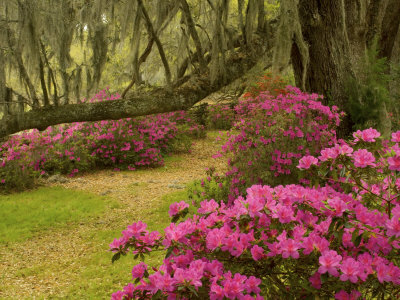

On a tour, visitors will listen to an interpreter highlight the cabins' histories as well as parts of the preservation project. Then they'll be able to wander through the structures, including the oldest cabin, where half of the two-family dwelling has been left unrestored as a time capsule.


The Magnolia Plantation and Garden's website offers this selection "From Slavery to Freedom: The Magnolia Cabin Project"

Magnolia's Cabin Project began more than four years ago in an effort to preserve five historic structures that date back to 1850. These former slave dwellings now serve as the focal point for an award-winning 45-minute program in African-American history.

Magnolia recognizes the importance of acknowledging the vital role that Gullah people and culture plays in any interpretation of Lowcountry history. By addressing this often overlooked part of the region's narrative, Magnolia seeks to respectfully afford credit where credit is due.


Visitors have the option to take a shuttle to the cabins, where they will experience an engaging and interactive discussion of the dynamic issues that shape this delicate inquiry. Afterward, time is given to allow everyone the opportunity to explore each cabin to appreciate the lengthy period in which the buildings were actively occupied - from the 1850s to the late-1990s. This arc of history conveys the tumultuous times continuously challenging African-American families from slavery, the Jim Crow/segregation era and through the modern Civil Rights period.

Magnolia promises visitors will leave with a newfound perspective rooted in cutting-edge historical and archaeological studies that consistently serve to inform and astonish all who visit.

Cabin A
Cabin A - Circa 1850's Slave Cabin

Built sometime in the early 1850's, this pine-framed duplex was designed to hold two separate families with as many as six people per room. Enslaved African-Americans lived here until Charleston fell to Union forces in February 1865.

Cabin A
Cabin B Justify Full- 1926 Gardener's Home

Built in the 1850's, this cabin was restored to reflect the mid 1920's era when it was the home of one of Magnolia's gardeners. The Hastie family often brought newspapers with them from Charleston and New York, which were used for cabin insulation and are recreated here.

Cabin A
Cabin C - 1969 Leach Family Home

Also erected in the 1850's, this cabin was later inhabited by free African-Americans working at Magnolia. The Leach family boasted a long lineage of prestigious gardeners dating back to the early 1930's, and Johnnie Leach resided here from 1946 until 1969.

Cabin A
Cabin D - 1870 Freedmen's House

African-American workers resided in this cabin off and on into the 1980's, making extensive alterations over the years. Magnolia Plantation restored this 1850's structure to its 1870's condition to illustrate a time when many former slaves became gardeners, porters and guides to the many visitors who traveled to Charleston aboard steamboats once tourism began its rise after the Civil War.

Cabin A
Cabin E - Circa 1900 Gardener's Home

This is the only cabin on this street not built during slavery. All indicators point to the building's completion occurring around 1900, and would have provided shelter for an individual or couple without children. The last person to inhabit this cabin was groundskeeper Allen Hinge, who left in 1999. (source: Magnolia Plantation & Gardens)


Friday, September 2, 2011

Beautiful Wilmington, North Carolina Landmarks Built With Slave Labor

Thalian Hall Wilmington, NC

The Star News article"Civil War Anniversary - Traces of slavery still found in Wilmington," by Ben Steelman on 31 August 2011: When North Carolina seceded from the Union in 1861, nearly half of Wilmington's residents weren't consulted on the issue.

Out of a population of 9,552 in the 1860 federal census, 3,777 of those living in Wilmington were slaves. Another 573 were listed as "free persons of color," but African Americans were not allowed to vote in antebellum North Carolina, nor could they hold office.

And how did those slaves live?

Thalian Hall/City Hall, Wilmington, North Carolina

"Well, we can guess they worked long hours," said Gareth Evans, executive director of the Bellamy Mansion Museum at Fifth Avenue and Market Street. "There was lots of scrubbing, lots of emptying chamber pots, lots of toting water."

A century and a half after the Civil War, traces of the legacy of slavery can still be found in Wilmington.
Thalian Hall Wilmington, NC

Many of those traces can be found in some of its most impressive public buildings, such as the Thalian Hall/City Hall complex or the Bellamy Mansion itself.

Both of these structures were largely built by slave and free black labor by skilled craftsmen such as William B. Gould, a plasterer, or Abraham H. Galloway, a bricklayer who pocketed his own wages and paid his owner, Brunswick County planter Thomas Hankins, $15 per month.

Thalian Hall Wilmington, NC

"I remember the bricklayers, they was all colored," a former Wilmington slave recalled in a Depression-era interview for the federal Works Progress Administration and later compiled in George P. Rawick's "American Slave."

"The man that plastered the City Hall was named George Price, he plastered it inside. The men that plastered the City Hall outside, and put those columns up in front, their names was Robert Finey and William Finey, they both was colored. …

Thalian Hall/City Hall

"Yes'm they was slaves, mos' all the fine work 'round Wilmington was done by slaves. They called 'em artisans. None of 'em could read, but give them any plans, and they could follow them to the las' line."

Over at the Bellamy Mansion, now cased in glass, is palpable proof of the contributions. Some years ago, repairs revealed a piece of plaster with the florid signature of William B. Gould, the man who did the work.

Born in 1837, the son of an English father and a slave mother, Gould was a slave belonging to Nicholas Nixon, who owned a large plantation in what is now Porters Neck.

Bellamy Mansion Museum at Fifth Avenue and Market Street

Like many of the Wilmington slaves, however, Gould enjoyed considerably more liberty than slaves who were working on the rice plantations along the Cape Fear River or one of the "turpentine orchards" of the pine forests nearby.

Slaves in the building trades could, in effect, rent themselves out, usually in contracts that ran from the first of the year to the last. They gave their owners a share of what contractors paid them and kept the rest.

In some cases, if a slave was hardworking and lucky enough, he could save enough money to buy his own freedom and that of his family – if his owner would take the payment.

Rear View of the Bellamy Mansion, Wilmington, North Carolina

Still, life was not idyllic, even for these workmen. Slaves were closely scrutinized by the local law. Each night, a bell in the old Market House at the foot of Market Street tolled, signaling the curfew for the slaves.

In 1857, the 20-year-old bricklayer Abraham H. Galloway smuggled himself aboard a ship and sailed to freedom in the North. He could not make his payments to his master, Hankins, and apparently feared he would be shipped off to tougher work or sold to a meaner master, according to his biographer, historian David Cecelski.

Born in 1837 in Smithville (now Southport), Galloway, like Gould, had been the son of a white man, a Brunswick planter's son, and a slave woman. Wilmington would hear from him again.

Bellamy Mansion

In 1862, in the midst of the Civil War, Gould would escape as well. On the night of Sept. 21, he and seven other slaves slipped down to the riverfront, stole a small boat and began to row down the Cape Fear.

On a voyage that took a couple of days, hiding in the swamps by day, the eight slaves made their way down the Cape Fear River and out to sea, where they reached the Navy vessel USS Cambridge, which was part of the blockade of Wilmington.

Gould promptly enlisted in the U.S. Navy, serving for the rest of the war. He kept a journal of his wartime service, later published as "Diary of a Contraband" in 2002 by Stanford University Press. ("Contraband" was a Civil War term for an escaped slave.)

Urban Slave Quarters At The Bellamy Mansion In Wilmington, North Carolina

North Carolina forbade the teaching of slaves to read and write, but the law was widely ignored. Gould probably learned his letters in Sunday school at St. John's Episcopal Church, which he attended, said his great-grandson, William B. Gould IV, who edited the journals.

Not all Wilmington slaves, of course, were builders. At the Bellamy Mansion, Dr. John D. Bellamy and his family kept nine slaves: seven women, who worked as cooks and maids, and two men, Guy the butler and Tony the coachman who doubled as a handyman, according to Evans.

The women lived in a two-story brick dormitory building behind the house, apparently joined from time to time by the slaves of guests. (The slave quarters had a total of 10 privies, Evans noted.) Guy and Tony lived above the Bellamy stable, which is now the museum's visitors' center.
Slave Quarters Interior

The Spartan slave quarters are currently being restored with funding from a federal grant. Evans hopes the project can be completed by the end of the year.

Gould was not the only slave to leave a written account. James Johnson, born in 1847 in Smithville (Southport), was sold to a succession of Brunswick county boat builders and planters. He worked as a hostler (i.e., a stable groom), a field hand and as a coachman.

In a 15-page narrative, he recalled going out on Sundays "into the fields (to) scare the birds from the Indian corn and rice."

Life was tougher on the plantations. Johnson vividly recalled how his master tied him to a tree trunk and "flogged me until the blood streamed down my back, and then ordered some of the other Negroes to wash me in salt and water in order to cure my lacerated back as soon as possible."
Plantation Slave Quarters

As the Civil War broke out, Johnson noted that food grew more scarce. In the summer of 1862, like Gould, Johnson and some of his friends stole a boat and made their way to the Union blockader USS Stars and Stripes.

He made his way to England, working as a sailor and a boxer until he underwent a religious conversion. Later he traveled as an evangelist, leaving a written account of his life that Cecelski and Alex Meekins discovered in archives in Oldham, England.

After the war, Gould moved to Massachusetts, where he prospered as a building contractor and became active in the Grand Army of the Republic, a Union veterans' organization. He died in 1923, having seen all six of his sons serve in the armed forces in the Spanish-American War or World War I.

Bellamy Mansion Negro House c. 1859

Galloway's life was perhaps the most amazing. During the Civil War, he returned to North Carolina. Based in Union-occupied New Bern, he served as a Union spy and as a sometime recruiter of ex-slaves for the Union Army. After the war, he returned to Wilmington, where he became active in the Republican Party. He represented New Hanover County in the state's 1868 constitutional convention, then served in the state Senate until his death in 1870. Cecelski is currently writing a full-length biography of Galloway for the University of North Carolina Press, due for publication in 2012. (source: Star News, Ben Steelman, 31 Aug. 2011)

Friday, June 24, 2011

South Carolina Slave Cabin Rescued and Restored

The Washington Times reported: CHARLESTON, S.C. | When Joe McGill spreads his sleeping bag on the floor of a slave cabin, he knows that spending the night there will conjure the specter of slavery.

Slave cabin before: "The two-room cabin "was in pretty bad shape. We managed to [salvage] maybe 50 percent of the original fabric," says Thomas Riddle, secondary social studies consultant at Greenville County Schools, who helped rescue the cabin. "We used many original wall studs, which were really cool because they were recycled from an earlier cabin. We used literally every scrap that we could." (source: National Trust for Historic Preservation)
"If I were a firm believer in ghosts and spirits and things of that nature, I don't think I could do this," said Mr. McGill, who is working to preserve buildings that are part of a past that many prefer to forget.

One night he heard dogs in the distance — a sound that recalled the search for runaways during slavery. He awoke on Mother's Day morning in a cabin thinking of children being sold from their mothers. Then he walked to the black graveyard on a plantation near Charleston.

"I thought, 'This is why I'm doing this — for those people in those graves to give them a voice for what they endured,'" said Mr. McGill, 48.

Mr. McGill, a program officer with the National Trust for Historic Preservation, spent Saturday night in a cabin at Hobcaw Barony near the coastal community of Georgetown.

The slave cabin after, with a new foundation, shingles, and framing, the cabin is scheduled to be dedicated Feb. 12, 2010. "The 23-by-16-foot structure was built before the Civil War by people enslaved by Dr. Thomas Blackburn Williams, and later became a home for families who worked on a nearby farm. The last occupants moved out in the early 1930s."(source: National Trust for Historic Preservation)
It was the fifth night this year that he has slept on a cabin floor, trying to attract attention to the need to preserve the structures and the history they hold.

Mr. McGill, who is black, is also a re-enactor with the 54th Massachusetts, the black Union regiment that fought at Battery Wagner on Charleston Harbor during the Civil War. He said that spending the night in the cabins helps him connect with his ancestors.

He first slept in a cabin at Boone Hall Plantation near Charleston a decade ago as part of a program for the History Channel titled "The Unfinished Civil War," which focused on the dispute over the Confederate flag flying over the South Carolina Statehouse.

During the past year, Joe McGill has slept in 22 former slave dwellings in six states. He does it to draw attention to the need to preserve the structures that are part of the heritage of blacks in America.
He has returned to the cabin project this year and meets with reporters wherever he goes to draw attention to the buildings. He said that preserving the cabins requires local efforts and his goal is to encourage people to save the ones that are left.

The cabins where Mr. McGill has stayed — such as those at Magnolia Plantation and Gardens near Charleston — have been restored, but many others have been neglected.

Mr. McGill started in May with a list from the State Historic Preservation Office showing cabins at about 30 sites. He thinks his effort is already helping because since he started the sleep-ins, three more cabins have been identified.

Magnolia Plantation Slave Quarters

He plans to sleep later this summer in a cabin in Anderson, in upstate South Carolina, and this fall in cabins in Alabama.

South Carolina once had thousands of slave cabins. Many did not survive because they were modestly constructed of wood or because people didn't want a connection with a dark chapter of history, Mr. McGill said.

Andy Chandler, who helps administer the National Register of Historic Places for the State Historic Preservation Office, said no firm figures are available on how many cabins are still standing in the state.

About 1,300 listings are on the register for South Carolina, and some may include sites with cabins. But, he said, since some sites have been on the register for decades, some of the cabins may not be there anymore. People who recommend sites for inclusion on the register don't always consider slave cabins worth mentioning. (source: The Washington Times)

Tours of the former slave cabin are available at the Rober Mountain Science Center's Living History Farm. The cabin was restored and moved from a site on Grove Road in Greenville. (GEORGE GARDNER/Staffer)

Slave cabin sleepovers

Monday, March 7, 2011

III. HOUSES: Slave Quarters

III. HOUSES.


The huts of the slaves are mostly of the poorest kind. They are not as good as those temporary shanties which are thrown up beside railroads. They are erected with posts and crotches, with but little or no frame-work about them.


They have no stoves or chimneys; some of them have something like a fireplace at one end, and a board or two off at that side, or on the roof, to let off the smoke. Others have nothing like a fireplace in them; in these the fire is sometimes made in the middle of the hut.


These buildings have but one apartment in them; the places where they pass in and out, serve both for doors and windows; the sides and roofs are covered with coarse, and in many instances with refuse boards.

Greenhill, Virginia Slave Quarters

In warm weather, especially in the spring, the slaves keep up a smoke, or fire and smoke, all night, to drive away the gnats and musketoes, which are very troublesome in all the low country of the south; so much so that the whites sleep under frames with nets over them, knit so fine that the musketoes cannot fly through them.

Greenhill, Virginia DUCK BARN (ducks have better housing than enslaved human beings)

Some of the slaves have rugs to cover them in the coldest weather, but I should think more have not. During driving storms they frequently have to run from one hut to another for shelter. In the coldest weather, where they can get wood or stumps, they keep up fires all night in their huts, and lay around them, with their feet towards the blaze.


Men, women and children all lie down together, in most instances. There may be exceptions to the above statements in regard to their houses, but so far as my observations have extended, I have given a fair description, and I have been on a large number of plantations in Georgia and South Carolina up and down the Savannah river.
Slave Quarters at the San Francisco Plantation - the most Opulent Plantation on the Great River Road of Louisiana

Their huts are generally built compactly on the plantations, forming villages of huts, their size proportioned to the number of slaves on them. In these miserable huts the poor blacks are herded at night like swine, without any conveniences of bedsteads, tables or chairs.


O misery to the full! to see the aged sire beating off the swarms of gnats and musketoes in the warm weather, and shivering in the straw, or bending over a few coals in the winter, clothed in rags. I should think males and females, both lie down at night with their working clothes on them.
God alone knows how much the poor slaves suffer for the want of convenient houses to secure them from the piercing winds and howling storms of winter, especially the aged, sick and dying. Although it is much warmer there than here, yet I suffered for a number of weeks in the winter, almost as much in Georgia as I do in Massachusetts.


The slave quarter described above likely appeared similar to the one pictured in this photograph of a late 19th century freedman's home near Richmond, Virginia.


source: "NARRATIVE AND TESTIMONY OF REV. HORACE MOULTON, MR. MOULTON is an esteemed minister of the Methodist Episcopal Church, in Marlborough, Mass. He spent five years in Georgia, between 1817 and 1824. The following communication has been recently received from him. MARLBOROUGH, MASS., Feb. 18, 1839."

HOME

HOME
Click here to return to the US Slave Home Page