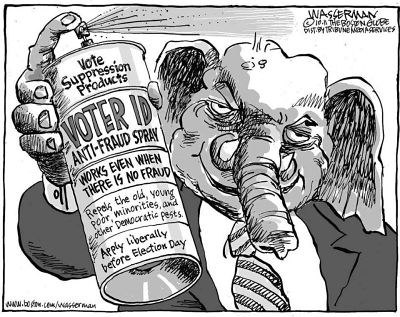
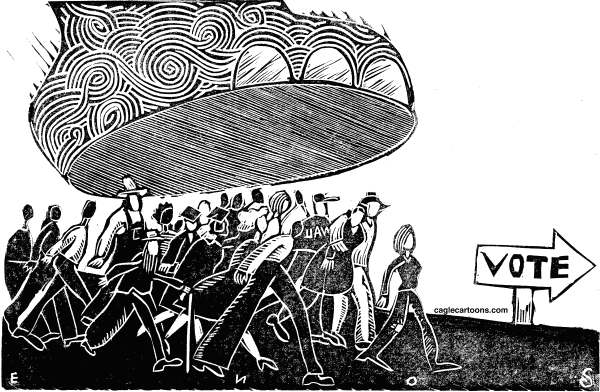
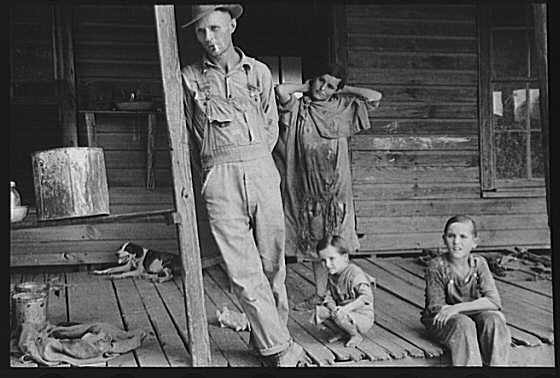
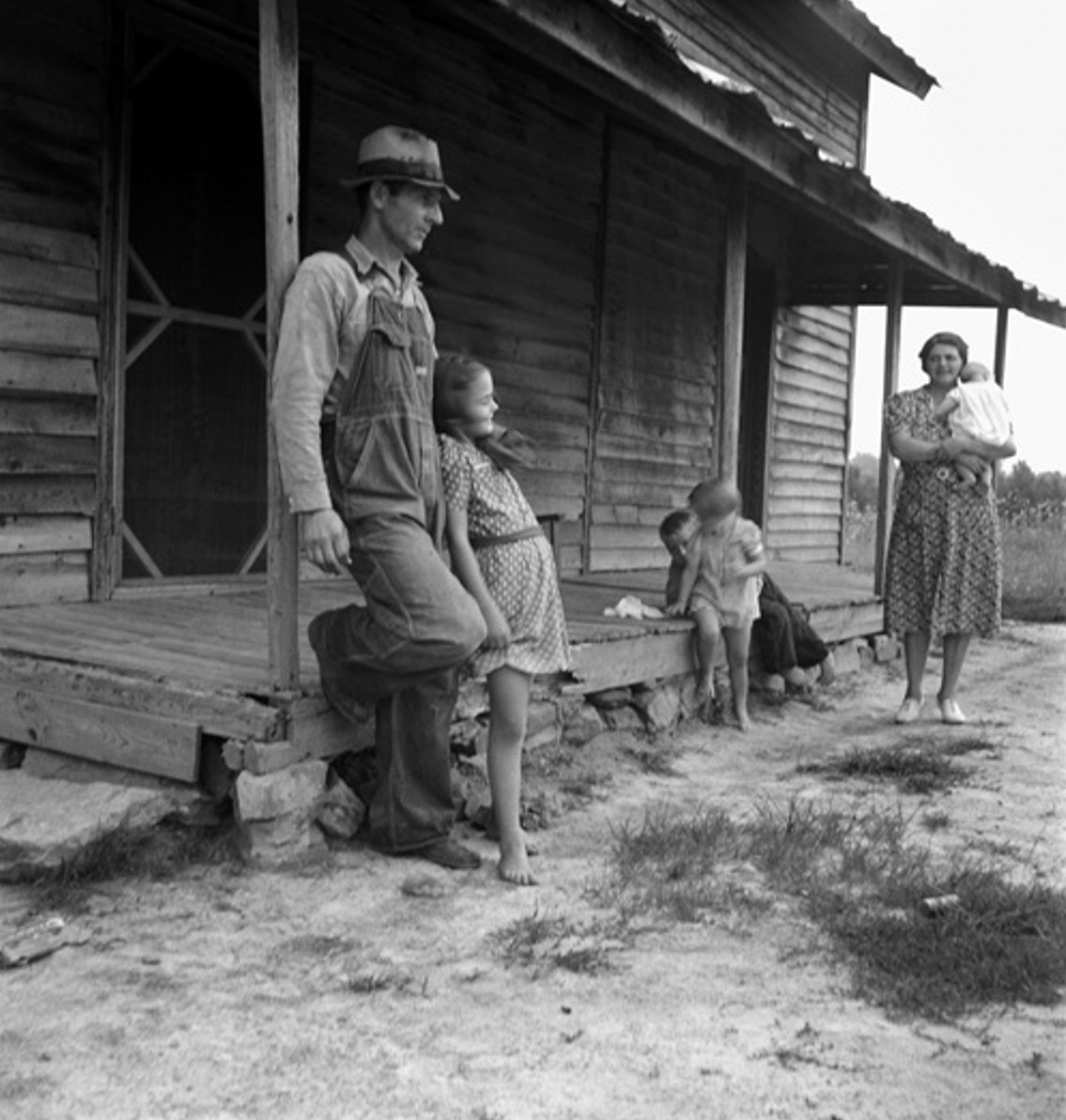
From Yes! Magazine, "How Voter Suppression Could Swing the Election: It won’t be easy to protect our votes from being sidelined and stolen this year, but here are a few simple things we can do," by Greg Palast, on 24 August 2012 -- In more than 100 years, there has not been a single case of voter identity fraud in the state of Indiana. Yet, in 2008, 145,000 legitimate voters there were turned away from the polls because they could not produce the photo IDs acceptable to state officials on a crusade against “voter fraud.”
Approximately two out of three of those voters were black. Ten of them were black and white (nuns from the Sisters of the Holy Cross). One nun, aged 98, had given up her driver’s license as had her “younger” sisters.
If someone steals your wallet, you don’t take the rest of your money and throw it in the street. If someone steals your vote, don’t just hand them the next one.
Now, 16 states have passed voter ID laws similar to Indiana’s. The story is that legislators are trying to stop an epidemic of people voting under false names or casting the ballots of dead people. But nobody’s come up with more than a tiny handful of cases where that’s happened. Taking away the votes of hundreds of thousands of people to stop one or two fake votes is like killing a flea with a shotgun.
Moreover, no fewer than 68,029 Indiana citizens, and 488,136 voters nationwide, had their absentee ballots thrown out on nutty technicalities like using the wrong size envelope or crossing out a bubble instead of filling it in.
In all, my fellow investigator, Robert F. Kennedy Jr., and I found that more than 5.9 million citizens were wrongly barred from voting or having their ballots counted in 2008.
Nonetheless, Indiana, birthplace of the Ku Klux Klan, was won by a black man, Barack Obama, despite the massive number of votes tossed and voters turned away.
That happened because in Indiana, and nationwide, a massive turnout of African-American voters and record registration of young voters—both groups that are hugely affected by voter ID laws—overcame efforts to block votes.
Because of all the attacks on voting I’ve reported, I’ve been asked, “Why bother? If they’re going to steal my vote, then why should I vote at all?”
The answer is, “That’s what the thieves want you to say.” If someone steals your wallet, you don’t take the rest of your money and throw it in the street. If someone steals your vote, don’t just hand them the next one.
It won’t be easy to protect our votes this year—estimates say the new restrictions could again disenfranchise as many as 6 million people. But Dr. Martin Luther King Jr. protected the votes of African-Americans when voting while black meant risking your life. Our task in 2012 is far easier.
First and foremost, check your voting status. Think you’re registered to vote? Check again. Under new federal laws, secretaries of state have eliminated 22 million voters from the registries in the past two years. Check online right now.
How To Ask Candidates Questions
That Make a Difference
Tips for spreading your ideas without getting the runaround.
Do you live in a state with new ID laws? Find out what ID you need, and figure out a way to get it. It may not be easy—but that’s the point. They’re hoping that people will just throw up their hands—and throw away their votes. Do you vote at one address and register a car at another? That’s asking for trouble. Have you added your middle initial to your signature? Well, don’t.
Read the instructions on your absentee or mail-in ballot. If they tell you to fill in a bubble, don’t cross it out. If they say to use a pencil, don’t use a pen. It may seem like trivial stuff, but it killed almost half a million votes last time.
The people who don’t want your vote to count are counting on you to give up easily. Don’t do it. We can work to fix the laws after the election. But right now, the most important thing is to find out what rules are in place and make sure you follow them.
Get informed—then get going. Voting is for We the People, not Them the Ballot Bandits. (source: Yes! Magazine)
[Greg Palast wrote this article for It's Your Body, the Fall 2012 issue of YES! Magazine. Greg is a widely published investigative reporter and author of several books. His latest, Billionaires & Ballot Bandits, a look at the role of big money in the current election, features comics by Ted Rall. BallotBandits.org]
From H-Net, by Lewie Reece, on July 2001 -- Students of southern political history have long recognized the impact of disfranchisement. The process by which southern state legislatures and constitutional conventions stripped African-Americans and poor whites of the ballot has long been deemed an important event. Yet understanding the meaning of that event has often proved illusive. To date, the most significant work on disfranchisement has been that of J. Morgan Kousser. Kousser's The Shaping of Southern Politics was an immediate classic, and remains the most important book written on Post-Reconstruction southern politics. Kousser demonstrates clearly that Republicans, far from disappearing from politics after Reconstruction, remained a vibrant force in the region's politics until disfranchisement.
From Kousser's perspective, disfranchisement was an event necessitated by the deep pressure that planter elites felt from opposition politics in the late nineteenth century. It was not poor whites who transformed the political system, but rather the planter elite who, through their control of the legal process at the state legislative level and at state constitutional conventions, eliminated the political opposition. Law then is at the center of Democrats' attempts to create a political universe in which their power was unchallenged. Kousser also clearly demonstrates that political democracy was effectively dead in the South by the early 1900s, never again to revive until the civil rights revolution of the 1960s.
Perman's work builds upon many of the important conclusions that Kousser reached about the workings of the southern political system. It is an attempt to examine in great detail the process through which southern states disfranchised the political opposition. Perman delves into the thought processes of those who pushed disfranchisement forward. His interest and heavy investment of effort in archival materials allows him to provide an interesting picture of the Democratic political establishment. They are a morally repellant lot, but Perman provides a much more detailed examination of their motivation and influence. Many of the southern politicians who exercised such influence have been given little attention within the larger historiography of southern politics and so Perman's observations have real merit. His portrait of Ernest Kruttschnitt, the leader of disfranchisement forces in Louisiana, is expressed with particular talent and skill.
Perman provides a much more detailed description of these political leaders than anything we have had previously, and presents an important appreciation of the people who led the drive to disfranchisement. His work reveals a palpable political fear in these leaders' approach to disfranchisement. Disfranchisement was never an afterthought, but a calculatingly determined move on the part of a political elite who were consumed by racism and resolved to crush biracial democracy in the South.
Perman's approach to detailing the story of disfranchisement in the South is to describe the way in which it developed throughout the region chronologically, state by state. This methodology reflects the reality that while disfranchisement was a movement which developed across the entire South, it was also remarkably local. He clarifies the different dynamics particular to each state. One of the real strengths of Perman's account is the appreciation of these differences, as well as the various factional differences within the Democratic party. His focus on the different cadences of statewide politics allows him to show considerable appreciation of the different problems the planter elites struggled to overcome. His narrative is told in an engaging style, and reflects a real gift for making some of the more complicated political maneuvering comprehensible.
One of the other important elements in Perman's text is his appreciation of the long term significance of disfranchisement's impact on political development in the South. Perman clearly describes the onset of segregation, and the way race remained a central part of a disfranchised southern political culture. The events of disfranchisement thus have a considerable legacy, one that proves to be remarkably long lasting.
Equally valuable are the connections which Perman shows between events in the South and the increasingly racist cast of national politics in the Progressive Era. Little attention has been focused on the way in which the McKinley Administration consciously undermined Republican support for civil rights. The chapters which explain the movement away from civil rights as a national issue are quite effective, and have a certain emotional power. Historians of Progressivism have often accepted racism in national politics rather than studying it in sufficient detail, and these sections of the book are particularly instructive.
Perman's book is an important contribution to the historical literature. It does however, suffer from interpretive flaws. We can assign these flaws to current understandings of the period, as much as to Perman, but they do limit the impact of his work. First, although Republicans, and their junior partners the Populists, make an occasional appearance in Perman's text, the book is largely a study of how planter elite Democratic politicians disfranchised southern politics. We learn very little about southern Republicans and Populists during the disfranchisement campaigns. Since Republicans and Populists actively resisted disfranchisement on a consistent and determined basis, the absence of their story is a major gap.
Perhaps in some ways this reflects that historians have refused to take the role of post-Reconstruction southern Republicans seriously. As a result, the significance of African-American political activism is largely lost. This is however, a problem not simply with Perman's excellent discussion, but rather with the limitations of current southern political history.
One might wish as well, that Perman could have given more attention to the manner in which disfranchisement was a legal process. Disfranchisement, regardless of the form taken, was simply the imposition of legal statutes, regulations, and constitutions that restricted who could and could not register to vote. These laws had the effect of purging the electoral system of a multitude of voters who simply could not comply with the legal restrictions the various states imposed. The effect of these mechanisms was the denial of the ballot to African-Americans and poor whites, thereby insuring the power of the wealthy which dominated the Democratic party in the South. If disfranchisement was a revolution, and I think it was, then it was a legal revolution, as well as a political one.
Nevertheless, despite these qualms, it should be said that Perman's book makes a signal contribution to the study of disfranchisement. Struggle For Mastery provides a far more detailed examination of the southern political elite than anything we have had previously. It provides very detailed descriptions of the way in which disfranchisement worked, especially as a local and statewide movement. Perman also makes a real effort to integrate such a study of disfranchisement within a broader national focus. Historians of post-Reconstruction southern politics will find Struggle For Mastery an important book which merits serious examination. (Copyright 2001 by H-Net, all rights reserved.)
Glenn Feldman. The Disfranchisement Myth: Poor Whites and Suffrage Restriction in Alabama.
From H-Net, by , on October 2005, "Race Trumps Class in New South Alabama" -- In this narrowly focused, deeply researched book, Glenn Feldman seeks to forever banish one oft-repeated mantra of New South political history: populist hill-country whites joined with African Americans to oppose disfranchisement during the height of Jim Crow. This assumption is a myth, he argues, because poor whites were just as ready to curtail black voting as any Deep South planter. When Alabamians adopted a new Constitution in 1901, most poor whites approved self-destructive suffrage limitations in order to ensure the exclusion of African Americans from the polls. Feldman deconstructs the machinations of Alabama politicians who engineered the call for a Constitutional Convention in 1900, oversaw the writing of the new document, and guided its adoption. In this short book, Feldman provides what will surely become the definitive study of Alabama politics between 1898 and 1902. Scholars in other southern states will need to explore their own states' voting patterns on disfranchisement legislation more closely to see if the Feldman thesis holds in their locale as well. Surely all who teach the New South will reexamine their understanding of the political role played by poor whites.
The strengths of this book are many: exhaustive archival research into political lives; precise reconstruction of political decision-making based on Convention records; extensive use of contemporary editorials; a comprehensive bibliography; clear and often lyrical prose; and a more careful construction of the argument than this review can convey. What will bring this reviewer back to the book again and again are the chilling quotations--mostly from newspapers of the day--of white spokesmen about African-American citizens. Should you ever underestimate the vitriolic language in play at the turn of the century, just examine some of Feldman's examples from poor white, hill-country newspapers. For example, from the Marshall Banner, "'All coons look alike' to us, and have the same smell whether his name be Booker Washington [or not] ... [He] is still a negro and should understand that he must remain in the proper place" (p. 87). In a long diatribe, the Clanton Banner wrote, "Remove the negro into the humiliated station of life that nature intended for him" (p. 57). Feldman finds "the plain folk" consistently embracing such racist assumptions.
The Disfranchisement Myth begins with Feldman defining the title term, which he coined to describe the assumption "that common whites opposed suffrage restriction" for African Americans because they knew their own citizenship rights were equally vulnerable (p. 1). He explains how a superficial examination of voting returns coupled with a sympathy for the independent white farmer led such preeminent scholars as C. Vann Woodward, J. Morgan Kousser, and Michael Perman to assume that votes against black disfranchisement represented a fusion of African-American and poor white voters even after the demise of Populism.[1] As the reader begins this introduction, however, she has the sense of being dropped into an ongoing professional conversation about the role of poor whites in Progressive-era Alabama. The author spends no time developing a national (or southern) historical context nor reviews the history of poor white and African-American collaboration during the Populist era. Neither does he define basic terms such as "poor white" or "wiregrass." This is a work for specialists in Alabama history and Feldman goes right to task, illustrating three reasons that the "disfranchisement myth" has endured and calling for a reexamination of this myth.
The first chapter begins with a thoughtful description of scientific racism and southern whites' preoccupation with black political power under Reconstruction. These ideologies brought Alabama whites together, even when planter interests and yeoman interests might otherwise diverge. Rather than painting poor whites as "blameless victims of draconian patrician machinations," (p. 23) Feldman positions poor whites as willingly sacrificing some political power in order to guarantee white privilege. Even avid white populists "were white men first" (p. 24). Feldman uses the Alabama Senatorial race of 1900 as a prelude to the kind of racist rhetoric that would dominate the constitutional convention debates soon to follow. Incumbent John Tyler Morgan defeated former governor Joseph F. Johnston by trumpeting white supremacy and making race the primary issue in a campaign between two very similar candidates. Feldman finds that Morgan was able to effectively dismember what had been the populist coalition by hammering on black inferiority.
In the second chapter, the author analyzes the politics behind calling a constitutional convention as opposed to continuing to disfranchise African Americans by force or through state law alone. He argues that proponents built on the racial rhetoric of the 1900 Senate campaign to emphasize the need for whites to establish their hegemony concretely. Two tropes continually reappeared in speeches, editorials, and planning meetings: the horrors of Radical Republican Reconstruction and the intellectual superiority of whites. He uses the minutes of the Democratic State Convention to produce a detailed discussion of the political maneuvering within the Democratic leadership to secure the call for a convention. His close examination of newspapers in the predominantly white, non-planter counties reveals deep racist attitudes, whereas planter-dominated areas voiced paternalistic platitudes. Opposition to calling a convention came mainly from those who either found it unnecessary, as the black vote was well controlled already, or who feared that a new Constitution might also deprive them of voting rights. Pro-constitution advocates countered with assurances that the great sacrifices of poor whites in the Great War would never be forgotten. Enough voters believed this "pledge" that the call for a convention passed by a 24,800 state-wide vote margin.
The Convention itself produced a document that would take effect in two stages, a temporary plan from 1901-1903 whereby voting was restricted "by literacy and property tests ... [and] a poll tax" only (p. 90). The permanent Constitution would take effect in 1903 with "five disfranchising mechanisms with no corresponding loopholes for poor whites.... All five could be equally applicable to blacks and poor whites" (pp. 90-91). Thus the new Constitution embedded class privilege as it excluded African-American and poor white voters.
A separate chapter covers the ratification process itself. Ratification arguments also took two trajectories: blatant arguments about the inferiority of African Americans (p. 1) and the frightening specter of Radical Reconstruction rule (p. 2). Either way, ratification supporters heralded white supremacy and the necessity that whiteness trump class interest. Feldman reconstructs voting county by county to illustrate how little of the anti-Constitution vote was actually composed of poor whites. Instead, opposition came from some black voters and some white planter paternalists who saw no need for further restraints of the franchise. White males, regardless of class, were equally susceptible to racist arguments and to the hollow promise that no whites would lose their vote. According to Feldman, most poor white voters bought these arguments and "privileged Democracy had its way" (p. 125). An appendix contains detailed tables of voting for both calling the convention and ratification.
Did poor whites, in fact, lose their political voice under the new voting requirements? In 1903, the statewide total of registered white voters fell by 41,329 men despite a growing Alabama population. Some "reform" Democrats and poor whites who had opposed the new Constitution rallied to urge the party to adopt a (white) primary, hoping to give non-elites a voice. This final gesture cemented black disfranchisement, as both political parties became "lily-white," but did nothing to empower the poor farmer.
When Feldman writes in his conclusion that "[i]t is not a pretty sight to see plain people unwittingly work harm to their future prospects because of a shortsighted indulgence of emotion and, in fact, of prejudice," the reader suspects that the author is also addressing contemporary political behavior (p. 167). The willingness of working-class voters to vote against their own economic interests in order to voice support for perceived moral values rings true in the last presidential election. People do not "make political decisions based on rational estimations of their political interests" (p. 167). Indeed!
Having convinced the reader, I hope, that this is in fact a very important book, this reviewer must also lodge two caveats. As carefully, forcefully, and articulate as Feldman's argument is, it is just one argument about a very specific political event in only one state. It would have made a superb journal article and as such, secured a larger audience than it will probably find as a hardback monograph. An article could be assigned to classes with ease--and with much profit, not only for its content, but also as an example of research skill and excellent prose writing. Why is it that scholars feel compelled to include every possible piece of evidence in order to stretch an argument into a slim book? Are tenure and promotion guidelines driving decisions about how to publish our work? One result of the decision to present this research as a monograph is that the thesis is repeated and repeated in every chapter. It is fine micro-history, but may not get the wide reading audience it deserves.
A second quibble is that the best of the new political history views political choices through the lens of not only race and class, but also of gender. This reader found but one paragraph that dealt with the use of racial rhetoric in the woman suffrage debate. The book pays no attention to the cooperation, even the lead, of women in promoting white superiority and in segregating people of color to the fringes of proper society. Since the author cites both Jane Dailey's and Glenda Gilmore's works in his one paragraph, he surely understands how much of the power of white cultural formation must be attributed to women and women's organizations. (source: H-Net)
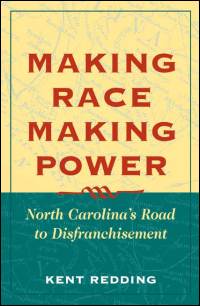
From H-Net, "Mobilizing Power from the Top Down," by Kelly D. McMichael, on August 2004 -- Most historians view the hegemony of the Democratic Party and the disfranchisement of African Americans in the late-nineteenth-century South as inevitable, but Kent Redding argues in Making Race, Making Power that the path state politics might have taken was entirely unpredictable. Redding's easily readable text makes a convincing argument for the need to approach southern politics from a different direction, looking at southern elites not just from their exalted positions or their ability to command resources (as power holders) but as power makers. Redding is interested in the process elites used to collectively mobilize power and examines one state, North Carolina, to determine how the political mobilization process led to disfranchisement. North Carolina shared many similarities with other southern states during the period. For example, Republicans were ousted from power in the 1870s, the Ku Klux Klan intimidated large numbers of African Americans, and blacks and many poor whites lost the vote due to the poll tax, literacy, and registration requirements. But North Carolina was exceptional because it suffered less than many of the other southern states from political violence, corruption, and fraud, leaving the democratic processes in the state relatively intact well into the 1890s. Black political mobilization remained strong, and a fusion between the Republicans and Populists in 1892 allowed the two parties to defeat the Democrats. The loss led to the extraordinary white supremacy campaigns of the rest of the decade.
Kent Redding. Making Race, Making Power: North Carolina's Road to Disfranchisement.
Redding begins by posing several questions, including asking why it took so long for African Americans to be disfranchised (when Democrats were already in power) and why blacks were allowed to vote until the 1890s in such large numbers. Essentially, he wants to know why disfranchisement occurred when it did. Why did Democrats formally restrict suffrage when they did? Redding determines that white Democratic elites in North Carolina, and likely elsewhere in the region, were initially divided about what political strategies the party should pursue. Over time the party had to face the powerful and innovative techniques of their competition. Organized blacks and Populists created new means of political mobilization that challenged the old patterns of organization and forced the Democrats to work along new lines, mainly by adapting the same types of strategies their opponents employed. The Democrats combined the use of new political techniques with their already solidified social position and abundant resources, a combination that allowed the party to gain a solid hold on the state and thwart any second or third party competition.
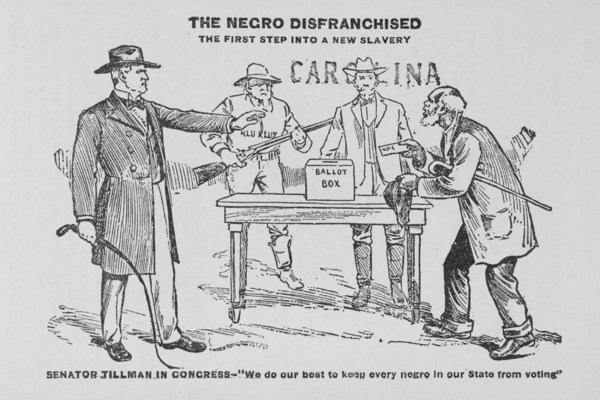
"The Negro Disfranchised. The First Step Into A New Slavery. Senator Tillman in Congress - 'We o or best to keep every negro in our State from voting."
Redding begins his analysis by examining voter turnout patterns across thirty years in the eleven traditionally southern states. Using multiple variable-centered analyses, he quantitatively reveals the loose process by which voter turnout was determined, a process combining race, competition, voting regulations, and class. Overall voting turnout declined from 65 percent in 1880 to less than 30 percent by 1912. The low turnout proved a necessary condition for Democrats to create an elite, racially based one-party system. The state no longer needed to mediate between contending interest groups when a large proportion of the voters no longer participated. Instead the party--and by default the state--could work at eliminating those people from the voting rolls permanently.
After examining the declining voter turnout in the South and illustrating the multiple factors responsible, Redding concentrates on the case of disfranchisement in North Carolina. He argues that the state Democratic party was vertically organized, a term that denotes power based on hierarchies within the group. In the case of elite whites, the power reflects a local, community-based system of patronage and kinship, controlled by key county offices. While politicians spouted racially based rhetoric early on, such policies were loosely and inconsistently applied. Race simply did not prove a strong organizing factor for the Democratic party in the state until the late 1890s. Local elite rule proved strong enough over two decades to make disfranchisement unnecessary, but continued high voter turnout through the 1880s stressed elite whites, and the Democrats found that they could not predict or control the strong mobilization being mounted by blacks and populists, a condition that eventually made disfranchisement necessary.
While Democrats used a vertical organization of power, blacks in the Republican and Populist parties experimented with and succeeded in creating a horizontal form of power, creating new types of party mobilization based on an identity determined by interest. Republicans coalesced a party around issues of race while Populists did the same using the economic interests of farmers. Democrats still engaged in the traditional method of creating a party--building support through local networks--but found that identity based issues superseded local elites' abilities to control the voting population.
Faced with a resounding defeat in 1892 by the fused Republicans/Populists, the Democratic party in North Carolina knew it had to radically change its party organization. The party seized the political innovations of their competitors and recaptured the state by making the Democratic party synonymous with racial purity. Not only did the Democrats create a party based on white supremacy, they linked the issue of manhood (gender identity) with whiteness and confirmed the loosely held notion that all whites held a common identity based purely on their skin color. Potential white political fusion with blacks based on economic issues was effectively ended; whites were symbolically separated from blacks as each race was given a specific identity. Once back in power, Democrats used their control to eliminate their competition permanently.
Although Redding is a sociologist, his work is thoroughly grounded in the historiography of disfranchisement. It adds greatly to the standard in the field, J. Morgan Kousser's monograph, The Shaping of Southern Politics, by giving detailed evidence of the depth of African American political activity well into the 1890s. The Republican Party remained viable far longer than many historians suspect and blacks formed its vibrant backbone. Redding's evidence takes some of Michael Perman's interpretations in Struggle for Mastery: Disfranchisement in the South, 1888-1908 to task. Perman asserts that the Democratic elite were consumed by racism and that their political agenda was driven by the need to end biracial democracy in the South. Redding's work acknowledges the part that white supremacy played in disfranchisement, but his interpretations shine in their nuanced analysis of the multiple factors leading to a one-party state. Redding argues that race alone was not the overwhelming cause of disfranchisement. How could it be when held up against his original question of why the Democrats waited so many years to eliminate black suffrage? Race was only one factor among many others--and not even the most important factor--that determined the eventual disfranchisement of a significant number of voters.
Redding's effort to illustrate the fluid and relational means with which race, class, and even gender were all factors in determining disfranchisement is excellent. His work is extremely readable, despite the large amount of quantitative data included. His use of cliometric analysis, archival, and secondary sources brings authority to his conclusions. Redding presents a highly convincing argument, illustrating how Democratic elites became mobilizers of power. Race did not determine party policy, Redding argues, rather political battles determined the stand elites took on race. Redding proves that the solid democratic South was not a monolith, but rather that politics in the South remained dynamic well into the early 1900s and that marginal groups could exert real power that forced majorities to create or utilize new collective actions to maintain or regain control. (source:H-Net, )
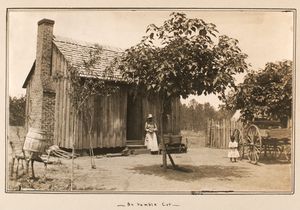
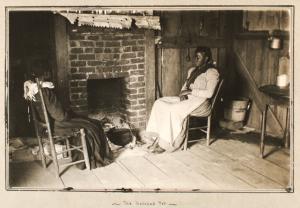
From the Black Collegian, "Black Driven And Cheated Out Of Their Land," by Linedda McIver -- The history of land loss in America spans hundreds of years dating back to broken treaties with the American Indians to the scheming maneuvers of powerful railroad companies and manufacturing giants who forced poor White landowners to sell. This history is well documented in books, movies, museums and archives.
However, very little attention has been given to the plight of Black land families who've lost thousands of acres of land taken illegally through underhanded dealings. Very little has been done to return the land to Black owners … until now.
In 2001, the Associated Press published the results of an 18-month investigation that revealed the extent that land has been historically taken from Black farmers, rural families and small business owners over the last 160 years. Their findings were published in a three-part web documentary titled "Torn From the Land."
In the series of articles, AP discovered that many cases of land takings involved Whites murdering Blacks to take over their land. In other incidences, Whites intimidated Blacks by threatening family members with murder, burning their homes or arresting Blacks on trumped up charges to force families to sign over land deeds. In some cases government officials approved the land takings, in others they took part in them.
Government involvement was the culprit in one of the cases highlighted in the AP series involving the Williams family of Sweet Water in Marengo County, AL, who fought a court battle in 1964 over a pair of 40-acre plots which state officials claim was not the Williams' property because of a 1906 federal designation as swampland. After the Williams family produced a deed and other documentation to prove ownership of the land, the judge urged the state to drop the lawsuit a calling the case a "severe injustice." The state won and the Williams's were ordered to leave their land.
In January 2002, after reading the AP story about the Williams' case, Alabama State Representative Thomas Jackson, D - Thomasville, introduced a resolution in the legislature calling for a 10-member panel to study whether the state has illegally taken land from Black residents. The house and senate passed the resolution to establish the African-American Land Loss Task Force.
The AP's public exposure of the Williams case also prompted former Governor Don Siegelman to authorize the State Attorney General to investigate whether the land should be returned to the family. According to Jackson, the investigation proved fruitful. Last November, Siegelman authorized the land to be returned to the Williams family.
"We were ecstatic to hear the governor's decision," Jackson said. "We plan to appoint the remaining members of the African-American Land Loss Panel in the near future. Hopefully, they will bring forth additional findings that will allow legislators to draft legislation that will properly restore land to their rightful owners."
The AP investigation of Black land loss included interviews with more than 1,000 people and examination of tens of thousands of public records. Their research uncovered 107 documented land takings in 13 Southern and border states resulting in 406 Black land owners losing more than 24,000 acres of farm and timberland, in addition to 85 smaller properties including stores and city lots.
AP reporters obtained information about the land cases by reviewing deeds mortgages, tax records, estate papers, court proceeding oil leases, and Freedmans' Bureau archives. They also interviewed Black families that lost land, title searchers, historians, land activists and public officials.
Some of the cases documented in the AP series include:
George Dinning and his family were in bed one night in January 1897 when about 25 White riders came to his farm with the intent of driving the family from their Franklin, KY home. The men accused Dinning of stealing turkeys and chickens and ordered him to leave his 142-acre farm within 10 days. After a brief altercation with the men, Dinning grabbed his shotgun and fired at the crowd killing one of the riders. The men retreated. Dinning turned himself in to the sheriff. The riders returned to the Dinning farm, threatened his wife and children with death and ordered them to leave. Mrs. Dinning immediately fled for her life with the children in tow. The next night their farm was burned to the ground.
Dinning was convicted of manslaughter, but later granted a pardon after an outpouring of petitions from prominent Whites who felt Dinning was wrongly incarcerated. Dinning moved his family to Indiana and later sued his attackers. The U.S District Court awarded him $50,000, but he received only $1,750 after the defendants claimed poverty. The Dinning family never returned to their land, which was folded into the holdings of their White neighbors who paid only the taxes owed.
In the 1850s, a Richmond, VA plantation owner Thomas Howlett directed in his will that his 264-acre plantation be sold and the proceeds be given to his slaves. Instead, the executor of Howlett's estate, Benjamin Hatcher, ran the plantation on his own. After the Civil War, the former slaves complained to the Union Army, which ordered Virginia courts to investigate. Hatcher testified that he sold the plantation in 1862 and invested the proceeds on the slaves' behalf in Confederate War Bonds. The bonds became worthless. Virginia courts ruled that the Blacks were owed nothing. Willow Oaks Corp acquired the property in 1955. Today the land is a country club with as assessed value of $2.94 million.
In 1908, 50 hooded White men circled the home of David Walker, a Black farmer in Hickman, KY, in an attempt to force him outside for a whipping. Walker refused and the men set fire to the house forcing Walker, his wife and five children to run outside. The riders shot them all, leaving three of the children wounded and all the others dead. No one was charged in the killings. The land was taken from the surviving children. Records show that Walker's 2 1ž2 -acre farm was folded into his White neighbor's property. The neighbor sold it to another man, whose daughter owns the land today.
According to the AP, the U.S. Agricultural Census showed that in 1910, Black Americans owned at least 15 million acres of farmland, nearly all of it in the South. Today, Blacks own only 1.1 million acres of farmland and are part owners of another 1.07 million acres.
AP admits that the information contained in the "Torn From the Land" series is only a glimpse into the extent of land takings from Black families because of gaps in public records. The AP reporters were only able to find crumbling tax records, deed books with pages torn from them and crudely altered records.
Dr. Marcus Tillery believes those records can be further researched by college students and young activists. "In recent years, Black land loss has tapered off since the USDA and others have been called on the carpet for illegal land takings, and organizations such as The Land Loss Fund (TLLF) has created more public awareness," said Tillery, one of the lead activists with TLLF, a grassroots, charitable organization seeking to improve the social, educational and economic welfare of those affected by the loss of family-owned land especially in rural African-American communities.
Tillery is also a professor of technology and chair of the Department of Manufacturing Systems at North Carolina Agricultural and Technical State University. "African Americans should understand that land loss is not by accident. It is a conscious effort to rid Blacks of income-producing abilities. It is important that you find out and know about your family's land. If you find you have land, be sure to set up an heir property situation by putting the land in a trust or some other vehicle that protects the land."
He said college students are in a good position to assist in efforts to help restore land to Black families. "Students are privy to a wealth of research information and resources on college campuses," he said. "Corporations have the resources and ability to find out who owns what and take it. We must counteract that with our resources. Student research and assistance with grass roots efforts are ways to do that." (source: Black Collegian)
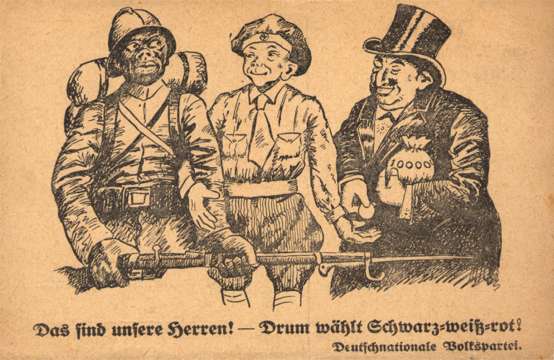
"Thus is our gentlemen! Vote Black-White-Red." Published by the German National People's Party for the 1924 vote.
New legislation across the US could have a huge impact on the country's 2012 presidential elections. Largely Republican politicians have passed a range of new voting laws that groups fear could disenfranchise as many as five million American voters this year.
Voting in America: When is Democracy not a Democracy?
Politicians claim that they are concerned about preventing voter fraud but minority communities see the civil rights gained in the 1960s as being under attack again in a subtler way.
The department of justice has already made strong rulings against laws that have been passed in South Carolina and Texas because they discriminate against minorities.
Fault Lines travels to Tennessee and Florida, two states that have passed strict laws, to explore the origins and consequences of the new legislation.
Who are the individuals that are at risk of not participating in the next election? What are groups doing to fight back? And could enough voters be disenfranchised in 2012 that it could have a significant impact on the outcome of the election?
Techniques of Direct Disenfranchisement, 1880-1965
"Direct" disenfranchisement refers to actions that explicitly prevent people from voting or having their votes counted, as opposed to "indirect" techniques, which attempt to prevent people's votes from having an impact on political outcomes (e.g., gerrymandering, ballot box stuffing, stripping elected officials of their powers).
The 15th Amendment prohibited explicit disenfranchisement on the basis of race or prior enslavement. So Southern states devised an array of alternative techniques designed to disenfranchise blacks and, to a lesser extent, poor whites. There were three broad, overlapping phases of the disenfranchisement process. From 1868-1888, the principal techniques of disenfranchisement were illegal, based on violence and massive fraud in the vote counting process. Starting in 1877, when Georgia passed the cumulative poll tax, states implemented statutory methods of disenfranchisement. From 1888-1908, states entrenched these legal techniques in their constitutions. Here we explore the principal means of direct disenfranchisement, and the attempts to use Federal law to prevent disenfranchisement, through 1965, when the Voting Rights Act was passed. For the most part, until the advent of the Civil Rights Movement in the 20th c., the Supreme Court acquiesced in the methods used to disenfranchise blacks by gutting the Federal laws enacted to protect blacks. Whenever it resisted, the Southern states followed the motto "if at first you don't succeed. . . ."
Violence
Violence was a principal means of direct disenfranchisement in the South before Redemption. In 1873, a band of whites murdered over 100 blacks who were assembled to defend Republican officeholders against attack in Colfax, Louisiana. Federal prosecutors indicted 3 of them under the Enforcement Act of 1870, which prohibited individuals from conspiring "to injure, oppress, threaten, or intimidate any citizen with intent to prevent or hinder his free exercise and enjoyment of any right or privilege granted or secured to him by the constitution or laws of the United States." The Supreme Court dismissed the indictments in U.S. v. Cruikshank, 92 U.S. 542 (1875), faulting them for failure to identify a right guaranteed by the federal government that had been violated in the slaughter: (1) Conceding that the right to assemble for the purpose of petitioning Congress or vote in federal elections was derived from the federal government, the Court argued that the right to participate in state politics was derived from the states, so individuals could look only to the states for protection of this right. (2) Conceding an exception, that the U.S. Constitution grants individuals the right against racial discrimination in the exercise of their rights to participate in state politics, the Court faulted the indictment for failure to charge a racial motivation for interference in the victims' right to vote (even though the racial motive was obvious). (3) In any event, the Court ruled that this federal right against racial discrimination was enforceable against the states only, not against individuals. (4) Other rights violated in the slaughter, such as the rights to life and against false imprisonment, were not derived from the federal government, so individuals had to resort to the states for protection of these rights. Cruikshank "rendered national prosecution of crimes against blacks virtually impossible, and gave a green light to acts of terror where local officials either could not or would not enforce the law." (Eric Foner, Reconstruction, 1989, 531).
Fraud
Electoral fraud by ballot box stuffing, throwing out non-Democratic votes, or counting them for the Democrats even when cast for the opposition, was the norm in the Southern states before legal means of disenfranchisement were entrenched. Between 1880 and 1901, Congress seated 26 Republican or Populist congressional candidates who had been "defeated" through electoral fraud. (Kousser, Shaping of Southern Politics, 263). In a key test of federal power to prohibit fraud in state elections, prosecutors brought indictments, under the Enforcement Act of 1870, against two inspectors of elections in Kentucky, for their refusal to receive and count the vote of a black elector in a city election. The Supreme Court dismissed the indictments in U.S. v. Reese, 92 U.S. 214 (1875). It eviscerated the Enforcement Act by throwing out its provisions for punishing election officials for depriving citizens of their voting rights, on the ground that they exceeded Congress' power to regulate elections. (The provisions stated that officials shall be punished for failure to count the votes of eligible electors, when the 15th Amendment granted Congress only the power to punish officials for depriving electors of the right to vote on account of race.) Although electoral fraud remained common in the South, it brought its practitioners under the glare of unfavorable publicity. This motivated a turn to legal means of disenfranchisement.
Poll Taxes
Georgia initiated the poll tax in 1871, and made it cumulative in 1877 (requiring citizens to pay all back taxes before being permitted to vote). Every former confederate state followed its lead by 1904. Although these taxes of $1-$2 per year may seem small, it was beyond the reach of many poor black and white sharecroppers, who rarely dealt in cash. The Georgia poll tax probably reduced overall turnout by 16-28%, and black turnout in half (Kousser, The Shaping of Southern Politics, 67-8). The purpose of the tax was plainly to disenfranchise, not to collect revenue, since no state brought prosecutions against any individual for failure to pay the tax. In 1937, a white man brought suit against Georgia's poll tax, alleging violations of the 14th Amendment and the 19th Amendment (prohibiting discrimination in the right to vote on account of sex). (Women not registered to vote were exempt from the poll tax). The Supreme Court rejected his arguments in Breedlove v. Suttles, 302 U.S. 277 (1937), disingenuously claiming that it was unrelated to any attempt to disenfranchise. It held that the poll tax was a legitimate device for raising revenue, and that the 19th Amendment regulated voting, not taxation. Although the 24th Amendment prohibited the poll tax in Federal elections, even that wasn't enough to prevent a last-ditch attempt to burden the right to vote with a tax. In Harman v. Forssenius, 380 U.S. 528 (1965), the Court struck down a Virginia law requiring federal electors to file burdensome paperwork if they did not pay a poll tax. It took the Voting Rights Act of 1965 to prohibit the poll tax in state elections. The Supreme Court independently declared poll taxes an unconstitutional violation of the equal protection clause of the 14th Amendment in Harper v. Virginia State Bd. of Elections, 383 U.S. 663 (1966).
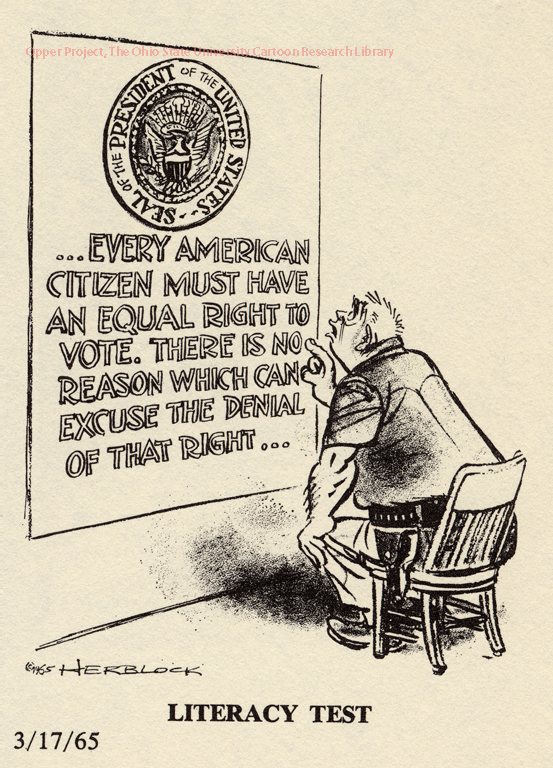
Literacy Tests
The first implicit literacy test was South Carolina's notorious "eight-box" ballot, adopted in 1882. Voters had to put ballots for separate offices in separate boxes. A ballot for the governor's race put in the box for the senate seat would be thrown out. The order of the boxes was continuously shuffled, so that literate people could not assist illiterate voters by arranging their ballots in the proper order. The adoption of the secret ballot constituted another implicit literacy test, since it prohibited anyone from assisting an illiterate voter in casting his vote. In 1890, Southern states began to adopt explicit literacy tests to disenfranchise voters. This had a large differential racial impact, since 40-60% of blacks were illiterate, compared to 8-18% of whites. Poor, illiterate whites opposed the tests, realizing that they too would be disenfranchised. To placate them, Southern states adopted an "understanding clause" or a "grandfather clause," which entitled voters who could not pass the literacy test to vote, provided they could demonstrate their understanding of the meaning of a passage in the constitution to the satisfaction of the registrar, or were or were descended from someone eligible to vote in 1867, the year before blacks attained the franchise. Discriminatory administration ensured that blacks would not be eligible to vote through the understanding clause. However, illiterate whites also felt the impact of the literacy tests, since some of the understanding and grandfather clauses expired after a few years, and some whites were reluctant to expose their illiteracy by publicly resorting to them. The Supreme Court struck down Oklahoma's grandfather clause in Guinn v. U.S., 238 U.S. 347 (1915), as an obvious ruse to evade the 15th Amendment. Oklahoma responded to Guinn by passing a law requiring all those who had not voted in the 1914 election (when the grandfather clause was still in effect) to register to vote within 11 days, or forever forfeit the franchise. The Supreme Court invalidated this arrangement in Lane v. Wilson, 307 U.S. 268 (1939). None of this touched the literacy tests, only the white exemption from it. Not until 1949 in Davis v. Schnell, 81 F. Supp. 872, did a Federal court strike down discriminatory administration of a literacy test. In Lassiter v. Northampton Cty. Bd. of Ed., 360 U.S. 45 (1959), the Court upheld the Constitutionality of literacy tests, notwithstanding their differential racial impact, provided states were willing to have their impact fall on illiterate whites as well. Congress abolished literacy tests in the South with the Voting Rights Act of 1965, and nationwide in 1970.
Restrictive and Arbitrary Registration Practices
Southern states made registration difficult, by requiring frequent re-registration, long terms of residence in a district, registration at inconvenient times (e.g., planting season), provision of information unavailable to many blacks (e.g. street addresses, when black neighborhoods lacked street names and numbers), and so forth. When blacks managed to qualify for the vote even under these measures, registrars would use their discretion to deny them the vote anyway. Alabama's constitution of 1901 was explicitly designed to disenfranchise blacks by such restrictive and fraudulent means. Despite this, Jackson Giles, a black janitor, qualified for the vote under Alabama's constitution. He brought suit against Alabama on behalf of himself and 75,000 similarly qualified blacks who had been arbitrarily denied the right to register. The Supreme Court rejected his claim in Giles v. Harris, 189 U.S. 475 (1903). In the most disingenuous reasoning since Plessy v. Ferguson, 163 U.S. 537 (1896) (rejecting a challenge to state-mandated racial segregation of railroad cars, on the ground that blacks' claims that segregation was intended to relegate them to inferior status was a figment of their imaginations), Justice Oliver Wendell Holmes put Giles in a catch-22: if the Alabama constitution did indeed violate the 15th Amendment guarantee against racial discrimination in voting, then it is void and Giles cannot be legally registered to vote under it. But if it did not, then Giles' rights were not violated. But, in the face of Giles' evidence of fraud, the Court cannot assume that the constitution is valid and thereby order his registration in accordance with its provisions. Holmes also held that Federal courts had no jurisdication over state electoral practices, and no power to enforce their judgements against states. Undaunted, Giles filed suit for damages against the registrars in state court, and also petitioned the court to order the registrars to register him. The state court dismissed his complaints and the Alabama Supreme Court affirmed, offering another catch-22: if Alabama's voting laws violated the 14th and 15th Amendments as Giles alleged, then the registrars had no valid laws under which they could register him. But if the laws were valid, then the registrars enjoyed immunity from damages for the ways they interpreted them. The Supreme Court affirmed this decision in Giles v. Teasley, 193 U.S. 146 (1904).
The White Primary
Disenfranchisement brought about one-party rule in the Southern states. This meant that the Democratic nominee for any office was assured of victory in the general election, shifting the real electoral contest to the party primary. This fact provided yet another opportunity to disenfranchise blacks. Texas passed a law forbidding blacks from participating in Democratic primary elections. The Supreme Court struck down this law as a plain violation of the 14th and 15th Amendments in Nixon v. Herndon, 273 U.S. 536 (1927). So Texas passed another law providing for each party's state executive committee to determine who could vote in its primaries. Accordingly, the Texas Democratic Party Executive Committee resolved to permit only white Democrats to participate in its primary. The idea was that, as a private association, the party executive committee was not subject to the 14th and 15th Amendments, which applied only to the states. The Supreme Court rejected this reasoning in Nixon v. Condon, 286 U.S. 73 (1932), holding that the Texas Democratic Party Executive Committee got its power to determine party membership from the state of Texas, and so acted as state officials. The State Democratic Convention promptly met and passed a resolution limiting party membership to whites. This was enough to satisfy the Supreme Court that only private parties, not the state, were involved in determining primary electors (despite the fact that the state required and regulated primaries). It therefore upheld the exclusion of blacks from the Texas Democratic primary in Grovey v. Townsend, 295 U.S. 45 (1935). However, in U.S. v. Classic, 313 U.S. 299, a case involving electoral fraud in a primary election, the Supreme Court acknowledged that primary elections were such an integral part of the selection of government officeholders that federal laws guaranteeing the right to vote applied to them. The conflict between Grovey and Classic was resolved in Smith v. Allwright, 321 U.S. 649 (1944), which found that primary elections were so pervasively regulated by the state that, in doing their part to run primaries, political parties were state actors and thus subject to the 14th and 15th Amendments. Texas Democrats evaded this ruling by arrangement with the all-white Jaybird Democratic Association (a leadership caucus within the party), which held elections unregulated by the state. The winner of the Jaybird Party election would enter the Democratic party primary, and the Democratic party would put up no opposition, thus ensuring victory to the Jaybird Party candidate. The Supreme Court saw through this ruse in Terry v. Adams, 345 U.S. 461 (1953), finally putting an end to the white primary after 9 years of acquiescence and 26 years of litigation.
The history of black disenfranchisement demonstrates that it was a product not simply of the actions of Southern states and individuals, but of a failure to uphold and exercise federal power. Congress failed to fully exercise its powers under the 14th amendment (for example, it never reduced Southern states' congressional representation in proportion to its illegal disenfranchisement, as it was authorized to do). The Supreme Court actively undermined federal executive powers to protect black voting rights, refused to acknowledge racial discrimination even when it was obvious, and acquiesced in blatant constitutional violations by resorting to specious reasoning. Although it slowly came around in some cases, historian Eric Foner's judgment, that reconstruction is "America's unfinished revolution" remains true to this day. Click on the right arrow below to survey contemporary techniques of disenfranchisement. (source: University of Michigan)
The information on this page draws from: J. Morgan Kousser, The Shaping of Southern Politics: Suffrage Restriction and the Establishment of the One-Party South, 1880-1910 (Yale UP, 1974) and Samuel Issacharoff, Pamela Karlan and Richard Pildes, The Law of Democracy (Foundation press, 1998).