Showing posts with label diaspora. Show all posts

Wednesday, May 9, 2012

Welcome to Buenaventura, Colombia: Bienvenidos a Buenaventura, Colombia

For years, 25,000 Afro-Colombian refugees and migrants have lived in a town on stilts over the sea [Oliver Schmieg]

On May 22, 2007, the New York Times article, "Cocaine Wars Make Port Colombia’s Deadliest City," by  Simon Romero reported -- BUENAVENTURA, Colombia, May 15 — Visitors to this city can be forgiven for thinking no place is safe here. Gunfire often echoes through the slums surrounding its port, the country’s most important on the Pacific coast. As larger cities have calmed, Buenaventura has emerged as the deadliest urban center in Colombia’s long internal war.

Soldiers search almost every car at checkpoints on the winding road from Cali. Guerrillas recently fired mortar shells at the police headquarters. The stately Hotel Estación, a neo-Classical gem built in 1928, where executives come to hammer out deals to import cars or export coffee, is guarded by dozens of soldiers in combat fatigues.

“It’s as if we have a little Haiti within Colombia,” said Lt. Nikolai Viviescas, 25, a police officer who was transferred from Bogotá six months ago. “It feels like another country.”

They are residents of Buenaventura on Colombia's Pacific Coast [Oliver Schmieg]

Although Bogotá, the capital, and other cities have become secure and prosperous enough that it is possible there to forget about this country’s four-decade-old civil conflict for a while, Buenaventura is a different story.

Killings in this city of about 300,000 climbed 30 percent last year, to 408, giving Buenaventura the nation’s highest homicide rate at 144 per 100,000, more than seven times the rate in Bogotá and four times that of Medellín. And this year, the police say, 222 people have been killed here.

A vast majority of the killings are the product of a narrow territorial conflict over control of the edge of the city’s slums, acres of wooden shacks built on stilts over the sea. From these makeshift wharves, police and naval officials say, fast boats depart with cocaine for points north. Buenaventura’s geography, crucial in connecting Colombia to the global flow of trade, also holds strategic cachet for drug traffickers.


But now the Colombian government is attempting to relocate the entire community [Oliver Schmieg]


Despite receiving more than $5 billion in antinarcotics and counterinsurgency aid from the United States this decade, making the country the largest recipient of American aid in the hemisphere, Colombia remains the world’s largest cocaine producer and the supplier of 90 percent of the cocaine consumed in the United States.

Drug lords, rebels and resurgent paramilitary gangs all draw on Buenaventura’s slum dwellers as their foot soldiers.

The police say that many of the combatants on the rebels’ side belong to the Manuel Cepeda Vargas Urban Front, a cell of the main rebel group FARC that is based in Cali and opposes the Autodefensas Campesinas del Pacífico, composed mostly of former paramilitary fighters.


It wants to move them to an island barrio [Oliver Schmieg]

“Nothing in this fight is about ideology,” said Antero Viveros, the head of a community group in Lleras, a large slum controlled by the guerrillas. “It is about drugs, with members of one ethnicity killing each other.”

Despite its emergence as Colombia’s most dangerous city, people displaced by fighting in the countryside still see Buenaventura as a refuge. About 42,000 refugees have arrived here since 1998, mostly Afro-Colombians from rural areas, according to the federal government. They swell the ranks of what may be Colombia’s poorest slums.

“If you’re hungry, you’ll do whatever imaginable to survive,” said Fernando Nuñez, 29, a Lleras resident who ekes out a living repairing old cellphones.


And to build a commerical port and tourist beaches in Buenaventura [Oliver Schmieg]

President Álvaro Uribe has forcefully criticized the violence here and sent new police and navy commanders to the city at the start of the year. About 2,000 soldiers and police officers, who also wear combat uniforms and carry semiautomatic weapons, patrol Buenaventura.

Still, critics say authorities have long neglected Buenaventura’s problems in part because Afro-Colombians receive scant federal attention. Nongovernmental groups say Afro-Colombians account for up to a quarter of the country’s population of 44 million, by some measures giving Colombia the largest black population in the Spanish-speaking world. And more than 80 percent of Buenaventura’s residents are black.

Community leaders are trying to resist the eviction; Or at least fight for decent compensation [Oliver Schmieg]


This month, when the president chose Paula Marcela Moreno Zapata as culture minister, was the first time an Afro-Colombian ascended to a cabinet position in the country’s history. Yet political analysts and black advocacy groups said the appointment was largely to appease Democrats in Washington who complain of racial exclusion in Colombia as they weigh a trade agreement.

“The war in Buenaventura is not going to be ended by symbolic actions from Bogotá,” said Rosaliano Riascos, a Buenaventura native who fled the city after a wave of paramilitary-led killings several years ago. Mr. Riascos, who heads an independent black advocacy group in Bogotá, said it had been a year since he returned to Buenaventura to visit family. “Buenaventura is a no-man’s land,” he said.


As the move would not only rob residents of their homes but of their main livelihood - fishing [Oliver Schmieg]


The entrance to Lleras looks like that of any shantytown elsewhere in Colombia, with cinder-block shacks and a few paved streets. But deeper into the slum, the structures are made from discarded wood, with newcomers squeezing into lean-tos alongside older houses. Rusted barrels collect rain from zinc roofs, the only source of fresh water.

Sewage bubbles down trash-strewn dirt roads before flowing into the sea. Stereos blare vallenato and reggaetón music. And precariously built homes are hoisted above the water on spindly pieces of wood.

Many of the residents of these hovels hesitate to offer their names out of fear of retaliation over what they might say. One middle-aged man, offering a visitor a cup of rum from the steps of his house, said he had worked as a stevedore at the port years ago before losing that job. “Now,” he said, “I do nothing.”

The vast majority of the residents of the area are black and many see the eviction in race terms [Oliver Schmieg]


Some economists hold up Buenaventura as an example of the risks of exposing certain areas of developing economies to market forces. María del Pilar Castillo, an economist at Valle University in Cali, said many residents lost economic security when the city’s port was privatized more than a decade ago, cutting its work force and reducing benefits.

With taxes on the imports flowing through Buenaventura’s port largely going directly to the central government, the city reaps few benefits from international trade, even as Colombia’s economy grows more than 6 percent a year. So the poor in Buenaventura, with an unemployment rate of about 28 percent, resort to the drug trade.


Map of Colombia

“There is no other viable industry here, so there are no other viable jobs,” said Ana María Mercedes Cano, director of Buenaventura’s Chamber of Commerce. “So we live in a situation with violence all around us.”

Civilians are increasingly caught in the cross-fire. Guerrillas were blamed for an attack earlier this year in which five people, including one police officer, were killed when a homemade mortar shell was fired at a police truck. Security officials here say laws that are lax on minors, who carry out many of the attacks, make it difficult to reduce the killings.


They argue that the Afro-Colombians have managed to acquire prime real estate and now the white and mixed race elite want to take it for themselves [Oliver Schmieg]


“We have a justice system designed for Switzerland, yet we have no Swiss here,” said Col. Yamil Moreno, the chief of police in Buenaventura. In the same breath, Colonel Moreno, who was transferred here from the north, callously described Buenaventura’s dying combatants.

“These vagabonds,” he said, “are good only for drinking, dancing and killing.” (source: The New York Times, 2007)


Monday, March 19, 2012

Universal Negro Improvement Association


As Marcus Garvey returned to Jamaica in 1914, after four years in Central America and Europe, he came upon the autobiography of Booker T. Washington, the conservative dean of American black leaders. It was while reading Up from Slavery, Garvey said, that he developed his vision for the Universal Negro Improvement Association. "Where is the black man's government?" Garvey asked himself. "Where is his King and his kingdom? Where is his President, his ambassador, his country, his men of big affairs? I could not find them," he said, "and then I declared, 'I will help to make them.'"


On July 20, 1914, Marcus Garvey, at the age of twenty-eight, founded the Universal Negro Improvement Association. His co-founder was Amy Ashwood, who would later become his first wife. The U.N.I.A. was originally conceived as a benevolent or fraternal reform association dedicated to racial uplift and the establishment of educational and industrial opportunities for blacks, taking Booker T. Washington's Tuskegee Institute as a model. The U.N.I.A. floundered in Jamaica. But shortly after Garvey's relocation to Harlem in 1916, New York became the headquarters of the movement. The Harlem branch started with 17 members meeting in a dingy basement. But by the spring of 1918, Garvey's strong advocacy of black economic and political independence had taken hold, and U.N.I.A. branches and divisions were springing up in cities and towns across the country, and then in different parts of the world. By 1920 Garvey claimed nearly a thousand local divisions in the United States, the Caribbean, Central America, Canada and Africa.

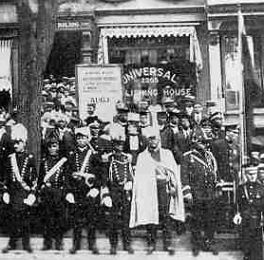
UNIA Parade, organized in Harlem, 1924; [One of the slogans carried in the parade; Harlem, corner of the 135th Street and Lenox Avenue.]
UNIA Parade, organized in Harlem, 1924; [One of the slogans carried in the parade; Harlem, corner of the 135th Street and Lenox Avenue

Garvey's followers were largely ordinary people, described by the Baltimore Observer as "cooks, porters, hodcarriers, and washwomen," and said Garvey should have on the official seal of the empire "a washtub, a frying pan, a bailhook and a mop." Large branch meetings were like religious revivals, with entire families gathering for a day of debates, fashion shows, classical music, plays and vaudeville acts. Garvey gave his followers, who were dispossessed in the broader society, a sense of belonging. Men could join the African Legion. For young people, the U.N.I.A. Juvenile Division. And in the Black Cross Nurses and the Universal Motor Corps, the Garvey movement offered black women a place of their own. He created the red, black and green flag to symbolize black unity. And there were official U.N.I.A. slogans, prayers, poetry and songs.

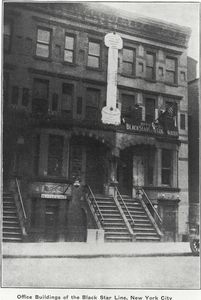
Office buildings of the Black Star Line, New York City.
Office buildings of the Black Star Line, New York City


Garvey was known to rule the U.N.I.A. with an iron hand. He did not tolerate disagreement on even insignificant matters, and demanded complete loyalty from U.N.I.A. members. His autocratic style would over the years cause considerable dissension within the ranks, and turnover and defections among the U.N.I.A.'s top leadership.


In addition to the internal problems of the Garvey movement, Garvey and the U.N.I.A. became targets of the Bureau of Investigation (the precursor to the FBI) in a campaign directed by the then up-and-coming J.Edgar Hoover. For five years beginning in 1919, largely under Hoover's direction, Bureau of Investigation officers would report on U.N.I.A. activities in over two dozen cities. Hoover would also coordinate the actions of at least seven federal government agencies investigating Garvey, in what some experts have called a personal vendetta.

Membership in the U.N.I.A. declined after Garvey's incarceration for federal mail fraud between 1925 and 1927, and his deportation in 1927 increased the factionalization within the movement. A new U.N.I.A. and African Communities League of the World, over which Garvey presided, was incorporated at the 1929 U.N.I.A. convention in Kingston. It was distinguished from the rival U.N.I.A., Inc., in New York, headed by Fred A. Toote in 1929, and by Lionel Francis in 1931. Part of the American-based movement remained loyal to Garvey, notably the Garvey Club and the Tiger Division of New York. In 1935, after being deported from America and spending a few years in Jamaica, Garvey moved his headquarters to London. After his death in 1940, Garveyite loyalists elected a new slate of officers in New York, and the headquarters of the parent body was moved to Cleveland under the direction of a new president general, James Stewart, who eventually relocated to Monrovia, Liberia.  (source: PBS)


Wednesday, January 11, 2012

Cemetery for New African Slaves Unearthed in Rio, Brazil

According to the Hindu Times, on 23 Decemberr 2011, "," by Tom Phillips: Locals called it the cemetery of the new blacks, but it was a cemetery only in name. Devoid of headstones, wreaths or tearful mourners, this squalid harbour side burial ground was the final resting place for thousands of Africans shipped into slavery.

The new world greeted them with a lonely death in an unfamiliar land.

For decades the cemetery and those buried there between 1760 and 1830 were forgotten, hidden under layer after layer of urban development.

But 15 years after the cemetery's fortuitous discovery — during the renovation of Petrucio and Ana de la Merced Guimaraes's family home when builders unearthed a series of muddy skeletons — academics now believe they have evidence of the true reach of the slave trade.

The study of teeth from 30 partial skeletons has hinted that slaves arriving in Rio — many of whom were sold on to work in coffee and sugar plantations or gold mines — came from a much wider geographical region than once thought.


The figure is three million

Archaeologists and anthropologists studying bone and tooth fragments are shedding light on the horrors of a trade that saw at least three million slaves shipped from Africa to Brazil between 1550 and 1888, when the practice was officially abolished.

“It was ugly: a dump into which bodies were thrown and burned,” said Sheila Mendonca de Souza, a bio-archaeologist studying the cemetery in Rio de Janeiro, once one of the busiest slave ports in the Americas.

“People weren't buried in tombs, they were tossed away into mass graves.” Della Cook, a biological anthropologist from the University of Indiana working on the burial ground, said: “There is a lot of scholarship on slave cemeteries and the slave trade in North America but very little in South America, which is one of the things that makes this site fascinating.


Isotope analysis

“We have historical records but we haven't been able to look before at the people themselves.” Using strontium isotope analyses of tooth enamel — a technique that helps detect where a person was raised and has previously been used on samples from burial sites in the Caribbean and Mexico — academics were able to confirm the large area from where the “new blacks” came.

“What we got was essentially the entire range of strontium isotope values,” said Cook. “It surprised us that the spectrum was so broad.” The results indicated that slavers had “waded way into the interior” of Africa rather than restricting their search to coastal areas, Cook added.

Mendonca, who works for the national school of public health in Rio, said: “We were not able to pinpoint a specific place ... but we confirmed the diversity of origin of those [slaves] who were arriving in Rio de Janeiro. They came both from the Atlantic coast and east coast.” A parallel study of cosmetic tooth modifications, common in some regions of Africa, also underlined the scope of the slave trade.


Most were young people

Mendonca said her team had found tooth markings indicating some of the slaves were native to what are now Sudan and Mozambique, in northeastern and southern Africa. Archaeologists believe as many as 20,000 slaves may have been buried at the cemetery, mostly men aged 18-25 who died during the gruelling journey to Brazil or shortly after arriving.

“The majority were very young, principally young boys and girls who would adapt better to captivity than older people,” said Mendonca.

The dire conditions of the slave market and port, close to the cemetery, were captured by British writer Maria Graham, following a visit in the early 1820s.

Rescued slaves; Dated 1869, this picture is a rare snapshot of the terrible slave trafficking. The emaciated boys sit on the lower deck of a Royal Navy ship apparently have been taken from a slave vessel trading illegally off the African coast. The captain had instructions not to return the slaves. (Pictures copyright National Archives and partners.)

“Almost every house in this very long street is a depot for slaves ... In some places the poor creatures were lying on mats, evidently too sick to sit up,” she wrote.

“The number of ships from Africa that I see constantly entering the harbour, and the multitudes that throng the slave-houses in this street, convince me that the importation must be very great. The ordinary proportion of deaths on the passage is, I am told, about one in five.” The three million slaves who made the journey were previously thought to have come only from what is now Nigeria and from the Portuguese colonies of Angola and Cape Verde.

Some fled, forming autonomous cities known as quilombos. Several of Rio de Janeiro's favelas — among them the Morro da Coroa, the Morro dos Prazeres and Pereirao — are thought to have begun life as quilombos.

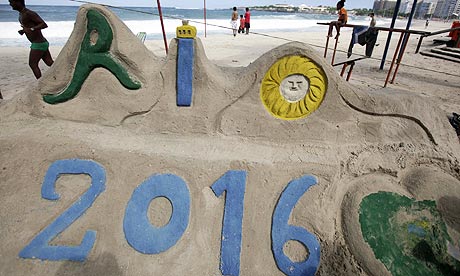
Impact of 2016 Olympics

With Rio undergoing a facelift for the 2016 Olympics, some archaeological discoveries have been made as the city renovates its decrepit downtown port.

In early 2010 archaeologists unearthed what they believe to be the remains of Rio's Valongo slave port, through which tens of thousands of African slaves were shipped.

Experts hope advancing redevelopment projects will help them rescue further clues about the identities of Brazil's “new blacks”, who were buried not far from the Valongo dock.

“When you start messing around with the landscape these things will appear,” said Dr Ricardo Ventura Santos, a bio-anthropologist from Brazil's Oswaldo Cruz Foundation, who is coordinating the cemetery research team.

Cook said she hoped redevelopment would permit further excavation and the inclusion of places such as the slave burial ground on the city's tourist trail, creating a “monument to the African experience in Brazil.” The excavation of a Roman cemetery under London's Spitalfields market, during the 1990s, could serve as a model, she added.

“Rio has very little history of the slave trade for either Brazilians or external tourists,” she said. (source: The Hindu)
1


Sunday, August 28, 2011

Slave market at Pernambuco, Brazil

Gate and Slave market at Pernambuco, after Earle; view down street crowded with slaves, guarded by soldiers to right

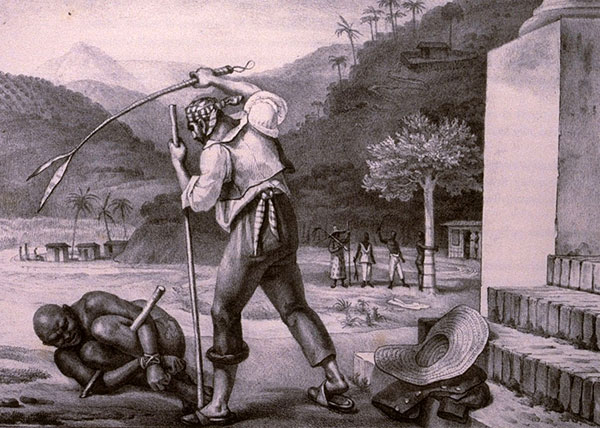
Slave market at Pernambuco, Brazil. Includes black slaves sitting on the street while an auction is going on. Includes scene of beating, dwellings, sword, horse about to trample a baby, dog, and woman carrying a burden on her head.

Source creator: Callcott, Maria, Lady, 1785-1842
Source Title: Journal of a voyage to Brazil, and residence there, during part of the years 1821, 1822, 1823. By Maria Graham.
Source place of publication: London

The Slave market at Rio


The Slave market at Rio; street where buyers examine slaves, one of whom sits on ground in left foreground, child slaves being inspected by man wearing hat and striped trousers, dog to right, soldiers in distance. 1813

Tuesday, August 9, 2011

Back Pay: Reparations for Slavery

A Jamaican Newspaper, the Gleaner, published an article entitled "Back pay for slavery," on 7 August 2011, by Carolyn Cooper, Contributor to the Gleaner:
THE PRINCIPLE of reparations was established long ago in the 1833 Act for the Abolition of Slavery throughout the British colonies. But there was a catch to the act - not much different in essence from the original sin of catching Africans for enslavement in the Americas. Reparations were to be made to the perpetrators of human trafficking, not to the victims.

This is how the act opens: "Whereas divers persons are holden (held) in slavery within divers of His Majesty's colonies, and it is just and expedient that all such persons should be manumitted and set free, and that a reasonable compensation should be made to the persons hitherto entitled to the services of such slaves for the loss which they will incur by being deprived of their right to such services ... ," etc.

This is a classic example of the diabolical mindset of 'wicked white people'. Slaveholders were legally entitled to the services of their slaves and therefore had a right to 'reasonable compensation' for loss of service. The enslaved had no such rights or entitlements. They were freed with nothing in their two long hands; just like that rather sad-looking couple standing in a basin of water in New Kingston's 'Emancipation Park'.

Statues in Emancipation Park, Kingston, Jamaica

When I talk about 'wicked white people' I don't mean specific individuals who have done me personal wrong. I'm not speaking about singular acts of evil. It's a far bigger issue. What concerns me is the collective crimes against humanity committed by gravalicious people who consider themselves absolutely entitled by God and nature to dominate the world. In many instances, these self-proclaimed rulers just happen to be white.

In the age of colonial conquest, 'wicked white people' as a special interest group committed crimes of unapologetic horror. They ravaged other people's bodies, souls, lands and histories; they vandalised sacred objects and then locked them away in 'museums' - those cemeteries of other people's culture. 'Wicked white people' invading and stealing, stealing, stealing without conscience.

I know I'm going to be accused of racism for exposing 'wicked white people' to public scrutiny in this way. But that's just another ploy of 'wicked white people' and their collaborators to perpetuate mental slavery. It's racism to talk about racist behaviour. But actual racist behaviour is not racism. It's just human nature. What an irony!

Justice versus expediency

So let's say instead that 'nice and decent' white people agreed that it was "just and expedient" to set the enslaved free. But the yoking of justice and expedience in the Act for the Abolition of Slavery reveals the central philosophical and practical dilemma at the heart of the emancipation enterprise.

Justice seemingly puts emancipation on solid moral ground. Expedience erodes all claims to moral authority. It was expedient to emancipate enslaved Africans because plantation slavery had become an expensive proposition. The substitution of beet for cane turned West Indian sugar into a rather sour deal.

After centuries of mostly verbal outrage - incessant talk, talk, talk about 'wicked white people' - we, the collective victims of transatlantic slavery, must finally decide to take legal action in the largest class-action suit in the history of the world. This is a truly wonderful idea. Not the wishy-washy, everyday sense of 'wonderful', meaning simply 'great'; it's the mind-blowing, original meaning of the word: full of wonder.

Five hundred years after the rape of the body and land of the original inhabitants of this part of the world; 500 years after the violent uprooting and enslavement of millions of Africans, we, their descendants, both native and immigrant, must lay claim to rights of reparation.

In the sweet by and by

Enslaved Sugar Plantation Labour

For many Africans in the diaspora, it is in religion that we find hope for reparations. The Christian religion seems to recommend long-term investment in the celestial stock market. The concept of reparations has best been expressed in pious hymns like this: "In the sweet by and by I'll have a mansion so bright and so fair, won't it be glorious when I get there in the sweet by and by?" God will repair the breach. God is the ultimate human rights arbitrator.

Then we have those Africans who want hard cold cash in the here and now. Think of the title song from the movie The Harder They Come: "They tell me bout the pie up in the sky waiting for me when I die. But between the day you born and when you die, they never seem to hear even your cry. So as long as the sun will shine, I'm gonna get my share, what's mine. The harder they come, the harder they fall, one and all."

That's an excellent anthem for the Reparations Movement, the Garveyism of our times. It's the same kind of daring that made Marcus Garvey conceive the Universal Negro Improvement Association and Communities League: a global movement of African peoples who see themselves as having a shared history and a common destiny.


And don't think it's a joke. With derisive laughter cynics like to say, 'when you get the money you can check me.' But the Jews got compensation from the Germans; Japanese-Americans got compensation for the atrocities committed against them. Why not Africans? I'd like to know what, exactly, our National Commission on Reparations is doing about it.

If you think that after 500 years it's now too late for reparations, just remember Psalm 90:4 in which David, himself a Jew, converses with the Supreme Arbitrator: "For a thousand years in thy sight are but as yesterday when it is past." Come to think of it, all we're really talking about is half a day's back pay. (source: The Gleaner)

Sunday, July 17, 2011

Panama Canal

From Reuters, "Panama Canal's Black Builders Await Due Credit," by Tim Gaynor: Panama City (Reuters) - In the year when the United States is to cede control of the Panama Canal to Panama, the waterway's governing body has named a tugboat for its longest serving and most reliable employee.
Tugboat Cecil F. Haynes on the Panama Canal

But for Cecil Haynes, 86, a soft-spoken Panamanian of West Indian descent, it is more than just a personal tribute. It is long-awaited recognition of the role played by black labor in the canal's history.

"West Indians made a very valuable contribution to the canal," he said, sitting in the offices where he has worked since joining the commission in 1928. "But we never got the credit we deserved."

Between 1904 and the canal's completion on the eve of the First World War, more than 25,000 West Indians heeded U.S. President Theodore Roosevelt's call to "make the dirt fly."

As the Dec. 31 transition to Panamanian control looms, Haynes hopes the thousands of black workers who labored to build the canal will finally be honored alongside its white engineers.

Panamanian West Indian Museum

Housed in a one-room former colonial church in Panama City's rundown Calidonia district, the Panamanian West Indian Museum has championed the memory of the canal's black work force since the museum opened in 1981.

"The Americans were known for their engineering skill," said Melva Lowe Goodin, the museum's president. "But it was the West Indians who gave the sweat and the blood."

Black Labor On A White Canal


For the black workers from Barbados, Jamaica and Martinique who made up two-thirds of the canal's labor force, the work was hard, dangerous and indifferently paid.

"My father came here in 1904 to dig the ditch. Back then it was just jungle and mosquitoes," Haynes recalled with a smile.

White employees of the Canal Commission were given comfortable housing, while many black workers lived in railway boxcars or shacks in the forests bordering the work site.

In the early years, malaria and yellow fever were rife and accidents were frequent. Records at the wooden museum show that of 5,600 employees killed by disease and accidents between 1904 and the project's completion 10 years later, 4,500 were black.


Particularly hazardous were the vast excavations at Culebra Cut, a 9-mile(5.6-km)-long navigation channel blasted through the cordillera, the range that divides Panama, with dynamite.

Work crews were vulnerable to landslides as they dug the unstable slopes of the cut and accidents with dynamite were common. An explosion in 1908 killed 23 workers and injured 40.


With tragic irony, an action by the Canal Commission intended to improve public health put workers in even greater danger from landslides and explosions.

"Many workers went deaf as a side effect of the heavy doses of quinine they were required to take to treat malaria," Lowe Goodin said. "They just didn't hear the shouted warnings to get out of the way."

Canal Zone Caste SystemMore than seven decades after drawing his first paycheck, Haynes recalls the two-tier pay system that led to segregation of white and black workers in the U.S.-controlled Canal Zone.

"While white workers were paid on the gold roll, in U.S. dollars, we were all paid on the silver roll in local currency," he said.

Silver roll employees had to drink at separate drinking fountains and stand at different lines in the post office under what one observer called the "Canal Zone caste system."
The Canal Zone, a 10-mile(16-km)-wide security strip the length of the waterway, was run under U.S. federal laws, with its own court system and police force, until it reverted to Panamanian control in 1979.

"You couldn't go into gold roll shops," Haynes said. "And after working hours you couldn't be seen in the zone. You would be arrested for loitering or trespassing."

Black workers were classed as "helpers" although they might be qualified in a range of canal-related trades and were paid at half the rate of white co-workers.


American Experience The Panama Canal

Watch the full episode. See more American Experience.

Saturday, July 16, 2011

The Traditions of the Panamanian Congos


African slaves in the fierce struggle for freedom against the Spanish Empire (the 'runaways') were also land in the jungle magic Portobelo. And after escaping deep into its dense forests and hills, the Maroons built fortified villages, known as Palenque, from which declared war against their former slavers. So successful were these courageous battle in the Spanish fugitives were forced to declare several truces, and finally to recognize their freedom and independence.

The traditions of the Congos consist of unwritten traditional performances, with characters from mythology, rituals, costumes, architecture, music, food and dance. Its impromptu street performances recall was metaphorically describe their ancestry and the victory of good over evil.
Congo culture survived thanks to the use of 'double effect' that enslaved Africans used as a weapon of resistance, which allowed them to communicate with one another while confusing the Spanish. By distorting the meaning, the reality becomes ambiguous making the African teachers in the exchange of information. The ability to communicate with each other without being discovered, they made it possible to plan escapes and riots, as well as operate an elaborate system of espionage. The result is a story full of symbolism and idiosyncratic culture, paradigms and metaphors that arouse fascination among visitors to Portobelo ready to be wrapped in mists of light.
One of the traditions of the people is the drummer of "Congos" during Carnaval this tradition dates from the time of slavery in colonial times.


One of the main traditions of the people is the drum of "Congos". It usually occurs during the carnival in February. This tradition dates back to slavery in the colony. It is a mockery of the Spanish kings and during the dance, which lasts several days, the participants assume the role of runaway slaves fleeing the Spanish. They hide in different parts of the village and take captive.

The dance has a story in which characters representing the Congolese fight against the devil, who is on the loose in those days. At the end are saving the "Queen Conga" with the help of "bird" and "John of God" in these traditions is easy to see the syncretism between Catholicism and African rituals Antilles.

Congo, Evocation of complaints from black ancestors and now facts and incidents of everyday life.
The Congo is the one that has persisted and is alternated with salsa dancing or popular. As for the special clothing is congo: change of chintz, striking large flowered skirt, head, crown fitted with colored ribbons, mirrors, flowers typical of the season (Caracucho, jasmine, papos, Havana), pinned at Trez in circle on the sides of the head.

Men use ketones, pants backwards subjects with rope, tape crowns interspersed with mirrors, a motet or quirky bag that serves to put few things picked up.

The Congos are the descendants of the Maroons, who have preserved the stories of their ancestors in a living tradition which is essentially a work of art. You travel back in time achieving power and strength as they approach their African ancestors of the seventeenth century. (source: Webscolar)

Friday, July 15, 2011

Peruvian Government Apologies For Racism, Not Slavery


Amamda Todd of the Liberation reported, "Peruvian government apology for racism leaves out slavery," on 4 December 2009: The government of Peru has issued an apology to citizens of African descent for the first time. A public ceremony will be held for African Peruvians, who are 5 to 10 percent of the population.
Peruvian type: During the course of the slave trade, an estimated 95,000 slaves were brought into Peru from Africa. The last group arrived in 1850 and slavery was abolished in 1856.(Photographed by E. Maunoury of Lima.)

The statement admits that discrimination still exists, but makes no reference to slavery, referring instead only to the "abuse, exclusion and discrimination" of African Peruvians. The first Africans in Peru were the slaves of the Spanish conquistadors. More were brought over to work the land until slavery was abolished in 1854.

Not surprisingly, the apology did not mention what will or should be done to fix the racism and discrimination still present in society. Of course not. Racism is an institution that is part and parcel of capitalist society. Racism is a handy wedge to divide workers and keep them from banding together to fight for their common interest. It has been one of the most effective weapons against working-class struggle available to the rich. (source: The Liberation)

Thursday, June 30, 2011

Afro-Uruguay Spirit of Resistance in Candombe

In her article, "Uruguay Spirit of Afro Resistance Alive in Candombe" from Upside Down World, Marie Trigona (a writer, radio producer and filmmaker based in Buenos Aires) reports: In the streets of Montevideo, Uruguay, Afro-Uruguayans celebrate an often-ignored part of their history - Candombe and resistance. For more than 200 years Afro descendants have maintained the tradition of Candombe, a rhythm that traveled from Africa to Uruguay with African slaves. The music carries centuries of resistance and liberation.
The word Candombe literally means "place and dance of Africans." The musical tradition evolved during the colonial era. Africans brought to Uruguay for slave labor used the rhythm of the tambores, or drums, to communicate with each other and defy colonialists.

Today the music thrives in Montevideo's working class neighborhoods, where African descendants have kept alive the tradition of the Llamadas, parades where Candombe is played. Candombe drummer Mitchel Navos says that Candombe didn't originate in Africa, but with Afro-descendants in Montevideo. "Candombe is specifically from Montevideo. Candombe like Montevideo's Candombe doesn't exist in any other part of the world." He also asserts that Candombe's spirit has been passed down for generations despite a historical void surrounding the music's origins.

Origins of Candombe
Montevideo's colonial district is the birthplace of Uruguay's Candombe music. Africans from the Southern and Western regions (Bantú regions which include Congo, Angola and Mozambique) were brought to Uruguay and Argentina through the slave trade beginning in 1750. "Africans arriving from the Bantú region brought with them the Candombe rhythm," explains Navos. "Being from different nations and regions, they didn't have the possibility of communicating through language."
In whatever time their white masters allowed, slaves communicated through drums and dance. The first Llamadas took place at this time. Some historians assert that the word Llamadas - "parade of calls," refers to the drums Africans played to call out to each other in their homes. Each tribe had a particular rhythm that could be identified from afar.

Within these living quarters, African musicians gave birth to a rhythm and tradition which has been passed on for generations. Martin Silva is a young musician from Montevideo's Barrio Sur. His grandparents taught him the Candombe rhythm and the origins of Candombe. "Before the llamadas were held in Ansinas, which was a conventillo or a housing complex here on Isla de Flores and nearby streets. It was a huge housing complex where hundreds of families lived. The llamadas were held there, they paraded inside. It was a different kind of festivity. It's not the same as today."
Upper class whites tried to ban Candombe gatherings in the 19th century. One of the earliest historical documents tracing Candombe music is an 1808 police record, when citizens of Montevideo requested that these dances be severely repressed and completely prohibited. Afro descendants took their music underground, to defy the oppressive conditions of slavery.

"We can't refer to anything before 1900 with historical certainty," explains Navos. There exists an extensive historical void regarding Candombe practices between 1800 and 1900. "What exists today is what we could hide and preserve, which has led to the transformation of Candombe in what it is today, from generation to generation," he continues.

"Barrio Sur and Palermo were where the meat curing plants were located. Many of the black slaves had to work in the meat curing plants, but also many lived in the curing plants. That's where music from Africa mixed with Catholicism." Many historians assert that the first Llamadas took place in clandestine music halls, until they went public with the abolishment of slavery in the late 19th century. "The first Llamadas held was a procession from the Meat curing plants toward Montevideo's main cathedral, in the Old part of the city. In commemoration of Day of the Kings, they made a procession to give a tribute to the Catholic Saints of the Masters. That's when Western Traditions got mixed in. That's when the term Llamadas, or walking procession, came to be. Before it wasn't about walking in the streets, it was held in a hall or like a band performance."

Symbols of Afro descendants' painful past
The dance and music are filled with symbols of African descendants' painful past. The troupes the perform the Llamadas are called comparsas, and are made up of cuerdas (drummers) and dancers. The drummers walk very slowly, barely separating their feet as they walk. This rhythm and style of procession is meant to symbolize Afro-descendants' past and historical roots when their ancestors were made to walk with chains and shackles.

Three main characters lead the llamadas: the Mama Vieja (Grandmother), Gramillero (Old Doctor), and Escobero (Wizard). The Gramillero walks with a cane as if he's about to fall over. The Mama Vieja carries an umbrella attending to the Grammillero. The Escobero sweeps the ground with a great baton.
Navos describes the significance of these three characters. "The Escobero, I don't know if he's a magician or wizard, he's the person in charge of taking charge of the spirit of the comparsa. The Escobero walks in front of the flags to clean the bad spirits opening the way for the comparsa."

The Gramillero and Mama Vieja symbolize two key figures in Afro-Uruguayan history: the old doctor who uses medicinal herbs to cure and the grandmother, the matriarchal figure. Navos explains the significance of those characters. "Those characters are as important to us as our grandparents. In a family they are the roots. They are the oldest people in the comparsa. Their dance is about that. Simulating the pain in their slow dance, there's an expression of fatigue in their dance."


Candombe as a cultural tool

Some of the city's Candombe troops feature more than 50 drummers and dozens of dancers. Each neighborhood has its own rhythm and style. In Barrio Sur, where slaves took the music underground in the 19th century, new Candombe troops are emerging today.

According to Mario Suarez a young musician playing a traditional African drum in the Isla de Flores comparsa, the Llamadas is more than a performance. "The Llamadas and Candombe for the Afro descendants are a passion and a tradition. We have to maintain the tradition. The identity of the comparsa of Isla de Flores is strong, because it's part of the identity barrio Ansinas and Barrio Sur. The first Llamadas took place here in the barrio Ansinas and the barrio Sur."

Today Afro-Uruguayans number around 100,000, or about 6 percent of the population. For many Uruguayans of Afro descent, Candombe is part of everyday life and resistance in a continually discriminating society. The Llamadas ispracticed all year long, not just during Carnival. Uruguayans have also adopted the increasingly popular Candombe music as part of their national identity. Especially in the past 30 years, the music has influenced White musicians. The music was used to express resistance to the repressive regime during Uruguay's bloody military junta from 1973-1984. Today, Candombe isn't just heard in Montevideo but has spread to Uruguay's interior and echoes in Argentina.

"Candombe is not only a question of skin color, it's a way of thinking and being," says Diego Bonga Martinez from the Afro-cultural movement in Buenos Aires. In Buenos Aires, the Llamadas have been continually repressed by police and government officials. Martinez adds, "Candombe is a cultural weapon we have used to defend ourselves with, for our culture to live on." From the size and sound of the growing number of comparsas participating in the Llamadas in Montevideo, this tradition will be passed on for generations to come.
(http://upsidedownworld.org/main/content/view/1145/48/)


"Welli Candombe", a short film by Michael Abt-

HOME

HOME
Click here to return to the US Slave Home Page