The Christian Science Monitor reported on 17 August 2011 in a book review written by Carlo Wolff, "Manufacturing Hysteria: A History of Scapegoating, Surveillance, and Secrecy in Modern America" How fear has sometimes driven America to forsake its highest ideals. 1
The United States was founded on the notion of being open to all, with malice toward none. At the same time, the US has a history of being hostile to the “other,” be that racial, political, sexual, or economic. Historian and writer Jay Feldman tracks that hostility from World War I to now, when disputes over immigration roil the country state by state. The picture he paints in Manufacturing Hysteria: A History of Scapegoating, Surveillance, and Secrecy in Modern America is dark.
Among the key agents of darkness: J. Edgar Hoover, from his time with FBI precursor the Bureau of Investigation to his discredited end; several presidents, particularly Woodrow Wilson, Franklin Delano Roosevelt, and George W. Bush; and first among equals, Sen. Joe McCarthy (R) of Wisconsin, the heartland demagogue who inadvertently helped liberalism regain its voice.
Feldman launches his scapegoating inquiry with an anecdote about rural Illinois in April 1918, when the good folk of Collinsville lynched Robert Paul Prager, a German immigrant, alleged Socialist, and suspected spy. Prager’s murder attests to the toxic patriotism of president-to-be Warren G. Harding, who helped to stir the pot with his remark that “the only place for Germany’s ‘miserable spies … is against the wall.’ ”
Over the past 90-plus years, this attitude led to the persecution of German, Mexican, and Japanese-Americans, both native and second-generation. It first was crystallized in 1918 with passage of the Sedition Act, a law curtailing free speech that ultimately led to the demise of the International Workers of the World (aka the Wobblies).
World War I, writes Feldman, signaled “the birth of the surveillance state,” which gave arms manufacturers “enormous influence in governmental affairs,” and began to make “governmental secrecy” an “operational norm.” All paved the way for the “red scare,” culminating in the Palmer raids, which decimated the tiny US Communist party and led to the deportation of those suspected of Bolshevik sympathie
In the early ’30s, hundreds of thousands of Mexicans were deported from Texas and California and, as the Depression deepened, “the notion that illegal aliens were occupying jobs that would otherwise go to American citizens took on increased currency,” Feldman writes.
During the ’40s, FDR, tipped off by the FBI and the military as to the existence of an imminent “fifth column,” issued Executive Order 9066, authorizing the evacuation of more than 100,000 immigrant Japanese (Issei) and American-born Nisei from the West Coast.
In both cases, agricultural interests played a key role, assuming a racist nativist stance. “The evacuation and internment of the West Coast ethnic Japanese is a serious blot on Roosevelt’s legacy, but it is in keeping with his often cavalier disregard for civil liberties,” Feldman writes.
The “red scare” of 1919 was revived in the early ’50s when Senator McCarthy ruled the political field, enabled for far too long by politicians too timorous to challenge him – including President Eisenhower, who issued an executive order of his own in 1953 mandating loyalty to the country.
This led to nearly 1,000 employees in the US State Department losing their jobs because of “sex perversion”; meanwhile, Ike’s Operation Wetback resurrected the Depression-Era scapegoating of Mexicans and Mexican-Americans. And Hoover launched the Counterintelligence Program-Communist Party USA, or COINTELPRO – without telling the administration.
Feldman spends little time on the administrations of Jimmy Carter, Ronald Reagan, and Bill Clinton, but touches on the George W. Bush years, when the USA Patriot Act was passed and the Terrorism Information and Prevention System, a sophisticated nationwide snitch operation, failed to gain purchase; apparently many Americans balk at the notion of spying on each other.
At the same time, increasing technological sophistication facilitates the systematization of political paranoia and makes surveillance harder to detect. “Manufacturing Hysteria” is a cautionary, liberalizing history – and a book that serves as a philosophical call to arms. (source: Christian Science Monitor )
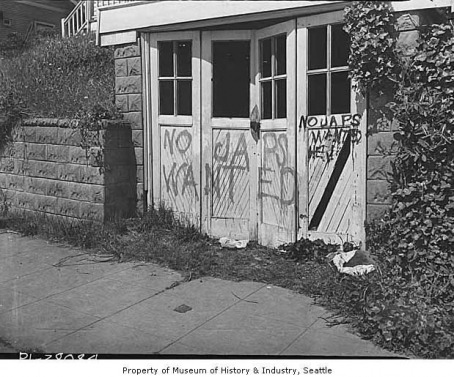
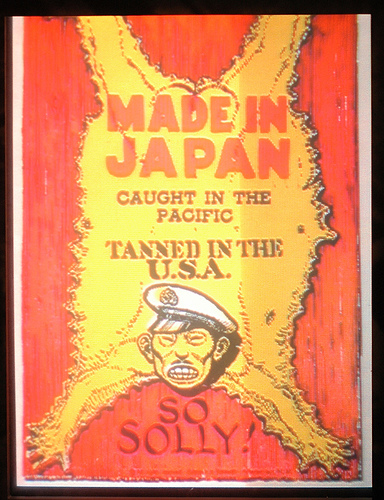
Jay Feldman reported on the curtailment of civil liberties for minorities during times of war and strife in the United States. Mr. Feldman argued that throughout American history, government officials and private citizens have capitalized on public anxieties to oppress minorities. The author showed a few pictures as he recounted the stories of several groups that have faced persecution, including the deportation of Mexican immigrants and Mexican Americans throughout the Depression to the placement of 112,000 Japanese Americans in internment camps during World War II. Jay Feldman responded to questions from members of the audience at Book Passage Bookstore in Corte Madera, California, on September 13, 2011.
Grace Lee Boggs on Detroit, Gardens, and Revolution
Emily Loftis of Mother Jones writes on 15 April 2011, on Grace Lee Boggs: Grace Lee Boggs is a ninety-five-year-old veteran activist who is redefining what revolution means in the Motor City. Boggs' new book, The Next American Revolution: Sustainable Activism for the Twenty-First Century is both a memoir and a manifesto—a portrait of a young woman's journey through several major social movements, and the lessons she hopes to share with a new generation of activists.
In the early 1940's the young Chinese-American woman finished her doctorate in philosophy and began looking for a professorship. She quickly found herself facing departments that unblinkingly told her, "We don't hire orientals." As if dealing with that racism wasn't enough, she bucked the prejudices of the Civil Rights era and married Black Power and labor activist, Jimmy Boggs, in the early 1950's. At the height of the McCarthy era, she was "radicalized" by hanging around Marxist leaders such as A. Phillip Randolph and C.L.R. James. Those influences stayed with her when she moved to Detroit, where she joined the race and labor movements during the city's most riotous years.
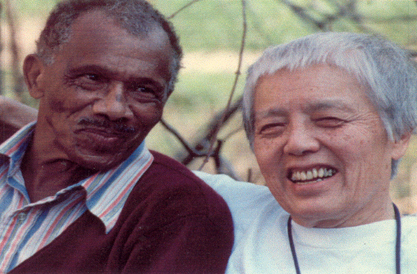
James and Grace Lee Boggs
Boggs encourages readers to redefine their own ideas about current efforts towards social justice. When I asked her what she thought about today's class warfare: "We tend to think in terms of how to carry on the class struggle—how to reduce the scandalous and shamelss disparity from the wealth on the top and poverty on the bottom. We have to get outside of that particular paradigm. We have gotten used to the paradigm that allowed us to enjoy the comforts and conveniences that were won at the expense of other people and the Earth." When pressed on whether it's realistic to expect a complete overhaul of our institutions, without experiencing a major collapse, she piped,"We have experienced a major collapse in Detroit."
And Boggs is no armchair revolutionary. At 95-years-old, she is one of Detroit's citizens who is attempting to recreate the city and pass along her hard-earned wisdom to a population that suffers from 11.8 percent unemployment. In 1995, she and her now-deceased husband started the Boggs Center, which includes the Detroit Summer program, where urban kids learn how to garden, renovate Detroit's dilapidated properties, and tackle crime through restorative justice training. Also, Detroit Summer's Live Art Media Project produced a documentary called Rising Up from the Ashes: Chronicles of a Dropout that exposed the failures of the city's school system."We realized," says Boggs, "the young people were part of the solution instead of the problem." She hopes that Detroit can be rebuilt from the ground up—by the forgotten youth of a city notorious for despair. "Revolutions aren't created by governments," she smiled big, eyebrows raised in bright anticipation. (source: Mother Jones)
The next American revolution, sustainable activism for the twenty-first century
"From White City to World City" by Scott Kurashige
Los Angeles has served as a major testing ground of American race relations owing to its proximity to both the Mexican border and, as my account especially recognizes, the Pacific Ocean. Writer Carey McWilliams remarked that the nation’s imperial expansion turned the Pacific into an “American highway.” Consequently, a transpacific imaginary always factored into the construction of the West Coast’s multiracial relations during the twentieth century. It loomed especially large in the minds of the city’s leading figures. Heir to the fortune of the Southern Pacific railroad, Henry Huntington became one of the region’s wealthiest men and most extensive landholders of the early twentieth century. “Los Angeles is destined to become the most important city in this country, if not the world,” proclaimed Huntington in 1912. “It can extend in any direction as far as you like; its front door opens on the Pacific, the ocean of the future. The Atlantic is the ocean of the past. Europe can supply her own wants; we shall supply the wants of Asia.” The city’s first African American mayor, Tom Bradley, entered office six decades later with nearly an identical vision. “It was something that was just so clear to me that I never questioned it,” he recalled, “the development of this city as a gateway to the Pacific Rim.” Bradley, of course, was in a much better position to actualize this vision, for the advance of globalization had put a new premium on the importance of “world cities” as a nexus of international trade.6
A large body of scholars has devoted the past two decades to understanding Los Angeles as a “world city.” Many assert that the former “exception” is now the model of urbanism for the “post-Fordist” era of globalization. While researchers have traced the origins of the city’s decentralized spatial form and its “flexible” regime of accumulation, racial politics has especially come to the fore of scholarly attention. Most notably, City of Quartz by Mike Davis demonstrated the centrality of race and class to the operation of power in twentieth-century Los Angeles. Davis’s groundbreaking work sparked a flurry of regional studies that have tended to focus on explaining the post-1848 ascendance of the “white city” or the post-1965 immigration reshaping the “world city.” But there remains a chronological and intellectual void waiting to be filled. How did a city governed by white supremacy become a center of multiculturalism? The city’s postwar reorientation complicates the traditional view of the mid–twentieth century as a time when a lull in immigration heightened the assimilation of ethnic groups and aided the consolidation of a national consensus. My contention is that many of the new dynamics that would later characterize multiculturalism were initiated in this same period. In order to situate itself as the “capital of the Pacific Rim,” Los Angeles had to develop a self-awareness of its multiracial diversity and an interconnection to the peoples and cultures of the global community. While Los Angeles did not exercise a full commitment to racial equality, its qualified embrace of multiculturalism was a prerequisite for its emergence as a “world city.”7
Drawing attention to this overlooked historical evolution of multiracial relations in Los Angeles, I devote careful attention to the factors that caused the historical trajectories of Black and Japanese Americans to converge and diverge. The book is roughly divided into three chronological sections. Chapters 1 through 3 examine two overlapping processes of exclusion during the interwar era that created experiences with racism common to both groups but situated them as leaders of distinct spheres of struggle. Revolving around World War II, chapters 4 through 7 detail how the total exclusion of Japanese Americans and the integration of African Americans alongside other non-Japanese minorities drove a wedge between the two groups while creating a paradigm shift in racial politics. Addressing the postwar aftermath of this shift, chapters 8 through 11 focus on the two overlapping processes of integration that set the two groups apart and ultimately gave rise to multiculturalism.
For African Americans from the Jim Crow South, moving west was a common strategy of survival and advancement, especially when job opportunities opened during World War II. What they encountered in Los Angeles, however, were new ideas and technologies to propagate segregation and inequality in their new surroundings. Challenges to white racism led not to its elimination but its evolution into more socially acceptable forms over the course of the twentieth century. In the early 1900s, prominent civic leaders openly espoused white supremacist beliefs, and advocates of Klan-type violence and intimidation called the city home. Yet, as the promotion of segregation and white privilege became increasingly attached to suburbanization, whites sought primarily to avoid people of color rather than engage them in direct conflict. They rarely concealed the racial prejudice behind their motives before World War II, but postwar civil rights measures forced them to make significant adjustments. Denying their involvement in a racist system, postwar culprits of segregation instituted a “more insidious” form of Jim Crow couched in the ostensibly race-neutral concept of “individual rights.” By the 1970s, with the movement for integration having been undermined, Black/white polarization reached an extreme stage that sociologists call “hypersegregation.” To be certain, some moderate achievements of integrationism left their mark on Black Los Angeles. The most blatant forms of overt racism had been eliminated, and a new African American professional class had risen. But the new sense of belonging and mobility that minority professionals experienced stood in stark contrast to the devastation of inner-city neighborhoods. The decoupling of integration from social democratic reform especially hurt urban African American workers, whose fortunes were tied to the dwindling prospects of the Fordist economy.8
Japanese Americans experienced the swiftest and most dramatic transition from segregation to integration. As “aliens ineligible to citizenship,” pre–World War II Japanese immigrants were political pariahs oppressed by racism and forced to make all sorts of accommodations just to maintain a stake in America. With the onset of war, the dehumanization of the Japanese “race” built on a legacy of exclusion and demagoguery to fuel the demand for Japanese American internment. And yet, scarcely two decades removed from the camps, Japanese Americans would emerge as the only “successful” model of racial integration. Whereas racial essentialism had previously tied ethnic Japanese to the transpacific “Yellow Peril” discourse, the postwar era and the American occupation of Japan linked them to transpacific integration. Driven by liberal tolerance and imperial arrogance, American elites sought to integrate the non-Communist Third World into its sphere (the “free world”) and promote the heightened level of international trade we now associate with “globalization.” A necessarily multiracial discourse became a constitutive element of American efforts to achieve and maintain global hegemony. Consequently, the assimilation of the American-born Nisei into many neighborhoods and professions previously restricted to whites carried special political significance to the city and the nation. Demonstrating the malleability of race relations, “successful” Japanese American integration ostensibly proved that the spread of American values could transcend the supposed racial divide between “Caucasians” and “Orientals.”9
Far from mutually exclusive, these Black and Japanese American trajectories were mutually determining over the course of a period stretching a quarter century before and after the Bronzeville/Little Tokyo encounter of the mid-1940s. During the interwar era, Black and Japanese Americans were roughly equal targets of degradation by whites. However, as variations by race and nationality differentiated the responses of Black and Japanese Americans to both housing and employment discrimination, members of each group looked to their counterparts in the other group for models of racial progress. There were, for instance, ways in which the national origins and ethnic heritage of Japanese Americans provided relative advantages. Before internment, Japanese immigrants possessed a common homeland that provided them with a psychic boost of nationalist pride and a basis for cooperative enterprises. In fact, Black organizers, who espoused self-help and economic nationalism, marveled at the ability of local Japanese entrepreneurs to capture segments of the city’s expanding consumer market. At the same time, the Black community’s greater legal standing and prowess made it better positioned to press for full citizenship rights. Seeking “better” housing, Japanese immigrants followed African Americans into Westside neighborhoods where Black homeowners and activists had begun to break down racial restrictions. Complementing previous research on multiethnic solidarity in the Eastside, my account recovers a neglected history of Black and Japanese American solidarity in the Westside, ranging from West Jefferson as early as the 1920s to postwar Crenshaw as late as the 1970s and beyond.10
But we should not assume that overlapping histories point only toward interethnic coalitions and affiliation. They can also explain divergences in Black and Japanese American trajectories, thereby serving to demystify interethnic tensions. During World War II, national imperatives to defeat a transpacific enemy shaped the city’s multiracial politics. The expansion of war-related jobs and the push for civic unity created the conditions for racial harmony—but only for those who escaped detainment behind barbed wire. As “national security” measures stripped Japanese Americans of citizenship and constitutional rights, they created space for African Americans to assert their “Americanness.” Framing its militant activism as the highest form of patriotism, the Black community mobilized to demand its fair share of wartime economic growth and to push for a voice in local governance. African Americans united with labor activists to build an alliance of the dispossessed that some contemporary observers perceived to be an unstoppable force for progressive social change.
But as Black segregation, poverty, and militancy intensified during the postwar era, Japanese Americans were invoked as a “model minority” whose achievement surpassed even that of whites. Tacit acceptance of Japanese Americans allowed whites to act in a manner consistent with modernist narratives of integration, to see themselves as tolerant people with rational rather than prejudiced reasons for opposing Black political demands. If Japanese Americans could attain middle-class status after being interned—so went the “model minority” argument—then Blacks had only themselves to blame if they did not follow suit. The creation of this “success story,” however, was largely an ideological construction, for it disregarded the lingering damage the internment had inflicted, and it erased from history those members of the Japanese American community who failed to achieve upward mobility. Its purpose was to buttress the claim that America was a progressive, egalitarian nation and to blunt the arguments of both domestic and foreign critics who claimed otherwise.
Many of the key roots of the “world city” run directly through these mutually determining trajectories of Black and Japanese American history. As US Cold War strategy prioritized alliances with Japan and other Asian governments, Los Angeles increasingly tied its economic and cultural life to the Pacific Rim. Moving toward a celebration of ethnic diversity, the city proved that the changes brought about by imperial entanglements were not unidirectional.
Still, the “world city” was a product of local as well as global conditions, taking a particular form in Los Angeles due to the configuration of urban politics symbolized by Mayor Tom Bradley’s ascension. More than a reflection of elite motives and behavior, the “world city” also resulted from grassroots challenges to racial discrimination and exclusion. Bradley launched his career through neighborhood organizing efforts in Crenshaw, the multiethnic district that became the central focus of postwar Black and Japanese American efforts to integrate the Westside. The mayor’s dominant representation of the “world city” reflected the moderate achievements of integrationists, who helped create a diverse community in Crenshaw and then sought to replicate this diversity by practicing affirmative action to change the face of municipal government. Meanwhile, young radicals in Crenshaw produced oppositional forms of multiculturalism under the rubric of “Third World” liberation. Both the moderates and the radicals could cite the polyethnic culture of a Crenshaw institution like the Holiday Bowl as inspiration.
Although a full analysis of post-1965 Los Angeles lies beyond the scope of the book, the research on which this history is based is unquestionably a product of this multicultural era. As a critique of the notion of history as a grand narrative privileging the dominant elements in society, multiculturalism has made us more receptive to hearing voices on the margins and to seeing history from diverse perspectives. What it has not done is provide a framework for understanding the many intersections of the ethnic narratives it has produced. Through a detailed study of the triangular relations between African Americans, Japanese Americans, and whites, I attempt to show how the fragments of interethnic history accessible through existing sources can be pieced together. This I take as the primary challenge to comparative ethnic studies scholarship ready to move from documenting the oppression and resistance of minorities to locating the emergence of a nonwhite majority. In this way, we might see the future in the past. As the well-traveled writer and activist Carey McWilliams argued in the mid-1940s, Los Angeles stood at the forefront of the nation’s “racial frontier” because of what he labeled its “quadrilateral” pattern of interaction between white, Black, Asian, and Mexican Americans. This uniquely West Coast configuration provided the nation with “one more chance, perhaps a last chance, to establish the principle of racial equality.” Those observing the city were thus blessed with “a ringside seat in the great theatre of the future.” That future has arrived. Multiethnic Los Angeles is no longer exceptional; it is a symbol of twenty-first-century American culture.11
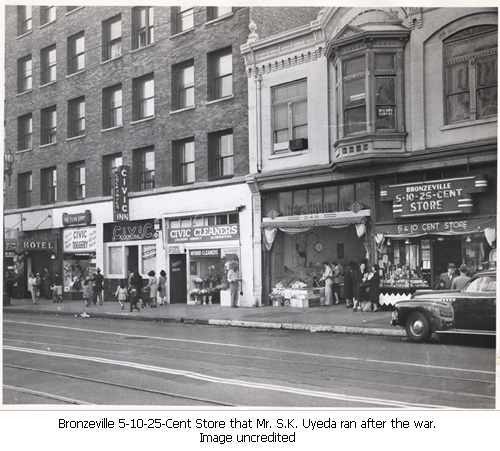
In the middle of 1943, Arthur Miley, an aide to Los Angeles County supervisor John Anson Ford, declared, “From all I heard it appears that Little Tokyo is going to be one big headache.” Conditions of squalor in the congested, segregated neighborhood in downtown Los Angeles alarmed public officials, social workers, and ethnic community leaders. Large families routinely occupied storefronts, warehouses, and churches never intended for human habitation. With others living in shacks, garages, and sheds, Miley warned that “permanent occupancy” in such facilities “would lead to juvenile and moral delinquency.” Inspectors from the city health department discovered one family living in an apartment so small that a set of twins was forced to sleep in dresser drawers. They later found a family of nine inhabiting one room with a five-foot ceiling and no windows. Fears of a public health catastrophe mounted. The chair of the Little Tokyo Committee of the Council of Social Agencies reported, “Garbage is scattered about and the rats are taking over.” Los Angeles mayor Fletcher Bowron vowed to eliminate the neighborhood’s “deplorable overcrowding of as many as 16 adults and children in one room and extremely serious disease hazards.” Demanding more than “patchwork remedies,” the Communist Party’s local branch called for “the adoption and enforcement of a public policy” that would “make ‘Little Tokyos’ impossible.” Arthur Miley concluded that officials needed to take action “immediately on a large scale” or risk subjecting the city “to disease, epidemics, race riots and a general breaking down of the home front in this area.” But while public officials employed racially loaded language to characterize Little Tokyo, its residents at this time were not Japanese. Following the removal of Japanese Americans from Los Angeles during the early months of World War II, the ethnic enclave had shifted from being the center of the “Japanese problem” to serving as ground zero for the “Negro problem.” In May 1944, the Los Angeles Times declared that both residential and commercial structures formerly occupied by Japanese Americans were “now overflowing with thousands of Negro families from the Deep South.”1
The wartime transformation of Little Tokyo into a community that African American entrepreneurs and community leaders dubbed Bronzeville most literally exemplifies the intersection of Black and Japanese American histories in twentieth-century Los Angeles. That African Americans would reside in a space previously carved out by Japanese Americans was no coincidence. Because the city’s white elites were preoccupied with building a business-friendly “open shop” town by subduing white labor unions, both Black and Japanese American pioneers arriving before the First World War had initially seen Los Angeles as a site of relative freedom and opportunity. As they simultaneously faced exclusion from segregated white neighborhoods, members of both groups lived in the same geographic niches during the first half of the twentieth century. Although the federal government allowed interned Japanese Americans to return to the West Coast in 1945, the sharp wartime rise in the Black population had overextended these small pockets of unrestricted housing. As the war neared its end, the question of how Little Tokyo’s recent arrivals would get along with the district’s prewar inhabitants thus became a major source of debate. Prominent white politicians and media outlets predicted violent turf battles between Black and Japanese Americans would erupt. Black and Japanese American activists, by contrast, envisioned a new level of interethnic political cooperation developing from heightened interaction between their communities. Those with only a conventional understanding of “race relations”—characterized by the bilateral interaction between a white majority and a Black minority—were ill-prepared to respond to these developments.
Three issues at the fore of the Little Tokyo/Bronzeville story—the omnipotence of white racism, the specter of interethnic conflict, and the promise of interethnic coalitions—resonate throughout this book. In the pages that follow, I will demonstrate how and why Black and Japanese American communities came to occupy overlapping positions within the racial politics and geography of twentieth-century Los Angeles.
To provide an overarching framework for this investigation, I trace the contours of the city’s multiracial hierarchy as it changed from the “white city” of the early twentieth century to the “world city” of the more recent past. Charting the rise of segregation, I posit that racism lay at the core of the 1920s real estate boom that made Los Angeles a major metropolis with a population surpassing 1 million. Although popular conceptions associate suburbanization with post–World War II American culture, the Southland’s decentralization took off three decades before the fifties sitcom Leave It to Beaver began filming in the San Fernando Valley. Unlike the old downtown elite, who championed industrial Los Angeles as the “Chicago of the West,” a rising bloc of developers and realtors drew on an idealized vision of the suburban neighborhood to market Southern California, especially the “Westside,” as a site for the preservation and renewal of whiteness. Viewing World War II as a turning point, I highlight the distinct but equally critical roles Black and Japanese Americans played in the rise and fall of integration. The war brought a new sense of unity and difference. As whites and Blacks came together around the notion of “interracial progress,” they did so primarily because anti-Japanese mobilization had created a heightened basis for national unity. Nevertheless, the postwar movement for integration brought about a reversal of Black and Japanese American fortunes. Whites increasingly exhibited either a passive or active acceptance of Japanese Americans but took greater measures to distance themselves both socially and geographically from Black (and Mexican) Americans. The ideological characterization of Japanese Americans as a “model minority” to be integrated served to stigmatize the others as “problem” minorities to be contained. But to the degree any postwar consensus existed, it was torn apart by the Watts Rebellion, signaling the demise of both integration and white hegemony. The book closes in the aftermath of Watts and at the dawn of the multicultural era, as African American mayor Tom Bradley and grassroots activists advanced and competing visions of Los Angeles as a multiethnic city within a global community.
This explication of urban political conditions provides context for closer scrutiny of the debates and struggles that took place within and between Black and Japanese American communities. The historical significance of these communities during this period is considerable. Los Angeles housed what were by far the largest concentrations of African Americans and Japanese Americans on the West Coast. Furthermore, while Blacks were of course the nation’s largest nonwhite minority, Japanese Americans comprised the bulk of all Asians living in the United States. Ultimately, however, the presence of these two groups transcended numbers. At distinct historic junctures, the city’s Black and Japanese American communities respectively served both as central targets of white supremacists and as models of racial progress.
My study couples two interconnected levels of analysis. At the most immediate level, this book is an account of how Black and Japanese Americans battled for housing, jobs, and political representation in Los Angeles as members of distinct ethnoracial groups. Drawing connections between seminal “Japanese” events like World War II internment and “Black” events like the civil rights movement, I compare and contrast the socioeconomic status and political standing of African Americans, Japanese Americans, and whites over the course of much of the twentieth century. My research further reveals how Black and Japanese Americans responded to instances of interethnic competition, as well as the degree to which they embraced opportunities for cooperation within oppositional social movements. As the narrative unfolds, it explains why Black and Japanese Americans faced common forms of racial discrimination prior to World War II but were subsequently thrust onto different historical paths.
On a second and broader level, this book is a case study of how race functions in a multiethnic context. By highlighting the triangular nature of relations between African Americans, Japanese Americans, and whites, my study provides multiple vantage points from which we may contemplate how diverse residents of Los Angeles saw their place within a multiracial order. Exploring the range of meanings these residents attached to both segregated and integrated communities, it offers a sense of how the multiethnic city was experienced on the ground. But it also shows how the ground itself shifted over the course of the twentieth century. What I mean by this is that the book’s central categories of analysis—“African American,” “Japanese American,” and “white”— were historically contingent constructs. Racial definitions varied over time and space in conjunction with demographic, economic, and political changes that resituated Los Angeles within a regional, national, and global order. Most obviously, a host of terms have been employed to identify these groups, many of which are now anachronistic and some of which have always been pejorative—“Negro,” “Black,” “colored,” “Japanese,” “Oriental,” “Caucasian,” as well as a host of vulgar epithets.
The Shifting Grounds of Race: Black and Japanese Americans in the Making of Multiethnic Los Angeles, by Scott Kurashige
While racialized struggles over resources altered the status of groups and their relationship to power, they perhaps less obviously changed the rules by which racial politics operated. Beyond charting material relations between Black, Japanese, and white Americans, my research uncovers the ideological bases of these triangular relations. White elites played Black and Japanese Americans off against each other to solidify white hegemony. In turn, Black and Japanese Americans remained highly conscious of each other’s image and status as they negotiated and renegotiated their position within a multiracial social order. Differences in racialization became a basis for an opportunistic form of triangulation. By actively distancing themselves from the other group or passively accepting the distance created by white denigration of the other group, both Black and Japanese Americans were at times able to promote a sense of national belonging and greater white acceptance. Yet, if triangulation represented a form of capitulation to a hegemonic multiracial discourse, progressive activists of all races repeatedly sought to develop a counterhegemonic vision of multiracial solidarity.2
As much as this book is about what transpired in the past, it is equally concerned with how we think about the politics of race. Moving in step with the multiethnic rhythms of life and politics in Los Angeles requires interrogating and in some cases abandoning commonly held assumptions drawn from histories written in black and white. For the remainder of this introduction, I argue that putting Black/Japanese American relations at the center of the history of race, politics, and urban space complicates what we have come to know as the “urban crisis,” thereby challenging us to better come to terms with the origins of the “world city.”
Beyond the Biracial City
A focus on multiethnic Los Angeles history from the perspective of Black and Japanese Americans offers new ways of seeing and new modes of interpreting what historian Thomas Sugrue has called “the origins of the urban crisis.” Part of my story can be explained by the national patterns of urban segregation and inequality outlined by Sugrue in his influential 1996 book and expanded on by others in his wake. The Great Migration brought southern Blacks seeking political freedom and economic opportunity to the cities of the North and West, especially as the demand for their labor soared and Executive Order 8802 provided a measure to combat employment discrimination during World War II.
Although a wave of European immigrants had used industrial employment as a first step toward social assimilation and economic security, racism and deindustrialization ultimately denied African Americans the same form of advancement. Whites viewed workers of color as competitors for their jobs, and they feared that integration would destroy their property values and deteriorate their children’s schools. They deployed legal mechanisms, political pressure, grassroots mobilization, and racist violence to defend white privilege. Furthermore, postwar development, which was a joint product of private enterprise and public policy, magnified the scale of Black/white segregation and inequality. While new housing and employment opportunities concentrated in predominantly white suburbs, urban renewal efforts ravaged low-income residents and communities of color. Lastly, Cold War conservatism further dampened the prospects of urban Blacks by undermining the redistributive aspects of New Deal reform and repressing social democratic movements that advanced the principles of multiracial unity and “civil rights unionism.”3
At its core, the urban crisis narrative is an account of the failure of racial integration—a social movement and historical process whose fate has been inextricably bound to the construction of American national identity. First propelled by the optimistic liberal nationalism of World War II, the concept of racial integration prompted a heated public debate about national character. Social scientist Gunnar Myrdal’s assertion that the “Negro problem” was a “moral issue” striking at “the heart of the American” served as the opening salvo. Published in 1944, Myrdal’s monumental book, An American Dilemma: The Negro Problem and Modern Democracy, argued that racism was the central defect of a nation built on the principles of liberty, democracy, and equality. He was convinced, however, that Americans—by which he essentially meant white Americans—were inherently moral and rational beings, who would resolve the glaring contradiction preventing their nation from attaining its highest ideals. What followed in actuality was a quarter century of sharp conflict proving that integration was a difficult if not impossible goal to achieve. Epitomizing the pessimism of the late 1960s was the “basic conclusion” of the Kerner Commission. Charged by the federal government to investigate social conditions in the aftermath of the wave of urban rebellions, the blue-ribbon panel proclaimed, “Our nation is moving toward two societies, one black, one white—separate and unequal.” The urban crisis narrative reflects the cumulative effort of an entire generation of scholars and political commentators to comprehend why things went so terribly wrong.4
While the urban crisis scholarship has enriched our understanding of the structural bases of poverty and racial oppression, it has yet to transcend the binary logic that has most informed scholarly and popular discourse on race in the United States. For example, the analysis Sugrue presents in The Origins of the Urban Crisis revolves around “the color line between black and white,” which he characterizes as “America’s most salient social division.” To be certain, my narrative recognizes that Black/white relations have played a critical role in the shaping of American politics. Like other major metropolitan areas, Los Angeles developed a predominantly Black ghetto that became socially and economically isolated from the more prosperous and predominantly white suburbs.
As frustration and anger mounted, mainstream politics did little to redress inner-city problems. Erupting in 1965, the Watts Rebellion marked one of the first major uprisings of the decade anywhere in the United States. Yet, in spite of these parallels, the established narrative stressing failure, repression, and decline cannot properly explain the history of racial politics in multiethnic Los Angeles. I maintain that it is impossible to grasp the predicament of African Americans or envision viable forms of African American political struggle without taking into account the many concerns that arise from multiracial dynamics. In Los Angeles, Black/white relations were neither autonomous nor so demonstrable as to make all other racial and ethnic relations residual. For instance, both anti-Black and anti-Japanese rhetoric and tactics proved integral to the architecture of segregation. To lure white migrants, suburban champions devised racial restrictive covenants to “protect” residential subdivisions from “invasions” by Black and Japanese Americans largely confined to the working-class Eastside neighborhoods like Little Tokyo and the Central Avenue district. What must also be stressed is that the communities Black and Japanese Americans created were never defined solely by their exclusion from white suburbia but rather through an array of interethnic and multi-ethnic relationships.5
It is my contention that the urban crisis has spawned an equally menacing epistemological crisis. Viewing integration as an aborted process, we have become transfixed with changes that did not occur at the expense of fully comprehending those that actually did. We need to complement our intricate knowledge of what was lost in the past with an awareness of what has created the new problems and possibilities we are now facing. My account is premised on the notion that the origins of the urban crisis overlapped with the origins of the economically vibrant and multicultural “world city” in postwar Los Angeles. To understand how these two seemingly opposing tendencies could be intertwined, we need to raise new questions about the history of segregation and integration: How and why did African Americans and the “Negro problem” become materially and ideologically linked to the “urban crisis”? How and why did Japanese Americans and the “model minority” become materially and ideologically linked to the rise of the “world city”? I submit that these were mutually constitutive processes that are best understood when situated within a multiracial context that recognizes the interconnection of local, national, and transnational dynamics. (source: Princeton)
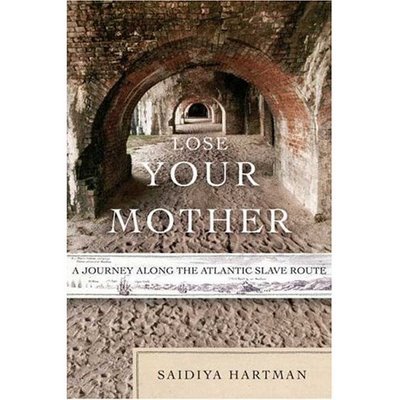
Lose Your Mother: A Journey Across the Atlantic Slave Route, by Saidiya Hartman
From the New York Times, on 11 February 2007, "Erasing Slavery," by Elizabeth Schmidt: Saidiya Hartman’s story of retracing the routes of the Atlantic slave trade in Ghana is an original, thought-provoking meditation on the corrosive legacy of slavery from the 16th century to the present and a welcome illustration of the powers of innovative scholarship to help us better understand how history shapes identity. But the book is also — this must be stressed — splendidly written, driven by this writer’s prodigious narrative gifts. She combines a novelist’s eye for telling detail (“My appearance confirmed it: I was the proverbial outsider. Who else sported vinyl in the tropics?”) with the blunt, self-aware voice (“On the really bad days, I felt like a monster in a cage with a sign warning: ‘Danger, snarling Negro. Keep away’ ”) of those young writers who have revived the American coming-of-age story into something more engaging and empathetic than the tales of redemption or of the exemplary life well lived, patterned on Henry Adams, Benjamin Franklin and Frederick Douglass.
Hartman’s main focus in “Lose Your Mother” is shaking up our abstract, and therefore forgettable, appreciation for a tragedy wrought on countless nameless, faceless Africans. She makes us feel the horror of the African slave trade, by playing with our sense of scale, by measuring the immense destruction and displacement through its impact on vivid, imperfect, flesh-and-blood individuals — Hartman herself, the members of her immediate family she pushes away but mulls over, the Ghanaians she meets while doing her field work and the slaves whose lives she imaginatively reconstructs from the detritus of slavery’s records.
Her own journey begins in the stacks of the Yale library, where as a graduate student she came across a reference to her maternal great-great-grandmother in a volume of slave testimony from Alabama. Her excitement at finding a sign of her family’s past was undercut by her great-great- grandmother’s brief reply when asked what she remembered of being a slave: “Not a thing.” Hartman, while “crushed” to hear so little of her ancestor’s voice, turns negation into possibility, into all that can be communicated by such reticence: “I recognized that a host of good reasons explained my great-great-grandmother’s reluctance to talk about slavery with a white interviewer in Dixie in the age of Jim Crow.” Years later, after Hartman had begun work on this book, she returned to those interviews and could find no trace of the reference. She scoured the library for misshelved volumes, reread five surrounding volumes, reviewed her early notes but never found that paragraph imprinted in her memory, “the words filling less than half a page, the address on Clark Street, the remarks about her appearance, all of which where typed up by a machine in need of new ribbon.”
Hartman’s desire to know about slavery is thwarted at every turn: by grandparents who refuse to talk about the subject, by parents and a brother who urge her to stop brooding about the past and get on with her life, by the Ghanaians she encounters who either avoid the topic of slavery entirely or make it into a generic tourist attraction, and above all, by the huge gaps she encounters in her archival work, as the vanishing act of her great-great-grandmother’s testimony illustrates. Hartman’s response to what she calls the “non-history” of the slave fuels her drive “to fill in the blank spaces of the historical record and to represent the lives of those deemed unworthy of remembering.”
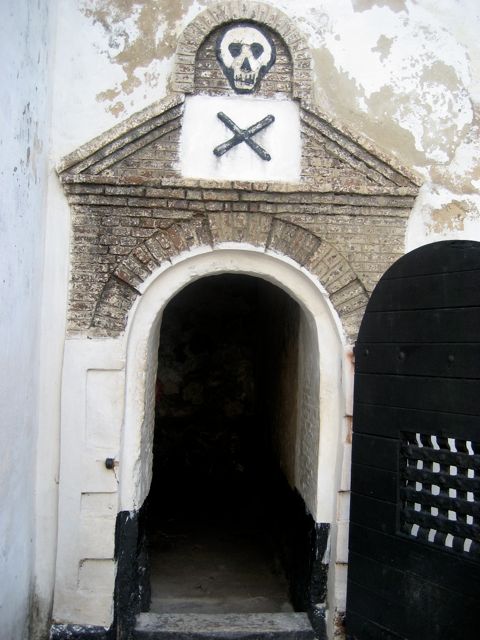
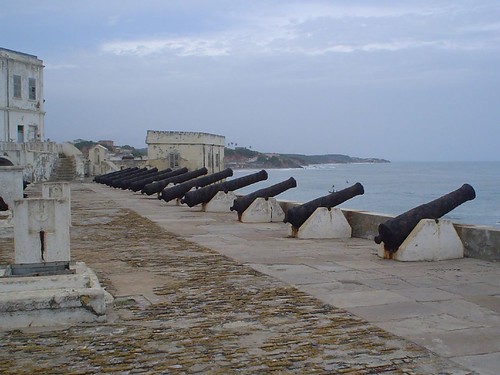
Hartman, the author of “Scenes of Subjection: Terror, Slavery, and Self-Making in Nineteenth-Century America,” selects Ghana because it provides a vivid backdrop against which to understand how people with families, towns, religions and rich cultural lives lost all traces of identity. Ghana had “more dungeons, prisons and slave pens than any other country in West Africa,” she notes. “Nine slave routes traversed Ghana. In following the trail of captives from the hinterland to the Atlantic coast, I intend to retrace the process by which lives were destroyed and slaves born.” But Hartman, who “dreamed of living in Ghana” since college, is also interested in the country’s more recent centrality in the Pan-African movement since its independence in 1957, when the first president, Kwame Nkrumah, opened up the country to members of the African diaspora, creating a Ghana whose slogan was “Africa for Africans at home and abroad.”
In contemporary post-Nkrumah Ghana, Hartman confronts her own sense of pure Generation X despondency: “I had come to Ghana too late and with too few talents. I couldn’t electrify the country or construct a dam or build houses or clear a road or run a television station or design an urban water system or tend to the sick or improve the sanitation system or revitalize the economy or cancel the debt. No one had invited me. I was just ... about as indispensable as a heater in the tropics.”
No one will talk to her directly about slavery. It’s old news for those progress-minded people focusing on Ghana’s many current social and economic woes, and it’s too painful for others who want to avoid the collective guilt of remembering the ways Africans in the former Gold Coast facilitated the slave trade. As the Ghanaian poet Kofi Anyidoho says, “We knew we were giving away our people, we were giving them away for things.”
By the end of her stay in Africa, Hartman faces the fact that she hasn’t found “the signpost that pointed the way to those on the opposite shore of the Atlantic.” She has had to rely primarily on her imagination in reconstructing the lives of particular slaves. But just as she gleaned something in her great-great-grandmother’s refusal to engage, she hears something beyond “the story I had been trying to find” in a small, walled town in the interior, one of the few places where the slave raids had been resisted: “In Gwolu, it finally dawned on me that those who stayed behind,” the survivors of the slave trade, “told different stories than the children of the captives dragged across the sea.” (source: The New York Times, Elizabeth Schmidt)
Journeying along a slave route in Ghana, following the trail of captives from the hinterland to the Atlantic coast, Saidiya Hartman retraces the history of the Atlantic slave trade from the fifteenth to the twentieth century and reckons with the blank slate of her own genealogy. There were no survivors of Hartman's lineage, nor far-flung relatives in Ghana of whom she had come in search. She traveled to Ghana in search of strangers. The most universal definition of the slave is a stranger torn from kin and country. To lose your mother is to suffer the loss of kin, to forget your past, and to inhabit the world as a stranger.