
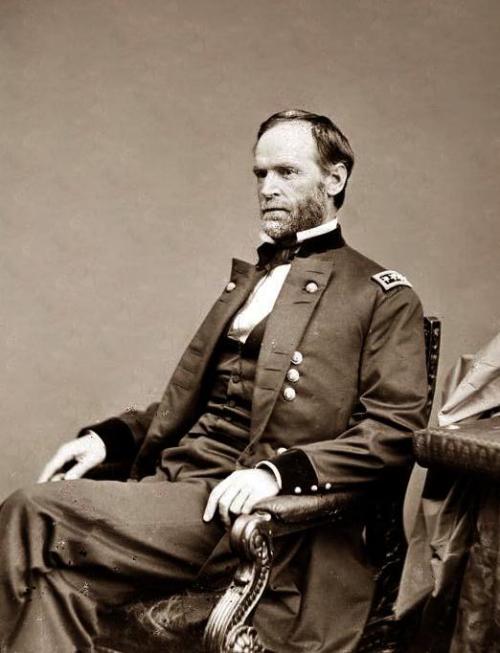
Major-General William Tecumseh Sherman
During Mr. Stanton's stay in Savannah we discussed this negro question very fully; he asked me to draft an order on the subject, in accordance with my own views, that would meet the pressing necessities of the case, and I did so. We went over this order, No. 15, of January 16, 1865, very carefully. The secretary made some verbal modifications, when it was approved by him in all its details, I published it, and it went into operation at once. It provided fully for the enlistment of colored troops, and gave the freedmen certain possessory rights to land, which afterward became matters of judicial inquiry and decision. Of course, the military authorities at that day, when war prevailed, had a perfect right to grant the possession of any vacant land to which they could extend military protection, but we did not undertake to give a fee-simple title; and all that was designed by these special field orders was to make temporary provisions for the freedmen and their families during the rest of the war, or until Congress should take action in the premises. All that I now propose to assert is, that Mr. Stanton, Secretary of War, saw these orders in the rough, and approved every paragraph thereof, before they were made public:
HEADQUARTERS MILITARY DIVISION OF THE MISSISSIPPI, IN THE FIELD, NEAR SAVANNAH, GEORGIA, January 16, 1865.
1. The islands from Charleston south, the abandoned rice-fields along the rivers for thirty miles back from the sea, and the country bordering the St. John's River, Florida, are reserved and set apart for the settlement of the negroes now made free by the acts of war and the proclamation of the President of the United States.

2. At Beaufort, Hilton Head, Savannah, Fernandina, St. Augustine, and Jacksonville, the blacks may remain in their chosen or accustomed vocations; but on the islands, and in the settlements hereafter to be established, no white person whatever, unless military officers and soldiers detailed for duty, will be permitted to reside; and the sole and exclusive management of affairs will be left to the freed people themselves, subject only to the United States military authority, and the acts of Congress. By the laws of war, and orders of the President of the United States, the negro is free, and must be dealt with as such. He cannot be subjected to conscription, or forced military service, save by the written orders of the highest military authority of the department, under such regulations as the President or Congress may prescribe. Domestic servants, blacksmiths, carpenters, and other mechanics, will be free to select their own work and residence, but the young and able-bodied negroes must be encouraged to enlist as soldiery in the service of the United States, to contribute their share toward maintaining their own freedom, and securing their rights as citizens of the United States.

Negroes so enlisted will be organized into companies, battalions, and regiments, under the orders of the United States military authorities, and will be paid, fed, and clothed; according to law. The bounties paid on enlistment may, with the consent of the recruit, go to assist his family and settlement in procuring agricultural implements, seed, tools, boots, clothing, and other articles necessary for their livelihood.

8. Whenever three respectable negroes, heads of families, shall desire to settle on land, and shall have selected for that purpose an island or a locality clearly defined within the limits above designated, the Inspector of Settlements and Plantations will himself, or, by such subordinate officer as he may appoint, give them a license to settle such island or district, and afford them such assistance as he can to enable them to establish a peaceable agricultural settlement.

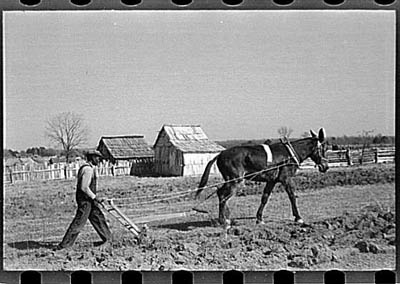
The three parties named will subdivide the land, under the supervision of the inspector, among themselves, and such others as may choose to settle near them, so that each family shall have a plot of not more than forty acres of tillable ground, and, when it borders on some water-channel, with not more than eight hundred feet water-front, in the possession of which land the military authorities will afford them protection until such time as they can protect themselves, or until Congress shall regulate their title. The quartermaster may, on the requisition of the Inspector of Settlements and Plantations, place at the disposal of the inspector one or more of the captured steamers to ply between the settlements and one or more of the commercial points heretofore named, in order to afford the settlers the opportunity to supply their necessary wants, and to sell the products of their land and labor.

4. Whenever a negro has enlisted in the military service of the United States, he may locate his family in any one of the settlements at pleasure, and acquire a homestead, and all other rights and privileges of a settler, as though present in person. In like manner, negroes may settle their families and engage on board the gunboats, or in fishing, or in the navigation of the inland waters, without losing any claim to land or other advantages derived from this system. But no one, unless an actual settler as above defined, or unless absent on Government service, will be entitled to claim any right to land or property in any settlement by virtue of these orders.

5. In order to carry out this system of settlement, a general officer will be detailed as Inspector of Settlements and Plantations, whose duty it shall be to visit the settlements, to regulate their police and general arrangement, and who will furnish personally to each head of a family, subject to the approval of the President of the United States, a possessory title in writing, giving as near as possible the description of boundaries; and who shall adjust all claims or conflicts that may arise under the same, subject to the like approval, treating such titles altogether as possessory. The same general officer will also be charged with the enlistment and organization of the negro recruits, and protecting their interests while absent from their settlements; and will be governed by the rules and regulations prescribed by the War Department for such purposes.

6. Brigadier-General R. Saxton is hereby appointed Inspector of Settlements and Plantations, and will at once enter on the performance of his duties. No change is intended or desired in the settlement now on Beaufort Island, nor will any rights to property heretofore acquired be affected thereby.
By order of Major-General W. T. Sherman, L. M. DAYTON, Assistant Adjutant-General.

 Brigadier General Jefferson C. Davis had few complaints about the able-bodied black men who were supplying the muscle and sweat to keep his Union XIV Corps on the move with Major General William T. Sherman’s 62,000-man army. The black ‘pioneers’ were making the sandy roads passable for heavy wagons and removing obstacles that Rebel troops had placed in his path. Davis was irritated, though, by the few thousand other black refugees following his force toward Georgia’s coast. He had been unable to shake them since the Union army stormed through Atlanta and other places in Georgia in late 1864, liberating them from their owners.

 General Jefferson Davis, known to some by the derisive nickname ‘General Reb’ because of his name, was a veteran Regular Army soldier who loved battle. Short-tempered and a proficient cusser, he had a nasty reputation and was infamous in his time for a furious, short-lived feud with Union Major General William Nelson. In August 1862 Nelson and Davis had got into a heated argument over the defense of Louisville, Kentucky, where Nelson was in command. Nelson ordered Davis, a brigadier general, to leave. The two men met again a few weeks later in a Cincinnati hotel. Davis demanded an apology from his superior, and Nelson stubbornly refused to give him one. Minutes later the angry brigadier shot and killed the major general at point-blank range. Davis was arrested but later released. Though plenty of questions went unanswered, no charges were ever filed against him.


 In course, when considering Sherman and his actions, it’s important to remember that his ideas about black people, though shocking today, were hardly unique in his time. The majority of Union volunteers, and of Northerners in general, were at most ambivalent about emancipation and were vehemently opposed to black suffrage.
 Then there is William T. Sherman, the field commander ultimately responsible for Davis’s actions. Sherman was rewarded with the Thanks of Congress for the revolutionary ‘total war’ he waged during his March to the Sea. At the May 1865 Grand Review of the Armies, the huge parade through Washington, D.C., to celebrate Union victory, Sherman was hailed as a war hero. A few years later, newly elected President Ulysses S. Grant made Sherman a full general and general-in-chief of the U.S. Army.

