Wednesday, June 12, 2013

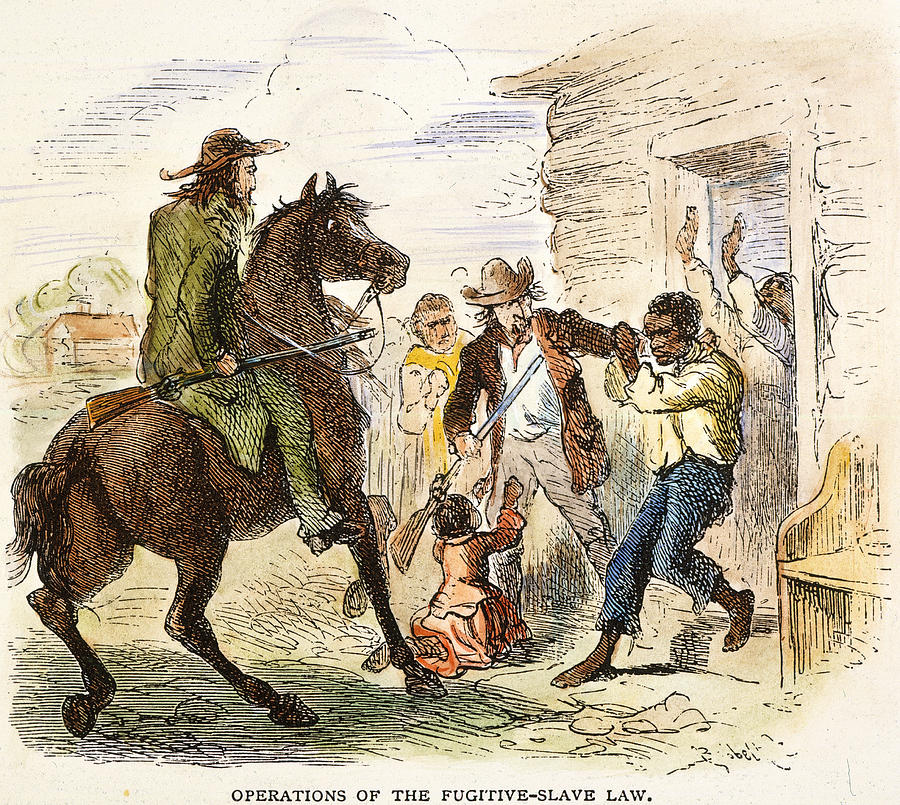
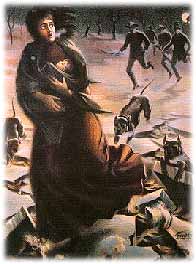
The Fugitive Slave Law, 1860

From the New York Times, "December 10, 1860: The Fugitive Slave Law."

Senator DOUGLAS has given notice of his intention to introduce a bill amending the Fugitive Slave law of 1850, so as to provide more effectually for the recovery of "persons held to service escaping from one State to another." We have no intimation of the character of its provisions. But if it should be framed in the proper spirit and with due regard to the exigencies of the case, it cannot fail to pave the way for action on the part of the Northern States, which may give the Union men of the South a better basis for their efforts to preserve the Union than they have at present.

There are two objects to be accomplished by amendments of the Fugitive Slave law, -- one, the more effective operation of that law in securing the return of fugitives, -- the other, the removal of those features of it which have put freemen at the North in jeopardy, and have thus led to the enactment of the obnoxious Personal Liberty bills. Fortunately, these measures depend upon each other. Whatever secures the latter, secures the former also. Mr. DOUGLAS knows enough of Northern sentiment to understand the necessity of removing all just ground of complaint, in order to secure the execution of the law. There is unquestionably a very strong feeling against the surrender of any fugitive slave; -- but this sentiment will yield to the conviction of the absolute and imperative Constitutional duty of surrender, if that conviction is only allowed fair play, -- by being left untrammeled and unhampered by valid objections to the law.

It seems to us, therefore, that certain concessions can be made to Northern feeling on this point, not only without the slightest risk of impairing the efficiency of the law, but on the contrary, with the certainty of increasing it -- and with the additional advantage of securing the prompt repeal of the Personal Liberty bills, which find their only support in the sentiment of hostility to these harsh features of the existing act.

This done, there is one other provision which should be made to secure the interests of the South in this matter -- namely, compensation for such of their fugitives as may be unconstitutionally " released from service," either by legislation or by violence, in any State. It is easy to find plausible objections to such a provision -- and somewhat difficult, perhaps, to frame its details so as to be perfectly satisfactory. But its main object is substantially just, and will be felt to be so by the great body of the people; -- and if there is a general agreement on the main principle, there will be no unconquerable obstacle in the way of giving it an acceptable shape.

The Chicago Tribune has a long and able article protesting against the whole scheme. We have no disposition to urge it in a controversial spirit, -- nor do we think any vindication of its essential justice and necessity required. In regard to its alleged expensiveness, however, we think the Tribune is entirely at fault, in assuming that 100,000 or 50,000 or any such number of fugitives would have to be paid for annually. We have no recent reliable statistics on the subject, -- but the last census returns gave the following statement of the number of fugitive slaves which each slaveholding State lost in the year 1850:

Alabama............... 29
Arkansas.............. 21
Delaware.............. 26
Florida................ 18
Georgia................ 89
Kentucky.............. 96
Louisiana.............. 90
Maryland.............. 279
Missouri............... 60
Mississippi............. 41
North Carolina........ 64
South Carolina......... 10
Tennessee............. 70
Texas.................. 29
Virginia................ 83
Total................1,011
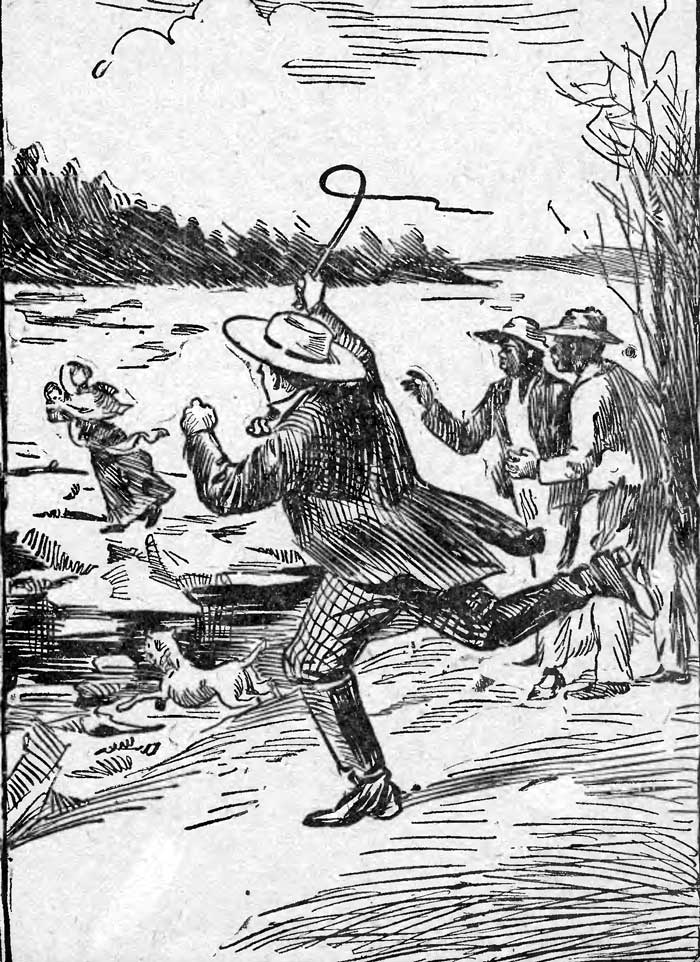

As a matter of course the border States lose the most. Maryland lost 1 in 320 of the whole number of her slaves; Missouri, 1 in 1,450; Kentucky, 1 in 2,100; Georgia, 1 in 2,700, and Louisiana, 1 in 4,000. Since the date of these statistics the number of fugitives has probably increased, -- perhaps 50 per cent. -- which gives about 1,500 as the number annually lost to the South from this cause.

Any bill providing for compensation should be so framed as not to invite any relaxation of Southern vigilance to prevent escapes. We hope that the proposed amendments of Mr. DOUGLAS may consult the welfare of the whole country, rather than the resentments of any party or section, on this subject. (source: The New York Times; Copyright 2013 The New York Times Company)

The Capture of Fugitive Slave, Anthony Burns


From the PBS series Africans in America, "Anthony Burns captured: 1854" -- As a slave owned by Charles Suttle of Alexandria, Virginia, Anthony Burns had many privileges. He was allowed to hire himself out. He supervised the hiring out of four other slaves owned by Suttle. He had the freedom to take on additional jobs, as long as he paid his master a fee. He joined a church, where he became a preacher. He learned to read and write. Still, Anthony Burns was not content. At an early age he had learned that "there [was] a Christ who came to make us free" and felt "the necessity for freedom of soul and body." In 1854, he took steps to find freedom. While working in Richmond, Burns boarded a ship heading north, to the city of Boston.

Burns arrived in Boston in March -- a fugitive, but free. This new-found freedom, however, would be short-lived. Soon after his arrival he sent a letter to his brother, who was also a slave of Charles Suttle. Even though the letter was sent by way of Canada, it found its way into the hands of their master.


A few years earlier, Suttle could have expected little help from a northern state in recovering a fugitive slave. Nine states had personal liberty laws declaring that they would not cooperate with the federal government in the recapturing of slaves. But with the recent passing of the Fugitive Slave Act, a component of the Compromise of 1850, the law was on Suttle's side.

Suttle travelled to Boston to claim his "property," and on May 24, under the pretext of being charged for robbery, Burns was arrested. Boston abolitionists, vehemently opposed to the Slave Act, rallied to aid Burns, who was being held on the third floor of the federal courthouse. Two separate groups met at the same time to discuss Burn's recapture: a large group, consisting mainly of white abolitionists, met at Fanueil Hall; a smaller group, mostly blacks, met in the basement of the Tremont Temple.


The meeting at the Tremont Temple was quickly over. Those present decided to march to the courthouse and release Burns, using force if necessary. The meeting at Fanueil Hall lasted much longer. The group there debated the course of action. When the intentions of the Tremont Temple gathering were announced, however, the meeting abruptly ended. About two hundred citizens left Fanueil Hall and headed to the courthouse.

The crowd outside the courthouse quickly grew from several hundred to about two thousand. A small group of blacks, led by white minister Thomas Wentworth Higginson, charged the building with a beam they used as a battering ram. They succeeded in creating a small opening, but only for a moment. A shot was fired. A deputy shouted out that he had been stabbed, then died several minutes later. Higginson and a black man gained entry, but were beaten back outside by six to eight deputies.


Boston inhabitants had successfully aided re-captured slaves in the past. In 1851, a group of black men snatched a fugitive slave from a courtroom and sent her to Canada. Anthony Burns would not share the same fate. Determined to see the Fugitive Slave Act enforced, President Franklin Pierce ordered marines and artillery to assist the guards watching over Burns. Pierce also ordered a federal ship to return Burns to Virginia after the trial.

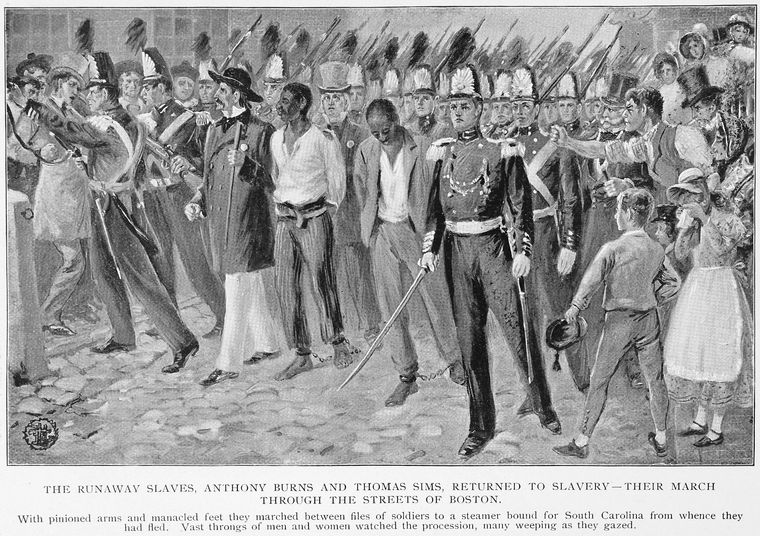
Burns was convicted of being a fugitive slave on June 2, 1854. That same day, an estimated 50,000 lined the streets of Boston, watching Anthony Burns walk in shackles toward the waterfront and the waiting ship.

A black church soon raised $1300 to purchase Burns' freedom. In less than a year Anthony Burns was back in Boston.  (source:  the PBS series Africans in America)


Watch Failed Protests on PBS. See more from American Experience.

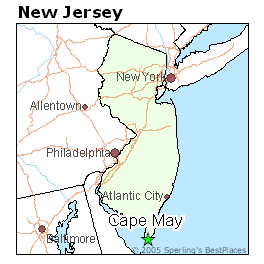
Slavery in Cape May, New Jersey


As reported in the Cape May Gazette, "Bizarre History of Cape May > Slavery in Cape May County lasted 146 years," by Jacob Schaad Jr., on 5 June 2023 -- The first reported slaves were brought to the area now known as Cape May and Lower Township in 1688. The last slave was said to have been freed in 1834.

During those 146 years, the territory to become Cape May County was to tell its own story of slavery, some of it more moderate than the South, but all of it negative in its final summary.

The man who started it never lived here, and never even set foot on the soil, but still was a powerful influence in the early development of the cape.


Dr. Daniel Coxe was an English court physician who wanted to establish a “New Empire in America.” From his distant shore he hired an agent who bought 95,000 acres of Cape May peninsula land for him, some from the Lenape people who were paid, among other items, 16 gallons of rum, a hot item in those days of merchandising.

“I pity them greatly,” said one semi-sympathizer of the slaves, “but I must be mum. For how could we do without sugar and rum?”

Coxe’s idea for a “New Empire in America” apparently included slaves or, as he put it in 1688, “four stout Negroes.” Two of them were married in Cape May County and their contract stipulated that if they had any children they must serve until they reached the age of 31 or whenever the law said.


By the middle of the 18th century slavery was on the rise in Cape May County. More than 50 slaves, most of them African-Americans and a few Native Americans, were said to be on the plantations of the county’s property owners. Jacob Spicer Jr., who owned vast real estate here, mentioned a “Red Negroe” in his will, and Abigail Hand, whose surname was to live long in Cape May history, suggested that her family included “Indian and black folk.”

The slaves were bought in Philadelphia where people bought furniture, clothing and books.

“I set out from home to go to Philadelphia to buy a Negro or two,” said Aaron Leaming Jr., a prominent member of the original whaling families who came to this area from Connecticut and Long Island in hopes of finding prosperity.


In the mid-1700s the whalers owned 91 percent of the slaves on the cape, and they willed their slaves to other members of their families. In some cases, what amounted to human chattels were treated kindlier than those in the deeper southland. They were allowed to live with the families and sometimes sleep in the master’s kitchen near the fireplace.

It was not always the safest place to be, however. In one case, it was reported, a heavy wind blew down the chimney and killed the sleeping son of a slave.

There were some slave owners, like Aaron Leaming Jr., who gave their slaves more freedom than the traditional masters. He allowed them to travel around the county on their own, to go fishing and to visit others. He was also said to take care of the ill as if they were members of his own family.


Nevertheless, they were still slaves, inventoried much like horses and cows and other animals, and it was to get worse after the Revolutionary War when Cape May County was to experience the biggest growth in slave owning in its history.

Official tax records show that in the Lower Precinct, which encompassed Cape May and Lower Township, the slave population increased from six to 33 between 1774 and 1784. In the Middle Precinct the numbers jumped from 18 to 63 during the same period. Some whaler families who owned no slaves before the war were affluent enough to buy some for their properties, which were called plantations.

As prevalent as slavery was, there was some movement to curtail or abolish slavery. The Quakers had taken action to forbid the immigration of slaves into other areas of New Jersey, but were not successful in Cape May County where the whalers were still bringing them. There is some historical conjecture that some of the owners did not formally declare all their slaves so they would not have to pay taxes on them.

There was actually a court case in 1768 in which a slave was freed. His name was Jethro and his mother was Charity Briggs, a mulatto who was free. Jethro was bound over to a series of masters but eventually was declared a free man on a motion by the attorney general.


By the time the 19th century arrived, the county was beginning to take a different look at slavery. In 1802 the manumission of slaves began here when slave owner John Stites freed Nancy Coachman in Lower Township. The New Jersey legislature had paved the way in 1786 when it banned the further importation of slaves into the state.

It took another 18 years before the legislature allowed children born of slaves after 1804 to be declared free when women turned 21 and men turned 25.

Slavery was tardily and formally abolished in New Jersey in 1846, although most slave owners in Cape May County had freed their human chattels before that. Some of the freed slaves and perhaps a few runaways settled in remote areas of the county, which still had to be developed. One of the first African-American communities to be developed was in the section of Lower Township that is now known as Erma.

Most of the freed went to work as farm laborers or domestics, some at the hotels that were springing up the still-named Cape Island. More progress was yet to come. In 1850, more than a decade before the Civil War that was to change it all, three African-American families paid taxes on properties they owned. Another turned farmer. Some of the slaves opted to stay with their former masters in their new lives as a free people.

It was an era too when the name of Harriet Tubman was to gain prominence in the local history of slavery. She was an escaped slave from Maryland, worked at the Congress Hall and was active in the Underground Railroad which helped more than 300 slaves to their freedom.

So it was that before a war that tore the nation apart, the people of the southernmost territory in New Jersey were part of the issue that ignited the Civil War. Slavery was here too, not as volatile as that in the South, but that doesn’t make it less excusable.  [source: The Cape May Gazette.  (Some of the information in this article was researched in the books, “Cape May County, New Jersey, The Making Of A American Resort Community,” by Jeffery M. Dorwart and “Cape May County, New Jersey, 1638-1897,” by Lewis Townsend Stevens.)]

Tuesday, June 11, 2013

Free At Last in New Hampshire


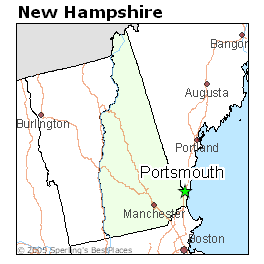
As reported in the USA Today, "N.H. posthumously frees 14 Revolutionary War slaves," on 7 June  2013 -- PORTSMOUTH, N.H. (AP) — New Hampshire has posthumously emancipated 14 slaves who fought in the Revolutionary War and asked state lawmakers for their freedom more than 230 years ago.

A group of 20 slaves submitted a petition to the New Hampshire General Assembly on Nov. 12, 1779, while the war was still being fought. They argued that the freedom being sought by colonists should be extended to them, as well, and maintained that "public tyranny and slavery are alike detestable to minds conscious of the equal dignity of human nature."

Slaves were brought to the colony from Africa by 1645. They were concentrated around the Portsmouth area. Because New Hampshire did not impose a tariff on slave, it became a base for slave importation into America. These slaves were then smuggled into other colonies. (source: http://ejhly1.wix.com/colonial-new-hampshire?_escaped_fragment_=__slavery)

Gov. Maggie Hassan signed a bill Friday emancipating the 14 slaves, who were never freed before they died.

"Their plea fell on deaf ears," she said at a ceremony. "It is a source of deep shame that our predecessors didn't honor this request. But today, more than 230 years too late for their petition, we say that freedom truly is an inherent right not to be surrendered."

The original petition was found in state archives nearly 30 years ago, but supporters pushed lawmakers to pass the bill this year in part to bring attention to an African-American burial ground in downtown Portsmouth, where the city is raising money to build a memorial park to commemorate the site. The remains of six African slaves were discovered at the site several years ago during routine street improvements.

Excerpts from the 1779 petition will be etched in stone and be part of the park.

Valerie Cunningham, who wrote a history of slavery in Portsmouth, noted that the petitioners weren't asking for money, nor were they just asking for their own freedom; they were asking the state to abolish slavery altogether.

"Let's celebrate today with the expectation that this symbolic act will remind us to continue working for social justice here in the Granite State," she said.


Testifying at a public hearing on the bill this year, Woullard Lett, a member of the Manchester NAACP, said it's never too late to right a wrong.

"It's symbolic and 200 years late; however, then and now, it's the right thing to do," he said.

Copyright 2013 The Associated Press. All rights reserved. This material may not be published, broadcast, rewritten or redistributed.  (source: USA Today)

Yankee Slavery in the North


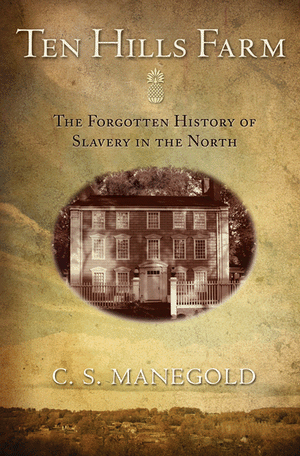
From the Boston Globe, "New England’s scarlet ‘S’ for slavery," by C. S. Manegold, on 18 January 2010 -- ALMOST HALF a century ago, Martin Luther King Jr. captured a problem that still plagues us today. Cautioning his flock against the complacent embrace of incomplete knowledge, he warned: “Nothing in all the world is more dangerous than sincere ignorance and conscientious stupidity.’’

I have thought of those words often in the last few years as I worked to unearth the history of a century and a half of slavery on a Massachusetts farm first owned by the famous Puritan, Governor John Winthrop, whose “Model of Christian Charity’’ is often quoted even now.


In the several times I have presented these unpleasant truths in talks at major universities, I have inquired afterwards - who knew this history of slavery in the North? Usually only about three hands go up of 30. And most of these people are professors. Among non-professors the void is even deeper. Students, stumbling on this news, tend to ask with some aggression: “Why didn’t they teach us this?’’ Why didn’t I know?

I am older, and I grew up in a different time, but I said these words myself not long ago. Now that I know better, I realize there are many answers to the question. But the best perhaps are these: Easier not to. More comfortable not to.

Yet as King suggested, responsible dialogue can not move forward with half-truths and willful ignorance. In this regard, the North has work to do. It lags behind the South in stepping up to ugly truths.

Let me share a simple primer: The first men, women and children to be enslaved by whites in New England were Native American prisoners of war doled out as favors to other tribes who had allied themselves with the settlers’ cause, or to white soldiers who fought with some distinction in those wars. “There is a little Squa that Steward Calacot desireth,’’ wrote one hopeful recipient to Winthrop. “Lieutenant Damport also desireth one, to witt, a tall one with three strokes upon her stomach. . ..’’

Among these enslaved Indians, some were shipped off to the Caribbean where they were traded for “cotton, and tobacco and Negroes,’’ as Winthrop noted in his famous journal. The year was 1638. On October 3, 1639, the Massachusetts Court of Assistants ruled “the Governor had leave to keep a Narragansett Indian and his wife.’’ Other Northern settlers had already chosen blacks; and those first African slaves to reach New England were followed by a constant and accelerating flow. The pattern would repeat until black slavery in the North became a common fact of life transcending social class.


Nor was this slavery somehow “soft.’’ One of the first published accounts of life in New England tells of a man who lived near what today is Logan Airport. That man, Samuel Maverick, ordered one slave to rape another, that he might have a “breed of Negroes.’’ Other tragic stories abound. Many more are lost forever.

Slavery, though, was legal. Winthrop, the author of the notion of America as a “city upon a hill,’’ helped to make it so. Three years after the first shipment of enslaved Africans arrived on Massachusetts soil, he helped to write the first law in North America officially sanctioning the practice. The Massachusetts Body of Liberties in 1641 decreed there “shall never be any bond slavery’’ (good enough so far. . .) “unless it be lawful captives taken in just wars, and such strangers as willingly sell themselves or are sold to us.’’ [italics added]

Who could this formulation possibly leave out?


Follow the money. Find the families. Together they will tell the story. In the case of slavery in the North, they tell a story of enslavement stretching in a single weave from Massachusetts, Rhode Island, Connecticut. . . to Barbados, Antigua, Surinam. . . to Africa. Today there is a Winthorp (sic) Bay in Antigua near the international airport. It is named for Winthrop’s son Samuel, who served as lieutenant governor and presided over a large plantation worked by slaves. Samuel’s brother, John Jr., the governor of Connecticut, owned black slaves on many properties, as did his siblings, heirs, and friends. On and on it went.

On the same land Governor Winthrop first had farmed, other families would come. They were slave-owners, too, every one. Slavery did not end in Massachusetts until after the American Revolution when a series of “freedom suits’’ taken to the courts by slaves and free blacks impelled the legislators to live up to their grand rhetoric of freedom.


The end was neither swift nor definitive. Not a single newspaper article from the time made note of the end of a century and a half of bondage. Instead, the high court finally ruled, and then there were debates over semantics until, farm by farm, owner by owner, the practice sputtered, and then failed. But not before some of those enslaved had been sold back to the Caribbean so an owner could avoid a difficult financial loss.

Only Vermont explicitly outlawed slavery in its constitution in 1793. Article One: “Slavery prohibited.’’ That was the exception, not the rule.


Then we forgot.

But the forgetting took time. Remnants of the truth remained in 1915 when, on what was left of Winthrop’s “Ten Hills Farm,’’ a three-day pageant celebrated America’s early history. Among the players were John Winthrop, George Washington, the slave Belinda, and a slave named George who killed himself rather than be sold. Newspapers crowed about the refreshing inclusivity of the event. But those accounts referred only to impoverished Irish and Italian immigrants who had followed the trolley tracks to move outside of Boston. George and Belinda were white folk dressed in blackface. The larger slave population (which counted at least 27 on that farm in the 1700s) sat huddled on a bench. Photographs still show them there - white boys from the Medford High School Glee Club, their faces rubbed with coal.

Perhaps in 1915 the memory was still too fresh to fade. Twenty-three years later, the same was true. That year, the WPA artist Henry Billings dipped his brush to paint an enormous mural for the Medford Post Office. His “Golden Triangle of Trade’’ shows a white sailor leaning up against a post. That man is watching another, a black man, working, cane upon his shoulder, manacles lying open in the tropical sand. The triangle above them - topped by a huge American eagle - sweeps from Africa, across the Caribbean, and then straight to Boston Harbor. That history was still perhaps too fresh to kill.


The North has surely done a good job since.

Think of the South, and slavery immediately comes to mind. Think of the North, and there march in the heroes and the Patriots, the stern-faced abolitionists, poets and philosophers. In time, the vanishing was almost total. Visitors who go to 105 Brattle Street in Cambridge today usually go there to visit Henry Wadsworth Longfellow’s old house without realizing the slave past (Cuba, Tony, Darby. . .) that stretched way back inside those walls.

Did Barack Obama know, when he studied law at Harvard, that the basement apartment he rented in Somerville lay on ground that hosted slavery for 150 years? Did his dean welcome students with the information that the Law School was created out of money made partly from the work of and trade in men who never saw a day of freedom?


This void in general knowledge persists five years after the powerful exhibit in 2005 by the New York Historical Society, “Slavery in New York.’’ It persists as scholars strain and labor to uncover deeper aspects of this past. It persists though this is 150 years lost, not 10. And it persists despite the fact that statistics from the period of the American Revolution tell an abbreviated story of at least 10,000 souls enslaved across the North, not a handful of domestic “servants’’ afforded gentle treatment.

“We have memorized America,’’ the poet Miller Williams wrote.

He was eloquent. But he was wrong.


The national dialogue has stalled on easy binaries: North/South. Abolitionists/slave owners. Blue states/red states. You know the drill. Miller Williams asks us to look forward to be true to values we have always held. It’s a lovely thought. But honestly, it would be better to heed King’s warning, and look backward at a past imperfectly remembered.

Then, just maybe, we can talk. (source: The Boston Globe,© Copyright 2010 Globe Newspaper Company.)

Klansville U.S.A

“Klansville U.S.A: The Rise and Fall of the Civil Rights-Era Ku Klux Klan” by David Cunningham

From the  Washington Post“'Klansville U.S.A: The Rise and Fall of the Civil Rights-Era Ku Klux Klan' by David Cunningham," reviewed by Jonathan Yardley, on 2 November 2012  --  A personal note may be in order here. In the summer of 1964, after three years of journalistic apprenticeship in Washington and New York, I returned to North Carolina, where I had spent four years of college, and joined the editorial staff of the Greensboro Daily News (now the Greensboro News-Record) as an editorial writer. It was a time of intense and often emotional activity on the civil rights front, and, as the city where the sit-in movement had begun three years earlier, Greensboro was right in the middle of it. The Daily News, like all the other major papers in the state’s medium-size cities, was moderate by inclination though rather more conservative on the subject of civil rights than I. Still, I wrote about civil rights and related matters throughout the decade I was there and was pretty much given a free hand.

By coincidence, my arrival in Greensboro coincided almost exactly with the quite startling revival of the Ku Klux Klan in North Carolina. “By the summer of 1964,” David Cunningham writes in “Klansville, U.S.A.,” “the Carolina Klan established a demanding schedule of nightly rallies across the state, where they enlisted thousands of dues-paying members.” More than that, “at its mid-1960s peak the [Klan’s] presence in North Carolina eclipsed klan membership in all other southern states combined.” (Cunningham puts “klan” in lowercase because it was a diverse organization, or disorganization, with many offshoots, some of them mutually incompatible.) For obvious reasons Cunningham’s book is of great interest to me, albeit a great disappointment, about which more later.


That North Carolina should have been the state where the KKK thrived most during the mid-1960s — Cunningham reports that in mid-1966 it had 192 Klaverns and 52.2 percent of the total Klan membership in the 10 states of the South — was a mystery to many and a source of considerable dismay to the state’s leadership, which prided itself on its nonviolent response to the challenges posed by the civil rights movement. The state had been described by V.O. Key, in his immensely influential (if now somewhat dated) “Southern Politics in State and Nation” (1949), as “energetic and ambitious” with “a reputation for progressive outlook and action in many phases of life, especially industrial development, education, and race relations,” a judgment that had been confirmed by the election in 1960 of a notably capable and progressive governor, Terry Sanford.

But North Carolina has always been a much more complicated (and interesting) place than its publicists have claimed. If Raleigh, Greensboro, Winston-Salem and Charlotte generally shunned confrontation over civil rights and mostly avoided violence, their efforts at amelioration were largely token in nature and did not disturb the fundamental social, economic and political order. The university at Chapel Hill and its cohorts in Raleigh and Greensboro (there was as yet no multi-branched Consolidated University of North Carolina) were nationally known for their academic excellence and open-mindedness, but it was well into the 1980s before any of them became more than tokenly integrated.

15 year-old Dorothy Geraldine Counts was one of the first 3 African American students to attend a previously all white high school in Charlotte, North Carolina. Angry white mobs yelled and taunted her on the way to school.

Most important, east of Raleigh all the way to the Atlantic coast was an area as entrenched in antediluvian racial customs and animosities as any place in the Deep South. “North Carolina’s eastern counties were the [United Klans of America’s] stronghold,” Cunningham writes. “Mark their klaverns on a map, [UKA leader] George Dorsett quipped, and it looked like the area had the measles. A sweeping congressional inquiry found that ninety-five of the UKA’s North Carolina units — nearly 60 percent of the state’s overall total — were located there, though the region housed only a third of the state’s residents.”

Greensboro and its surrounding area had plenty of Klan members, more than a few of whom made their feelings known to editors and writers at the Daily News — at least one of whom, to my recollection, found a fiery cross planted in his front lawn — but the east was the KKK’s most fertile ground.


Why, then, did the KKK thrive in ostensibly “liberal,” or at least “progressive,” North Carolina? In the specific case of Greensboro, Cunningham suggests “the combustible admixture of pride and anger stemming from the city’s status as ground zero for the sit-in movement, and the resulting political conservatism concealed by a veneer of civility.” Precisely why the city’s indisputable conservatism should be ascribed to the sit-in movement is a mystery — Greensboro was conservative long before that — but it is true that beneath the city’s “veneer” of moderation seethed animosities just waiting to find expression. (source; the Washington Post)


Monday, June 10, 2013

The Confederate Jews of Dixie

Touro Synagogue, New Orleans, Louisiana

From the New York Times Book Review, "Look Away, Already: Among those fighting for the Confederacy were 2,000 members of the Jewish community." by Roy Hoffman, on 28 January 2001 -- Comprehensive and readerly, ''The Jewish Confederates'' offers an informative look at what Robert N. Rosen estimates as the 2,000 Jews -- out of a Confederate force of more than a million -- who went into battle on behalf of Dixie. In its locket-sized portraits of hundreds of soldiers, the book valuably reminds us that as some Johnny Rebs lay dying on blood-soaked fields, they might have pictured, in anguished yearning for home, loved ones gathered not around the Christmas goose but the Passover lamb.

The author of two histories of his hometown, Charleston, S.C., Rosen has done yeoman's work in gathering together the stories of scores of Confederate loyalists, not just oft-portrayed public figures like Florida's David Yulee and Louisiana's Judah P. Benjamin but also those who might otherwise be remembered only by their families or in local, synagogue histories.

The Jewish Confederates by Robert N. Rosen

Lt. Joshua Lazarus Moses, for example, a Citadel graduate and one of five brothers to serve the Confederacy, has a poignant story. He was killed in action at Fort Blakely, outside Mobile, Ala., on April 9, 1865 -- the same day Lee surrendered at Appomattox. In 1868 his mother wrote a poem to her ''brave'' son, expressing her pride ''that thus my gallant son should die.'' Benedict Oppenheimer, deaf from childhood scarlet fever, joined up in Tennessee. ''Oppenheimer's great-niece recalled that he used to tell her in sign language or with pencil and paper some of his many experiences,'' Rosen writes. ''He told of how the company always picked him to fire the cannon because he was deaf anyway and it did not hurt his ears.''

Rebel patriots like these, Rosen shows, were the norm, with the South's 25,000 Jews at the time -- especially in cities like Charleston, Savannah, and Richmond with an ''acculturated and assimilated Jewish elite'' -- willing to scrap tooth and nail against Yankee invaders. As Rabbi James Gutheim of New Orleans, at a dedication ceremony for a Montgomery, Ala., synagogue, prayed for his ''beloved country, the Confederate States of America'' in 1862: ''Behold, O God, and judge between us and our enemies, who have forced upon us this unholy and unnatural war -- who hurl against us their poisoned arrows steeped in ambition and revenge.''

Judah Benjamin, the Jewish Confederate Secretary of State, was featured on the Confederate two-dollar bill.

''Modern-day Jews are very uncomfortable with the notion that antebellum Southern Jews owned slaves and that a few were in the business of slave trading,'' Rosen writes. He does not shrink from depicting some Southern Jews as slaveholders, but neither does he explore the ramifications of that fact. Rather than mounting a sustained discussion of Jews and slavery, Rosen plays out his argument piecemeal, at times leaving the reader with contradictory notions. Splitting hairs, he assures us in the preface that ''few Jewish Confederate soldiers owned slaves,'' but he later states: ''In 1840 three-fourths of all heads of families in Charleston owned at least one slave, and the incidence of slaveholding among Jews likely paralleled that of their neighbors. . . . Richmond's rabbis supported slavery.''

Congregation Kahal Kadosh Beth Elohim is a historic synagogue located at 90 Hasell Street in Charleston, South Carolina. The synagogue was founded in the 1740s and is one of the oldest synagogues in the United States.

Rosen also sends incongruous messages as to how Jews were perceived by the Christian South. Early on, he writes, ''The Old South was remarkably free of prejudice against Jews,'' but later he explores how anti-Jewish attitudes flared up as the war unfolded: ''When the Civil War began, many Southerners had never met a Jew.''

However, this is not a book about the home front; it is a book about the battlefield. Sometimes inconsistent as social analysis, ''The Jewish Confederates'' works best as a kind of living diorama. On its revolving picturescape turn the romantic and callow youths, rifles at their sides, Stars of David around their necks, and the, yes, inspiring Confederate battle flag fluttering overhead. (source: The New York Times)

Sunday, June 9, 2013

The Struggle over Equality in Post-Emancipation Washington, D.C

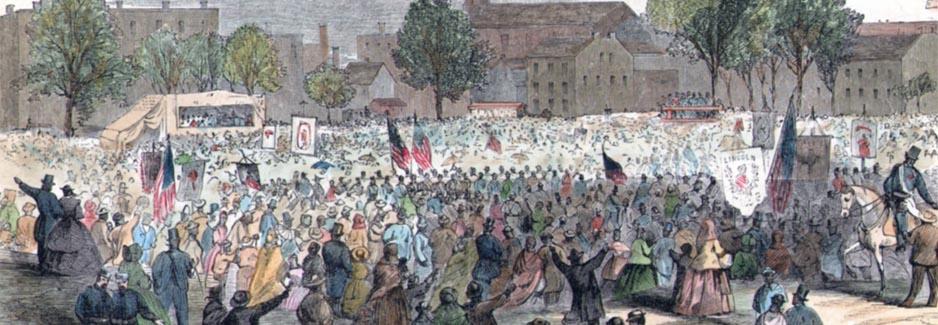
Emancipation Day Celebrations: Sketch of the celebration of the Abolition of Slavery in DC. (Moorland Spingarn Research Center)

From The New York Times, "Capital Injustice," by Kate Mansur, on 28 March 2011 -- On March 29, 1961, the states completed ratification of the 23rd Amendment, which gave residents of the District of Columbia the right to vote in presidential elections. The anniversary is worth remembering, both because the amendment was an important step toward full political equality for citizens of the nation’s capital and because it was frustratingly incomplete.

A half-century later, the District of Columbia’s population, estimated in the new census at 601,723, is larger than Wyoming’s and only slightly smaller than Vermont’s. Yet Washingtonians still have no meaningful voice in Congress and lack full authority over their own affairs.

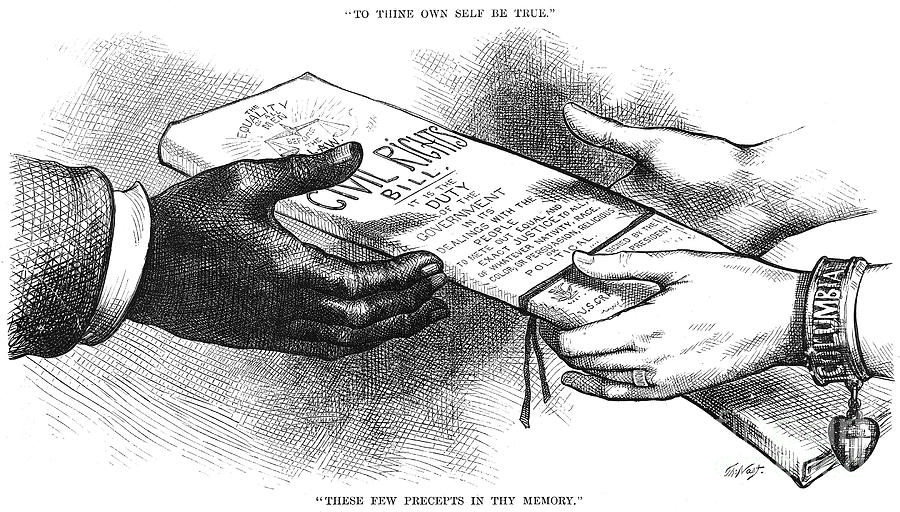
http://images.fineartamerica.com/images-medium-large/1-cartoon-civil-rights-1875-granger.jpg

Washington is an undemocratic anomaly, despite the grand ideals of equal rights carved into the city’s stone monuments. Its second-class citizenship is a legacy of racial injustice and, more recently, partisanship in Congress.

To preserve the capital’s independence from politics in the states, the nation’s founders provided in the Constitution for a federal district over which Congress would “exercise exclusive legislation.” Nonetheless, Congress soon chartered a city government. By 1848, all of the capital’s white male residents were entitled to vote for a mayor and city council.

Democracy continued to expand in the Civil War era. A Republican-led Congress ended slavery in the capital in 1862, and enfranchised black male residents in 1867.

http://www.historypressblog.net/wp-content/uploads/2013/02/New-Washington.jpg

Black men’s suffrage transformed the local government. With white voters split between the parties, black Washingtonians — who made up a third of the population and were almost entirely Republicans — had significant influence in electoral politics. Soon, the city government outlawed or restricted racial discrimination in public accommodations and public works hiring. Black men were elected to local office. Public schools were established for black children.

But as African-American political power increased, so did challenges to home rule from local whites. Long-time conservative Democrats and pro-business Republicans in the district combined to persuade Congress to diminish the power of the newly biracial electorate. The result was a territorial form of government for the capital in which presidential appointees held the most powerful offices. It was only a few steps from there to complete disfranchisement. In 1874, at the behest of conservative businessmen, Congress again reorganized the government, this time placing three presidentially appointed commissioners at its helm. Supporters argued that the change was essential for efficient government; opponents called the end of local self-government un-American.

Washingtonians still had no vote as the capital became the nation’s first majority-black large city in the late 1950s. As national civil rights leaders pressured Congress to eliminate the country’s most glaring breaches of democracy, Washington activists pushed for representation in Congress and the return of home rule.

Five times from 1949 to 1960, the Senate passed home rule bills. Each time, the bills died in the House Committee on the District of Columbia, led imperiously for nearly three decades by John L. McMillan, a segregationist Democrat from South Carolina.

In fact, even the relatively uncontroversial 23rd Amendment could not be ratified in most of the South. The only former Confederate state to ratify was Tennessee. In North Carolina, a segregationist organization called the amendment “another effort to strengthen the National Association for the Advancement of Colored People.”

http://lcweb2.loc.gov/ammem/aap/photo01.jpg

But numerous Republican-led state legislatures in the North readily ratified the amendment, showing that racial politics were far more important than partisanship in influencing ratification.

Today, as the black population edges downward from a majority toward a plurality, the capital’s residents remain at the mercy of Congress. They are represented by a lone House delegate with limited voting rights. Even their hold on home rule, granted at last in 1973, is tenuous. City budgets require approval by Congress, and Republican lawmakers have overruled or threatened local decisions on issues like needle exchange, gun control, same-sex marriage and abortion.

The 23rd Amendment is a reminder that support can be rallied for greater democracy for the district. And yet, in our polarized political climate, the powerful argument for voting representation in Congress seems perpetually stymied.

http://dcentric.wamu.org/files/2011/03/A-Masur.jpg
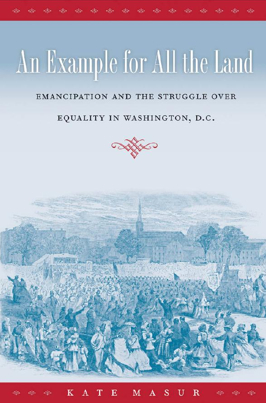
An Example for All the Land: Emancipation and the Struggle over Equality in Washington, D.C., by Kate Masur
One problem is indifference; most Americans are unaware of the capital’s anomalous status, the city’s “Taxation Without Representation” license plates notwithstanding. A second is partisanship; to establish a vote in Congress for Washingtonians, who are overwhelmingly Democrats, Republicans would have to place a moral imperative ahead of partisan interests.

Another is race. A half-century after the dawn of the civil rights era, many Americans still have a hard time seeing African-Americans as citizens entitled to the rights that so many white people take for granted. For residents of a place once known as “Chocolate City,” these attitudes are a sadly familiar obstacle to equality.


US Supreme Court: Inherently Unequal

http://brianbirdwell.net/wp-content/uploads/2012/06/american-flag-gavel-scales-of-justice1-600x198.jpg

From the Los Angeles Times Book Review, "'Inherently Unequal' by Lawrence Goldstone: The well-argued work asserts the U.S. Supreme Court facilitated discrimination after the Civil War, by Steve Oney, on 30 January 2011 -- In the years immediately following the Civil War, America appeared to possess the will and the means to end racial segregation and give the same rights enjoyed by whites to its 4 million recently freed black slaves. These noble goals, of course, were not achieved for another century. During the intervening decades, the South saw the rise of Jim Crow and Judge Lynch. In "Inherently Unequal," constitutional scholar Lawrence Goldstone convincingly lays the blame for this tragedy at the door of the institution that could have made the difference but did not: the United States Supreme Court.

Until the early 1870s, advocates of Radical Reconstruction dominated politics in Washington. At the same time, voters approved the 13th, 14th and 15th amendments to the Constitution, granting the federal judiciary enormous power to effect change. But as President Abraham Lincoln's enlightened Supreme Court appointees left the bench, their replacements began to institute, in Goldstone's words, "the same two-tiered system of justice that had existed in the slave era." President Ulysses S. Grant in particular chose poorly, picking justices who came from corporate practices and had little interest in racial equality. In 1875, one of Grant's selections, Chief Justice Morrison R. Waite, foreshadowed what was ahead. He set aside the conviction in a lower federal court of a white man involved in an 1873 massacre in Louisiana of 100 black militiamen who, after laying down their weapons, were slaughtered by 250 armed whites. Many of those who participated were members of the Ku Klux Klan.

Inherently Unequal by Lawrence Goldstone
Inherently Unequal: The Betrayal of Equal Rights by the Supreme Court, 1865-1903;By Lawrence Goldstone

Such decisions did not occur in a vacuum. For most Americans, Goldstone asserts, the Civil War was fought not to liberate the slaves but to save the union. Just as important, the Republican Party was drifting away from its Lincolnesque roots and into the arms of big business, which was agnostic about the plight of defenseless blacks down South.

Social Darwinism also exerted a baleful influence. As articulated by British philosopher Herbert Spencer, this view maintained that wealth provided not just the means by which the fittest survived but evidence of their very fitness. A corollary held that impoverishment was proof of unfitness. A majority of the prosperous men from whose ranks Supreme Court justices were drawn accepted the theory, and few groups were as impoverished as American blacks.

Little wonder that by the 1880s, the Supreme Court was consistently ruling against black plaintiffs. In a series of cases arising from the beatings of blacks by whites in Southern states, the high tribunal, with Justice Joseph P. Bradley (another Grant appointee) writing the key opinions, found that the victims could not seek redress in Washington. As Bradley saw it, the 14th amendment did not give the court the power to regulate private behavior even if it was discriminatory.

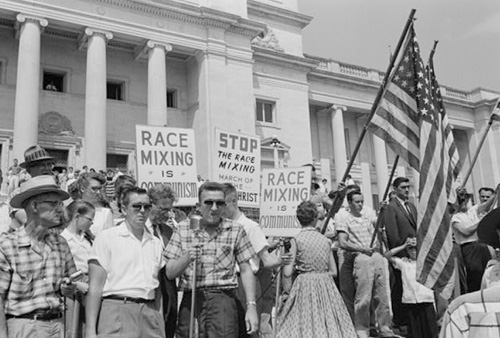
http://historymartinez.files.wordpress.com/2012/07/brown-protests.jpg

Plessy versus Ferguson soon followed. Homer Plessy was a New Orleans black man who, after buying a first-class train ticket, was denied his seat. Goldstone does a splendid job teasing out the nuances of this infamous affair, showing that some railroad companies actually backed Plessy. The men who owned the trains did not want to incur the expense of providing segregated conveyances. Not that it mattered. In 1896, the Supreme Court upheld Louisiana's "Separate Car Law," finding that it did not violate the 13th amendment. The body ruled that "a statute which implies merely a legal distinction between the white and colored races … had no tendency to … reestablish a state of involuntary servitude."

In all of this there was only one hero, Justice John Marshall Harlan, the lone dissenter in Plessy. Proclaimed Harlan: "Our Constitution is color-blind … The law regards man as man, and takes no account of his surroundings or his color."

Goldstone's insistence upon laying out the particulars of almost every civil rights case that reached the Supreme Court in the late 19th century makes "Inherently Unequal" a compellingly thorough work, but it also causes its chief weakness. While judicial back and forth can provide for meaty legal cogitation, it occasionally bogs down the narrative.

http://a.abcnews.go.com/images/US/ap_supreme_court_jt_120928_wg.jpg

This, however, is a quibble. Although other writers — principally Eric Foner and C. Vann Woodward — have done much to illuminate the horrors of the post-Reconstruction era, "Inherently Unequal" sheds new light on the Supreme Court's central role. By the end of the book, readers will see why Goldstone opens it with a chilling account of the 1899 lynching of a black man in Newnan, Ga. Sam Hose was burned at the stake without a trial for killing a white farmer who'd drawn a gun on him and announced his decision to shoot. After Hose was dead, the mob cut out his heart and presented a chunk to Georgia's governor. 

An act of such barbarity defies easy explanation, but Goldstone leaves little doubt that it was tacitly sanctioned by the indifferent rulings of the nation's highest court. He gives the legendary black muckraker Ida B. Wells what amounts to the last word: "During six weeks of the months of March and April just passed [1899], twelve colored men were lynched in Georgia.... The real purpose of these savage demonstrations is to teach the Negro that he has no rights that the law will enforce." (source: LA Times, Copyright 2013 Los Angeles Times)

Watch Lawrence Goldstone on PBS. See more from Tavis Smiley.

Thursday, June 6, 2013

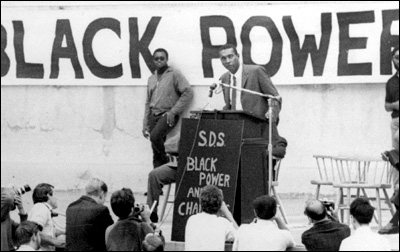
Stokely Carmichael and Charles Hamilton, from Black Power (1967)


Stokely Carmichael and Charles Hamilton, from Black Power (1967)

The advocates of Black Power reject the old slogans and meaningless rhetoric of previous years in the civil rights struggle. The language of yesterday is indeed irrelevant: progress, non-violence, integration, fear of "white backlash," coalition. . . .

One of the tragedies of the struggle against racism is that up to this point there has been no national organization which could speak to the growing militancy of young black people in the urban ghettos and the black-belt South. There has been only a "civil rights" movement, whose tone of voice was adapted to an audience of middle-class whites. It served as a sort of buffer zone between that audience and angry young blacks. It claimed to speak for the needs of a community, but it did not speak in the tone of that community. None of its so-called leaders could go into a rioting community and be listened to. In a sense, the blame must be shared-along with the mass media-by those leaders for what happened in Watts, Harlem, Chicago, Cleveland, and other places. Each time the black people in those cities saw Dr. Martin Luther King get slapped they became angry. When they saw little black girls bombed to death in a church and civil rights workers ambushed and murdered, they were angrier; and when nothing happened, they were steaming mad. We had nothing to offer that they could see, except to go out and be beaten again. We helped to build their frustration.


We had only the old language of love and suffering. And in most places-that is, from the liberals and middle class-we got back the old language of patience and progress. . . .

Such language, along with admonitions to remain non-violent and fear the white backlash, convinced some that that course was the only course to follow. It misled some into believing that a black minority could bow its head and get whipped into a meaningful position of power. The very notion is absurd. . . .

There are many who still sincerely believe in that approach. From our viewpoint, rampaging white mobs and white night-riders must be made to understand that their days of free head-whipping are over. Black people should and must fight back. Nothing more quickly repels someone bent on destroying you than the unequivocal message: "O.K., fool, make your move, and run the same risk I run-of dying."

Next we deal with the term "integration." According to its advocates, social justice will be accomplished by "integrating the Negro into the mainstream institutions of the society from which he has been traditionally excluded." This concept is based on the assumption that there is nothing of value in the black community and that little of value could be created among black people. The thing to do is to siphon off the "acceptable" black people into the surrounding middle-class white community.

The goals of integrationists are middle-class goals, articulated primarily by a small group of Negroes with middle-class aspirations or status. . . .


Secondly, while color blindness may be a sound goal ultimately, we must realize that race is an overwhelming fact of life in this historical period. There is no black man in the country who can live "simply as a man." His blackness is an ever-present fact of this racist society, whether he recognizes it or not. It is unlikely that this or the next generation will witness the time when race will no longer be relevant in the conduct of public affairs and in public policy decision-making. . . .

"Integration" as a goal today speaks to the problem of blackness not only in an unrealistic way but also in a despicable way. It is based on complete acceptance of the fact that in order to have a decent house or education, black people must move into a white neighborhood or send their children to a white school. This reinforces, among both black and white, the idea that "white" is automatically superior and "black" is by definition inferior. For this reason, "integration" is a subterfuge for the maintenance of white supremacy.  [source: http://voyager.dvc.edu/~mpowell/afam/black_power.htm  From Stokely Carmichael and Charles Hamilton, Black Power (New York: Vintage, 1967).]


HOME

HOME
Click here to return to the US Slave Home Page