From the New York Times, "Human Cargo: A study of the little-known slave trade in the Islamic world," by Adam Hochschild, on 4 March 2001 -- Early on in ''Islam's Black Slaves,'' his history of slavery in the Muslim world, Ronald Segal cites some estimates. One scholar puts the rough total at 11.5 million slaves during more than a dozen centuries, and another at 14 million. We will never know the precise number, of course, but it is striking that these two figures neatly bracket many scholars' estimates for the much-better-documented Atlantic slave trade. So why in the West today do we generally pay so little attention to Islamic slavery? One reason, suggests Segal, a South African-born editor and the author of ''The Black Diaspora,'' is that in the Muslim world slavery never became the publicly fought moral and political issue that it did in the United States and Europe.
Islamic slavery began long before the Atlantic slave trade, and its purposes were largely different. Although some slaves were put to work in the fields, they were more valued as items of conspicuous consumption. The Muslim elite wanted them as guards and soldiers, as concubines, as cooks, as musicians and simply to show how rich they were: a 10th-century caliph of Baghdad had 11,000 slaves at his palace.
The boundary between slavery and freedom, or at least between slavery and power, was much more fluid than in the West. The Ottoman sultan commonly married off his daughters and sisters to slaves, and in this and many other Islamic regimes, slaves or former slaves reached astonishingly high positions. Baybars, a former Turkish slave, led an army that defeated a Mongol invasion of Egypt in 1260; there were other slave generals as well. An Ethiopian slave became vizier to the sultan of Delhi and later governor of a province. A caliph who ruled in Egypt for most of the 11th century was the son of a black slave concubine. A Slavic slave -- not all slaves were Africans -- was governor of Valencia in Islamic Spain.
ISLAM'S BLACK SLAVES: The Other Black Diaspora, By Ronald Segal.
All this will seem strange to many American eyes. Apparently the reason monarchs made so many slaves high officials was that they were dependably loyal -- more so than members of rival clans or leaders with local constituencies. But how can you be loyal to someone who has deprived you of your freedom? This is a mystery Segal does not explore.
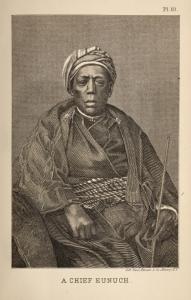
Indeed, freedom was not the only thing slaves lost. Many of the males were eunuchs. A still larger number, in the long centuries before modern surgery, did not survive the slash of the knife. Eunuchs' jobs included, among other things, guarding harems. But much more mystifying is the honor accorded to senior eunuchs. Many were among those governors and generals, and under the Ottomans, one black eunuch was chief administrator of Mecca and Medina. In the late 19th century, an observer noticed that ''when any eunuch . . . enters one of the tramcars in Stamboul, all the Turks who may happen to be in the vehicle immediately rise, salaam profoundly and remain standing till the great man has chosen a seat.'' Did the fact that the ''great man's'' owner was the sultan outweigh his status as a slave? Or did his being a eunuch contribute to his status, as celibacy, in a way, does to the status of a Roman Catholic priest? Segal again leaves us in the dark here.
The last two chapters of the book bring the story up to the present, and appropriately so. One is about how slavery continues in some Islamic countries today, especially Sudan and Mauritania. In the case of Mauritania, some of the fault lies with its former colonizers, the French: Segal points out how they reached a quiet accommodation with slaveholders, rather than risk rebellions from the local power structure. His final chapter looks at the rise of the Nation of Islam in the United States, some of whose members might be disillusioned if they read this book. Their attraction to Islam is easy enough to understand: it seemed an alternative to Christianity, under whose auspices Atlantic slavery and then segregation flourished. But the-enemy-of-my-enemy-is-my-friend is no better a principle in religion than in politics.
A Chief Eunuch to the Sultan
In the end, neither Christianity nor Islam is that different from most other major religions, which usually remain major because they sanctify whatever is the social structure of the day. And for centuries that structure was one of slavery. As Seymour Drescher, one of the finest historians of abolition, puts it, just 200 years ago ''personal bondage was the prevailing form of labor in most of the world. . . . Freedom, not slavery, was the peculiar institution.'' Servitude stretched from serfdom in Russia to the sugar plantations of the Caribbean to the indigenous slave systems in Africa that supplied both the Arabian and Atlantic trades. The surprise is less that major religions justified these horrors than that, after historically so short a time, they officially do so no longer.
Segal deserves great credit for putting the history of Islamic slavery on the record in a carefully documented way. Sadly, the significance of the story is not matched by the skill of the telling. ''Islam's Black Slaves'' reads like a string of encyclopedia entries. Names of caliphs, emirs, sultans and slaves flow by in a relentless torrent. None emerge as memorable characters. There is an equally confusing blizzard of place names; Segal mentions the Fezzan several times, for example, before saying it is in southern Libya. We reach Page 133 before encountering a full-fledged eyewitness description that brings a scene alive -- a British officer's vivid picture of an 1819 slave caravan making the long, perilous trek across the Sahara. Segal quotes only a few such accounts, which is surprising because 19th-century Europeans wrote dozens of them. Explorers justified Europe's great colonial land grab in Africa by a flood of indignant firsthand exposés of the slave trade to the Arab world.
A Chief Eunuch, 1875
Segal never bothers with even the most basic storytelling devices, like following a typical African from capture to transport across the desert to sale as a slave. And finally, he quotes barely a word from any of these millions of Islamic slaves. This seems puzzling, because it appears that they were more likely to be literate than their counterparts in the Americas. Did not a single one of all these slave governors, viziers and generals write his memoirs, send a personal letter or talk to a biographer? If not, that in itself calls for explanation. Otherwise it leaves too big a silence at the heart of such an important story. (source: New York Times)
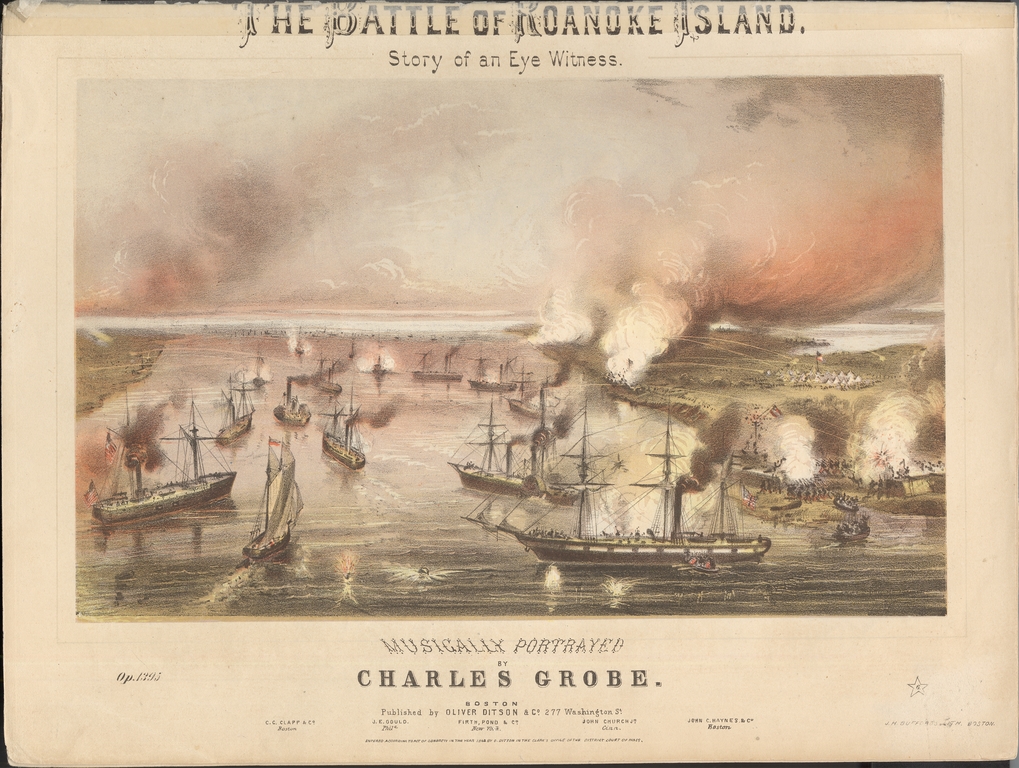
As reported in the New York Times' Disunion section, on 7 February 7, 2012, in an article entitled, "Lost, Again," by Gregory P. Downs -- On Feb. 7, 1862, United States soldiers poured from surf boats onto Roanoke Island off of North Carolina’s eastern shore. Almost three hundred years earlier, Sir Walter Raleigh had dispatched colonists to that same island to establish a famously ill-fated settlement. With the Civil War, Roanoke would once again be home to a lost colony.
For months the Union Navy had been carving its way down the coast, taking control of islands off North Carolina, South Carolina and Georgia. Those victories slowed but did not stop the Confederate’s access to supplies. In the vast Outer Banks of North Carolina, small boats could slip past the barrier islands and dart across the shallow sound behind them, bringing goods to Carolina towns like Newbern, Edenton and Elizabeth City, and, through backdoor canals, to Norfolk, Va. Roanoke, spanning about 10 miles in the center of the sound, controlled the inner waterways, the flow of Confederate supplies and, therefore, the river towns themselves.
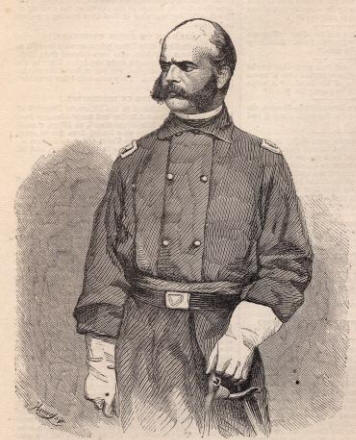
Both the United States and the Confederacy understood the island’s importance. Under Henry G. Wise, a former Virginia governor, the Confederates had gathered about 3,000 troops there, sank ships nearby as barricades and girded themselves for attack. The United States’ combined operations, led by Gen. Ambrose Burnside, commandeered ferry boats to carry a specially selected 13,000-man expeditionary force from Annapolis, Md. in early January. Beset by storms, seasickness and a perilous crossing through shallow channels, the fleet did not reach Roanoke Island until Feb. 6, nearly a month later.
Despite the United States’ overwhelming numerical superiority, the island could not be easily captured. Its eastern side was too shallow to approach, the western too well-guarded by Confederate batteries. A runaway slave, a teenager named Tom, provided United States officers with a plan. South of the Confederate forts, he told them, was a farm with a protected harbor. They could land there with relative ease, then make their way up the island.
General Burnside
Covered by an intense bombardment of the Confederate forts, more than 10,000 soldiers landed on the beach on Feb. 7. During a “wearisome and disagreeable” night, the soldiers camped and pondered the next day’s battle.
The next morning, Union soldiers marched into a thicket of trouble. About a thousand Confederate soldiers manned a battery of three guns “completely covering and commanding the road,” one officer recalled. To either side lay seemingly impenetrable swamps. The solution arrived in the form of a different type of combined assault, as soldiers once again took to water to tramp through the morass on either side. A soldier described it as an “hour of almost superhuman effort, cutting bushes with our swords, and wading to our middle in bogs and water.” When they emerged, the pinned Confederates surrendered the island and nearly 2,500 prisoners of war. Only 60 soldiers died in the fighting, 37 from the United States, 23 from the Confederacy. Confident in their victory, Union soldiers tramped around the ruins of Sir Walter Raleigh’s old fort, pondering the famous Lost Colony; so many took souvenirs that the Army had to post guards to protect it.
The Burnside expedition landing on the southern end of Roanoke Island. Library of Congress
With the capture of the island, the United States controlled much of the coast. Along with the United States’ victory the following week at Fort Donelson, Tenn., Roanoke helped revive Northern morale. Soon a series of Carolina cities fell, most notably New Bern, and expeditionary forces up the Carolina rivers cut railroad crossings and, by year’s end, began drawing slaves from plantations for service in the Union Army.
The victory at Roanoke also shook up the Confederate government. Under sharp criticism for not better supplying the island’s defenders, Confederate Secretary of War Judah Benjamin resigned. Blaming limited supplies, not Benjamin’s actions, for the defeat, Confederate President Jefferson Davis soon appointed Benjamin secretary of state.
But the victories along the coast did not deliver the outcome the United States hoped for. Politicians were confident that success there would inspire an uprising among patriotic white Southerners. Instead, however, the myth of white Southern loyalism faded into mist, at least along the Carolina coast. Most white residents took oaths and went about their fishing, neither fighting the nation nor aiding it.
Instead, as Patricia Click demonstrates in her book “Time Full of Trial: The Roanoke Island Freedmen’s Colony, 1862-1867,” the island soon became home to a new sort of patriot and a new type of colony: an enormous settlement of freedpeople. At first, the island’s slave population actually decreased, as many of the 200 slaves on the island chose to return to their families across the sound. But even as Burnside promised white residents of the island that he would not “destroy your freedom, demolish your property, liberate your slaves” or “injure your women,” the Union began to take in runaway slaves from Confederate-controlled areas and settle them there. A “party of fifteen or twenty of these loyal blacks, men, women and children, arrived on a ‘Dingy,’ ” one officer said later. Slaves arrived from the mainland in larger and larger numbers, 100 within the first month, and 250 by early April, spurred by rumors that they would soon be free.
The “calm trustful faith with which these poor people came over from the enemy, to our shores; the unbounded joy which they manifested when they found themselves within our lines, and Free; made an impression on” Vincent Colyer, soon to be their superintendent and later a notable painter of the American West. Many officers “gathered around the tent to hear them sing the hymn, ‘The precious Lamb, Christ Jesus, was crucified for me.’ ”
Over the next several years, the Union transformed Roanoke Island into a large “colony” for former slaves. By “giving them land, and implements,” said one of the white administrators, Union officials at the Roanoke colony hoped to lay “the foundations of new empire,” the basis for a “NEW SOCIAL ORDER IN THE SOUTH.” After marking out wide avenues in an “African village,” Horace James, the freedmen’s commissioner, apportioned acre plots to families for their own farming. With the help of Northern missionaries, freedpeople established schools to teach reading, writing, and sewing. “Light has been flashed for the first time into hundreds of benighted minds, with an effect as electric, as inspiring, as beautiful, as when the Divine Spirit moved upon the formless void, and said, ‘Let there be light,’ and there was light,” James wrote. In an appeal for Northern support, James asked, “Let us fight with our right hand, and civilize with our left.”
The colony faced enormous challenges. Unlike the Sea Islands off Georgia, Roanoke was not lush farmland. While one missionary called it “the Eden of North Carolina,” a Northern reporter described it as “a miserable place, being nothing but an inner sandbank, ornamented with stunted trees, scrubwood and tangled brushwood.” As 3,000 freedpeople poured into the island, especially after an 1864 Confederate counterattack on the river town of Plymouth, the people’s needs vastly outstripped the colony’s supplies. “From one to two hundred arrive every few days, and it is a matter of no small moment to know where to shelter them,” wrote one missionary (and Horace James’s cousin), Elizabeth James. “There are many who escape literally ‘with the skin of their teeth.’”
Many lived in groups of up to 10 people, cramped in brush and earth huts or under pine boughs. “Scenes of suffering are witnessed there which baffle description,” she wrote. “There are hundreds here ready to perish for lack of clothing, to-night.” In December, after the arrival of boatloads of former slaves, Elizabeth James reported, “I see sights, often, often, that make my heart ache, & which I have no power to relieve.” By the spring of 1864, two-thirds of the island residents lived on government rations. “Here are 3,000 bodies nearly naked, nine-tenths of them are women and children,” another missionary wrote.
As they confronted these conditions, United States officials struggled against practical and ideological limitations. Horace James, a staunchly antislavery Congregationalist minister, longed to prove that freedpeople were more self-reliant than “dependent” white Southerners; he denied rations both because he was stretched thin and because he wanted to convince the North that former slaves “ask nothing more than a decent chance to make themselves wholly independent of government aid.”
James’ vaunted independence, however, could look perilously like starvation. In desperation, freedpeople turned to Northern missionaries for help. When Elizabeth James received a shipment of shoes or clothes, “a crowd presses sometimes from before sunrise until nine at night, to buy, to beg, or to look on, & it exhausts my strength.” After an empty boat arrived, the missionary Sarah Freeman wrote that she could “not now even encourage the people to hope” for help from the North. “All I can do is to encourage them to hope in God.” That day, a mother of five burst into tears, saying “Honey, I is trusted and prayed since I was here to see you, and it seems like as God would never hear me, but dat my poor children must freeze this winter any way.” The missionary had no words to comfort her. Other missionaries gave up on human aid and prayed that “ ‘Elijah’s God’ will send us food.”
Outraged by James and other local officials, freedpeople appealed in increasingly complex ways to distant leaders. “No one knows the injustice practiced on the negro’s at Roanoke,” they wrote to Gen. Benjamin Butler, “our garden’s are plundere’d by the white soldiers, what we raise to support ourselves with is stolen from us, and if we say anything about it we are sent to the guard house…..it’s not uncommon thing to see women and children crying for something to eat.” In March 1865, a black school teacher named Richard Boyle gathered a group of petitions from “We Colored men of this Island” to President Lincoln, “the last resort and only help we have got, feeling that we are entirely friendless.” Without Lincoln’s help, they would be “Stamp down or trodden under feet by our Superintendent.”
Freedpeople celebrated Confederate surrender, but the end of the war worsened conditions on Roanoke Island. Horace James stopped giving rations to soldiers’ families, a move one missionary called “heart sickening.” In June 1865, several teachers petitioned to Washington for help. The “scores of women and children crying for bread, whose husbands, Sons and fathers are in the army today” should create an obligation on the government to “prevent suffering” for the “infirm and the helpless,” which “justice, humanity, and every principle of Christianity forbids.” Another missionary proclaimed that the scenes of “fearful” destitution in the winter of 1865 “so stir me at times, that I can only cry: ‘Lord, help! or we perish!’”
After the war the government returned the property to the prior white owners, despite freedpeople’s petitions to “remain upon the land.” In other colonies on the Sea Islands or near New Bern, freedpeople remained in the area as squatters or renters, but most of those on Roanoke crossed the sound to the coastal towns and plantations where they had lived before the war. Soon there were only a scattered few freedpeople left on the island. The “African Village” had become the newest Lost Colony of Roanoke. (source: New York Times' Disunion)
From the National Park Service --- Roanoke Island was the setting for an historic experiment during the Civil War. Following the island's occupation by Union forces in 1862, it became a haven for African American families from throughout the region. Their presence prompted the Union army to establish a Freedmen's Colony on the northern end of Roanoke Island.
While most of the freedmen returned to the mainland, many descendants still live, work and raise their families on Roanoke Island today.
The first Freedmen's Village, on Hilton Head Island, c. 1864 [National Archives and Records Administration]
This colony, similar to others established by the Union army, gave African Americans their first tastes of independence and freedom. However, like other sites, it was short-lived and soon faded from the pages of history.
In February 1862, Northern forces under the command of Maj. Gen. Ambrose Burnside overran the Confederate fortifications on Roanoke Island, gaining control of northeastern North Carolina's strategically valuable waterways. With occupation, the Union army was faced with the question of what to do with the slaves who had been sent by their owners to help the Confederates build fortifications on Roanoke Island.
Labeling the slaves as "contraband of war," the Federals emancipated them, offering a new start on the island. Runaways started appearing shortly after the battle ended. Soon, hundreds of slaves from the interior of the state made the journey to the island. They assisted the Union troops in rebuilding forts on Roanoke and Hatteras Islands as well as New Bern and other strategic areas in North Carolina. They also served as cooks, woodcutters, teamsters, longshoremen, carpenters, and blacksmiths. Women were employed in doing mundane, menial tasks such as cooking and cleaning for Union officers. Other African Americans, more courageous than most, were employed as spies, scouts, and guides and completed many invaluable missions for the Union.
By May 1863, the population situation was so acute that the Federal government seized many local lands and established a formal colony on the island. Major General John G. Foster, commander of the Department of North Carolina, instructed Army chaplain Reverend Horace James as "Superintendent of Blacks in North Carolina" to "settle the colored people on the unoccupied lands and give them agricultural implements and mechanical tools... and to train and educate them for a free and independent community." According to Assistant Superintendent George O. Sanderson, a sergeant with the 43rd Massachusetts Infantry, the Freedmen's Colony was laid out on the north end of the island using "compass, chart and chain, and a gang of choppers" among "the old groves of pine, gum and cypress."
Arriving in October of 1863, Miss Elizabeth James, "...a lady sent out by the American Missionary Association," became the first teacher in the community. She worked alone for three months, living in log cabin and working in another until other teachers followed her to the colony
Freedmen's colonies offered education for children and adults. National Park Service, Fort Raleigh National Historic Site
The colony continued to grow as more freedmen sought "safe haven". A local census in 1864 reported that 2,212 black freedmen resided on the island. A church and several schools with seven teachers were established, as well as a sawmill operation. The next year, the superintendent reported 561 houses had been built and the population had increased to 3,901.
This jump occurred even after African American men were allowed to join the Union army. Of nearly 4,000 North Carolina enlistees, over 150 men were recruited from the Roanoke Island community alone.
Time Full of Trial: The Roanoke Island Freedmen's Colony, 1862-1867
At the end of the war, a government order restored all lands that were confiscated by the Union army back to the original owners. The black residents on Roanoke Island failed to receive the rights and privileges to their homesteads promised by the government when they established the colony. Further government orders that reduced food rations and other necessities of life ushered in the beginning of the end. The colony's population declined by half from 1865 to 1866 as residents left to seek a new life elsewhere. In November of 1866, Maj. Gen. John C. Robinson, Assistant Commissioner for Freedmen's Affairs in North Carolina, feared that a "great destitution" would befall the occupants of the colony, due to the poor quality of the soil. Robinson "made arrangements for the transportation of these people from the island," as he believed that great numbers of freedmen would be forced to leave. By late 1866, the freedmen's population had dwindled to a few families and by 1867 the colony was officially decommissioned.
The Freedmen's Colony on Roanoke Island never became the self-sufficient community its planners envisioned. Its isolation and the transfer into the army of most of the working men made the residents more and more dependent on the government for support. It did, however, provide homes for the families of soldiers, brought education for the first time to the colony's residents, and gave them a renewed sense of hope. Furthermore, while most of the freedmen returned to the mainland, many descendants still live, work and raise their families on Roanoke Island today. While the Freedmen's Colony is not as well known as another unsuccessful colony on these same shores, its contribution to the betterment of the African American community in particular and American society in general cannot be overlooked. (source: National Park Service)
It all began in 1884 when the Berlin, the capital of the German Empire, gathered delegates from major European powers to divide spheres of influence. The Germans won Togo, Cameroon, German East Africa and German Southwest Africa, now Namibia.
At the same time Europe had a response of a new theory that the colonists tried in practice. With one came influential German geographer Friedrich Ratzel, who in the late 19th and 20 century, he taught at the University of Leipzig. He came up with the theory of living space (Lebensraum). According Raetzela nation must have some room to expand and that, to survive and prosper. In the book "Antropogeografie" Friedrich Ratzel argues that part of space that Germany needs new finds in the colonies. German Southwest Africa for this purpose seemed to be ideal as the supporters of German expansion, but seeing the obstacle represented by hererský strain. Future settlers in Namibia, the situation seemed acceptable - could not own land or resources. And he did not want the territory where they settled, lease land or cattle. Herero had to work for the Germans, and had virtually no chance to prevent abuse. There are few cases where the Herero trying to seek legal assistance because he did not get paid, they were beaten, or when he was killed by someone from their family.
The southern colonies rebellion broke out less hererské and news about him came 14th January 1904 in Berlin. German media created images of the wild, the poor enemy who rapes white women and kill children. She ran a promotion campaign to create an enemy that actually exist. Emperor Wilhelm II. ordered to send military reinforcements to help quell the rebellion hererské. And he had to help him in the new army commander, Lothar Trotha, but he did not come to Namibia to negotiate for him would be to conduct a sign of weakness and an insult to German honor. Trotha thinking about a single solution - the destruction of the Herero tribe.
11th morning August 1904 the Germans started shooting at insurgents hererské of guns and rifles. Battle of Waterberg hererskou ended in defeat. In the past the water tanks the Germans built several hundred meters long fence with guard posts. Something happened in a colonial history, the first time. That was the Herero genocide committed in their subsequent shows "Vernichtungsbefehl" order of destruction, which, General Trotha. In it he writes that all Herero must leave the territory occupied by the Germans, who does so, he will be shot.
Concentration Camps in South Africa
In Berlin, however, shocked Trothův extermination order, rang with angry protests. Criticized by the main political parties, wrote about it in newspaper articles. It was a national scandal. Emperor Wilhelm II. pressure the government backed down. Herero soldiers told them that the emperor has forgiven and can return home. But it was a lie. The extermination policy continued - in the capital city of Windhoek was the first concentration camp. 4,000 people passed by him, were beaten and starved to death. Other camps were built on the coast, in the town of Swakopmund, a center of German industry and trade. Imprison the Herero to 3000, mostly women and children. Inmates working on construction sites and port. Each captured Herero got number. It was recorded in the book. And it could carry over Namibia, depending on where the need for such labor. Concentration camps were a huge source of cheap labor (10 marks per month). Their concentration camps and private businessmen to establish, for example, in Swakopmund and other cities was an army camp, camps as well as companies. His camp is supposed Vermona Company, shipbuilding firm, which then used its residents to work. In Swakopmund died between 1904 - 1909 200 Herero. We will not find here, but no record of their memory, and many city dwellers even deny the existence of the camp. Miss any reminder of the first genocide of the 20th century.
The other two camps were in Lüderitz. In one of them, on the island of Shark Island location applied strictly forbidden. It could be described as a death camp. It was an island where people were placed in order to exterminate them. Most of the victims of the Herero did not form a camp, but another strain: Námové. The German newspaper, the express written that Námové unfamiliar in the world and is not in it for them instead. So it was a very deliberate attempt to Shark Island to exterminate the tribe. In September 1906 it was brought to the island of Namu in 1732 after the German army surrendered. For seven months, 1,032 of them killed and ninety percent of the remaining incapacitated for work.
Military supervisors of Shark Island and other concentration camps in German Southwest Africa, participated in scientific experiments, used to justify war. Traded with the skulls, which they sent to Germany. The Hottentot skulls, as the Germans called Námy, scientists are interested in theories of genetics influence of Eugen Fischer. He came to Namibia in 1904. It sent him here several German universities. And he began conducting experiments on casualties of war prisoners and Ovahererů Nam. A total of 778 examined the heads of the dead. This so-called research had shown that the Negro race downshift white Aryan race in Europe.
Only in 1908 concentration camps were closed. Three quarters of the Herero population, 65,000 people were extinct, wiped out half Nam. Hundreds of villages were empty. Raetzelův dream of living space filled with tragedy. The remaining Herero and Námové farmers were sold as slaves. Concentration camps or the killing has reminded the Waterberg. A new history represented years of genocide, as famous for empire. (source:)
Picture: "A Rebel Captain forcing negroes to load cannon under the fire of Berdan's sharp shooters."
ARMY SLAVE CATCHING.
As reported in the Chicago (IL) Tribune, “Army Slave Catching,” May 28, 1861 -- As long as slaves continue to be employed by the rebels in their service, throwing up fortifications etc., as they were at Charleston and are to-day at Norfolk and Richmond, our commanders should take no trouble to return such of them as are arrested in their attempts to regain their liberty. They are, to use a Crimean word, the [illegible] of the Confederate army; to them will be due most of the work that will be done; and every one that is returned is only adding to the available force of those who are striving to cut our throats. We do not touch the question of humanity; but look at the matter solely in light of expediency. Judging then by military rules alone, we regard all cases of rendition as so many evidences of folly of which our Gen. Butlers and Major Dimmicks must yet be cured. No officer of the Government would, we take it, feel that he was under obligation [to?] [illegible] the traitors if they should be caught within our lines. But one strong-armed slave is worth any half-dozen horses in the Southern service. Why, then, send him back?
"Impressing Negroes to Work on the Nashville Fortifications," Annuals of the Army of the Cumberland, John Fitch, 1864
Again, this is not a war of compliments. Pretty soon the shooting of bullets must begin. The object to be attained is to compel the people of the seceding States to acknowledge obedience to the Constitution and the laws. For the present we are bound to do them all the injury in our power. For that our armies are levied. We shall burn their towns, sink their ships and boats, cut off their trade, shut them out of the markets of the world, kill as many of them as we can in battle, and if necessary desolate their fields. This is war. It is horrid work; but it is all implied in rebellion. Why, then, when we are pointing Minie muskets at their breasts should we be called upon to respect their claims to human property? Why are slaves, held in defiance of all law, human and divine, the only property that shall be restored to those who are destroying the value of all property? (source: Chicago (IL) Tribune, “Army Slave Catching,” May 28, 1861)
As reported in the Jacksonville Florida Times-Union, "Built on Slavery: Africans played a far greater role in Florida's history than Hollywood's viewpoint suggests, by Nicole Johnson McGill, on 9 December 2001 -- Slavery in America often conjures images of antebellum plantations with sprawling fields worked by weary black folks picking cotton or tobacco under the hot sun and the watchful eye of a whip-yielding white overseer.
This, after all, is the picture of slavery most often presented to us in books, on television and in the movies.
But the history of slavery in Florida challenges that cliche and reveals that black people were a diverse lot. Sure, they worked the fields, and yes, they were mammies, too. But they were also warriors and talented artisans who played vital roles in shaping Florida history. They could earn money and buy their own freedom. Slaves helped build cities, and while few structures remain, traces of their work still can be seen throughout Northeast Florida.
"I don't think people think of bridges and seawalls and forts as being constructed by slaves," said Jane Landers, a history professor at Vanderbilt University and author of Black Society in Spanish Florida (University of Illinois, $19.95). "But from the very beginning, slaves were responsible for building all of the major forts, the main public works, bridges and seawalls. All of those were constructed by enslaved Africans."
This year marks the 500th anniversary of the arrival of the first slaves in the New World, a landmark that has caused many to look back on the legacy of slavery in America.
Call it the Gone With the Wind phenomenon, said University of North Florida history professor Carolyn Williams, referring to the way Hollywood has shaped the American perception of slavery. "We don't see how complex it was and the rich contributions of black people from slavery through freedom."
To perpetuate the story of plantation slavery in the antebellum South as the whole truth is to distort history, said Landers of Vanderbilt, and ultimately to deny African-Americans a past rich in resourcefulness, entrepreneurial spirit, leadership and resistance.
Spanish influence
The earliest contributions of blacks were documented in the meticulously detailed records of the Spanish, who controlled Florida during two periods -- from 1565-1763 and from 1784-1821.
When Spanish explorers started arriving in the New World, both free and enslaved Africans journeyed with them as they conquered the Caribbean, and black people were among the first to settle in North America.
African-born explorer Juan Garrido was one. He fought the Indians in the conquest of Hispaniola and was with Juan Ponce de Leon on his voyages to Florida in 1513 and 1521. An African-born slave by the name of Bernaldo, a caulker from Vizcaya, was another. He accompanied Hernando de Soto in his 1539 expedition through what is now the southeastern United States and sailed on the Mississippi River before anyone knew its name.
Spanish records show that African-born slaves worked alongside Indians and Europeans. Some of their work still stands in St. Augustine, such as the city's seawalls and the Castillo de San Marcos, which was built from 1672-1695. Slaves served in Spain's militia, too, defending Florida from the British and later from the United States.
"My hero was Capt. Francisco Menendez," said Landers. In 1740 Menendez, an African slave who served in the militia, petitioned the Spanish king for the rank of captain and the salary that would accompany the title. As proof of his loyalty, he proudly listed all of his accomplishments, including a victory he led against the British as commander of the Mose Militia and renovations he did on the fort in St. Augustine.
"He tells the Spanish crown that he did construction work on a specific part of the Castillo de San Marcos for free," Landers said.
Fight for control
Florida was a sanctuary for runaway slaves from British colonies, and later the United States.
"The enslaved people who crossed the international border, across the St. Marys River, knew there was a difference," Landers said.
In Spanish Florida, slavery was not as severe as it was in British colonies or even in plantations in Latin America. Because of the growing threat of the British to the north, it was in Florida's best interest to offer refuge to runaways and to build a population that would be eager to aid in the colony's defense.
Like slavery in African countries, it was not necessarily a permanent situation, either. Slaves had some rights and could work their way out of bondage. The Catholic church and Castilian law provided for this because slavery was considered an "unnatural condition."
"If they were an enslaved person there also was a way for them to earn money," Landers said. "The Catholic calendar was full of holy days [when slaves didn't have to work] so even slaves had their own little businesses going on."
Most black slaves in the New World were West Africans, people who were desirable because of the skills they possessed, said Williams of UNF.
African masonry and metalworking techniques were used in the Castillo de San Marcos, as well as forts at ports in Havana, Santo Domingo, San Juan, Cartagena, Portobelo and Acapulco.
"They were skilled craftsmen," she said. "They got those skills from their African ancestors. People think that slaves had only marginal agricultural skills, but they knew about rice cultivation, they knew carpentry and metallurgy. They knew a lot of things."
Many African slaves also were quick to learn new languages, including English, Spanish and French. They also could communicate with various Indian tribes, said Williams. Many served as translators and middlemen during transactions between the various traders in the New World.
Slaves' lot in life took a turn for the worse in 1763, when Florida became a British colony during a 21-year stretch between the two periods of Spanish rule. The British brought with them their chattel-based system of enslavement, in which blacks were treated as property.
The number of slaves imported from Africa increased dramatically during those years, Landers said, and British plantations sprouted up along the St. Johns River and throughout Florida. "When ranches got developed in the late 1700s, black slaves and some who were free were overseers on plantations," Landers said, adding that slaves also worked as sailors, rowers and riverboat pilots.
"All of the wharf jobs and all of the steamship and shipping labor, they would have handled as well," Landers said. "They were the backbone of all of that."
Spain regained power in Florida in 1784 and ceded the territory to the United States in 1821.
In Jacksonville area
In the mid to late 1850s, railroad companies in the Jacksonville area, such as Florida Atlantic & Gulf Central linking Lake City and Jacksonville and the Florida Railroad Co. out of Fernandina, relied on both free and enslaved blacks to build some of the tracks and track beds that can still be seen today, said Joel McEachin of the Jacksonville Historic Preservation Commission.
"Slaves helped build Old Plank Road, the first paved road out of Jacksonville going toward Lake City," McEachin said. "I'm sure that when the British were here, they helped build Old Kings Road. There was so much that was done in relation to the slave plantations, whether it was building docks or digging canals for rice cultivation."
The Red Bank plantation was built with slave labor in 1854. The home, on Greenridge Road on the Southside, is one of a handful of pre-Civil War structures still standing in Jacksonville.
In the 1930s, in interviews for the Federal Writers' Project, life on the Red Bank plantation was described in great detail. Slaves there used a large kiln to fire clay found on the plantation to make the bricks. In addition to growing cotton and other crops, they tended to horses in the stables and worked in the plantation's blacksmith and carpenter shops.
Dave Nelson of Uncle Davey's Americana on St. Augustine Road has several books on slavery, abolitionist newspapers and artifacts such as copper tags worn about the necks of slaves in Charleston. The tags identified the various occupations of slaves -- carpenter, mechanic, blacksmith. Nelson also has shackles from that era.
"That's sort of ironic, that they actually made their own shackles," said Nelson.
If something needed to be done, slaves and free blacks were likely the ones to do it, said Williams of UNF. The black workers were good craftsmen and came cheaper than white workers.
"That's part of the reason why whites who had those skills resented blacks," she said. "These are the jobs they would have had."
Blacks found ways to work the system, writes Florida A&M University professor Larry Eugene Rivers, in his book Slavery in Florida: Territorial Days to Emancipation (University Press of Florida, $29.95). In many instances, after serving their masters, they worked other jobs in their off hours to earn extra money.
"Probate records, estate sales records, advertisements and runaway notices suggest that many if not most of them commonly worked under hire," Rivers wrote. "In doing so they labored as carpenters, longshoremen and mechanics; they also staffed timber mills and cotton warehouses."
Whether or not they kept all of their wages depended on the agreement they had with their masters.
During the Civil War, when many slaves took advantage of the opportunity to escape, blacks served with the Union army and helped build the defensive infrastructure in Jacksonville, said McEachin of the preservation commission.
"They were Union soldiers recruited from the Battle of Olustee," he said, "and they came back to Jacksonville to fortify the city."
After the war, those soldiers, along with their families and countless other former slaves, settled in black communities -- LaVilla near Jacksonville, Franklintown on Amelia Island, in Mandarin along San Jose and Orange Pickers Road, and in places such as Lincolnville in St. Augustine and Rosewood west of Gainesville -- where they continued to build and leave their mark.
Historian and author Jane Landers said LaVilla was settled by many families that had been enslaved.
"Basically those are the people [LaVillans] who were freed after the Civil War. They become the businessmen and the founders of that community."
Even though they were free, they faced a new system of bondage, Williams said, in the form of segregation, discrimination and Jim Crow laws, that would deny them a fair opportunity to make a good living utilizing the very skills that had made them so desirable through centuries of slavery. (source: Jacksonville Florida Times-Union; Staff writer Nicole Johnson McGill )
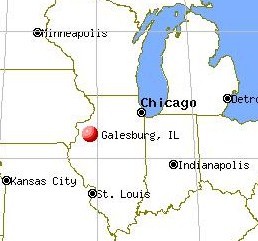
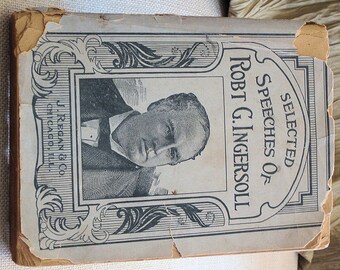
From the Works of Robert G. Ingersoll, "An Address to the Colored People," delivered to the colored people at Galesburg, Illinois, 1867 -- FELLOW-CITIZENS—Slavery has in a thousand forms existed in all ages, and among all people. It is as old as theft and robbery.
Every nation has enslaved its own people, and sold its own flesh and blood. Most of the white race are in slavery to-day. It has often been said that any man who ought to be free, will be. The men who say this should remember that their own ancestors were once cringing, frightened, helpless slaves.
When they became sufficiently educated to cease enslaving their own people, they then enslaved the first race they could conquer. If they differed in religion, they enslaved them. If they differed in color, that was sufficient. If they differed even in language, it was enough. If they were captured, they then pretended that having spared their lives, they had the right to enslave them. This argument was worthless. If they were captured, then there was no necessity for killing them. If there was no necessity for killing them, then they had no right to kill them. If they had no right to kill them, then they had no right to enslave them under the pretence that they had saved their lives.
Galesburg, Illinois
Every excuse that the ingenuity of avarice could devise was believed to be a complete justification, and the great argument of slaveholders in all countries has been that slavery is a divine institution, and thus stealing human beings has always been fortified with a "Thus saith the Lord."
Slavery has been upheld by law and religion in every country. The word Liberty is not in any creed in the world. Slavery is right according to the law of man, shouted the judge. It is right according to the law of God, shouted the priest. Thus sustained by what they were pleased to call the law of God and man, slaveholders never voluntarily freed the slaves, with the exception of the Quakers. The institution has in all ages been clung to with the tenacity of death; clung to until it sapped and destroyed the foundations of society; clung to until all law became violence; clung to until virtue was a thing only of history; clung to until industry folded its arms—until commerce reefed every sail—until the fields were desolate and the cities silent, except where the poor free asked for bread, and the slave for mercy; clung to until the slave forging the sword of civil war from his fetters drenched the land in the master's blood. Civil war has been the great liberator of the world.
Slavery has destroyed every nation that has gone down to death. It caused the last vestige of Grecian civilization to disappear forever, and it caused Rome to fall with a crash that shook the world. After the disappearance of slavery in its grossest forms in Europe, Gonzales pointed out to his countrymen, the Portuguese, the immense profits that they could make by stealing Africans, and thus commenced the modern slave-trade—that aggregation of all horror—that infinite of all cruelty, prosecuted only by demons, and defended only by fiends. And yet the slave-trade has been defended and sustained by every civilized nation, and by each and all has been baptized "Legitimate commerce," in the name of the Father, the Son and the Holy Ghost:
It was even justified upon the ground that it tended to Christianize the negro.
It was of the poor hypocrites who had used this argument that Whittier said,
"They bade the slaveship speed from coast to coast, Fanned by the wings of the Holy Ghost."
Backed and supported by such Christian and humane arguments slavery was planted upon our soil in 1620, and from that day to this it has been the cause of all our woes, of all the bloodshed—of all the heart-burnings—hatred and horrors of more than two hundred years, and yet we hated to part with the beloved institution. Like Pharaoh we would not let the people go. He was afflicted with vermin, with frogs—with water turned to blood—with several kinds of lice, and yet would not let the people go. We were afflicted with worse than all these combined—the Northern Democracy—before we became grand enough to say, "Slavery shall be eradicated from the soil of the Republic." When we reached this sublime moral height we were successful. The Rebellion was crushed and liberty established.
A majority of the civilized world is for freedom—nearly all the Christian denominations are for liberty. The world has changed—the people are nobler, better and purer than ever.
Every great movement must be led by heroic and self-sacrificing pioneers. In England, in Christian England, the soul of the abolition cause was Thomas Clarkson. To the great cause of human freedom he devoted his life. He won over the eloquent and glorious Wilberforce, the great Pitt, the magnificent orator, Burke, and that far-seeing and humane statesman, Charles James Fox.
In 1788 a resolution was introduced in the House of Commons declaring that the slave trade ought to be abolished. It was defeated. Learned lords opposed it. They said that too much capital was invested by British merchants in the slave-trade. That if it were abolished the ships would rot at the wharves, and that English commerce would be swept from the seas. Sanctified Bishops—lords spiritual—thought the scheme fanatical, and various resolutions to the same effect were defeated.
The struggle lasted twenty years, and yet during all those years in which England refused to abolish the hellish trade, that nation had the impudence to send missionaries all over the world to make converts to a religion that in their opinion, at least, allowed man to steal his brother man—that allowed one Christian to rob another of his wife, his child, and of that greatest of all blessings—his liberty. It was not until the year 1808 that England was grand and just enough to abolish the slave-trade, and not until 1833 that slavery was abolished in all her colonies.
The name of Thomas Clarkson should be remembered and honored through all coming time by every black man, and by every white man who loves liberty and hates cruelty and injustice.
Clarkson, Wilberforce, Pitt, Fox, Burke, were the Titans that swept the accursed slaver from that highway—the sea.
In St. Domingo the pioneers were Oge and Chevannes; they headed a revolt; they were unsuccessful, but they roused the slaves to resistance. They were captured, tried, condemned and executed. They were made to ask forgiveness of God, and of the King, for having attempted to give freedom to their own flesh and blood. They were broken alive on the wheel, and left to die of hunger and pain. The blood of these martyrs became the seed of liberty; and afterward in the midnight assault, in the massacre and pillage, the infuriated slaves shouted their names as their battle-cry, until Toussaint, the greatest of the blacks, gave freedom to them all.
In the United States, among the Revolutionary fathers, such men as John Adams, and his son John Quincy—such men as Franklin and John Jay were opposed to the institution of slavery. Thomas Jefferson said, speaking of the slaves, "When the measure of their tears shall be full—when their groans shall have involved heaven itself in darkness—doubtless a God of justice will awaken to their distress, and by diffusing light and liberality among their oppressors, or at length by his exterminating thunder manifest his attention to the things of this world, and that they are not left to the guidance of a blind fatality."
Thomas Paine said, "No man can be happy surrounded by those whose happiness he has destroyed." And a more self-evident proposition was never uttered.
These and many more Revolutionary heroes were opposed to slavery and did what they could to prevent the establishment and spread of this most wicked and terrible of all institutions.
You owe gratitude to those who were for liberty as a principle and not from mere necessity. You should remember with more than gratitude that firm, consistent and faithful friend of your downtrodden race, Wm. Lloyd Garrison. He has devoted his life to your cause. Many years ago in Boston he commenced the publication of a paper devoted to liberty. Poor and despised—friendless and almost alone, he persevered in that grandest and holiest of all possible undertakings. He never stopped, or stayed, or paused until the chain was broken and the last slave could lift his toil-worn face to heaven with the light of freedom shining down upon him, and say, I am a Free Man.
You should not forget that noble philanthropist, Wendell Phillips, and your most learned and eloquent defender, Charles Sumner.
But the real pioneer in America was old John Brown. Moved not by prejudice, not by love of his blood, or his color, but by an infinite love of Liberty, of Right, of Justice, almost single-handed, he attacked the monster, with thirty million people against him. His head was wrong. He miscalculated his forces; but his heart was right. He struck the sublimest blow of the age for freedom. It was said of him that, he stepped from the gallows to the throne of God. It was said that he had made the scaffold to Liberty what Christ had made the cross to Christianity. The sublime Victor Hugo declared that John Brown was greater than Washington, and that his name would live forever.
I say, that no man can be greater than the man who bravely and heroically sacrifices his life for the good of others. No man can be greater than the one who meets death face to face, and yet will not shrink from what he believes to be his highest duty. If the black people want a patron saint, let them take the brave old John Brown. And as the gentleman who preceded me said, at all your meetings, never separate until you have sung the grand song,
"John Brown's body lies mouldering in the grave,
But his soul goes marching on."
You do not, in my opinion, owe a great debt of gratitude to many of the white people.
Only a few years ago both parties agreed to carry out the Fugitive Slave Law. If a woman ninety-nine one-hundredths white had fled from slavery—had traveled through forests, crossed rivers, and through countless sufferings had got within one step of Canada—of free soil—with the light of the North Star shining in her eyes, and her babe pressed to her withered breast, both parties agreed to clutch her and hand her back to the dominion of the hound and lash. Both parties, as parties, were willing to do this when the Rebellion commenced.
The truth is, we had to give you your liberty. There came a time in the history of the war when, defeated at the ballot box and in the field—driven to the shattered gates of eternal chaos—we were forced to make you free; and on the first day of January, 1863, the justice so long delayed was done, and four millions of people were lifted from the condition of beasts of burden to the sublime heights of freedom. Lincoln, the immortal, issued, and the men of the North sustained the great proclamation.
As in the war there came a time when we were forced to make you free, so in the history of reconstruction came a time when we were forced to make you citizens; when we were forced to say that you should vote, and that you should have and exercise all the rights that we claim for ourselves.
And to-day I am in favor of giving you every right that I claim for myself.
In reconstructing the Southern States, we could take our choice, either give the ballot to the negro, or allow the rebels to rule. We preferred loyal blacks to disloyal whites, because we believed liberty safer in the hands of its friends than in those of its foes.
We must be for freedom everywhere. Freedom is progress—slavery is desolation, cruelty and want.
Freedom invents—slavery forgets. The problem of the slave is to do the least work in the longest space of time. The problem of free men is to do the greatest amount of work in the shortest space of time. The free man, working for wife and children, gets his head and his hands in partnership.
Freedom has invented every useful machine, from the lowest to the highest, from the simplest to the most complex. Freedom believes in education—the salvation of slavery is ignorance.
The South always dreaded the alphabet. They looked upon each letter as an abolitionist, and well they might. With a scent keener than their own bloodhounds they detected everything that could, directly or indirectly, interfere with slavery. They knew that when slaves begin to think, masters begin to tremble. They knew that free thought would destroy them; that discussion could not be endured; that a free press would liberate every slave; and so they mobbed free thought, and put an end to free discussion and abolished a free press, and in fact did all the mean and infamous things they could, that slavery might live, and that liberty might perish from among men.
You are now citizens of many of the States, and in time you will be of all. I am astonished when I think how long it took to abolish the slave-trade, how long it took to abolish slavery in this country. I am also astonished to think that a few years ago magnificent steamers went down the Mississippi freighted with your fathers, mothers, brothers, and sisters, and maybe some of you, bound like criminals, separated from wives, from husbands, every human feeling laughed at and outraged, sold like beasts, carried away from homes to work for another, receiving for pay only the marks of the lash upon the naked back. I am astonished at these things. I hate to think that all this was done under the Constitution of the United States, under the flag of my country, under the wings of the eagle.
The flag was not then what it is now. It was a mere rag in comparison. The eagle was a buzzard, and the Constitution sanctioned the greatest crime of the world.
Robert G. Ingersoll
I wonder that you—the black people—have forgotten all this. I wonder that you ask a white man to address you on this occasion, when the history of your connection with the white race is written in your blood and tears—is still upon your flesh, put there by the branding-iron and the lash.
I feel like asking your forgiveness for the wrongs that my race has inflicted upon yours. If, in the future, the wheel of fortune should take a turn, and you should in any country have white men in your power, I pray you not to execute the villainy we have taught you.
One word in conclusion. You have your liberty—use it to benefit your race. Educate yourselves, educate your children, send teachers to the South. Let your brethren there be educated. Let them know something of art and science. Improve yourselves, stand by each other, and above all be in favor of liberty the world over.
The time is coming when you will be' allowed to be good and useful citizens of the Great Republic. This is your country as much as it is mine. You have the same rights here that I have—the same interest that I have. The avenues of distinction will be open to you and your children. Great advances have been made. The rebels are now opposed to slavery—the Democratic party is opposed to slavery, as they say. There is going to be no war of races. Both parties want your votes in the South, and there will be just enough negroes without principle to join the rebels to make them think they will get more, and so the rebels will treat the negroes well. And the Republicans will be sure to treat them well in order to prevent any more joining the rebels.
The great problem is solved. Liberty has solved it—and there will be no more slavery. On the old flag, on every fold and on every star will be liberty for all, equality before the law. The grand people are marching forward, and they will not pause until the earth is without a chain, and without a throne. (source: Works of Robert G. Ingersoll)