Thursday, December 20, 2012

17th Century War On Christmas


From the New York Times, "Yuletide’s Outlaws," by Rachel N. Schnepper, on 14  December 2012  -- EACH year, as wreaths and colored lights are hung on any structure that can support their weight, another holiday tradition begins: the bemoaning of the annual War on Christmas.

The American Family Association has called for boycotting Old Navy and the Gap for, out of political correctness, not using the term “Christmas” in their holiday advertising. Parents have criticized schools for diminishing Christmas celebrations by giving equal time to Hanukkah and Kwanzaa. And the Catholic League used to have a Christmas “watch list” for naming and shaming “Christmas kill-joys.”


Anxiety over the War on Christmas is, in other words, an American tradition. But few realize how far back that tradition goes. The contemporary War on Christmas pales in comparison to the first — a war that was waged not by retailers but by Puritans who considered the destruction of Christmas necessary to the construction of their godly society.

In the early 17th century in England, the Christmas season was not so different from what it is today: churches and other buildings were decorated with holly and ivy, gifts were exchanged and charity was distributed among the poor.

 war on

Also much as it is today, it was a period of carousing and merriment. The weeks around Christmas were celebrated with feasting, drinking, singing and games. Mummers would blacken their faces and dress up in costumes, often in the clothes of the opposite sex, to perform plays in the streets or in homes. Carolers, too, would sing door to door as well as in the home. Wealthy lords threw open their manors, inviting local peasants and villagers inside to gorge on food and drink. Groups of young men called wassailers would march in and demand to be feasted or given gifts of money in exchange for their good wishes and songs.

Puritans detested these sorts of activities, grumbling that Christmas was observed with more revelry than piety. Worse, they contended that there was no Scriptural warrant for the celebration of Jesus’ birth. Puritans argued (not incorrectly) that Christmas represented nothing more than a thin Christian veneer slapped on a pagan celebration. Believing in the holiday was superstitious at best, heretical at worst.


When the Puritans rebelled against King Charles I, inciting the English Revolution, the popular celebration of Christmas was on their hit list. Victorious against the king, in 1647, the Puritan government actually canceled Christmas. Not only were traditional expressions of merriment strictly forbidden, but shops were also ordered to stay open, churches were shut down and ministers arrested for preaching on Christmas Day.

The Puritans who came to America naturally shared these sentiments. As the Massachusetts minister Increase Mather explained in 1687, Christmas was observed on Dec. 25 not because “Christ was born in that Month, but because the Heathens Saturnalia was at that time kept in Rome, and they were willing to have those Pagan Holidays metamorphosed into Christian” ones. So naturally, official suppression of Christmas was foundational to the godly colonies in New England.


On their first Christmas in the New World, the Pilgrims at Plymouth Colony celebrated the holiday not at all. Instead they worked in the fields. One year, the colony’s governor, William Bradford, yelled at visitors to the colony who, unaware that Christmas was celebrate englandd more in the absence than in the commemoration, were taking the day off. He found them “in the streete at play, openly; some pitching the barr, and some at stoole-ball, and shuch like sports.” After that incident, no one again tried to take off work for Christmas in the colony.

The Puritans in the Massachusetts Bay Colony went one step further and actually outlawed the celebration of Christmas. From 1659 to 1681, anyone caught celebrating Christmas in the colony would be fined five shillings.


Well into the 18th century, those who attempted to keep the tradition of wassailing alive in New England often found themselves arrested and fined. Indeed, the Puritan War on Christmas lasted up to 1870, when Christmas became a legally recognized federal holiday. Until then, men and women were expected to go to work, stores were expected to remain open, and many churches did not even hold religious services.

So the next time someone maintains that they are defending traditional American values by denouncing the War on Christmas, remind them of our 17th-century Puritan forefathers who refused to condone any celebration or even observance of the holiday. In America, our oldest Christmas tradition is, in fact, the War on Christmas.  (source: New York Times,, Rachel N. Schnepper is a junior faculty fellow in history at Washington and Lee University)


The Dutch Christmas with Zwarte Pieten in Blackface


From Forbes, "The Unbearable Whiteness of Piet-ing: Dutch Santa's Blackface Elves," by John Giuffo (Contributor), on 4 December 2012 -- Christmastime in Amsterdam has a special kind of magic, and a unique kind of controversy.

White lights slide down buildings and arch across shopping streets, multiplying their twinkle in canal reflections. No garish multi-color, animatronic ego contests anywhere. You will hear Christmas music, but you’re not assaulted, and dreams of restraining orders against Bing Crosby never fill your head (unfortunately, the same couldn’t be said of his children). No one is trampled in shopping frenzies, no one gets arrested for assaulting line-cutters, and the gift giving comes in early December, separate from the more low-key holiday of the 25th. Family members write sardonic poems for each other. Poems! Glühwein – a sort of hot Christmas sangria – warms hands and bellies. And Sinterklaas arrives not on a reindeer-pulled sleigh laden with loot, but on a white horse, accompanied by a small cohort of his helpers, the Zwarte Pieten, or Black Petes – white revelers coated in blackface.


For many American visitors who first witness the tradition, it can be jarring, to say the least. This year, Sint, as he’s commonly known, arrived in Amsterdam on Sunday, November 18, where he paraded through the central canal ring, greeted by ecstatic crowds and hyper-excited kids in the thousands. (He’ll make his way through towns across the country until December 5, when he visits the country’s children, leaves gifts, and takes the carrots they leave in their shoes for his hungry steed).

Followed by dozens of his “helpers,” the Christmas saint and his white horse trotted south along with the Petes, who tossed pepernoten, small ginger cookies, to children lining the parade route. Black, brown, or white, most Dutch kids and their parents love their Santa and are quick to defend him. But those unfamiliar with the practice are often taken aback.


One young American traveler, stopping in Amsterdam during her first trip through Europe, happened upon the parade by chance on her way to check into her hotel room, and had a conversation with her mother via Skype that sounded – from my side of the shared paper-thin hotel wall – all too familiar (I wasn’t creeping, I was reporting): “Mom, it was crazy. Apparently their Santa rides a horse, and there were all these white people with blackface around him. I looked it up when I got in, and they’re called Black Petes,” she said, half incredulous, half nervous laughter. “It was so racist!”

But is it?


The answer is more complicated than it would seem, especially for Americans, who along with our luggage bring with us the baggage of a past full of Al Jolsons and Ted Danson Friar’s Club roasts. University of Southern Mississippi sorority girls aside, it’s pretty well understood in 21st century America that painting a white face black is offensive, and will usually land the ersatz minstrel in hot water.

But how much of a role does intent play in defining an action as racist? If a politician thinks “it would be helpful to be Latino,” and darkens his skin when addressing Latino constituents (some might argue “appear to darken,” but come on), is that racist? The cast members of “Jersey Shore” spend what seems like half their residuals on tanning salons, but few would see that as evidence of questionable racial views, though most view it as evidence of questionable taste.


Flip it around. The Wayans Brothers might have committed a crime against comedy with their 2004 movie, “White Chicks,” but without a history of institutionalized rape, murder, and oppression by black people against white people, it’s difficult to see the movie as racist – although some have argued that it is. “’White Chicks’ is nothing more than a female ‘Amos and Andy’ with the races reversed,” wrote Kevin Carr at Film Threat, but he also admits that he wasn’t offended. Without a doubt, it’s a raw-dog root canal of a flick, and the Wayans’ whiteface doesn’t pass the uncanny valley test – they look creepy as hell – but it’s hard to be offended by anything other than the lack of humor and the movie’s $113 million global gross (you disappoint me, Earth).

Eddie Murphy’s iconic “Saturday Night Live” short about going undercover as a white man retains its punch and hilarity almost 30 years later, precisely because he’s turning the racist blackface trope on its head. His padawan, Dave Chappelle, plumbed similar terrain to fantastic effect. So intent unquestionably determines the offensiveness of painting one’s face a different color, but so does history. And the Dutch have a different history.


Like the cast of one big minstrel street show, the Black Petes, decked out in their most colorful 17th-century gear, shook hands, posed for photos with families, and, in Amsterdam’s version of an annual ritual held all over the country, danced to club music blasting from a mobile DJ booth parade float. Poses were struck, some silly, some uncomfortably stereotypical (an example, but not from the parade).

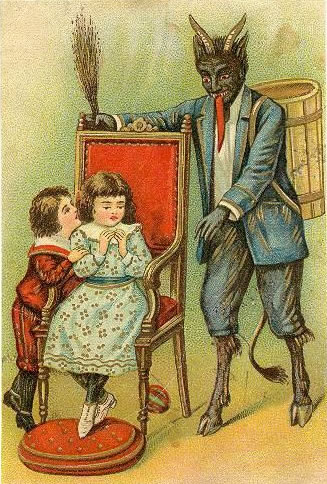
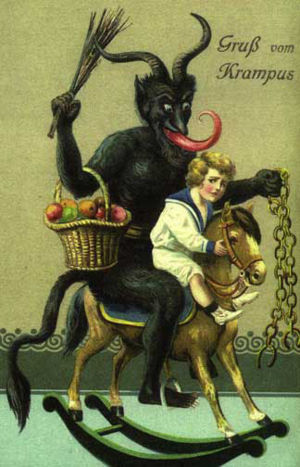
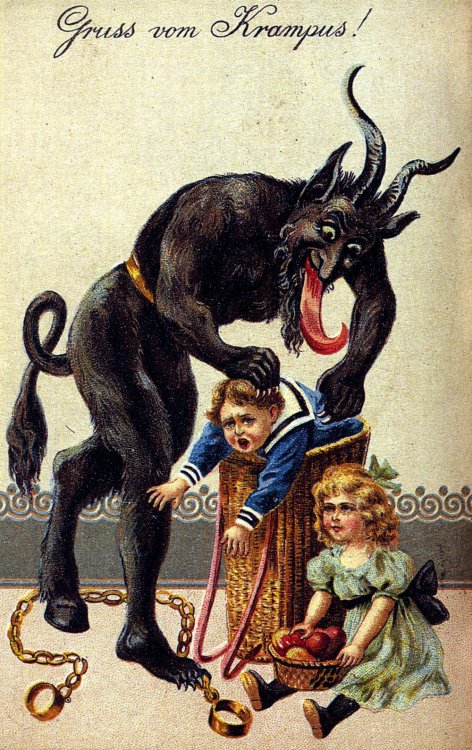
According to tradition, Sint is accompanied by six to eight “black” men – initially, Moors from Spain (actually, Bari, Italy, which Spain owned at the time) – who weren’t Nick’s helpers as much as they were his slaves. Most European cultures welcome a version of St. Nicholas in one way or another this time of year, and many also feature a tradition of a “bad” or evil companion who wields the stick against naughty children when the carrot doesn’t work. In Austria, there’s the Krampus, a devil-yeti who follows St. Nick on his routes and ensures that the insolent children are placed in burlap sacks and beaten with reeds (pretty standard, really). In much of Germany, he appears as Knecht Ruprecht, or Servant Rupert, who leaves behind sticks in the shoes of bad children – gifts for their parents to engage in sanctioned child abuse. Puts a lump of coal in the stocking in context, doesn’t it?

Book cover

Black Pete’s origins lie here in this common mythology, shaped by time and by imperial domination of the Netherlands under Spanish Habsburg rule. Dutch Calvinism didn’t go in for such idolatry, so the tradition was kept alive but low key in the Netherlands until 1850, when Jan Schenkman wrote “St. Nicholas and His Servant,” the first Dutch book where the modern version of the steamboat-traveling Spanish gift-giver and his black servants appear. Its illustrations are the first depictions of Black Pete as he’s known today, and the images of the extra-darkened imp tossing screaming children into sacks and dragging them to Spain seem like the Scared Straight programs of their day.


This sort of caricature of black people was fairly common at the time, and would persist for decades. Winsor McCay’s U.S. comic strip, “Little Nemo in Slumberland”, which he began in 1912, is still celebrated as an unquestionably innovative and groundbreaking work of comics art today, despite the depiction of his “Imp,” a mischievous African cannibal who speaks in gibberish. Al Jolson rode his “Mammy” to greater fame in 1927 with “The Jazz Singer.” By 1993, blackface had been more widely recognized for what it is, so when Ted Danson painted up under cover of supposedly ribald comedy, he damaged his “Cheers” goodwill.


Americans owe our Santa Claus to Sinterklaas, a tradition kept alive by some Dutch settlers and later resurrected by Washington Irving in his “History of New York.” But our version of St. Nick really came into his own because of Clement Clarke Moore, whose 1823 poem, “A Visit From St. Nicholas,” (later renamed “’Twas the Night Before Christmas”) pulled together elements of Irving’s book, the historical St. Nicholas, and influence from a Dutch neighbor. The very name Santa Claus itself points to the Dutch origins of our jolly old toymaker. Santa’s helpers appear as elves in the American tradition, traced back to Louisa May Alcott in 1850, but popularized later in Godey’s Lady’s Book, the most widely-circulated magazine before the Civil War.

The idea of elves as Santa’s faithful servants (“helpers” implies they have other employment options), compared to a so-called saint’s slaves, seems positively benign. But the same American cultural superiority that clutches at pearls when it encounters Dutch revelers in blackface appears unconcerned by the stereotypical portrayal of dwarves as elves.


Peter Dinklage, who in January won a best supporting actor Golden Globe for his role as Tyrion Lannister – undoubtedly the best character on HBO’s “Game of Thrones” – used his acceptance speech as a platform to call attention to anti-dwarf discrimination and to the plight of Martin Henderson, who was paralyzed after a rugby fan threw him against a wall, following the lead of a popular British rugby player engaged in a controversial round of “dwarf tossing.”

“Dwarves are still the butt of jokes,” Dinklage later told The New York Times. “It’s one of the last bastions of acceptable prejudice. Not just by people who’ve had too much to drink in England and want to throw a person. But by media, everything.” The same profile made a point of describing Dinklage’s lean years, before earning fame in the charming and quiet indie film, “The Station Agent.” As a struggling actor in an unheated Brooklyn dump, he refused offers to appear in commercials as one of Santa’s elves, and he paid the price in potato chip dinners. He’s also the only prominent dwarf actor to be given the chance to chew up meaty roles that don’t play up his size to comedic effect – though Tyrion is bitingly funny, his height informs his character’s frustrations about being the smartest man in the room while at the same time being dismissed because of his stature.


The Netherlands continues to struggle with race-based resentment over immigration – a fact which played a role in the rise in popularity of Geert Wilders, (diminished recently with the election of a new governing coalition in September) a far-right politician who advocates banning immigration from Muslim countries. Organizations based in the U.S., such as FrontPage and The Middle East Forum, a pro-Israeli think tank, have provided funding for Wilders’ political party, The Party for Freedom. Segregation and a marked lack of assimilation by many immigrants fuels this divide, and the Dutch find themselves arguing over what it means to be Dutch. But there are plenty of Dutch entertainers and public figures of all shades who aren’t limited to jobs as Black Petes, although almost all politicians in national government are white.


For some Americans, the question of the racist nature of the Black Petes is settled. Jessica Olien, a recent émigré to the Netherlands, described them in a Slate piece last year as a straight-up racist tradition. She does a decent job of explaining the history, pointing to the colonization of Suriname and Indonesia, and the key role the Dutch West India Company played in the slave trade. She also highlights a couple of incidents where critics of the Black Petes have been arrested or prevented from displaying their artwork. But she fails to fairly describe the opinions of Dutch people who, while acknowledging the insensitivity of the Petes, nonetheless view it as relatively innocuous because the costumes are not based in racist hatred, but in tradition.


“Because the Dutch don’t have that intent, it is actually mostly in good fun and without a core racism and demeaning feelings behind [the Petes],” says Andrew Moskos, owner and one of the founders of Boom Chicago, a popular English-language improv comedy venue located in one of the city’s most heavily-trafficked squares. But as an American expat living in Amsterdam for the past two decades, Moskos is also ambivalent about the Black Petes. That tension is at the heart of the troupe’s newest show, “There’s No Such Thing as Sinterklaas,” which turns on the complications and contradictions inherent in the holiday. Pointing to the perennial controversy over the Black Petes within the Netherlands, Moskos says their sarcastic take on the tradition is nothing new. Jordan Peele, half of Comedy Central’s “Key and Peele,” recorded a funny video during his stint at Boom almost a decade ago. Titled “Zwarte Piet Revolution (Christmas in Holland),” the song uses Run DMC’s “Christmas in Hollis” as a jumping-off point for a story about two Black Petes who’ve had enough of Sinterklaas’ crap.


Moskos points out that during a video shoot for one of Boom Chicago’s comedic Sinterklaas clips, black children and their parents had some of the most enthusiastic reactions to the Petes he’s seen. At the parade I attended, black children were just as excited as the others, although a photo I took of one of the Petes hoisting a young black girl up to give Sint a poem just…feels wrong. “It’s not racist because the intent’s not there, but it is, I would say, offensive,” says Moskos.

Dimitri Tokmetzis, a journalist and the publisher of Sargasso, a Dutch news site, agrees. “I don’t think the Dutch want to offend black people with Zwarte Piet. We don’t have a history with blackface,” he says (Disclosure: Tokmetzis is a friend and a stand-up guy). “On the other hand, there are clearly some racist undertones that many people won’t recognize. Zwarte Piet is always depicted as stupid and one song even states that although Zwarte Piet is black, you can basically trust him because he means well.”

“So there is this disconnect between the intentions of most people and how it comes across to those who are more sensitive to racial issues,” says Tokmetzis.

An estimated 85 percent of Dutch people travel abroad, so they’re no strangers to the traditions of other cultures (embarrassing when compared to the one-third of Americans who hold passports), or to the growing criticism from the United States, the U.K., and Canada, where the Black Petes are almost universally reviled, or, at best, interpreted as some sort of evidence of Dutch insularity. But Netherlanders realize their Petes are problematic, and the debate within the country grows each year. A popular newspaper, NRC Handelsblad, published a story last week looking at the criticisms of Boom Chicago’s show. And articles such as Olien’s Slate piece receive widespread, if sometimes defensive, coverage.

In an attempt to modernize the Black Petes, some people have begun painting themselves in a rainbow of face paint colors, with blue and green Petes substituting for their more problematic predecessors. Others have switched explanations and try to argue that the Petes are black because of the chimney soot that’s an occupational hazard – but only for their hands and faces, not their colorful, pristine clothing.

How exactly does one change a Christmas tradition? Does an entire country decide overnight that this fairytale told to children is poisonous and racist, and try to reshape ritual? How do you tell a kid that Santa is an offensive asshole?

“There is more opposition to Zwarte Piet than you might think,” says Jessica Silversmith, director of the regional Anti-Discrimination Bureau for Amsterdam, in an interview with Toby Sterling of the Associated Press today. Where her office has traditionally received one or two complaints about the Black Petes a year, she expects hundreds of complaints this year.

Tokmetzis agrees that the debate over the Zwarte Pieten is growing, and it’s clear that while the Dutch cling fervently to their ages-old Christmas traditions, something will have to change. What’s unclear is how long those changes will be in coming, and to what extent they will alter the characterizations of Sinterklaas’ blackface elves.

Until then, get used to seeing news and opinion fueled by sanctimonious outrage from people who don’t seem to get as worked up about our own offensive holiday traditions. As someone of Italian-American heritage, I can’t begin to describe my anger and frustration at the annual Columbus Day parade thrown and attended by idiots too blinded by their own ethnic pride to pause and realize they’re celebrating a genocidal profiteer. And while we’re at it, we might also benefit from a culturally-introspective pause at the end of November as well.

“Many national celebrations have their own uncomfortable truths in them,” Tokemetzis reminds us. “You just celebrated Thanksgiving, although the Native Americans probably didn’t have much to be thankful about. I don’t think many American families are willing to change their Thanksgiving rituals to a more PC version.”

Be careful when lobbing judgement, is the point. Glass houses and all. (source: Forbes)

Wednesday, December 19, 2012

A Colonial Christmas in Louisiana


From The Advocate, "A Colonial Christmas — with wassailing, too: Event takes participants back to 1810," by Janice Lovett (Special to The Advocate), on 3 December 2012 -- ST. FRANCISVILLE - The lyrics of the classic Christmas carol - "Here we come a-wassailing, among the leaves so green..." captured the spirit of the 1810 Colonial Christmas celebration held Saturday at Oakley Plantation House on the Audubon State Historic Site just outside St. Francisville [Louisiana].

A handful of early-bird townsfolk and travelers arriving well before noon were treated to the sight of costumed staff members making preparations for the evening's festivities.

Slave Cottages/Cabins

Bustling around the grounds in period clothing, the tour guides, re-enactors and staff made ready for a traditional 1810 Christmas that was to occur during the night: a candlelight tour of the house, storytelling around a bonfire, roasted chestnuts, vintage dancing, and food of that era.

With flushed face and bare feet, head cook Kari House stoked the fire in the open hearth of the outbuilding kitchen as she pulled fresh-baked bread from an iron kettle.


"This area of the Spanish colony was settled by the English, Irish and Scottish," she said. "So the traditional Christmas fare was not Cajun or Creole, it was ham and turkey and mashed potatoes and cranberry sauce. And wassail."

Wassail - a warm and spicy alcoholic beverage - was imbibed in England by chilled 19th century carolers as they tramped from orchard to orchard, singing blessings to the trees for a bountiful new year.

Cooking on open hearth


But cooking in bare feet near an open hearth - is that traditional, too? House laughed, "Probably so. The head cook was the best-treated slave on the plantation, yet she and her helpers usually had only one pair of shoes. And those were saved for church."

Kari's husband, John House, manages the Audubon site for the Louisiana Office of State Parks.

This was his 10th Colonial Christmas. He explained choosing 1810 as an emblematic yuletide year was no accident.

"For a brief period in 1810, residents in the surrounding area rebelled against Spanish rule and became an independent nation," he said.

"They called themselves the West Florida Republic. That lasted about three months. But in December, the U.S. Army marched up from New Orleans, said ‘No,' and annexed us into a U.S. Territory."

In a nod to that military history, an all-volunteer group of militia re-enactors set up camp in the grassy field across from Oakley House.

With their costumed wives and children looking on, they wheeled a naval gun mounted on a field carriage into the clearing, a common warfare practice of the time.

Under the direction of Park Ranger Daniel Wilcox, the crew fired the cannon with a thunderous "boom" that roared through the woods, shaking the 200-year-old house.

Advocate staff photo by TRAVIS SPRADLING -- St. Francisville's Daniel Wilcox, left, a park ranger at Audubon State Historic Site, and Denham Springs' Dale Lampton, right, examine a flag after it was presented to them by Central's Michael Matherne (not pictured). The living history re-enactors portrayed South Florida rebellion militia members during  a Colonial Christmas event at Audubon State Historic Site Saturday. Behind them on the porch of a slave cabin are other re-enactors, left to right, Susan Matherne, John Flippen and Rhett Termini.

Audubon paintings

Built in 1801, for a brief time the house sheltered noted artist and naturalist John James Audubon, hired to tutor the owner's daughter.

"It was here that Audubon painted 32 local birds for his famous illustrations," said newest ranger and tour guide, Susan Caston.


A lasting impression provided by the tour was the simplicity of holiday decorating used during the Federalist period: garlands of cypress fastened with red bows over the gallery, boughs of pine festooned with apples and lemons on the mantel, sprigs of red berries in a vase.

But no Christmas trees. "Trees came later, during the Victorian period," Caston said.


The natural décor pleased retired art teacher Lorraine Liebert, of Lafayette, who said she was looking forward to sampling the wassail later that evening.

"I visited one of my daughters in Europe, where they drink a lot of wassail during the holidays.

"It was delicious," Liebert said. "I wonder what it tastes like here?"


As a special treat for those who could not attend the Colonial Christmas celebration at Audubon State Historic Site this year, Kari House shared her Wassail recipe:
Wassail Recipe
1 gallon apple cider
2 cups cranberry juice
½ cup honey
½ cup sugar
2 oranges
Whole cloves
1 apple, peeled and diced
Allspice
Ginger
Nutmeg
3 cinnamon sticks or 3 Tbs. ground cinnamon
½ cup to 1 cup brandy (optional)

Set your crock pot to its lowest setting and pour in apple cider, cranberry juice, honey and sugar. Stir as it heats so honey and sugar dissolve. Stud oranges with cloves and place in the pot (they'll float). Add diced apple, allspice, ginger and nutmeg to taste - usually a few tablespoons of each is plenty. Snap the cinnamon sticks in half and add to mix.

Cover pot and simmer 2 to 4 hours on low. Add brandy about 30 minutes before serving. Enjoy! (source: The Advocate)

A Merry Krampus Christmas from Nike

NIKE SB KRAMPUS DUNK HIGH

From the Nike website -- Something wicked this way walks from Nike Skateboarding and the sinister mind of Sean Cliver. This December heads will roll as an otherworldly darkness manifests in the form of a horned beast with forked tongue, roaming the countryside in search of those both rowdy and rascally. The limited edition Krampus Dunk High SB is upon us, and naughty has never been so nice.


Drawing from the holiday folklore of Eastern Europe, this unique release is the brainchild of one of skateboarding’s most notorious graphic artists. Never one to steer away from controversy, Sean Cliver has been pushing buttons on the bottoms of boards for over twenty years now, with some of skating’s most infamous graphics under his belt. Armed with an amazingly mischievous mind coupled with the most intricate of hand styles, Cliver’s often snide work is instantly recognizable to rippers worldwide. This Dunk represents Sean’s first official venture into the realm of shoe design, and it seems perfectly fitting that a hoofed holiday horror would provide sole motivation for the artist’s much-anticipated design.
KrampusTongue.jpg

For those not familiar with the Krampus legend, our muse is a rather unsightly and wicked fellow long established in European Christmas tradition as something of an accomplice to good ol’ St. Nick, but for those unfortunate children finding themselves absent from Santa’s all-important “nice” list at year’s end. Providing stark contrast to the bloated bearded jolly of his counterpart, this beast boasts razor-sharp antlers and a hell-spawned fur both matted and splattered from his devilish pursuits. A far cry from the benign lump of coal, Krampus traditionally tends to these serial offenders with a sack, a switch and some chains before consuming them voraciously. Bah humbug!

KrampusHeel.jpg

As one would imagine, the imagery passed down through the years surrounding such a provocative legend is as fascinating as it is grizzly, providing impeccable fodder for a Cliver masterpiece, and he most certainly did not disappoint. What lays before us is red-and-black ode to the darker side of Yuletide cheer, a place where “nice” left town a long time ago and Santa doesn’t even think about stopping. Faux goat hair and cracked leather combine with a red-flecked black sole to make for dead-on extension of the hooved heathen at the height of netherworld fashion. A fur-lined inner replicating the look and feel of a stocking is not only an ingenious riff on the Christmas theme but also comes bearing gifts in the form of exclusive Cliver artwork on the insole and tongue.

KrampusShirt1.jpeg

Sean’s amazing design gives careful attention to each diabolical detail with a resourceful approach to make even Krampus crack a smile. “My favorite part about the shoe is that it came out with this super tactile-feel from all the different materials used. I’m not even the touchy-feely type but I’m all about feeling these up,” says Cliver.
KrampusHat.jpeg
This same texturized approach can be seen in the accompanying crackled leather hat and limited edition t-shirts that are also set to emerge from the darkness in the wake of Krampus’ yearly visit. Nike Skateboarding will be issuing a Cliver-designed pair of Dri-Fit shirts both bearing the beast’s mark just in time to give you a hoven leg-up on this year’s potential Krampuskarten costumes. Christmas just came early. So proceed with caution. We will soon find ourselves deep inside the black heart of Krampus season. Be prepared. Nobody’s safe. (source: Nike)


Krampus The Austrian Christmas Devil

Krampus, Austria and Hungary

St. Nick’s devil-like counterpart has one task: to punish bad children before Christmas. In other words, he’s no jolly fat man. Instead, picture a red devil with cloven hooves, horns, and a long tongue (though he can take the form of a bearded wild man or huge hairy beast). Instead of a bag full of toys, Krampus carries chains and a basket for abducting especially bad children and hauling them to hell. Experience this holiday tradition at Krampusnacht parties and Krampus Runs, during which rowdy revelers cavort through town in beastly costumes. (http://thewondrous.com/the-10-strangest-holiday-traditions-of-the-world/)


From the Tuscon Citizen, "This year, put the Krampus back in Christmas!" by Don Lacey on 27 November 2012 -- Most American’s have grown up with stories of Santa’s elves, reindeer and even his wife Mrs. Claus, but it’s a shame how few know about St. Nicholas’s other helper, Krampus.(source: The Tuscon Citizen

In popular Central European tradition, this demonic character accompanies St. Nicholas on his yearly run to give gifts to well behaved children. However, Krampus is not a gift giver but exists to provide a warning to poorly behaved kids. According to tradition when he finds a troublesome child, he snatches this child into his sack and takes him away to be devoured. He is known to carry chains, belts, and birch branches to discipline the unruly before consuming them. The very idea that this tradition has been watered down to a mere giving of coal to bad kids is almost saddening. To this day, in many parts of Germany, Austria, Hungary, Slovenia, and Croatia men dressed as this goat-like monster take to the streets to frighten children. (source: The Tuscon Citizen)


This character did not make it into the American Santa mythology. Perhaps the American Santa tradition ended up being so clean, commercial, and capitalistic that this disciplinarian monster just did not fit in. Perhaps the people at Rankin Bass had so much difficulty squeezing Krampus into their scenes of smiling elves singing in Santa’s work shop, that the whole idea was forgotten altogether. With so many children today terrified of sitting on Santa’s lap imagine what sort of reaction a man in a Krampus suit would have generated. (source: The Tuscon Citizen)


The role Krampus has traditionally played might not be the best idea. Terrifying children into good behavior through threats of being eaten by a viscous monster is hardly a healthy or honest form of parental guidance. Also, teaching children through fear greatly reinforces the notion, that it’s only wrong if you get caught. Threatening children with visits from Krampus is morally repugnant in the same way that threatening children with an eternity in hell is. (source: The Tuscon Citizen)


While I object to using Krampus as a disciplinary tool, he is a fascinating character and part of an interesting Christmas tradition. This character, lost in history, makes for great discussion and American’s would be well served to learn of this mysterious helper to Saint Nicholas along with other “lost traditions.” (source: The Tuscon Citizen)


Tuesday, December 18, 2012

Christmas in the Netherlands: Zwarte Piet (Black Pete)


From The Guardian  "Black Pete exposes the Netherlands' problem with race: White people dressing up as fools with black faces is not the harmless Christmas fun that the Dutch make it out to be," by Siji Jabbar, on 5 December 2012--  I once heard a joke that went something like this: when the world is coming to an end, move to the Netherlands because everything happens there 50 years later. A bit harsh, I thought, after all, the Dutch are a relatively progressive people with much to recommend them: from the high level of volunteering to absence of hysteria around subjects such as cannabis, prostitution, same-sex marriage and euthanasia. On the matter of race, though, you do wonder. Particularly around this time of year, by way of a character called "Zwarte Piet" (Black Pete).


In America you have Santa Claus, in the UK he's Father Christmas, and in the Netherlands he's called Sinterklaas. Unlike the other Santas, though, the Dutch Sinterklaas arrives with his slave/servant called Zwarte Piet. The slave-servant comes dressed like a renaissance minstrel: black face, painted red lips, afro wig. The arrival is a huge event: Sinterklaas and the Zwarte Pieten make a grand entrance, and the whole parade is broadcast on public television. Sinterklaas sits tall on a white horse while his black servants share out candy to the kids on the sidelines, and families from all over the country turn up to watch. Or course, there are always several Black Petes, typically played by white people, all in blackface, with red painted lips and afro wigs.


The transformation, however, is not complete with the outfit and greasepaint. The character must speak poor Dutch with a stupid accent, and must act childlike and mischievous when performing. And from mid-November, when Sintaklass and his servants arrive, you can see Zwarte Pieten all over, on television programmes and commercials and on the streets, acting the fool.

At schools across the country, children sing songs referring to the skin tone and character of the black servant "...even if I'm black as coal I mean well…", "Saint Nicolas, enter with your black servant", etc, and there are other old songs about Zwarte Piet in which he's made out to be a little bit stupid, a little bit clumsy, more akin to a child than an adult, the same generalizations previously applied to black people, but which can no longer be made explicitly.


What on is going on with the Dutch? How can such an abhorrent anachronism exist in a seemingly modern and progressive country? As one writer put it, "millions of black people were killed or enslaved by white people over four centuries, and millions more continue to suffer discrimination all over Europe and in the States, so this Zwarte Piet character is about as funny as wearing a swastika."

As I hinted in the first paragraph, Zwarte Piet is not the only sign that the Dutch have a problem with race. Dutch society also has more subtle ways of reminding black people of their place and keeping them there. If you spend any time in the Netherlands, you will soon hear the words "allochtoon" used in polite conversation.


People of "non-western" descent are labeled "allochtoon", not only by the white society, but also by law. "Allochtoon" is based on a Greek word, "allokhthon", and means "found in a place other than where they were formed". But no non-Dutch white person living in the Netherlands is referred to as allochtoon, only non-white people, Dutch and otherwise. These allochtonen, the "outsiders" (many of whom were born and raised in the Netherlands) are the ones typically accused by the right-wing politician Geert Wilders and others of exploiting the country's resources and social services while not integrating properly into Dutch society. The word allochtoon is thus used as a continuous reminder to people of colour in the Netherlands that white-Dutch people simply do not see them as an equal member of the society, let alone as Dutch, no matter multi-cultural said society might appear on the surface.

Yet a fifth of the Dutch population consists of people of colour. This includes people from former colonies such as Indonesia and Surinam, but also people whose roots lay in Morocco and Turkey. Since the 1980s, there has also been a steady stream of migrants from sub-Saharan Africa to the Netherlands. Some of them are now grandparents, with kids and grandkids who consider the Netherlands home (or try to, at any rate). All of these people are "allochtoon".


In this context, one can start to understand why the unemployment rate of non-white Dutch people (at 15% in the first quarter of 2012) is two-and-a-half times higher than the Dutch average. One also starts to understand why black and white Dutch people see nothing wrong with a film like Alleen Maar Nette Mensen ("Only Decent People") or why, in December last year, the editor of Dutch fashion magazine Jackie thought it was okay to give its readers fashion advice that they could dress like a "Nigga Bitch", associating the style with Rihanna. Rihanna, of course, didn't hold back in her response (she's not black Dutch, so one imagines she didn't know her place), and the editor was forced to resign. But here's the thing, many white and black people felt the editor would have kept her job, if the controversy hadn't been picked up outside the Netherlands. Those who objected were labelled "too sensitive". When the editor was first confronted about the racist slur, her response was that it was just a "bad joke".

Why do people keep defending Zwarte Piet? Is it that they really can't see that it is racist or that they don't want to see? One blogger (Toby Sterling) writes that actually, the people who defend Zwarte Piet know all to well that he is a racist caricature, but that they are experiencing the psychological phenomenon known as "cognitive dissonance": the brain filters out new information (Zwarte Piet is a racist caricature) that conflicts with what one already believes (I love Zwarte Piet and I am not a racist).

You don't have to have a degree in psychology or sociology to work out that the figure of Zwarte Piet, and the use of words like "neger" and "allochtoon" ensure the continued internalisation of ideas of superiority of white Dutch people, and of inferiority and marginalisation of black Dutch people. Nor do you need it to understand the associate power of symbols like Zwarte Piet. You can keep a symbolic boot on someone's neck, and it can be just as effective as doing so physically, more so, even.
The debate is also, as Lulu Wang writes, a discussion about citizenship and identity. "And because this discussion does not take place behind closed doors between politicians and intellectuals only, but in schools, between colleagues, family-members and friends, it offers us a chance to challenge old conceptions of self and other at many different levels. However, this annual debate is not sufficient to change things, but it can lead to more activism, a critical outlook and recognition of those situations where the same strategies of marginalisation are being used. The Black servant and his White master can not be isolated from the social context, Dutch society, in which they exist."

In researching this piece, and from discussing it with Dutch people, black and white, I discovered that this debate has been going on for years, every year. Initially, I thought that was cause for concern. Perhaps the defenders of the "tradition" believe so long as they don't listen to anything the black Dutch people say, the debate will never get beyond talk, and the anti-Piet campaigners will give up from exhaustion. But I was reassured that the numbers (black and white) of those against this "tradition" are indeed growing.

Playwright Mark Walraven, for instance, says he used to be one of the many white men who would paint their faces black each year to the delight of children. "I stopped after I began working with black people," he said. "Many people are offended by this symbol."


Four years ago, Walraven put on a play In the Shadow of the Saint about the debate over Black Pete at Amsterdam's Krater Theater. One of messages of his play is that you can still have Sinterklaas without Black Pete. "Many countries have abolished these kinds of things but in Holland they still exist," Walraven said. "Nevertheless, most Dutch don't consider themselves to be racist and feel they are being personally attacked when you criticise Black Pete," he said.

"The majority here in Holland refuse to talk about Black Pete. They are afraid that the people who discuss it want to take away Sinterklaas as a phenomenon." (source: The Guardian)


HOME

HOME
Click here to return to the US Slave Home Page