Sunday, September 14, 2014

Author Edward E Baptist On The Economist's Book Review


https://blogger.googleusercontent.com/img/b/R29vZ2xl/AVvXsEjCHyyYOHsprrQ3ZOmNQblUvkgkfKdWwJ9eWslx_oPAQjsNIdIeqxp_ud03Ulz0Y7Y0AqDuKGt4MJ688amkn81UND4VTASII2YIPAGJl9Yjj-rg30zvpFRmaRe8OCYcdzC8IygF4uStrqog/s1600/douglas.png

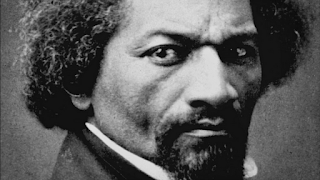
As reported by The UK Guardian, "The Economist's review of my book reveals how white people still refuse to believe black people about being black: This is what happens when racism goes viral. This is why, somehow, it still can," by Edward E Baptist, on 7 September 2014  --  In 1845, Frederick Douglass, a fugitive from slavery, joined dozens of white passengers on the British ship Cambria in New York harbor. Somewhere out on the Atlantic, the other passengers discovered that the African American activist in their midst had just published a sensational autobiography. They convinced the captain to host a sort of salon, wherein Douglass would tell them his life story. But when the young black man stood up to talk, a group of Southern slaveholders, on their way to Britain for vacation or business or both, confronted him. Every time Douglass said something about what it was like to be enslaved, they shouted him down: Lies! Lies! Slaves were treated well, insisted the slaveholders; after all, they said, the masters remained financially interested in the health of their human “property”.

In a review of my book about slavery and capitalism published the other day, the Economist treated it the same way that the tourist enslavers treated the testimony of Frederick Douglass on that slave-era ship long ago. In doing so, the Economist revealed just how many white people remain reluctant to believe black people about the experience of being black.
http://blog.constitutioncenter.org/wp-content/uploads/2013/02/frederickdouglass.jpg

Apparently, I shouldn’t have focused my historical research on how some people lived off the uncompensated sweat of their “valuable property”, the magazine’s anonymous reviewer wrote: “Almost all the blacks in his book are victims, almost all the whites villains.” Worst of all, this book reviewer went on, I had, by putting the testimony of “a few slaves” at the heart of book about slavery, somehow abandoned “objectivity”’ for “advocacy”.

Of course, the reviewer wasn’t treating me like the slaveowners on the Cambria treated Douglass. They threatened to kidnap him and send him to New Orleans – the largest slave market in North America. No, a single nameless reviewer from a single stodgy magazine couldn’t do much to me.

Still, the review enraged a significant number of people. Within a few hours, Twitterstorians scorched the earth of the magazine’s comments page with radioactive reviews of the review. The parodies and viral disdain forced the Economist to retract the review and issue a partial apology.

http://sites.duke.edu/tidesofkinship/files/2014/02/TimeCivilWar_p019_slaveFamily_2_slideshow.jpg

But the Economist didn’t apologize for dismissing what slaves said about slavery. That kind of arrogance remains part of a wider, more subtle pattern in how black testimony often gets treated – sometimes unknowingly – as less reliable than white. The Economist reviewer was saying that the key sources of my book, African Americans – black people – cannot be believed.

As the historian Jelani Cobb pointed out to MSNBC’s Chris Hayes on Friday night, the reviewer’s ideas about slavery’s history are not actually as uncommon as many of us would like to believe. He’s right: All across the American south, you can go to historic plantation sites still pushing the idea that slaves who had a “good” master were happy, and “faithful”.

If you write about the history of slavery, you become used to the pattern: No matter how many accounts you cite from ex-slaves, people often say they need more information before they can accept what former cotton pickers say about how cotton picking worked. And when we’re talking about contemporary events, the presumptive doubt is just as bad.

http://www.shirleyplantation.com/images/slave_bucket.jpg

For instance: white people have had numerous opportunities, especially after Ferguson, to hear what African Americans think about how policing takes place when white civilians aren’t around. Yet twice as many white Americans as black Americans still think that police treat African Americans fairly.

Perhaps this is because, according to a recent survey, 75% of white Americans have zero black American friends. Surely if more white people knew more black people on a personal level, some would be more ready to accept the accounts from African Americans about how white privilege affects their own lives.


Instead, we’ve still got white magazine writers refusing to believe first-person accounts of history, which re-enforces white privilege at the very time when we should be revoking it. In the meantime, both historians and advocates of contemporary change often have to turn to the strategy of getting white people to vet black testimony before other white people will believe it.

Back in 1845 on the Cambria, as the attackers surrounded Douglass, threatening to throw him overboard, he told the other white passengers that if they didn’t believe his words, he would speak the words of the enslavers. Straight from the book of state law in the south, Douglas read aloud those punishments allotted to slaves, then – “lashings on the back, the cropping of ears and other revolting disfigurements” – as now: “for the most venial crimes, and even frequently when no crime whatever had been committed”.  (source: The Guardian)

Friday, September 12, 2014

Greg Grandin’s "Empire of Necessity"

http://media.npr.org/assets/img/2014/01/23/theempireofnecessity_sq-0a9bdead3b415ebc6b318a2f3bbc0bb67812e17c.jpg

From the New York Times Sunday Book Review, "A Vengeful Fury: Greg Grandin’s ‘Empire of Necessity’," by Andrew Delbanco, on 10 January 2014 -- Between the early 16th century and the middle of the 19th, more than 12 million human beings were shipped against their will from Africa to the New World and sold into slavery. An untold number died at different stages of the journey — overland in Africa, during the “middle passage” at sea or soon after arrival. Among those who perished, most died of disease, some by suicide and still others from wounds or execution following failed revolts.

For nearly four centuries, as Greg Grandin writes in his powerful new book, slavery was the “flywheel” that drove the global development of everything from trade and insurance to technology, religion and medicine. To read “The Empire of Necessity” is to get a sort of revolving scan from the center of the wheel. What we see is an endless sequence of human transactions — the production and exchange of meat, sugar, rice, cotton, tobacco, gold, among many other things — all connected, through slavery, by linkages whose full extent cannot be discerned from any point along the way. Slaves, Grandin writes, “were at one and the same time investments (purchased and then rented out as laborers), credit (used to secure loans), property, commodities and capital.”

http://ecx.images-amazon.com/images/I/51Ctn6eyN-L._SY344_BO1,204,203,200_.jpg

Grandin’s kaleidoscopic technique gives his book a certain pastiche quality (many years and miles are silently traversed in the breaks between chapters), but through a remarkable feat of research he establishes a strong narrative line that gives the book coherence and momentum. Beginning in 1804 with their embarkation from West Africa, he follows a particular group of slaves to a British slave ship until it is seized in the name of “liberty, equality and fraternity” by a French pirate, who exercised his liberty by selling them to a buyer in Buenos Aires. Then came a forced march across the “never-ending blanket of grass” of the Argentine pampas, which must have cruelly reminded the captives of the African steppe they once had known. Next was the hard climb into the Andes, where the weak and sick had their limbs or heads cut off in order to facilitate removal of shackles and halters for future use, their mutilated bodies left to nonhuman predators along the trail. Upon arrival in Valparaiso, survivors were taken aboard the slave ship Tryal, bound for Lima, under the command of a Spaniard named Benito Cerreño.

Into this harrowing account Grandin, the author of “Fordlandia,” intersperses sections about two New Englanders who seem at first disconnected from the story but who were destined to intersect with the lives — and deaths — of the slaves, and thereby with each other. The first was a merchant seaman named Amasa Delano who dropped anchor in late 1805 at Santa Maria Island off the Chilean coast. The second was a Massachusetts writer, Herman Melville (from whom Grandin borrows his title), who, probably sometime in the 1840s, read Delano’s memoir and was drawn to the tale of what happened early in 1805 when Delano spied a ship sailing erratically near the island, in evident need of help.
http://cdn.history.com/sites/2/2013/12/150619827-H.jpeg

That ship was the Tryal, whose human “cargo” had rebelled, murdered their owner along with a score of other whites and demanded that Cerreño sail them back to Africa. Fifty years later, Melville made Delano’s story the basis of a short novel that he called “Benito Cereno.”

When Delano boarded the vessel to aid what he surmised was a distressed crew, he was duped by the risen slaves — and by Cerreño, who feared for his life should he hint at the truth — into believing that the disorder aboard was the result of storm damage and disease. But as Delano was being rowed back to his own ship, the Spanish captain suddenly leapt overboard after him, screaming for help. Now grasping the truth of the situation (at least some of it), Delano dispatched an armed party that subdued, then tortured, the rebellious slaves. When he returned to the ship, he found them “writhing in their viscera.”

In “Benito Cereno,” Melville retold these events with some significant ­changes. Omitting what Grandin calls “Delano’s nearly yearlong hounding” of the Spaniard for what he considered his due compensation for the rescue, he emphasized Cereno’s lingering shock and Delano’s impenetrable insouciance. He focused on the leader of the slave rebellion, whose corpse, after his trial and hanging, was decapitated, with the head impaled on a spike in the main plaza of Lima so all could contemplate his “voiceless end.”

http://www.truthdig.com/images/eartothegrounduploads/9780805094534_custom-c1e1b96b55bb0ecc95468b545d1acdede0770b0e-s6-c30.jpg

Melville refused to write knowingly about the unknowable inner lives of the slaves, a reticence that elevated his novella far above the antislavery manifestoes of his time in which slaves appear in one form of caricature or another. He conveyed the horror of slavery while looking unblinkingly at the reciprocal fury of self-liberated slaves toward those who had enslaved them.

Grandin does not say much about the literary power of “Benito Cereno.” But by reconstructing the world through which the slaves moved toward their doom, he has done more than any previous scholar — and there have been many — to illuminate the context of the work in which Melville confronted slavery without presuming to comprehend its vast ramifications. “The Empire of Necessity” is also a significant contribution to the largely impossible yet imperative effort to retrieve some trace of the countless lives that slavery consumed.  (source: New York Times Sunday Book Review)


Greg Grandin on "The Empire of Necessity: Slavery, Freedom, and Deception in the New World" from Brooklyn Historical Society on Vimeo.

Wednesday, July 23, 2014

University Slavery: The University of Maryland


From the Washington Post, "Students Trace University of Maryland's Slavery Ties," by Jenna Johnson a Washington Post Staff Writer, on 10 October 2009 -- When the University of Maryland elaborately celebrated its 150th anniversary in 2006, there were only fleeting mentions of its early ties to slavery. The next year, black faculty members urged President C.D. Mote Jr. to follow the lead of Maryland lawmakers and issue an apology for the university's historic use of slave labor.

Mote refused to do so, but he asked a group of students to research the topic. As they presented him with a final report Friday, the students recommended the university "issue a statement of regret," honor African Americans who assisted with its creation by naming them founders, add classes focused on slavery, continue research and ensure that the university is not benefiting from current international "coercive labor practices."


Mote said Friday that he will review the recommendations but that he has no plans for a statement because all institutions at that time were influenced by slavery.

"It's a little difficult for a university to retrospectively change its founders," he said. "It's like changing the signers of the Declaration of Independence."

The report does not contain a "smoking gun" or examples of how slaves were forced to construct parts of the campus beginning in 1856, just before the Civil War and the abolition of slavery, said history professor Ira Berlin, who led the class. But at least 16 of the university's original 24 trustees owned slaves, and it would have been nearly impossible then to "undertake this type of enterprise in Maryland and not use slaves," he said.


"If slaves didn't lay the bricks, they made the bricks. If they didn't make the bricks, they drove the wagon that brought the bricks. If they didn't drive the wagon, they built the wagon wheels," Berlin is quoted as saying in the report.

The report tells the story of three men who were instrumental in opening the Maryland Agriculture College, as the university was then known, at a time when farmers were forced to plan how they would operate in a post-slavery economy.

The three "founders" profiled are remarkably different: Charles B. Calvert, a principal founder and wealthy backer of the school, came from a prominent Maryland family that had owned dozens of slaves for decades. Benjamin Hallowell, the school's first president who resigned after one month, was a Quaker who adamantly opposed slavery and requested that slave labor not be used. Adam Plummer was one of Calvert's slaves, whose labor "created the wealth that funded the college," the students wrote in the report.

Plummer's great-great-grandson, the Rev. L. Jerome Fowler, said he received a copy of the report this week and opened to the table of contents. Tears came to his eyes.

"I saw my ancestor, Adam Francis Plummer, listed as a founder," Fowler said at a reception Friday. "You don't know what that did for me."

noose

In the past decade, several other universities have researched the role of slavery in their construction and early days of operation. But in many instances, these research projects are conducted by professors and historians, not undergraduates, Berlin said. During the first semester, the class studied the history of slavery. The next semester, they began researching and writing.

"To be able to rummage through archives and decipher old handwriting -- undergraduates never get to do that," said Jessica Dwyer-Moss, a senior majoring in government, politics and history. Unlike class reports that are graded and forgotten, Dwyer-Moss says, she hopes this report is read throughout the campus so that it "might do some good in the world."  (source: Washington Post)


Slavery and the University of Maryland (Fortune's Bones, February 24, 2012) from The Clarice on Vimeo.

Oregon Slavery

From The Portland Tribune"Nokes' book breaks the chains of history," by Lori Hall on 16 May 2013 --  When Greg Nokes of West Linn found out that one of his Oregon ancestors was a slave owner he was surprised to say the least.

His relative, Robert Shipley, took his slave, Ruben Shipley, with him, moving from Missouri to Oregon with the promise of releasing Ruben after he helped settle a farm back in 1853.

First, Nokes was not pleased to learn about that component of his family’s history. Second, he was interested to learn there were slaves in Oregon, what was known as a state closed to slavery.

Intrigued, Nokes started researching and writing. The result is his latest book, “Breaking Chains: Slavery on Trial in the Oregon Territory,” which launches May 19.


Research and writing are in Nokes’ blood. His father was an editor for The Oregonian when he was growing up and passed on the love of the written word to Nokes.

“Writing became natural to me,” he said.

After graduating from Willamette University, Nokes started working for the Medford Mail Tribune. From there he went on to 43 years of journalism, working 25 years with The Associated Press and 15 years with The Oregonian.

As a young man, not only did Nokes want to write, but he also wanted to see the world.

“I’ve been fortunate to do both,” said Nokes, who recently turned 76.

Nokes was stationed in New York, San Juan, Buenos Aires and Washington, D.C., while working for the AP. In D.C. he was an economics and diplomatic correspondent. Over the course of his career Nokes visited more than 50 countries before retiring in 2003.

Not one to settle down, Nokes launched a second career by researching and writing his first book, “Massacred for Gold.” It took him 14 years from start to finish to write this nonfiction story about a covered-up 1887 massacre of 34 Chinese gold miners in Hells Canyon. This book resulted in a memorial at Chinese Massacre Cove last year and shined a light on perhaps the largest massacre of Chinese people on American soil.
After finishing that book, Nokes sat down to coffee with his brother, Bill, to discuss book ideas. Bill suggested writing about Ruben Shipley, an element of family history Nokes did not know about.

“In researching his life, I came across other slaves in Oregon,” Nokes said. “This was all new to me.”

In all, Nokes could find 35 names of slaves in Oregon, though he said there were probably up to 100, and “hardly anyone in Oregon knew of this history.”

One family that struck a particular chord with Nokes was the Holmes clan. Slaves Robin and Polly Holmes and their children moved from Missouri to Oregon with their master, Nathaniel Ford, in 1844. They had expected to be freed upon moving to the state closed to slavery.


Like many other settlers, Ford ignored the territory’s laws and forced the Holmeses to work his land. Robin and Polly were finally freed in 1850, but Ford refused to free their three children.

Despite being illiterate and an obvious underdog, Robin Holmes fought back for his children by taking his former master to court.

“He managed to get the ear of some sympathetic attorneys and sued Ford,” Nokes said.

The court battle lasted 15 months, but a judge finally ruled in Holmes’ favor, granting the return of his children.

According to Nokes, Holmes vs. Ford, decided in 1853, is a landmark case in Oregon and the only slavery case ever brought in Oregon courts.

“It’s just another story people in Oregon didn’t know about,” Nokes said.


“Breaking Chains,” however, is more than just the Holmeses’ story. The book explores slavery in general in Oregon and the territory’s questionable laws, including its 1857 Constitution that banned African Americans from moving into the state. That law wasn’t repealed until 1926.

Though Nokes may not be proud of his ancestor, he was happy to learn Ruben Shipley became a successful farmer. And because of his ancestry, Nokes had the opportunity to write “Breaking Chains” in the hopes that Oregonians can learn the complete picture and history of this region and how it formed.

“I hope it will get into schools. I think it will be useful,” Nokes said of the book. “I like to think I contributed to the knowledge of this region’s history. ... The book is more about the history of slave issues in Oregon than just individual slaves.” (source: The Portland Tribune)

Monday, July 21, 2014

Washington and Lee University Will Remove Confederate Flag


As reported by the Washington Post, in an article entitled, "U.S. colleges have worked to address ties to slavery, Confederacy," by Karen Chen, on 8 July 2014 -- With Washington and Lee University’s announcement Tuesday that it will remove historic Confederate battle flags from the main chamber of Lee Chapel and its acknowledgement of regret for the school’s ties to slavery, the college in Lexington, Va., joined numerous other U.S. colleges that have worked to address their ties to slavery and the Confederacy. Here is a list of prominent schools that are among those that have publicly addressed the issue during the past decade, in chronological order.


University of Alabama — 2004. The university apologized to descendants of slaves who had connections to campus in the years prior to the Civil War, according to the Associated Press. The move, among the first ever by a U.S. school, came shortly after the school decided to put a marker near the graves of two slaves on campus and to put others on buildings where slaves had worked and lived.


University of North Carolina at Chapel Hill — 2005. The school installed the Unsung Founders Memorial to recognize the people of color who helped build the university, both free and enslaved statewide.


University of Virginia — 2007. The Board of Visitors unanimously passed a resolution expressing regret for the use of slaves at the school. The resolution recognized that the vision of the school’s founder, Thomas Jefferson, was carried out by slaves who helped build the Rotunda and the buildings on the Lawn, the historic heart of the school that Jefferson designed.


Brown University — 2007. The Ivy League school in Providence, R.I., commissioned a three-year report examining the institution’s history with slavery, which culminated in a recommendation to acknowledge the past, spread the report’s findings and a promise to create a hefty endowment for Providence urban public schools. A dedicated memorial is scheduled to be completed this year, in time for Brown’s 250th anniversary.


College of William and Mary — 2009. The historic Williamsburg, Va. school — which graduated four signers of the Declaration of Independence — opened “The Lemon Project,” an investigation into its slavery ties.

Harvard University — 2011. A Harvard history professor and more than 30 students created a booklet called “Harvard and Slavery: Seeking a Forgotten History”, according to the Harvard Gazette. It reported that three Harvard presidents owned slaves and that slaves worked on campus as early as 1639.

Emory University — 2011. The university in Georgia apologized for its connections to slavery on the day before the school’s 175th anniversary. In a resolution, the school acknowledged its “entwinement with the institution of slavery throughout the College’s early history” and “regrets both this undeniable wrong and the University’s decades of delay in acknowledging slavery’s harmful legacy.”

Princeton University — 2013. History professor Martha Sandweiss led a seminar that began digging into the New Jersey Ivy League school’s history with slavery.

Washington and Lee University — 2014. After a protest from a group of black students, the university announced that it will remove Confederate battle flags from the main chamber of Lee Chapel, which honors Confederate Gen. Robert E. Lee, who served as the university’s president after the Civil War. The school also said it regrets its connection to slavery and acknowledges that it owned as many as 80 slaves in its early years. (source: The Washington Post)

Wednesday, July 9, 2014

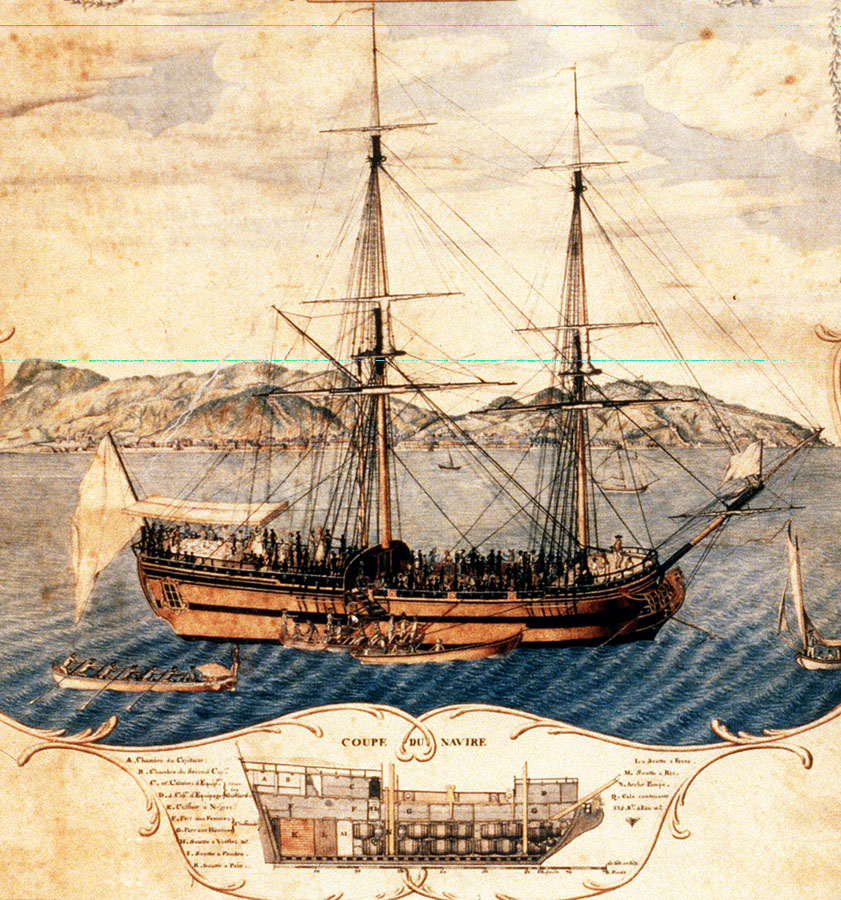
The Slave Ship Called "Diligent"


From the London Review of Books, "Tricky Business," Megan Vaughan reviews The Diligent: A Voyage through the Worlds of the Slave Trade by Robert Harms, Perseus, 466 pp, £17.99, February 2002, ISBN 1 903985 18 8 -- On 1 June 1731, the Billy brothers, Guillaume and François, waved goodbye to their ship, the Diligent, as it set sail from Brittany. It was weighed down with Indian cloth, cowry shells from the Maldives, white linen from Hamburg, guns, ammunition and smoking pipes from Holland, kegs of brandy from the Loire Valley, and with the all-important supplies for the crew: firewood and flour, dry biscuits, fava beans, hams, salt beef, cheese, white wine and water. There was one other item to be loaded: 150 slave irons with their locks and keys, manufactured by the Taquet brothers in Nantes. Each iron could restrain two slaves. The Diligent was setting off on its first slave-trading voyage.

The Africans who would wear these irons were destined for the French West Indian island of Martinique. French development of this and other islands had lagged behind the English. In 1700 there were about thirty thousand African slaves in the French colonies, compared with around a hundred thousand in the English ones, and sugar exports were correspondingly smaller, but the first decades of the 18th century would see a rapid growth in French involvement in the slave trade and in the development of their colonies. The activities of the Billy brothers were part of a more general trend, as the usually dirigiste French Crown gave a greater degree of freedom to merchants and entrepreneurs.


The 1731 voyage was the Billy brothers’ first involvement in the slave trade. It demanded a very significant investment: the cost of sending a ship on the African slave run was two or three times that of other branches of commerce. Outfitting the Diligent, including food, loading costs and two months’ salary for the crew, came to 80,000 livres – more than four times the price of the ship itself, and this before insurance. The Billy brothers were expecting big profits from the sale of Africans they would never see.

Robert Harms has based his riveting account of the ‘worlds of the slave trade’ on a journal kept by a young lieutenant on the Diligent, Robert Durand, a document sold in the 1980s to the Beinecke Library at Yale, where Harms teaches. Historians have uncovered records of more than seventeen thousand slaving voyages in the 18th century, but, as Harms points out, only a handful give us any insight into the daily life of the ship, the crew and its human cargo. Most are careful records of the ship’s passage, prices, rates of exchange, slaves’ vital statistics and deaths. As Robin Blackburn has argued, the slave trade and the slave plantation were run with an instrumental rationality, according to business principles that were ahead of their time, and produced an abundance of statistics. Durand’s journal is one of the handful of records that provides more than this, but even so it is characterised as much by its silences as by its evocative descriptions and jaunty drawings. ‘Curiously,’ Harms writes, ‘Robert Durand mentioned the African captives only twice during the entire 66 days of the middle passage, and then only to record deaths.’


Harms uses the voyage of the Diligent to take us through the ‘worlds’ of the Atlantic slave trade in the early 18th century. There are three of them in this case: France, West Africa and Martinique, with a few offshore islands thrown in. Harms’s argument is that these worlds are distinct, with their own histories and dynamics, but that during this period the slave trade was beginning to link their fates. Perhaps his most original contribution to the ever increasing scholarship on slavery, however, is his account of the French slave traders and the political and social context of early 18th-century French colonial commerce.

The ships that sailed from Brittany had their backs turned to the impoverished rural economy of the hinterland. The big players in colonial trade were Nantes and later Lorient, and though government-chartered companies had previously exercised near complete monopolies, by this time the merchants of Nantes were proving successful advocates of private enterprise. The development of the French colonies may have been dirigiste in comparison to the English, but the French King could not afford to ignore an increasingly vociferous group of private merchants pressing for reform of the now discredited system of corporate mercantilism. Still, French colonial trade, as Harms makes clear, was relatively unintegrated into the larger economy, which was still predominantly agricultural. In the 18th century, commercial cities like Nantes were a bit like the ‘free trade zones’ of the ‘Third World’ today – disconnected from the rest of the country, importing and exporting goods that most people would never own, and perhaps never see. Arriving in Nantes, with its grand merchants’ mansions and its opera house, the English traveller Arthur Young found himself in a strikingly different world from the one he had been journeying through: ‘Mon Dieu! I cried to myself, do all the wastes, the deserts, the heath, ling, furz, broom and bog that I have passed for three hundred miles lead to this spectacle? What a miracle, that all this splendour and wealth of the cities of France should be so unconnected with the country!’ (source: The London Review of Books: Vol. 24 No. 24 · 12 December 2002, pages 23-24 | 3741 words)


Saturday, June 21, 2014

USA Slave Ports: Baltimore City Inner Harbor


As reported by the Baltimore Sun, "A bitter Inner Harbor legacy: the slave trade: City Diary," by Ralph Clayton on 12 July 2000 -- THOUSANDS of NAACP members descended on Baltimore for their convention this week, prompting visits to the major tourist attractions that line the Pratt Street corridor.

What most of the hundreds of thousands of tourists who visit the Inner Harbor each year don't realize is that they are walking on sacred ground, where countless thousands of men, women, and children suffered during Baltimore's darkest hour.


Between 1815 and 1860, traders in Baltimore made the port one of the leading disembarkation points for ships carrying slaves to New Orleans and other ports in the deep South. Interstate traders in the domestic coast slave trade found Baltimore's excellent harbor, central location and position in the midst of a developing "selling market" attractive incentives in which to build their slave pens and base their operations near the bustling port.

The major slave dealers, who came from Kentucky, Georgia, Virginia and Tennessee built their slave pens near Pratt Street, the major east-west connection to the wharves in the Inner Harbor and Fells Point.

One of the first major pens was built behind a white frame house near the corner of Cove and Pratt streets, near the intersection of what is today Martin Luther King Jr. Boulevard. The pen belonged to Tennessee native Austin Woolfolk, whose reign in Baltimore ran from 1818 to 1841.

Georgia native Hope Hull Slatter constructed his pen in 1838, several doors east of Howard and Pratt streets. During his 14-year stay, Slatter was ably assisted by his male slave, a jail steward.

By the late 1850s, Joseph Donovan, who had used pens on Pratt Street and Camden Street near Light Street, had a new pen constructed on the southwest corner of Camden and Eutaw streets, near where the Babe Ruth statue now stands at Oriole Park at Camden Yards.


Many other traders made their mark in Baltimore during the height of the slave trade: James Franklin Purvis, whose pen was on Harford Road near Aisquith; Bernard M. and Walter L. Campbell, whose pen was on the south side of Conway Street, near Hanover Street. (He would later buy Slatter's pen after Slatter's departure for Mobile, Ala., in 1848); William Harker, several doors south of Baltimore Street, on the west side of Calvert Street; and John Denning, on Frederick Street, several hundred feet behind the current site of the Holocaust memorial.

The "travelling traders" like George Kephart of Maryland, David Anderson of Kentucky, and Barthalomew Accinelly of Virginia came to town, gathered purchased slaves, and shipped them on packets that regularly made the run from Baltimore to New Orleans.

Although numerous wharves at Fells Point were used by the packet ships, so were the Pratt Street wharves that lined the north side of the Inner Harbor. The site of the current Pratt Street Pavilion, once underwater, was the home to numerous such packets as well as the docks that housed their agents' offices.

The methods for moving the slaves down Pratt Street differed, depending on the trader. Woolfolk preferred to march his slaves in the middle of the night, chained together and on foot. Slatter often used carriages and omnibuses to convey his slaves to the packet ships.


Ships with names like Agent, Architect, Hyperion, General Pinckney, Intelligence, Kirkwood, Tippecanoe and Victorine made their runs from wharves along the Inner Harbor as well as Fells Point.

Greed made for strange bedfellows. Many of Baltimore's slave dealers shipped together on the same brigs, barks, ships and schooners making their cyclical runs to New Orleans. In October 1845, Campbell, Donovan and Slatter shipped 117 souls aboard the Kirkwood from the Frederick Street dock. The Tippecanoe sailed from Chase's wharf in January 1842 with 114 souls shipped by Purvis, Slatter and others.

For 45 years, thousands of families and individuals were sent south on their final passage. For most on board, this meant a death that came when families and loved ones were separated and "sold South" -- a separation from which few returned. It also signified almost certain separation from one another in New Orleans; large families were rarely sold to the same buyer.

[BaltSlaveTrade.JPG]

Tourists who go to the attractions of the harbor area this summer should take time to remember the price that so many paid in blood and broken hearts on Pratt Street.

Remember the young woman who took her and her child's life in Woolfolk's pen in the spring of 1826, rather than go south; the man who, in 1821, upon learning that he had been sold to a trader, slit his own throat at one of Baltimore's wharves; or the unsuccessful attempt in1846 of a female slave to drown herself at the Light Street dock rather than live another day in slavery.

Remember.


Friday, June 6, 2014

"The First Decoration Day" or Memorial Day


For the Newark Star Ledger, "The First Decoration Day" by David W. Blight of Yale University -- Americans understand that Memorial Day, or "Decoration Day," as my parents called it, has something to do with honoring the nation's war dead. It is also a day devoted to picnics, road races, commencements, and double-headers. But where did it begin, who created it, and why?

As a nation we are at war now, but for most Americans the scale of death and suffering in this seemingly endless wartime belongs to other people far away, or to people in other neighborhoods. Collectively, we are not even allowed to see our war dead today. That was not the case in 1865.


At the end of the Civil War the dead were everywhere, some in half buried coffins and some visible only as unidentified bones strewn on the killing fields of Virginia or Georgia. Americans, north and south, faced an enormous spiritual and logistical challenge of memorialization. The dead were visible by their massive absence. Approximately 620,000 soldiers died in the war. American deaths in all other wars combined through the Korean conflict totaled 606,000. If the same number of Americans per capita had died in Vietnam as died in the Civil War, 4 million names would be on the Vietnam Memorial. The most immediate legacy of the Civil War was its slaughter and how remember it.

War kills people and destroys human creation; but as though mocking war's devastation, flowers inevitably bloom through its ruins. After a long siege, a prolonged bombardment for months from all around the harbor, and numerous fires, the beautiful port city of Charleston, South Carolina, where the war had begun in April, 1861, lay in ruin by the spring of 1865. The city was largely abandoned by white residents by late February. Among the first troops to enter and march up Meeting Street singing liberation songs was the Twenty First U. S. Colored Infantry; their commander accepted the formal surrender of the city.


Thousands of black Charlestonians, most former slaves, remained in the city and conducted a series of commemorations to declare their sense of the meaning of the war. The largest of these events, and unknown until some extraordinary luck in my recent research, took place on May 1, 1865. During the final year of the war, the Confederates had converted the planters' horse track, the Washington Race Course and Jockey Club, into an outdoor prison. Union soldiers were kept in horrible conditions in the interior of the track; at least 257 died of exposure and disease and were hastily buried in a mass grave behind the grandstand. Some twenty-eight black workmen went to the site, re-buried the Union dead properly, and built a high fence around the cemetery. They whitewashed the fence and built an archway over an entrance on which they inscribed the words, "Martyrs of the Race Course."

Then, black Charlestonians in cooperation with white missionaries and teachers, staged an unforgettable parade of 10,000 people on the slaveholders' race course. The symbolic power of the low-country planter aristocracy's horse track (where they had displayed their wealth, leisure, and influence) was not lost on the freedpeople. A New York Tribune correspondent witnessed the event, describing "a procession of friends and mourners as South Carolina and the United States never saw before."

At 9 am on May 1, the procession stepped off led by three thousand black schoolchildren carrying arm loads of roses and singing "John Brown's Body." The children were followed by several hundred black women with baskets of flowers, wreaths and crosses. Then came black men marching in cadence, followed by contingents of Union infantry and other black and white citizens. As many as possible gathering in the cemetery enclosure; a childrens' choir sang "We'll Rally around the Flag," the "Star-Spangled Banner," and several spirituals before several black ministers read from scripture. No record survives of which biblical passages rung out in the warm spring air, but the spirit of Leviticus 25 was surely present at those burial rites: "for it is the jubilee; it shall be holy unto you… in the year of this jubilee he shall return every man unto his own possession."


Following the solemn dedication the crowd dispersed into the infield and did what many of us do on Memorial Day: they enjoyed picnics, listened to speeches, and watched soldiers drill. Among the full brigade of Union infantry participating was the famous 54th Massachusetts and the 34th and 104th U.S. Colored Troops, who performed a special double-columned march around the gravesite. The war was over, and Decoration Day had been founded by African Americans in a ritual of remembrance and consecration. The war, they had boldly announced, had been all about the triumph of their emancipation over a slaveholders' republic, and not about state rights, defense of home, nor merely soldiers' valor and sacrifice.

According to a reminiscence written long after the fact, "several slight disturbances" occurred during the ceremonies on this first Decoration Day, as well as "much harsh talk about the event locally afterward." But a measure of how white Charlestonians suppressed from memory this founding in favor of their own creation of the practice later came fifty-one years afterward, when the president of the Ladies Memorial Association of Charleston received an inquiry about the May 1, 1865 parade. A United Daughters of the Confederacy official from New Orleans wanted to know if it was true that blacks had engaged in such a burial rite. Mrs. S. C. Beckwith responded tersely: "I regret that I was unable to gather any official information in answer to this." In the struggle over memory and meaning in any society, some stories just get lost while others attain mainstream dominance.

Officially, as a national holiday, Memorial Day emerged in 1868 when General John A. Logan, commander-in-chief of the Grand Army of the Republic, the Union veterans organization, called on all former northern soldiers and their communities to conduct ceremonies and decorate graves of their dead comrades. On May 30, 1868, when flowers were plentiful, funereal ceremonies were attended by thousands of people in 183 cemeteries in twenty-seven states. The following year, some 336 cities and towns in thirty-one states, including the South, arranged parades and orations. The observance grew manifold with time. In the South Confederate Memorial Day took shape on three different dates: on April 26 in many deep South states, the anniversary of General Joseph Johnston's final surrender to General William T. Sherman; on May 10 in South and North Carolina, the birthday of Stonewall Jackson; and on June 3 in Virginia, the birthday of Jefferson Davis.


Over time several American towns, north and south, claimed to be the birthplace of Memorial Day. But all of them commemorate cemetery decoration events from 1866. Pride of place as the first large scale ritual of Decoration Day, therefore, goes to African Americans in Charleston. By their labor, their words, their songs, and their solemn parade of flowers and marching feet on their former owners' race course, they created for themselves, and for us, the Independence Day of the Second American Revolution.

The old race track is still there — an oval roadway in Hampton Park in Charleston, named for Wade Hampton, former Confederate general and the white supremacist Redeemer governor of South Carolina after the end of Reconstruction. The lovely park sits adjacent to the Citadel, the military academy of South Carolina, and cadets can be seen jogging on the old track any day of the week. The old gravesite dedicated to the "Martyrs of the Race Course" is gone; those Union dead were reinterred in the 1880s to a national cemetery in Beaufort, South Carolina. Some stories endure, some disappear, some are rediscovered in dusty archives, the pages of old newspapers, and in oral history. All such stories as the First Decoration Day are but prelude to future reckonings. All memory is prelude. (source: David Blight.com)


David W. Blight teaches American History at Yale University where he is the director of the Gilder Lehrman Center for the Study of Slavery, Resistance, and Abolition, the author of the Bancroft prize-winning Race and Reunion: The Civil War in American Memory, and the forthcoming A Slave No More: Two Men Who Escaped to Freedom, Including Their Narratives of Emancipation.


"The First Decoration Day"

Monday, June 2, 2014

The Life of A Slave Girl


From North Carolina History Project -- The “best-known, nineteenth-century African-American woman’s autobiography” is how historian Nell Irvin Painter describes Harriet Jacobs’s Incidents in the Life of a Slave Girl, Written by Herself (1861). The Tar Heel’s work is also noteworthy because Jacobs penned the words, unlike other slave autobiographies, including Sojourner Truth’s, which were dictated. The book’s cumbersome title makes this point evident.

The slave autobiography describes the cruelty of slavery, debunks the myth of the content or happy slave, and argues that a slave’s behavior must be judged by different standards than those applied to free people. Harriet Jacobs’s slave experiences in Edenton, North Carolina influenced her themes and rationalizations for her behavior. (Her judgmental grandmother denounced Jacob’s physical relationship with an unmarried white lawyer and held her grandaughter to moral standards that wavered not in trying times.)
Harriet Jacob's owner placed an advertisement in newspapers offering a $100 reward for Jacob's capture. Image courtesy of North Carolina Office of Archives and History, Raleigh, NC.
After she fled to the North, Jacobs was encouraged by friends to write her story. She started writing her story (in secret) during the 1850s, and it was ready for publication in 1861. Using a pseudonym, Linda Brent, Jacobs described the horrors of slavery and discussed topics, including rape and prostitution, theretofore unmentionable in print. After searching in vain for a publisher, Jacobs found a Boston firm willing to publish her work. The company experienced financial difficulties in late 1860, so one of Jacobs’s friends provided a subvention so that the book might be published in 1861.

The secession of the Southern states and the formation of the Confederacy understandably distracted editors from Incidents publication. A few abolitionist journals, including National Anti-Slavery Standard and Anglo-African, praised the book for shedding light on how the peculiar institution fostered moral and sexual turpitude. Overall, however, editors ignored the book, and it went into obscurity until the Civil Rights Movement.  (source: North Carolina History Project)

Wednesday, May 28, 2014

Complicity: How The North Profited From Slavery


Complicity' Explores Hypocrisy Of North's Virtue, book review, on 26 September 2005, by WALTER W. WOODWARD; Special to The Courant Walter W.. Woodward is Connecticut State Historian and an assistant professor of history at the University of Connecticut.

Here is a book you may not want to pick up but won't be able to put down. It is history written with the urgency of breaking news, a journalist's ear for the perfect quotation and an unflinching sensitivity to the human dimensions of a most intentionally inhuman institution.

It addresses an ugly historical reality to which readers of The Courant have already been partially exposed through two special issues of its Northeast magazine. What those publications began, the book completes.


``Complicity: How the North Promoted, Prolonged, and Profited From Slavery'' is a powerful indictment of the American North for its pervasive racism both before and after the Civil War and for its full complicity in profiting from and practicing enslavement.

``Complicity,'' by Anne Farrow, Joel Lang and Jenifer Frank (Ballantine Books, 288 pp., $25.95), explodes the myth of moral superiority with which Northerners have mantled themselves since the Civil War. In 10 image-rich chapters, the North's profound engagement with slavery from the 1600s to the 1900s -- yes, the 1900s -- is told through stories that will surprise and disturb.

The authors begin with the 1861 declaration by Mayor Fernando Wood that New York City should secede from the United States. His reasoning was simple. Southern cotton -- slave-picked, -ginned and -baled -- was the lifeblood of New York's economy.

The fulcrum of an international cotton trade, New York merchants scrambled to supply Southern planters with luxury goods while the city's shipwrights built vessels to transport cotton and sometimes human merchandise. Wood believed New York's best interests lay in following the money -- right out of the Union.


The slave-based profits made by the South's Lords of the Lash were matched in New England by those of the Lords of the Loom, northern industrialists whose mills in 1850 consumed 150 million pounds of cotton a year. Ironically, America's first power-driven mill was funded by a Providence abolitionist, Moses Brown, whose brother John tried to succeed in the slave trade. Cotton indeed became, as Emerson said, ``The thread that holds the union together,''

New England's economic dependence on slavery did not begin with Eli Whitney's cotton gin. ``Complicity'' looks back to the 17th-century Puritan trade with the West Indies, when Yankee food, horses and wood sustained a Caribbean sugar industry that consumed slaves by the tens of thousands.

Slave plantations in Rhode Island, Connecticut and New York supported that trade. So did the slave traders of Newport and Bristol, R.I., who in the 18th century carried rum distilled from West Indies molasses to Africa to trade for slaves at 150 gallons per man. Rhode Island slavers transported more human cargo across the Middle Passage than any other American state. Even after slave trading was made a capital crime in 1820, a contraband trade continued out of New York until the Civil War.


The North never had the slave populations the South did. But was Northern captivity -- in which slaves were raised ``family style''-- more benign than its Southern counterparts? Chapters on the life of the Connecticut captive Venture Smith and the 1741 slave uprising in New York that led to 13 slaves' being burned at the stake help convey the cruelty embedded in the Northern slave experience as well as the many forms of resistance employed by captive people.

Northerners still take pride in their participation in the Underground Railroad. Few mention its counterpart, the kidnapping of free blacks from the North into slavery. This practice was rampant, especially in the mid-Atlantic states, where gangs of kidnappers made being free uncertain and insecure. ``Complicity'' documents this as another form of slave trade, sanctioned by racism, fugitive slave laws and onerous Supreme Court decisions. It also documents the Northern hatred that greeted abolitionists such as William Lloyd Garrison and Prudence Crandall. Particularly moving are the stories of Elijah Lovejoy, assassinated while defending his printing press from a mob in Alton, Ill., and the brief but powerful recounting of the life and death of John Brown.

Belief in white supremacy lay at the heart of Northern tolerance for slavery and racism. ``Complicity'' documents how 19th-century Northern intellectuals provided a scientific foundation for the most extreme forms of racism. The Philadelphia physician Samuel George Morton's study of skull sizes led him to argue that whites and blacks were permanently different. His colleague Josiah Nott and Harvard's Louis Agassiz went further, saying whites and blacks were different species, blacks permanently inferior.


The most powerful chapter of ``Complicity'' may be the last, which tells of the late-19th-century rise to prominence of the towns of Ivoryton and Deep River. Their wealth came from producing a product essential for that staple of Victorian refinement, the parlor piano. This product, ivory veneer for piano keys, was cut from the heavy elephants' tusks carried by slaves from deep in the African interior to the coast for shipment to Connecticut.

Two businesses, one owned by abolitionists, the other by a utopian industrialist, controlled 75 percent of the ivory production in America. Yet neither had a problem growing rich through a trade that led -- through their purchases alone -- to the deaths or enslavement of 2 million Africans. This ability to separate profit from human rights is a characteristic of so many of the Northern whites who figure in ``Complicity.''

``What kinds of people were these?'' I wonder indignantly. Only later, when I slip on my Malaysia-manufactured shoes and Mexico-manufactured slacks and shirt and sit in my bargain-priced Thailand-manufactured chair, do I realize the truth: They were people like me.


Professional historians may find a number of things to quibble about in ``Complicity.'' It makes a huge argument by selectively surveying moments that emphasize Northern racism and slavery. The authors make no effort to explain why, for instance, New York City did not secede, and why hundreds of thousands of Northerners abandoned the cotton economy to battle the South.

There is, I think, an element of special pleading in this book. But it is an effort to counter-balance a myth about Northern virtue that itself has been based on special pleading of the most tenuous kind.

For that reason, and because of the quality of its writing, the power of its narrative and the clarity of its voice, you should read this book -- and get others to do so, too.  (source: Hartford Courant)

HOME

HOME
Click here to return to the US Slave Home Page