Thursday, January 3, 2013

James Meredith and the Ole Miss Riot: A Soldier's Story

Henry T. Gallagher

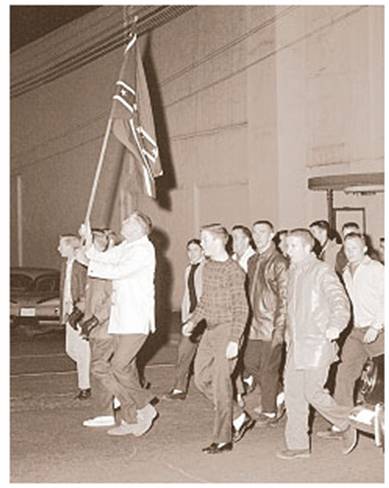
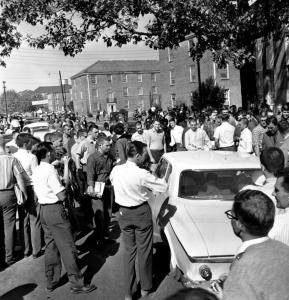
From the Memphis Commercial Appeal, "Violence helped forge new Ole Miss," by Michael Lollar, on 1 October 2012  -- OXFORD, Miss. — When the smoke and the tear gas cleared, a French journalist and a local jukebox repairman lay dead. Twenty-two deputy U.S. marshals were shot, and 166 other marshals injured. Dozens of students were wounded by exploding tear gas canisters, bricks and rocks.

The next morning, Oct. 1, 1962, most of 30,000 U.S. troops began arriving. It was the biggest invasion of the South by a federal army since the Civil War. They were there to assist marshals and National Guardsmen, to put down riots and to escort James Meredith from his dorm to his first class at the University of Mississippi.


James Meredith and the Ole Miss Riot: A Soldier's Story, By Henry T. Gallagher

A 12-member security detail of Army sharpshooters was assigned to accompany Meredith and to keep him in sight at all times, but it couldn't stop every hostility. An Army 2nd lieutenant in charge of the detail recalls a student yelling to Meredith as he emerged from the dorm that first morning: "Good morning, you black bastard." Another shouted, "Go back to Africa where you belong, n — "

Meredith walked through the insults and into history as the first black student enrolled at Ole Miss. Fifty years later, he is ranked by some in the top echelon of civil rights heroes. "I would rank him with Martin Luther King, Rosa Parks and Thurgood Marshall," said pre-pharmacy student Da'Andrea Kelly, 18, as Ole Miss observed what it calls "Fifty Years of Integration — Opening the Closed Society."


Notably absent from the observances is Meredith himself. He was 29 and an Air Force veteran when he enrolled to complete his undergraduate degree in political science at Ole Miss. Now 79, Meredith said last week, "I'm not involved in all of that. That was an insult to me and an embarrassment ... I took the insults for 50 years. I'm not going to take it no more."

Meredith, who later got a law degree from Columbia University, said his role in 1962 was bigger than himself. "I was at war. I was on a mission from God." It was a mission to end white supremacy, he has said through the years. "My present mission from God is to get the black people of Mississippi to do for themselves all that they can do to improve their lives."

The Ole Miss anniversary observances began Sept. 19 and continue through Oct. 15 with talks Monday including a 6 p.m. lecture by singer and social activist Harry Belafonte at the Gertrude Ford Center and a 3 p.m. talk at Overby Auditorium by former Army 2nd Lt. Henry T. Gallagher.

Gallagher, now an attorney in Washington, was head of Meredith's security detail and has written a new book, "James Meredith And The Ole Miss Riot — A Soldier's Story." Gallagher said last week he grew up in Minneapolis and arrived in Oxford as a 23-year-old with little understanding of the hidebound traditions that fueled the riots and the determination to preserve the South's "separate-but-equal" version of education.

Gallagher said his relationship with Meredith "bordered on friendship. Meredith would not let anyone get to know him well. Courageous guy, didn't warm up to people. He was a lone wolf if there ever was one. He distanced himself from everybody."

While the Army was sent by President John F. Kennedy to guarantee his safety, Meredith seemed to be oblivious to the grave threat he faced. "I think he was annoyed by our presence," said Gallagher, who sometimes read Meredith's mail. "A lot of the letters were death threats. I once said, 'Look at this one. They know where your parents live in Kosciusko.' He would say, 'I've got to go to my Spanish class.' He was so single-minded."

Few students made gestures of friendship or kindness to Meredith, but when they did it was awkward, Gallagher said. "It wasn't that he was annoyed, but it broke his stride, his momentum. He didn't like distractions." Students who did speak to him sometimes faced reprisal from fellow students, like one female student whose classmates bleached her clothes simply because she spoke to Meredith, Gallagher said.


Students had been among the rioters on Sept. 29, but he said many were outside agitators, members of hate groups and included people from Alabama to Texas to California who traveled to Oxford to protest Meredith's admission. "These were mean guys with cigarettes rolled up in their sleeves, ducktail haircuts." Their anger was fed by then-Gov. Ross Barnett, who had sworn Meredith would never be admitted to Ole Miss. Barnett tried to bargain with Kennedy and his brother, Atty. Gen. Robert Kennedy, until they made it clear Meredith was to be admitted. The eventual rioters then took up positions including sniper posts atop the library and on the ground surrounding the Lyceum, the school's administration building.

Barnett then tried to convince the Kennedys to make it appear that he was forced at gunpoint to stand aside.

Ole Miss traditions and the sympathies of most students and faculty favored Barnett's resistance, a defiant stance reminiscent of Gov. Orval Faubus' efforts to prevent nine black students from entering Little Rock Central High School in 1957. Almost a year after the Ole Miss riots, Gov. George Wallace stood in the doorway of the University of Alabama, making a show of defiance to block the entry of two black students. "The president (Kennedy) wants us to surrender this state to Martin Luther King and his group of pro-communists who have instituted these demonstrations," Wallace fumed.

Ken Wooten, 79, was one of five student affairs directors on duty the night of the Ole Miss riots and spent most of the night and next morning inside the Lyceum. "The student affairs folks felt like we had an obligation to go out and try to get the students to go home. When we did we were encircled. The tear gas was so thick people were crying and puking and cursing. A mob is a mob is a mob. It was a bunch of wild people who did that." Wooten said he feared for his life that night. Inside the Lyceum, he said, "There was a time you could not walk those halls without stepping over a wounded man."

Wooten, who later became registrar and dean of admissions for Ole Miss, was among eyewitnesses who took part Wednesday in a panel discussion at Barnard Observatory, home to the Ole Miss Center for the Study of Southern Culture. He said some parents immediately withdrew their children from the school out of fear for their safety. "And the following four to five years were a no-growth period for the university."

But enrollment rebounded, and Ole Miss began actively recruiting black students. By 1982, the 20th anniversary of the riots, it had eight black faculty members and 750 black students — 8 percent of total enrollment. Ole Miss' enrollment this fall is 21,535. Of those, 3,546 students or 16.5 percent, are black, said spokesman Mitchell Diggs.

In 1962, only a few faculty members were considered "liberal" and open to black enrollment. "The whole state of Mississippi had been devoted to the way things were," said Ann Abadie, assistant director of the Center for the Study of Southern Culture. She had grown up in South Carolina, gone to school in North Carolina and came to Ole Miss as a graduate student. "It was more violent here. Many people were not considered in the human race. The racist attitudes were unbelievable and institutionalized here."
Those attitudes and the showdown over federal-versus-states' rights drew newspapers from around the world. Pravda and Izvestia, the state-run newspapers of the old Soviet Union, were among them, said Ed Meek, former head of public relations for Ole Miss.

 Meek was a journalism student in 1962 and had press credentials to cover the riot. He said the rioters were arrested, but, "They were all ultimately let go." Bitterness followed Meredith into his first class, where Meek said, "The other students left the classroom and so did the teacher, a graduate student." The Army maintained a presence for months, digging foxholes on campus and camping in pup tents in a nearby national forest because the land was owned by the federal government.

Memphis financial consultant Lyman Aldrich was a sophomore in 1962 and said Meredith's violent entrance to Ole Miss and his Army security detail did not put an end to his ordeal. The floors of his dorm were concrete, and students above him used to dribble basketballs and bang soft-drink bottles on the floor to wake him during the night.

Still, empathy for Meredith waned over the years as he became increasingly enigmatic. When Ross Barnett ran (unsuccessfully) for governor four years after the confrontation, Meredith endorsed him. He later worked as an aide to staunchly conservative Sen. Jesse Helms, then endorsed former Ku Klux Klansman David Dukes' campaign for governor of Louisiana.

English professor Robert Hamblin was a graduate student in 1962 and also a National Guardsman activated to help contain the riots. Now director of the Center for Faulkner Studies at Southeast Missouri State University in Cape Girardeau, Mo., he was invited to take part in the 50th anniversary observances at Ole Miss.

"The scene is calm and quiet and clean: no tear gas, no burning vehicles, no angry and screaming mob, no threatened reporters, no uniformed soldiers," he said in a talk last week.

During a campus jog, he passed the Lyceum and noticed its stately white columns show no trace of the bullet marks long visible after the riots.


As he continued, he passed a young black couple sharing lunch at a picnic table. "I wonder if they know the bloody history of this spot of ground, if they've ever heard of James Meredith ... or the other blacks who paved the way for their attendance at this institution.

"What matters is that they are here and welcome, and safe, and unafraid, entirely at ease in this place, subject to no threat of harm or censure. Not fifty yards away stands the Confederate soldier high on his marble pedestal. He too is calm and peaceful in this new world, and I like to think that he now celebrates with us not the divisions and conflicts of the past but the brighter, nobler promises of the future we always yearn and strive for, and sometimes possess." (source: Memphis Commercial Appeal )


James Meredith and the Ole Miss Riot: A Soldier's Story at the Winter Archives from University Press of Mississippi on Vimeo.

Ole Miss: 1962


From the Daily Journal of Northeast Mississippi, "The night in 1962 that shook the state and nation," by Errol Castens of the Daily Journal Oxford Bureau

OXFORD - Fifty years ago tonight, a riot broke out over the pending admission of James Meredith as the first black student at the previously all-white University of Mississippi.

Late that Sunday afternoon, students gathered in front of the Lyceum, spurred by celebration of the previous night's gridiron victory in Jackson and a mix of anger, curiosity and fear over what lay ahead.

U.S. Marshals had circled the Lyceum, ostensibly protecting Meredith, who was assumed to be inside. (He was actually in his room at Baxter Hall.)


"The students were returning from the football game, and it was a pep rally," said Ed Meek, then an Ole Miss student and a stringer for several news organizations. While Meek and fellow stringer Larry Speakes were busy snapping photos and scribbling notes, most Ole Miss students left and were replaced by out-of-town protesters.

"I heard a wup-wup-wup, and a bottle went over my head and hit a Marshal," Meek said. "The crowd had changed, and when I turned around I didn't recognize a soul."

The riot that ensued has been called "the Battle of Oxford" and "the last battle of the Civil War." Its toll included two people dead and hundreds wounded, vehicles torched, buildings damaged and about 31,000 troops deployed.


It left the Ole Miss campus a war zone, Oxford an occupied city and Mississippi's leadership having encouraged open rebellion against the federal government.

The riot occurred after a U.S. Supreme Court order to admit Meredith, a 29-year-old black Air Force veteran, into the previously all-white university, and Meredith's arrival on campus.

While students were early taunters of the Marshals sent by President John Kennedy and his brother, Attorney General Robert Kennedy, they soon were outnumbered.

"The rioters were nearly all from somewhere else," said Kaye Bryant. "I watched a charter bus from Alabama stop and a whole busload of armed men get off."


It was a confusing time. Bryant's then-husband was deputized as a sheriff's officer and tasked with keeping Meredith out of Ole Miss; later the same day he was federalized as a National Guardsman helping protect Meredith and enforce his admission.

Official defiance

Even after the court order, segregationist Gov. Ross Barnett repeatedly blocked Meredith's enrollment, secretly bargaining with the Kennedys to send armies so he could back down while saving face.

The Kennedys were trying to avoid using force that might trigger violent revolt. Ultimately, Barnett's address to the crowd during halftime of the Ole Miss-Kentucky football game in Jackson on Sept. 29 unleashed the rabble response and spurred the federal mobilization.


"I thought the stadium was going to come down," said Hassell Franklin, now of Houston and then a 25-year-old captain in Pontotoc's National Guard unit. "People were stomping and hollering, waving Rebel flags."

Claude Hartley, then captain of the Tupelo Guard unit, said commanders had been told they might be called upon to arrest the governor. When some men questioned whether they could fight against fellow Mississippians, Hartley said, "We're going over there to enforce the law, whether you agree with it or not."

Don Sheffield, then a 22-year-old manager of the Ole Miss football team, heard Barnett in Jackson.

"He was declaring that no university in Mississippi would be integrated as long as he was governor," he said. "I thought as I heard it, 'You crazy SOB, you don't care about me as a student if you're threatening to close the university.'"


All or none

During several years of Air Force service in Japan, Meredith had come to identify himself not primarily as a black man but as an American. Back in Mississippi, he would not accept second-class citizenship.

"Paradoxically, the concept of integration was never Meredith's goal. His objective was the total destruction of white supremacy," wrote William Doyle in "An American Insurrection."

Where many civil rights leaders pushed for incremental change, Meredith took an all-or-nothing approach. Doyle quoted him as saying, "My thing is the whole hog; either all of the citizenship rights, or none."


Unforgettable night

Those in Oxford during the riot will never forget it. Rioters used shotguns, rifles, a firetruck and a bulldozer to attack the Marshals. Soldiers nearly bounced out when their trucks ran over concrete benches thrown into the street, Franklin said, and though he was hit in the face with a lead pipe, he didn't realize he was injured until his gas mask filled with blood.

A French journalist and a local onlooker were the only two fatalities, although injuries were in the hundreds. Franklin is still amazed that the number was not far worse.


"That situation could not be rerun, in my view, and not get 50, 60, 75 people killed," he said. "These were wild people; they had lost their sense of reasoning."

The Rt. Rev. Duncan Gray Jr., retired Episcopal bishop of Mississippi and then-rector of St. Peter's Episcopal Church, was one of the only white clergymen in Oxford to openly support integration. He had gone to a friend's house to watch President Kennedy on TV.

"Just as soon as his speech was over, the network announced that a riot had broken out at the University of Mississippi and that two people had been killed," Gray recalled. "We got real concerned that Jim Silver (Ole Miss history professor and author of "Mississippi: The Closed Society") was one of them, knowing that he was out there."


Gray and two faculty friends went to campus and found the riot fully involved. They urged students to leave. Gray saw Gen. Edwin Walker, who had led the troops enforcing integration in Little Rock and who had retired to oppose integration, leading one portion of the mob near Ventress Hall. Gray climbed up on the Confederate statue to get his attention.

"I pled with him, 'Please, General Walker, ask them to stop all this,'" Gray said. "He turned and said, 'You make me ashamed to be an Episcopalian.'" Several people pulled Gray off the statue, but others rescued him as the mob headed into the Circle.


Psychological warfare was part of the mob mentality. Some guardsmen ripped off their name tapes after rioters tauntingly promised to look up their families.

Meek stayed out all night photographing and reporting, staying close to the ground to endure the tear gas that seemed to be everywhere. One of his photos from early the next morning showed columns of Jeeps extending over the horizon.


By daylight, the mob on campus had largely lost its energy.

"Most people were ready to get the hell out of there," Hartley said. Of about 50 people his soldiers had arrested, a grand total of two were from Lafayette County, and "only five or six" were from Mississippi.

"There were a lot of trashy people who just liked to do harm to other people and used the integration (issue) as an excuse," he said.


Gray went home around midnight, after the military was clearly in charge, but a surprise awaited him downtown the next morning.

"I got to the Square to go by the post office, and the town was full of soldiers," he said. "The conflict had moved from campus to downtown as these people were still coming in from out of town."

Meek went with Meredith and his U.S. Marshals escort to Meredith's first classes.

"Kennedy had made a really big deal that nobody was to interfere with the academic process - no pictures," Meek said, but the photojournalist in him couldn't resist. Carrying a camera under his coat, he snapped several that showed the emptied classroom after Meredith's arrival.


"Even the professor left," Meek said. "James was all alone."

For weeks, Guard and regular Army units camped in and around Oxford.

"We stayed over there 30 days while Meredith was going to school. We patrolled and stayed ready if we were needed to maintain the peace," Hartley said.

Some units stayed through the end of the fall semester.


'Our two-by-four'

While nobody argues that Mississippi has left behind all its racist past, a lot has changed since the Battle of Oxford. Nearly a quarter of Ole Miss students are from racial minorities, including 16.5 percent black. The Associated Student Body President and Homecoming Queen are both African-American. Mississippi has more black elected officials than any other state.

U.S. Attorney General Eric Holder, who visited Ole Miss on Thursday, said the university and the nation had to endure trauma to correct a fundamental flaw.


"This was never a question of doing what was easy; it was a matter of doing what was right," he said. "We needed to carry out the Supreme Court's decision, and to affirm that the United States was a nation governed by laws unbound by the politics of convenience or the pressures of the day."

History professor Charles Eagles, author of "The Price of Defiance: James Meredith and the Integration of Ole Miss," urges the university to teach more about the context of integration.

"Why here? Why 1962?" he said Monday at the Overby Center. "A lot of people treat the riot ... as something that just emerged and then went away."


Ole Miss, Eagles said, reflected Mississippi's widespread racial oppression wrapped in sentimentality, and weak university leadership during the civil rights era helped segregationist state leaders maintain its insularity.

"We have made progress," he said. "Is anybody concerned about why we had to make progress? About what came before the progress? We can celebrate progress once we acknowledge error. We can claim redemption once we acknowledge sin."

Chancellor Dan Jones says the commemoration of 1962's events is a chance to do just that.

"As we look back, we acknowledge the years of injustice endured by Mr. Meredith and countless others, express regret and offer our apology for the injustice," Jones said. "We also take this opportunity to recommit ourselves to open doors of opportunity to everyone regardless of race or ethnicity."

Kaye Bryant long pondered how Mississippi's passive majority - people by many measures generous, pious, law-abiding and patriotic - were so blind to the evils of segregation and the cruelties that enforced it.

"All our thinking got turned completely around," she said.

Bryant found her answer in an old tale about a balky mule known to oppose the farmer's every effort to make him useful. When a neighbor later noticed the mule had become a model of cooperation, a transformation that the farmer explained as having hit the mule with a two-by-four "to get his attention."


"After that, he settled right down," she said.

The integration of Ole Miss was followed a few years later by the court-ordered integration of public schools all over Mississippi. Community leaders in Oxford set about quickly to pursue a peaceable joint path.

"We never had a single problem, because somebody had gotten our attention, and we didn't want to go there again," said Bryant. "James Meredith was our two-by-four." (source: DJournal of Northeast Mississippi)

Signing The Emancipation Proclamation


From the Smithsonian Magazine, "How the Emancipation Proclamation Came to Be Signed: The pen, inkwell and one copy of the document that freed the slaves are photographed together for the first time," by Louis P. Masur, on  December 2012 -- On July 20, 1862, John Hay, Lincoln’s private secretary, predicted in a letter that the president “will not conserve slavery much longer.” Two days later, Lincoln, wearing his familiar dark frock coat and speaking in measured tones, convened his cabinet in his cramped White House office, upstairs in the East Wing. He had, he said, “dwelt much and long on the subject” of slavery. Lincoln then read aloud a 325-word first draft of the Emancipation Proclamation, intended to free slaves in Confederate areas not under United States authority.

Salmon P. Chase, secretary of the treasury, stated that he would give the measure his “cordial support.” Secretary of State William Henry Seward, however, advised delay until a “more auspicious period” when demonstrable momentum on the battlefield had been achieved by the Union.

Lincoln concurred, awaiting a propitious moment to announce his decision and continuing to revise the document. At noon on Monday, September 22, Lincoln again gathered the cabinet at the White House. Union troops had stopped the Confederate Army advance into Maryland at the Battle of Antietam on September 17. The president saw that he now operated from a position of greater strength. Secretary of the Navy Gideon Welles later observed that Lincoln “remarked that he had made a vow, a covenant, that if God gave us the victory...it was his duty to move forward in the cause of emancipation.”

The meeting soon adjourned, and the preliminary Emancipation Proclamation was issued that day. “It is my last trump card, Judge,” he told his supporter Edwards Pierrepont, a New York attorney and jurist. “If that don’t do, we must give up.”
One hundred-fifty years later, three numinous artifacts associated with the epochal event have been photographed together for the first time. An inkwell—according to the claims of a Union officer, Maj. Thomas T. Eckert, used by Lincoln to work on “an order giving freedom to the slaves of the South” as the president sat awaiting news in the telegraph room of the War Department—is in the collections of the Smithsonian National Museum of American History. The first draft of the Proclamation resides at the Library of Congress. And the pen with which Lincoln signed the final document belongs to the Massachusetts Historical Society.
 
Yet even when Lincoln acted decisively on September 22, he announced that he would sign the act only 100 days hence, affording additional time for the Northern public to prepare for his shift in policy. The New York Times opined that “There has been no more far reaching document ever issued since the foundation of this government.” The Illinois State Register in Springfield, Lincoln’s hometown, warned darkly of “the setting aside of our national Constitution, and, in all human probability, the permanent disruption of the republic.”

One of the weightiest questions was whether significant numbers of Union soldiers would refuse to fight in a war whose purpose was now not only to preserve the Union but also to end slavery. “How Will the Army Like the Proclamation?” trumpeted a headline in the New York Tribune. Yet the Army would stand firm.
 

During that 100-day interlude, Lincoln’s own thinking evolved. He made alterations in the document that included striking out language advocating colonization of former slaves to Africa or Central America. He opened the ranks of the Army to blacks, who until then had served only in the Navy. Lincoln also added a line that reflected his deepest convictions. The Proclamation, he said, was “sincerely believed to be an act of justice.”

The edict, says NMAH curator Harry Rubenstein, “transforms the nation. Lincoln recognized it and everybody at the moment recognized it. We were a slave society, whether you were in the North or the South. Following this, there was no going back.”


When the moment arrived for signing the Proclamation—on January 1, 1863—Lincoln’s schedule had already been crowded. His New Year’s reception had begun at 11 a.m. For three hours, the president greeted officers, diplomats, politicians and the public. Only then did he return to his study. But as he reached for his steel pen, his hand trembled. Almost imperceptibly, Lincoln hesitated. “Three hours of hand-shaking is not calculated to improve a man’s chirography,” he said later that evening. He certainly did not want anyone to think that his signature might appear tremulous because he harbored uncertainty about his action. Lincoln calmed himself, signed his name with a steady hand, looked up, and said, “That will do.” Slaves in Confederate areas not under Union military control were decreed to be “forever free.”

Ultimately, it was Lincoln who declared his own verdict on his legacy when he affixed his signature that afternoon in 1863. “I never in my life felt more certain that I was doing right,” he said, “than I do in signing this paper. If my name goes into history, it will be for this act, and my whole soul is in it.”

Wednesday, January 2, 2013

Slavery in American Cinema

From the Globe and Mail, "Hollywood and slavery: A delicate dance around America’s long racial tragedy," by Geoff Pevere, on 20 December 2012 -- “The bringing of the African to America brought the first seeds of disunion.” – the first intertitle to appear in D.W. Griffiths’s The Birth of a Nation (1915)

It might seem a curious thing to have not one but two holiday-season movies – Lincoln and Django Unchained – concerned with America’s grim history of race slavery, but slavery in film has always been a subject for special occasions. It may be as ugly as historical realities get, but that doesn’t mean it isn’t spectacular.

D.W. Griffith understood this. When the former actor and pioneering cinematic visionary set out to film the very first long-form historical drama in 1915, based on Thomas Dixon’s pulpishly rousing, shamelessly dubious account of how the Ku Klux Klan rode to the rescue of a Reconstruction-ravaged South, he used the freeing of blacks from the bonds of indentured servitude as the incident that incited the greatest story the American public, until that point in its history, had ever been told.

The movie was not only a sensation but a fountain of momentous firsts: the first bona-fide blockbuster, selling out wherever it was permitted to play, and eventually taking in more money than any other American movie until the arrival, in 1939, of Gone With the Wind, another epic event about the sad song of the Old South.


The Birth of a Nation was also the first movie to demonstrate that feature-length narrative, if carefully structured and cunningly paced, was the movies’ proper popular form. It was the first to introduce a vocabulary of expressive techniques – including cross-cutting, prolonged suspense and flashbacks – that would prove elementary to the evolving moving-picture vocabulary. It confirmed the popular primacy of myth over history, thereby introducing one of American popular culture’s most enduring and powerful properties: the tailoring of the past for the purposes of the present.

It also confirmed the danger in such power: After its release, and in the wake of its juggernaut popularity, The Birth of Nation – a movie in which a chaste young Southern belle throws herself off a cliff rather than be ravaged by a brutishly lustful former slave (played by a white actor in blackface) – riots broke out, a white man murdered a black teenager in Indiana, lynchings were reported and the KKK enjoyed a sharp upward thrust in notoriety and membership. So D.W. Griffith also introduced the movie business to controversy.
Slavery has been addressed very carefully in the movies ever since. When the second major movie event with black enslavement as its backdrop appeared – Gone With the Wind, based on one of the most popular novels of the last century’s first half – it depicted black servitude as part of the romantic texture of an Old South ruined and banished to history by the Civil War and reconstruction – gone with the wind. The slaves of the plantation Tara remain loyal even after Abolition, and there is no hint of the abuse, torture and misery of human enslavement. As in The Birth of a Nation, Reconstruction is viewed as the greater evil.

Steven Spielberg

The American slave tradition is an unhealing wound, less painfully dressed up than directly touched. This is why ancient world slavery, in the form of biblical epics where the enslaved tend to be white people with American accents and the enslavers Romans with British accents, is probably more common to Hollywood movies than America’s own history. Movies like The Ten Commandments, Ben-Hur and Spartacus also provide the additional salve of justifying rebellion while muting the race issue – the easier to honour America’s own revolutionary past while ignoring its racist shame. These movies reached their peak of popularity in the late fifties and early sixties, about a century after the Civil War and the 13th Amendment (the passing of which is the subject of Steven Spielberg’s Lincoln), and just as American history was screeching round the corner toward civil rights, race riots, the assassinations of Malcolm X and Martin Luther King, and popular black payback movies like Shaft.
In the blaxploitation movies of the late sixties and early seventies, which provide the generic inspiration for Quentin Tarantino’s vigilante slave payback spaghetti western Django Unchained, the rage of sustained second-class citizenship is ventilated through sex and violence, the very stuff that terrified audiences in 1915, but which was tactically displaced from the 19th-century plantation to the urban frontier. But there were exceptions, and they were revealing: When the hyper-violent and sexualized plantation-gothic Mandingo was released in 1975, it was ripped apart for its unblinkingly sleazy look at white decadence, racism and sexual anxiety. The better to keep slavery safely contained in prison movies, the Planet of the Apes cycle and PoW escape flicks. Real slavery remained just too hot.

For movies, that is. TV was something else. For some reason, the home screen was not only far more comfortable depicting slavery in all its misery and horror, it was capable of creating events from the subject matter: The Autobiography of Miss Jane Pittman broke the dam in 1974, and with Roots came the flood in 1977. For a moment, right around the American republic’s bicentennial, everybody was looking back at something close to the truth.
 
But it’s a hard truth, and remains so for a very simple reason: How can a country founded on principles of freedom and liberty for all have kept black people enslaved for so long? And then nearly torn itself apart over the issue of whether or not that enslavement should continue?

In both Lincoln and Django Unchained, slavery is still, after all these years, cautiously regarded through the scrim of mythology. Spielberg’s movie is at its best when focusing on the political cunning of Abraham Lincoln’s efforts to abolish slavery in the United States permanently, and at its worst when black characters appear almost solely to remind us what’s really at stake. In Tarantino’s movie, Jamie Foxx’s freed slave may become the biggest gunslinging badass of the Old South, but he’s got the least developed character and fewest humdinger lines. Not to mention a very hard century and a half ahead.  (source: © 2013 The Globe and Mail Inc. All Rights Reserved.)

2012 Presidential Election: Obamamania

From the UK Independent, "'Gangnam Style' to Obamamania: 12 reasons to be cheerful about 2012: If the economic crisis has turned you into a gloomy bunny this year, here are a dozen reasons to look back on the past 12 months and smile." on 30 December 2012, "No. 3 Obamamania!" by David Randall -- 
And so, as 2012 sits mumbling to itself in the Father Time Care Home Facility for Terminally Past-it Years, sipping soup through a Tommy Tippee cup and calling all the nurses "mummy", let us give thanks to ethnic-minority Americans, the country's women, its welfare claimants, tree-huggers, nerds, pinko liberals, gays of either coast, geeks, members of the Book of the Month Club, listeners to public radio, and Medicare patients.

These are the real heroes of the past 12 months, for they are the ones who stood between us and a billionaire bozo as leader of the free world. They didn't let us down. Aided by the congenitally centre-leaning mainstream media and an economy at last responding to treatment, together they stopped the planet having to cope with the election of Willard Mitt Romney as president.
 There was a time, of course, just after the first presidential debate, when the possibility arose that this most rainbow of coalitions might not pull it off. The polls actually had Romney in the lead. But some of us never lost faith. We were convinced that, even in a nation notorious for spawning more than its share of loony-tunes, the millions who know a right-wing huckster when they see one would finally do right by us all.
And they did. They re-elected Barack Obama – a thoughtful politician whose aversion to knee-jerkery, cronyism, and trying to bomb Muslim countries into over-sized hamburger-eating democracy has been such a welcome contrast with his predecessor. Just think: a president who not only reads books, but appears to understand them as well.

The alternative result in November hardly bears contemplating. Romney is a multi-billionaire who declined to come clean about his past tax-paying, who dismissed 47 per cent of his fellow countrymen and women – that's close to 100 million people in real money – as feckless ne'er-do-wells, and who chose as his running mate a man whose economic policies make George Osborne look like a Trotskyite.
 
All you need do to appreciate the enormity of what we avoided is to tot up those elements and interest groups who would have been throwing their hats in the air at a Romney victory: bankers, the gun lobby, billionaires and country-club types, Middle East extremists, Fox News, rabidly conservative bloggers, al-Qa'ida, Goldman Sachs bonus-getters, Sarah Palin and assorted camouflage-wearing, Bowie-knife-owning libertarian nut-jobs.

God bless America – especially 47 per cent of it. (source:  UK Independent)

HOME

HOME
Click here to return to the US Slave Home Page