Monday, February 6, 2012

The Dopeman in Afghanistan


"AFGHANISTAN CLAIMS TITLE OF WORLD'S LARGEST HEROIN PRODUCER" reports the 24-7PressRelease- OAK RIDGE, NJ, April 06, 2008 — As 18,000 American troops continue to fight terrorism in Afghanistan, a new threat to global security rears its ugly head: the country's growing drug trade.

"Afghanistan has become the world's largest exporter of heroin," says Stephen Della Valle, author of the new addiction and recovery memoir Rising Above the Influence. "Nearly sixty percent of their gross national product comes from sales of the drug, which may also be funding the country's reconstruction—even more so than any foreign aid they're being given."


Fields of opium poppies have long grown in almost every province of Afghanistan, but only in the last twenty-five years have they developed into the country's biggest cash crop. Last year, Afghan "farmers" cultivated a half million acres and produced 4,000 tons of opium, much of which was made into 400 tons of morphine and heroin.

"Ninety-two percent of the world's heroin comes from Afghanistan these days," notes Mr. Della Valle. "They produce more heroin than Colombia produces cocaine, and that's really saying something."


According to the U.S. Department of Health and Human Services' 2001 National Household Survey on Drug Abuse, 3.1 million Americans over the age of twelve reported using heroin at least once in their lifetimes.

While the people of Afghanistan are making $3 billion a year from their sales of the drug, the addicts themselves are suffering from some of heroin's most deadly side effects, including: Collapsed veins, Infection of the heart lining and valves, Liver disease, Pneumonia, Increased risk of contracting HIV, hepatitis C and other infectious diseases.

"With the overthrow of the Taliban," says Mr. Della Valle, "Afghanistan's political and economic situation surely improved. But the US' vow to end drug production in that country has so far come to nothing. The country's role in the worldwide addiction epidemic remains as serious as ever." (source: 24/7)
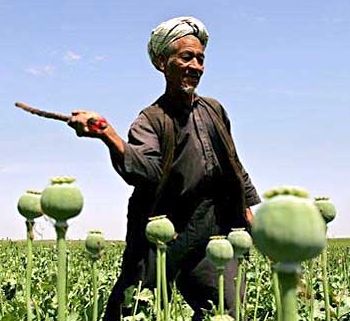

The United Nations News Centre reported on 29 July 2011 – The head of the United Nations anti-drugs agency has called for strengthening border controls around Afghanistan – still the world’s leading producer of opium and heroin – boosting security in that country, and lowering demand in so-called “consumer countries.”

Yury Fedotov, Executive Director of the UN Office on Drugs and Crime (UNODC), said in an introduction to a new study, Global Afghan Opium Trade – A Threat Assessment, that curtailing the Afghan illegal drug trade would “benefit the Afghan people, the wider region and the international community as a whole.”

“Trafficking in Afghan opiates is… very lucrative, generating some $61 billion in illicit funds in 2009 out of $68 billion for the global illicit opiate trade,” according to the report.


“Most of this money went into the pockets of traffickers all along the transnational heroin distribution routes, and some went to insurgents.” Afghan farmers earn relatively little from the trade, the report noted.

Spanning a decade, the report states that some 16.5 million people annually abuse opiates worldwide. Heroin takes the bulk of the market, with 12 million to 13 million people consuming 375 tons of heroin per year; of that, 150 tons are consumed in Europe.

Afghanistan is the world's largest producer of opium; while poppy cultivation was relatively stable at 119,000 hectares in 2010, a poppy blight affecting the high cultivation areas in 2010 reduced potential opium production to 3,200 metric tons, down over 40 percent from 2009; the Taliban and other anti-government groups participate in and profit from the opiate trade, which is a key source of revenue for the Taliban inside Afghanistan; widespread corruption and instability impede counterdrug efforts; most of the heroin consumed in Europe and Eurasia is derived from Afghan opium; vulnerable to drug money laundering through informal financial networks; regional source of hashish (2011) . (source: CIA)


In 2007, Afghanistan supplied 93% of the world's opium, according to the U.S. State Department. Illicit poppy production, meanwhile, brings $4 billion into Afghanistan,[12] or more than half the country’s total economy of $7.5 billion, according to the United Nations Office of Drug Control (UNODC).[13] It also represents about half of the economy of Pakistan, and of the ISI in particular.[source: Global Research]

Opium poppy cultivation and drug trafficking have become significant factors in Afghanistan’s fragile political and economic order over the last 25 years. Since the fall of the Taliban in late 2001, Afghanistan has become the source of 87% of the world’s illicit opium and heroin, in spite of ongoing efforts by the Afghan government, the United States, and their international partners to combat poppy cultivation and drug trafficking. Across Afghanistan, regional warlords, criminal organizations, and corrupt government officials continue to exploit opium production and trafficking as reliable sources of revenue and patronage, which perpetuates the threat these groups pose to the country’s fragile internal security and the legitimacy of its embryonic democratic government. The trafficking of Afghan drugs also appears to provide financial and logistical support to a range of extremist groups operating in and around Afghanistan, including remnants of the Taliban regime and Al Qaeda operatives. U.N. officials estimate that in-country illicit profits from Afghanistan’s record 2004 opium poppy crop were equivalent in value to 60% of the country’s legitimate GDP. (source: 2004 CRS Report to Congress)


Sunday, February 5, 2012

"Guns Slaves and Drugs"


The British East India Company was making profits by exchanging opium for tea in China. When Chinese authorities tried to obstruct this traffic, Britain waged the Opium War (1839-1842) and through the treaty of Nanjing forced them to allow trade and to cede the island of Hong Kong. In the painting the mandarin called Li is ordering the destruction of 20,291 bales of opium. (World History Plusl)


The East India Company about this time took over the importation of opium to China and by 1830 the illegal traffic averaged almost three million pounds a year. The effort of the Chinese to stop this illegal traffic, coupled with trade disagreements between Cantonese and British merchants, resulted in the so-called opium war between England and China in which the British enforced their right of free trade. China had to pay a huge indemnity, open certain ports for trade, and Britain established a government monopoly by which Indian opium was sold to Chinese merchants.

East India Company's opium factory stacking room.

Some idea of the huge volume of opium imported to China is conveyed by this picture of the stacking room in the East India Company's opium factory at Patna, India. The East India Company developed a monopoly of opium cultivation in India but disengaged itself legally and officially from the illicit trade with China by using private merchants, the so-called "country ships," sailing under its license to transfer and sell the opium in China. Private traders, however, grew restive under this monopoly, and their discontent, combined with the more general free trade agitation in Great Britain, resulted in the abolition of the Company's monopoly of the China trade in 1833. This in turn led to a new influx of opium traders, including many Americans, and the extension of the traffic beyond the Canton region to the entire southeastern coast of China. (source: COSMEO)

Opium factory in India.

A documentary about the opium wars. Part of a series called "Guns Slaves and Drugs" by Tom Joseph


Saturday, February 4, 2012

Slave Food: Okra


Okra is low in Saturated Fat and Sodium, and very low in Cholesterol. It is also a good source of Protein, Riboflavin, Niacin, Phosphorus, Potassium, Zinc and Copper, and a very good source of Dietary Fiber, Vitamin A, Vitamin C, Vitamin K, Thiamin, Vitamin B6, Folate, Calcium, Magnesium and Manganese. (source: Nutritional Data)

Okra (botanical name: Abelmoschus esculentus).

Okra: Abelmoschus esculentus, also called guibo and guimyombo, originated in what geo-botanists call the Abyssinian (Ethiopian) center of human food zones. It is still cultivated in present-day Ethiopia on the plateau portions of Eritrea, and in parts of the Sudan. It also became the essential ingredient of Louisiana gumbo.Food scholar Jessica Harris asserts that okra is “the one vegetable absolutely emblematic of the African presence in the New World.”

Indeed, its shape, texture and thickening abilities are predominantly associated with southern cooking, and most especially in southern Louisiana where it has been utilized for centuries to not only thicken but give a name to the state’s most iconic food: gumbo.

The apocryphal story of okra’s journey to the New World is that slaves brought the seeds with them. But as Harris wryly notes, given the horrors of being abducted from one’s home and sold into slavery, it is unlikely one had time to pack even the seeds of a treasured vegetable. Instead, like breadfruit, okra was probably brought over to be cultivated as a cheap foodstuff to feed the burgeoning slave population. While okra is often savored alone, it is most renowned for its thickening abilities, specifically in gumbo. (http://sofab.wikia.com/wiki/Okra)


Okra or gumbo, as it is called in Africa, was especially favoured in French and Spanish Louisiana during the colonial era, when European and Native American cuisine came together with African cooking to produce the unique Creole cuisine of New Orleans. Gumbo is a popular stew or soup, made up of vegetables mixed with chicken, pork, shrimp, or crawfish with okra as the main ingredient. The stew is thickened with powder from sassafras leaves (gumbo file).

Slaves in South Carolina commonly prepared the seeds of the Okra plant as a coffee substitute. Its leaves were also used medicinally as a softening ingredient in making a poultice, which is a warm mixture of bread or clay that can be applied to aching or inflamed parts of the body. Enslaved women sometimes used okra to achieve abortions by lubricating the uterine passage of pregnant women with the plant’s slimy pods. In West Africa, women today still use okra to induce an abortion, employing much the same method. (source: Slavery in America)


Thursday, February 2, 2012

Child Labor In North Carolina's Textile Mills

Children work at the Cherryville Manufacturing Company, a textile mill in Cherryville, N.C.

From the University of North Carolina Libraries: “Labor” was not a new concept to children who went to work in the mills. Many spent their earliest years on their family’s farm, helping their parents with chores and working in the fields. Making a living on a family farm was difficult, especially when the family was renting the land from a large landowner. Everyone on the farm worked hard at raising enough crops and livestock to support the family, but farm families rarely made a profit. Some went into deep debt during years with poor crops.

Mill owners looking for employees capitalized on the frustrations of farm families. They sent recruiters to rural and mountain farm areas to hand out pamphlets singing the praises of mill life. For families struggling to grow enough food to feed themselves and make a small profit, the prospect of a regular paycheck was appealing. Ethel Shockley and her husband moved off the farm they were renting in Virginia to work in the cotton mills of Burlington, NC in 1921. They made about 75 cents a day working on the farm and could make 2 dollars a day working in the mills. Like the Shockleys, thousands of farmers across the South made the decision to trade in their self-sufficient farm life for life in the mill village, and they brought their children with them.

Young boys working as doffers and sweepers in a textile mill in Hickory, N.C.

During the late 19th and early 20th century, the few laws prohibiting child labor were moderate and rarely enforced. In North Carolina, the age limit was 13 for employment in factories such as mills, and children under 18 were allowed to work up to a shocking 66 hours per week! Mill owners had to “knowingly and willfully” break these laws before they could be convicted. Even more lenient laws were in place in South Carolina, where the age limit for factory workers was 12 years old. However, orphans and children with “dependent” parents (those too sick to work) could work at any age and any amount of hours. These laws were rarely, if ever, enforced. Former child workers remember scrambling to hide in closets on the few occasions when factory inspectors would visit to check on working conditions in the mill.

Children working in a textile mill

The system of “helpers” was another way mill owners got around child labor laws. Very small children as young as 6 or 7 years old would visit the mill to bring meals to their parents or older siblings during the work day or simply to play amidst the machinery. These young “helpers” would begin to learn the jobs that older workers performed and try their hand at various tasks. The presence of tiny children in the mill could be explained to inspectors by saying the children were only “helping” and not on the payroll. As they got older, they spent more and more time helping until they began working full-time in the mills, usually between ages 10 to 14.


Many young mill laborers worked in the spinning room because mill owners felt their small hands were well-suited to this work. Work in the spinning room was not especially skilled or difficult, but required a watchful eye. Spinners were usually preteen or teen girls, who had to constantly attend to the cotton being spun on machines. These were the workers who “put up ends”, or repaired breaks in the thread. Doffers, often small boys, walked back and forth in the spinning room, replacing the full bobbins of thread with empty ones. Sweepers, also small boys, swept up the cotton fiber and lint from the floor and machinery to keep things running smoothly. Spinners and doffers were usually required to keep up with a certain number of machines on a side, and many workers remember“running sides” or being paid by the number of sides they worked.

Three young boys work at spinning machines in a textile mill in Cherryville, N.C.

Many former child workers speak of their eagerness to earn money, which pushed them to drop out of school and begin working in the mill. Some even began working against their parents’ wishes. It was difficult for some to see the advantage in continuing their schooling when recruitment ads claimed they could make as much as adult mill workers. Workers under 16 usually began working for 25 to 50 cents per day during the early 20th century, and could increase to $1.50 per day or more as they became more experienced.

Two little boys, child laborers in a textile mill, stand in front of their home.

CHARLIE AND OLLIE ALLEN. Charlie and Ollie Allen had been working at the Harriet Cotton Mills when this photograph was taken. Ollie was then about ten years old. Hine wrote that “the sanitary conditions are frightful.” Note that the front porch is held up by a slab of rock.
Lewis Wickes Hine, photographer. From the records of the United States National Child Labor Committee.
For the child workers, working in the mills wasn’t always uninterrupted drudgery. Children were allowed to take breaks when their work was caught up, and some of the less strict supervisors let them go outside to play during breaks. The child workers were also allowed to talk to one another in the mill across the openings in the machinery. Sometimes, the workers learned how to read lips because the machines were so loud they couldn’t understand each other otherwise!

Workers in the mills also played pranks on each other. Frank Durham remembered workers teasing new employees who had just moved from the farm and didn't know much about mill work. “There was something like that going all the time, some little old tricks and then playing pranks,” said Durham. “A new hand would come in down there sometime to work, and they’d send him after a left-handed monkey wrench, or go down there and get the key to the elevator, or the bobbin stretcher and all that stuff. Somebody that didn't know there was no such thing.” (source: Learn North Carolina)

Southern Textile Mills


"In U.S. South, Textile Mills Gone but Not Forgotten," by Willie Drye in National Geographic News, on 19 October 2004: For more than a century after the U.S. Civil War ended in 1865, the working day began across the South with the shriek of whistles at textile mills.

The whistles have nearly stopped blowing, however. The jobs that once underpinned the economy of hundreds of small towns from Virginia to Mississippi are now in Mexico, India, and China. The handsome old redbrick buildings where people once earned the money to raise families are empty, and many are falling into disrepair.


Today some people question whether younger generations understand how hard their parents and grandparents worked to make ends meet and build their communities.

Now a determined group of former mill workers, professional and amateur historians, and volunteers has launched a grassroots effort to preserve at least some of what remains of a vanishing era.

"We're trying to create a big, giant vacuum cleaner to capture those memories, or the stories will be gone," said Lynn Rumley, the great-granddaughter of a Virginia textile worker. Rumley lives in the former mill town of Cooleemee, North Carolina—about 26 miles (42 kilometers) southwest of Winston-Salem—and is leading the Southwide Textile Heritage Initiative.

Rumley wants to raise money and recruit members to compile oral histories of textile workers, to persuade school systems to teach students about their textile heritage, and to lure tourists to the old mill villages.

"We really do believe that this is a story people want to hear about," Rumley said. "It's a way of life that's gone, by and large."

Cotton spinning mill with children at work, South Carolina, 1903.

It was a compact lifestyle so nearly identical throughout the South that, if you asked mill hands in the rolling hills of northern Georgia or the coastal plain of North Carolina where they lived, they'd probably say, with a mixture of pride and self-effacement, "I live on the mill hill."

In small towns such as Haw River, North Carolina, and Valley, Alabama, and larger cities such as Macon, Georgia, and Columbia, South Carolina, hundreds of thousands of men and women went into the mills every morning. They ran the spindles and looms, loaded and unloaded the trucks, kept the books, and signed the paychecks.

At the end of their shifts they went home to mill-owned housing that they rented for a few dollars a month. When they went shopping they bought groceries and supplies in mill-owned stores. They watched movies in theaters built by the mill, and they played baseball for mill-sponsored teams.


They also developed deep personal bonds. They looked after their neighbors' children when parents had to work. And when there was a death or illness, they cleaned their neighbors' houses, cooked their meals, and comforted the bereaved families.

"It instilled a sense of togetherness, fellowship, whatever you want to call it," said Joel Jackson, who grew up in Bemis, Tennessee, a mill town about 80 miles (130 kilometers) east of Memphis. "It was a tight-knit community. I knew 90 percent of the people in town as a kid, and my dad knew everybody. If anybody got in trouble, or there was a death, everybody was there to help until they were not needed."

The mill life also had its idyllic aspects. "We were on the low end of the economic ladder, but we didn't lack for anything," Jackson said. "It was a simple life, but it was satisfying." ...


But there was a darker side to the South's textiles industry.

The region's dependence on textiles began after the Civil War, when many towns desperate for industry scraped together their own capital to start cotton mills. Impoverished mountaineers and farmers left their land to work in those mills. Textile barons in New England, eager to take advantage of a large pool of cheap labor, also started moving their operations south.

North Carolina journalist Gerald W. Johnson said profit "never became the dominant motif" for many of these early mills. "Always it was the prospect of civic and social salvation that was stressed," Johnson said.


But with people willing to work for very low wages, most of the mills made money anyway. Profits started booming in 1914, when World War I began and Southern textile mills landed huge military contracts.

But things changed when the war ended and windfall profits stopped. Many mills were now in the hands of owners who weren't motivated by "social salvation." By the late 1920s their greed and mismanagement had brought hard times to the textile towns. Many mill hands lost their jobs, and those who continued to work faced ever increasing production demands.


Flaring tempers and violence took a deadly turn in March 1929, when textile workers fed up with pay cuts and ceaseless demands for more production went on strike in Gastonia, North Carolina. A sheriff and several mill workers were shot dead.

Mill owners often used brutal tactics to break textile strikes, and organized labor was never able to gain much of a foothold in the South.

By the end of World War II in 1945, the industry had stabilized again, and textile towns flourished for about 25 years. No one knows exactly how many people worked in the southern mills when they were at their peak employment. But in 1960 there were 505,000 textile workers in North Carolina alone.

This photograph depicts the fire at the textile mill in Avalon, N.C. on June 11, 1911. I had never heard of Avalon and so turned to the handy North Carolina Gazetteer to figure out exactly where it is. Or, in this case, was. The story of Avalon gives us a sense of just how important the local mill was to early 20th-century North Carolinians. The fire was a disaster, damaging the mill well beyond any point where it could have been repaired. With the primary engine of their economy gone, the people of Avalon, located in Rockingham County, loaded around sixty houses, a Moravian church, a school, and a company store onto horse-drawn rollers and moved the whole town two miles west to Mayodan. (source: North Carolina Miscellany)
The textile industry has never lost its appetite for cheap labor, and the jobs that once filled the southern mills started to be shipped outside the United States.

Norris Dearmon, who spent 43 years in the office of Cannon Mills in Kannapolis, North Carolina, recalls the days when 18,000 people worked in the giant plant there. But after changing owners and shedding jobs for more than a decade, that mill closed in July 2003. "All the equipment's been stripped out and sent to China, India, Mexico, wherever," Dearmon said. "They really cleaned it out."

Now Dearmon is helping with the textile heritage preservation effort. Among other things, he's collecting reed hooks that weavers used in the mills. When a thread broke on their looms, weavers used reed hooks to snag the strands so the threads could be tied back together. The hooks often became very personal tools, because many weavers made their own.


Tom Hanchett, historian at the Levine Museum of the New South in Charlotte, said he hopes the work of Rumley, Dearmon, Jackson, and others will spur other people to restore the unused mill buildings. He'd like to see them used for other purposes and suggests that a textile heritage trail across the South be created to recount the times when the lives of generations of Southerners revolved around the old mill villages.

"It's always important to know where we came from," Hanchett said. "It's important to celebrate the hard work and vision that created the world we're in now, to realize that it didn't just happen [on its own]."

Willie Drye is the author of Storm of the Century: The Labor Day Hurricane of 1935, published by National Geographic.

Social Responsibility: Walter Rauschenbusch

Walter Rauschenbusch

Social Responsibility

In Christianity and the Social Crisis (1907), Rauschenbusch wrote that "Whoever uncouples the religious and the social life has not understood Jesus. Whoever sets any bounds for the reconstructive power of the religious life over the social relations and institutions of men, to that extent denies the faith of the Master." The significance of this work is that it spoke of the individual's responsibility toward society.

In his Theology for the Social Gospel (1917), he wrote that for John the Baptist, the baptism was "not a ritual act of individual salvation but an act of dedication to a religious and social movement."

Concerning the social depth and breadth of Christ's atoning work, Rauschenbusch writes: "Jesus did not in any real sense bear the sin of some ancient Briton who beat up his wife in B. C. 56, or of some mountaineer in Tennessee who got drunk in A. D. 1917. But he did in a very real sense bear the weight of the public sins of organized society, and they in turn are causally connected with all private sins."

Rauschenbusch enumerates "six sins, all of a public nature, which combined to kill Jesus. He bore their crushing attack in his body and soul. He bore them, not by sympathy, but by direct experience. Insofar as the personal sins of men have contributed to the existence of these public sins, he came into collision with the totality of evil in mankind. It requires no legal fiction of imputation to explain that 'he was wounded for our transgressions, he was bruised for our iniquities.' Solidarity explains it."


These six "social sins" which Jesus, according to Rauschenbusch, bore on the Cross:
"Religious bigotry, the combination of graft and political power, the corruption of justice, the mob spirit (being "the social group gone mad") and mob action, militarism, and class contempt-- "every student of history will recognize that these sum up constitutional forces in the Kingdom of Evil. Jesus bore these sins in no legal or artificial sense, but in their impact on his own body and soul. He had not contributed to them, as we have, and yet they were laid on him. They were not only the sins of Caiaphas, Pilate, or Judas, but the social sin of all mankind, to which all who ever lived have contributed, and under which all who ever lived have suffered."  (http://en.wikipedia.org/wiki/Walter_Rauschenbusch)

In a Southern Cotton Mill By Elbert Hubbard

In a Southern Cotton Mill: By Elbert Hubbard

I THOUGHT to lift one of the little toilers to ascertain his weight. Through his thirty-five pounds of skin and bone there ran a tremor of fear, and he struggled forward to tie a broken thread. I attracted his attention by a touch, and offered him a silver dime. He looked at me dumbly through a face that might have belonged to a man of sixty, so furrowed, tightly drawn, and full of pain it was. He did not reach for the money—he did not know what it was.
There were dozens of such children, in this particular mill. A physician who was with me said that they would all be dead probably in two years, and their places filled by others—there were plenty more. Pneumonia carries off most of them. Their systems are ripe for disease, and when it comes there is no rebound—no response. Medicine simply does not act—nature is whipped, beaten, discouraged, and the child sinks into a stupor and dies. [By Elbert Hubbard (American author and lecturer, 1859-1915)]

Wednesday, February 1, 2012

Rural Poverty in America

The majority of those living in poverty in both urban and rural areas are not minorities. Forty-eight percent of those living in poverty in America are white (O'Hare 1996). In 1990, 72.9 percent of those living in poverty in rural areas in the United States were white (RSS Task Force 1993:32). In the North Central region, the rural poor are even more likely to be white, comprising in 1993 more than 90 percent of those in rural poverty, with African Americans comprising 3.7 percent and Native Americans 2.9 percent..

From Christianity Today, "A Developing Nation Inside the U.S.: The forgotten rural poor face desperate challenges." by Nicole Russell and Mark Moring, on 4 January 2011: The phrase "poverty in America" conjures images of urban blight and plight, but in reality, rural poverty rates are higher than those in metropolitan areas.

According to the U.S. Census Bureau and the U.S. Department of Agriculture, about 16 percent of rural populations (about 8.1 million people) are poor, compared with about 12 percent of urban populations. Children fare worse: In urban areas of 1 million or more residents, 16 percent of children fall below the poverty line, compared with as many as 27 percent in some rural areas.

More than one in five poor children in America live in a rural area, but when media or policymakers discuss poverty, they usually talk about the city. When the Communication Consortium Media Center examined more than 1,400 newspaper articles on federal welfare reform several years ago, not one article dealt with the issue in rural areas.
While poverty exists in both urban and rural areas, the characteristics of those living in poverty in these two places are distinctly different. Not only do rural areas have consistently higher rates of poverty than urban places, but those living in poverty in rural areas are more likely to be white and living in two-adult households. (source: http://www.sullivan-county.com/nf0/dispatch/pov_myths.htm)
William P. O'Hare, a fellow at the University of New Hampshire's Carsey Institute, which conducts policy research on vulnerable children and families, wrote in a 2009 study that "in recent decades … rural poverty has been overshadowed by the plight of the 'urban underclass.'?" In the same study, The Forgotten Fifth: Child Poverty in Rural America, O'Hare noted that unlike urban poverty, rural poverty has many guises, including "impoverished rural hollows in the Appalachian Mountains, former sharecroppers' shacks in the Mississippi Delta, desolate Indian reservations on the Great Plains, and emerging colonias along the Rio Grande. The lack of a single image of rural poverty makes it more difficult to describe and discuss it."

It also makes it more difficult to find solutions. In rural counties, there is typically little work available. Steel mills and other manufacturing plants have been shutting down for decades, and natural resources (ores, forests) are depleted. Dated images of rural folks raising their own crops and livestock have mostly disappeared; 94 percent of today's rural labor force is engaged in work other than farming—that is, when they can find work. Jobs have moved from agriculture, mining, and forestry to low-skill manufacturing and the service sector, areas that are deficient in rural regions.


"In urban/suburban poverty there are 1,000 people per square mile," says Romanita Hairston, vice president of U.S. programs at World Vision. "People bring resources—housing, health care, and increased density for social support services. In a rural area that's less densely populated, you get the opposite effect."

Scott Allard, an expert on social welfare policy and poverty at the University of Chicago, says that "while the experience of being poor is largely the same in both suburban and rural areas—people struggle to put food on the table or pay bills—it also tends to be deeper and more extreme in rural areas."

Logistically, the rural poor have far fewer prospects, says Allard. "They have to commute great distances to find a job. Many don't have cars, and there is no public transportation. Because the distance is difficult and there are far fewer job opportunities, they face an opportunity deficit."

Rural flight is also an issue. Many young adults, unable to find jobs or concerned about future opportunities, have fled to cities and suburbs. Left in their wake are communities with a disproportionately aging population. Health care demands rise, property values plummet, schools have trouble finding good teachers, and the cycle continues and even worsens. (source: Christianity Today)


Benjamin Banneker's letter to Thomas Jefferson

Mural of Benjamin Banneker and his achievements as surveyor, inventor, and astronomer (Library of Congress)

Benjamin Banneker to Thomas Jefferson


SIR,

I AM fully sensible of the greatness of that freedom, which I take with you on the present occasion; a liberty which seemed to me scarcely allowable, when I reflected on that distinguished and dignified station in which you stand, and the almost general prejudice and prepossession, which is so prevalent in the world against those of my complexion.

I suppose it is a truth too well attested to you, to need a proof here, that we are a race of beings, who have long labored under the abuse and censure of the world; that we have long been looked upon with an eye of contempt; and that we have long been considered rather as brutish than human, and scarcely capable of mental endowments.


Sir, I hope I may safely admit, in consequence of that report which hath reached me, that you are a man far less inflexible in sentiments of this nature, than many others; that you are measurably friendly, and well disposed towards us; and that you are willing and ready to lend your aid and assistance to our relief, from those many distresses, and numerous calamities, to which we are reduced. Now Sir, if this is founded in truth, I apprehend you will embrace every opportunity, to eradicate that train of absurd and false ideas and opinions, which so generally prevails with respect to us; and that your sentiments are concurrent with mine, which are, that one universal Father hath given being to us all; and that he hath not only made us all of one flesh, but that he hath also, without partiality, afforded us all the same sensations and endowed us all with the same faculties; and that however variable we may be in society or religion, however diversified in situation or color, we are all of the same family, and stand in the same relation to him.

Sir, if these are sentiments of which you are fully persuaded, I hope you cannot but acknowledge, that it is the indispensable duty of those, who maintain for themselves the rights of human nature, and who possess the obligations of Christianity, to extend their power and influence to the relief of every part of the human race, from whatever burden or oppression they may unjustly labor under; and this, I apprehend, a full conviction of the truth and obligation of these principles should lead all to. Sir, I have long been convinced, that if your love for yourselves, and for those inestimable laws, which preserved to you the rights of human nature, was founded on sincerity, you could not but be solicitous, that every individual, of whatever rank or distinction, might with you equally enjoy the blessings thereof; neither could you rest satisfied short of the most active effusion of your exertions, in order to their promotion from any state of degradation, to which the unjustifiable cruelty and barbarism of men may have reduced them.

Sir, I freely and cheerfully acknowledge, that I am of the African race, and in that color which is natural to them of the deepest dye; and it is under a sense of the most profound gratitude to the Supreme Ruler of the Universe, that I now confess to you, that I am not under that state of tyrannical thraldom, and inhuman captivity, to which too many of my brethren are doomed, but that I have abundantly tasted of the fruition of those blessings, which proceed from that free and unequaled liberty with which you are favored; and which, I hope, you will willingly allow you have mercifully received, from the immediate hand of that Being, from whom proceedeth every good and perfect Gift.


Sir, suffer me to recall to your mind that time, in which the arms and tyranny of the British crown were exerted, with every powerful effort, in order to reduce you to a state of servitude : look back, I entreat you, on the variety of dangers to which you were exposed; reflect on that time, in which every human aid appeared unavailable, and in which even hope and fortitude wore the aspect of inability to the conflict, and you cannot but be led to a serious and grateful sense of your miraculous and providential preservation; you cannot but acknowledge, that the present freedom and tranquility which you enjoy you have mercifully received, and that it is the peculiar blessing of Heaven.

This, Sir, was a time when you clearly saw into the injustice of a state of slavery, and in which you had just apprehensions of the horrors of its condition. It was now that your abhorrence thereof was so excited, that you publicly held forth this true and invaluable doctrine, which is worthy to be recorded and remembered in all succeeding ages : ``We hold these truths to be self-evident, that all men are created equal; that they are endowed by their Creator with certain unalienable rights, and that among these are, life, liberty, and the pursuit of happiness.'' Here was a time, in which your tender feelings for yourselves had engaged you thus to declare, you were then impressed with proper ideas of the great violation of liberty, and the free possession of those blessings, to which you were entitled by nature; but, Sir, how pitiable is it to reflect, that although you were so fully convinced of the benevolence of the Father of Mankind, and of his equal and impartial distribution of these rights and privileges, which he hath conferred upon them, that you should at the same time counteract his mercies, in detaining by fraud and violence so numerous a part of my brethren, under groaning captivity and cruel oppression, that you should at the same time be found guilty of that most criminal act, which you professedly detested in others, with respect to yourselves.


I suppose that your knowledge of the situation of my brethren, is too extensive to need a recital here; neither shall I presume to prescribe methods by which they may be relieved, otherwise than by recommending to you and all others, to wean yourselves from those narrow prejudices which you have imbibed with respect to them, and as Job proposed to his friends, ``put your soul in their souls' stead;'' thus shall your hearts be enlarged with kindness and benevolence towards them; and thus shall you need neither the direction of myself or others, in what manner to proceed herein. And now, Sir, although my sympathy and affection for my brethren hath caused my enlargement thus far, I ardently hope, that your candor and generosity will plead with you in my behalf, when I make known to you, that it was not originally my design; but having taken up my pen in order to direct to you, as a present, a copy of an Almanac, which I have calculated for the succeeding year, I was unexpectedly and unavoidably led thereto.

This calculation is the production of my arduous study, in this my advanced stage of life; for having long had unbounded desires to become acquainted with the secrets of nature, I have had to gratify my curiosity herein, through my own assiduous application to Astronomical Study, in which I need not recount to you the many difficulties and disadvantages, which I have had to encounter.


And although I had almost declined to make my calculation for the ensuing year, in consequence of that time which I had allotted therefor, being taken up at the Federal Territory, by the request of Mr. Andrew Ellicott, yet finding myself under several engagements to Printers of this state, to whom I had communicated my design, on my return to my place of residence, I industriously applied myself thereto, which I hope I have accomplished with correctness and accuracy; a copy of which I have taken the liberty to direct to you, and which I humbly request you will favorably receive; and although you may have the opportunity of perusing it after its publication, yet I choose to send it to you in manuscript previous thereto, that thereby you might not only have an earlier inspection, but that you might also view it in my own hand writing.

And now, Sir, I shall conclude, and subscribe myself, with the most profound respect, Your most obedient humble servant,

BENJAMIN BANNEKER [1791]


********************************************************

Thomas Jefferson to Benjamin Banneker

Philadelphia Aug. 30. 1791.


Sir,

I thank you sincerely for your letter of the 19th. instant and for the Almanac it contained. no body wishes more than I do to see such proofs as you exhibit, that nature has given to our black brethren, talents equal to those of the other colours of men, & that the appearance of a want of them is owing merely to the degraded condition of their existence both in Africa & America. I can add with truth that no body wishes more ardently to see a good system commenced for raising the condition both of their body & mind to what it ought to be, as fast as the imbecillity of their present existence, and other circumstance which cannot be neglected, will admit. I have taken the liberty of sending your almanac to Monsieur de Condorcet, Secretary of the Academy of sciences at Paris, and member of the Philanthropic society because I considered it as a document to which your whole colour had a right for their justification against the doubts which have been entertained of them.

I am with great esteem, Sir,

Your most obedient. humble servant.

Thomas Jefferson

The Black History Month Story


From The Black Collegian: The ongoing discussion of the necessity to study Black History has persisted for more than 100 years. The early initiatives were defensive in nature and sought to prove the worthiness of Black people to be a part of the body politic of this nation and in fact, members of the human race. From the 1660s, when Virginia and Maryland institutionalized slavery, Black people felt it necessary to justify their existence. The young nation issued a fugitive slave law, extended the slave trade for 20 years, and the U.S. Constitution spelled out the less-than-human status of the children of Africa by designating them three-fifths of a person. After the government laid the foundation for white supremacy, various individuals joined the chorus touting the inferiority of Black folk. (source: The Black Collegian)

A college professor, a noted governor and the president of the United States supported white supremacy. Dr. Thomas Dew of William and Mary attempted to justify the institution of slavery by saying that Africans "[differ] from us [whites] in color and habits and [are] vastly inferior in the scale of civilization." George McDuffie, the Governor of South Carolina, added that African slavery was "destined by providence, evidenced by the color of their skin and intellectual inferiority and natural improvidence of this race." (source: The Black Collegian)

And Abraham Lincoln, the Great Emancipator, suggested that he would assign the superior status to whites, and supported Black colonization because he doubted the ability of free Black people to live successfully among whites.


Enter historians of the African/ African-American experiences to debunk the myths and escalate the struggle for freedom, justice and equality. The first years of the 20th century witnessed the pioneers and the first professionally trained historians of African descent. In 1897, W.E.B. DuBois' Harvard University doctoral dissertation, The Suppression of the African Slave-Trade, was published as the first volume of the prestigious Harvard Historical Classics. DuBois published many other books including The Philadelphia Negro and Black Reconstruction. In addition, he was a founding member of the NAACP, an the first editor of the organization's The Crisis magazine. In 1939 he founded Phylon, Atlanta University's "Review of Race and Culture." Of his studies about the African and African- American experience, DuBois said, "My attention from the first was focused on democracy and democratic development and upon the problem of the admission of my people into the freedom of democracy."1 (source: The Black Collegian)

In 1915, Carter G. Woodson, another Harvard graduate, organized the Association for the Study of Negro Life and History. The following year he published the first issue of The Journal of Negro History. According to Woodson, The Journal was created for "the collection of sociological and historical data on the Negro, the study of peoples of African blood, the publishing of books in this field, and the promotion of harmony between the races by acquainting the one with the other."2 The Journal of Negro History has been the most enduring of scholarly works on Black people. In 1926 Woodson developed the concept for the celebration of "Negro History Week," which has evolved into African American History Month, observed in February each year. Earl E. Thorpe author of Black Historians – A Critique, wrote of DuBois and Woodson, "Both were far more prolific than any Negro historian before or since, and both felt it necessary to adhere rigidly to the canons of objectivity and scientific procedure. Together with their admirers and disciples, these two men "made" modern Negro historiography." 3 (source: The Black Collegian)

Of the early historians, DuBois and Woodson are the most noted. Though there are those contributors of note before and after these two giants, the most noted pre-20th century historian is George Washington Williams, who some call the father of Black history. He had been a soldier, a Baptist minister, a lawyer and an Ohio legislator when he became interested in Black history while preparing for a lecture on services rendered to America by descendents of Africa. He found such an abundance of sources that he felt it necessary to write a general history of the "Negro." He retired from public life and worked for seven years researching and writing his monumental A History of the Negro Race in America from 1619 to 1880. Although Williams is the most noted, others included Robert Benjamin Lewis, James W.C. Pennington, William Wells Brown, William Stills, and Benjamin Brawley, among others. (source: The Black Collegian)


There is a large group of 20th century lay scholars who were not professionally trained as historians or social scientists, but who have made considerable contributions to the research, writing, and preservation of Black history. Of these, Thorpe writes, "The lay Negro historians of this period represent that group of non-professional persons, in all periods, who have a fondness for the discipline of history, feeling that their life experiences peculiarly fit them for chronicling some historical events."4 These include such notables as Arthur Schomburg, John Wesley Cromwell, Kelly Miller, J.A. Rogers, John Henrik Clarke, Dr. Ben Jochannon, John Jackson, Drusilla Dunjee Houston, among others. (source: The Black Collegian)

One would be remiss if the names of Charles H. Wesley, Monroe Nathan Work, Merl R. Eppse, C.L.R. James, George Padmore, and George G.M. James were not mentioned in such an account. And of course the professional ranks of Black historians would be incomplete without the giants Rayford W. Logan, William Sherman Savage, Lorenzo Greene, Luther P. Jackson, Benjamin Quarles, Lawrence Reddick, William Brewer, Clinton E. Knox, Eric Williams and John Hope Franklin. (source: The Black Collegian)

These scholars and many others laid the foundation and kept the flame burning for our history. Even when it was not popular, and in spite of loud denunciations by some, and almost a deafness of silence by others, they dedicated their lives to guarantee that Black history would not remain "Lost, Stolen or Strayed." (source: The Black Collegian)


Carter G. Woodson Tribute

Negro History Week Poster, February 13, 1944

February 13, 1944. Broadside 1944 .A8 FF, Special Collections, Library of Virginia, Richmond, Virginia.

Negro History Week Began

This poster announcing Negro History Week was published by the Association for the Study of Negro Life and History. This organization, founded in 1915 by Virginia native Carter G. Woodson (1875–1950), and now known as the Association for the Study of African American Life and History, organized the first Negro Achievement Week in 1924 and the first Black History Month in 1976. The image on this poster is from a portion of a famous painting Battle at Bunker's Hill by John Trumbull (1756–1843). An enslaved African American, Peter Salem, who is credited with having killed British major John Pitcairn at Bunker Hill, is depicted standing behind an American officer. (source: The Library of Virginia)

February is African American History Month


The Library of Congress, National Archives and Records Administration, National Endowment for the Humanities, National Gallery of Art, National Park Service, Smithsonian Institution and United States Holocaust Memorial Museum join in paying tribute to the generations of African Americans who struggled with adversity to achieve full citizenship in American society.

As a Harvard-trained historian, Carter G. Woodson, like W. E. B. Du Bois before him, believed that truth could not be denied and that reason would prevail over prejudice. His hopes to raise awareness of African American's contributions to civilization was realized when he and the organization he founded, the Association for the Study of Negro Life and History (ASNLH), conceived and announced Negro History Week in 1925. The event was first celebrated during a week in February 1926 that encompassed the birthdays of both Abraham Lincoln and Frederick Douglass. The response was overwhelming: Black history clubs sprang up; teachers demanded materials to instruct their pupils; and progressive whites, not simply white scholars and philanthropists, stepped forward to endorse the effort.


By the time of Woodson's death in 1950, Negro History Week had become a central part of African American life and substantial progress had been made in bringing more Americans to appreciate the celebration. At mid–century, mayors of cities nationwide issued proclamations noting Negro History Week. The Black Awakening of the 1960s dramatically expanded the consciousness of African Americans about the importance of black history, and the Civil Rights movement focused Americans of all color on the subject of the contributions of African Americans to our history and culture.

The celebration was expanded to a month in 1976, the nation's bicentennial. President Gerald R. Ford urged Americans to “seize the opportunity to honor the too-often neglected accomplishments of black Americans in every area of endeavor throughout our history.” That year, fifty years after the first celebration, the association held the first African American History Month. By this time, the entire nation had come to recognize the importance of Black history in the drama of the American story. Since then each American president has issued African American History Month proclamations. And the association—now the Association for the Study of African American Life and History (ASALH)—continues to promote the study of Black history all year. (Excerpt from an essay by Daryl Michael Scott, Howard University, for the Association for the Study of African American Life and History)


About This Year’s Theme (2012)

This year's theme "Black Women in American Culture and History" honors African American women and the myriad of roles they played in the shaping of our nation. The theme, chosen by the Association for the Study of African American Life and History urges all Americans to study and reflect on the value of their contribution to the nation. (source: The Library of Congress)

Slave Burials in the Old College Ground


The 1794 chapel at Holy Trinity Catholic Church is one of the most sacred spaces in Washington, D.C. -- the first place where Catholics could worship publicly in what was later to become the nation's capitol. It's sacred in a more secular sense to its immediate neighbors, residents of the historic Georgetown community and fierce guardians of its architectural character. (Georgetown Education)

Slave Burials in the Old College Ground

From the Death Register of Holy Trinity Church, Georgetown, a list of slaves buried in the “Old College Ground”, a burial ground on the campus of Georgetown University until 1953.


Charity, a servant woman of Mr. Zech. Smith’s, who died the 19th inst. (January 18, 1821)

Peter, a Servt. Boy of Mrs. Weaver, who died the 21st inst. (January 22, 1821)

Smith’s Louisa, a col’d child (January 22, 1821)

Teresa, a servt. woman of Mrs. Spalding (January 31, 1821)

Rachel, a Col’d Woman of the College Wash House (October 22, 1821)

Ruth, a Col’d Woman of the Visitation (January 24, 1823)

_____ a child from the people belonging to the Monastery (February 20, 1825)

Charles – black – servant of the College (January 3, 1832)

Mary, (Col’d) daughter of John Lee, a free (Col’d) Man, and of Mary, a slave to Mr. Newton age 6, was buried in the College Ground, paid. (January 5, 1835)

George – black – servt. of Miss Jane Sewall = chol.[cholera] (August 29, 1832)

Clare – black – servt. of Mr. Jos. Semmes – chol. (September 4, 1832)

Sarah – black – servt. of Mrs. Widow Semmes – chol. (September 6, 1832)

Leonard (Butler) black – a servt. of Mr. Birth – chol. (September 7, 1832)

[Glover Park History: Historical Sketches of Glover Park, Upper Georgetown, and Georgetown Heights, by Carlton Fletcher]

HOME

HOME
Click here to return to the US Slave Home Page