Thursday, June 27, 2013

Lawyer William J. Whipper Argues Against Disenfranchisement: South Carolina 1895

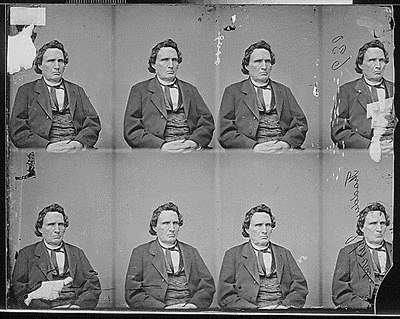
William J. Whipper
The Honorable William J. Whipper, Esquire (1834-1907)

Fighting Back: A Black Lawyer Argues Against Disenfranchisement

The South Carolina Constitutional Convention of 1895 completed the process of disenfranchising African-Americans (and many poor whites). The state’s restrictive policies began with the election law of 1882 that used an intricate system of eight ballot boxes to discourage illiterate white and black residents from voting. The 1895 convention added a poll tax and literacy test, thereby ensuring that a coalition of remaining black voters and disaffected whites could not unite to challenge Democratic Party rule in South Carolina. A handful of black delegates to the convention raised their voices against this disenfranchisement. One of them was William J. Whipper, a Northern black lawyer who had moved to South Carolina during Reconstruction to become a rice planter as well as a Republican political leader. But when northern support for Reconstruction waned in 1875, so too did black political power in South Carolina. The Governor refused to sign a commission for the judgeship to which Whipper had been elected by the state legislature. In this speech to the Convention, Whipper argued for retaining African-American voting rights.

[W. J. Whipper:] I am not here as a suppliant, nor do I put myself and my race in the attitude of a begger. I am here as a man and a representative, not representing simply the negro, but representing the people. The fact that I am a negro has nothing to do with my status here. And just here I will digress to speak of the flippant way the term “nigger” has been used in this convention. I am a negro. There are five others here that are negroes. We are proud of it, and we hope to be able to do something in and out of this convention that the negroes will be proud of and white men compelled to recognize. . . .


Is the negro such a bad citizen that you should violate all law, human and divine, and chain him down? You have the wealth and intelligence. Now you say you musn’t let the negro vote because he will vote against you. The negro is an imitative being. This has made him valuable and a necessity. What the negro asks now is that they be treated as men. You say that you must rule this country; that it’s white man’s country. We are here to ask you to stay your hand and do justice.

When the gentleman from Barnwell [County] comes here and labors long to show that under the 15th amendment that the negroes were not entitled to hold office, I say, wasn’t that a small effort. If the negro was not fit, how could he hold office?


Another gentleman—even here in the evening of the nineteenth century—comes and says the Bible justified slavery. He says he would like to have 100 slaves now. If he had them he would be worse off than any one of you. He would be taught that this business was unprofitable and troublesome.

We have only six of us here of the inferior race, and you have 154. Men upon this floor are clamoring for white supremacy, come here and assume dignity and call us niggers with the flippancy of barroom attendants. The trouble is “negro rule” and “white supremacy.” Was there ever any such thing as negro rule in South Carolina? It was the rule of white men, supported by the negroes. Ain’t there more negroes than white men on your farms? Yet, don’t your wife rule? In the convention of 1868 there were less than a dozen negroes and less than a dozen white men engaged in the work done there. I am proud of the work done in that convention. The way it has stood the test has shown that there was nothing dangerous in it. They had simply taken the best parts of other Constitutions. Most of the men were there to vote as they were told.


This convention, 'tis said, is to prevent negro rule and establish white supremacy. Again, as a matter of fact, there never was any negro rule in South Carolina. When was there ever a time when we had a negro governor? We never had a majority of negro officers at any time in this State. Indeed, there were only four colored men who ever held any of the State offices, and that only for a single term each. There never was a county in this State controlled by colored officers. In fact all of the important officers, clerk of the court, sheriff, treasurer, auditors throughout the whole State, with less than half a dozen exceptions, have been filled by white men. Does this look like negro rule? Even in the darkest hours of reconstruction, when the bad legislation led to the fall of the Republican party, white men held the offices; white men did the robberies; many of them Democrats of the deepest die, who reaped the rewards for their purchase of negroes. There never was a negro lobbyist parading the corridors of this house. They were white men. Call them carpetbaggers, scalawags, renegades, what you will, they were white men, and are responsible for the bad legislation. Charge not this up to the account of the negro. There was never a time in even old Beaufort county, where there were not more white officers than negroes. Is that negro rule? Beaufort never had a colored sheriff during the reconstruction period. Talk about negro rule. The negro could have ruled, but he has shown discretion. There was never negro rule in a single county or a single town in this State. He challenged the body to say if there was a town with a negro intendant and a majority of the town council. If I am wrong correct me. We could have elected such in my town of Beaufort. We are 20 to 1 there. Does this look like negro rule? Does that look like we want to trample on the rights of the white man?

Do away with this negro rule howl. When the negroes had a majority in the lower house, the only place where they ever had a majority, white men governed them. Things were done there that were against his protest—white men ruled. Bonds were flooded all over the State. Corruption was rife. I proclaimed it on the floor. The leading Democratic newspaper in Charleston was even subsidized. He thought a negro brought the fact out in full. That is a matter of record. I warned them to stop. But who were the lobbyists that carried it all through? They were all white men. Some of them South Carolinians, some Democrats from New York. They must take the consequences. . . .


We are going to make this fight all along the line. I know that nothing I can say will change a single vote. I do say that sooner or later, God being always right, right will eventually prevail. We want you to understand that we have rights and they must sooner or later be recognized. We are testing the very ground work of this whole matter in the United States supreme court, and we will push it to the bitter end. We may go on to congress. We want this thing to pass in the very worst form it can pass.

Where township governments exist we then know every ra[s]cal in the community. We are now going on with our fight and try to sap the very foundation of this convention. It is a duty I owe to myself and this convention that I tell you this—not in a threatening spirit, however. We go to you now and ask for justice. God is just and justice cannot sleep forever. I have spoken to you in the kindest of spirit. Whatever concerns mankind, this convention, South Carolina, all these concerns me. Your people today—the negroes are yours—are deeply concerned.


If you vote down my amendment, then fix the matter in justice to the negro and to yourselves. Remember ever that the oppressor meets a just fate. Remember, too, that:

"The laws of changeless justice bind

Oppressor with oppressed

And close as sin and suffering joined

We march to fate abreast."
(source: History Matters)

Voter Disenfranchisement In North Carolina


The Raleigh Telegram OPINION: "Voter Disenfranchisement In NC, Then And Now," by D.G. Martin, on 8 January 2013  --  RALEIGH – They “disfranchised us, and now we intend to disfranchise them.”

It sounds like what North Carolina Republicans might have said behind closed doors while they were gerrymandering legislative and congressional districts to assure their party’s continuing dominance.

However, the words came from a white Democratic state senator more than 100 years ago. Legendary historian C. Vann Woodward used the quote to show the thinking behind the white supremacy political movement in the late 1800s.


Both efforts, the post-Reconstruction “disfranchisement” and the 2011 redistricting, reduced the influence of African Americans in state government.

What made me think about the link between these two events, separated by more than 100 years?

First, an early reading of an upcoming biography of Josephus Daniels by Lee Craig reminded me of the Democratic Party’s successful efforts to minimize or eliminate African American influence in North Carolina politics at the turn of the last century.


Secondly, talking recently to a Democratic former state legislative leader, I suggested that Republicans had gone much further in redistricting to marginalize opponents than Democrats ever had. He smiled, and said, “Oh no, we would have done as much [after the 2000 census] if we had had the tools and hadn’t had Republican judges looking over our shoulders.”

Was there an element of revenge in the modern Republicans’ gerrymandered redistricting plan? It was certainly there in post-Reconstruction politics. Here is more of Woodward’s quote: “One main object was [so] to redistrict the state that for the next ten years not a Republican can be elected to the Legislature…I believe in the law of revenge. The Radicals disfranchised us, and now we intend to disfranchise them.”


As Reconstruction came to an end, white Southerners blamed all their political problems on newly enfranchised blacks and their Republican or Radical allies, which they called “the Negro problem.”

“The Democrats employed a variety of devices to diminish the Republican vote,” according to Michael Perman in “Pursuit of Unity: A Political History of the American South.” “One tactic was to redraw electoral districts so as to disperse black voters throughout the white-majority districts and consolidate the remaining black vote into one, perhaps two, congressional seats. Through similar gerrymandering schemes, they also diluted the black vote for the state legislature.”


In North Carolina during early post-Reconstruction times, black areas were put into separate governing units, which were controlled by the white Democratic-controlled state government. Meanwhile, white areas were given “home rule,” the power to govern locally.

These efforts to limit black participation were marginally successful. But they did not prevent blacks and Republicans, joined by white Populists in a Fusion partnership, from taking over state government in 1896 and dismantling many of these white-control devices.

In response, white Democrats mounted the successful white supremacy campaigns of 1898 and 1900 that finally “solved” the Negro problem by freezing blacks almost completely out of the electoral process.

In today’s North Carolina, the Republican program to disperse blacks and Democrats into Republican districts and crowd the remainder into a very few districts has been, like the white supremacy campaign, successful in minimizing African American influence.

With the shift from a Democratic majority in the legislature and the results of new redistricting plan, African Americans have gone from being a powerful minority in a majority party to a powerless majority in a minority party.


The warning a supporter gave to a new female African American legislator says it best. “[Y]ou’re going into a war where you are a minority in every sense of that word. Not just because you’re a woman, not just because you’re black, but because you are one of the few Democrats.” (source: The Raleigh Telegram)

Wednesday, June 26, 2013

Voting Rights and the Supreme Court


From the Nation Magazine, "What the Supreme Court Doesn’t Understand About the Voting Rights Act," by Ari Berman, on 25 June 2013 --  No sooner had the Voting Rights Act passed in 1965, after two hundred years of slavery and nearly 100 years of Jim Crow, than Southern conservatives, who failed to stop the law, began to attack it. South Carolina mounted the first constitutional challenge to the law only a month after it was enacted. President Nixon tried to weaken the law take the “monkey…off the backs off the South,” as did Presidents Ford in 1975 and Reagan in 1982. Every effort to gut the VRA failed. Each time the law’s constitutionality was challenged, in 1966, 1973, 1980 and 1999, the Supreme Court upheld the act. Every congressional reauthorization, in 1970, 1975, 1982 and 2006, made the law stronger, not weaker, in protecting voting rights. Each Congressional reauthorization was signed by a Republican president, cementing the bipartisan consensus supporting the VRA. “The Voting Rights Act became one of the most consequential, efficacious, and amply justified exercises of federal legislative power in our Nation’s history,” Justice Ginsburg wrote in her dissent today.

That consensus held until now, with the Roberts Court finding that Section 4 of the Voting Rights Act is unconstitutional. Section 4 is how states are covered under Section 5 of the Voting Rights Act, the provision which requires states with the worst history of voting discrimination—those who had a discriminatory voting device on the books and voter turnout of less than 50 percent in the 1964 election—to preclear their voting changes with the federal government. Without Section 4, there’s no Section 5. The most effective provision of the country’s most effective civil rights law is now dead until and unless Congress figures out a new way to cover states where voting discrimination is most prevalent that satisfies the Roberts Court.


Explained the Chief Justice, who has been trying to weaken the VRA ever since he was a young lawyer in the Reagan Justice Department: “Nearly 50 years later, things have changed dramatically. Largely because of the Voting Rights Act, ‘[v]oter turnout and registration rates’ in covered jurisdictions ‘now approach parity. Blatantly discriminatory evasions of federal decrees are rare. And minority candidates hold office at unprecedented levels.’ The tests and devices that blocked ballot access have been forbidden nationwide for over 40 years. Yet the Act has not eased Section 5’s restrictions or narrowed the scope of Section 4’s coverage formula along the way. Instead those extraordinary and unprecedented features have been reauthorized as if nothing has changed, and they have grown even stronger…. In 1965, the States could be divided into those with a recent history of voting tests and low voter registration and turnout and those without those characteristics. Congress based its coverage formula on that distinction. Today the Nation is no longer divided along those lines, yet the Voting Rights Act continues to treat it as if it were.”

Congress, which reauthorized the VRA by a vote of 390-33 in the House and 98-0 in the Senate in 2006, “cannot justify the considerable burdens created by Section 5,” the Chief Justice wrote. The Court’s message to Congress: drop dead. “In the Court’s view, the very success of Section 5 of the Voting Rights Act demands its dormancy,” wrote Justice Ginsburg in her powerful dissent. “Congress was of another mind. Recognizing that large progress has been made, Congress determined, based on a voluminous record, that the scourge of discrimination was not yet extirpated. The question this case presents is who decides whether, as currently operative, Section 5 remains justifiable, this Court, or a Congress charged with the obligation to enforce the post–Civil War Amendments ‘by appropriate legislation.’ With overwhelming support in both Houses, Congress concluded that, for two prime reasons, Section 5 should continue in force, unabated. First, continuance would facilitate completion of the impressive gains thus far made; and second, continuance would guard against backsliding. Those assessments were well within Congress’ province to make and should elicit this Court’s unstinting approbation.”


There’s a particular irony to the Court killing Section 5 just months after a presidential election in which voter suppression attempts played a starring role. Congress was prescient when it reauthorized the VRA in 2006 for another twenty-five years. Thirty-one discriminatory voting laws have been blocked by Section 5 since that time. Six of nine states fully covered by Section 5, all in the South, passed new voting restrictions since the 2010 election, when GOP state legislatures approved a wave of voter suppression laws unseen since before 1965. In 2008, Shelby County, Alabama, the plaintiff challenging the VRA, was found guilty of the very type of voter discrimination the VRA was meant to address, after trying to eliminate the only black city council district in the city of Calera. The law’s coverage formula, though dated, is still surprisingly accurate. Law professors Christopher Elmendorf and Douglas Spencer surveyed data on racial stereotypes from the 2008 election and found that “Section 5…is remarkably well tailored to the geography of anti-black prejudice.” If anything, Section 5 should be expanded to encompass the wide scope of twenty-first-century voting discrimination, not narrowed or eliminated.

Today’s opinion by the Roberts Court was the most radical since Citizens United v. FEC and the worst voting rights decision in a century, since the Court upheld poll taxes and literacy tests in Giles v. Harris in 1903. “The Court’s opinion can hardly be described as an exemplar of restrained and moderate decisionmaking,” wrote Ginsburg. “Quite the opposite. Hubris is a fit word for today’s demolition of the VRA.” Just as the Citizens United decision led to an explosion of unregulated dark money spending in US elections, so too will the loss of Section 5 encourage many more of the shadowy voter suppression attempts that we saw in 2012.


What will that mean in practice? Texas’ voter ID law, which was blocked under Section 5 by a federal court last year and could disenfranchise up to 800,000 registered voters without government-issued photo ID, will immediately go into effect. The states of the Old Confederacy will return to the pre-1965 playbook, passing new voter suppression laws that can only be challenged, after years of lengthy litigation, in often-hostile Southern courts, with the burden of proof on those subject to discrimination, rather than those doing the discriminating. Conservatives will be emboldened to challenge the parts of the VRA, like Section 2, that apply nationwide.

“The sad irony of today’s decision lies in its utter failure to grasp why the VRA has proven effective,” wrote Justice Ginsburg. “The Court appears to believe that the VRA’s success in eliminating the specific devices extant in 1965 means that preclearance is no longer needed. With that belief, and the argument derived from it, history repeats itself. The same assumption—that the problem could be solved when particular methods of voting discrimination are identified and eliminated—was indulged and proved wrong repeatedly prior to the VRA’s enactment. Unlike prior statutes, which singled out particular tests or devices, the VRA is grounded in Congress’ recognition of the ‘variety and persistence’ measures designed to impair minority voting rights. In truth, the evolution of voting discrimination into more subtle second-generation barriers is powerful evidence that a remedy as effective as preclearance remains vital to protect minority voting rights and prevent backsliding.”


There will be no easy fix in Congress. The body looked at updating how states were covered in Section 5, but no one could come up with a better answer than the draftees of the VRA in 1965. Changing the places covered by Section 5 would have blown up the entire bill. There was no political will or necessity to expand Section 5 nationwide, and “no objective statistical criteria could have added the most recent bad actors (Ohio and Florida) to the list of currently covered jurisdictions,” wrote Nate Persily, a law professor at Columbia University. “The fact that Section 5 was geographically targeted has always been seen as one of its constitutional saving graces.” Georgia Representative Charlie Norwood offered an amendment that would have exempted the entire Deep South and covered only Hawaii, a state with no history of racial discrimination in voting. The amendment was defeated 318 to 96.

Asking this current Congress, which can hardly do more than name post offices, to revamp the VRA is a very steep task. Representative Steny Hoyer, the number-two ranking Democrat in the House, was pessimistic when I asked him recently what Congress would do if the Court overturned Section 5. “I think right now it would be difficult, because I don’t think, frankly, that the Republican majority in the House would allow it on the floor,” Hoyer said. “And I don’t think the Republican minority in the Senate would refrain from filibustering it. So I don’t think there would be much opportunity for legislative response unless the Democrats take control of the House, in which case there clearly would be a legislative response.”


The VRA hasn’t changed, but the Republican Party has. Today’s 5-4 decision by the Roberts Court gutting the VRA was the result of three factors, as I wrote in February: “a whiter, more Southern, more conservative GOP that has responded to demographic change by trying to suppress an increasingly diverse electorate; a twenty-five-year effort to gut the VRA by conservative intellectuals, who in recent years have received millions of dollars from top right-wing funders, including Charles Koch; and a reactionary Supreme Court that does not support remedies to racial discrimination.” Will the same Republicans who voted overwhelmingly for the VRA’s reauthorization in 2006 do so again? Will a new crop of Tea Party Republicans, such as Ted Cruz and Rand Paul, even allow it?

But the Court’s decision today could also spark a major backlash among minority voters, like the failed voter suppression attempts of 2012 that resulted in black turnout surpassing white turnout for the first time in US history. Just as the VRA’s passage led to counter-mobilization drives led by the likes of George Wallace, who registered to vote hundreds of thousands of conservative white voters in the 1960s, so too could the loss of Section 5 motivate a new wave of minority voting activism. “I absolutely believe that Americans will be even more embolden to hold every elected official accountable on protecting and expanding voting rights,” says Jotaka Eaddy, director of voting rights at the NAACP. “If Congress fails to act it will trigger a very [strong] response from the electorate.”  (source: The Nation Magazine; Read more: What the Supreme Court Doesn’t Understand About the Voting Rights Act | The Nation http://www.thenation.com/blog/174973/what-supreme-court-doesnt-understand-about-voting-rights-act#ixzz2XNzkqX2c )


Frank Bruni: "Paula Deen is Where Sass Meets Crass"


From the New York Times, "Paula’s Worst Ingredients," by Frank Bruni, on 24 June 2013 -- Paula Deen is where sass meets crass, where the homespun and folksy curdle into something with a sour aftertaste.

Her manner may be as sugary as her cooking, her smile as big as the hams she hawked for Smithfield. But she doesn’t pause when she should. Doesn’t question herself when she must.

There’s a dearth of reflection, a deficit of introspection, and that’s not just a generational thing and not just a regional thing, as some of her fans and other observers have begun to assert, unprepared to surrender their image of Paula the Southern Eccentric to the reality of Paula the Deep-Fried Boor.


It’s a judgment thing. A sensitivity thing. It’s what happens when your shtick proves as golden as hers and your world is larded with handlers who only say “yes” and fans who only say “more.” You don’t think anybody could possibly see anything untoward in you. So you stop looking for, adjusting to, and correcting the untoward impulses that are in every last one of us.

A fresh illustration of this traveled through cyberspace on Monday, a video that shows Deen at The New York Times last October, being interviewed onstage by my colleague Kim Severson. The subject of race comes up.

“I feel like the South is almost less prejudiced,” Deen says, “because black folks played such an integral part in our lives. They were like our family.”


That statement alone is awkward — she’s referring to servants, presumably — but she doesn’t stop there. Motioning to the inky backdrop behind her and Severson, she notes that her beloved driver, bodyguard and assistant, Hollis Johnson, is as “black as that board.”

“Come out here, Hollis,” she adds, looking offstage and directing the audience’s attention there. “We can’t see you standing against that dark board.”

That’s a lot of apparent focus on skin color, in a vein so breezy it really does make you wonder, especially given what that creepy deposition brought to light last week. She admitted having used “the n word,” more than once. She admitted finding beauty in a “plantation-style wedding” with an all-black wait staff. From her butter to her banter, she’s a Confederate caricature, and a reminder of a past that’s still too present.


Just how far have we trekked on our long road toward a more colorblind, equitable society? Just how hurtfully do we still stumble? Such questions are prominent this week, with the Supreme Court sidestepping an affirmative-action decision and testimony in the Trayvon Martin case set to begin. We’re once again taking stock.

And it’s this backdrop that’s relevant to Deen’s firing by the Food Network and, on Monday, by Smithfield Foods. In a world of pervasive insult and elusive consensus, she provided a discrete opportunity for a line to be drawn. She served up a teachable moment on a platter.

There’s almost always a larger context like that when someone falls as spectacularly as Deen has fallen, and there’s almost always a prelude: a first strike.


Hers was in early 2012. That’s when she lost the benefit of the doubt, not racially but in terms of her character, by revealing that she had been diagnosed three years earlier with Type 2 diabetes, which is abetted by the calorie bombs on which her empire thrived.

This disclosure was timed not to benefit her fans, who were continuing to follow her fatty counsel, but to benefit her: one of her sons had a new healthy-cooking show that needed promoting, and she herself was stepping out as a spokeswoman — a paid spokeswoman — for a diabetes drug.


What’s more, the triumphant cynicism of this situation seemed lost on her. She beamed as always. Was saucy as ever. You knew then that she had levitated to some altitude where she felt above reproach; that her investment in the bacon-wrapped burlesque of Paula, Inc., trumped a healthy conscience; and that self-examination was a condiment gone from her larder. And it’s through the lens of that knowledge that many Americans responded to her deposition and questioned what was in her heart.

Others have urged clemency, noting that she’s 66 years old and has lived her life far south of the Mason-Dixon line.

Please. All of her adult years postdate the Civil Rights Act of 1964, and she’s a citizen of the world, traveling wide and far to peddle her wares. If she can leave Georgia for the sake of commerce, she can leave Georgia in the realm of consciousness.


Beyond which, people can change, growing past wrongful ways in the name of what’s right. We pass new laws. We adopt new language. That’s the recipe for progress: putting justice ahead of habit, principle over precedent.

It’s not one that’s been mastered by Deen, whose worst ingredient isn’t corn syrup or Crisco but willful obtuseness.  (source: The New York Times)

Voting Rights Under Attack

Justice Scalia: "Let's Talk About Racial Entitlements!"

From Slate Magazine, "Goodbye to the Crown Jewel of the Civil Rights Movement: People died to pass Section 5 of the Voting Rights Act, but that didn’t save it at the Supreme Court," by Heather Gerken, on 25 June 2013  --  The Supreme Court struck down the crown jewel of the Civil Rights movement today. Section 5 was the most powerful tool in the movement’s arsenal. Although I’m a law professor and thus supposed to be opining on the court’s decision and Congress’ potential response, I want to spend a little time mourning Section 5’s passing before hashing out the consequences.


To understand why Section 5 was special, you have to know a bit about its history. The brutal attacks on civil rights marchers crossing the Edmund Pettus Bridge provided the push needed to pass the Voting Rights Act. When the Voting Rights Act passed in 1965, almost no African-Americans were registered to vote in the Deep South due to brutal repression and sickening legal chicanery. Civil rights litigators and the Department of Justice were doing their best to help. They filed lawsuit after lawsuit to make it possible for blacks to register. But every time a court deemed one discriminatory practice illegal, local officials would switch to another. Literacy tests, poll taxes, burdensome registration requirements—these techniques were all used to prevent African-Americans from voting. Southern voting registrars would even resign from their positions as soon as a lawsuit was on the cusp of succeeding, thereby sending the case back to square one. The Voting Rights Act aimed to change all of this.
Chief Justice Roberts shreds the Voting Rights Act

Section 5 was the most important and imaginative provision in the law. It required certain states and jurisdictions, mostly in the South, to ask the federal government's permission before making any change—no matter how small—in the way they run elections. Until a rule was "precleared," it could not go into effect. This unusual provision solved the central problem of voting-rights enforcement during the civil rights era—keeping up with the increasingly creative strategies recalcitrant state and local governments used to disenfranchise voters. Section 5 shifted the burden of inertia, allowing the Department of Justice to get one step ahead of local officials.

It worked. It worked miraculously well, in fact. In a remarkably short period, African-American registration rates shot up. Section 5 mattered especially for the Deep South, where there were large concentrations of black voters. By the 1990s, these states were able to send a historic number of black representatives to Congress. But Section 5 didn’t just matter for the big-ticket races. For decades it provided strong protections for minority voters in local and state elections as well as federal ones. Based on those successes, Congress renewed Section 4’s “coverage formula”—the provision that determines which jurisdictions have to preclear changes and which don’t—again and again.

"Looks like Scalia wore the wrong ROBES to work again...."

The last renewal in 2006 finally proved to be too much for the five conservative justices. Today’s opinion rebukes Congress for relying on 40-year-old data. Put more simply, the court took Congress to task for its failure to recognize that the South is no longer the South. Chief Justice John Roberts, writing for the five-justice majority, insisted that the principles of federalism forbid Congress to require some states, and not others, to get pre-approval for potentially discriminatory election changes.


Roberts left open the possibility that Congress could make a different record and start over, thereby bringing Section 5 to life again. Almost no one thinks that’s going to happen. Section 5 is dead. Congress may or may not pass something in its place, but it will look nothing like what existed at 9:59 this morning, before the Court handed down its opinion. And part of me just wants to mourn that fact.

That might seem like an odd notion given that experts have long known that Section 5 was on its last legs. The process has been so drawn out, in fact, that it feels as if everything that can be said about Section 5’s demise has already been said. Every election law professor has had cynical discussions about whether Section 5 still matters. We’ve all offered learned opinions on the likelihood of future legislation and what shape it should take.


But still. Although we all knew this was coming, it nonetheless feels like a bit of a shock. Because Section 5 was special. No one—not even the majority today—denied that fact. It feels strange to treat this like any other Supreme Court decision.

If this were the usual case, I would be telling you that Section 5 was important for this and not that, that the court has to be right that the 1960s coverage formula couldn’t last forever, that Congress should have done more to fix what everyone knew would be a sticking point with the court. I would be giving you concrete examples of where Section 5’s absence will matter going forward. (The Texas attorney general would have beaten me to the punch by announcing two hours after the ruling was handed down that its voter ID law, blocked last year by Section 5, will go into effect immediately.) If this were the usual case, it wouldn’t bother me that this issue will be pushed off the front page tomorrow by the next round of Supreme Court blockbusters.


But for now—for just one moment—a bit of simple mourning is in order. I don’t want to end this column with a punch line or a what-comes-next paragraph. It seems disrespectful, somehow. People fought and died for this one. It made a difference—a huge difference—in the lives of a lot of people. That’s reason enough to mourn its passing.  (source: Slate Magazine)


Countdown to Election 2012: A Last-Minute Assessment from Yale Law School on Vimeo.

The 1965 Voting Rights Act: Born in Alabama and died in Alabama


As reported by the Alabama Media Group, "The 1965 Voting Rights Act: Born in Alabama and died in Alabama?" by Charles J. Dean, on 25 June 2013  --  BIRMINGHAM, Alabama – In early March Rep. John Lewis of Georgia stood near the foot of the Edmund Pettus Bridge in Selma and, as he has done for decades, remembered Bloody Sunday.

That is the iconic name given to March 7, 1965, when Lewis and others were attacked and beaten by Alabama state troopers and Dallas County sheriff deputies as they attempted to begin a march over the bridge and a trip to Montgomery to press for the right to vote.


Most know the story. The attack galvanized the Civil Rights struggle. From it a straight line emerged from an Alabama bridge named for a confederate general to the Congress, which later that year passed the 1965 Voting Rights Act. From Congress the line extended to the White House where President Lyndon Johnson, with John Lewis watching, signed the act into law.

That law is widely considered to have been the most important and most successful act of the Civil Rights movement.

On Tuesday, the U.S. Supreme Court essentially declawed it, ruling that a key provision of it was old and out of date and needed to be updated by a Congress not likely to do it, most observers believe.


For Lewis the decision provided both an answer to a question he was asked on the bridge in March and then an observation he made himself about the then pending challenge to the old law, a challenge that came from Alabama's Shelby County. Lewis, a native of Alabama, was asked if he was concerned the law might be struck down.

"...I am worried that some will believe we no longer need the vigilance the law provides," said Lewis. "... I'm worried some who look at history see it as a circle that must one day close as opposed to a line that moves forward. I think we're going to find out if a majority of the court believes history needs to keep rolling out or if the circle needs to close."

Tuesday's 5-4 decision by the court closed the circle on the law unless a deeply divided Congress acts.

After the decision Lewis said he was dismayed by the ruling and summed up his reaction this way:

"What the Supreme Court did was to put a dagger in the heart of the Voting Rights Act."


Rep. Terri Sewell, D-Birmingham, said this: "Today's Supreme Court ruling is a major setback for voting rights in this country."

Sewell noted the irony of Tuesday's court ruling.

"It is terribly ironic that the state responsible for the enactment of the Voting Rights Act is now being used by the Supreme Court to dismantle the core of that act," said Sewell.

State Sen. Hank Sanders, D-Selma, was angered by the decision.

""I think it's the most destructive decision the Supreme Court has rendered in 50 years," said Sanders.

Alabama Gov. Robert Bentley issued a statement saying Alabama will not tolerate discrimination but also said, "Alabama has made tremendous progress over the past 50 years, and this decision ... recognizes that progress."

Rep. Mike Hubbard, speaker of the Alabama House of Representatives also issued a statement after the ruling.

"The Alabama of today is vastly different than the one of a half century ago, and the time for us to be freed from the burden of federal oversight is long overdue," said Hubbard. "Today's ruling clearly states that our constitutional rights as Alabamians take precedence over the wants and whims of liberal Justice Department bureaucrats in Washington, D.C. Starting today, Alabama will be able determine its own destiny when it comes to campaigns, elections and voting procedures in our state."

President Barack Obama Tuesday issued a statement after the decision was handed down saying he was "deeply disappointed" by it and called on Congress to pass laws to ensure every American has equal access to the polls.

In March of 2007 then Sen. Obama traveled to Selma as a presidential candidate to celebrate the 42nd anniversary of Bloody Sunday. He was not alone. Then Sen. Hillary Clinton, also seeking the presidency came as well. And, so did former President Bill Clinton.

This year Vice President Joe Biden came to Selma, along with U.S. Attorney General Eric Holder.


That's all evidence of the special place Selma holds in civil rights history and Alabama holds, said historian Taylor Branch, who is best known for his landmark trilogy on the civil rights era.

"The next three years mark fiftieth anniversaries for hosts of important civil rights era moments, critical moments that shaped the nation. And, in so many of those moments Alabama stands at the center from Birmingham to Montgomery to Tuscaloosa and most especially to Selma," said Branch. "Selma is where the world finally watched on their TV's the brutal face of oppression in the Deep South. It's why you see politicians and leaders come back to Selma over and over. ...I think it's beyond ironic that the state that is home to the most important piece of legislation in the civil rights era could turn out to be the state that mounts the challenge that could kill it."  (source: Alabama Media Group, "The 1965 Voting Rights Act: Born in Alabama and died in Alabama?" by Charles J. Dean, on 25 June 2013 )


Government by Judiciary: The Supreme Court Rules Voting Rights a Dead Letter


As reported in TruthOut, "Ku Klux Kourt Kills King's Dream Law, Replaces Voting Rights Act With Katherine Harris Acts," By Greg Palast, on 25 June 2013 --  They might as well have burned a cross on Dr. King's grave. The Jim Crow majority on the Supreme Court just took away the vote of millions of Hispanic and African-American voters by wiping away Section 4 of the Voting Rights Act of 1965.

When I say "millions" of voters of color will lose their ballots, I'm not kidding. Let's add it up.

Last year, the GOP Secretary of State of Florida Ken Detzner tried to purge 180,000 Americans, mostly Hispanic Democrats, from the voter rolls. He was attempting to break Katherine Harris' record.
Detzner claimed that all these brown folk were illegal "aliens."


But Section 4 of the Voting Rights Act requires that 16 states with a bad history of blocking black and brown voters must "pre-clear" with the US Justice Department any messing around with voter rolls or voting rules. And so Section 4 stopped Detzner from the racist brown-out.

I'll admit there were illegal aliens on Florida voter rolls - two of them. Let me repeat that: TWO aliens - one a US Marine serving in Iraq (not yet a citizen); the other an Austrian who registered as a Republican.

We can go from state to state in Dixie and see variations of the Florida purge game.


Yet the 5-to-4 Supreme Court majority ruled, against all evidence, that, "Blatantly discriminatory evasions [of minority voting rights] are rare." As there's no more racially bent voting games played in states including Florida, Georgia, Arizona and Alaska (yes, pre-clearance goes WAY north of the Confederacy), then, the justices said, there's no more reason for pre-clearance.


Whom do they think they're fooling? The court itself, just last week, ruled that Arizona's law requiring the showing of citizenship papers was an unconstitutional attack on Hispanic voters. Well, Arizona's a Section 4 state.

You'll love this line from the Ku Klux Kourt majority. They wrote that the "coverage" of Section 4 applies to states where racially bent voting systems are now "eradicated practices."


"Eradicated?" I assume they didn't see the lines of black folk in Florida last November. That was the result of the deliberate reduction in the number of polling places and early voting hours in minority areas. Indeed, if the Justice Department, wielding Section 4, didn't block Florida from half its ballot-box trickery, Obama would have lost that state's electoral votes.

And that's really what's going on here: the problem is not that the court majority is racist. They're worse: they're Republicans.

We've had Republicans, like the great Earl Warren, who put on the robes and take off their party buttons.

But this crew, beginning with Bush v. Gore, is viciously partisan. They note that "minority candidates hold office at unprecedented levels." And the Republican Supremes mean to put an end to that. See "Obama" and "Florida" above.

And when they say "minority," they mean "Democrat."


Because that's the difference between 1965 and today. When the law was first enacted - based on the personal pleas of Martin Luther King - African-Americans were blocked by politicians who did not like the color of their skin.

But today, it's the color of minority voters' ballots - overwhelmingly Democratic blue - which is the issue.

In California - one of the "Old South" states that is singled out for pre-clearance - an astonishing 40 percent of voter registration forms were rejected by the Republican Secretary of State on cockamamie clerical grounds. When civil rights attorney Robert F. Kennedy and I investigated, we learned that the reject pile was overwhelmingly Chicano and Asian - and overwhelmingly Democratic.

How? Jim Crow ain't gone; he's moved into cyberspace. The new trick is lynching by laptop: removing voters, as was done in Florida and Arizona (and a dozen other states) by using poisoned databases to pick out "illegal" and "felon" and "inactive" voters - who all happen to be of the Hispanic or African-American persuasion. The GOP, for all the tears of its consultants, knows it can't rock these votes, so they block these votes.

Despite the racial stench of today's viciously antidemocratic ruling, the GOP majority knew they were handicapping the next presidential run by a good 6 million votes. (That's the calculation that RFK and I came up with for racially bent vote loss in 2004 - and the GOP will pick up at least that in the next run.)
And the court knew full well that their ruling today was the same as stuffing several hundred thousand GOP red votes into the ballot boxes for the 2014 Congressional races.


Thaddeus Stevens on Suffrage (African American Voting Rights)

From the New York Times, "Thaddeus Stevens on Suffrage," published on 13 January 1868


Thaddeus Stevens on Suffrage
Washington, D.C., January 6, 1868

DEAR SIR: So far as I took any position with regard to negro suffrage, it was and is that universal suffrage is an inalienable right, and that since the amendments to the Constitution, to deprive the negroes of It would be a violation of the Constitution as well as of a natural right.  True, I deemed the hastening of the bestowal of that franchise as very essential to the welfare of the nation, because without it I believe that the Government will pass into the hands of REBELS and their friends, and that such an event would be DISASTROUS to the WHOLE COUNTRY.

With universal suffrage  I believe that true men of all the nation can maintain their position.  Without it, whether that suffrage be impartial, or in ANY WAY QUALIFIES, i look upon this Republic as likely to relapse into an OLIGARCHY, which will be ruled by coarse copperheadism and proud conservatism.

I have never insisted that the franchise should be unjustly regulated so as to secure a Republican ascendancy  but I have insisted, and do insist, that there can be no unjust regulation of that franchise which will give to any other party the power if the Republicans are true to themselves, and do not fall into their usual vice of cowardice.

The Republicans, once beaten into a minority by force of negro prejudice, will never again obtain the majority, and the nation will become a despotism.

Very respectfully yours,

Thaddeus Stevens
(source:  The New York Times, "Thaddeus Stevens on Suffrage," published on 13 January 1868)

A Brief History of African American Voter Disenfranchisement


From the African American Experience's Jim Crow Encyclopedia,  "Disenfranchisement," by Sherita L. Johnson  --  Depriving African Americans the right to vote, or disenfranchisement, was a significant feature of Jim Crow politics for almost a century. It began in the late nineteenth century as a means to curtail the political advantages African Americans had gained during Reconstruction. After the Civil War, three constitutional amendments were ratified to ease the transition from slavery to freedom: the Thirteenth Amendment abolished slavery, the Fourteenth Amendment granted former slaves the right to citizenship, and the Fifteenth Amendment granted black men the right to vote. These three Reconstruction amendments were contested by the former Confederate states because African Americans were no longer under whites' control. This period of relative freedom and equality lasted for about a decade, until Southern states repealed all the Reconstruction Acts created by radical Republicans, the party once headed by Abraham Lincoln. By the mid-1870s, the Democratic Party had regained much of their former congressional power with the support of a new administration. White Southerners sought redemption for the loss of the Civil War, and their most pressing concern was, as one historian puts it, a “struggle for mastery” once again over African Americans.

In a move to return to the white supremacy status quo, disenfranchisement was a political process that took only a few decades to accomplish. The history of black suffrage began when the Fifteenth Amendment was ratified in 1870. Only a small percentage of free blacks, primarily in the North, had voting privileges prior to then. During Reconstruction, African Americans took full advantage of their voting rights by supporting Republican officials, particularly electing other blacks to office. High-ranking black Republicans during this period included state legislators, governors, and U.S. senators. Congressmen Robert Smalls from South Carolina and John Lynch from Mississippi as well as Louisiana Governor P.B.S. Pinchback were among the many black politicians elected by black voters during the 1870s and early 1880s. Such victories were short-lived, as white Southerners began manipulating the elections in various ways. Black voters were often verbally harassed or physically assaulted to prevent them from casting their ballots or even reaching the polls. Violent threats and terror campaigns for voter intimidation usually occurred without legal intervention.


Some African Americans would refuse to be intimidated despite such warnings. If they did succeed at casting their votes, however, white election officials often destroyed these ballots. Black voters were usually unaware that their votes were not counted under such conditions. “Ballot box stuffing” was yet another deceptive tactic used to disenfranchise African Americans. This practice of “counting out” the intended votes of African Americans for an opposing candidate or using phony ballots against the candidate supported by a black majority were ways of “stealing” the vote. This second phase in the history of black suffrage was an age of “Redemption,” when white Southerners schemed to regain political control of once Republican-dominated governments.

White Democrats were determined to find other ways of effectively disenfranchising blacks that would prevent them from even registering to vote. They drew a fine distinction between having “the ability to vote at elections” and “the right to vote” at all. The latter option was a more permanent solution to the “race problem” attributed in part to black suffrage. All the political, social, and economic advancements African Americans had made in just a few years since slavery antagonized white supremacist ideas about natural social order. The rallying cry of “Negro domination” signaled the fears of white Southerners in regard to the power wielded by the black vote in support of the Republican Party. African Americans were never in control as white Southerners imagined, because segregation laws upheld white hegemony. Blacks were deemed social inferiors with little or no civil rights to protect. Yet, the idea of blacks ruling whites inspired a revolution. The specter of “Negro domination” could only be replaced by another political obsession, “white supremacy.” Complete disenfranchisement resolved the ideological conflict of race by restoring white supremacy.

1959 Poll Tax Receipt

By the 1890s, Southern states began to deprive African Americans of their voting rights by creating stringent voting restrictions. Property qualifications were required in Alabama, Louisiana, Virginia, North Carolina, Mississippi, Georgia, and South Carolina; the registered voter had to own as much as $300 or more in real estate or personal assets. Poll taxes were imposed in Tennessee, Arkansas, Florida, Texas, and several other states with property qualifications. A third common voting restriction was an education qualification. Literacy tests were administered to prove if a potential voter was capable of understanding his rights. Often these tests included reading and interpreting passages from the U.S. Constitution. Sometimes the election officials would read an article or constitutional amendment and ask the applicant to explain the passages. Such practices were common in Mississippi, South Carolina, Louisiana, Alabama, North Carolina, and Virginia. Not all of the voting restrictions were effective in just eliminating black voters, but some whites could also be disenfranchised too. Therefore, “saving clauses” were often included in voting restriction proposals as loopholes for whites who would be otherwise disqualified by property, poll tax, and educational qualifications. The “grandfather clause” was intended as a nonracial requirement that nevertheless limited black suffrage; it stipulated that any son or descendent of a (Confederate) soldier or any one who had the right to vote prior to 1867 would then inherit his ancestral voting rights. This law of inheritance did not always prevent African Americans from voting, considering the documented participation of black soldiers in both the Union and Confederate armies during the Civil War. Nevertheless, the grandfather clause did eliminate a majority of black voters who were themselves descended from former slaves. Some African Americans just faltered under considerable pressures of disenfranchisement. They would not vote at all or would sell their votes altogether. These two forms are not technically forms of disenfranchisement, since the individual was not prevented from voting but instead chose not to do so. However, the employment qualification and character assessments were two notorious forms of voting restrictions found in Alabama. The black voter would have to prove that he had suitable employment and then that he was of “good character.” Both qualifications were judged by a white election official and therefore subject to his discretion.

African Americans responded to the motives and means of disenfranchisement with their actions and words. In record numbers, they continued to vote despite the fraudulent election schemes. Less educated blacks would sometimes be accompanied to the polls by others to insure a fair chance at voting. Most African Americans believed that voting was a basic right of U.S. citizenship and were determined to maintain their civil rights at all costs, even to their personal safety. Writer Charles Chesnutt participated in the public debates about the second-class citizenship status being forced on African Americans. In his article, “The Disenfranchisement of the Negro” (1903), Chesnutt challenged the constitutionality of the various voting restrictions imposed in Southern states. He therefore criticized the federal government for being influenced by white Southerners: “Not only is the Negro taxed without representation in the [South], but he pays, through the tariff and internal revenue, a tax to a National government whose supreme judicial tribunal declares that it cannot, through the executive arm, enforce its own decrees, and, therefore, refuses to pass upon a question, squarely before it, involving a basic right of citizenship” (92). Chesnutt believed that the federal government could have taken action by using congressional regulations, under the Fourteenth Amendment, to prevent Southerners from “a district where voters [had] been disfranchised” from ever holding office. Thus, white Southerners' political power would be just as limited as disenfranchised African Americans. The black press also responded to voter manipulation by castigating the perpetrators. The Richmond Planet and Southwestern Christian Advocate (a Methodist paper in New Orleans), for example, featured editorials about black disenfranchisement that was occurring throughout the South. Between 1902 and 1905, the Baltimore Afro-American Ledger led a series of campaigns against the move to segregate public transportation, as an additional consequence of disenfranchisement. It circulated few successful petitions and organized boycotts that would allow blacks to retain at least an illusion of political power.


"One Less Negro Vote" -- The Richmond Whip

“Restoration,” or the third phase in the history of black suffrage, was completed by the early twentieth century. The black vote was eliminated by amendments to state constitutions. Southern states held conventions to revise their suffrage requirements that could circumvent federal election laws. The Democrats secured their political power through voting manipulation and intimidation. They had also manipulated public opinion against black suffrage as a challenge to white supremacy. Only when organizations such as the National Association for the Advancement of Colored People (NAACP) began to take action did white supremacists lose some footing. By the 1930s and 1940s, organized by the NAACP, black voter registration drives once again appeared as the modern Civil Rights Movement began to take shape. Medgar Evers and other activists challenged the election of racist demagogues in Mississippi and Georgia. It was the black vote that secured the presidential election of Harry S. Truman in 1948. As evidenced in Truman's administration, civil rights legislation was reintroduced to the national public. African Americans staged massive protests against racial discrimination and segregation throughout the 1950s and 1960s. Militant opposition to racial oppression and support of voting rights was signaled by Malcolm X's speech “The Ballot or the Bullet” (1964) to a gathering in Cleveland. Black disenfranchisement, one of the last vestiges of Jim Crow, would finally be overturned by the Voting Rights Act of 1965 when federal authorities would regulate voter registration and blacks could free access to the ballot. See alsoBlack Codes; Nadir of the Negro; Williams v. Mississippi.  (source: African American Experience's Jim Crow Encyclopedia,  "Disenfranchisement," by Sherita L. Johnson )

HOME

HOME
Click here to return to the US Slave Home Page