Monday, April 15, 2013

The Confederacy's Salt Famine: by Andrew F. Smith


The Salt Famine

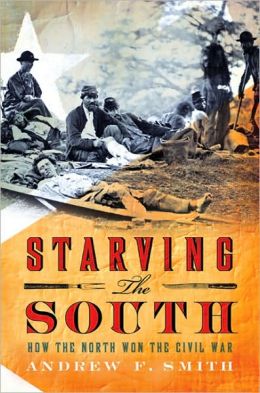
A book excerpt from the Denver Post, "Starving the South: How the North Won the Civil War" by Andrew F. Smith, posted on 5 June 2011  --  Prior to the Civil War, Southerners used an estimated 450 million pounds of salt annually. Very little salt was produced in the antebellum South; most of it came from Wales on ships, which carried salt as ballast when they sailed to Southern ports to pick up cotton. In the nineteenth century, salt was used for commercial purposes, such as tanning leather for use in making harnesses and shoes. Salt’s most important use, however, was as a preservative. In an age without refrigeration, virtually all pork and beef that was not cooked and served immediately after slaughter was preserved in brine. Salt was used to preserve fish, and other foods, such as butter, had to be salted. Salt was also used in cooking and was added as a condiment at the table. At the time, Americans consumed more salt than any other nation in the world, and more salt was used in the South than in any other region of the United States.

Once the blockade was declared, ships no longer brought salt into Southern ports. New Orleans had large stockpiles of salt, but this accumulation had shrunk to nothing by the fall of 1861. The price for salt surged so high that many farmers who raised hogs were unable to preserve them because they had no salt. One farmer wrote to the governor of Mississippi: “With a great many now, the deepest anxiety prevails to keep our families from suffering for want of salted provisions. Meat is now ready to be slaughtered.”

The shortage of imported salt was only one reason for its rising price; another cause was speculation. An editor of a Mississippi newspaper reported in November 1861 that “all the salt in New Orleans and elsewhere is now in the hands of speculators.… Something must be done in the matter, and be done quickly. We are willing that speculators should reap a rich profit, but we are not willing for them to suck the very life blood out of the people, if we can avoid it.”

The salt famine became severe in 1862. In March of that year an Alabama official reported that speculators were using “every artifice and fraud” to acquire salt. In May 1862 the editor of Atlanta’s Southern Confederacy announced that “we will be in a dreadful condition unless we get salt.” In December twenty women from Greenville, Alabama, became fed up with the salt famine. They marched on the local railroad station shouting “Salt or Blood,” and forced an agent to give up the contents of a large sack of salt.


Facing severe shortages, Southern leaders encouraged domestic salt production. States offered rewards for locating salt deposits and bonuses for its production. Southerners began to manufacture salt from salt lakes, saline artesian wells, and seawater. While such domestic production helped families and small farmers, these sources did not produce enough salt to meet the military and civilian needs of the Confederacy. Only five areas in the South had sufficient concentrations of salt to produce the large quantities needed to replace imported salt. These were the Great Kanawha River, near Charleston, then in Virginia; Goose Creek near Manchester, Kentucky; the salt wells in Clarke, Washington, and Mobile counties in Alabama; the saline wells near New Iberia in northern Louisiana; and the great saline artesian wells in the extreme southwest corner of Virginia, near Saltville. In addition, large-scale operations to convert ocean water to salt emerged in Florida. These operations produced enough salt for military, industrial, and civilian needs, but it was difficult to transport due to the lack of railroads in Florida.

When the price of salt skyrocketed in early 1862, Daniel D. Avery and his son-in-law, Edmund McIlhenny, began working the salt springs on Avery Island, not far from New Iberia, about 140 miles west of New Orleans. By accident, Avery discovered a source of dry, pure rock salt a mere fifteen to twenty feet below the surface. Avery and McIlhenny began to quarry this salt in May 1862. A Confederate agent sent out to evaluate the site claimed that the mine could supply “the Confederacy if properly managed.” As the Union forces controlled New Orleans, salt from Avery’s Island had to be shipped by a circuitous route overland to the Red River, and to the Mississippi, where it could then be distributed throughout the eastern Confederacy.


Union forces were well aware of the importance of salt to the Confederacy, and they targeted salt production facilities. The salt manufacturing areas around Kanawha Valley in Virginia and Goose Creek in Kentucky were taken or destroyed by the North early in the war. In Louisiana, Union forces seized New Iberia and took control of Avery Island in 1863. Saltville, Virginia, was regularly targeted, but it wasn’t finally captured until December 1864. Meanwhile, the Union navy conducted continuous amphibious efforts to disrupt salt manufacturing in North Carolina and repeatedly assaulted saltworks and plantations along Florida’s Gulf Coast. Many plantation owners took their slaves inland, where, often, both master and slave became subsistence farmers.

Another solution to the salt famine was for Southerners to curtail their use of salt. Those living near the coast cooked rice, grits, and hominy in seawater. Civilians were encouraged to eat tinned corned beef, which didn’t need salt added at the table. Southern newspapers, journals, and books published dozens of recipes made with little salt. Salt conservation and even salt recycling became common practices. Southerners collected and reused loose salt grains from cured meat. Troughs and barrels used for brining meat were dried and the salt recaptured for future use. The floorboards in salt houses were ripped out and soaked in water, which was then boiled down to produce a little salt. People even dug up the soil under old smokehouses and recovered salt, which was fed to cattle and horses. In addition to conservation and recycling efforts, Southerners experimented with numerous methods for curing meat with little or no salt, but the meat often spoiled. Experimenters also produced a substance that tasted somewhat like salt, according to Varina Davis, the wife of Jefferson Davis; however, this had no preservative property.


Without salt, Southerners frequently went without meat, and as time went on, things only got worse. After the occupation of Avery Island and New Iberia by Union forces in 1863, a resident of the area told the Confederate Congress that those living in “Louisiana lying east of the Mississippi River are starving for the want of salt and salt meat.” Southern governors spoke of “salt famines” and established programs for citizens to buy salt cheaply, yet the price continued to rise.27 Despite these efforts, the salt famine meant shortages of pork that would previously have been preserved. The beef supply also dwindled because salt was essential to the diet of cattle, and without it, the animals did not fatten up. Likewise, cavalry and artillery horses sickened from the absence of salt (a necessary electrolyte for animals kept hard at work) in their diet. By the end of the war, Confederate leaders were offering exorbitant fees for blockaders to bring in salt and salted meat. Had the South just figured out a better way to tap the natural salt deposits that they had, imports would have been unnecessary. Then there was the transportation problem. (source: The Denver Post --  A book excerpt from the Denver Post, "Starving the South: How the North Won the Civil War" by Andrew F. Smith, posted on 5 June 2011)

Friday, April 12, 2013

FREDERICK DOUGLASS: THE INTERNAL SLAVE TRADE, 1852

THE INTERNAL SLAVE TRADE.

Take the American slave-trade, which we are told by the papers, is especially prosperous just now. Ex-Senator Benton tells us that the price of men was never higher than now. He mentions the fact to show that slavery is in no danger. This trade is one of the peculiarities of American institutions. It is carried on in all the large towns and cities in one half of this confederacy; and millions are pocketed every year, by dealers in this horrid traffic. In several states, this trade is a chief source of wealth. It is called (in contradistinction to the foreign slave-trade) "the internal slave-trade." It is, probably, called so, too, in order to divert from it the horror with which the foreign slave-trade is contemplated. That trade has long since been denounced by this government, as piracy. It has been denounced with burning words, from the high places of the nation, as an execrable traffic. To arrest it, to put an end to it, this nation keeps a squadron, at immense cost, on the coast of Africa. Every-where, in this country, it is safe to speak of this foreign slave-trade, as a most inhuman traffic, opposed alike to the laws of God and of man. The duty to extirpate and destroy it, is admitted even by our DOCTORS OF DIVINITY. In order to put an. end to it, some of these last have consented that their colored brethren (nominally free) should leave this country, and establish themselves on the western coast of Africa! It is, however, a notable fact, that, while so much execration is poured out by Americans, upon those engaged in the foreign slave-trade, the men engaged in the slave-trade between the states pass without condemnation, and their business is deemed honorable.

Behold the practical operation of this internal slave-trade, the American slave-trade, sustained by American politics and American religion. Here you will see men and women, reared like swine, for the market. You know what is a swine-drover? I will show you a man-drover. They inhabit all our Southern States. They perambulate the country, and crowd the highways of the nation, with droves of human stock. You will see one of these human flesh jobbers, armed with pistol, whip and bowie-knife, driving a company of a hundred men, women, and children, from the Potomac to the slave market at New Orleans. These wretched people are to be sold singly, or in lots, to suit purchasers. They are food for the cotton-field, and the deadly sugar-mill. Mark the sad procession, as it moves wearily along, and the inhuman wretch who drives them. Hear his savage yells and his blood-chilling oaths, as he hurries on his affrighted captives! There, see the old man, with locks thinned and gray. Cast one glance, if you please, upon that young mother, whose shoulders are bare to the scorching sun, her briny tears falling on the brow of the babe in her arms. See, too, that girl of thirteen, weeping, yes! weeping, as she thinks of the mother from whom she has been torn! The drove moves tardily. Heat and sorrow have nearly consumed their strength; suddenly you hear a quick snap, like the discharge of a rifle; the fetters clank, and the chain rattles simultaneously; your ears are saluted with a scream, that seems to have torn its way to the centre of your soul! The crack you heard, was the sound of the slave-whip; the scream you heard, was from the woman you saw with the babe. Her speed had faltered under the weight of her child and her chains! that gash on her shoulder tells her to move on. Follow this drove to New Orleans. Attend the auction; see men examined like horses; see the forms of women rudely and brutally exposed to the shocking gaze of American slave-buyers. See this drove sold and separated for ever; and never forget the deep, sad sobs that arose from that scattered multitude. Tell me citizens, WHERE, under the sun, you can witness a spectacle more fiendish and shocking. Yet this is but a. glance at the American slave-trade, as it exists, at this moment, in the ruling part of the United States.


I was born amid such sights and scenes. To me the American slave-trade is a terrible reality. When a child, my soul was often pierced with a sense of its horrors. I lived on Philpot Street, Fell's Point, Baltimore, and have watched from the wharves, the slave ships in the Basin, anchored from the shore, with their cargoes of human flesh, waiting for favorable winds to waft them down the Chesapeake. There was, at that time, a grand slave mart kept at the head of Pratt Street, by Austin Woldfolk. His agents were sent into every town and county in Maryland, announcing their arrival, through the papers, and on flaming "hand-bills," headed CASH FOR NEGROES. These men were generally well dressed men, and very captivating in their manners. Ever ready to drink, to treat, and to gamble. The fate of many a slave has depended upon the turn of a single card; and many a child has been snatched from the arms of its mother, by bargains arranged in a state of brutal drunkenness.
The flesh-mongers gather up their victims by dozens, and drive them, chained, to the general depot at Baltimore. When a sufficient number have been collected here, a ship is chartered, for the purpose of conveying the forlorn crew to Mobile, or to New Or-leans. From the slave prison to the ship, they are usually driven in the darkness of night; for since the anti-slavery agitation, a certain caution is observed.

In the deep still darkness of midnight, I have been often aroused by the dead heavy footsteps, and the pitious cries of the chained gangs that passed our door. The anguish of my boyish heart was intense; and I was often consoled, when speaking to my mistress in the morning, to hear her say that the custom was very wicked; that she hated to hear the rattle of the chains, and the heart-rending cries. I was glad to find one who sympathized with me in my horror.


Fellow-citizens, this murderous traffic is, to-day, in active operation in this boasted republic. In the solitude of my spirit, I see clouds of dust raised on the highways of the South; I see the bleeding footsteps; I hear the doleful wail of fettered humanity, on the way to the slave-markets, where the victims are to be sold like horses, sheep, and swine, knocked off to the highest bidder. There I see the tenderest ties ruthlessly broken, to gratify the lust, caprice and rapacity of the buyers and sellers of men. My soul sickens at the sight.

"Is this the land your Fathers loved, The freedom which they toiled to win? Is this the earth whereon they moved? Are these the graves they slumber in?"

But a still more inhuman, disgraceful, and scandalous state of things remains to be presented.

By an act of the American Congress, not yet two years old, slavery has been nationalized in its most horrible and revolting form. By that act, Mason & Dixon's line has been obliterated; New York has be-come as Virginia; and the power to hold, hunt, and sell men, women and childreH, as slaves, remains no longer a mere state institution, but is now an institution of the whole United States. The power is co-extensive with the star-spangled banner, and American Christianity. Where these go, may also go the merciless slave-hunter. Where these are, man is not sacred. He is a bird for the sportsman's gun./ By that most foul and fiendish of all human decrees, the liberty and person of every man are put in peril. Your broad republican domain is hunting ground for men. Not for thieves and robbers, enemies of society, merely, but for men guilty of no crime. Your law-makers have commanded all good citizens to engage in this hellish sport. Your President, your Secretary of State, your lords, nobles, and ecclesiastics, enforce, as a duty you owe to your free and glorious country, and to your God, that you do this accursed thing. Not fewer than forty Americans, have, within the past two years, been hunted down, and, without a moment's warning, hurried away in chains, and consigned to slavery, and excruciating torture. Some of these have had wives and children, dependent on them for bread; but of this, no account was made. The right of the hunter to his prey, stands superior to the right of marriage, and to all rights in this republic, the rights of God included! For black men there are neither law, justice, humanity, nor religion.


The Fugitive Slave Law makes MERCY TO THEM, A CRIME; and bribes the judge who tries them. An American JUDGE GETS TEN DOLLARS FOR EVERY VICTIM HE CONSIGNS to slavery, and five, when he fails to do so. The oath of any two villains is sufficient, under this hell-black enactment, to send the most pious and exemplary black man into the remorseless jaws of slavery! His own testimony is nothing. He can bring no witnesses for himself. The minister of American justice is bound, by the law to hear but one side; and that side, is the side of the oppressor. Let this damning fact be perpetually told. Let it be thundered around the world, that, in tyrant-killing, king-hating, people-loving, democratic, Christian America, the seats of justice are filled with judges, who hold their offices under an open and palpable bribes, and are bound, in deciding in the case of a man's liberty, to hear only his accusers!

In glaring violation of justice, in shameless disregard of the forms of administering law, in cunning arrangement to entrap the defenseless  and in diabolical intent, this Fugitive Slave Law stands alone in the annals of tyrannical legislation. I doubt if there be another nation on the globe, having the brass and the baseness to put such a law on the statute-book. If any man in this assembly thinks differently from me in this matter, and feels able to disprove my statements, I will gladly confront him at any suitable time and place he may select.  (source: The University of RochesterORATION, DELIVERED IN CORINTHIAN HALL, ROCHESTER, BY FREDERICK DOUGLASS, JULY 5TH, 1852.)

Abraham Lincoln's Turning-point by Eric Foner


From The UK Guardian, "The Emancipation Proclamation at 150: Abraham Lincoln's turning-point; The preliminary proclamation freed no slaves, but it irrevocably changed the Union's grounds for war against the Confederacy," by Eric Foner, on 17 September 2012 -- One hundred and fifty years ago this week occurred one of the crucial turning points of the American civil war and, indeed, of American history. Not on the battlefield, although at Antietam on 17 September 1862, a Union army forced Confederates under Robert E Lee to abandon their invasion of Maryland. Rather, it came five days later, when Abraham Lincoln issued "A Proclamation" warning the south that if the war did not end within 100 days, he would declare slaves in areas under rebellion "forever free".

Like all great historical transformations, emancipation during the civil war was a process, not a single event. It played out over time, arose from many causes and was the work of many individuals. It began at the war's outset when slaves, ignoring Lincoln's insistence that the struggle was about national unity, not slavery, began to seek refuge behind Union lines. It did not end until December 1865, when secretary of state William H Seward announced the ratification of the 13th amendment, irrevocably abolishing slavery throughout the reunited nation. But what came to be known as the Preliminary Emancipation Proclamation marked a key step in this process.


Lincoln believed that union, not emancipation, was the lowest common denominator of public support for the war. But he also understood that slavery was the war's fundamental cause. Beginning in November 1861, he promoted a plan to encourage voluntary abolition in Delaware, Maryland, Kentucky and Missouri, the border slave states that remained with the union. The federal government would provide financial compensation to states that acted to end slavery, and would encourage the freed people to emigrate to Africa or Central America. (Lincoln had long believed that "colonization", as this idea was called, would benefit both races; most blacks denounced it as a denial of their right to equality in the United States.)

On 22 July 1862, Lincoln informed his cabinet of a dramatic change in policy. He had decided to issue an order freeing all slaves in Confederate-held areas as of the following 1 January. During the previous months, he had been subjected to enormous pressure to adopt a new course. The Republican majority in Congress had pressed forward with actions against slavery – barring the army from returning fugitives, abolishing slavery in Washington, DC and, in the Second Confiscation Act, freeing slaves held by Confederates if they came within Union lines.


Lincoln signed all of these measures. With the war at a stalemate, he was increasingly convinced that the Union could not emerge victorious without making slavery a target. He was also exasperated with southerners, including the border states, who professed loyalty to the Union but insisted that slavery remain undisturbed. When a prominent citizen of New Orleans complained that the army was encouraging slaves to escape, Lincoln fired back:
"What would you do in my position? … Would you give up the contest, leaving any available means unapplied?"

Not all cabinet members approved of Lincoln's decision, although all recognized its momentous significance. But Seward warned that issuing the proclamation immediately might seem as an act of desperation – he advised Lincoln to wait until the Union achieved a military victory. Lincoln put the Proclamation aside. During the next two months, he continued to affirm his previous policy regarding slavery, urging a black delegation at the White House to promote colonization among their people, and publishing a widely-noted letter to New York Tribune editor Horace Greeley, reaffirming that preservation of the Union, not abolition, was the war's primary purpose.

Antietam provided the victory for which Lincoln had been waiting, and on 22 September 1862, he issued the Preliminary Emancipation Proclamation. The document revealed Lincoln's thinking at a crucial moment of transition. He reiterated his previous commitment to monetary compensation for slaveholders whose states consented to abolition and his belief that the freed people should be colonized outside the United States. (These elements would be eliminated in the final Emancipation Proclamation.) But he made it clear that after 1 January, the Union army would be fighting not simply to preserve the Union, but to destroy the major institution of southern life.


Lincoln's proclamation was only a warning. It did not free a single slave – that would come when the Emancipation Proclamation was issued. But contemporaries understood that the character of the civil war was about to change. Perhaps the most penetrating assessment came from Karl Marx, then writing occasional dispatches from London for the New York Tribune:
"Up to now, we have witnessed only the first act of the civil war – the constitutional waging of war. The second act, the revolutionary waging of war, is at hand."
(source: The UK Guardian)

Taylor Branch on Race in the South


From the Washington Monthly, "Taylor Branch on Race in the South," by Taylor Branch

In the summer of 1969, Taylor Branch took a job registering rural black voters in his home state of Georgia. He kept a diary of his experiences, which he later turned into a Washington Monthly article detailing how the gains of the civil rights era were being systematically undermined by corrupt police in the rural South. The experience also sparked the idea for Parting the Waters: America in the King Years 1954–63, Branch’s Pulitzer Prize–winning narrative history of the civil rights movement.

ll right, get the money off the table,” said Bubba-doo Wiggins, the proprietor of the Big Apple in Cuthbert, Georgia, as he jumped from his perch with a can of Colt 45 and a fistful of house-cut dollars. In what resembled the routine panic of a grammar school fire drill, he herded all the card players across the hall into a small closet on the mysterious side of the shack. The younger people scattered. The white man, a graduate student visiting the town, followed the pack, disoriented, and was the last to squeeze into the tiny room.


“What the hell is going on?” he whispered to his fellow loser.

“Beer truck,” he replied, obviously amused at the other’s perplexity.

Through a crack in the door, the stranger could see Bubba-doo behind the bar. He saw the proprietor put down his Colt 45 to greet two uniformed white men who ambled up and began some small talk.

“Who’s that, the sheriff?” whispered the white man to the loser.

“No, the police,” he said. “They go around with the beer truck every Friday.”

The screen door closed again, and a rotund white man soon came into view, wheeling a half-dozen cases of beer up to the bar. He was wearing a Schlitz uniform and smoking a cigar. He left for another load.


Bubba-doo soon rapped on the door with the all-clear sign, and the poker players tumbled out into the hallway. The white man ran to a window in time to watch the beer truck stir up the red dust, with the police car right behind.

Unfortunately, the poker game had evaporated. As the others filed past on their way home for supper,the stranger decided that their interest in him wasdirectly related to whether or not his pockets werefull.

“No more game here, man,” observed his fellow loser.

The two losers walked across the room, past the jukebox, and out onto the Big Apple’s front porch, where the strains of a twilight hymn from the revival floated on the summer air.

“Whatchew doing down here in niggertown?” came a voice from the police car, which had drifted back down the road, evidently having finished its beer run.

‘‘Sir?”


‘‘I said whatchew doing down here in niggertown?”

“I’m, you know, I’m doing a manpower survey for the university. Uh, I’m seeing about the kind of jobs these people have around here.”

“You what?” The stranger walked down the steps and over to the passenger side of the police car, experiencing all the physical symptoms of acute fear—shaking, sweating, burning skin, gulping, pounding heart, dry mouth, cold hands, wobbling knees, cloudy, swirling brain.

“You ain’t down here trying to stir up our niggers, are you?”

“No, sir.”

“We treat our niggers real good around here, so we ain’t had no riots or anything, and we aim to keep it that way. Do you know you could get knifed down here easy as that?”

“No, sir,” said the accused, looking surprised and hoping that the policeman would take him for a bumbling student, which seemed accurate enough.


From the white people’s point of view, the operation of the law is a distinctly informal business in southwest Georgia. Few local whites are ever arrested, other than a drunk or two, and the main concerns of the law are traffic tickets and the maintenance of calm among the black people. Neither task draws much attention from most white people, and keeping the lid on the black parts of town seems so easy that it produces boredom.

If policemen seem rather overlooked by the white people, the Negroes act in compensation, for black people see them as the symbol of white power. The policeman represents more than violence or the fact that whites inevitably win any interracial legal battle. The man who rose from the pool room to the police car symbolizes the unpredictability of law enforcement for blacks. Lacking the restraint and formality of schoolbook law, he uses his badge as he sees fit and is often governed by an ornery mood.

The farcical tragedy of law and order in the black belt lies in the exclusion of black people from even a sniff of fairness. Enforced lines of discrimination still separate balcony from ground floor in theaters and courtrooms, front from back in laundromats, and white from black in hospitals. The hospitals of small counties are bastions of segregation, and the towns are rife with tales of bed switching or employees’ jumping into beds when the inspectors come. One clinic has survived such inspections without indoor toilets for black patients, who must walk two hundred yards to the outhouse or have relatives there to handle bedpans. The sanitation facilities are generally indicative of the quality of care in that institution.

A black man may walk into the restaurant only to pass the waitress on her way to tell the police that he has “made advances” toward her; and sometimes he may sit down to wait futilely for service or to find that the prices are triple those on the menu and the portions microscopic. Faced with an infinite variety of such obstacles, local black people usually take their food through the ubiquitous side window.


Black subordination in the public realm has crucial ramifications in all areas of racial contact, for blacks have no avenue of recompense for wrongs against them—whether by a restaurant owner or an individual white man. Moreover, they have no means of seeking outside assistance even if they wish to brave its hazards. They find themselves in helpless equilibrium: the local predicament of black people incapacitates them from birth, and incapacitated people are rendered unable to seek outside help even if it is available.

Only 30 percent of the eligible black people in southwest Georgia are registered to vote—primarily because people are paralyzed with fear. This fear, in turn, depends upon the most devastating forms of personal discrimination. Acute fear is itself a measure of the absence of law and order, almost by definition.
(source: the Washington Monthly)

Thursday, April 11, 2013

Deconstructing Reconstruction: by Nicholas Lemann


From the Washington Monthly's January/ February 2013 issue, "Deconstructing Reconstruction: The tumultuous decade that followed the Civil War failed to enshrine black voting and civil rights, and instead paved the way for more than a century of entrenched racial injustice, by Nicholas Lemann

Children in elementary school often come home with the idea that the purpose of the Civil War was to end slavery—but if that were true, then why did it take Abraham Lincoln so long to issue the Emancipation Proclamation, and why was it less than universally popular in the Union states? If you see the movie Lincoln, you get a much fuller picture of the contingency of emancipation, and of the difficulty of passing the Thirteenth Amendment to the Constitution, which abolished slavery completely—but why didn’t Lincoln and the Congress think to address at the same time the obvious question of what status the freed slaves would have after that? After Lincoln’s assassination, Congress and the state governments settled that matter by passing the Fourteenth and Fifteenth Amendments, which gave the former slaves full civil rights and voting rights—but why was it necessary for exactly the same rights to be reenacted, after enormous struggle, nearly a century later, during the civil rights era?


The answers to all these questions are essentially the same: for most of American history, white America has been highly ambivalent, or worse, about the idea of full legal equality for black Americans. Emancipation itself was a forced move, an obvious consequence of the war only in retrospect; it happened because in war zones in the Confederate states, slaves left their plantation homes and appeared at Union army encampments (they were known at the time as “contraband”), and somebody had to decide what to do about them; sending them back to their owners would be both morally suspect and a form of material aid to the enemy. There has always been a debate about what kind of Reconstruction regime Lincoln would have instituted after the war, had he lived; his racial impulses were generous, but he was not an abolitionist until he actually abolished slavery. Reconstruction—the tumultuous decade or so that followed the Civil War—was an enormous shaping force in American history, and not just in the area of race relations. It’s worth recounting in basic outline, because it’s a far less familiar story than that of the Civil War itself, but far more relevant today.

The word “Reconstruction” is somewhat misleading in the American case, because it implies that the main challenge was managing the tension between punishing the South for seceding and getting it back on its feet economically and politically. In this instance the more pressing question was what the lives of the millions of freed slaves in the South would be like. Would they be able to vote? To hold office? To own property? To sue white people? Would government undertake an active, expensive effort to educate them and put them on the way to economic self-sufficiency? Merely to say that former slaves were now free turned out to resolve remarkably little.

In the period just after the Civil War, Lincoln’s vice president and successor, Andrew Johnson, was impeached for moving too slowly on these matters, and for being too lenient with the South. Then the fiercely antislavery “radical Republicans” took power, rammed through the Fourteenth (civil rights) and Fifteenth (voting rights) Amendments, maintained the presence of federal troops in the South to enforce those laws, and ran a proto-War on Poverty through a new federal agency called the Freedmen’s Bureau, which was meant to help the freed slaves. Just as the Emancipation Proclamation and the Thirteenth Amendment were enormously controversial, in the North as well as the South, so too, only more so, were these “radical Reconstruction” measures.


The freed slaves never got “forty acres and a mule,” a land-reform idea that has resonated through the years but wasn’t enacted (see “Rumors of Land”), but they did get the basics of citizenship—most importantly, the right to vote. One of the most amazing achievements in the history of black America was the creation, in just a few years, of an elaborate political machinery—Republican, of course—that produced far higher (in fact, pretty close to 100 percent) voter turnout among freed slaves in the South than the United States as a whole has now. One result of this was that the South elected dozens of black officials to national office, and another was that state and local governments delivered, at least to some extent, what the freed slaves wanted, notably education at all levels.

None of this was especially popular in the North, and it was wildly unpopular in the white South. Most of the rest of America chose to understand black political empowerment in the South in terms that are still familiar in conservative discourse today: excessive taxation, corruption, and a power imbalance between federal and state government. These arguments were more presentable than simply saying that black people shouldn’t be allowed to vote, and they built sympathy for the white South among high-minded reformists in the North who were horrified by the big-city political machines that immigrants had created in their own backyard. Good-government reformers hated the idea of uneducated people taking over the democratic machinery and using it to distribute power and patronage, rather than in more high-minded ways. Liberal northeastern publications like the Nation, the Atlantic Monthly, and Harper’s Weekly were reliably hostile to Reconstruction, and their readers feasted on a steady diet of horror stories about swaggering corrupt black legislators, out-of-control black-on-white violence, and the bankruptcies of state and local government.


The Ku Klux Klan, which began in the immediate aftermath of the war and was suppressed by federal troops, soon morphed into an archipelago of secret organizations all over the South that were more explicitly devoted to political terror. These organizations—with names like White Line, Red Shirts, and White League—had shadowy ties to the more respectable Democratic Party. Their essential technique was to detect an incipient “Negro riot” and then take arms to repel it. There never actually were any Negro riots; they were either pure rumor and fantasy that grew from a rich soil of white fear of black violence (usually entailing the incipient despoliation of white womanhood) or another name for Republican Party political activity, at a time when politics was conducted out of doors and with high-spirited mass participation. The white militia always won the battle, if it was a battle, and nearly all the violence associated with these incidents was suffered by black people. In the aggregate, many more black Americans died from white terrorist activities during Reconstruction than from many decades of lynchings. Their effect was to nullify, through violence, the Fifteenth Amendment, by turning black political activity and voting into something that required taking one’s life into one’s hands.


All of this was known at the time (the movie Birth of a Nation can be seen as an extended brag about the effects of these techniques during Reconstruction), and there was no mystery about what the remedy to Southern political terrorism was: federal troops. Just as in every “Negro riot” the white militia won, in every encounter between the U.S. Army and a white militia, the Army won. The Army was in the South to enforce the Fourteenth and Fifteen Amendments, and it became increasingly clear that without its presence, the white South would regionally nullify those amendments through terrorism. But the use of federal troops to confront the white militias was deeply unpopular, including in the North. Remember that in the 1870s, despite the Civil War, few Americans thought of their national government as properly occupying an ongoing active presence in their lives. The country had never been entirely for full rights for African Americans in the first place, and it wanted to put the Civil War and its legacy behind it. In January 1875, troops under the command of General Philip Sheridan, the great Union cavalryman, marched onto the floor of the Louisiana legislature to ensure that representatives elected by black voters would be seated. This incident was denounced by virtually every respectable liberal voice in the North; at a public protest meeting in Faneuil Hall in Boston, most of the leading white former abolitionists demonstrated that they had turned against Reconstruction. It’s a clear example of the idea that the past is another country—it is hard for us to imagine today how abolitionists could support emancipation but not full black citizenship, but many of them did.


President Ulysses S. Grant, perhaps out of conviction and perhaps out of political calculation (black Southern voters were a big part of the Republican electoral base), placed himself close to the pro-Reconstruction edge of white opinion. Every member of his Cabinet was more hostile to Reconstruction than he was. But he did not feel confident that he could empower federal troops again and again to enforce black voting rights until the South finally accepted those rights. The crucial moment came in the fall of 1875 (election dates were less standardized then than they are now), when Mississippi and Ohio held state elections. White terrorists in Mississippi made it clear, by arming themselves and disrupting Republican political activity, that they intended to suppress the black vote to the point that the Democrats would win. A group of Ohio politicians visited Grant and told him that if he had federal troops enforce the Fifteenth Amendment in Mississippi, it would be so unpopular in Ohio that the Democrats would win there. Grant tried to compromise by sending a negotiator to Mississippi to broker a peace treaty between the Republicans and the White Line organization, but the Democrats immediately violated the treaty, there was a wave of electoral violence in November, and the Democrats swept back to power (while the Republicans held Ohio).


The next year, militia organizations across the South copied “the Mississippi plan” for black vote suppression, and this was one reason the 1876 presidential election ended in a tie—which was resolved by the Republicans promising to withdraw federal troops from the former Confederacy, in return for the presidency. From that point on, enforcement of the Fourteenth and Fifteenth Amendments in the South grew increasingly lax. Whites with guns “called upon” politically active Republicans, black and white, and urged them to move to the North or drop their political activities—and the advice was frequently taken. By the 1890s the Southern states were able legally to institute the Jim Crow system, which formally rescinded black civil rights and voting rights, without challenge from the federal government. Through at least the first half of the twentieth century, most white Americans, North and South, understood Reconstruction to have been a miserable failure on its own terms, and even most liberals regarded Jim Crow as an impregnable fortress. In 1957, Congress passed a civil rights bill, and President Dwight Eisenhower sent federal troops to the South to ensure black Americans’ rights (specifically, the right to attend Central High School in Little Rock, Arkansas)—the first time either had happened since 1875.


Once your ear is tuned to hear them, echoes of Reconstruction are all around us today. The distinctive voting patterns of the South are a product of Reconstruction and Jim Crow, and the dramatic switch in the South’s political loyalties beginning in the 1960s is a direct result of the Democratic Party’s aligning itself with the original goals of Reconstruction. Reconstruction was the beginning point for most of our debates about the proper size and extent of the federal government; the Fourteenth and Fifteenth Amendments were the first important measures directing the national government to do something affirmatively, rather than forbidding it to do something. It’s no accident that African Americans are consistently the group with the most favorable view of government; essentially all of their progress toward full legal equality came as a result of government—specifically, federal government—action. Periods of greater state and local power were periods of at best no progress, and at worst more terror. And psychologically, the yawning gap that still exists between the way whites and blacks understand Reconstruction—which, unlike the Civil War and the civil rights movement, has had almost no depictions for popular audiences since the days of Gone With the Wind, but gets communicated privately inside family homes in very different ways—must partly account for what remains of the profound gaps between the races in their perception of the essential nature of the national project. (source: The Washington Monthly)

Click here to read more from our Jan/Feb 2013 cover package “Race, History, and Obama’s Second Term.”

A Second Emancipation By Taylor Branch


From the Washington Monthly's January/ February 2013 issue, "A Second Emancipation: One hundred years after Lincoln signed the Proclamation, Martin Luther King Jr. tried unsuccessfully to get President John F. Kennedy to issue a second one. That failure changed the course of history," by Taylor Branch and Haley Sweetland Edwards


In October 1961, Martin Luther King Jr. and President John F. Kennedy took an after-lunch stroll through the elegant hallways of the White House residence. Their meeting that day was not official: it was not in the White House’s appointment book, and King had not been formally invited to discuss any sort of business. It was instead a guarded and rather stilted introduction for leaders of professed goodwill, in a political climate that remained extremely sensitive about race.

When the men passed the Lincoln Bedroom on their tour, King noticed the Emancipation Proclamation framed on the wall, and took the opportunity to raise, ever so delicately, the pressing issue of civil rights. King suggested something radical: a second Emancipation Proclamation, a proposal that would become the centerpiece of King’s lobbying campaign for the next year.

Taylor Branch, the Pulitzer Prize-winning civil rights scholar and biographer of King, recently sat down with Washington Monthly editor Haley Sweetland Edwards and explained this idea, what happened next, and how Kennedy’s choice on the matter altered King’s thinking and the course of the civil rights movement.

How did the off-the-record meeting between King and Kennedy come about that October evening?

The administration had summoned King to Washington for a meeting that day at the Justice Department, where officials insisted that one of his advisers was a dangerous communist subversive and that King had to get rid of him. King was still shaken by the demand when he went into the residence, not the West Wing, for his private meeting with the president. An appointment with the president would have been too controversial—King was still a radioactive figure then. He had gone to jail in the South; he’d been indicted and tried for violating segregation laws embedded in the constitutions of the southern states; and he’d been denounced by the same governors who’d supported the president. King’s White House visit was deliberately made intimate but hidden, and social. He was led upstairs to the residence for a private luncheon with President Kennedy and Jackie.

Jackie’s presence was a signal to King that he couldn’t say anything political that would ruin the moment—nothing about segregation or the sit-ins or the Freedom Rides that shook the country that year. They talked politely about their educations in Boston, their children, and that sort of thing.

Why, of all things, did King suggest a second Emancipation Proclamation?

When they were walking down the hallway, King saw the Emancipation Proclamation hanging on the wall in the Lincoln Bedroom. It provided an excuse for him to bring up politics in a positive way—to talk about the historic glow of Lincoln’s decision. King suggested that perhaps the president would consider issuing a second Emancipation Proclamation for January of 1963, on the 100th anniversary of the first one. Just as Lincoln had used an executive order to abolish slavery in the Southern states, King said, Kennedy could outlaw segregation.

King loved the idea of a second Emancipation Proclamation. He thought it would be easier for Kennedy than passing legislation—southerners had strangled every significant civil rights proposal in Congress for a century. At the same time, King hoped for an initiative by the president to make things easier for a struggling civil rights movement. King had not joined the Freedom Rides himself, nor yet accepted the personal sacrifice of a determined campaign to end segregation. He deeply hoped that if the president issued an executive order, there could be an easy way out for both of them.


What happened after that conversation outside the Lincoln Bedroom?

For the next six months, King and his lawyers drafted a second Emancipation Proclamation in Kennedy’s name. Then in May of 1962, when King was in Washington for a meeting to launch his Gandhi Society for Human Rights, he delivered a copy to the White House personally. It was a very fancy draft, bound in leather for the president, with copies for all the lower-level officials involved in civil rights. The cover letter said, “We ask that you proclaim all segregation statutes of all southern states to be contrary to the constitution, and that the full powers of your office be employed to void their enforcement.” The idea was to get the president to issue this second executive order on September 22, 1962—the hundredth anniversary of Lincoln’s Emancipation Proclamation, issued after the Civil War battle of Antietam.

How did Kennedy respond?

He didn’t. Not even by private letter. A while later, when King received an invitation to a White House luncheon for the archbishop of Cyprus, he declined. The standoff turned into an understated duel of manners. Kennedy was trying to keep things social, and King, by turning down the luncheon, was trying to signal that he could not be bought off. He had very real business that required attention.

For Kennedy, addressing segregation was a hornet’s nest. Because he knew that no Democrat could hope to be elected without the support of the solid South, it was never quite the right moment to become politically exposed on the issue of segregation.


During his 1960 presidential campaign, Kennedy had promised action to reduce segregation wherever the powers of the federal government reached. He’d said he could end segregation in federally subsidized public housing “with the stroke of a pen”—in other words, without getting it through Congress. Once in office, however, he stalled. Supporters of civil rights actually mailed thousands of pens to the White House in a publicity campaign with a rare touch of humor, saying the president must have misplaced his pen.

Meanwhile, excruciating dramas over segregation continued after the Freedom Rides in the summer of ’61, which Kennedy said were embarrassing the United States. When Kennedy met with Premier Krushchev in Vienna, he said he had to endure criticism—from the Soviets, of all people, who had no freedom!—that America could not be free, judging by the way it treated its black citizens. By September of 1962, it still took a lethal riot and a year’s occupation by 20,000 U.S. soldiers to secure the token integration of Ole Miss by its first black student, James Meredith.

So the September anniversary of the Emancipation Proclamation came and went without note from the White House?

This was a big disappointment to King, and a shock to King’s allies in Congress. King actually got them to write a letter saying that they’d understood the president was going to come to an event on the steps of the Lincoln Memorial on September 22. Their fallback plan was to goad the White House into action on January 1, 1963, the 100th anniversary of the New Year’s Day on which the Emancipation Proclamation went into effect.

Toward that end, after months of lobbying, King delivered another draft of the second Emancipation Proclamation to the White House on December 17, 1962. It was much shorter. By this point, he’d backtracked on asking the president to proclaim all the segregation laws null. Instead, this draft called only for the nation to celebrate the spirit and example of the Emancipation Proclamation throughout 1963, invoking Lincoln’s legacy behind President Kennedy.

How did Kennedy react to that draft?

It bounced around the White House for a bit—but remember, this was December ’62. Kennedy had just weathered the global threat of the Cuban Missile Crisis, and his administration was preoccupied with efforts to free the Bay of Pigs prisoners still in Cuba. He just didn’t respond to the draft proclamation, and missed the January 1 deadline, too.

After that, the White House announced a plan to host a social event for Lincoln’s birthday. From Kennedy’s point of view, it was a good solution—he could avoid the risk of issuing an executive order in a way that emphasized how much the emancipation tradition belonged to Republicans, not Democrats. He used Lincoln’s birthday as the occasion to invite many black dignitaries into the White House, which had been mostly off-limits except in token ways. The White House endured a great deal of negative press for inviting Sammy Davis Jr., who had a white wife. The idea of a mixed-race couple in the White House was still very controversial in 1963—which in itself is a pretty good sign of how blighted and benighted people were about race.

Did King go to the White House event for Lincoln’s birthday?

No. When Kennedy blew the New Year’s Day anniversary, King realized he could no longer count on Kennedy to take leadership on civil rights. Nor could he bear any longer to let young people—that is, college students, the Freedom Riders, the ones going to sit-ins and to jail—bear the whole burden of raising the issue of segregation. King was worried he was losing his window in history. He believed every movement was about political timing: you only get so much capital to spend, you only get so many chances. He thought the issue of desegregation was beginning to recede. He said southerners were rallying to the defense of segregation more strongly than supporters of the Brown [vs. Board of Education] decision were rallying to freedom. King felt they needed to change the climate of public opinion in their favor—and that meant taking a risk.

It was after Kennedy blew this second deadline that King realized he had nothing left to wait for. He had to “go for broke,” as he called it, and head down to Birmingham, Alabama, which was considered the toughest bastion of racism in the South. It’s hard for people to understand what a big leap that was for him, but one way of understanding it is that he didn’t tell his own father, or the board of his protest group, that he was going. He didn’t want them to try to stop him.

Would it be fair to say that Kennedy’s failure to embrace the second Emancipation Proclamation catalyzed a turning point in the civil rights movement?

King knew that Lincoln had issued the original Emancipation Proclamation in the middle of a war with lots of people dying. I think he realized that in order to get the president, or anyone, to act, what he had to do was go to Birmingham and essentially recreate those conditions—not a full-fledged civil war, but something that dramatized the moral imperative of the segregation issue in America.

In the end, King authorized not only high school students, but also elementary school students as young as six years old, to participate in a huge wave of demonstrations beginning May 2. That’s when Birmingham brought out the dogs and fire hoses and shocked the world. That’s when the issue of segregation really broke through people’s emotional barriers, not only in the United States but around the world. Up until that point, people had always found ways to evade the problem, to say it was someone else’s responsibility or that time would solve the problem. King had always known on some level that he’d have to join the students in the street, but like all of us who are human, he looked for an easier way until every door was closed and his conscience wouldn’t let him avoid it anymore.

Did Kennedy miss a major moral opportunity to do the right thing?

It’s historically accurate to say that Kennedy was not the vanguard figure in civil rights that popular history makes him out to be. It’s also true, however, that his fears were probably justified. Had he issued an executive order against segregation through a second Emancipation Proclamation, it probably would have weakened his administration without accomplishing anything. The southern states would have declared it illegal. They would have said he couldn’t declare a war measure since there wasn’t a war going on. And that would have made Kennedy look ineffectual, reduced his prestige, and perhaps cost him the next election. And then the next president would be even less likely to take on the entrenched power of the southern states. So unless you expect your political leaders to give up the prospect of holding office, you have to acknowledge that he had pretty good reason not to act on a second Emancipation Proclamation.

Kennedy did finally go on television and propose a civil rights bill in June of 1963, but by that time demonstrations of sympathy for what had happened in Birmingham had broken out in hundreds of cities across the country. At that point, Kennedy didn’t have any choice but to calm the fires of protest before they consumed his government.

King succeeded in getting Kennedy to act, just not in the way he’d intended.

People are always tempted to say that presidents and leaders should supply all the initiative, but in fact what worked in the civil rights movement was the combination of an aroused citizenry, which claimed rights and changed the political mood, and responsive national leaders. President Johnson later said that if, at the right time, King and the priests and ministers who were risking their lives down in Selma changed the political climate enough, then I can and will propose the voting rights bill. And he did. And that was really the pinnacle of cooperation between citizens taking responsibility for their government and government leaders responding to a political climate—a political climate created by the citizens themselves. (source: The Washington Monthly)


Wednesday, April 10, 2013

CHOCOLATE AND SLAVERY


CHOCOLATE AND SLAVERY

From the INTELLIGENT LIFE magazine, "Chocolate and Slavery," the March/April 2013 issue, by Samantha Weinberg  --  Once the world’s leading cacao producer, the tiny nation of São Tomé and Príncipe seems to have fallen off the map. Samantha Weinberg, entranced, went twice in a year—and unearthed a dark history

BEFORE I WENT to São Tomé and Príncipe, I wouldn’t have been able to pick out a cacao—or cocoa—pod from a police line-up of tropical fruit. But it is impossible to spend time on this west African archipelago and not become immersed in the culture of chocolate. The two islands—São Tomé is the larger, a comma of green with its tail nudging the Equator; Príncipe, to its north, is smaller and more verdant still—were the first African nation to cultivate cacao, and, for a few years around the turn of the 20th century, the world’s leading cacao producer.

Chocolate, in a way, lured me to São Tomé the first time. It was a bleak midwinter and I had a week to kill between jobs. In a smart London chocolate shop, I’d seen a little pouch of dark chocolate buttons labelled "Origin: São Tomé". It nudged a memory of a friend who had been evacuated from Angola 20 years earlier and found himself on an island "as close to paradise as it’s possible to get". That was São Tomé, and I had heard no further mention of it. The promise of remoteness and chocolate proved irresistible.


A month later I’m on the weekly TAP flight from Lisbon, wedged between two women with braided hair. Woken as we begin our descent over the Gulf of Guinea, I crane towards the window for a glimpse of the islands. I have no idea what to expect: a rummage around the internet revealed little apart from that it rained a lot and that there were no cash machines for visitors. But here it is: a green, mountainous mass, sloping down to slim crescents of pale sand skimming the edges where the forest gives way to the blue of the ocean. When São Tomé was discovered by two Portuguese explorers, João de Santarém and Pedro Escobar, in about 1470, it was probably uninhabited, and even now there is little sign that it was once among Portugal’s most productive dependencies.

Although the islands are steamily beautiful, it is hard to imagine what made Portugal think that they would be a useful colony. They’re small—only 1,001km between the two of them—volcanic and thickly vegetated. Exploring São Tomé and Príncipe, on foot, by jeep and on a bike, I am struck again and again by the power of that nature, both to feed—crops grow here almost visibly—and to destroy. The pavements of the capital (also called São Tomé) are ruptured by roots that force their way up through the thick stone. In the virgin rainforest, giant figs strangle the life out of tall oka trees and without constant care each cacao tree or coffee bush is soon smothered under a blanket of vines, so it is almost impossible to make out where the abandoned plantations were.


The early settlers, and the slaves they brought from mainland Africa, had to cope with disease and isolation. They hacked away at the forest and planted sugar cane and pepper. It must have been a constant battle to plant, nurture and harvest, and keep the crops clear of weeds in the wet heat of the tropics. In time São Tomé was trumped by Brazil, where the terrain was better suited to large-scale agriculture.

It wasn’t until the 1820s that São Tomé and Príncipe found their métier. Cacao had been grown since the time of the Aztecs in Central America, but only in a narrow girdle around the Equator, between 18 degrees north and 15 degrees south. By the early 19th century, however, the European tongue had been so tantalised by the taste that demand started to outstrip supply. "And so cacao set forth into its great diaspora," Paul Richardson writes in "Indulgence: Around the World in Search of Chocolate" (2003). "How it travelled is something of an enigma, since cacao beans lose their ability to germinate after a couple of weeks and the portable Wardian greenhouse…had not yet been invented." Somehow a Brazilian named João Baptista Silva managed to keep them fertile during the Atlantic crossing, and the first plants were introduced on Príncipe in 1820. When they responded well to the conditions, they were shipped on to São Tomé. Over the succeeding decades more land was cleared for more acres of plantations, more slaves imported mainly from Angola, more settlers, more machinery. And more cacao.


CARLOS HAS BEEN recommended to me as the best guide on the island. A young, pale-skinned man, he seems to bridge the gap between old and new São Tomé. He speaks four languages, wears his jeans fashionably low and has a Facebook page. Yet he knows which plant can be used as washing powder and which protects against the evil eye, and he can shimmy up a coconut palm as though it was a flight of stairs.

We set out on a tour of the old roças, the plantations that are scattered across both islands. As we’re heading north, Carlos swings off the only tarred road and comes to a stop. He gets out and plunges into the dusk of the forest, re-emerging with what looks like a golden grenade in each hand. They are more or less the same size, with indented stripes stretching from one end to the other. He bashes one against the tyre of the jeep and peels off the thick outer skin to reveal a dome of translucent white flesh, protecting an inner core of pips. I break off a section and suck—it tastes both sweet and sharp, like a half-ripe mango. But when I spit out the pips and go to chuck them into the undergrowth, Carlos puts up his hand: "Wait a minute, that’s not it."


We climb back into the jeep and drive a little farther, through a pair of crumbling gateposts. The road turns a corner and in front of us, enthroned at the top of grand, curved steps, is a two-storey building, painted Germolene-pink. From a distance it is dramatic; there are 13 windows on the upper floor under a tiled roof, with long wings below on either side. "It was the plantation hospital," Carlos says.

We park next to an ancient tractor and look around. Close up, the hospital is a shell, the double doors locked, the windows shuttered. A goat is standing at the top of the steps, silhouetted against the mottled sky. Stretching back along the drive, beyond the once-white walls, is a rubble of low buildings. Children are careering down the cobbled road on makeshift go-karts—no more than crates on mismatched wheels—whooping and laughing. A pair of old men sit on stools on the pavement, watching.


Carlos leads the way to an open barn-like structure. Filling most of the building is a stone platform covered with what look at first like almonds. I pick up a handful and realise that they are pips, similar to the ones I was just sucking, only these are warm, their husks roasted and crispy. I rub one between my fingers and another layer comes off to reveal an inner kernel, dark brown, smooth and shiny. Carlos carefully extracts a tiny pin from one end, and hands the rest back to me. "This is cacao, this is what these islands are about. Go on, taste it."

THE ESSENCE OF raw chocolate—bitter, rich, nutty—lingers on my tongue as we arrive at Roça Monte Café, up in the hills above São Tomé city. I stop to take a picture of an old man wearing a smart corduroy cap and polished shoes. He has a lovely smile and a gentle voice. He says the same thing, over and over: "I was brought here 50 years ago from Cape Verde, a virtual slave," Carlos translates. "For 50 years I worked as a slave does."

Portugal officially abolished slavery in 1876. But the cacao wouldn’t turn a profit without cheap workers, so the landowners devised a covert version of forced labour, "recruiting" workers on contracts that gave them minimal recompense for heavy work and left little room for voluntary repatriation. As we walk around, Carlos points out the beautiful old casa grande, where the owner would stay when he was visiting from Portugal, and the former hospital. "All the big roças had hospitals," he says. "They had schools and morgues and cemeteries. Most of the people who came to work on the plantations never left."


A small child in tattered clothes with a wild-haired doll strapped to her back takes my hand and leads me down the cobbled street, where the old slave quarters merge into a jumble of wooden shacks. It’s busy: teenage girls are singing as they wash clothes in a communal stone sink, a woman crouches in front of three small pyramids of tomatoes. There is little else here: the hulk of an old tank, a small Libyan-owned coffee operation, but no shops or bars or cars.

We stop at Roça Água Izé on the way back into town and Carlos shows me the old hospital: with its curved steps and towers, it could be Norma Desmond’s mansion from "Sunset Boulevard", fallen further into decay. There’s a family camped in a room at the back, a goat dozing in the courtyard and trees growing out of the walls, but apart from that it is empty. "My mother was born in that hospital," Carlos says. "My grandfather worked in the cacao plantation, but he managed to get out and set up a small business making alcohol on Príncipe." His mother now works as a laundress at Bom Bom, Príncipe’s one chic resort. I ask what the people do now for work. "They grow food and sell it in the market. Some are fishermen, some still work on the plantation. It’s one of the only ones still going." We find the foreman, who unlocks a series of warehouses. In the first are lines of jute sacks filled with cacao; in the next, wooden fermenting troughs—though only a fraction contain fruit. It smells cloying and sharp, like an orchard at the end of a wet autumn. The great drying ovens are quiet, and in a vast structure at the back is a sprawling machine with pulleys, pumps and presses. The sun shines through the high windows, picking out a crochet of cobwebs covering every strut and girder. With a look of pride, the foreman pushes a button and the machine creaks into motion; Heath Robinson’s imagination brought to life.


On my last afternoon, I buy chocolate at the museum. It is unlike any chocolate I’ve tasted: soft and slightly grainy, with a flavour that gets more intense as it melts on your tongue. It is made by an Italian called Claudio Corallo and I want to know how he does it, so we call in at his house, on the main esplanade, only to find he’s away in Europe.

Instead I go to the Cacao Centre, a cultural space housed in the old railway station, where I sit on my own and watch a film of late-19th-century plantation life. In patchy black-and-white, an overseer walks out in a pale suit and solar topi. The bell tolls and hundreds of slave men and women scurry out to be counted. I recognise the long avenue of the first roça we went to—then called Rio do Ouro, River of Gold—with the pink hospital, though in the film everything is immaculate, the grass trimmed and the buildings gleaming white. There are young, muscled men with white cloths wrapped round their waists and women in starched aprons, some with a baby strapped to their back. Are they the parents of the old men I saw sitting on stools, the great-grand-parents of the children playing on go-karts? Back in the plane, watching the island merge back into a solid green, I feel sad. Sad to be leaving and sad about what I have just begun to understand.


IN LATE AUGUST, Gravana, the dry season, is drawing to a close. The tall flame trees are beginning to sport their vivid orange blossom, a sign that rain is on the way. I am back, this time with my family. I want to show them the beach on Príncipe where I had watched a giant turtle digging the perfect nest to shelter her eggs; to climb back up through the rainforest to Lagoa Amelia, named after a Portuguese girl who fell into a crater disguised by vines; and to swim with them in the vast shimmering shoal of sardines at Lagoa Azul. I am also determined to meet Claudio Corallo.

Back in England, I had read Miguel Sousa Tavares’s novel "Equador" (Equator), set in São Tomé at the turn of the 20th century, when half the world was eating chocolate produced from Santoméan cacao. The islands he describes are full of familiar places: his hero, Luís Bernardo Valença, swims off Seven Waves beach, rides through the obô (primary forest) to Roça Rio de Ouro and spends time in the south, near Porto Alegre, where I had watched loggerhead-turtle hatchlings being released back into the ocean. But the plantation culture he paints, with its thrice-daily rollcall, 24-hour shifts, brutal overseers with whips and guns, and the soulful sung lament of the workers, was at odds with the gentle pace of life I’d seen and the proud, friendly people I’d met.


Tavares’s story hinges on the visit of a British emissary, sent to check whether the Portuguese were keeping to the terms of the end-of-slavery treaty. It is based on the real visit of William Cadbury of Cadbury’s chocolate, who met plantation owners and then reported: "Most of the mortality is from two diseases—anaemia and dysentery; complaints that are easily developed by people in a depressed mental condition…this is exactly what one would expect when we know that these people are forcibly taken from their homes for work across the sea, without any hope of return." Cadbury’s report was seen by the Portuguese as an attempt to get the world buying cacao produced in the British colony of the Gold Coast (now Ghana), and it had a devastating effect on São Tomé. British chocolate manufacturers boycotted its cacao and the local industry started sinking.

We drive up through the forest to Roça de Bombaim. There is a light mist, which softens the dark green of the forest and spritzes the air. The gatehouse is almost engulfed in the embrace of a strangler fig. As we drive into a large courtyard, three small boys wave and call out, "Branca, branca" (white). As we slow to a stop, they strike a pose, each clutching a stub of sugar cane, and start rapping.

It takes a moment to work out that they’re singing in English, something bang-recent by Jay-Z. When they finish, we applaud and they bow and scamper away, along the front of a line of buildings, also deserted and subsiding, and round the corner to the old slave quarters. Later, heading out for a swim in a nearby waterfall pool, we are stopped by a pair of old men wearing gumboots. They have few teeth and yellowing beards, and it soon becomes apparent that they are drunk on palm wine. When they see us, they salute, stand up straight and start singing the Portuguese national anthem, out of tune.


In 1975 the Portuguese pulled out of their remaining African colonies: Mozambique, Angola, Cape Verde and São Tomé. They went quickly, leaving almost everything—houses, furniture, tractors and trains, and about 80,000 descendants of slaves and contract workers, most of whom had no experience of life away from the strict regimen of the roça.

Carlos jokes with the old men before commissioning them to buy us a bottle of fresh palm wine. They told him that they had worked their whole life up here in the cloud. I ask how he feels about the past and he shakes his head. "Too many people are still living it. We have to let go and move forward. The Portuguese left us their plantations and their houses, but we are letting it all go to ruin."

Upstairs in the casa grande, a salmon villa with a touch of the teahouse about its eaves and its wrap-around wooden balcony, I can almost see the ghosts of those old colonists and their corseted wives, dancing while the workers sang of home in the cramped slave quarters. The generator has run dry of fuel and we are the only guests. Dinner is delicious—fresh swordfish and vegetables grown in the walled garden, lightly spiced chicken for the children, fresh papaya and star fruit for pudding. We eat by candlelight and then Carlos teaches us a local card game called Bishka, which is as fiendishly complex as only a game developed over years in a closed-circuit community can be.


A car draws up outside. There is a whoosh and the room is bathed in light. A Brazilian soap opera bawls from the television, and four Santoméans run in out of the night, laughing and shouting — the girls in tight skirts, the men wearing sunglasses on top of their shaven heads. Someone turns the music up and we dance on the terrace overlooking the forest. The next morning, I wake up early—the mist is lifting from the trees, the birds are singing and the ghosts of last night have disappeared.

WHEN WE GET back from a trip to Príncipe, I have an appointment to meet Claudio Corallo. He has given us permission to visit his plantation there. The rains have started, and we spend much of the next four days dodging the deluge, sheltering under the thick palm and almond trees which arch over perfect beaches, surfing in the waves and basking on black boulders when the sun comes out.


Príncipe is a purer version of São Tomé, with a population of 6,000 and, in Santo António, the smallest city in the world. The painted wooden houses are neat, the Príncipeans relaxed. It strikes me as the opposite of "Lord of the Flies": its isolation has brought apparent harmony. We spend a day at Bom Bom Island Resort which, with two of the larger roças and another beach, has recently been bought by a South African high-tech billionaire and space tourist, Mark Shuttleworth. He has shipped in agronomists and architects, sociologists and experts in cacao and coffee and tropical forests, and dreams of transforming Príncipe into a sustainable island paradise. Claudio Corallo thinks he will turn it into "Disneyland".

Corallo’s plantation, Terreiro Velho, is at the end of a rutted track. The old house is shuttered and looks forlorn. But the view, towards the undulating virgin rainforest in the south, with its empty beaches and high waterfalls, is dramatic. The cacao trees are short, with glossy, flat green leaves and pods hanging down from the branches and growing straight out of the trunks, in a spectrum of colours from deep aubergine through watermelon green to the warm gold of ripe papayas. They look well cared for, sheltering under the high canopy that provides the shade they need.


After the beans are fermented and dried, they’re sent back by boat to São Tomé, dehusked and depinned, before being delivered, stripped and ready for transformation, to Corallo’s base in the city. Arriving early in the morning, I am led around the edge of his yellow villa to a low, wooden building at the back, with a corrugated-iron roof. Claudio Corallo is waiting, lean and tanned, with a white moustache. He has lively eyes behind metal-rimmed glasses, and an energy and precision to everything he says and does.

Speaking in French, he opens the door to his laboratoire. The smell of chocolate billows out, warm and smooth. We sit on stools at a high wooden bench and look around. On shelves lining the room are bottles filled with raisins steeping for three months in homemade cacao liquor; later, these will be encased in dark chocolate to make a bar that is rich, hot and somehow transcending. Workers wearing white coats, nurse’s hats and masks are stirring and smoothing the chocolate, and others cutting and packing it and labelling the little cardboard boxes: 100% Cocoa, 80% Sablé, Soft 70% with nibs, etc. My daughter’s eyes are wide and she is almost visibly salivating. Over the past two weeks we have eked out two boxes of Corallo chocolate, allowing ourselves a small slab each night. On Príncipe, in our simple, remote guesthouse, it has felt as precious as Charlie Bucket’s birthday bar.


Corallo tells us his story: after university in Florence, he moved to the Belgian Congo, where he managed a coffee plantation in the dark heart of the country, shipping the beans along the Congo River. At 1,650km, it was bigger than this entire nation. In 1993, when the situation there became too tense, he moved his family to São Tomé. What started as a lifestyle decision became an obsession when he discovered Terreiro Velho. "I didn’t know anything about cacao and didn’t like chocolate," he says. "I bought all the best brands to learn the tastes." He pulls out a bar of Lindt and gives us each a square. "First you will have an explosion of sugar, then vanilla, very strong, then bitterness and a gluey sensation in your mouth. There is no taste of cacao." He wrings his hands. "It should be like a grand vin, like a melody of taste."

He cleared the land, trimmed the canopy—"you need sunlight like confetti"—replanted the cacao and developed his own methods of roasting and refining his chocolate. Once ready, it is shipped to his shops in Lisbon, Nyon in Switzerland and Berkeley in California, and to retailers around Europe. "What makes it possible is the spirit of the people here, their quality and exactitude. I tell them every day, we are the best in the world, by miles."


We spend our last evening at Paraiso dos Grelhados, a restaurant operating out of an old blue ship’s container parked on the esplanade. We eat concón, flying gurnard, cooked on a half-barrel barbecue and drink local beer. People keep joining our table: Carlos and two biker friends, the leader of the Socialist Party, the chief justice and a man who grows porcelain roses. After dinner, we go to a party in the park to celebrate the end of Gravana, where there are food stalls and old popcorn-makers, redolent of 1950s fairs, children’s games, music and dancing. There are no laments, few Portuguese and no chocolate.

We leave early in the morning, heavily armed with boxes of Corallo and an earnest vow: to savour chocolate. It will never taste quite the same again.  (source: INTELLIGENT LIFE magazine, March/April 2013; Samantha Weinberg is our assistant editor and the author of "A Fish Caught in Time".)

HOME

HOME
Click here to return to the US Slave Home Page